Articles | Volume 18, issue 7
https://doi.org/10.5194/essd-18-5143-2026
© Author(s) 2026. This work is distributed under
the Creative Commons Attribution 4.0 License.
the Creative Commons Attribution 4.0 License.
https://doi.org/10.5194/essd-18-5143-2026
© Author(s) 2026. This work is distributed under
the Creative Commons Attribution 4.0 License.
the Creative Commons Attribution 4.0 License.
Data description article
| 
21 Jul 2026
Data description article |
| 21 Jul 2026
| 21 Jul 2026
Glacial Lake Observatory (GLO): annual dataset of glacial lakes in Nepal and transboundary catchments (2017–2024)
Lauren D. Rawlins
School of Geography and water@leeds, University of Leeds, Leeds, UK

School of Geography and water@leeds, University of Leeds, Leeds, UK
Rakesh Bhambri
Wadia Institute of Himalayan Geology, Dehradun, Uttarakhand, India
Nitesh Khadka
State Key Laboratory of Mountain Hazards and Engineering Resilience, Institute of Mountain Hazards and Environment, Chinese Academy of Sciences, Chengdu 610299, China
University of Chinese Academy of Sciences, Beijing 101408, China
Mohan B. Chand
Department of Environmental Science and Engineering, Himalayan Cryosphere, Climate and Disaster Research Centre (HiCCRDC), School of Science, Kathmandu University, Dhulikhel, Nepal
Related authors
Nitesh Khadka, Vishnu Prasad Pandey, C. Scott Watson, Guoxiong Zheng, Tianpei Wu, Keshab Sharma, Lauren D. Rawlins, Simon Allen, Manish Raj Gouli, and Dibas Shrestha
Nat. Hazards Earth Syst. Sci., 26, 4131–4152, https://doi.org/10.5194/nhess-26-4131-2026, https://doi.org/10.5194/nhess-26-4131-2026, 2026
Short summary
Short summary
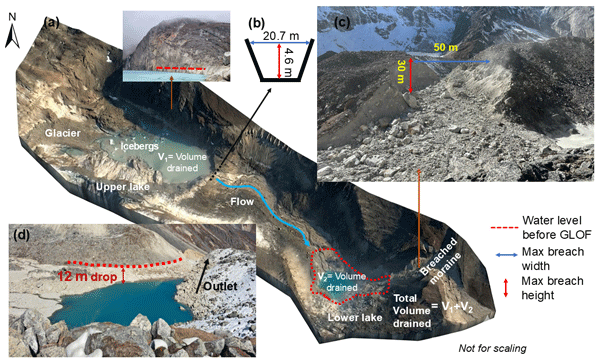
On 16 August 2024, a cascading glacial lake outburst flood destroyed Thame Village, Nepal. An upstream glacial lake formed in the late 2000s overtopped triggering a downstream lake breach. Combined release of ~770,000 m³ with peak discharge >800 m³/s reached the village within 22–25 min. Losses exceeded 6.18 million USD. Small, rapidly evolving lakes pose often overlooked GLOF risks in a warming climate.
Lauren D. Rawlins, David M. Rippin, Andrew J. Sole, Stephen J. Livingstone, and Kang Yang
The Cryosphere, 17, 4729–4750, https://doi.org/10.5194/tc-17-4729-2023, https://doi.org/10.5194/tc-17-4729-2023, 2023
Short summary
Short summary
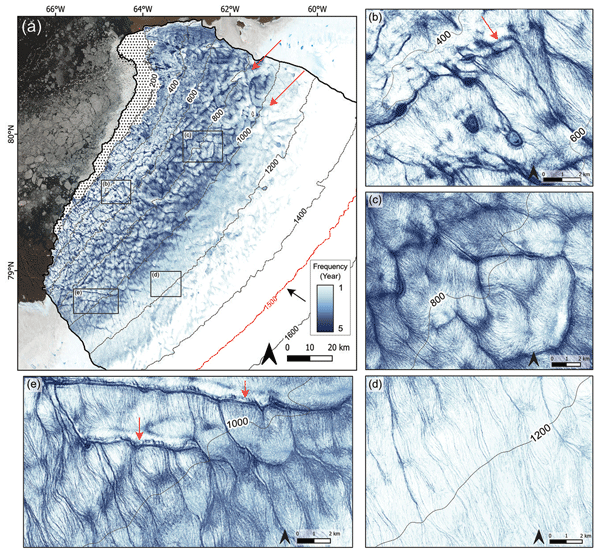
We map and quantify surface rivers and lakes at Humboldt Glacier to examine seasonal evolution and provide new insights of network configuration and behaviour. A widespread supraglacial drainage network exists, expanding up the glacier as seasonal runoff increases. Large interannual variability affects the areal extent of this network, controlled by high- vs. low-melt years, with late summer network persistence likely preconditioning the surface for earlier drainage activity the following year.
Nitesh Khadka, Vishnu Prasad Pandey, C. Scott Watson, Guoxiong Zheng, Tianpei Wu, Keshab Sharma, Lauren D. Rawlins, Simon Allen, Manish Raj Gouli, and Dibas Shrestha
Nat. Hazards Earth Syst. Sci., 26, 4131–4152, https://doi.org/10.5194/nhess-26-4131-2026, https://doi.org/10.5194/nhess-26-4131-2026, 2026
Short summary
Short summary
On 16 August 2024, a cascading glacial lake outburst flood destroyed Thame Village, Nepal. An upstream glacial lake formed in the late 2000s overtopped triggering a downstream lake breach. Combined release of ~770,000 m³ with peak discharge >800 m³/s reached the village within 22–25 min. Losses exceeded 6.18 million USD. Small, rapidly evolving lakes pose often overlooked GLOF risks in a warming climate.
Sujan Thapa, Ragini Vaidya, Mohan Bahadur Chand, and Rijan Bhakta Kayastha
EGUsphere, https://doi.org/10.5194/egusphere-2025-4454, https://doi.org/10.5194/egusphere-2025-4454, 2025
Preprint archived
Short summary
Short summary
This study examines how avalanches striking a glacial lake can cause sudden floods downstream in Nepal's Manaslu region. We used computer simulations to simulate various avalanche sizes and their effects on the lake. These simulations revealed that medium and large avalanches could lead to severe flooding in a short amount of time. This highlights the pressing need for early warning systems and better disaster preparedness to protect at-risk communities.
C. Scott Watson, Maggie Creed, Januka Gyawali, Sameer Shadeed, Jamal Dabbeek, Divya L. Subedi, and Rojina Haiju
EGUsphere, https://doi.org/10.5194/egusphere-2024-2722, https://doi.org/10.5194/egusphere-2024-2722, 2024
Preprint archived
Short summary
Short summary
We evaluate three flood modelling approaches to demonstrate their applicability in a data-sparse flash flood environment. We derive a reference flood extent using satellite imagery and show that a computationally fast flood model can match a fully physics-based model, whilst running 300 times faster. We also show that a 1 in 100-year rainfall event based on historical data (1985–2014) could increase by almost 40 % in the mid-future (2041–2060), which could cause 23 % (4 km2) greater inundation.
Alton C. Byers, Marcelo Somos-Valenzuela, Dan H. Shugar, Daniel McGrath, Mohan B. Chand, and Ram Avtar
The Cryosphere, 18, 711–717, https://doi.org/10.5194/tc-18-711-2024, https://doi.org/10.5194/tc-18-711-2024, 2024
Short summary
Short summary
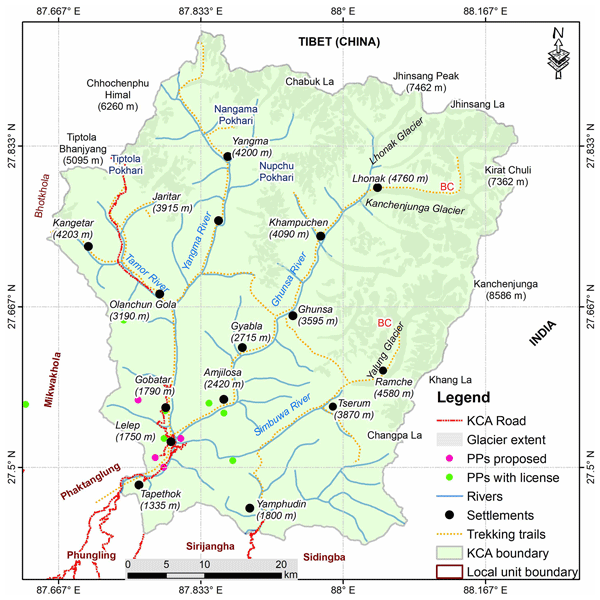
In spite of enhanced technologies, many large cryospheric events remain unreported because of their remoteness, inaccessibility, or poor communications. In this Brief communication, we report on a large ice-debris avalanche that occurred sometime between 16 and 21 August 2022 in the Kanchenjunga Conservation Area (KCA), eastern Nepal.
Lauren D. Rawlins, David M. Rippin, Andrew J. Sole, Stephen J. Livingstone, and Kang Yang
The Cryosphere, 17, 4729–4750, https://doi.org/10.5194/tc-17-4729-2023, https://doi.org/10.5194/tc-17-4729-2023, 2023
Short summary
Short summary
We map and quantify surface rivers and lakes at Humboldt Glacier to examine seasonal evolution and provide new insights of network configuration and behaviour. A widespread supraglacial drainage network exists, expanding up the glacier as seasonal runoff increases. Large interannual variability affects the areal extent of this network, controlled by high- vs. low-melt years, with late summer network persistence likely preconditioning the surface for earlier drainage activity the following year.
C. Scott Watson, John R. Elliott, Susanna K. Ebmeier, Juliet Biggs, Fabien Albino, Sarah K. Brown, Helen Burns, Andrew Hooper, Milan Lazecky, Yasser Maghsoudi, Richard Rigby, and Tim J. Wright
Geosci. Commun., 6, 75–96, https://doi.org/10.5194/gc-6-75-2023, https://doi.org/10.5194/gc-6-75-2023, 2023
Short summary
Short summary
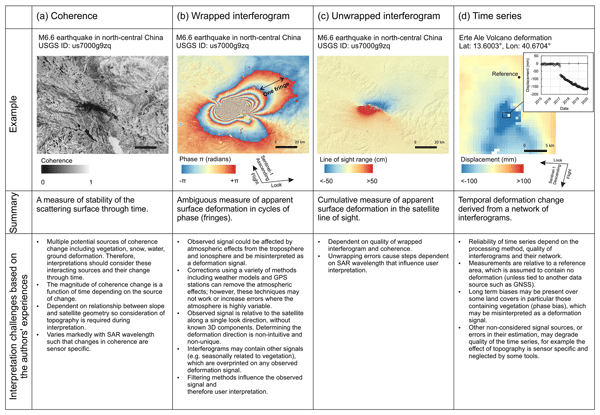
We evaluate the communication and open data processing of satellite Interferometric Synthetic Aperture Radar (InSAR) data, which measures ground deformation. We discuss the unique interpretation challenges and the use of automatic data processing and web tools to broaden accessibility. We link these tools with an analysis of InSAR communication through Twitter in which applications to earthquakes and volcanoes prevailed. We discuss future integration with disaster risk-reduction strategies.
C. Scott Watson, John R. Elliott, Susanna K. Ebmeier, María Antonieta Vásquez, Camilo Zapata, Santiago Bonilla-Bedoya, Paulina Cubillo, Diego Francisco Orbe, Marco Córdova, Jonathan Menoscal, and Elisa Sevilla
Nat. Hazards Earth Syst. Sci., 22, 1699–1721, https://doi.org/10.5194/nhess-22-1699-2022, https://doi.org/10.5194/nhess-22-1699-2022, 2022
Short summary
Short summary
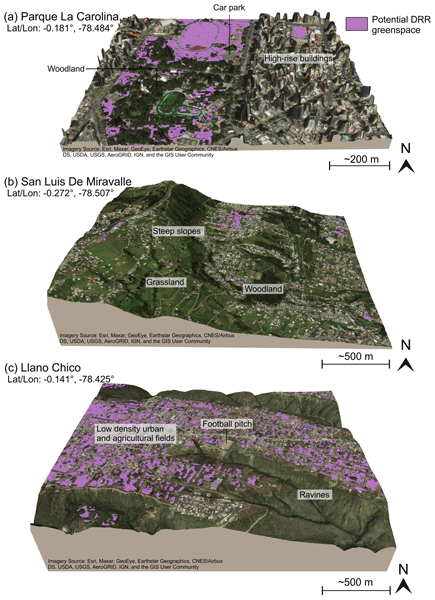
We assess how greenspaces could guide risk-informed planning and reduce disaster risk for the urbanising city of Quito, Ecuador, which experiences earthquake, volcano, landslide, and flood hazards. We use satellite data to evaluate the use of greenspaces as safe spaces following an earthquake. We find disparities regarding access to and availability of greenspaces. The availability of greenspaces that could contribute to community resilience is high; however, many require official designation.
Cited articles
Ali, S., Ali, S., Wang, L., Ul Hassan, S. R., Khan, G., Ali, S., Hussain, T., and Ali, D.: Deep learning model to detect glacial lakes using high-resolution optical and radar satellite images, Remote Sens. Appl. Soc. Environ., 38, 101579, https://doi.org/10.1016/j.rsase.2025.101579, 2025.
Allen, S. K., Sattar, A., King, O., Zhang, G., Bhattacharya, A., Yao, T., and Bolch, T.: Glacial lake outburst flood hazard under current and future conditions: worst-case scenarios in a transboundary Himalayan basin, Nat. Hazards Earth Syst. Sci., 22, 3765–3785, https://doi.org/10.5194/nhess-22-3765-2022, 2022.
Bajracharya, S. R., Maharjan, S. B., Shrestha, F., Sherpa, T. C., Wagle, N., and Shrestha, A. B.: Inventory of glacial lakes and identification of potentially dangerous glacial lakes in the Koshi, Gandaki, and Karnali river basins of Nepal, the Tibet Autonomous Region of China, and India, ICIMOD – International Centre for Integrated Mountain Development, https://doi.org/10.53055/ICIMOD.773, 2020.
Benn, D. I., Wiseman, S., and Hands, K. A.: Growth and drainage of supraglacial lakes on debris-mantled Ngozumpa Glacier, Khumbu Himal, Nepal, J. Glaciol., 47, 626–638, https://doi.org/10.3189/172756501781831729, 2001.
Bolch, T., Kulkarni, A., Kääb, A., Huggel, C., Paul, F., Cogley, J. G., Frey, H., Kargel, J. S., Fujita, K., Scheel, M., Bajracharya, S., and Stoffel, M.: The State and Fate of Himalayan Glaciers, Science, 336, 310–314, https://doi.org/10.1126/science.1215828, 2012.
Bolch, T., Shea, J. M., Liu, S., Azam, F. M., Gao, Y., Gruber, S., Immerzeel, W. W., Kulkarni, A., Li, H., Tahir, A. A., Zhang, G., and Zhang, Y.: Status and Change of the Cryosphere in the Extended Hindu Kush Himalaya Region, in: The Hindu Kush Himalaya Assessment: Mountains, Climate Change, Sustainability and People, edited by: Wester, P., Mishra, A., Mukherji, A., and Shrestha, A. B., Springer International Publishing, Cham, 209–255, https://doi.org/10.1007/978-3-319-92288-1_7, 2019.
Bookhagen, B. and Burbank, D. W.: Topography, relief, and TRMM-derived rainfall variations along the Himalaya, Geophys. Res. Lett., 33, 1–5, https://doi.org/10.1029/2006gl026037, 2006.
Brun, F., Berthier, E., Wagnon, P., Kaab, A., and Treichler, D.: A spatially resolved estimate of High Mountain Asia glacier mass balances from 2000 to 2016, Nat. Geosci., 10, 668–673, https://doi.org/10.1038/ngeo2999, 2017.
Byers, A. C., Rounce, D. R., Shugar, D. H., Lala, J. M., Byers, E. A., and Regmi, D.: A rockfall-induced glacial lake outburst flood, Upper Barun Valley, Nepal, Landslides, https://doi.org/10.1007/s10346-018-1079-9, 2018.
Byers, A. C., Shugar, D. H., Chand, M. B., Portocarrero, C., Shrestha, M., Rounce, D. R., and Watanabe, T.: Three Recent and Lesser-Known Glacier-Related Flood Mechanisms in High Mountain Environments, Mt. Res. Dev., 42, A12–A22, 2022.
Canty, A. and Ripley, B.: boot: Bootstrap Functions, [R package], CRAN – Comprehensive R Archive Network, https://doi.org/10.32614/CRAN.package.boot, 1999.
Cao, B., Chen, Y., Zhao, X., Tian, X., and Wang, F.: Refined identification and expansion mechanisms of glacier-fed lakes in high mountain Asia, Int. J. Digit. Earth, 18, 2591977, https://doi.org/10.1080/17538947.2025.2591977, 2025.
Carrivick, J. L. and Tweed, F. S.: A global assessment of the societal impacts of glacier outburst floods, Global Planet. Change, 144, 1–16, https://doi.org/10.1016/j.gloplacha.2016.07.001, 2016.
Chand, M. B. and Watanabe, T.: Development of Supraglacial Ponds in the Everest Region, Nepal, between 1989 and 2018, Remote Sens.-Basel, 11, 1058, https://doi.org/10.3390/rs11091058, 2019.
Chen, F., Zhang, M., Guo, H., Allen, S., Kargel, J. S., Haritashya, U. K., and Watson, C. S.: Annual 30 m dataset for glacial lakes in High Mountain Asia from 2008 to 2017, Earth Syst. Sci. Data, 13, 741–766, https://doi.org/10.5194/essd-13-741-2021, 2021.
Chen, L.-C., Papandreou, G., Schroff, F., and Adam, H.: Rethinking Atrous Convolution for Semantic Image Segmentation, arXiv, https://doi.org/10.48550/arXiv.1706.05587, 5 December 2017.
Cheng, X., Shangguan, D., Yang, C., Li, W., Zhou, Z., Liu, X., Li, D., Zhang, X., Ding, H., Liu, Z., Yu, Y., Wang, X., He, B., Yang, Q., Li, Y., Wang, R., Liu, Y., Deng, L., and Shi, Y.: Temporal and spatial changes of glacial lakes in the central Himalayas and their response to climate change based on multi-source remote sensing data, Global Planet. Change, 245, 104675, https://doi.org/10.1016/j.gloplacha.2024.104675, 2025.
Davison, A. C. and Hinkley, D. V.: Bootstrap Methods and their Application, 1st edn., Cambridge University Press, https://doi.org/10.1017/CBO9780511802843, 1997.
Dubey, S., Sattar, A., Gupta, V., Goyal, M. K., Haritashya, U. K., and Kargel, J. S.: Transboundary hazard and downstream impact of glacial lakes in Hindu-Kush Karakoram Himalayas, Sci. Total Environ., 914, 169758, https://doi.org/10.1016/j.scitotenv.2023.169758, 2024.
Farinotti, D., Round, V., Huss, M., Compagno, L., and Zekollari, H.: Large hydropower and water-storage potential in future glacier-free basins, Nature, 575, 341–344, https://doi.org/10.1038/s41586-019-1740-z, 2019.
Fugger, S., Fyffe, C. L., Fatichi, S., Miles, E., McCarthy, M., Shaw, T. E., Ding, B., Yang, W., Wagnon, P., Immerzeel, W., Liu, Q., and Pellicciotti, F.: Understanding monsoon controls on the energy and mass balance of glaciers in the Central and Eastern Himalaya, The Cryosphere, 16, 1631–1652, https://doi.org/10.5194/tc-16-1631-2022, 2022.
Fujita, K., Takeuchi, N., and Seko, K.: Glaciological observations of Yala Glacier in Langtang Valley, Nepal Himalayas, 1994 and 1996, Glacier Res., 16, 75–78, 1998.
Gardelle, J., Arnaud, Y., and Berthier, E.: Contrasted evolution of glacial lakes along the Hindu Kush Himalaya mountain range between 1990 and 2009, Global Planet. Change, 75, 47–55, https://doi.org/10.1016/j.gloplacha.2010.10.003, 2011.
Glacial Lake Observatory, Google Earth Engine script repository: Sentinel-1 image-processing script, Google Earth Engine Code Editor, https://code.earthengine.google.com/c5f25b9006cf0755a6d22ab7de36ff30 (last access: 13 July 2026), 2025a.
Glacial Lake Observatory, Google Earth Engine script repository: Sentinel-2 image-processing script, Google Earth Engine Code Editor, https://code.earthengine.google.com/75bcb7bac5481c382ce17c1bb1ada94f (last access: 13 July 2026), 2025b.
Gorelick, N., Hancher, M., Dixon, M., Ilyushchenko, S., Thau, D., and Moore, R.: Google Earth Engine: Planetary-scale geospatial analysis for everyone, Remote Sens. Environ., 202, 18–27, https://doi.org/10.1016/j.rse.2017.06.031, 2017.
Gouli, M. R., Hu, K., Khadka, N., Liu, S., Yifan, S., Adhikari, M., and Talchabhadel, R.: Quantitative assessment of the GLOF risk along China-Nepal transboundary basins by integrating remote sensing, machine learning, and hydrodynamic model, Int. J. Disast. Risk Re., 118, 105231, https://doi.org/10.1016/j.ijdrr.2025.105231, 2025.
Government of Nepal, Ministry Of Foreign Affairs: Framework for belt and road cooperation between the Government of Nepal and the Government of the People's Republic of China | Ministry Of Foreign Affairs, https://mofa.gov.np/content/641/framework-for-belt-and-road-cooperation-between/ (last access: 16 October 2025), 2024.
GTN-G: GTN-G Glacier Regions, Global Terrestrial Network for Glaciers, https://doi.org/10.5904/gtng-glacreg-2023-07, 2023.
Haeberli, W., Schaub, Y., and Huggel, C.: Increasing risks related to landslides from degrading permafrost into new lakes in de-glaciating mountain ranges, Geomorphology, 293, 405–417, https://doi.org/10.1016/j.geomorph.2016.02.009, 2017.
Haritashya, U., Kargel, J., Shugar, D., Leonard, G., Strattman, K., Watson, C., Shean, D., Harrison, S., Mandli, K., and Regmi, D.: Evolution and Controls of Large Glacial Lakes in the Nepal Himalaya, Remote Sens.-Basel, 10, 798, https://doi.org/10.3390/rs10050798, 2018.
Harrison, S., Kargel, J. S., Huggel, C., Reynolds, J., Shugar, D. H., Betts, R. A., Emmer, A., Glasser, N., Haritashya, U. K., Klimeš, J., Reinhardt, L., Schaub, Y., Wiltshire, A., Regmi, D., and Vilímek, V.: Climate change and the global pattern of moraine-dammed glacial lake outburst floods, The Cryosphere, 12, 1195–1209, https://doi.org/10.5194/tc-12-1195-2018, 2018.
He, Y., Yao, S., Yang, W., Yan, H., Zhang, L., Wen, Z., Zhang, Y., and Liu, T.: An Extraction Method for Glacial Lakes Based on Landsat-8 Imagery Using an Improved U-Net Network, IEEE J. Sel. Top. Appl., 14, 6544–6558, https://doi.org/10.1109/JSTARS.2021.3085397, 2021.
Hrudya, P. H., Varikoden, H., and Vishnu, R.: A review on the Indian summer monsoon rainfall, variability and its association with ENSO and IOD, Meteorol. Atmos. Phys., 133, 1–14, https://doi.org/10.1007/s00703-020-00734-5, 2021.
ICIMOD: Glacial Lakes and Glacial Lake Outburst Floods in Nepal, https://lib.icimod.org/records/2kqn5-yrm13 (last access: 16 October 2025), 2011.
ICIMOD: River Basins and Cryosphere – Information Sheets, https://lib.icimod.org/records/1vagr-wq318 (last access: 16 October 2025), 2019.
ICIMOD: Major River Basins in the Hindu Kush Himalaya (HKH) Region [Data set], ICIMOD [data set], https://doi.org/10.26066/RDS.2732, 2021.
Immerzeel, W. W., Lutz, A. F., Andrade, M., Bahl, A., Biemans, H., Bolch, T., Hyde, S., Brumby, S., Davies, B. J., Elmore, A. C., Emmer, A., Feng, M., Fernández, A., Haritashya, U., Kargel, J. S., Koppes, M., Kraaijenbrink, P. D. A., Kulkarni, A. V., Mayewski, P. A., Nepal, S., Pacheco, P., Painter, T. H., Pellicciotti, F., Rajaram, H., Rupper, S., Sinisalo, A., Shrestha, A. B., Viviroli, D., Wada, Y., Xiao, C., Yao, T., and Baillie, J. E. M.: Importance and vulnerability of the world's water towers, Nature, 577, 364–369, https://doi.org/10.1038/s41586-019-1822-y, 2020.
Irvine-Fynn, T. D. L., Porter, P. R., Rowan, A. V., Quincey, D. J., Gibson, M. J., Bridge, J. W., Watson, C. S., Hubbard, A., and Glasser, N. F.: Supraglacial Ponds Regulate Runoff From Himalayan Debris-Covered Glaciers, Geophys. Res. Lett., 44, 894–904, https://doi.org/10.1002/2017GL075398, 2017.
JAXA – Japan Aerospace Exploration Agency: ALOS World 3D – 30 m (AW3D30), Version 4.1, EORC – Earth Observation Research Center [data set], https://www.eorc.jaxa.jp/ALOS/en/dataset/aw3d30/ (last access: 18 October 2025), 2024.
Jones, D. B., Harrison, S., Anderson, K., Shannon, S., and Betts, R. A.: Rock glaciers represent hidden water stores in the Himalaya, Sci. Total Environ., 793, 145368, https://doi.org/10.1016/j.scitotenv.2021.145368, 2021.
Kaushik, S., Singh, T., Joshi, P. K., and Dietz, A. J.: Automated mapping of glacial lakes using multisource remote sensing data and deep convolutional neural network, Int. J. Appl. Earth Obs., 115, 103085, https://doi.org/10.1016/j.jag.2022.103085, 2022.
Khadka, N., Zhang, G., and Thakuri, S.: Glacial Lakes in the Nepal Himalaya: Inventory and Decadal Dynamics (1977–2017), Remote Sens.-Basel, 10, 1913, https://doi.org/10.3390/rs10121913, 2018.
Khadka, N., Chen, X., Liu, W., Gouli, M. R., Zhang, C., Shrestha, B., and Sharma, S.: Glacial lake outburst floods threaten China-Nepal connectivity: Synergistic study of remote sensing, GIS and hydrodynamic modeling with regional implications, Sci. Total Environ., 948, 174701, https://doi.org/10.1016/j.scitotenv.2024.174701, 2024a.
Khadka, N., Chen, X., Shrestha, M., and Liu, W.: Risk perception and vulnerability of communities in Nepal to transboundary glacial lake outburst floods from Tibet, China, Int. J. Disast. Risk Re., 107, 104476, https://doi.org/10.1016/j.ijdrr.2024.104476, 2024b.
Khadka, N., Zheng, G., Chen, X., Zhong, Y., Allen, S. K., and Gouli, M. R.: An ice-snow avalanche triggered small glacial lake outburst flood in Birendra Lake, Nepal Himalaya, Nat. Hazards, 121, 6357–6365, https://doi.org/10.1007/s11069-024-07014-0, 2025.
Khan, I., Vardaman, M., Johnston, J., and Jacobs, J. M.: Glacial lake mapping: Progress, challenges, and future directions, Arct. Antarct. Alp. Res., 57, 2592365, https://doi.org/10.1080/15230430.2025.2592365, 2025.
King, O., Bhattacharya, A., Bhambri, R., and Bolch, T.: Glacial lakes exacerbate Himalayan glacier mass loss, Sci. Rep.-UK, 9, 18145, https://doi.org/10.1038/s41598-019-53733-x, 2019.
Kraaijenbrink, P. D. A., Bierkens, M. F. P., Lutz, A. F., and Immerzeel, W. W.: Impact of a global temperature rise of 1.5 degrees Celsius on Asia's glaciers, Nature, 549, 257–260, https://doi.org/10.1038/nature23878, 2017.
Kumar, A., Mal, S., Schickhoff, U., and Dimri, A. P.: Basin-scale spatio-temporal development of glacial lakes in the Hindukush-Karakoram-Himalayas, Global Planet. Change, 245, 104656, https://doi.org/10.1016/j.gloplacha.2024.104656, 2025.
Kumar, R. and Vijay, S.: Automated satellite-based glacial lake inventory and change detection in High Mountain Asia, Sci. Rep.-UK, 16, 5760, https://doi.org/10.1038/s41598-026-35446-0, 2026.
Lehner, B., Verdin, K., and Jarvis, A.: New Global Hydrography Derived From Spaceborne Elevation Data, Eos T. Am. Geophys. Un., 89, 93–94, https://doi.org/10.1029/2008EO100001, 2008.
Ma, D., Li, J., and Jiang, L.: Efficient glacial lake mapping by leveraging deep transfer learning and a new annotated glacial lake dataset, J. Hydrol., 657, 133072, https://doi.org/10.1016/j.jhydrol.2025.133072, 2025.
Maharjan, S. B., Mool, P. K., Lizong, W., Xiao, G., Shrestha, F., Shrestha, R. B., Khanal, N. R., Bajracharya, S. R., Joshi, S., Shai, S., and Baral, P.: The Status of Glacial Lakes in the Hindu Kush Himalaya, ICIMOD Res. Rep. 20181, https://doi.org/10.53055/ICIMOD.742, 2018.
Maharjan, S. B., Sherpa, T. C., and Shrestha, A. B.: Thame Valley Glacial Lake Outburst Flood 2024: Causes, impacts and future risks, https://doi.org/10.53055/ICIMOD.1101, 2025.
Maurer, J. M., Schaefer, J. M., Rupper, S., and Corley, A.: Acceleration of ice loss across the Himalayas over the past 40 years, Sci. Adv., 5, eaav7266, https://doi.org/10.1126/sciadv.aav7266, 2019.
McFeeters, S. K.: The use of the Normalized Difference Water Index (NDWI) in the delineation of open water features, Int. J. Remote Sens., 17, 1425–1432, https://doi.org/10.1080/01431169608948714, 1996.
Miles, E. S., Watson, C. S., Brun, F., Berthier, E., Esteves, M., Quincey, D. J., Miles, K. E., Hubbard, B., and Wagnon, P.: Glacial and geomorphic effects of a supraglacial lake drainage and outburst event, Everest region, Nepal Himalaya, The Cryosphere, 12, 3891–3905, https://doi.org/10.5194/tc-12-3891-2018, 2018.
Miles, K. E., Willis, I. C., Benedek, C. L., Williamson, A. G., and Tedesco, M.: Toward Monitoring Surface and Subsurface Lakes on the Greenland Ice Sheet Using Sentinel-1 SAR and Landsat-8 OLI Imagery, Front. Earth Sci., 5, https://doi.org/10.3389/feart.2017.00058, 2017.
Ministry of External Affairs, Government of India, and His Majesty's Government of Nepal: Amended Agreement concerning the Koshi Project (Revision of the Agreement of 25 April 1954), Amended Annexure A. Kathmandu, https://www.cawater-info.net/bk/water_law/pdf/nepal-india-1966.pdf (last access: 18 October 2025), 1966.
Mir, B. H., Kumar, R., Lone, M. A., and Tantray, F. A.: Climate change and water resources of Himalayan region – review of impacts and implication, Arab. J. Geosci., 14, 1088, https://doi.org/10.1007/s12517-021-07438-z, 2021.
Mullissa, A., Vollrath, A., Odongo-Braun, C., Slagter, B., Balling, J., Gou, Y., Gorelick, N., and Reiche, J.: Sentinel-1 SAR Backscatter Analysis Ready Data Preparation in Google Earth Engine, Remote Sens.-Basel, 13, 1954, https://doi.org/10.3390/rs13101954, 2021.
Nie, Y., Liu, Q., and Liu, S.: Glacial Lake Expansion in the Central Himalayas by Landsat Images, 1990–2010, PLoS ONE, 8, 1–8, https://doi.org/10.1371/journal.pone.0083973, 2013.
Niggli, L., Allen, S., Frey, H., Huggel, C., Petrakov, D., Raimbekova, Z., Reynolds, J., and Wang, W.: GLOF Risk Management Experiences and Options: A Global Overview, https://doi.org/10.1093/acrefore/9780199389407.013.540, 2024.
OWSA – One World South Asia: Climate Change: Nepal, China Unite to Tackle Growing Threat of Glacial Lake Outbursts, OneWorld SouthAsia, 27 August 2025, https://owsa.in/climate-change-nepal-china-unite-to-tackle-growing-threat-of-glacial- lake-outbursts/ (last access: 18 October 2025), 2025.
Pasquarella, V. J., Brown, C. F., Czerwinski, W., and Rucklidge, W. J.: Comprehensive quality assessment of optical satellite imagery using weakly supervised video learning, in: 2023 IEEE/CVF Conference on Computer Vision and Pattern Recognition Workshops (CVPRW), 2023 IEEE/CVF Conference on Computer Vision and Pattern Recognition Workshops (CVPRW), 2125–2135, https://doi.org/10.1109/CVPRW59228.2023.00206, 2023.
Poudel, U., Gouli, M. R., Hu, K., Khadka, N., Regmi, R. K., and Thapa, B. R.: Multi-breach GLOF hazard and exposure analysis of Birendra Lake in the Manaslu Region of Nepal, Nat. Hazards Res., https://doi.org/10.1016/j.nhres.2025.03.007, 2025.
Qayyum, N., Ghuffar, S., Ahmad, H. M., Yousaf, A., and Shahid, I.: Glacial Lakes Mapping Using Multi Satellite PlanetScope Imagery and Deep Learning, ISPRS Int. J. Geo-Inf., 9, 560, https://doi.org/10.3390/ijgi9100560, 2020.
Rawlins, L. D., Watson, C. S., Bhambri, R., Khadka, N., and Chand, M. B.: Datasets supporting – Glacial Lake Observatory (GLO): A dataset of glacial lakes in Nepal and transboundary catchments (2017–2024), Zenodo, https://doi.org/10.5281/zenodo.17802333, 2025.
RGI Consortium: Randolph Glacier Inventory – A Dataset of Global Glacier Outlines, Version 7.0, NSIDC: National Snow and Ice Data Center, Boulder, Colorado USA, https://doi.org/10.5067/f6jmovy5navz, 2023.
Rohl, K.: Characteristics and evolution of supraglacial ponds on debris-covered Tasman Glacier, New Zealand, J. Glaciol., 54, 867–880, https://doi.org/10.3189/002214308787779861, 2008.
Ronneberger, O., Fischer, P., and Brox, T.: U-Net: Convolutional Networks for Biomedical Image Segmentation, arXiv, https://doi.org/10.48550/arXiv.1505.04597, 18 May 2015.
Rounce, D. R., Hock, R., and Shean, D. E.: Glacier Mass Change in High Mountain Asia Through 2100 Using the Open-Source Python Glacier Evolution Model (PyGEM), Front. Earth Sci., 7, https://doi.org/10.3389/feart.2019.00331, 2020.
Sahu, R. and Singh, D. P.: Conventional and deep learning approaches for glacial lake mapping using remote sensing data: a comprehensive review, Int. J. Remote Sens., 46, 3992–4020, https://doi.org/10.1080/01431161.2025.2496001, 2025.
Sakai, A., Chikita, K., and Yamada, T.: Expansion of a moraine-dammed glacial lake, Tsho Rolpa, in Rolwaling Himal, Nepal Himalaya, Limnol. Oceanogr., 45, 1401–1408, 2000a.
Sakai, A., Takeuchi, N., Fujita, K., Nakawo, M., Nakawo, M., Raymond, C. F., and Fountain, A.: Role of supraglacial ponds in the ablation process of a debris-covered glacier in the Nepal Himalayas, https://api.semanticscholar.org/CorpusID:130792649 (last access: 16 October 2025), 2000b.
Sattar, A., Haritashya, U. K., Kargel, J. S., and Karki, A.: Transition of a small Himalayan glacier lake outburst flood to a giant transborder flood and debris flow, Sci. Rep.-UK, 12, 12421, https://doi.org/10.1038/s41598-022-16337-6, 2022.
Schwanghart, W., Worni, R., Huggel, C., Stoffel, M., and Korup, O.: Uncertainty in the Himalayan energy–water nexus: estimating regional exposure to glacial lake outburst floods, Environ. Res. Lett., 11, 1–9, 2016.
Sharma, A. and Prakash, C.: Glacial lakes mapping using satellite images and deep learning algorithms in Northwestern Indian Himalayas, Model. Earth Syst. Environ., 10, 2063–2077, https://doi.org/10.1007/s40808-023-01885-1, 2024.
Sharma, A., Prakash, C., and Thakur, D.: Glacier lakes detection utilizing remote sensing integration with satellite imagery and advanced deep learning method, Appl. Geomat., 16, 829–850, https://doi.org/10.1007/s12518-024-00594-3, 2024.
Shrestha, F., Steiner, J. F., Shrestha, R., Dhungel, Y., Joshi, S. P., Inglis, S., Ashraf, A., Wali, S., Walizada, K. M., and Zhang, T.: A comprehensive and version-controlled database of glacial lake outburst floods in High Mountain Asia, Earth Syst. Sci. Data, 15, 3941–3961, https://doi.org/10.5194/essd-15-3941-2023, 2023.
Shugar, D. H., Burr, A., Haritashya, U. K., Kargel, J. S., Watson, C. S., Kennedy, M. C., Bevington, A. R., Betts, R. A., Harrison, S., and Strattman, K.: Rapid worldwide growth of glacial lakes since 1990, Nat. Clim. Change, 10, 939–945, https://doi.org/10.1038/s41558-020-0855-4, 2020.
Shukla, A., Garg, P. K., and Srivastava, S.: Evolution of Glacial and High-Altitude Lakes in the Sikkim, Eastern Himalaya Over the Past Four Decades (1975–2017), Front. Environ. Sci., 6, https://doi.org/10.3389/fenvs.2018.00081, 2018.
Siddique, M. A., Basit, A., Qayyum, N., Naseer, E., Bhatti, M. K., Minchew, B., Ali, M., Perez, C. S., and Marino, A.: Towards Automated Monitoring Of Glacial Lakes In Hindu Kush And Himalayas Using Deep Learning, in: IGARSS 2023–2023 IEEE International Geoscience and Remote Sensing Symposium, 2165–2168, https://doi.org/10.1109/IGARSS52108.2023.10281471, 2023.
Tadono, T., Ishida, H., Oda, F., Naito, S., Minakawa, K., and Iwamoto, H.: Precise global DEM generation by ALOS PRISM, ISPRS Ann. Photogramm. Remote Sens. Spat. Inf. Sci., 2, 71, https://doi.org/10.5194/isprsannals-II-4-71-2014, 2014.
Tang, Q., Zhang, G., Yao, T., Wieland, M., Liu, L., and Kaushik, S.: Automatic extraction of glacial lakes from Landsat imagery using deep learning across the Third Pole region, Remote Sens. Environ., 315, 114413, https://doi.org/10.1016/j.rse.2024.114413, 2024.
Taylor, C., Robinson, T. R., Dunning, S., Carr, J. R., and Westoby, M.: Glacial lake outburst floods threaten millions globally, Nat. Commun., 14, 487, https://doi.org/10.1038/s41467-023-36033-x, 2023.
Taylor, C. J., Carr, J. R., and Rounce, D. R.: Spatiotemporal supraglacial pond and ice cliff changes in the Bhutan–Tibet border region from 2016 to 2018, J. Glaciol., 68, 101–113, https://doi.org/10.1017/jog.2021.76, 2022.
Tom, M., Odermatt, D., David, C. H., Cerbelaud, A., Wade, J., and Frey, H.: Monitoring earth's glacial lakes from space with machine learning, Sci. Remote Sens., 12, 100277, https://doi.org/10.1016/j.srs.2025.100277, 2025.
Veh, G., Korup, O., and Walz, A.: Hazard from Himalayan glacier lake outburst floods, P. Natl. Acad. Sci. USA, 117, 907–912, https://doi.org/10.1073/pnas.1914898117, 2020.
Venables, W. N. and Ripley, B. D.: Modern applied statistics with S, Springer Science & Business Media, https://doi.org/10.1007/978-0-387-21706-2, 2013.
Wang, X., Guo, X., Yang, C., Liu, Q., Wei, J., Zhang, Y., Liu, S., Zhang, Y., Jiang, Z., and Tang, Z.: Glacial lake inventory of high-mountain Asia in 1990 and 2018 derived from Landsat images, Earth Syst. Sci. Data, 12, 2169–2182, https://doi.org/10.5194/essd-12-2169-2020, 2020.
Wangchuk, S. and Bolch, T.: Mapping of glacial lakes using Sentinel-1 and Sentinel-2 data and a random forest classifier: strengths and challenges, Sci. Remote Sens., 100008, https://doi.org/10.1016/j.srs.2020.100008, 2020.
Wangchuk, S., Bolch, T., and Zawadzki, J.: Towards automated mapping and monitoring of potentially dangerous glacial lakes in Bhutan Himalaya using Sentinel-1 Synthetic Aperture Radar data, Int. J. Remote Sens., 1–26, https://doi.org/10.1080/01431161.2019.1569789, 2019.
Watson, C. S., Quincey, D. J., Carrivick, J. L., and Smith, M. W.: The dynamics of supraglacial ponds in the Everest region, central Himalaya, Global Planet. Change, 142, 14–27, https://doi.org/10.1016/j.gloplacha.2016.04.008, 2016.
Watson, C. S., King, O., Miles, E. S., and Quincey, D. J.: Optimising NDWI supraglacial pond classification on Himalayan debris-covered glaciers, Remote Sens. Environ., 217, 414–425, https://doi.org/10.1016/j.rse.2018.08.020, 2018.
Watson, C. S., Kargel, J. S., Shugar, D. H., Haritashya, U. K., Schiassi, E., and Furfaro, R.: Mass Loss From Calving in Himalayan Proglacial Lakes, Front. Earth Sci., 7, https://doi.org/10.3389/feart.2019.00342, 2020.
Whitehead, P. G., Barbour, E., Futter, M. N., Sarkar, S., Rodda, H., Caesar, J., Butterfield, D., Jin, L., Sinha, R., Nicholls, R., and Salehin, M.: Impacts of climate change and socio-economic scenarios on flow and water quality of the Ganges, Brahmaputra and Meghna (GBM) river systems: low flow and flood statistics, Environ. Sci.-Proc. Imp., 17, 1057–1069, https://doi.org/10.1039/C4EM00619D, 2015.
World Meteorological Organization: State of the Climate in Asia 2024, United Nations, Geneva, https://library.wmo.int/idurl/4/69575 (last access: 18 October 2025), 2025.
Xu, X., Liu, L., Huang, L., and Hu, Y.: Combined use of multi-source satellite imagery and deep learning for automated mapping of glacial lakes in the Bhutan Himalaya, Sci. Remote Sens., 10, 100157, https://doi.org/10.1016/j.srs.2024.100157, 2024.
Yao, T., Bolch, T., Chen, D., Gao, J., Immerzeel, W., Piao, S., Su, F., Thompson, L., Wada, Y., Wang, L., Wang, T., Wu, G., Xu, B., Yang, W., Zhang, G., and Zhao, P.: The imbalance of the Asian water tower, Nat. Rev. Earth Environ., 3, 618–632, https://doi.org/10.1038/s43017-022-00299-4, 2022.
Zhang, G., Yao, T., Xie, H., Wang, W., and Yang, W.: An inventory of glacial lakes in the Third Pole region and their changes in response to global warming, Global Planet. Change, 131, 148–157, https://doi.org/10.1016/j.gloplacha.2015.05.013, 2015.
Zhang, T., Wang, W., An, B., and Wei, L.: Enhanced glacial lake activity threatens numerous communities and infrastructure in the Third Pole, Nat. Commun., 14, 8250, https://doi.org/10.1038/s41467-023-44123-z, 2023.
Zhang, T., Wang, W., and An, B.: Heterogeneous changes in global glacial lakes under coupled climate warming and glacier thinning, Commun. Earth Environ., 5, 374, https://doi.org/10.1038/s43247-024-01544-y, 2024a.
Zhang, T., Wang, W., and An, B.: Heterogeneous changes in global glacial lakes under coupled climate warming and glacier thinning – Global Glacial Lake Dataset, https://doi.org/10.11888/Cryos.tpdc.300938, 2024b.
Zheng, G., Allen, S. K., Bao, A., Ballesteros-Cánovas, J. A., Huss, M., Zhang, G., Li, J., Yuan, Y., Jiang, L., Yu, T., Chen, W., and Stoffel, M.: Increasing risk of glacial lake outburst floods from future Third Pole deglaciation, Nat. Clim. Change, 11, 411–417, https://doi.org/10.1038/s41558-021-01028-3, 2021.
Short summary
Glacial lakes are expanding as glaciers melt in High Mountain Asia. These lakes store meltwater but can trigger dangerous outburst floods (GLOFs), threatening downstream communities. Using satellite imagery and deep learning, we mapped lakes across the Nepal-transboundary region (2017–2024) and found rapid growth, especially in the Koshi basin. This research supports the Glacial Lake Observatory, which will enable long-term monitoring and hazard reduction.
Glacial lakes are expanding as glaciers melt in High Mountain Asia. These lakes store...


Altmetrics
Final-revised paper
Preprint