Articles | Volume 18, issue 1
https://doi.org/10.5194/essd-18-493-2026
© Author(s) 2026. This work is distributed under
the Creative Commons Attribution 4.0 License.
the Creative Commons Attribution 4.0 License.
https://doi.org/10.5194/essd-18-493-2026
© Author(s) 2026. This work is distributed under
the Creative Commons Attribution 4.0 License.
the Creative Commons Attribution 4.0 License.
Data description article
| 
19 Jan 2026
Data description article |
| 19 Jan 2026
| 19 Jan 2026
Mapping and spatial distribution of relict charcoal hearths across Poland
Michał Słowiński
CORRESPONDING AUTHOR

Department of Past Landscape Dynamics, Institute of Geography and Spatial Organization, Polish Academy of Sciences, 00-818 Warszawa, Poland
Agnieszka Halaś
Department of Past Landscape Dynamics, Institute of Geography and Spatial Organization, Polish Academy of Sciences, 00-818 Warszawa, Poland
Michał A. Niedzielski
Department of Urban and Population Studies, Institute of Geography and Spatial Organization, Polish Academy of Sciences, 00-818 Warszawa, Poland
Krzysztof Szewczyk
Department of Past Landscape Dynamics, Institute of Geography and Spatial Organization, Polish Academy of Sciences, 00-818 Warszawa, Poland
Jerzy Jonczak
Department of Soil Science, Institute of Agriculture, Warsaw University of Life Sciences, 02-787 Warszawa, Poland
Dominika Łuców
Department of Past Landscape Dynamics, Institute of Geography and Spatial Organization, Polish Academy of Sciences, 00-818 Warszawa, Poland
Sebastian Tyszkowski
Department of Environmental Resources and Geohazards, Institute of Geography and Spatial Organization, Polish Academy of Sciences, 87-100 Toruń, Poland
Sandra Słowińska
Climate Research Department, Institute of Geography and Spatial Organization, Polish Academy of Sciences, 00-818 Warszawa, Poland
Agnieszka Gruszczyńska
Department of Past Landscape Dynamics, Institute of Geography and Spatial Organization, Polish Academy of Sciences, 00-818 Warszawa, Poland
Bogusława Kruczkowska
Department of Soil Science, Institute of Agriculture, Warsaw University of Life Sciences, 02-787 Warszawa, Poland
Aleksandra Chojnacka
Department of Biochemistry and Microbiology, Institute of Biology, University of Life Sciences, 02-787 Warszawa, Poland
Tomasz Polkowski
Department of Past Landscape Dynamics, Institute of Geography and Spatial Organization, Polish Academy of Sciences, 00-818 Warszawa, Poland
Krzysztof Sztabkowski
Laboratory of Natural Environment Chemistry, Forest Research Institute, Braci Leśnej 3, 05-090 Sękocin Stary, Poland
Dariusz Brykała
Laboratory for Interdisciplinary Research into the Anthropocene, Institute of Geography and Spatial Organization, Polish Academy of Sciences, 87-100 Toruń, Poland
Jacek Wolski
Department of Geoecology, Institute of Geography and Spatial Organization, Polish Academy of Sciences, 00-818 Warszawa, Poland
Tomasz Samojlik
Mammal Research Institute, Polish Academy of Sciences, 17-230 Białowieża, Poland
Adrian Kaszkiel
Climate Research Department, Institute of Geography and Spatial Organization, Polish Academy of Sciences, 00-818 Warszawa, Poland
Barbara Gmińska-Nowak
Laboratory for Interdisciplinary Research into the Anthropocene, Institute of Geography and Spatial Organization, Polish Academy of Sciences, 87-100 Toruń, Poland
Mateusz Kramkowski
Department of Environmental Resources and Geohazards, Institute of Geography and Spatial Organization, Polish Academy of Sciences, 87-100 Toruń, Poland
Tomasz Związek
Laboratory for Interdisciplinary Research into the Anthropocene, Institute of Geography and Spatial Organization, Polish Academy of Sciences, 87-100 Toruń, Poland
Related authors
Elwira Sienkiewicz, Karolina Kaucha, Michał Gąsiorowski, Urszula Kowalewska, and Michał Słowiński
EGUsphere, https://doi.org/10.5194/egusphere-2026-4131, https://doi.org/10.5194/egusphere-2026-4131, 2026
Short summary
Short summary
Combined diatom, Cladocera and geochemical records show that TSN did not follow a typical eutrophication pathway. Instead, it evolved from oligo-mesotrophic to oligotrophic and finally to persistent dystrophic conditions, driven by catchment terrestrialization, peatland expansion and hydrological isolation. The present dystrophic state reflects long-term natural development, demonstrating that mountain lake dystrophication is locally controlled by catchment and hydrological changes.
Agnieszka Halaś and Michał Słowiński
Earth Syst. Sci. Data, 18, 3853–3888, https://doi.org/10.5194/essd-18-3853-2026, https://doi.org/10.5194/essd-18-3853-2026, 2026
Short summary
Short summary
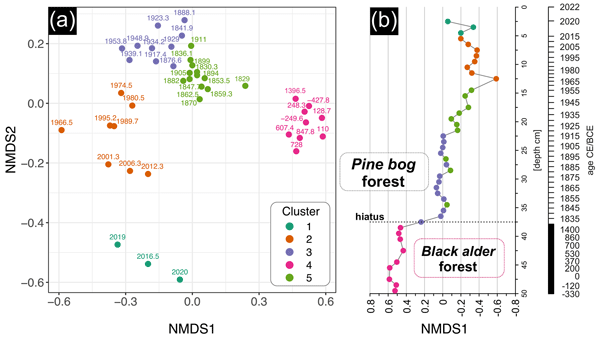
Peatlands act as natural time capsules, preserving records of past environments. We compiled and mapped metadata from over 650 peat samples from Western Siberian Lowland, summarizing decades of research. Our database organizes information about existing studies, showing which periods, regions, and methods have been investigated, and guiding researchers toward gaps where future work can expand our understanding of these ecosystems.
Ewa Zin, Tomasz Związek, Marcin Klisz, Sandra Słowińska, Dominik Róg, Milena Obremska, Dominika Łuców, Jarosław Pietruczuk, Joachim Popek, Katarzyna Piotrowicz, Kamil Pilch, Krzysztof Szewczyk, Agnieszka Halaś, and Michał Słowiński
Biogeosciences, 23, 3091–3138, https://doi.org/10.5194/bg-23-3091-2026, https://doi.org/10.5194/bg-23-3091-2026, 2026
Short summary
Short summary
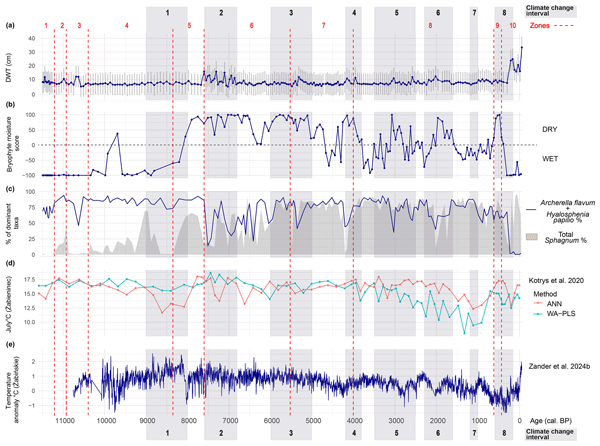
We used a multi-proxy approach combining peat, tree ring, climate, and historical records to reconstruct > 2300 years of peatland dynamics in a Central European region. Results show a human-induced shift from alder to pine forest due to land use change and acidification, stressing the importance of long-term records for peatland conservation.
Eliise Poolma, Katarzyna Marcisz, Leeli Amon, Patryk Fiutek, Piotr Kołaczek, Karolina Leszczyńska, Dmitri Mauquoy, Michał Słowiński, Siim Veski, Friederike Wagner-Cremer, and Mariusz Lamentowicz
Clim. Past, 21, 1933–1959, https://doi.org/10.5194/cp-21-1933-2025, https://doi.org/10.5194/cp-21-1933-2025, 2025
Short summary
Short summary
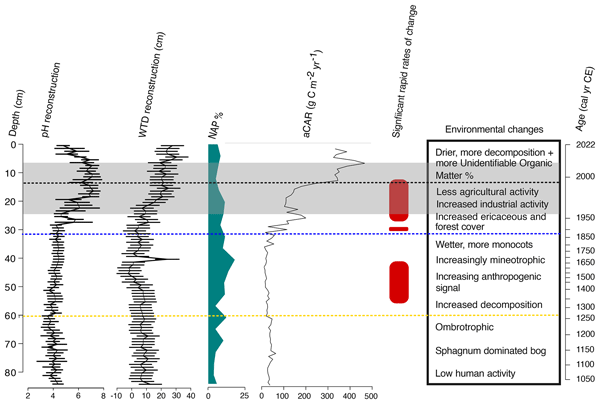
We studied a peatland in northern Poland to see how climate and natural ecosystem changes shaped it over the past 11,500 years. By analysing preserved plants and microscopic life, we found clear shifts in wetness linked to climate and internal development. This longest complete peat record in the region shows how peatlands help us understand long-term environmental change and their future resilience to climate change.
Luke Oliver Andrews, Katarzyna Marcisz, Piotr Kołaczek, Leeli Amon, Siim Veski, Atko Heinsalu, Normunds Stivrins, Mariusz Bąk, Marco A. Aquino-Lopez, Anna Cwanek, Edyta Łokas, Monika Karpińska-Kołaczek, Sambor Czerwiński, Michał Słowiński, and Mariusz Lamentowicz
Biogeosciences, 22, 5849–5875, https://doi.org/10.5194/bg-22-5849-2025, https://doi.org/10.5194/bg-22-5849-2025, 2025
Short summary
Short summary
The long-term effects of alkalinisation upon peatland ecosystem functioning remains poorly understood. Using palaeoecological techniques, we show that intensive cement dust pollution altered vegetation cover and reduced carbon storage in an Estonian peatland. Changes also occurred during the 13th century following agricultural intensification. These shifts occurred following substantial as well as small but sustained increases in alkalinity. Limited recovery was evident ~30 years post-pollution.
Tomasz Polkowski, Agnieszka Gruszczyńska, Bartosz Kotrys, Artur Górecki, Anna Hrynowiecka, Marcin Żarski, Mirosław Błaszkiewicz, Jerzy Nitychoruk, Monika Czajkowska, Stefan Lauterbach, and Michał Słowiński
Clim. Past, 21, 1779–1800, https://doi.org/10.5194/cp-21-1779-2025, https://doi.org/10.5194/cp-21-1779-2025, 2025
Short summary
Short summary
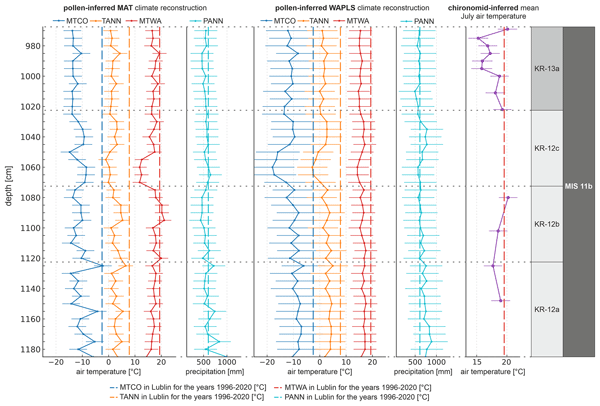
In our study, we investigate changes in environment and climate that occured during post-Holsteinian period in Krępa palaeolake (eastern Poland). To achieve this goal we reconstructed summer temperature at the time using Chironomidae larvae head capsules and pollen data. This is first research from Central Europe with both chironomids and pollen used to trace climate change through post-Holsteinian period. We hope to encourage scientific community to carry out further research in the region.
Agnieszka Halaś, Mariusz Lamentowicz, Milena Obremska, Dominika Łuców, and Michał Słowiński
Biogeosciences, 22, 4797–4822, https://doi.org/10.5194/bg-22-4797-2025, https://doi.org/10.5194/bg-22-4797-2025, 2025
Short summary
Short summary
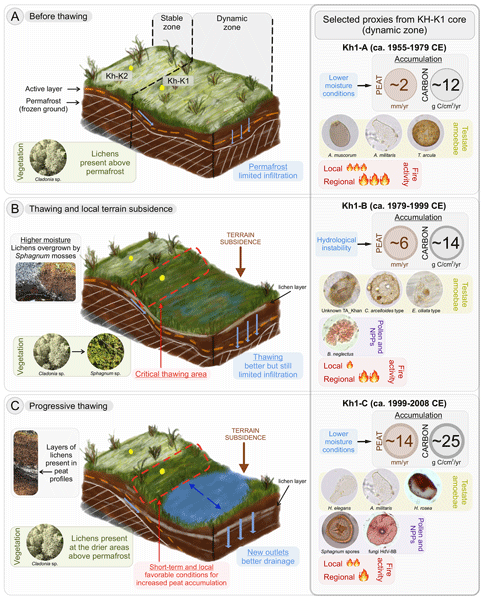
Western Siberian peatlands regulate global climate, but their response to permafrost thaw remains poorly studied. Our study analyzed peat cores from a peat plateau and a lake edge to track changes over two centuries. We found that permafrost thawing, driven by rising temperatures, altered peatland hydrology, vegetation, and microbial life. These shifts may expand with further warming, affecting carbon storage and climate feedbacks. Our findings highlight early warning signs of ecosystem change.
Łukasz Sobechowicz, Dariusz Brykała, Ewa Kaznowska, Michał Wasilewicz, Jacek Wolski, Marcin Noras, and Wojciech Aleksander Siwek
Earth Syst. Sci. Data, 18, 6101–6118, https://doi.org/10.5194/essd-18-6101-2026, https://doi.org/10.5194/essd-18-6101-2026, 2026
Short summary
Short summary
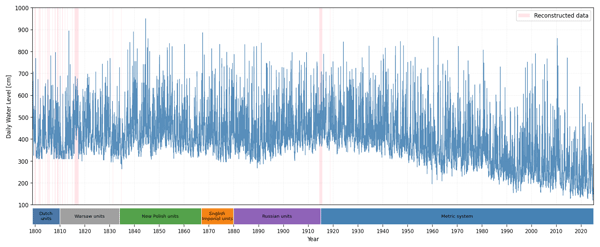
We present a 225-year (1799–2024) homogenized daily water level record for the Vistula River in Warsaw, comprising 82 453 observations. Adjustments were made for gauge relocations, zero shifts, unit differences, and Julian–Gregorian discrepancies. Missing data were reconstructed using the Long Short-Term Memory (LSTM) method, applied to stage–stage relationships with downstream stations. The dataset provides a robust basis for long-term hydrological, climatic, and socio-environmental research.
Elwira Sienkiewicz, Karolina Kaucha, Michał Gąsiorowski, Urszula Kowalewska, and Michał Słowiński
EGUsphere, https://doi.org/10.5194/egusphere-2026-4131, https://doi.org/10.5194/egusphere-2026-4131, 2026
Short summary
Short summary
Combined diatom, Cladocera and geochemical records show that TSN did not follow a typical eutrophication pathway. Instead, it evolved from oligo-mesotrophic to oligotrophic and finally to persistent dystrophic conditions, driven by catchment terrestrialization, peatland expansion and hydrological isolation. The present dystrophic state reflects long-term natural development, demonstrating that mountain lake dystrophication is locally controlled by catchment and hydrological changes.
Agnieszka Halaś and Michał Słowiński
Earth Syst. Sci. Data, 18, 3853–3888, https://doi.org/10.5194/essd-18-3853-2026, https://doi.org/10.5194/essd-18-3853-2026, 2026
Short summary
Short summary
Peatlands act as natural time capsules, preserving records of past environments. We compiled and mapped metadata from over 650 peat samples from Western Siberian Lowland, summarizing decades of research. Our database organizes information about existing studies, showing which periods, regions, and methods have been investigated, and guiding researchers toward gaps where future work can expand our understanding of these ecosystems.
Ewa Zin, Tomasz Związek, Marcin Klisz, Sandra Słowińska, Dominik Róg, Milena Obremska, Dominika Łuców, Jarosław Pietruczuk, Joachim Popek, Katarzyna Piotrowicz, Kamil Pilch, Krzysztof Szewczyk, Agnieszka Halaś, and Michał Słowiński
Biogeosciences, 23, 3091–3138, https://doi.org/10.5194/bg-23-3091-2026, https://doi.org/10.5194/bg-23-3091-2026, 2026
Short summary
Short summary
We used a multi-proxy approach combining peat, tree ring, climate, and historical records to reconstruct > 2300 years of peatland dynamics in a Central European region. Results show a human-induced shift from alder to pine forest due to land use change and acidification, stressing the importance of long-term records for peatland conservation.
Eliise Poolma, Katarzyna Marcisz, Leeli Amon, Patryk Fiutek, Piotr Kołaczek, Karolina Leszczyńska, Dmitri Mauquoy, Michał Słowiński, Siim Veski, Friederike Wagner-Cremer, and Mariusz Lamentowicz
Clim. Past, 21, 1933–1959, https://doi.org/10.5194/cp-21-1933-2025, https://doi.org/10.5194/cp-21-1933-2025, 2025
Short summary
Short summary
We studied a peatland in northern Poland to see how climate and natural ecosystem changes shaped it over the past 11,500 years. By analysing preserved plants and microscopic life, we found clear shifts in wetness linked to climate and internal development. This longest complete peat record in the region shows how peatlands help us understand long-term environmental change and their future resilience to climate change.
Luke Oliver Andrews, Katarzyna Marcisz, Piotr Kołaczek, Leeli Amon, Siim Veski, Atko Heinsalu, Normunds Stivrins, Mariusz Bąk, Marco A. Aquino-Lopez, Anna Cwanek, Edyta Łokas, Monika Karpińska-Kołaczek, Sambor Czerwiński, Michał Słowiński, and Mariusz Lamentowicz
Biogeosciences, 22, 5849–5875, https://doi.org/10.5194/bg-22-5849-2025, https://doi.org/10.5194/bg-22-5849-2025, 2025
Short summary
Short summary
The long-term effects of alkalinisation upon peatland ecosystem functioning remains poorly understood. Using palaeoecological techniques, we show that intensive cement dust pollution altered vegetation cover and reduced carbon storage in an Estonian peatland. Changes also occurred during the 13th century following agricultural intensification. These shifts occurred following substantial as well as small but sustained increases in alkalinity. Limited recovery was evident ~30 years post-pollution.
Tomasz Polkowski, Agnieszka Gruszczyńska, Bartosz Kotrys, Artur Górecki, Anna Hrynowiecka, Marcin Żarski, Mirosław Błaszkiewicz, Jerzy Nitychoruk, Monika Czajkowska, Stefan Lauterbach, and Michał Słowiński
Clim. Past, 21, 1779–1800, https://doi.org/10.5194/cp-21-1779-2025, https://doi.org/10.5194/cp-21-1779-2025, 2025
Short summary
Short summary
In our study, we investigate changes in environment and climate that occured during post-Holsteinian period in Krępa palaeolake (eastern Poland). To achieve this goal we reconstructed summer temperature at the time using Chironomidae larvae head capsules and pollen data. This is first research from Central Europe with both chironomids and pollen used to trace climate change through post-Holsteinian period. We hope to encourage scientific community to carry out further research in the region.
Agnieszka Halaś, Mariusz Lamentowicz, Milena Obremska, Dominika Łuców, and Michał Słowiński
Biogeosciences, 22, 4797–4822, https://doi.org/10.5194/bg-22-4797-2025, https://doi.org/10.5194/bg-22-4797-2025, 2025
Short summary
Short summary
Western Siberian peatlands regulate global climate, but their response to permafrost thaw remains poorly studied. Our study analyzed peat cores from a peat plateau and a lake edge to track changes over two centuries. We found that permafrost thawing, driven by rising temperatures, altered peatland hydrology, vegetation, and microbial life. These shifts may expand with further warming, affecting carbon storage and climate feedbacks. Our findings highlight early warning signs of ecosystem change.
Michal Bucha, Piotr Siupka, Anna Detman-Ignatowska, Sushmita Deb, Agnieszka Bylina, Daria Kaim, Aleksandra Chojnacka, Dominika Kufka, Dominika Lewicka-Szczebak, Anna Sikora, and Leszek Marynowski
EGUsphere, https://doi.org/10.5194/egusphere-2025-236, https://doi.org/10.5194/egusphere-2025-236, 2025
Preprint archived
Short summary
Short summary
In this work, we show the evidences of anaerobic activity of nitrogen-processing microorganisms that naturally occurred in outcropped organic-rich sediments as Miocene lignites. The results presented in this paper indicate the important role of nitrogen supply processes in environments depleted in this element and at the same time rich in humic substances, such as peat bogs, wetlands, immature sediments containing organic carbon (e.g. gyttja, fossil wood, coal).
Tomasz Związek, Piotr Guzowski, Radosław Poniat, Maciej T. Radomski, Monika Kozłowska-Szyc, Tomasz Panecki, Sandra Słowińska, Bogusława Kruczkowska, Michał Targowski, and Dagmara Adamska
Clim. Past, 18, 1541–1561, https://doi.org/10.5194/cp-18-1541-2022, https://doi.org/10.5194/cp-18-1541-2022, 2022
Short summary
Short summary
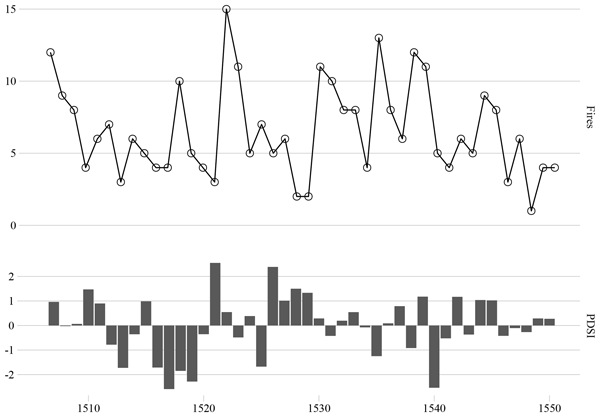
We wanted to take an in-depth look at how climate events affected the economy of early modern Poland. We focused on analysing all available sources of a fiscal nature for this period. In addition, we analysed available materials on the export of primary agricultural products. Our results have shown that the economic system in Poland at that time coped effectively with periodic droughts, and it was only the great drought of 1540 that significantly shook the state's economy.
Cited articles
Bielenin, K.: Starożytne mielerze świętokrzyskiego hutnictwa żelaza, Kwartalnik Historii Kultury Materialnej, 7, 467–472, 1959.
Blackbourn, D.: The Conquest of Nature: Water, Landscape, and the Making of Modern Germany, Norton, ISBN-10:0393329992, 2006.
Bonhage, A., Raab, T., Schneider, A., Raab, A., Ouimet, W., Völkel, J., and Ramezany, S.: From site to state – Quantifying multi-scale legacy effects of historic landforms from charcoal production on soils in Connecticut, USA, Catena, 232, https://doi.org/10.1016/j.catena.2023.107426, 2023.
Broda, J.: History of forestry in Poland, Wydawnictwo Akademii Rolniczej w Poznaniu, Wydawnictwo, ISBN 83-7160-216-2, 2000.
Buras, A., Hirsch, F., van der Maaten, E., Takla, M., Räbiger, C., Cruz Garcia, R., Schneider, A., Raab, A., Raab, T., and Wilmking, M.: Charcoal kiln relicts – a favorable site for tree growth?, in: EGU, Vienna, EGU2015-3574-2, 2015.
Buras, A., Hirsch, F., Schneider, A., Scharnweber, T., van der Maaten, E., Cruz-Garcia, R., Raab, T., and Wilmking, M.: Reduced above-ground growth and wood density but increased wood chemical concentrations of Scots pine on relict charcoal hearths, Sci. Total Environ., 717, 137189, https://doi.org/10.1016/j.scitotenv.2020.137189, 2020.
Cembrzyński, P.: Miasta górnicze Europy Środkowowschodniej w XIII–XVII w., doctoral dissertation, Dokt. 2015/070, Jagiellonian University, Kraków, https://ruj.uj.edu.pl/entities/publication/47442c27-92dd-4f09-849f-bc13708b0457 (last access: 16 January 2026), 2014.
Ciceri, D., Manning, D. A., and Allanore, A.: Historical and technical developments of potassium resources, Sci. Total Environ., 502, 590–601, https://doi.org/10.1016/j.scitotenv.2014.09.013, 2015.
Cleere, H., Crossley, D. W., and Worssam, B. C.: The Iron Industry of the Weald, Leicester University Press, ISBN 1 898937 04 4, 1985.
Codreanu-Windauer, S.: Holzkohlenmeiler-vergessene Denkmaler?, Erfassung und Bewertung von vorindustriellen Meilerstandorten-Workshop, 19 Februar 2019, 143–157, https://opus4.kobv.de/opus4-btu/frontdoor/deliver/index/docId/4817/file/GeoRS_Vol_8.pdf (last access: 16 January 2026), 2019.
Davis, D. S. and Lundin, J.: Locating Charcoal Production Sites in Sweden Using LiDAR, Hydrological Algorithms, and Deep Learning, Remote Sens., 13, https://doi.org/10.3390/rs13183680, 2021.
der Vaart, W. V. v., Bonhage, A., Schneider, A., Ouimet, W., and Raab, T.: Automated large-scale mapping and analysis of relict charcoal hearths in Connecticut (USA) using a Deep Learning YOLOv4 framework, Archaeolog. Prospect., 30, 251–266, https://doi.org/10.1002/arp.1889, 2022.
Dupin, A., Girardclos, O., Fruchart, C., Laplaige, C., Nuninger, L., Dufraisse, A., and Gauthier, E.: Anthracology of charcoal kilns in the forest of Chailluz (France) as a tool to understand Franche-Comte forestry from the mid-15th to the early 20th century AD, Quatern. Int., 458, 200–213, https://doi.org/10.1016/j.quaint.2017.03.008, 2017.
Ebert, B.: Learning from the Past: Rediscovering Traditional Medieval Wood Tar Adhesives for Sustainable Stone Conservation and Built Heritage, Stud. Conserv., 69, 63–71, https://doi.org/10.1080/00393630.2024.2339728, 2024.
Ellis, E. C.: Land Use and Ecological Change: A 12,000-Year History, Annu. Rev. Environ. Resour., 46, 1–33, https://doi.org/10.1146/annurev-environ-012220-010822, 2021.
European Environment Agency: CORINE Land Cover 2018 (version 2020_20u1), Copernicus Land Monitoring Service [data set], https://doi.org/10.2909/71c95a07-e296-44fc-b22b-415f42acfdf0, 2020.
European Space Agency: Environmental assessment report, https://www.esa.int/About_Us/ESA_Annual_Report_2020 (last access: 16 January 2026), 2000.
Fokt, K.: Późnośredniowieczne osadnictwo wiejskie na Dolnym Śląsku w świetle badań archeologicznych [Late medieval rural settlement in Lower Silesia in the light of archaeological research], Księgarnia Akademicka, Kraków, ISBN 9788376382067, 2012.
Gałka, B., Podlaska, M., and Kabała, C.: Siedliskotwórcze właściwości gleb brunatnych kwaśnych wytworzonych z granitoidów w Górach Stołowych, Sylwan, 157, 385–394, 2013.
Garbarino, M., Morresi, D., Meloni, F., Anselmetto, N., Ruffinatto, F., and Bocca, M.: Legacy of wood charcoal production on subalpine forest structure and species composition, Ambio, 51, 2496–2507, https://doi.org/10.1007/s13280-022-01750-y, 2022.
Geopartal: Map of Relief Shading (WMTS), Geopartal [data set], https://www.geoportal.gov.pl/en/services/view-services-wms-and-wmts/ (last access: 16 January 2026), 2025.
Groenewoudt, B.: Charcoal burning and landscape dynamics in the Early Medieval Netherlands, Ruralia VI, 327–337, https://doi.org/10.1484/M.RURALIA-EB.3.1150, 2005.
Groenewoudt, B. and Spek, T.: Woodland Dynamics as a Result of Settlement Relocation on Pleistocene Sandy Soils in the Netherlands (200 BC–AD 1400), Rural Landsc.: Soc. Environm. Hist., 3, https://doi.org/10.16993/rl.20, 2016.
Hardy, B., Cornelis, J. T., Houben, D., Leifeld, J., Lambert, R., and Dufey, J. E.: Evaluation of the long-term effect of biochar on properties of temperate agricultural soil at pre-industrial charcoal kiln sites in Wallonia, Belgium, Eur. J. Soil Sci., 68, 80–89, https://doi.org/10.1111/ejss.12395, 2017.
Hensel, W., Pazdur, J., Dembińska, M., Podwińska, Z., Rutkowska-Płachcińska, A., Keckowa, A., Molenda, D., Kamieńska, Z., Baranowski, B., and Kowecka, E.: Historia kultury materialnej Polski w zarysie: opracowanie zbiorowe, t. 1–6, Zakład Narod. im. Ossolińskich, ISBN 830400433X, 1978.
Hirsch, F., Raab, T., Ouimet, W., Dethier, D., Schneider, A., and Raab, A.: Soils on Historic Charcoal Hearths: Terminology and Chemical Properties, Soil Sci. Soc. Am. J., 81, 1427–1435, https://doi.org/10.2136/sssaj2017.02.0067, 2017.
Hirsch, F., Schneider, A., Bauriegel, A., Raab, A., and Raab, T.: Formation, Classification, and Properties of Soils at Two Relict Charcoal Hearth Sites in Brandenburg, Germany, Fron. Environ. Sci., 6, https://doi.org/10.3389/fenvs.2018.00094, 2018.
Hirsch, F., Schneider, A., Bonhage, A., Raab, A., Drohan, P. J., and Raab, T.: An initiative for a morphologic-genetic catalog of relict charcoal hearths from Central Europe, Geoarchaeology, 35, 974–983, https://doi.org/10.1002/gea.21799, 2020.
Huang, Z. X.: Extensions to the means algorithm for clustering large data sets with categorical values, Data Min. Knowl. Discov., 2, 283–304, https://doi.org/10.1023/A:1009769707641, 1998.
IUSS Working Group WRB: World reference base for soil resources, in: International soil classification system for naming soils and creating legends for soil maps, 4th Edn., IUSS – International Union of Soil Sciences, https://www3.ls.tum.de/boku/?id=1419 (last access: 15 January 2026), 2022.
Jankowski, M., Przewoźna, B., and Bednarek, R.: Topographical inversion of sandy soils due to local conditions in Northern Poland, Geomorphology, 135, 277–283, https://doi.org/10.1016/j.geomorph.2011.02.005, 2011.
Jonczak, J., Barbarino, V., Chojnacka, A., Kruczkowska, B., Szewczyk, K., Gmińska-Nowak, B., Kołaczkowska, E., Łuców, D., Halaś, A., Mroczkowska, A., Słowińska, S., Kramkowski, M., Kowalska, A., and Słowiński, M.: Historical charcoal production as a factor in soil cover heterogeneity in a fluvioglacial landscape – A case study from northern Poland, Geoderma, 445, https://doi.org/10.1016/j.geoderma.2024.116892, 2024.
Kabała, C., Charzyński, P., Chodorowski, J., Drewnik, M., Glina, B., Greinert, A., Hulisz, P., Jankowski, M., Jonczak, J., Łabaz, B., Łachacz, A., Marzec, M., Mendyk, Ł., Musiał, P., Musielok, Ł., Smreczak, B., Sowiński, P., Świtoniak, M., Uzarowicz, Ł., and Waroszewski, J.: Polish Soil Classification, 6th edition – principles, classification scheme and correlations, Soil Sci. Annual, 70, 71–97, https://doi.org/10.2478/ssa-2019-0009, 2019.
Kabała, C., Ksepko, M., and Musiał, P.: Typological and physicochemical variability of rusty soils (Brunic Arenosols) in the Bialowieża Forests, eastern Poland, Soil Sci. Annual, 72, 1–14, https://doi.org/10.37501/soilsa/143900, 2021.
Kacprzak, A. and Derkowski, A.: Cambisols developed from cover-beds in the Pieniny Mts. (southern Poland) and their mineral composition, Catena, 71, 292–297, https://doi.org/10.1016/j.catena.2007.01.004, 2007.
Kałagate, S., Osypiński, P., and Stachowiak, P.: Relikty późnonowożytnego mielerza odkryte na stanowisku nr 4 w Wilkowie, gm, Świdnica, pow. zielonogórski, woj. lubuskie, Archeologia Środkowego Nadodrza, 9, 241–249, 2012.
Klein, P. and Bauch, J.: Aufbau einer Jahrringchronologie für Buchenholz und ihre Anwendung für die Datierung von Gemälden, Holzforschung, De Gruyter Brill, 35–39, https://doi.org/10.1515/hfsg.1983.37.1.35, 1983.
Kottek, M., Grieser, J., Beck, C., Rudolf, B., and Rubel, F.: World map of the Köppen–Geiger climate classification updated, https://doi.org/10.1127/0941-2948/2006/0130, 2006.
Lasota, J., Błońska, E., and Pacanowski, P.: Forest sites and forest types on rendzinas in Poland, Soil Sci. Annual, 69, 121–129, https://doi.org/10.2478/ssa-2018-0012, 2018.
Lasota, J., Błońska, E., Babiak, T., Piaszczyk, W., Stępniewska, H., Jankowiak, R., Boroń, P., and Lenart-Boroń, A.: Effect of Charcoal on the Properties, Enzyme Activities and Microbial Diversity of Temperate Pine Forest Soils, Forests, 12, https://doi.org/10.3390/f12111488, 2021.
Liedekerke, M., Jones, A., and Panagos, P.: ESDBv2 Raster Library [Data set], Derived from the European Soil Database distribution v2.0, EUR 19945 EN, CD-ROM, European Commission & European Soil Bureau Network [data set], https://esdac.jrc.ec.europa.eu/content/european-soil-database-v2-raster-library-1kmx1km (last access: 16 January 2026), 2006.
Ludemann, T.: Airborne laser scanning of historical wood charcoal production sites – A new tool of kiln site anthracology at the landscape level, Wood and charcoal evidence for human and natural history, Papeles del Laboratorio de Arqueología de Valencia, Laboratorio de Arqueología de Valencia, 2012.
Marks, L.: Last Glacial Maximum in Poland, Quaternary Sci. Rev., 21, 103–110, https://doi.org/10.1016/S0277-3791(01)00086-5, 2002.
Marks, L.: Pleistocene river systems in the southern peribaltic area as indication of interglacial sea level changes in the Baltic Basin, Quatern. Int., 130, 43–48, https://doi.org/10.1016/j.quaint.2004.04.029, 2005.
Marszałek, E. and Kusiak, W.: Wypałwe?gla drzewnego w Bieszczadach w przeszłosìci i obecnie, Roczniki Bieszczadzkie, 21, 164–183, 2013.
Matuszkiewicz, J. M.: Potential natural vegetation of Poland, IGiPZ PAN, Warszawa, https://www.igipz.pan.pl/potential-vegetation-dge.html (last access: 16 January 2026), 2008.
Matuszkiewicz, J. M. and Wolski, J.: Potential natural vegetation of Poland (vector version), IGSO PAS, Warszawa, https://www.igipz.pan.pl/potential-vegetation-dge.html (last access: 16 January 2026), 2023.
Matuszkiewicz, W.: Szata roślinna, in: Geografia Polski Środowisko Przyrodnicze, edited by: Starkel, L., Wydawnictwo Naukowe PWN, Warszawa, 427–475, ISBN 8301096217, 1999.
Matuszkiewicz, W., Faliński, J. B., Kostrowicki, A. S., Matuszkiewicz, J. M., Olaczek, R., and Wojterski, T.: Potential natural vegetation of Poland, General map 1:300 000, IGSO PAS, Warszawa, https://www.igipz.pan.pl/potential-vegetation-dge.html (last access: 16 January 2026), 1995.
Miechówka, A. and Drewnik, M.: Rendzina soils in the Tatra Mountains, central Europe: a review, Soil Sci. Annual, 69, 88–100, https://doi.org/10.2478/ssa-2018-0009, 2018.
Mikulski, K.: Osadnictwo wiejskie województwa pomorskiego od połowy XVI do końca XVII wieku, v. 86, pt. 2, Towarzystwo Naukowe w Toruniu, ISBN 83-85196-05-6, 1994.
Oliveira, C., Aravecchia, S., Pradalier, C., Robin, V., and Devin, S.: The use of remote sensing tools for accurate charcoal kilns' inventory and distribution analysis: Comparative assessment and prospective, Int. J. Appl. Earth Obs. Geoinf., 105, https://doi.org/10.1016/j.jag.2021.102641, 2021.
Panagos, P.: The European soil database, GEO: connexion, 5, 32–33, 2006.
Paschalis, P.: O węglach do hut i kuźnic [About charcoal for steel mills and forges], Sylwan, 41–46, https://bibliotekanauki.pl/articles/824464 (last access: 16 January 2026), 1973.
Pierik, H. J., van Lanen, R. J., Gouw-Bouman, M. T., Groenewoudt, B. J., Wallinga, J., and Hoek, W. Z.: Controls on late-Holocene drift-sand dynamics: The dominant role of human pressure in the Netherlands, Holocene, 28, 1361–1381, https://doi.org/10.1177/0959683618777052, 2018.
Przybylski, P., Związek, T., Kowalczyk, J., and Słowiński, M.: Research perspectives on historical legacy of the Scots pine (Pinus sylvestris L.): Genes as the silent actor in the transformation of the Central European forests in the last 200 years, Elem. Sci. Anth., 13, https://doi.org/10.1525/elementa.2024.00041, 2025.
Raab, A., Takla, M., Raab, T., Nicolay, A., Schneider, A., Rösler, H., Heußner, K. U., and Bönisch, E.: Pre-industrial charcoal production in Lower Lusatia (Brandenburg, Germany): Detection and evaluation of a large charcoal-burning field by combining archaeological studies, GIS-based analyses of shaded-relief maps and dendrochronological age determination, Quatern. Int., 367, 111–122, https://doi.org/10.1016/j.quaint.2014.09.041, 2015a.
Raab, T., Raab, A., Nicolay, A., Takla, M., Hirsch, F., Rösler, H., and Bauriegel, A.: Opencast mines in South Brandenburg (Germany) – archives of Late Quaternary landscape development and human-induced land use changes, Archaeolog. Anthropolog. Sci., 8, 453–466, https://doi.org/10.1007/s12520-015-0227-6, 2015b.
Rokach, L. and Maimon, O.: Clustering Methods, in: Data Mining and Knowledge Discovery Handbook, edited by: Maimon, O., and Rokach, L., Springer US, Boston, MA, 321–352, https://doi.org/10.1007/0-387-25465-X_15, 2005.
Rutkiewicz, P., Malik, I., Wistuba, M., and Osika, A.: High concentration of charcoal hearth remains as legacy of historical ferrous metallurgy in southern Poland, Quatern. Int., 512, 133–143, https://doi.org/10.1016/j.quaint.2019.04.015, 2019.
Rutkiewicz, P., Kalicki, T., Kłusakiewicz, E., and Przepióra, P.: Historical Charcoal Burning in the Kamienna River Basin (Old Polish Industrial District, Central Poland) – First Results from Lidar Data, Acta Geobalcan., 8, 103–108, https://doi.org/10.18509/AGB218-3103r, 2021.
Samojlik, T., Rotherham, I. D., and Jedrzejewska, B.: Quantifying Historic Human Impacts on Forest Environments: A Case Study in Bialowieza Forest, Poland, Environ. Hist., 18, 576–602, https://doi.org/10.1093/envhis/emt039, 2013a.
Samojlik, T., Jędrzejewska, B., Michniewicz, M., Krasnodębski, D., Dulinicz, M., Olczak, H., Karczewski, A., and Rotherham, I. D.: Tree species used for low-intensity production of charcoal and wood-tar in the 18th-century Białowieża Primeval Forest, Poland, Phytocoenologia, 43, 1–12, https://doi.org/10.1127/0340-269x/2013/0043-0511, 2013b.
Schneider, A., Hirsch, F., Raab, A., and Raab, T.: Temperature Regime of a Charcoal-Enriched Land Use Legacy Soil, Soil Sci. Soc. Am. J., 83, 565–574, https://doi.org/10.2136/sssaj2018.12.0483, 2019.
Schneider, A., Bonhage, A., Hirsch, F., Raab, A., and Raab, T.: Hot spots and hot zones of soil organic matter in forests as a legacy of historical charcoal production, Forest Ecol. Manage., 504, https://doi.org/10.1016/j.foreco.2021.119846, 2022.
Słowiński, M., Lamentowicz, M., Luców, D., Barabach, J., Brykała, D., Tyszkowski, S., Pieńczewska, A., Śnieszko, Z., Dietze, E., Jazdżewski, K., Obremska, M., Ott, F., Brauer, A., and Marcisz, K.: Paleoecological and historical data as an important tool in ecosystem management, J. Environ. Manage., 236, 755–768, https://doi.org/10.1016/j.jenvman.2019.02.002, 2019.
Słowiński, M., Szewczyk, K., Łuców, D., Róg, D., Konopski, M., Słowińska, S., Kruczkowska, B., Jonczak, J., Gmińska-Nowak, B., Noryśkiewicz, A. M., Kołaczkowska, E., Tyszkowski, S., Swoboda, P., Chojnacka, A., Brykała, D., Kowalska, A., Barbarino, V., Kardasz, C., Niedzielski, M., Halaś, A., Kramkowski, M., Związek, T., Ważny, T., Mroczkowska, A., and Obremska, M.: A novel multiproxy approach to detect the impact of charcoal production on the natural environment in NW Poland – project concept and preliminary results, Geographia Polonica, 95, 205–225, https://doi.org/10.7163/GPol.0233, 2022.
Słowiński, M., Związek, T., Swoboda, P., Niedzielski, M. A., Słowińska, S., Konopski, M., Jonczak, J., Kruczkowska, B., Chojnacka, A., Róg, D., Szewczyk, K., and Brykała, D.: Human impacts on environment in the preindustrial forest landscapes in Poland – An overview, Elem. Sci. Anth., 12, https://doi.org/10.1525/elementa.2023.00065, 2024.
Słowiński, M., Halaś, A., Niedzielski, M., Szewczyk, K., Jonczak, J., Luców, D., Tyszkowski, S., Słowińska, S., Gruszczyńska, A., Kruczkowska, B., Chojnacka, A., Polkowski, T., Sztabkowski, K., Brykała, D., Wolski, J., Samojlik, T., Kaszkiel, A., Gminska-Nowak, B., and Związek, T.: ReCHAR database – spatial distribution of relict charcoal hearths across Poland [data set], Zenodo [data set], https://doi.org/10.5281/zenodo.15630690, 2025.
Smil, V.: Energy and Civilization: A History, MIT Press, ISBN 9780262338301, https://doi.org/10.7551/mitpress/10752.001.0001, 2017.
Solon, J., Borzyszkowski, J., Bidłasik, M., Richling, A., Badora, K., Balon, J., Brzezińska-Wójcik, T., Chabudziński, Ł., Dobrowolski, R., Grzegorczyk, I., Jodłowski, M., Kistowski, M., Kot, R., Krąż, P., Lechnio, J., Macias, A., Majchrowska, A., Malinowska, E., Migoń, P., Myga-Piątek, U., Nita, J., Papińska, E., Rodzik, J., Strzyż, M., Terpiłowski, S., and Ziaja, W.: Physico-geographical mesoregions of Poland: Verification and adjustment of boundaries on the basis of contemporary spatial data, Geographia Polonica, 91, 143–170, https://doi.org/10.7163/GPol.0115, 2018.
Suh, J. W., Anderson, E., Ouimet, W., Johnson, K. M., and Witharana, C.: Mapping Relict Charcoal Hearths in New England Using Deep Convolutional Neural Networks and LiDAR Data, Remote Sens., 13, https://doi.org/10.3390/rs13224630, 2021.
Suh, J. W., Ouimet, W. B., and Dow, S.: Reconstructing and identifying historic land use in northeastern United States using anthropogenic landforms and deep learning, Appl. Geogr., 161, 103121, https://doi.org/10.1016/j.apgeog.2023.103121, 2023.
Surowiecki, W.: O Rzekach Y Spławach Kraiów Xięstwa Warszawskiego z Zlecenia JW, Łubieńskiego, https://www.wbc.poznan.pl/dlibra/publication/17914/edition/29141/content (last access: 16 January 2026), 1811.
Waga, J. M., Szypuła, B., Sendobry, K., and Fajer, M.: Ślady działalności człowieka na terenach leśnych Parku Krajobrazowego “Cysterskie Kompozycje Krajobrazowe Rud Wielkich” odczytane z obrazów LiDAR oraz ich znaczenie w ochronie dziedzictwa kulturowego i przyrodniczego, Czasopismo Geograficzne, 93, 107–138, https://doi.org/10.12657/czageo-93-05, 2022.
White, J. C.: On the Use of Potash in Some Cutaneous Diseases, Boston Med. Surg. J., 61, 229–233, https://doi.org/10.1056/NEJM185910200611201, 1859.
Witharana, C., Ouimet, W. B., and Johnson, K. M.: Using LiDAR and GEOBIA for automated extraction of eighteenth–late nineteenth century relict charcoal hearths in southern New England, GIScience Remote Sens., 55, 183–204, https://doi.org/10.1080/15481603.2018.1431356, 2018.
Związek, T., Łuców, D., Popek, J., Klisz, M., Obremska, M., Sobechowicz, Ł., Solon, J., Słowiński, M., Przybylski, P., Tyburski, Ł., Zin, E., Jastrzębowski, S., Płaczkowska, E., Pilch, K., Szewczyk, K., Konczal, A. A., Rutkowski, P., Główka, D., and Swoboda, P.: Addressing multiple perspectives in studying environmental changes in forest landscapes during the modernization period (18th–19th centuries), Anthrop. Rev., 11, 302–328, https://doi.org/10.1177/20530196231205485, 2023.
Short summary
Poland’s first national inventory of relict charcoal hearths maps >634,000 features from light detection and ranging (LiDAR) digital terrain models (DTMs) processed in QGIS 3.18. We used relief-shaded bare-earth DTMs and web map tile services (WMTS), classifying features by size, form, slope, and environment into three main types. The open-access ReCHAR database supports research on forest history, early industries, and human–environment interactions.
Poland’s first national inventory of relict charcoal hearths maps >634,000 features from light...


Altmetrics
Final-revised paper
Preprint