Articles | Volume 18, issue 6
https://doi.org/10.5194/essd-18-3979-2026
© Author(s) 2026. This work is distributed under
the Creative Commons Attribution 4.0 License.
the Creative Commons Attribution 4.0 License.
https://doi.org/10.5194/essd-18-3979-2026
© Author(s) 2026. This work is distributed under
the Creative Commons Attribution 4.0 License.
the Creative Commons Attribution 4.0 License.
Data description article
| 
10 Jun 2026
Data description article |
| 10 Jun 2026
| 10 Jun 2026
A decade-long hydrographic moored time series near the Drygalski Ice Tongue, Terra Nova Bay, Ross Sea
Liv Cornelissen
CORRESPONDING AUTHOR

Earth Sciences New Zealand, formerly National Institute of Water and Atmospheric Research, Greta Point, Wellington 6021, New Zealand
Department of Physics, University of Auckland, Auckland 1142, New Zealand
Sukyoung Yun
Korea Polar Research Institute, Yeonsu-gu, Incheon 21990, Republic of Korea
Jasmin McInerney
Earth Sciences New Zealand, formerly National Institute of Water and Atmospheric Research, Greta Point, Wellington 6021, New Zealand
Brett Grant
Earth Sciences New Zealand, formerly National Institute of Water and Atmospheric Research, Greta Point, Wellington 6021, New Zealand
Fiona Elliott
Earth Sciences New Zealand, formerly National Institute of Water and Atmospheric Research, Greta Point, Wellington 6021, New Zealand
now at: University of Bergen, Bergen, Norway
Seung-Tae Yoon
Korea Polar Research Institute, Yeonsu-gu, Incheon 21990, Republic of Korea
now at: Kyungpook National University, Daegu, Republic of Korea
Christopher J. Zappa
Lamont Doherty Earth Observatory, Columbia University, Palisades, NY, USA
Won Sang Lee
Korea Polar Research Institute, Yeonsu-gu, Incheon 21990, Republic of Korea
Craig Stevens
Earth Sciences New Zealand, formerly National Institute of Water and Atmospheric Research, Greta Point, Wellington 6021, New Zealand
Department of Physics, University of Auckland, Auckland 1142, New Zealand
Related authors
Alexandra Gossart, Alena Malyarenko, Liv Cornelissen, Craig Stevens, Una Miller, Christopher J. Zappa, Nancy Luca, Pasquale Castagno, and Giorgio Budillon
EGUsphere, https://doi.org/10.5194/egusphere-2025-4332, https://doi.org/10.5194/egusphere-2025-4332, 2025
Preprint archived
Short summary
Short summary
Polynyas are areas of open water that form within the sea ice during the Antarctic winter. They occur along the coastline and act as hotspots for air–sea interactions and sea-ice formation. We use the P-SKRIPSv2 model to simulate air–sea–ice–ocean interactions in the Ross Sea. Model results are compared with observations, and we test how changes in air–sea–ice coupling affect the system. Our findings show that P-SKRIPSv2 provides a valuable tool to study polynyasa and understand their dynamics.
Yongcheol Park, Jinhoon Jung, and Won Sang Lee
Earth Syst. Sci. Data Discuss., https://doi.org/10.5194/essd-2026-647, https://doi.org/10.5194/essd-2026-647, 2026
Preprint under review for ESSD
Short summary
Short summary
Antarctica is difficult to monitor continuously, especially through winter and bad weather. We assembled a decade-long record of 23,768 low-frequency atmospheric sound events recorded at Jang Bogo Station from 2017 to 2026. The open dataset includes timing, direction, signal strength, and waveform information, providing a new resource for studying changes in the Antarctic coastal environment and for testing infrasound monitoring methods.
Yalalt Nyamgerel, Hyejung Jung, Chaeyoung Kim, Won Sang Lee, and Jeonghoon Lee
EGUsphere, https://doi.org/10.5194/egusphere-2026-3600, https://doi.org/10.5194/egusphere-2026-3600, 2026
Short summary
Short summary
We studied how water from melting snow and ice changes as it moves through layered ice. Using laboratory experiments, we found that the water signal is altered by interactions between flowing water and the surrounding ice. Faster flow increased exchange along active pathways but reduced the amount of ice involved. These findings show that meltwater signals are modified before leaving snow or ice, improving our understanding of water movement in cold regions.
Chengyan Liu, Zhaomin Wang, Dake Chen, Xianxian Han, Hengling Leng, Xi Liang, Liangjun Yan, Xiang Li, Craig Stevens, Andrew McC. Hogg, Kazuya Kusahara, Kaihe Yamazaki, Kay I. Ohshima, Meng Zhou, Xiao Cheng, Dongxiao Wang, Changming Dong, Jiping Liu, Qinghua Yang, Xichen Li, Ruibo Lei, Minghu Ding, Zhaoru Zhang, Dujuan Kang, Di Qi, Tongya Liu, Jihai Dong, Lu An, Ru Chen, Tong Zhang, Xiaoming Hu, Bo Han, Haibo Bi, Qi Shu, Longjiang Mu, Shiming Xu, Hu Yang, Hailong Liu, Tingfeng Dou, Zhixuan Feng, Lei Zheng, Xueyuan Tang, Guitao Shi, Yongqing Cai, Bingrui Li, Yang Wu, Xia Lin, Wenjin Sun, Yu Liu, Kai Yu, Yu Zhang, Weizeng Shao, Xiaoyu Wang, Shaojun Zheng, Chengyi Yuan, Chunxia Zhou, Jian Liu, Yang Liu, Yue Xia, Xiaoyu Pan, Jiabao Zeng, Kechen Liu, Jiahao Fan, Chen Cheng, and Qi Li
Geosci. Model Dev., 19, 2985–3033, https://doi.org/10.5194/gmd-19-2985-2026, https://doi.org/10.5194/gmd-19-2985-2026, 2026
Short summary
Short summary
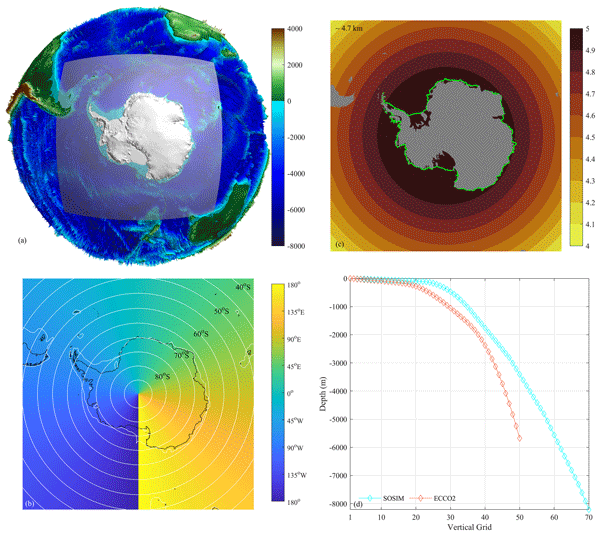
We developed a high-resolution computer model to simulate how the ocean, sea ice, and ice shelves interact around Antarctica. This helps us understand their critical role in global climate and sea-level rise. Our model successfully captures essential features like major currents and seasonal ice changes. Despite some remaining biases, it provides a useful tool for predicting future changes in this vital and rapidly evolving region.
Cynthia E. Bluteau, Danielle J. Wain, Julia C. Mullarney, and Craig L. Stevens
Ocean Sci., 22, 893–921, https://doi.org/10.5194/os-22-893-2026, https://doi.org/10.5194/os-22-893-2026, 2026
Short summary
Short summary
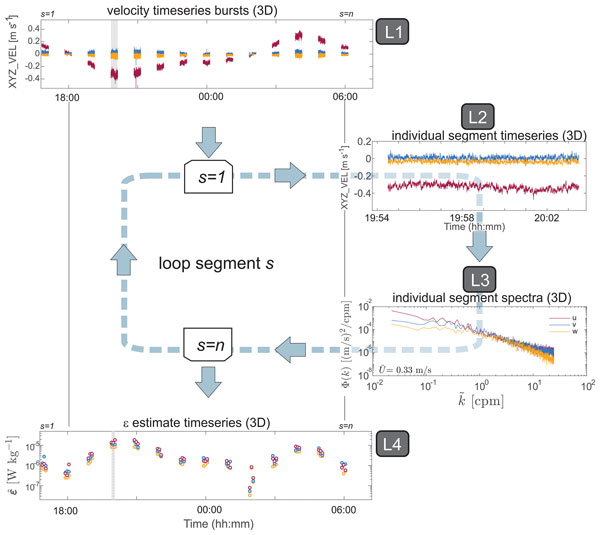
This article provides best practices for estimating an ocean turbulence parameter, epsilon, from velocity measurements. Improper data handling can lead to significant errors in the estimated mixing, propagating into estimates of heat transfers, salt, dissolved gases, and nutrients. The article explains how to process velocity datasets using benchmark datasets from different instruments and platforms in varied ocean environments. The datasets allow users to test their processing algorithms.
Shenjie Zhou, Pierre Dutrieux, Claudia Giulivi, Andrew Meijers, Won Sang Lee, Tae-Wan Kim, Tore Hattermann, and Markus Janout
Earth Syst. Sci. Data Discuss., https://doi.org/10.5194/essd-2025-727, https://doi.org/10.5194/essd-2025-727, 2026
Revised manuscript under review for ESSD
Short summary
Short summary
A collection of temperature and salinity measurements made in the Southern Ocean and around Antarctic continental shelf seas is assembled and described in this paper. A gridded product developed out of these scattered data points is also described. The gridded product provide us a better view of contemporary mean status of the Southern Ocean and Antarctic shelf seas and help models to better reference the prediction of the future climate.
Shenjie Zhou, Pierre Dutrieux, Claudia F. Giulivi, Adrian Jenkins, Alessandro Silvano, Christopher Auckland, E. Povl Abrahamsen, Michael Meredith, Irena Vaňková, Keith Nicholls, Peter E. D. Davis, Svein Østerhus, Arnold L. Gordon, Christopher J. Zappa, Tiago S. Dotto, Ted Scambos, Kathryn L. Gunn, Stephen R. Rintoul, Shigeru Aoki, Craig Stevens, Chengyan Liu, Sukyoung Yun, Tae-Wan Kim, Won Sang Lee, Markus Janout, Tore Hattermann, Julius Lauber, Elin Darelius, Anna Wåhlin, Leo Middleton, Pasquale Castagno, Giorgio Budillon, Karen J. Heywood, Jennifer Graham, Stephen Dye, Daisuke Hirano, and Una Kim Miller
Earth Syst. Sci. Data, 17, 5693–5706, https://doi.org/10.5194/essd-17-5693-2025, https://doi.org/10.5194/essd-17-5693-2025, 2025
Short summary
Short summary
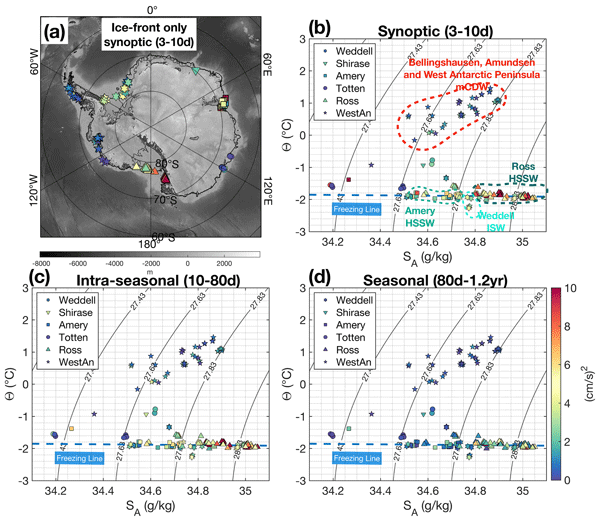
We created the first standardised dataset of in-situ ocean measurements time series from around Antarctica collected since 1970s. This includes temperature, salinity, pressure, and currents recorded by instruments deployed in icy, challenging conditions. Our analysis highlights the dominance of tidal currents and separates these from other patterns to study regional energy distribution. This unique dataset offers a foundation for future research on Antarctic ocean dynamics and ice interactions.
Alexandra Gossart, Alena Malyarenko, Liv Cornelissen, Craig Stevens, Una Miller, Christopher J. Zappa, Nancy Luca, Pasquale Castagno, and Giorgio Budillon
EGUsphere, https://doi.org/10.5194/egusphere-2025-4332, https://doi.org/10.5194/egusphere-2025-4332, 2025
Preprint archived
Short summary
Short summary
Polynyas are areas of open water that form within the sea ice during the Antarctic winter. They occur along the coastline and act as hotspots for air–sea interactions and sea-ice formation. We use the P-SKRIPSv2 model to simulate air–sea–ice–ocean interactions in the Ross Sea. Model results are compared with observations, and we test how changes in air–sea–ice coupling affect the system. Our findings show that P-SKRIPSv2 provides a valuable tool to study polynyasa and understand their dynamics.
Christian T. Wild, Reinhard Drews, Niklas Neckel, Joohan Lee, Sihyung Kim, Hyangsun Han, Won Sang Lee, Veit Helm, Sebastian Harry Reid Rosier, Oliver J. Marsh, and Wolfgang Rack
The Cryosphere, 19, 4533–4554, https://doi.org/10.5194/tc-19-4533-2025, https://doi.org/10.5194/tc-19-4533-2025, 2025
Short summary
Short summary
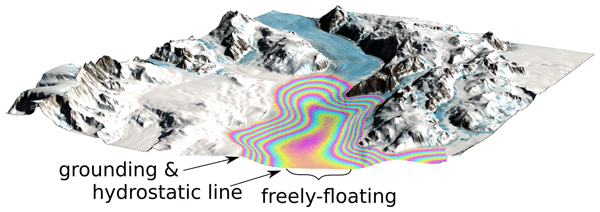
The stability of the Antarctic Ice Sheet depends on how resistance along the sides of large glaciers slows down the flow of ice into the ocean. We present a method to map ice strength using the effect of ocean tides on floating ice shelves. Incorporating weaker ice in shear zones improves the accuracy of model predictions, compared with satellite observations. This demonstrates the untapped potential of radar satellites to map ice stiffness in the most critical areas for ice sheet stability.
Arnaud F. Valcarcel, Craig L. Stevens, Joanne M. O'Callaghan, and Sutara H. Suanda
Ocean Sci., 21, 965–987, https://doi.org/10.5194/os-21-965-2025, https://doi.org/10.5194/os-21-965-2025, 2025
Short summary
Short summary
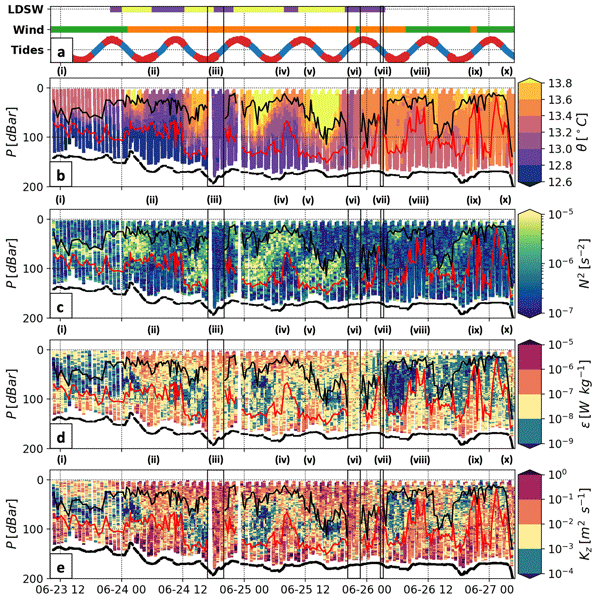
This paper describes underwater robotic measurements in an energetic strait. The data show how energy is transferred from winds and tides to turbulent processes. Boundary layers of strong turbulence affected the water from surface to seafloor across an unusually deep extent, except when fresher or warmer waters moved into the region. Numerical models revealed that turbulent energy transport allowed boundary layers to interact. This phenomenon may impact the biological structure of coastal seas.
Hyunjae Chung, Jikang Park, Mijin Park, Yejin Kim, Unyoung Chun, Sukyoung Yun, Won Sang Lee, Hyun A. Choi, Ji Sung Na, Seung-Tae Yoon, and Won Young Lee
Biogeosciences, 21, 5199–5217, https://doi.org/10.5194/bg-21-5199-2024, https://doi.org/10.5194/bg-21-5199-2024, 2024
Short summary
Short summary
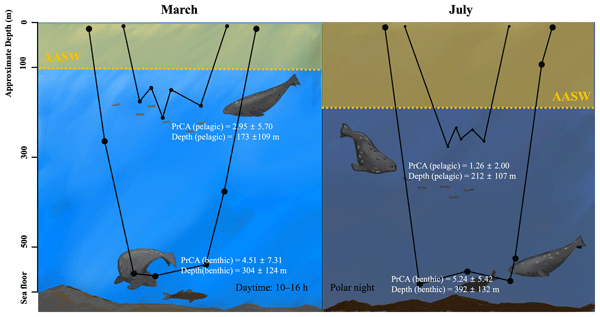
Understanding how marine animals adapt to variations in marine environmental conditions is paramount. In this paper, we investigated the influence of changes in seawater and light conditions on the seasonal foraging behavior of Weddell seals in the Ross Sea, Antarctica. Our findings could serve as a baseline and establish a foundational understanding for future research, particularly concerning the impact of marine environmental changes on the ecosystem of the Ross Sea Marine Protected Area.
Nathan J. M. Laxague, Christopher J. Zappa, Andrew R. Mahoney, John Goodwin, Cyrus Harris, Robert E. Schaeffer, Roswell Schaeffer Sr., Sarah Betcher, Donna D. W. Hauser, Carson R. Witte, Jessica M. Lindsay, Ajit Subramaniam, Kate E. Turner, and Alex Whiting
The Cryosphere, 18, 3297–3313, https://doi.org/10.5194/tc-18-3297-2024, https://doi.org/10.5194/tc-18-3297-2024, 2024
Short summary
Short summary
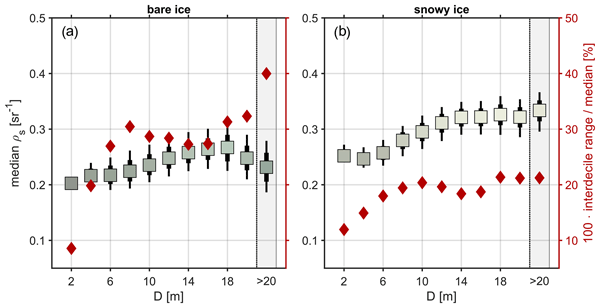
The state of sea ice strongly affects its absorption of solar energy. In May 2019, we flew uncrewed aerial vehicles (UAVs) equipped with sensors designed to quantify the sunlight that is reflected by sea ice at each wavelength over the sea ice of Kotzebue Sound, Alaska. We found that snow patches get darker (up to ~ 20 %) as they get smaller, while bare patches get darker (up to ~ 20 %) as they get larger. We believe that this difference is due to melting around the edges of small features.
Chris Pierce, Christopher Gerekos, Mark Skidmore, Lucas Beem, Don Blankenship, Won Sang Lee, Ed Adams, Choon-Ki Lee, and Jamey Stutz
The Cryosphere, 18, 1495–1515, https://doi.org/10.5194/tc-18-1495-2024, https://doi.org/10.5194/tc-18-1495-2024, 2024
Short summary
Short summary
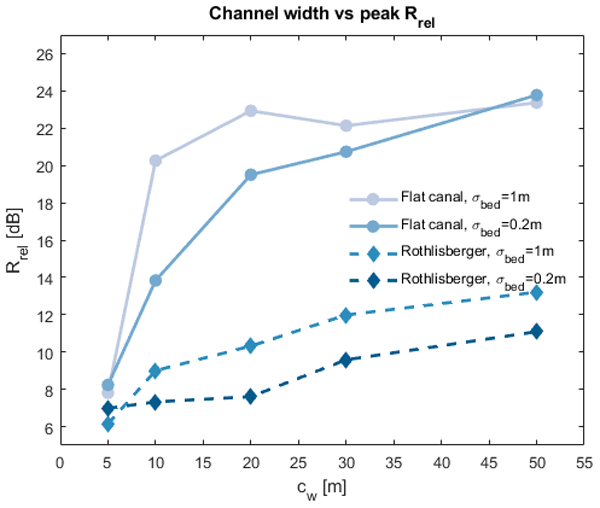
Water beneath glaciers in Antarctica can influence how the ice slides or melts. Airborne radar can detect this water, which looks bright in radar images. However, common techniques cannot identify the water's size or shape. We used a simulator to show how the radar image changes based on the bed material, size, and shape of the waterbody. This technique was applied to a suspected waterbody beneath Thwaites Glacier. We found it may be consistent with a series of wide, flat canals or a lake.
Christine F. Dow, Derek Mueller, Peter Wray, Drew Friedrichs, Alexander L. Forrest, Jasmin B. McInerney, Jamin Greenbaum, Donald D. Blankenship, Choon Ki Lee, and Won Sang Lee
The Cryosphere, 18, 1105–1123, https://doi.org/10.5194/tc-18-1105-2024, https://doi.org/10.5194/tc-18-1105-2024, 2024
Short summary
Short summary
Ice shelves are a key control on Antarctic contribution to sea level rise. We examine the Nansen Ice Shelf in East Antarctica using a combination of field-based and satellite data. We find the basal topography of the ice shelf is highly variable, only partially visible in satellite datasets. We also find that the thinnest region of the ice shelf is altered over time by ice flow rates and ocean melting. These processes can cause fractures to form that eventually result in large calving events.

Ji Sung Na, Taekyun Kim, Emilia Kyung Jin, Seung-Tae Yoon, Won Sang Lee, Sukyoung Yun, and Jiyeon Lee
The Cryosphere, 16, 3451–3468, https://doi.org/10.5194/tc-16-3451-2022, https://doi.org/10.5194/tc-16-3451-2022, 2022
Short summary
Short summary
Beneath the Antarctic ice shelf, sub-ice-shelf plume flow that can cause turbulent mixing exists. In this study, we investigate how this flow affects ocean dynamics and ice melting near the ice front. Our results obtained by validated simulation show that higher turbulence intensity results in vigorous ice melting due to the high heat entrainment. Moreover, this flow with meltwater created by this flow highly affects the ocean overturning circulations near the ice front.
Madelaine Rosevear, Benjamin Galton-Fenzi, and Craig Stevens
Ocean Sci., 18, 1109–1130, https://doi.org/10.5194/os-18-1109-2022, https://doi.org/10.5194/os-18-1109-2022, 2022
Short summary
Short summary
Understanding ocean-driven melting of Antarctic ice shelves is critical for predicting future sea level. However, ocean observations from beneath ice shelves are scarce. Here, we present unique ocean and melting data from the Amery Ice Shelf, East Antarctica. We use our observations to evaluate common methods of representing melting in ocean–climate models (melting
parameterisations) and show that these parameterisations overestimate melting when the ocean is warm and/or currents are weak.
Cited articles
Bianchi, N. C., Chiappini, N. M., Tabacco, N. I. E., Passerini, N. A., Zirizzotti, N. A., and Zuccheretti, N. E.: Morphology of bottom surfaces of glacier ice tongues in the East Antarctic region, Ann. Geophys., 44, https://doi.org/10.4401/ag-3609, 2001. a
Castagno, P., Capozzi, V., DiTullio, G. R., Falco, P., Fusco, G., Rintoul, S. R., Spezie, G., and Budillon, G.: Rebound of shelf water salinity in the Ross Sea, Nat. Commun., 10, https://doi.org/10.1038/s41467-019-13083-8, 2019. a, b
Cornelissen, L.: Livcornelissen/DIT_mooringdata: Processing and Quality Control Code for DIT Mooring Data (v1.0), Zenodo [code], https://doi.org/10.5281/zenodo.20376404, 2026. a
Cornelissen, L., Yun, S., McInerney, J., Grant, B., Elliot, F., Yoon, S., Zappa, C. J., Lee, W. S., and Stevens, C.: A decade-long hydrographic mooring dataset near the Drygalski Ice Tongue, Terra Nova Bay, Antarctica, SEANOE [data set], https://doi.org/10.17882/102640, 2025. a, b
Frezzotti, M. and Mabin, M.: 20th century behaviour of Drygalski Ice Tongue, Ross Sea, Antarctica, Ann. Glaciol., 20, 397–400, https://doi.org/10.3189/172756494794587492, 1994. a
Friedrichs, D. M., McInerney, J. B. T., Oldroyd, H. J., Lee, W. S., Yun, S., Yoon, S., Stevens, C. L., Zappa, C. J., Dow, C. F., Mueller, D., Steiner, O. S., and Forrest, A. L.: Observations of submesoscale eddy-driven heat transport at an ice shelf calving front, Commun. Earth Environ., 3, https://doi.org/10.1038/s43247-022-00460-3, 2022. a, b, c
Gomez-Fell, R., Marsh, O. J., Rack, W., Wild, C. T., and Purdie, H.: Basal mass balance and prevalence of ice tongues in the Western Ross Sea, Front. Earth Sci., 11, https://doi.org/10.3389/feart.2023.1057761, 2023. a
Gossart, A., Malyarenko, A., Cornelissen, L., Stevens, C., Miller, U., Zappa, C. J., Luca, N., Castagno, P., and Budillon, G.: Representation of polynyas in the Ross Sea coupled atmosphere–sea ice–ocean model P-SKRIPSv2, EGUsphere [preprint], https://doi.org/10.5194/egusphere-2025-4332, 2025. a
Haran, T., Klinger, M., Bohlander, J., Fahnestock, M., Painter, T., and Scambos, T.: MEaSUREs MODIS Mosaic of Antarctica 2013–2014 (MOA2014) Image Map, Version 1, NSIDC-0730, NASA National Snow and Ice Data Center Distributed Active Archive Center, Boulder, Colorado, USA [data set], https://doi.org/10.5067/RNF17BP824UM, 2018. a
Indrigo, C., Dow, C. F., Greenbaum, J. S., and Morlighem, M.: Drygalski Ice Tongue stability influenced by rift formation and ice morphology, J. Glaciol., 67, 243–252, https://doi.org/10.1017/jog.2020.9, 2021. a, b
Malyarenko, A., Gossart, A., Sun, R., and Krapp, M.: Conservation of heat and mass in P-SKRIPS version 1: the coupled atmosphere–ice–ocean model of the Ross Sea, Geosci. Model Dev., 16, 3355–3373, https://doi.org/10.5194/gmd-16-3355-2023, 2023. a
Miller, U. K., Zappa, C. J., Gordon, A. L., Yoon, S., Stevens, C., and Lee, W. S.: High salinity shelf water production rates in Terra Nova Bay, Ross Sea, Nat. Commun., 15, https://doi.org/10.1038/s41467-023-43880-1, 2024. a, b
Moctezuma-Flores, M., Parmiggiani, F., Fragiacomo, C., and Guerrieri, L.: Synthetic aperture radar analysis of floating ice at Terra Nova Bay – an application to ice eddy parameter extraction, J. Appl. Remote Sens., 11, https://doi.org/10.1117/1.JRS.11.026041, 2017. a
Morales Maqueda, M. A., Willmott, A. J., and Biggs, N. R. T.: Polynya dynamics: a review of observations and modeling, Rev. Geophys., 42, RG1004, https://doi.org/10.1029/2002RG000116, 2004. a
Morlighem, M., Favier, L., Seroussi, H., Rignot, E., Larour, E., Ben Dhia, H., and Aubry, D.: BedMachine Antarctica v3, Geophys. Res. Lett., 47, e2020GL088569, https://doi.org/10.5067/FPSU0V1MWUB6, 2020. a
Nicholls, K. W.: Predicted reduction in basal melt rates of an Antarctic ice shelf in a warmer climate, Nature, 388, 460–462, https://doi.org/10.1038/41302, 1997. a
Nortek: Norway, Aquadopp 6000M manual, https://www.nortekgroup.com/products/aquadopp2-6000-m/pdf (last access: 9 January 2026), 2026. a
Otago Sea Ice Monitoring Station: Antarctic Science Platform's Sea Ice and Carbon Cycle Feedbacks Project, https://seaice.otago.ac.nz/trackers/overview/ (last access: 9 January 2026), 2026. a
Rusciano, E., Budillon, G., Fusco, G., and Spezie, G.: Evidence of atmosphere–sea ice–ocean coupling in the Terra Nova Bay polynya, Cont. Shelf Res., 61–62, 112–124, https://doi.org/10.1016/j.csr.2013.04.002, 2013. a, b, c
Sea-Bird Scientific: SBE37SM/SBE37SMP, Bellevue, WA, USA, https://www.comm-tec.com/prods/mfgs/SBE/manuals_pdf/SBE37SM_016.pdf (last access: 9 January 2026), 2026a. a
Sea-Bird Scientific: Frequently asked questions: CTD accuracy and effect of fouling/contamination on conductivity/salinity data, https://blog.seabird.com/faqs/ (last access: 9 January 2026), 2026b. a
Sea-Bird Scientific: SBE56, Bellevue, WA, USA, https://www.comm-tec.com/Prods/mfgs/SBE/brochures_pdf/56brochureApr11.pdf (last access: 9 January 2026), 2026c. a
Stevens, C., Lee, W. S., Fusco, G., Yun, S., Grant, B., Robinson, N., and Hwang, C. Y.: The influence of the Drygalski Ice Tongue on the local ocean, Ann. Glaciol., 58, 51–59, https://doi.org/10.1017/aog.2017.4, 2017. a, b
Stevens, C., Yoon, S., Zappa, C. J., Miller, U. K., Wang, X., Elliott, F., Cornelissen, L., Lee, C., Yun, S., and Lee, W. S.: Ocean processes south of the Drygalski Ice Tongue, western Ross Sea, Deep-Sea Res. Pt. II, 217, 105411, https://doi.org/10.1016/j.dsr2.2024.105411, 2024. a, b
Tamura, T., Ohshima, K. I., Fraser, A. D., and Williams, G. D.: Sea ice production variability in Antarctic coastal polynyas, J. Geophys. Res.-Oceans, 121, 2967–2979, https://doi.org/10.1002/2015JC011537, 2016. a
Uchida, H., Kawano, T., and Fukasawa, M.: In situ calibration of moored CTDs used for monitoring abyssal water, J. Atmos. Ocean. Technol., 25, 1695–1702, https://doi.org/10.1175/2008jtecho581.1, 2008. a
Wang, Y., Zhou, M., Zhang, Z., and Dinniman, M. S.: Seasonal variations in Circumpolar Deep Water intrusions into the Ross Sea continental shelf, Front. Mar. Sci., 10, https://doi.org/10.3389/fmars.2023.1020791, 2023. a
Wong, A. P. S., Gilson, J., and Cabanes, C.: Argo salinity: bias and uncertainty evaluation, Earth Syst. Sci. Data, 15, 383–393, https://doi.org/10.5194/essd-15-383-2023, 2023. a
Yoon, S.-T., Lee, W. S., Stevens, C., Jendersie, S., Nam, S., Yun, S., Hwang, C. Y., Jang, G. I., and Lee, J.: Variability in high-salinity shelf water production in the Terra Nova Bay polynya, Antarctica, Ocean Sci., 16, 373–388, https://doi.org/10.5194/os-16-373-2020, 2020. a, b, c, d, e, f, g, h, i, j, k, l
Xu, Y., Zhang, W., Maksym, T., Ji, R., and Li, Y.: Stratification breakdown in Antarctic coastal polynyas. Part II: influence of an ice tongue and coastline geometry, J. Phys. Oceanogr., 53, 2069–2088, https://doi.org/10.1175/jpo-d-22-0219.1, 2023. a
Xylem Inc.: RCM9, Rye Brook, NY, USA, https://epic.awi.de/id/eprint/45145/1/RCM9.pdf (last access: 9 January 2026), 2026. a
Short summary
We present a decade-long mooring time series from southern Terra Nova Bay, Ross Sea, begun in December 2014 as the “DITx” array. Three sites around the Drygalski Ice Tongue record temperature, salinity, pressure, and currents. The data highlight seasonal cycles and variability, informing studies of water mass formation, ice–ocean interactions, glaciology, and regional ecosystems.
We present a decade-long mooring time series from southern Terra Nova Bay, Ross Sea, begun in...


Altmetrics
Final-revised paper
Preprint