Articles | Volume 18, issue 1
https://doi.org/10.5194/essd-18-333-2026
© Author(s) 2026. This work is distributed under
the Creative Commons Attribution 4.0 License.
the Creative Commons Attribution 4.0 License.
https://doi.org/10.5194/essd-18-333-2026
© Author(s) 2026. This work is distributed under
the Creative Commons Attribution 4.0 License.
the Creative Commons Attribution 4.0 License.
Data description article
| 
13 Jan 2026
Data description article |
| 13 Jan 2026
| 13 Jan 2026
Long-term sea surface temperature time series from Malin Head, Ireland

Marine Institute, Rinville, Oranmore, Co. Galway, H91 R673, Ireland
Guy Westbrook
Marine Institute, Rinville, Oranmore, Co. Galway, H91 R673, Ireland
Glenn Nolan
Marine Institute, Rinville, Oranmore, Co. Galway, H91 R673, Ireland
Rob Thomas
Marine Institute, Rinville, Oranmore, Co. Galway, H91 R673, Ireland
Eoghan Daly
Marine Institute, Rinville, Oranmore, Co. Galway, H91 R673, Ireland
Related authors
Sarah Daves, Guy Westbrook, Glenn Nolan, Rob Thomas, and Eoghan Daly
Earth Syst. Sci. Data Discuss., https://doi.org/10.5194/essd-2025-589, https://doi.org/10.5194/essd-2025-589, 2025
Revised manuscript not accepted
Short summary
Short summary
This paper presents an ongoing sea surface temperature dataset located at Ballycotton in the south of Ireland. The time series has been developed from deployments of high precision and accuracy sensors, with data beginning in 2010 and being mostly continuous from 2016. The work provides context to the development of the dataset and potential uses for the data. Preliminary warming analysis using this dataset shows an annual warming of 0.064 °C at the location throughout the time series.
Salem Ibrahim Salem, Andre Valente, Shubha Sathyendranath, Andrei Chuprin, Théo Renard, Jaime Pitarch, Ruth Airs, Moreno Ana, Maria-Manuel Angelico, David Antoine, Robert Arnone, Florinda Artuso, Paulo O. Oliveira, William Balch, Kathryn Barker, Ray Barlow, Simon Bélanger, Marco Bellacicco, Jean-François Berthon, Şükrü Beşiktepe, Francesco Bignami, Yngve Borsheim, Astrid Bracher, Federica Braga, Vittorio Brando, Robert J. W. Brewin, Vanda Brotas, Elisabetta Canuti, Francisco P. Chavez, Andrés Cianca, Hervé Claustre, Lesley Clementson, Simone Colella, Raul Costa, Cristina Nunes, Richard Crout, Emmanuel Devred, Annalisa Di Cicco, Federico Falcini, Ivan Farace, Afonso Ferreira, Scott Freeman, Robert Frouin, Carlos García-Soto, Isabella Giardina, Stuart W. Gibb, Arthur Gleason, Ralf Goericke, Richard Gould, Michael Grant, Nathalie Guillocheau, Hiroto Higa, Stanford B. Hooker, Chuamin Hu, Joji Ishizaka, Thomas Jackson, Mati Kahru, Milton Kampel, Bokyung Kim, Holger Klein, Piotr Kowalczuk, Susanne Kratzer, Raphael Kudela, Antonia Lai, Rosario Lavezza, Jesus Ledesma, Huiwon Lee, Steven Lohrenz, Hubert Loisel, Vivian Lutz, Antonio Mannino, Francesca Margiotta, Victor Martinez-Vicente, Salvatore Marullo, Luca Massi, Patricia Matrai, Atsushi Matsuoka, David McKee, Chiara Melillo, Carlos B. Mendes, Brian G. Mitchell, Tiffany Moisan, Enrique Montes, Frank Muller-Karger, Aimee Neeley, Michael Novak, Leonie O'Dowd, Michael Ondrusek, Emanuele Organelli, Heeyoon Park, Trevor Platt, Francesca Polonelli, Alex Poulton, Mariella Ragni, Michel Repecaud, Maurizio Ribera d’Alcalà, Tamara Rodriguez-Ramos, Rüdiger Röttgers, Manuel Ruiz-Villarreal, Michela Sammartino, Rosalia Santoleri, Gian Marco Scarpa, Thomas Schroeder, Valeria Segura, Timothy Smyth, Denise Smythe-Wright, Heidi M. Sosik, Joanna Stoń-Egiert, Malcolm Taberner, Jing Tan, Rob Thomas, Crystal Thomas, Gavin Tilstone, Andreia Tracana, Michael Twardowski, Vincenzo Vellucci, Gianluca Volpe, Kenneth Voss, Jeremy Werdell, Marcel Wernand, Bozena Wojtasiewicz, Simon Wright, Sunmi Yang, Giuseppe Zibordi, Maria Laura Zoffoli, and Steve Groom
Earth Syst. Sci. Data Discuss., https://doi.org/10.5194/essd-2026-539, https://doi.org/10.5194/essd-2026-539, 2026
Preprint under review for ESSD
Short summary
Short summary
This paper presents the fourth version of the ESA Ocean Colour Climate Change Initiative global in situ bio-optical database. The updated compilation combines observations from many international data sources collected between 1996 and 2025 and includes major expansions in coverage and variables. The dataset provides a consistent reference for validating satellite ocean-colour products and supports algorithm development and long-term climate studies.
Patrick J. McLoughlin, Lionel D. Swan, Glenn Nolan, Kieran Hickey, Maeve Upton, Robin Edwards, and Gerard D. McCarthy
EGUsphere, https://doi.org/10.5194/egusphere-2025-6404, https://doi.org/10.5194/egusphere-2025-6404, 2026
Short summary
Short summary
This study reconstructs historical sea-level change across Ireland using long-term tide-gauge and newly digitized historical data. Sea-level rise varies regionally, faster in the south and west, with an overall mean of ~1.9 mm per year and marked 21st-century acceleration. Results improve understanding of past changes, support coastal planning, and highlight areas most at risk.
Sarah Daves, Guy Westbrook, Glenn Nolan, Rob Thomas, and Eoghan Daly
Earth Syst. Sci. Data Discuss., https://doi.org/10.5194/essd-2025-589, https://doi.org/10.5194/essd-2025-589, 2025
Revised manuscript not accepted
Short summary
Short summary
This paper presents an ongoing sea surface temperature dataset located at Ballycotton in the south of Ireland. The time series has been developed from deployments of high precision and accuracy sensors, with data beginning in 2010 and being mostly continuous from 2016. The work provides context to the development of the dataset and potential uses for the data. Preliminary warming analysis using this dataset shows an annual warming of 0.064 °C at the location throughout the time series.
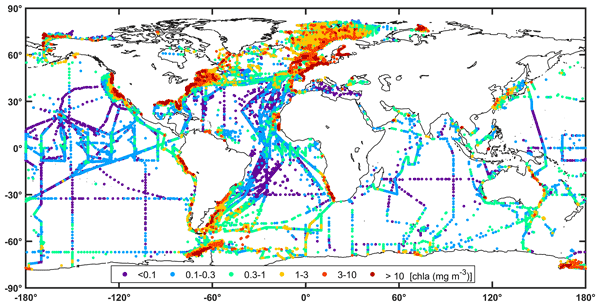
André Valente, Shubha Sathyendranath, Vanda Brotas, Steve Groom, Michael Grant, Thomas Jackson, Andrei Chuprin, Malcolm Taberner, Ruth Airs, David Antoine, Robert Arnone, William M. Balch, Kathryn Barker, Ray Barlow, Simon Bélanger, Jean-François Berthon, Şükrü Beşiktepe, Yngve Borsheim, Astrid Bracher, Vittorio Brando, Robert J. W. Brewin, Elisabetta Canuti, Francisco P. Chavez, Andrés Cianca, Hervé Claustre, Lesley Clementson, Richard Crout, Afonso Ferreira, Scott Freeman, Robert Frouin, Carlos García-Soto, Stuart W. Gibb, Ralf Goericke, Richard Gould, Nathalie Guillocheau, Stanford B. Hooker, Chuamin Hu, Mati Kahru, Milton Kampel, Holger Klein, Susanne Kratzer, Raphael Kudela, Jesus Ledesma, Steven Lohrenz, Hubert Loisel, Antonio Mannino, Victor Martinez-Vicente, Patricia Matrai, David McKee, Brian G. Mitchell, Tiffany Moisan, Enrique Montes, Frank Muller-Karger, Aimee Neeley, Michael Novak, Leonie O'Dowd, Michael Ondrusek, Trevor Platt, Alex J. Poulton, Michel Repecaud, Rüdiger Röttgers, Thomas Schroeder, Timothy Smyth, Denise Smythe-Wright, Heidi M. Sosik, Crystal Thomas, Rob Thomas, Gavin Tilstone, Andreia Tracana, Michael Twardowski, Vincenzo Vellucci, Kenneth Voss, Jeremy Werdell, Marcel Wernand, Bozena Wojtasiewicz, Simon Wright, and Giuseppe Zibordi
Earth Syst. Sci. Data, 14, 5737–5770, https://doi.org/10.5194/essd-14-5737-2022, https://doi.org/10.5194/essd-14-5737-2022, 2022
Short summary
Short summary
A compiled set of in situ data is vital to evaluate the quality of ocean-colour satellite data records. Here we describe the global compilation of bio-optical in situ data (spanning from 1997 to 2021) used for the validation of the ocean-colour products from the ESA Ocean Colour Climate Change Initiative (OC-CCI). The compilation merges and harmonizes several in situ data sources into a simple format that could be used directly for the evaluation of satellite-derived ocean-colour data.

David T. Pugh, Edmund Bridge, Robin Edwards, Peter Hogarth, Guy Westbrook, Philip L. Woodworth, and Gerard D. McCarthy
Ocean Sci., 17, 1623–1637, https://doi.org/10.5194/os-17-1623-2021, https://doi.org/10.5194/os-17-1623-2021, 2021
Short summary
Short summary
Observations of sea level, taken manually by reading a tide pole, were carefully taken at a number of locations around Ireland in 1842 as part of the first land survey of Ireland. Our study investigates how useful this type of sea level observation is for understanding mean sea level and tidal change. We find that when carefully adjusted for seasonal, meteorological, and astronomical factors, these data can provide important insights into changing sea levels.
Cited articles
Acquaotta, F. and Fratianni, S.: The importance of the quality and reliability of the historical time series for the study of climate change, Journal of Brazilian Climatology, 14, 19, http://hdl.handle.net/2318/153713 (last acess: 7 August 2025), 2014.
Caesar, L., McCarthy, G. D., Thornalley, D. J. R., Cahill, N., and Rahmstorf, S.: Current Atlantic Meridional Overturning Circulation weakest in last millennium, Nature Geoscience, 14, 118–120, https://doi.org/10.1038/s41561-021-00699-z, 2021.
Cannaby, H. and Hüsrevoğlu, Y. S.: The influence of low-frequency variability and long-term trends in North Atlantic sea surface temperature on Irish waters, ICES Journal of Marine Science, 66, 1480–1489, https://doi.org/10.1093/icesjms/fsp062, 2009.
Codiga, D. L.: Unified tidal analysis and prediction using the UTide Matlab functions. Technical Report 2011-01, Graduate School of Oceanography, University of Rhode Island, Narragansett, RI, 59 pp., https://doi.org/10.13140/RG.2.1.3761.2008, 2011.
CoreTrustSeal: https://www.coretrustseal.org/, last access: 1 September 2025.
Cornes, R. C., Tinker, J., Hermanson, L., Oltmanns, M., Hunter, W. R., Lloyd-Hartley, H., Kent, E. C., Rabe, B., and Renshaw, R.: The impacts of climate change on sea temperature around the UK and Ireland, MCCIP Science Review, 18 pp., https://doi.org/10.14465/2023.reu08.tem, 2023.
Daly, E., Nolan, G., Berry, A., Büscher, J.V., Cave, R.R., Caesar, L., Cronin, M., Fennell, S., Lyons, K., McAleer, A., McCarthy, G.D., McGovern, E., McGovern, J.V., McGrath, T., O'Donnell, G., Pereiro, D., Thomas, R., Vaughan, L., White, M., and Cusack, C.: Diurnal to interannual variability in the Northeast Atlantic from hydrographic transects and fixed time-series across the Rockall Trough. Deep Sea Research Part I: Oceanographic Research Papers, 204, 104233, https://doi.org/10.1016/j.dsr.2024.104233, 2024.
Duarte, C. M., Cebrián, J., and Marbà, N.: Uncertainty of detecting sea change, Nature, 356, 190–190, https://doi.org/10.1038/356190a0, 1992.
Dunne, S., Hanafin, J., Lynch, P., McGrath, R., Nishimura, E., Nolan, P., Ratnam, J. V., Semmler, T., Sweeney, C., Varghese, S., and Wang, S.: Ireland in a warmer world – scientific predictions of the Irish climate in the twenty-first century: 2001-CD-C4-M2, online version, Environmental Protection Agency, Johnstown Castle, Co. Wexford, Ireland, 1 pp., https://www.epa.ie/publications/research/climate-change/ireland-in-a-warmer-world—scientific-predictions-of-the-irish-climate-in-the-twenty-first-century.php (last access: 14 August 2025), 2009.
Dye, S. R., Hughes, S. L., Tinker, J., Berry, D. I., Holliday, N. P., Kent, E. C., Kennington, K., Inall, M., Smyth, T., Nolan, G., Lyons, K., Andres, O., and Beszczynska-Möller, A.: Impacts of climate change on temperature (air and sea), MCCIP Science Review, 2013, 12 pp., https://doi.org/10.14465/2013.ARC01.001-012, 2013.
Fernand, L., Nolan, G. D., Raine, R., Chambers, C. E., Dye, S. R., White, M., and Brown, J.: The Irish coastal current: A seasonal jet-like circulation, Continental Shelf Research, 26, 1775–1793, https://doi.org/10.1016/j.csr.2006.05.010, 2006.
Geological Survey Ireland: Open Topographic Lidar Data – Data Download, https://data.gov.ie/dataset/open-topographic-lidar-data (last access: 24 December 2025), 2021.
Gonzalez-Pola, C., Larsen, K. M. H., Fratantoni, P., and Beszczynska-Möller, A.: ICES Report on Ocean Climate 2021 (report), ICES Cooperative Research Reports (CRR), https://doi.org/10.17895/ices.pub.24755574.v1, 2023.
Goodwin, C. E., Strain, E. M. A., Edwards, H., Bennett, S. C., Breen, J. P., and Picton, B. E.: Effects of two decades of rising sea surface temperatures on sublittoral macrobenthos communities in Northern Ireland, UK, Marine Environmental Research, 85, 34–44, https://doi.org/10.1016/j.marenvres.2012.12.008, 2013.
Holt, J., Hughes, S., Hopkins, J., Wakelin, S. L., Penny Holliday, N., Dye, S., González-Pola, C., Hjøllo, S. S., Mork, K. A., Nolan, G., Proctor, R., Read, J., Shammon, T., Sherwin, T., Smyth, T., Tattersall, G., Ward, B., and Wiltshire, K. H.: Multi-decadal variability and trends in the temperature of the northwest European continental shelf: A model-data synthesis, Progress in Oceanography, 106, 96–117, https://doi.org/10.1016/j.pocean.2012.08.001, 2012.
IODE – International Oceanographic Data and Information Exchange: https://iode.org/, last access: 1 September 2025.
Leinweber, A., Gruber, N., Frenzel, H., Friederich, G. E., and Chavez, F. P.: Diurnal carbon cycling in the surface ocean and lower atmosphere of Santa Monica Bay, California, Geophysical Research Letters, 36, https://doi.org/10.1029/2008GL037018, 2009.
Luterbacher, J., Allan, R., Wilkinson, C., Hawkins, E., Teleti, P., Lorrey, A., Brönnimann, S., Hechler, P., Velikou, K., and Xoplaki, E.: The importance and scientific value of long weather and climate records; examples of historical marine data efforts across the globe, Climate, 12, 39, https://doi.org/10.3390/cli12030039, 2024.
Marine Institute: Malin Head Sea Surface Temperature daily averaged product, from 1958 to near-present, Marine Institute [data set], https://doi.org/10.20393/314DE8E2-79F0-4D36-B2BE-EE2A7E5590E2, 2025a.
Marine Institute: Malin Head Sea Surface Temperature data collection, from 1958 to near-present, Marine Institute [data set], https://doi.org/10.20393/85D35444-2FB3-4791-A977-AE29BB3B3CFC, 2025b.
Nolan, G., Cusack, C., Fitzhenry, D., McGovern, E., Cronin, M., O'Donnell, G., O'Dowd, L., Clarke, M., Reid, D., Clarke, D., De Eyto, E., Poole, R., Tray, E., Conway, A., O'Driscoll, D., Heney, K., Arrigan, M., Leadbetter, A., Dabrowski, T., Furey, T., and O'Cadhla, O.: Baseline study of Essential Ocean Variable monitoring in Irish waters; current measurement programmes & data quality, Marine Institute, Galway, Ireland, http://hdl.handle.net/10793/1804 (last access: 17 September 2025), 2021.
O'Sullivan, D., Daly, E., and Thomas, R.: An automated method to process, visualize, and publish quality controlled CTD (conductivity, temperature, depth) data using open-source technology, Bulletin of Marine Science 101, 913–932, https://doi.org/10.5343/bms.2024.0055, 2025.
Poul, H. M., Gröger, M., Karsten, S., Mayer, B., Pohlmann, T., and Meier, H. E. M.: Natural variability masks climate change sea surface temperature signals: a comparison between the Baltic Sea, North Sea and North Atlantic Ocean, Clim. Dynam., 63, 102, https://doi.org/10.1007/s00382-024-07538-y, 2025.
Raine, R. and McMahon, T.: Physical dynamics on the continental shelf off southwestern Ireland and their influence on coastal phytoplankton blooms, Continental Shelf Research, 18, 883–914, https://doi.org/10.1016/S0278-4343(98)00017-X, 1998.
Sailley, S. F., Catalan, I. A., Batsleer, J., Bossier, S., Damalas, D., Hansen, C., Huret, M., Engelhard, G., Hamon, K., Kay, S., Maynou, F., Nielsen, J. R., Ospina-Álvarez, A., Pinnegar, J., Poos, J. J., Sgardeli, V., and Peck, M. A.: Multiple models of European marine fish stocks: regional winners and losers in a future climate, Global Change Biology, 31, e70149, https://doi.org/10.1111/gcb.70149, 2025.
Seabird: SBE 39plus Temperature (P) Recorder User Manual, https://www.seabird.com/moored/sbe-39plus-temperature-depth-recorder/family-downloads?productCategoryId=54627473774 (last access: 24 December 2025), 2024.
Seabold, S. and Perktold, J.: Statsmodels: Econometric and statistical modeling with python, Proceedings of the 9th Python in Science Conference, https://www.researchgate.net/publication/264891066_Statsmodels_Econometric_and_Statistical_Modeling_with_Python (last access: 24 December 2025), 2010.
SeaDataNet: Data Quality Control Procedures – Version 2.0, https://www.seadatanet.org/Standards/Data-Quality-Control (last access: 24 December 2025), 2010.
Tinker, J., Krijnen, J., Wood, R., Barciela, R., and Dye, S. R.: What are the prospects for seasonal prediction of the marine environment of the North-west European Shelf?, Ocean Sci., 14, 887–909, https://doi.org/10.5194/os-14-887-2018, 2018.
Thomas, H., Craig, S. E., Greenan, B. J. W., Burt, W., Herndl, G. J., Higginson, S., Salt, L., Shadwick, E. H., and Urrego-Blanco, J.: Direct observations of diel biological CO2 fixation on the Scotian Shelf, northwestern Atlantic Ocean, Biogeosciences, 9, 2301–2309, https://doi.org/10.5194/bg-9-2301-2012, 2012.
Vytla, V., Baduru, B., Kolukula, S. S., Ragav, N. N., and Kumar, J. P.: Forecasting of sea surface temperature using machine learning and its applications, J. Earth Syst. Sci., 134, 25, https://doi.org/10.1007/s12040-024-02483-0, 2025.
Wilkinson, M. D., Dumontier, M., Aalbersberg, Ij. J., Appleton, G., Axton, M., Baak, A., Blomberg, N., Boiten, J.-W., Da Silva Santos, L. B., Bourne, P. E., Bouwman, J., Brookes, A. J., Clark, T., Crosas, M., Dillo, I., Dumon, O., Edmunds, S., Evelo, C. T., Finkers, R., Gonzalez-Beltran, A., Gray, A. J. G., Groth, P., Goble, C., Grethe, J. S., Heringa, J., 't Hoen, P. A. C., Hooft, R., Kuhn, T., Kok, R., Kok, J., Lusher, S. J., Martone, M. E., Mons, A., Packer, A. L., Persson, B., Rocca-Serra, P., Roos, M., Van Schaik, R., Sansone, S.-A., Schultes, E., Sengstag, T., Slater, T., Strawn, G., Swertz, M. A., Thompson, M., Van Der Lei, J., Van Mulligen, E., Velterop, J., Waagmeester, A., Wittenburg, P., Wolstencroft, K., Zhao, J., and Mons, B.: The FAIR Guiding Principles for scientific data management and stewardship, Sci. Data, 3, 160018, https://doi.org/10.1038/sdata.2016.18, 2016.
WMO: WMO Guidelines on the Calculation of Climate Normals, 2017 edition, WMO, Geneva, 29 pp., https://library.wmo.int/idurl/4/55797 (last access: 2 September 2025), 2017.
Short summary
This paper presents two datasets coming from a 67-year ongoing sea surface temperature time series from Malin Head, Ireland: a full-resolution measured dataset and a standardised data product. The latter of which has been stitched together from different measurement techniques and frequencies to make a more continuous and consistent time series. They have been used in a range of scientific papers to date and an annual warming trend of 0.015–0.022 °C has been found from the data.
This paper presents two datasets coming from a 67-year ongoing sea surface temperature time...


Altmetrics
Final-revised paper
Preprint