Articles | Volume 18, issue 5
https://doi.org/10.5194/essd-18-3165-2026
© Author(s) 2026. This work is distributed under
the Creative Commons Attribution 4.0 License.
https://doi.org/10.5194/essd-18-3165-2026
© Author(s) 2026. This work is distributed under
the Creative Commons Attribution 4.0 License.
A new dataset of Mesoscale Convective Complexes (MCC) derived from FY-2G satellite data

Department of Atmospheric Sciences, School of Environmental Studies, China University of Geosciences, Wuhan, China
Shuyun Zhao
CORRESPONDING AUTHOR
Department of Atmospheric Sciences, School of Environmental Studies, China University of Geosciences, Wuhan, China
Key Laboratory of Meteorological Disaster, Ministry of Education/Collaborative Innovation Center on Forecast and Evaluation of Meteorological Disasters, Nanjing University of Information Science & Technology, Nanjing, China
Department of Atmospheric Sciences, School of Environmental Studies, China University of Geosciences, Wuhan, China
Jianchuan Shu
Heavy Rain and Drought-Flood Disasters in Plateau and Basin Key Laboratory of Sichuan Province, Institute of Tibetan Plateau Meteorology, China Meteorological Administration, Chengdu, China
Wuke Wang
Department of Atmospheric Sciences, School of Environmental Studies, China University of Geosciences, Wuhan, China
Qimin Deng
Department of Atmospheric Sciences, School of Environmental Studies, China University of Geosciences, Wuhan, China
Zaheer Ahmad Babar
Flood Forecasting Division, Pakistan Meteorological Department, Lahore, Pakistan
Related authors
No articles found.
Yu Gou, Jian Zhang, Wuke Wang, Kaiming Huang, and Shaodong Zhang
Atmos. Chem. Phys., 25, 17319–17330, https://doi.org/10.5194/acp-25-17319-2025, https://doi.org/10.5194/acp-25-17319-2025, 2025
Short summary
Short summary
Tropopause height is a key climate change indicator, with accurate long-term trends vital for climate research. Radiosonde data, while reliable, has limited coverage. ERA5 (European Centre for Medium–Range Weather Forecasts Reanalysis v5) is a reanalysis dataset that provides global data, enabling comparisons of tropopause height estimates and then analyzed for long-term trends. Results show a 32 m mean difference (radiosonde – ERA5) with trends of +9 m/year (radiosonde) and +7 m/year (ERA5), crucial for characterizing tropopause changes under climate change.
Yu Gou, Jian Zhang, Wuke Wang, Kaiming Huang, and Shaodong Zhang
EGUsphere, https://doi.org/10.5194/egusphere-2024-4198, https://doi.org/10.5194/egusphere-2024-4198, 2025
Preprint withdrawn
Short summary
Short summary
The most commonly used tropopause height detection algorithm is based on the World Meteorological Organization (WMO) definition from 1957. However, with the increasing vertical resolution of atmospheric data, this definition has been found to fail in high-resolution radiosonde data. Thus, we propose an improved method to address this issue. This method can effectively bypassing thin inversions while preserving the fine–scale structure of the tropopause.
Jia Shao, Jian Zhang, Wuke Wang, Shaodong Zhang, Tao Yu, and Wenjun Dong
Atmos. Chem. Phys., 23, 12589–12607, https://doi.org/10.5194/acp-23-12589-2023, https://doi.org/10.5194/acp-23-12589-2023, 2023
Short summary
Short summary
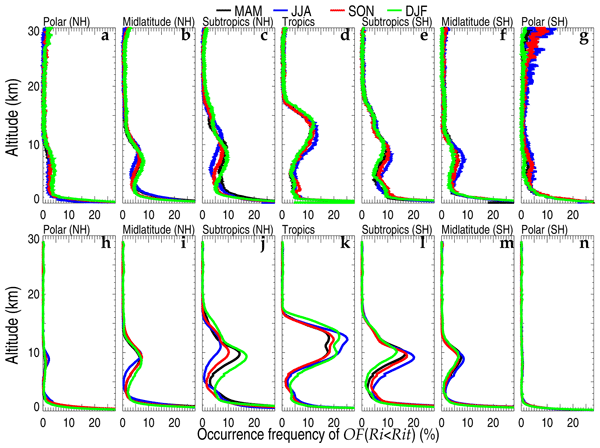
Kelvin–Helmholtz instability (KHI) is indicated by the critical value of the Richardson (Ri) number, which is usually predicted to be 1/4. Compared to high-resolution radiosondes, the threshold value of Ri could be approximated as 1 rather than 1/4 when using ERA5-based Ri as a proxy for KHI. The occurrence frequency of subcritical Ri exhibits significant seasonal cycles over all climate zones and is closely associated with gravity waves and background flows.
Wuke Wang, Jin Hong, Ming Shangguan, Hongyue Wang, Wei Jiang, and Shuyun Zhao
Atmos. Chem. Phys., 22, 13695–13711, https://doi.org/10.5194/acp-22-13695-2022, https://doi.org/10.5194/acp-22-13695-2022, 2022
Short summary
Short summary
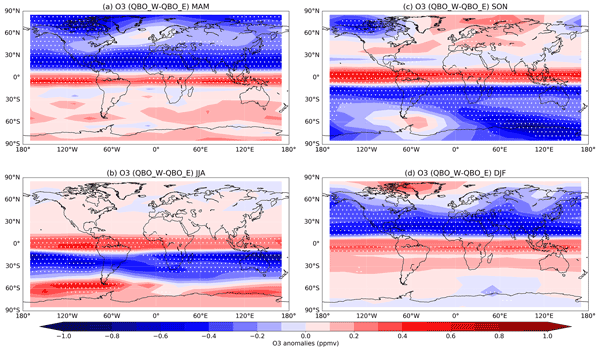
The ozone layer protects the life on the Earth by absorbing the ultraviolet (UV) radiation. Beside the long-term trend, there are strong interannual fluctuations in stratospheric ozone. The quasi-biennial oscillation (QBO) is an important interannual mode in the stratosphere. We show some new zonally asymmetric features of its impacts on stratospheric ozone using satellite data, ERA5 reanalysis, and model simulations, which is helpful for predicting the regional UV radiation at the surface.
Ming Shangguan and Wuke Wang
Atmos. Chem. Phys., 22, 9499–9511, https://doi.org/10.5194/acp-22-9499-2022, https://doi.org/10.5194/acp-22-9499-2022, 2022
Short summary
Short summary
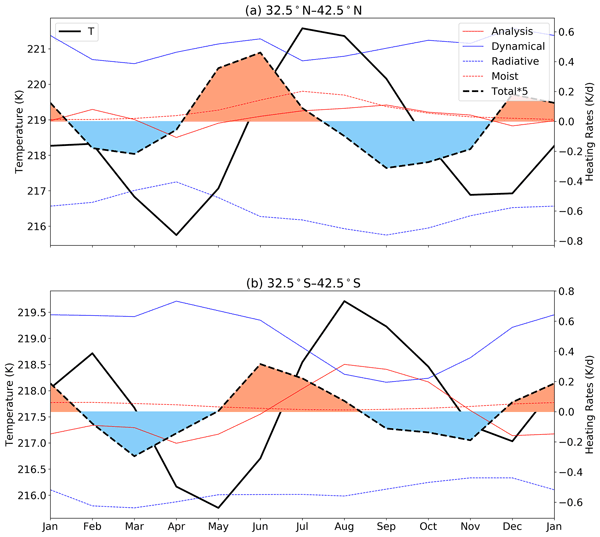
Skilful predictions of weather and climate on subseasonal to seasonal scales are valuable for decision makers. Here we show the global spatiotemporal variation of the temperature SAO in the UTLS with GNSS RO and reanalysis data. The formation of the SAO is explained by an energy budget analysis. The results show that the SAO in the UTLS is partly modified by the SSTs according to model simulations. The results may provide an important source for seasonal predictions of the surface weather.
Kai Qie, Wuke Wang, Wenshou Tian, Rui Huang, Mian Xu, Tao Wang, and Yifeng Peng
Atmos. Chem. Phys., 22, 4393–4411, https://doi.org/10.5194/acp-22-4393-2022, https://doi.org/10.5194/acp-22-4393-2022, 2022
Short summary
Short summary
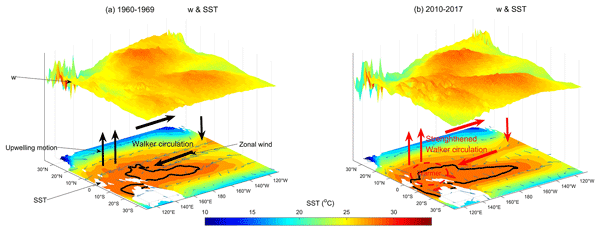
We identify a significantly intensified upward motion over the tropical western Pacific (TWP) and an enhanced tropical upwelling in boreal winter during 1958–2017 due to the warming of global sea surface temperatures (SSTs). Our results suggest that more tropospheric trace gases over the TWP could be elevated to the lower stratosphere, which implies that the emission from the maritime continent plays a more important role in the stratospheric processes and the global climate.
Cited articles
Abisusmita, R. W., Arsyad, M., and Subaer, S.: Karakteristik Mesoscale Convective Complex (MCC) di Wilayah Sulawesi Selatan dan Sekitarnya, Jurnal Fisika Unand, 12, 283–290, https://doi.org/10.25077/jfu.12.2.282-289.2023, 2023.
Augustine, J. A. and Howard, K. W.: Mesoscale Convective Complexes over the United States during 1986 and 1987, Mon. Weather Rev., 119, 1575–1589, https://doi.org/10.1175/1520-0493(1991)119<1575:MCCOTU>2.0.CO;2, 1991.
Blamey, R. C. and Reason, C. J. C.: Mesoscale Convective Complexes over Southern Africa, J. Climate, 25, 753–766, https://doi.org/10.1175/JCLI-D-10-05013.1, 2012.
Chang, C. D. Z.: Distribution characteristics of MCCs east of the Tibetan Plateau in China during summer 2007–2012, Journal of the Meteorological Sciences, 35, 445–453, https://doi.org/10.3969/2014jms.0008, 2015 (in Chinese).
Cotton, W. R. and Anthes, R. A.: Storm and Cloud Dynamics, Academic Press, San Diego, California, USA, 1989.
Ding, T., Guo, Z., Zou, L., and Zhou, T.: Impact of Convection-Permitting and Model Resolution on the Simulation of Mesoscale Convective System Properties Over East Asia, J. Geophys. Res., 128, e2023JD039395, https://doi.org/10.1029/2023JD039395, 2023.
Duan, L. and Guo, G.: Research on Method for MCS Automatic Identification and Tracking Based on FY Satellite Cloud Image, Electronic Science and Technology, 29, 116–126, 2016 (in Chinese).
Febrizky, L., Fadli, M., and Wiliam, W.: IDENTIFIKASI MESOSCALE CONVECTIVE COMPLEX (MCC) BERBASIS DATA SATELIT HIMAWARI-8 DI PULAU PAPUA DAN SEKITARNYA DESEMBER 2021-NOVEMBER 2022, OPTIKA: Jurnal Pendidikan Fisika., 7, 294–305, https://doi.org/10.37478/optika.v7i2.3132, 2023.
Fei, Z. W. H., Zhang, Y., Song, S., and Liu, J.: Automatic identification and tracking of MCS based on geostationary satellite infrared imagery, Journal of Applied Meteorological Science, 22, 115–122, 2011 (in Chinese).
Houze, R. A.: Structure and Dynamics of a Tropical Squall–Line System, Mon. Weather Rev., 105, 1540–1567, https://doi.org/10.1175/1520-0493(1977)105<1540:SADOAT>2.0.CO;2, 1977.
Houze Jr., R. A.: Orographic effects on precipitating clouds, Rev. Geophys., 50, https://doi.org/10.1029/2011RG000365, 2012.
Hua, S., Xu, X., and Chen, B.: Influence of Multiscale Orography on the Initiation and Maintenance of a Precipitating Convective System in North China: A Case Study, J. Geophys. Res.-Atmos., 125, e2019JD031731, https://doi.org/10.1029/2019JD031731, 2020.
Jing, X., Jing, Y., Chen, C., Tu, N., Wan, H., and Chen, H.: Characteristics and Causes of Meso-β Scale Flood-Causing Rainstorm on the Loess Plateau, Meteorological Monthly, 40, 1183–1193, https://doi.org/10.7519/j.issn.1000-0526.2014.10.003, 2014.
Laing, A. G. and Fritsch, J. M.: Mesoscale Convective Complexes in Africa, Mon. Weather Rev., 121, 2254–2263, https://doi.org/10.1175/1520-0493(1993)121<2254:MCCIA>2.0.CO;2, 1993.
Lakshmanan, V., Rabin, R., and DeBrunner, V.: Multiscale storm identification and forecast, Atmos. Res., 67–68, 367–380, https://doi.org/10.1016/S0169-8095(03)00068-1, 2003.
Le Barbé, L., Lebel, T., and Tapsoba, D.: Rainfall Variability in West Africa during the Years 1950–90, J. Climate, 15, 187–202, https://doi.org/10.1175/1520-0442(2002)015<0187:RVIWAD>2.0.CO;2, 2002.
Li, Y. W. J., Zheng, X., Guo, W., and Huang, W.: A study of Mesoscale Convective Complexes (MCC) in Southwest-South China, Atmospheric Sciences, 13, 415–422, https://doi.org/10.3878/j.issn.1006-9895.1989.04.05, 1989 (in Chinese).
Machado, L. A. T. and Rossow, W. B.: Structural Characteristics and Radiative Properties of Tropical Cloud Clusters, Mon. Weather Rev., 121, 3234–3260, https://doi.org/10.1175/1520-0493(1993)121<3234:SCARPO>2.0.CO;2, 1993.
Machado, L. A. T., Desbois, M., and Duvel, J.-P.: Structural Characteristics of Deep Convective Systems over Tropical Africa and the Atlantic Ocean, Mon. Weather Rev., 120, 392–406, https://doi.org/10.1175/1520-0493(1992)120<0392:SCODCS>2.0.CO;2, 1992.
Machado, L. A. T., Rossow, W. B., Guedes, R. L., and Walker, A. W.: Life Cycle Variations of Mesoscale Convective Systems over the Americas, Mon. Weather Rev., 126, 1630–1654, https://doi.org/10.1175/1520-0493(1998)126<1630:LCVOMC>2.0.CO;2, 1998.
Maddox, R. A.: Mesoscale convective complexes, B. Am. Meteorol. Soc., 61, 1374–1387, 1980.
Mathon, V. and Laurent, H.: Life cycle of Sahelian mesoscale convective cloud systems, Q. J. Roy. Meteor. Soc., 127, 377–406, https://doi.org/10.1002/qj.49712757208, 2001.
Matthews, J. and Trostel, J.: An improved storm cell identification and tracking (SCIT) algorithm based on DBSCAN clustering and JPDA tracking methods, American Meteorological Society, Atlanta, GA, http://ams.confex.com/ams/90annual/techprogram/paper_164442.htm (last access: 1 April 2026), 2010.
Miller, D. and Fritsch, J. M.: Mesoscale Convective Complexes in the Western Pacific Region, Mon. Weather Rev., 119, 2978–2992, https://doi.org/10.1175/1520-0493(1991)119<2978:MCCITW>2.0.CO;2, 1991.
Schumacher, R. S. and Rasmussen, K. L.: The formation, character and changing nature of mesoscale convective systems, Nature Reviews Earth & Environment, 1, 300–314, https://doi.org/10.1038/s43017-020-0057-7, 2020.
Shah, S., Notarpietro, R., and Branca, M.: Storm Identification, Tracking and Forecasting Using High-Resolution Images of Short-Range X-Band Radar, Atmosphere, 6, 579–606, https://doi.org/10.3390/atmos6050579, 2015.
Silva Dias, M. A. F. and Ferreira, R. N.: Application of a linear spectral model to the study of Amazonian squall lines during GTE/ABLE 2B, J. Geophys. Res., 97, 20405–20419, https://doi.org/10.1029/92JD01333, 1992.
Velasco, I. and Fritsch, J. M.: Mesoscale convective complexes in the Americas, J. Geophys. Res., 92, 9591–9613, https://doi.org/10.1029/JD092iD08p09591, 1987.
Vila, D. A., Machado, L. A. T., Laurent, H., and Velasco, I.: Forecast and Tracking the Evolution of Cloud Clusters (ForTraCC) Using Satellite Infrared Imagery: Methodology and Validation, Weather Forecast., 23, 233–245, https://doi.org/10.1175/2007WAF2006121.1, 2008.
Xiang, X. J. J.: Mesoscale Convective Complexes in southern China, Journal of Applied Meteorological Science, 6, 9–17, 1995 (in Chinese).
Xu, K.: A new dataset of MCC derived from FY-2G satellite data, Zenodo [data set], https://doi.org/10.5281/zenodo.17349888, 2025.
Yan, W. H. X., Zhao, Y., Yang, T., and Ni, H.: Introduction to a 3D structure identification technique for thunderstorm cells based on an improved DBSCAN clustering algorithm, J. Trop. Meteorol., 36, 542–551, https://doi.org/10.16032/j.issn.1004-4965.2020.050, 2020 (in Chinese).
Zhang, Y., Chen, H., Li, P., and Li, J.: The characteristics of summer mesoscale convective systems with different moving paths over Southwest China, Clim. Dynam., 63, 77, https://doi.org/10.1007/s00382-025-07586-y, 2025.
Short summary
We developed an automated algorithm using cloud-top temperature data from the Fengyun-2G geostationary satellite to create a decade-long dataset of Mesoscale Convective Complexes over China. Results show southwestern China as a primary hotspot and link interannual variability to ENSO-related air–sea interactions. This dataset supports studies of severe convection, weather forecasting, and climate variability.
We developed an automated algorithm using cloud-top temperature data from the Fengyun-2G...
Altmetrics
Final-revised paper
Preprint