Articles | Volume 18, issue 4
https://doi.org/10.5194/essd-18-2891-2026
© Author(s) 2026. This work is distributed under
the Creative Commons Attribution 4.0 License.
https://doi.org/10.5194/essd-18-2891-2026
© Author(s) 2026. This work is distributed under
the Creative Commons Attribution 4.0 License.
Mapping sea ice concentration using Nimbus-5 ESMR and local dynamical tie points

Emil Haaber Tellefsen
Danish Meteorological Institute (DMI), National Centre for Climate Research (NCKF), Copenhagen, Denmark
Department of Electronic Systems, Aalborg University, Aalborg, Denmark
DTU Space, Ørsted Plads building 348, 2800 Kgs. Lyngby, Denmark
Wiebke Margitta Kolbe
Danish Meteorological Institute (DMI), National Centre for Climate Research (NCKF), Copenhagen, Denmark
Related authors
No articles found.
Rasmus Tage Tonboe, Vishnu Nandan, Marcus Huntemann, Julienne Stroeve, Randall Scharien, John Yackel, Lars Kaleschke, Hoyeon Shi, and Tânia Casal
EGUsphere, https://doi.org/10.5194/egusphere-2026-1440, https://doi.org/10.5194/egusphere-2026-1440, 2026
This preprint is open for discussion and under review for The Cryosphere (TC).
Short summary
Short summary
Scattering and absorption from air bubbles, voids, and brine pockets significantly affect radar and microwave radiometer measurements of sea ice and light propagation through sea ice. Here, we used a high-resolution dataset, collected during the 2019–20 MOSAiC expedition, of thin ice slices of various Arctic sea ice types to estimate the autocorrelation length and density of the inclusions. The data can be used to initialize sea ice scattering models and for understanding satellite data.
Wiebke Margitta Kolbe, Rasmus T. Tonboe, and Julienne Stroeve
Earth Syst. Sci. Data, 16, 1247–1264, https://doi.org/10.5194/essd-16-1247-2024, https://doi.org/10.5194/essd-16-1247-2024, 2024
Short summary
Short summary
Current satellite-based sea-ice climate data records (CDRs) usually begin in October 1978 with the first multichannel microwave radiometer data. Here, we present a sea ice dataset based on the single-channel Electrical Scanning Microwave Radiometer (ESMR) that operated from 1972-1977 onboard NASA’s Nimbus 5 satellite. The data were processed using modern methods and include uncertainty estimations in order to provide an important, easy-to-use reference period of good quality for current CDRs.
Vishnu Nandan, Rosemary Willatt, Robbie Mallett, Julienne Stroeve, Torsten Geldsetzer, Randall Scharien, Rasmus Tonboe, John Yackel, Jack Landy, David Clemens-Sewall, Arttu Jutila, David N. Wagner, Daniela Krampe, Marcus Huntemann, Mallik Mahmud, David Jensen, Thomas Newman, Stefan Hendricks, Gunnar Spreen, Amy Macfarlane, Martin Schneebeli, James Mead, Robert Ricker, Michael Gallagher, Claude Duguay, Ian Raphael, Chris Polashenski, Michel Tsamados, Ilkka Matero, and Mario Hoppmann
The Cryosphere, 17, 2211–2229, https://doi.org/10.5194/tc-17-2211-2023, https://doi.org/10.5194/tc-17-2211-2023, 2023
Short summary
Short summary
We show that wind redistributes snow on Arctic sea ice, and Ka- and Ku-band radar measurements detect both newly deposited snow and buried snow layers that can affect the accuracy of snow depth estimates on sea ice. Radar, laser, meteorological, and snow data were collected during the MOSAiC expedition. With frequent occurrence of storms in the Arctic, our results show that
wind-redistributed snow needs to be accounted for to improve snow depth estimates on sea ice from satellite radars.
Julienne Stroeve, Vishnu Nandan, Rosemary Willatt, Ruzica Dadic, Philip Rostosky, Michael Gallagher, Robbie Mallett, Andrew Barrett, Stefan Hendricks, Rasmus Tonboe, Michelle McCrystall, Mark Serreze, Linda Thielke, Gunnar Spreen, Thomas Newman, John Yackel, Robert Ricker, Michel Tsamados, Amy Macfarlane, Henna-Reetta Hannula, and Martin Schneebeli
The Cryosphere, 16, 4223–4250, https://doi.org/10.5194/tc-16-4223-2022, https://doi.org/10.5194/tc-16-4223-2022, 2022
Short summary
Short summary
Impacts of rain on snow (ROS) on satellite-retrieved sea ice variables remain to be fully understood. This study evaluates the impacts of ROS over sea ice on active and passive microwave data collected during the 2019–20 MOSAiC expedition. Rainfall and subsequent refreezing of the snowpack significantly altered emitted and backscattered radar energy, laying important groundwork for understanding their impacts on operational satellite retrievals of various sea ice geophysical variables.
Stefan Kern, Thomas Lavergne, Leif Toudal Pedersen, Rasmus Tage Tonboe, Louisa Bell, Maybritt Meyer, and Luise Zeigermann
The Cryosphere, 16, 349–378, https://doi.org/10.5194/tc-16-349-2022, https://doi.org/10.5194/tc-16-349-2022, 2022
Short summary
Short summary
High-resolution clear-sky optical satellite imagery has rarely been used to evaluate satellite passive microwave sea-ice concentration products beyond case-study level. By comparing 10 such products with sea-ice concentration estimated from > 350 such optical images in both hemispheres, we expand results of earlier evaluation studies for these products. Results stress the need to look beyond precision and accuracy and to discuss the evaluation data’s quality and filters applied in the products.
Pia Nielsen-Englyst, Jacob L. Høyer, Kristine S. Madsen, Rasmus T. Tonboe, Gorm Dybkjær, and Sotirios Skarpalezos
The Cryosphere, 15, 3035–3057, https://doi.org/10.5194/tc-15-3035-2021, https://doi.org/10.5194/tc-15-3035-2021, 2021
Short summary
Short summary
The Arctic region is responding heavily to climate change, and yet, the air temperature of Arctic ice-covered areas is heavily under-sampled when it comes to in situ measurements. This paper presents a method for estimating daily mean 2 m air temperatures (T2m) in the Arctic from satellite observations of skin temperature, providing spatially detailed observations of the Arctic. The satellite-derived T2m product covers clear-sky snow and ice surfaces in the Arctic for the period 2000–2009.
Cited articles
Andersen, S., Tonboe, R., Kaleschke, L., Heygster, G., and Pedersen, L. T.: Intercomparison of passive microwave sea ice concentration retrievals over the high-concentration Arctic sea ice, J. Geophys. Res.-Oceans, 112, https://doi.org/10.1029/2006JC003543, 2007. a, b
Bell, B., Hersbach, H., Simmons, A., Berrisford, P., Dahlgren, P., Horányi, A., Muñoz-Sabater, J., Nicolas, J., Radu, R., Schepers, D., Soci, C., Villaume, S., Bidlot, J.-R., Haimberger, L., Woollen, J., Buontempo, C., and Thépaut, J.-N.: The ERA5 global reanalysis: Preliminary extension to 1950, Q. J. Roy. Meteor. Soc., 147, 4186–4227, https://doi.org/10.1002/qj.4174, 2021. a
Brodzik, M. J., Billingsley, B., Haran, T., Raup, B., and Savoie, M. H.: EASE-Grid 2.0: Incremental but Significant Improvements for Earth-Gridded Data Sets, ISPRS Int. J. Geo-Inf., 1, 32–45, https://doi.org/10.3390/ijgi1010032, 2012. a
Comiso, J. C., Cavalieri, D. J., Parkinson, C. L., and Gloersen, P.: Passive microwave algorithms for sea ice concentration: A comparison of two techniques, Remote Sens. Environ., 60, 357–384, https://doi.org/10.1016/S0034-4257(96)00220-9, 1997. a
Comiso, J. C., Wadhams, P., Pedersen, L. T., and Gersten, R. A.: Seasonal and interannual variability of the Odden ice tongue and a study of environmental effects, J. Geophys. Res.-Oceans, 106, 9093–9116, https://doi.org/10.1029/2000JC000204, 2001. a
Copernicus-Climate-Change-Service: ERA5 hourly data on single levels from 1940 to present, https://doi.org/10.24381/cds.adbb2d47, 2023. a
Fogt, R. L., Sleinkofer, A. M., Raphael, M. N., and Handcock, M. S.: A regime shift in seasonal total Antarctic sea ice extent in the twentieth century, Nat. Clim. Change, 12, https://www.nature.com/articles/s41558-021-01254-9, 2022. a
Goosse, H., Dalaiden, Q., Feba, F., Mezzina, B., and Fogt, R. L.: A drop in Antarctic sea ice extent at the end of the 1970s, Commun. Earth Environ., 5, https://doi.org/10.1038/s43247-024-01793-x, 2024. a, b
GSFC: Nimbus 5 Data Catalogues, available from NASA Goddard Space Flight Center, https://ntrs.nasa.gov/citations/19740021590 (last access: 21 April 2026), 1972–1974. a
Istomina, L., Heygster, G., Enomoto, H., Ushio, S., Tamura, T., and Haas, C.: Remote Sensing Observations of Melt Ponds on Top of Antarctic SEA ICE Using Sentinel-3 Data, in: IGARSS 2022–2022 IEEE International Geoscience and Remote Sensing Symposium, 3884–3887, https://doi.org/10.1109/IGARSS46834.2022.9884159, 2022. a
Ivanova, N., Pedersen, L. T., Tonboe, R. T., Kern, S., Heygster, G., Lavergne, T., Sørensen, A., Saldo, R., Dybkjær, G., Brucker, L., and Shokr, M.: Inter-comparison and evaluation of sea ice algorithms: towards further identification of challenges and optimal approach using passive microwave observations, The Cryosphere, 9, 1797–1817, https://doi.org/10.5194/tc-9-1797-2015, 2015. a, b
Kern, S.: Brief communication: Evaluation of the ESA CCI+ ESMR v1.1 sea-ice concentration product, The Cryosphere, 20, 527–534, https://doi.org/10.5194/tc-20-527-2026, 2026. a, b, c, d
Kern, S., Rösel, A., Pedersen, L. T., Ivanova, N., Saldo, R., and Tonboe, R. T.: The impact of melt ponds on summertime microwave brightness temperatures and sea-ice concentrations, The Cryosphere, 10, 2217–2239, https://doi.org/10.5194/tc-10-2217-2016, 2016. a
Kern, S., Lavergne, T., Pedersen, L. T., Tonboe, R. T., Bell, L., Meyer, M., and Zeigermann, L.: Satellite passive microwave sea-ice concentration data set intercomparison using Landsat data, The Cryosphere, 16, 349–378, https://doi.org/10.5194/tc-16-349-2022, 2022. a, b
Kolbe, W. M., Tonboe, R. T., and Stroeve, J.: Mapping of sea ice concentration using the NASA NIMBUS 5 Electrically Scanning Microwave Radiometer data from 1972–1977, Earth Syst. Sci. Data, 16, 1247–1264, https://doi.org/10.5194/essd-16-1247-2024, 2024. a, b, c, d, e, f, g, h, i, j, k, l, m, n, o, p, q, r, s, t, u, v, w, x, y, z, aa
Kolbe, W. M., Tonboe, R. T., and Stroeve, J.: Mapping of sea ice in 1975 and 1976 using the NIMBUS-6 Scanning Microwave Spectrometer (SCAMS), Remote Sens. Environ., 328, 114815, https://doi.org/10.1016/j.rse.2025.114815, 2025. a, b, c
Kwok, R.: Sea ice concentration estimates from satellite passive microwave radiometry and openings from SAR ice motion, Geophys. Res. Lett., 29, 25-1–25-4, https://doi.org/10.1029/2002GL014787, 2002. a, b
Lavergne, T., Sørensen, A. M., Kern, S., Tonboe, R., Notz, D., Aaboe, S., Bell, L., Dybkjær, G., Eastwood, S., Gabarro, C., Heygster, G., Killie, M. A., Brandt Kreiner, M., Lavelle, J., Saldo, R., Sandven, S., and Pedersen, L. T.: Version 2 of the EUMETSAT OSI SAF and ESA CCI sea-ice concentration climate data records, The Cryosphere, 13, 49–78, https://doi.org/10.5194/tc-13-49-2019, 2019. a, b
Masson-Delmotte, V., Zhai, P., Pirani, A., Connors, S., Péan, C., Berger, S., Caud, N., Chen, Y., Goldfarb, L., Gomis, M., Huang, M., Leitzell, K., Lonnoy, E., Matthews, J., Maycock, T., Waterfield, T., Yelekçi, O., Yu, R., and Zhou, B. (Eds.): Technical Summary, Cambridge University Press, Cambridge, United Kingdom and New York, NY, USA, 33–144, https://doi.org/10.1017/9781009157896.002, 2021. a
Moore, G. W. K., Våge, K., Renfrew, I. A., and Pickart, R. S.: Sea-ice retreat suggests re-organization of water mass transformation in the Nordic and Barents Seas, Nat. Commun., 13, 67, https://doi.org/10.1038/s41467-021-27641-6, 2022. a, b
Notz, D. and Stroeve, J.: Observed Arctic sea ice loss directly follows anthropogenic CO2 emission, Science, 354, 747–750, https://doi.org/10.1126/science.aag2345, 2016. a
Parkinson, C. L.: A 40-y record reveals gradual Antarctic sea ice increases followed by decreases at rates far exceeding the rates seen in the Arctic, P. Natl. Acad. Sci. USA, 116, 14414–14423, https://doi.org/10.1073/pnas.1906556116, 2019. a
Parkinson, C. L., Comiso, J. C., Zwally, H. J., Cavalieri, D. J., Gloersen, P., and Campbell, W. J.: Arctic sea ice, 1973–1976: Satellite passive-microwave observations, NASA Scientific and Technical Information Branch, Washington, DC, https://ntrs.nasa.gov/citations/19870015437, nASA SP-489, 1987. a
Parkinson, C. L., Comiso, J. C., and Zwally, H. J.: Nimbus-5 ESMR Polar Gridded Brightness Temperatures, Version 2 (User Guide), https://doi.org/10.5067/CIRAYZROIYF9, data set, 1999. a
Partington, K., Flynn, T., Lamb, D., Bertoia, C., and Dedrick, K.: Late twentieth century Northern Hemisphere sea-ice record from U.S. National Ice Center ice charts, J. Geophys. Res., 108, 3343, https://doi.org/10.1029/2002JC001623, 2003. a, b, c, d
Silvano, A., Narayanan, A., Catany, R., Olmedo, E., González-Gambau, V., Turiel, A., Sabia, R., Mazloff, M. R., Spira, T., Haumann, F. A., and Garabato, A. C. N.: Rising surface salinity and declining sea ice: A new Southern Ocean state revealed by satellites, P. Natl. Acad. Sci. USA, 122, e2500440122, https://doi.org/10.1073/pnas.2500440122, 2025. a
Tellefsen, E. H.: EHTellefsen/N5ESMR-SIC-processing: N5ESMR SIC v1.1.0 (v1.1.0), Zenodo [code], https://doi.org/10.5281/zenodo.19676225, 2026. a
Tellefsen, E. H., Kolbe, W. M., and Tonboe, R. T.: Updated Sea Ice Products for the NIMBUS 5 Electrically Scanning Microwave Radiometer data from 1972–1977, https://doi.org/10.11583/DTU.27835929.v2, 2024. a
Tellefsen, E. H., Tonboe, R. T., Kolbe, W. M., and Stroeve, J.: The Nimbus 6 Electrically Scanning Microwave Radiometer: Data rescue, Remote Sensing Applications: Society and Environment, 37, 101504, https://doi.org/10.1016/j.rsase.2025.101504, 2025. a, b
Tonboe, R. and Toudal, L.: Classification of new-ice in the Greenland Sea using Satellite SSM/I radiometer and SeaWinds scatterometer data and comparison with ice model, Remote Sens. Environ., 97, 277–287, https://doi.org/10.1016/j.rse.2005.05.012, 2005. a, b
Tonboe, R., Nandan, V., Makynen, M. P., Pedersen, L. T., Kern, S., Lavergne, T., Øelund, J., Dybkjær, G., Saldo, R., and Huntemann, M.: Simulated Geophysical Noise in Sea Ice Concentration Estimates of Open Water and Snow-covered Sea Ice, IEEE J. Sel. Top. Appl., 15, 1309–1326, https://doi.org/10.1109/JSTARS.2021.3134021, 2022. a
Tonboe, R. T.: The simulated sea ice thermal microwave emission at window and sounding frequencies, Tellus A, 62, 333–344, https://doi.org/10.1111/j.1600-0870.2010.00434.x, 2010. a
Tonboe, R. T., Eastwood, S., Lavergne, T., Sørensen, A. M., Rathmann, N., Dybkjær, G., Pedersen, L. T., Høyer, J. L., and Kern, S.: The EUMETSAT sea ice concentration climate data record, The Cryosphere, 10, 2275–2290, https://doi.org/10.5194/tc-10-2275-2016, 2016. a, b, c, d
Tonboe, R. T., Tellefsen, E., Kolbe, W. M., Toudal Pedersen, L., Lavergne, T., Sørensen, A., and Saldo, R.: ESA Sea Ice Climate Change Initiative (Sea_Ice_cci): Nimbus-5 ESMR Sea Ice Concentration, version 1.1, CEDA Archive [data set], https://doi.org/10.5285/8978580336864F6D8282656D58771B32, 2025. a, b, c, d
Turner, J., Phillips, T., Marshall, G. J., Hosking, J. S., Pope, J. O., Bracegirdle, T. J., and Deb, P.: Unprecedented springtime retreat of Antarctic sea ice in 2016, Geophys. Res. Lett., 44, 6868–6875, https://doi.org/10.1002/2017GL073656, 2017. a
Ulaby, F. T., Moore, R. K., and Fung, A. K.: Microwave Remote Sensing. Active and Passive. From Theory to Applications, vol. 3, Artech House Inc., Norwood, MA, ISBN 13:978-0890061923, 1986. a
US National Ice Center: U.S. National Ice Center Arctic Sea Ice Charts and Climatologies in Gridded Format, 1972–2007, Version 1, https://doi.org/10.7265/N5X34VDB, 2006. a
Wadhams, P. and Wilkinson, J.: The physical properties of sea ice in the Odden ice tongue, Deep-Sea Res. Pt. II, 46, 1275–1300, https://doi.org/10.1016/S0967-0645(99)00023-5, 1999. a
Short summary
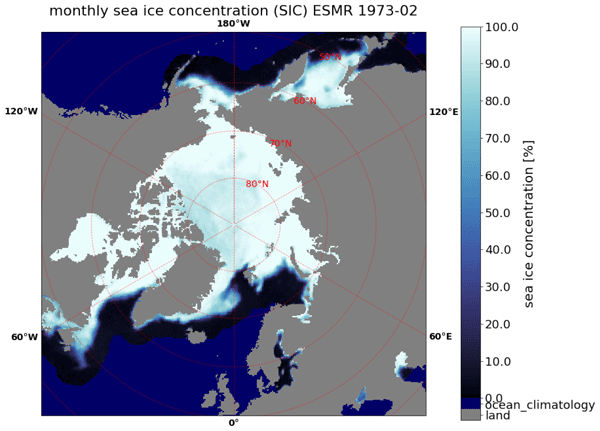
The Electrically Scanning Microwave Radiometer, the first spaceborne microwave instrument to map global sea ice, was launched aboard the NIMBUS 5 satellite in December 1972 and remained operational until May 1977. As part of the European Space Agency's Climate Change Initiative, this dataset has been reprocessed and validated to provide a nearly complete global record of sea ice concentration, with only a few data gaps in 1973 and 1975.
The Electrically Scanning Microwave Radiometer, the first spaceborne microwave instrument to map...
Altmetrics
Final-revised paper
Preprint