Articles | Volume 18, issue 1
https://doi.org/10.5194/essd-18-287-2026
© Author(s) 2026. This work is distributed under
the Creative Commons Attribution 4.0 License.
the Creative Commons Attribution 4.0 License.
https://doi.org/10.5194/essd-18-287-2026
© Author(s) 2026. This work is distributed under
the Creative Commons Attribution 4.0 License.
the Creative Commons Attribution 4.0 License.
Data description paper
| 
12 Jan 2026
Data description paper |
| 12 Jan 2026
| 12 Jan 2026
A novel global gridded ocean oxygen product derived from a neural network emulator and in-situ observations
Said Ouala
CORRESPONDING AUTHOR
IMT Atlantique, CNRS UMR Lab-STICC, INRIA Team Odyssey, Brest, France
Oussama Hidaoui
African Institute for Mathematical Sciences, Cape Town, South Africa
Zouhair Lachkar
Mubadala Arabian Center for Climate and Environmental Sciences, New York University Abu Dhabi, Abu Dhabi, United Arab Emirates
Related authors
Said Ouala, Oussama Hidaoui, and Zouhair Lachkar
EGUsphere, https://doi.org/10.5194/egusphere-2025-1771, https://doi.org/10.5194/egusphere-2025-1771, 2025
Preprint withdrawn
Short summary
Short summary
In this study, we develop a novel gridded ocean oxygen concentration product by combining observed oxygen data with emulated measurements derived from temperature and salinity profiles. This approach increases the density of observations, particularly in data-sparse regions, allowing for more accurate oxygen concentration estimates than current state-of-the-art products.
Zouhair Lachkar, Olivier Pauluis, Francesco Paparella, Basit Khan, and John A. Burt
Ocean Sci., 21, 3241–3263, https://doi.org/10.5194/os-21-3241-2025, https://doi.org/10.5194/os-21-3241-2025, 2025
Short summary
Short summary
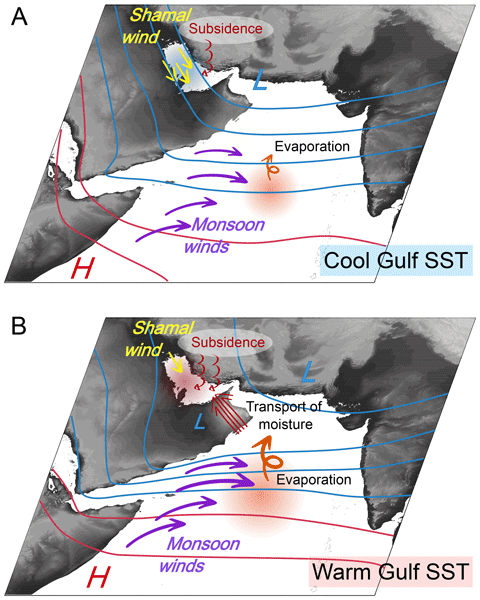
An analysis of model and reanalysis data reveals that extreme summer sea surface temperatures in the Arabian/Persian Gulf are driven by weakened local Shamal winds and intensified monsoon winds over the Arabian Sea. These conditions – typically associated with La Niña and a negative North Atlantic Oscillation phase – increase air moisture over the Gulf and enhance surface heat trapping. The findings offer promising prospects for forecasting summer marine heatwaves in the Gulf.
Said Ouala, Oussama Hidaoui, and Zouhair Lachkar
EGUsphere, https://doi.org/10.5194/egusphere-2025-1771, https://doi.org/10.5194/egusphere-2025-1771, 2025
Preprint withdrawn
Short summary
Short summary
In this study, we develop a novel gridded ocean oxygen concentration product by combining observed oxygen data with emulated measurements derived from temperature and salinity profiles. This approach increases the density of observations, particularly in data-sparse regions, allowing for more accurate oxygen concentration estimates than current state-of-the-art products.
Zouhair Lachkar, Michael Mehari, Muchamad Al Azhar, Marina Lévy, and Shafer Smith
Biogeosciences, 18, 5831–5849, https://doi.org/10.5194/bg-18-5831-2021, https://doi.org/10.5194/bg-18-5831-2021, 2021
Short summary
Short summary
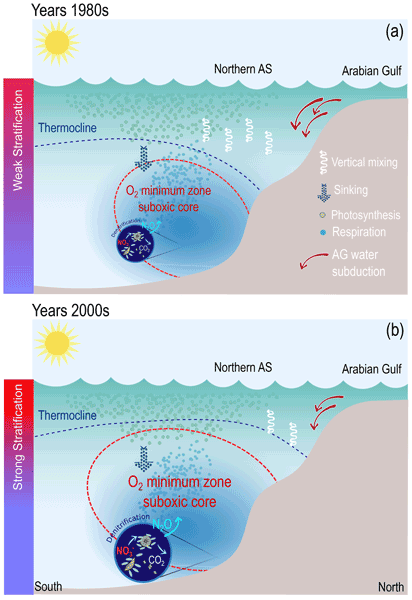
This study documents and quantifies a significant recent oxygen decline in the upper layers of the Arabian Sea and explores its drivers. Using a modeling approach we show that the fast local warming of sea surface is the main factor causing this oxygen drop. Concomitant summer monsoon intensification contributes to this trend, although to a lesser extent. These changes exacerbate oxygen depletion in the subsurface, threatening marine habitats and altering the local biogeochemistry.
Derara Hailegeorgis, Zouhair Lachkar, Christoph Rieper, and Nicolas Gruber
Biogeosciences, 18, 303–325, https://doi.org/10.5194/bg-18-303-2021, https://doi.org/10.5194/bg-18-303-2021, 2021
Short summary
Short summary
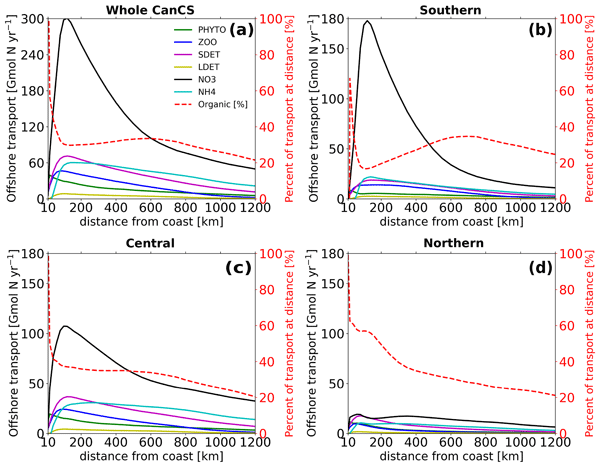
Using a Lagrangian modeling approach, this study provides a quantitative analysis of water and nitrogen offshore transport in the Canary Current System. We investigate the timescales, reach and structure of offshore transport and demonstrate that the Canary upwelling is a key source of nutrients to the open North Atlantic Ocean. Our findings stress the need for improving the representation of the Canary system and other eastern boundary upwelling systems in global coarse-resolution models.
Cited articles
Aouni, A. E., Gaudel, Q., Regnier, C., Van Gennip, S., Drevillon, M., Drillet, Y., and Lellouche, J.-M.: GLONET: Mercator's End-to-End Neural Forecasting System, Journal of Geophysical Research: Machine Learning and Computation, 2, e2025JH000686, https://doi.org/10.1029/2025JH000686, 2024. a
Bi, K., Xie, L., Zhang, H., Chen, X., Gu, X., and Tian, Q.: Accurate medium-range global weather forecasting with 3D neural networks, Nature, 619, 533–538, 2023. a
Bopp, L., Resplandy, L., Orr, J. C., Doney, S. C., Dunne, J. P., Gehlen, M., Halloran, P., Heinze, C., Ilyina, T., Séférian, R., Tjiputra, J., and Vichi, M.: Multiple stressors of ocean ecosystems in the 21st century: projections with CMIP5 models, Biogeosciences, 10, 6225–6245, https://doi.org/10.5194/bg-10-6225-2013, 2013. a
Chelton, D. B., Schlax, M. G., Samelson, R. M., and de Szoeke, R. A.: Global observations of large oceanic eddies, Geophysical Research Letters, 34, https://doi.org/10.1029/2007GL030812, 2007. a
Cheng, L., Trenberth, K. E., Fasullo, J., Boyer, T., Abraham, J., and Zhu, J.: Improved estimates of ocean heat content from 1960 to 2015, Science Advances, 3, e1601545, https://doi.org/10.1126/sciadv.1601545, 2017. a
Cheng, S., Quilodrán-Casas, C., Ouala, S., Farchi, A, Liu, C., Tandeo, P., Fablet, R., Lucor, D., Iooss, B., Brajard, J, Xiao, D., Janjic, T., Ding, W., Guo, Y., Carrassi, A., Bocquet, M., and Arcucci, R.: Machine learning with data assimilation and uncertainty quantification for dynamical systems: a review, IEEE/CAA Journal of Automatica Sinica, 10, 1361–1387, 2023. a
Claustre, H., Johnson, K. S., and Takeshita, Y.: Observing the global ocean with biogeochemical-Argo, Annual review of marine science, 12, 23–48, 2020. a
Codispoti, L., Brandes, J. A., Christensen, J., Devol, A., Naqvi, S., Paerl, H. W., and Yoshinari, T.: The oceanic fixed nitrogen and nitrous oxide budgets: Moving targets as we enter the anthropocene?, Scientia Marina, 65, 85–105, 2001. a
Dheeshjith, S., Subel, A., Adcroft, A., Busecke, J., Fernandez-Granda, C., Gupta, S., and Zanna, L.: Samudra: An AI Global Ocean Emulator for Climate, arXiv [preprint], https://doi.org/10.48550/arXiv.2412.03795, 2024. a, b
Duteil, O., Oschlies, A., and Böning, C. W.: Pacific Decadal Oscillation and recent oxygen decline in the eastern tropical Pacific Ocean, Biogeosciences, 15, 7111–7126, https://doi.org/10.5194/bg-15-7111-2018, 2018. a, b
Fourrier, M., Coppola, L., Claustre, H., D’Ortenzio, F., Sauzède, R., and Gattuso, J.-P.: A regional neural network approach to estimate water-column nutrient concentrations and carbonate system variables in the Mediterranean Sea: CANYON-MED, Frontiers in Marine Science, 7, 620, https://doi.org/10.3389/fmars.2020.00620, 2020. a
Gaillard, F., Reynaud, T., Thierry, V., Kolodziejczyk, N., and Von Schuckmann, K.: In situ–based reanalysis of the global ocean temperature and salinity with ISAS: Variability of the heat content and steric height, Journal of Climate, 29, 1305–1323, 2016. a
Good, S. A., Martin, M. J., and Rayner, N. A.: EN4: Quality controlled ocean temperature and salinity profiles and monthly objective analyses with uncertainty estimates, Journal of Geophysical Research: Oceans, 118, 6704–6716, 2013. a
Grégoire, M., Garçon, V., Garcia, H., Breitburg, D., Isensee, K., Oschlies, A., Telszewski, M., Barth, A., Bittig, H. C., Carstensen, J., et al.: A global ocean oxygen database and atlas for assessing and predicting deoxygenation and ocean health in the open and coastal ocean, Frontiers in Marine Science, 8, 724913, https://doi.org/10.3389/fmars.2021.724913, 2021. a
Gruber, N.: The marine nitrogen cycle: overview and challenges, Nitrogen in the marine environment, 2, 1–50, 2008. a
Gruber, N., Doney, S., Emerson, S., Gilbert, D., Kobayashi, T., Körtzinger, A., Johnson, G., Johnson, K., Riser, S., and Ulloa, O.: Adding oxygen to Argo: Developing a global in-situ observatory for ocean deoxygenation and biogeochemistry, in: Proceedings of OceanObs'09: Sustained Ocean Observations and Information for Society, Venice, Italy, 21–25 September 2009, ESA Publication WPP-306, https://doi.org/10.5270/OceanObs09.cwp.39, 2010. a
Hermes, J. C., Masumoto, Y., Beal, L. M., Roxy, M. K., Vialard, J., Andres, M., Annamalai, H., Behera, S., D'Adamo, N., Doi, T., Feng, M., Han, W., Hardman-Mountford, N., Hendon, H., Hood, R., Kido, S., Lee, C., Lee, T., Lengaigne, M., Li, J., Lumpkin, R., Navaneeth, K. N., Milligan, B., McPhaden, M. J., Ravichandran, M., Shinoda, T., Singh, A., Sloyan, B., Strutton, P. G., Subramanian, A. C., Thurston, S., Tozuka, T., Ummenhofer, C. C., Unnikrishnan, A. S., Venkatesan, R., Wang, D., Wiggert, J., Yu, L., and Yu, W.: A sustained ocean observing system in the Indian Ocean for climate related scientific knowledge and societal needs, Frontiers in Marine Science, 6, 355, https://doi.org/10.3389/fmars.2019.00355, 2019. a
Ito, T., Cervania, A., Cross, K., Ainchwar, S., and Delawalla, S.: Mapping dissolved oxygen concentrations by combining shipboard and Argo observations using machine learning algorithms, Journal of Geophysical Research: Machine Learning and Computation, 1, e2024JH000272, https://doi.org/10.1029/2024JH000272, 2024a. a, b, c, d, e, f, g, h, i, j, k, l, m, n, o, p, q
Ito, T., Garcia, H. E., Wang, Z., Minobe, S., Long, M. C., Cebrian, J., Reagan, J., Boyer, T., Paver, C., Bouchard, C., Takano, Y., Bushinsky, S., Cervania, A., and Deutsch, C. A.: Underestimation of multi-decadal global O2 loss due to an optimal interpolation method, Biogeosciences, 21, 747–759, https://doi.org/10.5194/bg-21-747-2024, 2024b. a, b, c
Keeling, R. F., Körtzinger, A., and Gruber, N.: Ocean deoxygenation in a warming world, Annu. Rev. Mar. Sci, 2, 199–229, 2010. a
Kingma, D. P. and Ba, J.: Adam: A Method for Stochastic Optimization, arXiv [preprint], https://doi.org/10.48550/arXiv.1412.6980, 2014. a
Kochkov, D., Yuval, J., Langmore, I., Norgaard, P., Smith, J., Mooers, G., Klöwer, M., Lottes, J., Rasp, S., Düben, P., Hatfield, S., Battaglia, P., Sanchez-Gonzalez, A., Willson, M., Brenner, M. P., and Hoyer, S.: Neural general circulation models for weather and climate, Nature, 1–7, 2024. a
Kwiatkowski, L., Torres, O., Bopp, L., Aumont, O., Chamberlain, M., Christian, J. R., Dunne, J. P., Gehlen, M., Ilyina, T., John, J. G., Lenton, A., Li, H., Lovenduski, N. S., Orr, J. C., Palmieri, J., Santana-Falcón, Y., Schwinger, J., Séférian, R., Stock, C. A., Tagliabue, A., Takano, Y., Tjiputra, J., Toyama, K., Tsujino, H., Watanabe, M., Yamamoto, A., Yool, A., and Ziehn, T.: Twenty-first century ocean warming, acidification, deoxygenation, and upper-ocean nutrient and primary production decline from CMIP6 model projections, Biogeosciences, 17, 3439–3470, https://doi.org/10.5194/bg-17-3439-2020, 2020. a
Lachkar, Z., Cornejo-D'Ottone, M., Singh, A., Arístegui, J., Dewitte, B., Fawcett, S., Garçon, V., Lovecchio, E., Molina, V., and Vinayachandran, P.: Biogeochemistry of greenhouse gases in coastal upwelling systems: Processes and sensitivity to global change, Elementa: Science of the Anthropocene, 12, https://doi.org/10.1525/elementa.2023.00088, 2024. a
Laffoley, D. D. and Baxter, J.: Ocean Deoxygenation: Everyone's Problem-Causes, Impacts, Consequences and Solutions, IUCN, https://doi.org/10.2305/IUCN.CH.2019.14.en, 2019. a
Lam, R., Sanchez-Gonzalez, A., Willson, M., Wirnsberger, P., Fortunato, M., Alet, F., Ravuri, S., Ewalds, T., Eaton-Rosen, Z., Hu, W., Merose, A., Hoyer, S., Holland, G., Vinyals, O., Stott, J., Pritzel, A., Mohamed, S., and Battaglia, P.: Learning skillful medium-range global weather forecasting, Science, 382, 1416–1421, 2023. a
Martin, S. A., Manucharyan, G. E., and Klein, P.: Synthesizing sea surface temperature and satellite altimetry observations using deep learning improves the accuracy and resolution of gridded sea surface height anomalies, Journal of Advances in Modeling Earth Systems, 15, e2022MS003589, https://doi.org/10.1029/2022MS003589, 2023. a
Martin, S. A., Manucharyan, G. E., and Klein, P.: Deep learning improves global satellite observations of ocean eddy dynamics, Geophysical Research Letters, 51, e2024GL110059, https://doi.org/10.1029/2024GL110059, 2024. a
Nguyen, T., Brandstetter, J., Kapoor, A., Gupta, J. K., and Grover, A.: ClimaX: A foundation model for weather and climate, arXiv [preprint], https://doi.org/10.48550/arXiv.2301.10343, 2023. a
Oschlies, A., Brandt, P., Stramma, L., and Schmidtko, S.: Drivers and mechanisms of ocean deoxygenation, Nature Geoscience, 11, 467–473, 2018. a
Ouala, S., Fablet, R., Herzet, C., Chapron, B., Pascual, A., Collard, F., and Gaultier, L.: Neural network based kalman filters for the spatio-temporal interpolation of satellite-derived sea surface temperature, Remote Sensing, 10, 1864, https://doi.org/10.3390/rs10121864, 2018. a
Ouala, S., Nguyen, D., Drumetz, L., Chapron, B., Pascual, A., Collard, F., Gaultier, L., and Fablet, R.: Learning latent dynamics for partially observed chaotic systems, Chaos: An Interdisciplinary Journal of Nonlinear Science, 30, 103121, https://doi.org/10.1063/5.0019309, 2020. a
Ouala, S., Brunton, S. L., Chapron, B., Pascual, A., Collard, F., Gaultier, L., and Fablet, R.: Bounded nonlinear forecasts of partially observed geophysical systems with physics-constrained deep learning, Physica D: Nonlinear Phenomena, 446, 133630, https://doi.org/10.1016/j.physd.2022.133630, 2023. a
Ouala, S., Chapron, B., Collard, F., Gaultier, L., and Fablet, R.: Online calibration of deep learning sub-models for hybrid numerical modeling systems, Communications Physics, 7, 402, https://doi.org/10.1038/s42005-024-01880-7, 2024. a
Ouala, S., Hidaoui, O., and Lachkar, Z.: A Novel Global Gridded Ocean Oxygen Product Derived from a Neural Network Emulator and In-situ Observations, Zenodo [data set], https://doi.org/10.5281/zenodo.15478088, 2025. a, b, c
Poupon, M. A., Resplandy, L., Lévy, M., and Bopp, L.: Pacific decadal oscillation influences tropical oxygen minimum zone extent and obscures anthropogenic changes, Geophysical Research Letters, 50, e2022GL102123, https://doi.org/10.1029/2022GL102123, 2023. a
Rabalais, N. N., Turner, R. E., and Wiseman Jr, W. J.: Gulf of Mexico hypoxia, aka “The dead zone”, Annual Review of ecology and Systematics, 33, 235–263, 2002. a
Roemmich, D. and Gilson, J.: The 2004–2008 mean and annual cycle of temperature, salinity, and steric height in the global ocean from the Argo Program, Progress in Oceanography, 82, 81–100, 2009. a
Roemmich, D., Johnson, G. C., Riser, S., Davis, R., Gilson, J., Owens, W. B., Garzoli, S. L., Schmid, C., and Ignaszewski, M.: The Argo Program: Observing the global ocean with profiling floats, Oceanography, 22, 34–43, 2009. a
Sauzède, R., Bittig, H. C., Claustre, H., Pasqueron de Fommervault, O., Gattuso, J.-P., Legendre, L., and Johnson, K. S.: Estimates of water-column nutrient concentrations and carbonate system parameters in the global ocean: A novel approach based on neural networks, Frontiers in Marine Science, 4, 128, https://doi.org/10.3389/fmars.2017.00128, 2017. a, b, c
Sharp, J. D., Fassbender, A. J., Carter, B. R., Johnson, G. C., Schultz, C., and Dunne, J. P.: GOBAI-O2: temporally and spatially resolved fields of ocean interior dissolved oxygen over nearly 2 decades, Earth Syst. Sci. Data, 15, 4481–4518, https://doi.org/10.5194/essd-15-4481-2023, 2023. a, b, c, d, e, f, g, h, i
Sundararajan, M., Taly, A., and Yan, Q.: Axiomatic attribution for deep networks, International conference on machine learning, 3319–3328, 2017. a
Valdenegro-Toro, M. and Mori, D. S.: A deeper look into aleatoric and epistemic uncertainty disentanglement, in: 2022 IEEE/CVF Conference on Computer Vision and Pattern Recognition Workshops (CVPRW), IEEE, 1508–1516, https://doi.org/10.1109/CVPRW56347.2022.00157, 2022. a, b
Vaquer-Sunyer, R. and Duarte, C. M.: Thresholds of hypoxia for marine biodiversity, Proceedings of the National Academy of Sciences, 105, 15452–15457, 2008. a
Wang, X., Wang, R., Hu, N., Wang, P., Huo, P., Wang, G., Wang, H., Wang, S., Zhu, J., Xu, J., Yin, J., Bao, S., Luo, C., Zu, Z., Han, Y., Zhang, W., Ren, K., Deng, K., and Song, J.: Xihe: A data-driven model for global ocean eddy-resolving forecasting, arXiv [preprint], https://doi.org/10.48550/arXiv.2402.02995, 2024. a
Short summary
Ocean deoxygenation poses major challenges to marine life and can alter carbon cycling. Direct measurements of dissolved oxygen are sparse, and interpolation methods are needed to study the variability and changes in oxygen content. In this work, we used machine learning to improve estimates of oxygen levels across the global ocean. Our approach produces a new gridded product that captures detailed changes in oxygen over time and space.
Ocean deoxygenation poses major challenges to marine life and can alter carbon cycling. Direct...


Altmetrics
Final-revised paper
Preprint