Articles | Volume 18, issue 3
https://doi.org/10.5194/essd-18-2075-2026
© Author(s) 2026. This work is distributed under
the Creative Commons Attribution 4.0 License.
the Creative Commons Attribution 4.0 License.
https://doi.org/10.5194/essd-18-2075-2026
© Author(s) 2026. This work is distributed under
the Creative Commons Attribution 4.0 License.
the Creative Commons Attribution 4.0 License.
Data description article
| 
23 Mar 2026
Data description article |
| 23 Mar 2026
| 23 Mar 2026
Airborne laser scanning transects over Canada's northern forests: lidar plots for science and application
Christopher W. Bater
CORRESPONDING AUTHOR
Canadian Forest Service (Pacific Forestry Centre), Natural Resources Canada, 506 West Burnside Road, Victoria, British Columbia, Canada
Joanne C. White
Canadian Forest Service (Pacific Forestry Centre), Natural Resources Canada, 506 West Burnside Road, Victoria, British Columbia, Canada
Hao Chen
Canadian Forest Service (Pacific Forestry Centre), Natural Resources Canada, 506 West Burnside Road, Victoria, British Columbia, Canada
Piotr Tompalski
Canadian Forest Service (Pacific Forestry Centre), Natural Resources Canada, 506 West Burnside Road, Victoria, British Columbia, Canada
Txomin Hermosilla
Canadian Forest Service (Pacific Forestry Centre), Natural Resources Canada, 506 West Burnside Road, Victoria, British Columbia, Canada
Michael A. Wulder
Canadian Forest Service (Pacific Forestry Centre), Natural Resources Canada, 506 West Burnside Road, Victoria, British Columbia, Canada
Related authors
No articles found.
Min Feng, Joseph O. Sexton, Panshi Wang, Paul M. Montesano, Leonardo Calle, Nuno Carvalhais, Benjamin Poulter, Matthew J. Macander, Michael A. Wulder, Margaret Wooten, William Wagner, Akiko Elders, Saurabh Channan, and Christopher S. R. Neigh
Biogeosciences, 23, 1089–1101, https://doi.org/10.5194/bg-23-1089-2026, https://doi.org/10.5194/bg-23-1089-2026, 2026
Short summary
Short summary
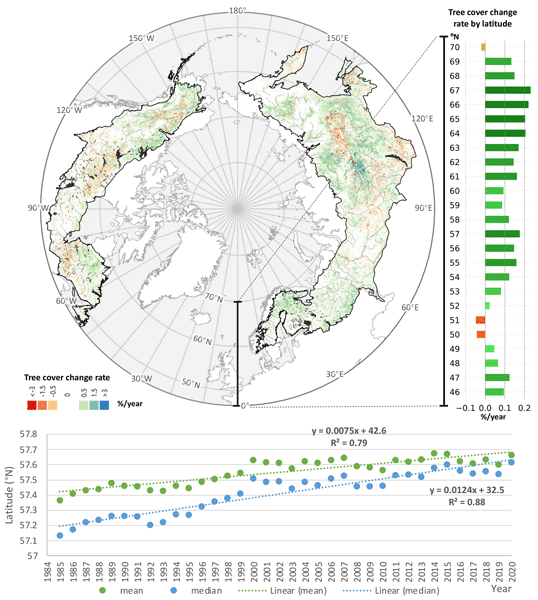
Analysis of 36 years of satellite tree cover data provide the first comprehensive confirmation of the northward advance of the boreal forest. Boreal tree cover expanded by 0.84 million km² (12%) from 1985 to 2020 and shifted northward by 0.43°. Gains outpaced losses across most latitudes, confirming a biome-wide poleward shift. Young forests now comprise 15% of the area of the world’s largest forest biome, storing 1–6 Pg C and potentially sequestering an additional 2–4 Pg C as they mature.
Salvatore R. Curasi, Joe R. Melton, Elyn R. Humphreys, Txomin Hermosilla, and Michael A. Wulder
Geosci. Model Dev., 17, 2683–2704, https://doi.org/10.5194/gmd-17-2683-2024, https://doi.org/10.5194/gmd-17-2683-2024, 2024
Short summary
Short summary
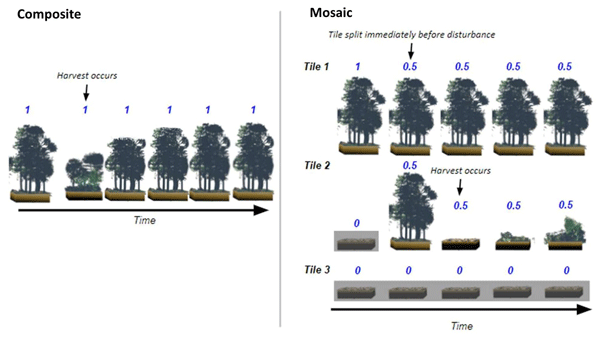
Canadian forests are responding to fire, harvest, and climate change. Models need to quantify these processes and their carbon and energy cycling impacts. We develop a scheme that, based on satellite records, represents fire, harvest, and the sparsely vegetated areas that these processes generate. We evaluate model performance and demonstrate the impacts of disturbance on carbon and energy cycling. This work has implications for land surface modeling and assessing Canada’s terrestrial C cycle.
Cited articles
Aldred, A. and Bonnor, G. M.: Application of airborne lasers to forest surveys, Canadian Forestry Service, Petawawa National Forestry Centre, Information Report PI-X-051, 62 pp., https://osdp-psdo.canada.ca/dp/en/search/metadata/NRCAN-CFS-1-4525 (last access: 6 March 2026), 1985.
Andersen, H. E., McGaughey, R. J., and Reutebuch, S. E.: Estimating forest canopy fuel parameters using LIDAR data, Remote Sens. Environ., 94, 441–449, https://doi.org/10.1016/j.rse.2004.10.013, 2005.
Andersen, H. E., Strunk, J., and Temesgen, H.: Using airborne light detection and ranging as a sampling tool for estimating forest biomass resources in the upper Tanana Valley of interior Alaska, West. J. Appl. For., 26, 157–164, https://doi.org/10.1093/wjaf/26.4.157, 2011.
Arumäe, T. and Lang, M.: Estimation of canopy cover in dense mixed-species forests using airborne lidar data, Eur. J. Remote Sens., 51, 132–141, https://doi.org/10.1080/22797254.2017.1411169, 2018.
Assmann, J. J., Moeslund, J. E., Treier, U. A., and Normand, S.: EcoDes-DK15: high-resolution ecological descriptors of vegetation and terrain derived from Denmark's national airborne laser scanning data set, Earth Syst. Sci. Data, 14, 823–844, https://doi.org/10.5194/essd-14-823-2022, 2022.
Babcock, C., Finley, A. O., Andersen, H. E., Pattison, R., Cook, B. D., Morton, D. C., Alonzo, M., Nelson, R., Gregoire, T., Ene, L., Gobakken, T., and Næsset, E.: Geostatistical estimation of forest biomass in interior Alaska combining Landsat-derived tree cover, sampled airborne lidar and field observations, Remote Sens. Environ., 212, 212–230, https://doi.org/10.1016/j.rse.2018.04.044, 2018.
Bater, C., White, J., Chen, H., Tompalski, P., Hermosilla, T., and Wulder, M.: Lidar plots and point cloud metrics derived from airborne laser scanning transects acquired over forests in northern Canada, Zenodo [data set], https://doi.org/10.5281/zenodo.16782860, 2025.
Bater, C. W., Wulder, M. A., Coops, N. C., Nelson, R. F., Hilker, T., and Nasset, E.: Stability of sample-based scanning-LiDAR-derived vegetation metrics for forest monitoring, IEEE T. Geosci. Remote, 49, 2385–2392, https://doi.org/10.1109/TGRS.2010.2099232, 2011.
Bolton, D. K., Coops, N. C., and Wulder, M. A.: Characterizing residual structure and forest recovery following high-severity fire in the western boreal of Canada using Landsat time-series and airborne lidar data, Remote Sens. Environ., 163, 48–60, https://doi.org/10.1016/j.rse.2015.03.004, 2015.
Boucher, J., Cotton-Gagnon, A., Dagnault, S., Zerb, J., Smiley, B. P., Russo, G., and Nolan, M.: Field guide: sampling fuels in the context of the Next-Generation Canadian Forest Fire Danger Rating System (NG-CFFDRS), Field Sampling Protocol and List of Attributes for Field Crews (2024), 30 pp., https://nfi.nfis.org/resources/others/Field_Guide_of_NG_Protocol_2024_v1.1_en.pdf (last access: 6 March 2026), 2024.
Bourdeau-Goulet, S. and Hassanzadeh, E.: Comparisons between CMIP5 and CMIP6 models: simulations of climate indices influencing food security, infrastructure resilience, and human health in Canada, Earths Future, 9, e2021EF001995, https://doi.org/10.1029/2021EF001995, 2021.
Bouvier, M., Durrieu, S., Fournier, R. A., and Renaud, J. P.: Generalizing predictive models of forest inventory attributes using an area-based approach with airborne LiDAR data, Remote Sens. Environ., 156, 322–334, https://doi.org/10.1016/j.rse.2014.10.004, 2015.
Brandt, J. P.: The extent of the North American boreal zone, Environ. Rev., 17, 101–161, https://doi.org/10.1139/A09-004, 2009.
Burton, P. J.: Understanding spring wildfires in Canada's northern forests, Glob. Change Biol., 29, 5983–5985, https://doi.org/10.1111/gcb.16879, 2023.
Canada's National Forest Information System: NTEMS Products, https://opendata.nfis.org/mapserver/nfis-change_eng.html, last access: 6 March 2026.
Canadian Forest Service Fire Danger Group: An overview of the next generation of the Canadian Forest Fire Danger Rating System (Information Report GLC-X-26), 70 pp., https://osdp-psdo.canada.ca/dp/en/search/metadata/NRCAN-CFS-1-40474 (last access: 6 March 2026), 2021.
Coops, N. C., Tompalski, P., Goodbody, T. R. H., Queinnec, M., Luther, J. E., Bolton, D. K., White, J. C., Wulder, M. A., van Lier, O. R., and Hermosilla, T.: Modelling lidar-derived estimates of forest attributes over space and time: A review of approaches and future trends, Remote Sens. Environ., 260, 112477, https://doi.org/10.1016/j.rse.2021.112477, 2021.
Crowley, M. A., Stockdale, C. A., Johnston, J. M., Wulder, M. A., Liu, T., McCarty, J. L., Rieb, J. T., Cardille, J. A., and White, J. C.: Towards a whole-system framework for wildfire monitoring using Earth observations, Glob. Change Biol., 29, 1423–1436, https://doi.org/10.1111/gcb.16567, 2023.
CSA Group: Airborne lidar data acquisition, 83 pp., https://www.csagroup.org/store/product/2431645/ (last access: 6 March 2026), 2025.
Fassnacht, F. E., White, J. C., Wulder, M. A., and Næsset, E.: Remote sensing in forestry: current challenges, considerations and directions, Forestry, 97, 11–37, https://doi.org/10.1093/forestry/cpad024, 2024.
Frazer, G. W., Magnussen, S., Wulder, M. A., and Niemann, K. O.: Simulated impact of sample plot size and co-registration error on the accuracy and uncertainty of LiDAR-derived estimates of forest stand biomass, Remote Sens. Environ., 115, 636–649, https://doi.org/10.1016/j.rse.2010.10.008, 2011.
Gillis, M. D., Omule, A. Y., and Brierley, T.: Monitoring Canada's forests: The National Forest Inventory, Forest. Chron., 81, 214–221, https://doi.org/10.5558/tfc81214-2, 2005.
Guindon, L., Manka, F., Correia, D. L. P., Villemaire, P., Smiley, B., Bernier, P., Gauthier, S., Beaudoin, A., Boucher, J., and Boulanger, Y.: A new approach for Spatializing the CAnadian National Forest Inventory (SCANFI) using Landsat dense time series, Can. J. Forest Res., 2010, https://doi.org/10.1139/cjfr-2023-0118, 2024.
Hansen, M. C., Egorov, A., Potapov, P. V., Stehman, S. V., Tyukavina, A., Turubanova, S. A., Roy, D. P., Goetz, S. J., Loveland, T. R., Ju, J., Kommareddy, A., Kovalskyy, V., Forsyth, C., and Bents, T.: Monitoring conterminous United States (CONUS) land cover change with Web-Enabled Landsat Data (WELD), Remote Sens. Environ., 140, 466–484, https://doi.org/10.1016/j.rse.2013.08.014, 2014.
Haslem, A., Kelly, L. T., Nimmo, D. G., Watson, S. J., Kenny, S. A., Taylor, R. S., Avitabile, S. C., Callister, K. E., Spence-Bailey, L. M., Clarke, M. F., and Bennett, A. F.: Habitat or fuel? Implications of long-term, post-fire dynamics for the development of key resources for fauna and fire, J. Appl. Ecol., 48, 247–256, https://doi.org/10.1111/j.1365-2664.2010.01906.x, 2011.
Hermosilla, T., Wulder, M. A., White, J. C., Coops, N. C., Hobart, G. W., and Campbell, L. B.: Mass data processing of time series Landsat imagery: pixels to data products for forest monitoring, Int. J. Digit. Earth, 9, 1035–1054, https://doi.org/10.1080/17538947.2016.1187673, 2016.
Hermosilla, T., Wulder, M. A., White, J. C., and Coops, N. C.: Land cover classification in an era of big and open data: Optimizing localized implementation and training data selection to improve mapping outcomes, Remote Sens. Environ., 268, 112780, https://doi.org/10.1016/j.rse.2021.112780, 2022.
Hermosilla, T., Wulder, M. A., White, J. C., Coops, N. C., Bater, C. W., and Hobart, G. W.: Characterizing long-term tree species dynamics in Canada's forested ecosystems using annual time series remote sensing data, Forest Ecol. Manag., 572, 122313, https://doi.org/10.1016/j.foreco.2024.122313, 2024.
Hopkinson, C., Wulder, M. A., Coops, N. C., Milne, T., Fox, A., and Bater, C. W.: Airborne lidar sampling of the Canadian boreal forest: planning, execution, and initial processing, in: Proceedings of the SilviLaser 2011 Conference, https://www.researchgate.net/profile/Michael-Wulder/publication/236455362_Airborne_lidar_sampling_of_the_ Canadian_boreal_forest_planning_execution_and_initial_ processing/links/63d99d73c97bd76a82 4ec55a/Airborne-lidar-sampling-of-the-Canadian-boreal-forest-planning-execution-and-initial-processing.pdf (last access: 6 March 2026), 2011.
Hopkinson, C., Lovell, J., Chasmer, L., Jupp, D., Kljun, N., and van Gorsel, E.: Integrating terrestrial and airborne lidar to calibrate a 3D canopy model of effective leaf area index, Remote Sens. Environ., 136, 301–314, https://doi.org/10.1016/j.rse.2013.05.012, 2013.
Jain, P., Barber, Q. E., Taylor, S. W., Whitman, E., Castellanos Acuna, D., Boulanger, Y., Chavardès, R. D., Chen, J., Englefield, P., Flannigan, M., Girardin, M. P., Hanes, C. C., Little, J., Morrison, K., Skakun, R. S., Thompson, D. K., Wang, X., and Parisien, M.: Drivers and impacts of the record-breaking 2023 wildfire season in Canada, Nat. Commun., 15, 6764, https://doi.org/10.1038/s41467-024-51154-7, 2024.
Kane, V. R., Bakker, J. D., McGaughey, R. J., Lutz, J. A., Gersonde, R. F., and Franklin, J. F.: Examining conifer canopy structural complexity across forest ages and elevations with LiDAR data, Can. J. Forest Res., 40, 774–787, https://doi.org/10.1139/X10-064, 2010.
Keane, R. E., Reinhardt, E. D., Scott, J., Gray, K., and Reardon, J.: Estimating forest canopy bulk density using six indirect methods, Can. J. Forest Res., 35, 724–739, https://doi.org/10.1139/x04-213, 2005.
Keith, H., Mackey, B. G., and Lindenmayer, D. B.: Re-evaluation of forest biomass carbon stocks and lessons from the world's most carbon-dense forests, P. Natl. Acad. Sci. USA, 106, 11635–11640, https://doi.org/10.1073/pnas.0901970106, 2009.
Lefsky, M. A., Cohen, W. B., Parker, G. G., and Harding, D. J.: Lidar remote sensing for ecosystem studies, BioScience, 52, 19–30, https://doi.org/10.1641/0006-3568(2002)052[0019:LRSFES]2.0.CO;2, 2002.
Lefsky, M. A., Hudak, A. T., Cohen, W. B., and Acker, S. A.: Patterns of covariance between forest stand and canopy structure in the Pacific Northwest, Remote Sens. Environ., 95, 517–531, https://doi.org/10.1016/j.rse.2005.01.004, 2005.
Li, Y., Andersen, H., and McGaughey, R.: A comparison of statistical methods for estimating forest biomass from light detection and ranging data, West. J. Appl. For., 23, 223–231, https://doi.org/10.1093/wjaf/23.4.223, 2008.
Magnussen, S. and Boudewyn, P.: Derivations of stand heights from airborne laser scanner data with canopy-based quantile estimators, Can. J. Forest Res., 28, 1016–1031, 1998.
Margolis, H. A., Nelson, R. F., Montesano, P. M., Beaudoin, A., Sun, G., Andersen, H. E., and Wulder, M. A.: Combining satellite lidar, airborne lidar, and ground plots to estimate the amount and distribution of aboveground biomass in the boreal forest of North America, Can. J. Forest Res., 45, 838–855, https://doi.org/10.1139/cjfr-2015-0006, 2015.
Martin-Ducup, O., Dupuy, J. L., Soma, M., Guerra-Hernandez, J., Marino, E., Fernandes, P. M., Just, A., Corbera, J., Toutchkov, M., Sorribas, C., Bock, J., Piboule, A., Pirotti, F., and Pimont, F.: Unlocking the potential of Airborne LiDAR for direct assessment of fuel bulk density and load distributions for wildfire hazard mapping, Agr. Forest Meteorol., 362, https://doi.org/10.1016/j.agrformet.2024.110341, 2025.
Matasci, G., Hermosilla, T., Wulder, M. A., White, J. C., Coops, N. C., Hobart, G. W., and Zald, H. S. J.: Large-area mapping of Canadian boreal forest cover, height, biomass and other structural attributes using Landsat composites and lidar plots, Remote Sens. Environ., 209, 90–106, https://doi.org/10.1016/j.rse.2017.12.020, 2018a.
Matasci, G., Hermosilla, T., Wulder, M. A., White, J. C., Coops, N. C., Hobart, G. W., Bolton, D. K., Tompalski, P., and Bater, C. W.: Three decades of forest structural dynamics over Canada's forested ecosystems using Landsat time-series and lidar plots, Remote Sens. Environ., 216, 697–714, https://doi.org/10.1016/j.rse.2018.07.024, 2018b.
McGaughey, R. J.: FUSION/LDV: Software for LIDAR Data Analysis and Visualization, http://forsys.sefs.uw.edu/fusion/fusionlatest.html (last access: 6 March 2026), 2024.
Moran, C. J., Kane, V. R., and Seielstad, C. A.: Mapping forest canopy fuels in the western United States with LiDAR-Landsat covariance, Remote Sens., 12, https://doi.org/10.3390/rs12061000, 2020.
Mutlu, M., Popescu, S. C., Stripling, C., and Spencer, T.: Mapping surface fuel models using lidar and multispectral data fusion for fire behavior, Remote Sens. Environ., 112, 274–285, https://doi.org/10.1016/j.rse.2007.05.005, 2008.
Næsset, E.: Predicting forest stand characteristics with airborne scanning laser using a practical two-stage procedure and field data, Remote Sens. Environ., 80, 88–99, https://doi.org/10.1016/S0034-4257(01)00290-5, 2002.
Næsset, E.: Practical large-scale forest stand inventory using a small-footprint airborne scanning laser, Scand. J. Forest Res., 19, 164–179, https://doi.org/10.1080/02827580310019257, 2004.
Næsset, E.: Estimating above-ground biomass in young forests with airborne laser scanning, Int. J. Remote Sens., 32, 473–501, https://doi.org/10.1080/01431160903474970, 2011.
Natural Resources Canada: The State of Canada's Forests: Annual Report 2023, Natural Resources Canada, Canadian Forest Service, Ottawa, Ontario, 116 pp., https://natural-resources.canada.ca/sites/nrcan/files/forest/sof2023/NRCAN_SofForest_Annual_2023_EN_accessible-vf.pdf (last access: 6 March 2026), 2023.
Nelson, R.: How did we get here? An early history of forestry lidar, Can. J. Remote Sens., 39, S6–S17, https://doi.org/10.5589/m13-011, 2013.
Nelson, R., Gobakken, T., Næsset, E., Gregoire, T. G., Ståhl, G., Holm, S., and Flewelling, J.: Lidar sampling - Using an airborne profiler to estimate forest biomass in Hedmark County, Norway, Remote Sens. Environ., 123, 563–578, https://doi.org/10.1016/j.rse.2011.10.036, 2012.
Nilsson, M.: Estimation of tree heights and stand volume using an airborne lidar system, Remote Sens. Environ., 56, 1–7, https://doi.org/10.1016/0034-4257(95)00224-3, 1996.
Ogle, S. M., Domke, G., Kurz, W. A., Rocha, M. T., Huffman, T., Swan, A., Smith, J. E., Woodall, C., and Krug, T.: Delineating managed land for reporting national greenhouse gas emissions and removals to the United Nations framework convention on climate change, Carbon Balance Manag., 13, https://doi.org/10.1186/s13021-018-0095-3, 2018.
Parisien, M. A., Barber, Q. E., Hirsch, K. G., Stockdale, C. A., Erni, S., Wang, X., Arseneault, D., and Parks, S. A.: Fire deficit increases wildfire risk for many communities in the Canadian boreal forest, Nat. Commun., 11, https://doi.org/10.1038/s41467-020-15961-y, 2020.
Parisien, M. A., Barber, Q. E., Flannigan, M. D., and Jain, P.: Broadleaf tree phenology and springtime wildfire occurrence in boreal Canada, Glob. Change Biol., 29, 6106–6119, https://doi.org/10.1111/gcb.16820, 2023.
Reutebuch, S. E., Anderson, H. E., and McGaughey, R. J.: Light detection and ranging (LIDAR): an emerging tool for multiple resource inventory, J. Forest., 103, 286–292, 2005.
Riaño, D., Meier, E., Allgöwer, B., Chuvieco, E., and Ustin, S. L.: Modeling airborne laser scanning data for the spatial generation of critical forest parameters in fire behavior modeling, Remote Sens. Environ., 86, 177–186, https://doi.org/10.1016/S0034-4257(03)00098-1, 2003.
Riaño, D., Chuvieco, E., Condés, S., González-Matesanz, J., and Ustin, S. L.: Generation of crown bulk density for Pinus sylvestris L. from lidar, Remote Sens. Environ., 92, 345–352, https://doi.org/10.1016/j.rse.2003.12.014, 2004.
Roussel, J. R. and Auty, D.: lidR: Airborne LiDAR Data Manipulation and Visualization for Forestry Applications, https://cran.r-project.org/package=lidR (last access: 6 March 2026), 2023.
Roussel, J. R., Auty, D., Coops, N. C., Tompalski, P., Goodbody, T. R. H., Meador, A. S., Bourdon, J. F., de Boissieu, F., and Achim, A.: lidR: An R package for analysis of Airborne Laser Scanning (ALS) data, Remote Sens. Environ., 251, 112061, https://doi.org/10.1016/j.rse.2020.112061, 2020.
Shannon, C. E.: A mathematical theory of communication, Bell Syst. Tech. J., 27, 379–423, https://doi.org/10.1002/j.1538-7305.1948.tb01338.x, 1948.
Shi, Y., Wang, J., and Kissling, W. D.: Multi-temporal high-resolution data products of ecosystem structure derived from country-wide airborne laser scanning surveys of the Netherlands, Earth Syst. Sci. Data, 17, 3641–3677, https://doi.org/10.5194/essd-17-3641-2025, 2025.
Singh, K. K., Chen, G., Vogler, J. B., and Meentemeyer, R. K.: When big data are too much: effects of LiDAR returns and point density on estimation of forest biomass, IEEE J. Sel. Top. Appl., 9, 3210–3218, https://doi.org/10.1109/JSTARS.2016.2522960, 2016.
Solberg, S., Næsset, E., Hanssen, K. H., and Christiansen, E.: Mapping defoliation during a severe insect attack on Scots pine using airborne laser scanning, Remote Sens. Environ., 102, 364–376, https://doi.org/10.1016/j.rse.2006.03.001, 2006.
Stefanidou, A., Gitas, I. Z., Korhonen, L., Stavrakoudis, D., and Georgopoulos, N.: LiDAR-based estimates of canopy base height for a dense uneven-aged structured forest, Remote Sens., 12, 1–20, https://doi.org/10.3390/rs12101565, 2020.
Stinson, G., Thandi, G., Aitkin, D., Bailey, C., Boyd, J., Colley, M., Fraser, C., Gelhorn, L., Groenewegen, K., Hogg, A., Kapron, J., Leboeuf, A., Makar, M., Montigny, M., Pittman, B., Price, K., Salkeld, T., Smith, L., Viveiros, A., and Wilson, D.: A new approach for mapping forest management areas in Canada, Forest. Chron., 95, 101–112, https://doi.org/10.5558/tfc2019-017, 2019.
Tews, J., Brose, U., Grimm, V., Tielbörger, K., Wichmann, M. C., Schwager, M., and Jeltsch, F.: Animal species diversity driven by habitat heterogeneity/diversity: The importance of keystone structures, J. Biogeogr., 31, 79–92, https://doi.org/10.1046/j.0305-0270.2003.00994.x, 2004.
Tompalski, P.: lidRmetrics, https://github.com/ptompalski/lidRmetrics (last access: 9 Mach 2026), 2024.
Tompalski, P., Hermosilla, T., Baral, S. K., Wulder, M. A., and White, J. C.: National remote sensing-derived aboveground biomass yield curves for Canada, Forestry, cpaf067, https://doi.org/10.1093/forestry/cpaf067, 2025.
van Ewijk, K. Y., Treitz, P. M., and Scott, N. A.: Characterizing forest succession in central Ontario using lidar-derived indices, Photogramm. Eng. Rem. S., 77, 261–269, https://doi.org/10.1117/12.2223586, 2011.
Vogelmann, J. E., Howard, S. M., Yang, L., Larson, C. R., Wylie, B. K., and VanDriel, N.: Completion of the 1990s National Land Cover Data set for the conterminous United States from Landsat Thematic Mapper data and ancillary data sources, Photogramm. Eng. Rem. S., 67, 650–662, 2001.
Wells, J. V., Dawson, N., Culver, N., Reid, F. A., and Morgan Siegers, S.: The state of conservation in North America's Boreal Forest: issues and opportunities, Front. For. Glob. Chang., 3, 1–18, https://doi.org/10.3389/ffgc.2020.00090, 2020.
White, J. C., Wulder, M. A., Varhola, A., Vastaranta, M., Coops, N. C., Cook, B. D., Pitt, D., and Woods, M.: A best practices guide for generating forest inventory attributes from airborne laser scanning data using an area-based approach, Natural Resources Canada, Canadian Forest Service, Canadian Wood Fibre Centre, Information Report FI-X-010, 50 pp., https://ostrnrcan-dostrncan.canada.ca/handle/1845/245224 (last access: 9 March 2026), 2013.
White, J. C., Wulder, M. A., Hobart, G. W., Luther, J. E., Hermosilla, T., Griffiths, P., Coops, N. C., Hall, R. J., Hostert, P., Dyk, A., and Guindon, L.: Pixel-based image compositing for large-area dense time series applications and science, Can. J. Remote Sens., 40, 192–212, https://doi.org/10.1080/07038992.2014.945827, 2014.
White, J. C., Tompalski, P., Vastaranta, M., Wulder, M. A., Saarinen, Stepper, C., and Coops, N. C.: A model development and application guide for generating an enhanced forest inventory using airborne laser scanning data and an area-based approach, CWFC Information Report FI-X-018, https://ostrnrcan-dostrncan.canada.ca/handle/1845/229341 (last access: 9 March 2026), 2017a.
White, J. C., Wulder, M. A., Hermosilla, T., Coops, N. C., and Hobart, G. W.: A nationwide annual characterization of 25 years of forest disturbance and recovery for Canada using Landsat time series, Remote Sens. Environ., 194, 303–321, https://doi.org/10.1016/j.rse.2017.03.035, 2017b.
White, J. C., Tompalski, P., Bater, C. W., Wulder, M. A., Fortin, M., Hennigar, C., Robere-McGugan, G., Sinclair, I., and White, R.: Enhanced forest inventories in Canada: implementation, status, and research needs, Can. J. Forest Res., 55, 1–37, https://doi.org/10.1139/cjfr-2024-0255, 2025.
Woods, M., Lim, K., and Treitz, P.: Predicting forest stand variables from LiDAR data in the Great Lakes – St. Lawrence forest of Ontario, Forest. Chron., 84, 827–839, 2008.
Wulder, M. A., Bater, C. W., Coops, N. C., Hilker, T., and White, J. C.: The role of LiDAR in sustainable forest management, Fores. Chron., 84, 807–826, https://doi.org/10.5558/tfc84807-6, 2008.
Wulder, M. A., White, J. C., Bater, C. W., Coops, N. C., Hopkinson, C., and Chen, G.: Lidar plots — a new large-area data collection option: context, concepts, and case study, Can. J. Remote Sens., 38, 600–618, https://doi.org/10.5589/m12-049, 2012a.
Wulder, M. A., White, J. C., Nelson, R. F., Næsset, E., Ørka, H. O., Coops, N. C., Hilker, T., Bater, C. W., and Gobakken, T.: Lidar sampling for large-area forest characterization: A review, Remote Sens. Environ., 121, 196–209, https://doi.org/10.1016/j.rse.2012.02.001, 2012b.
Wulder, M. A., Hermosilla, T., White, J. C., Bater, C. W., Hobart, G., and Bronson, S. C.: Development and implementation of a stand-level satellite-based forest inventory for Canada, Forestry, 97, 546–563, https://doi.org/10.1093/forestry/cpad065, 2024.
Zald, H. S. J., Wulder, M. A., White, J. C., Hilker, T., Hermosilla, T., Hobart, G. W., and Coops, N. C.: Integrating Landsat pixel composites and change metrics with lidar plots to predictively map forest structure and aboveground biomass in Saskatchewan, Canada, Remote Sens. Environ., 176, 188–201, https://doi.org/10.1016/j.rse.2016.01.015, 2016.
Short summary
We describe a new sampled airborne laser scanning (ALS) dataset collected across northern Canada. The ALS transects bridge the gap between ground measurements and satellite mapping, providing a new resource to understand, monitor, and manage northern forests. The lidar plots and point cloud metrics described form part of an open-data initiative to enhance structural information. This dataset supports key applications in forest inventory, wildfire risk assessment, and ecosystem monitoring.
We describe a new sampled airborne laser scanning (ALS) dataset collected across northern...


Altmetrics
Final-revised paper
Preprint