the Creative Commons Attribution 4.0 License.
the Creative Commons Attribution 4.0 License.
 | 12 Mar 2026
The PAGES CoralHydro2k Seawater δ18O Database: a FAIR-aligned compilation of seawater δ18O data to uncover “hidden” insights from the global ocean
Andrea L. Moore
Kristine L. DeLong
Sylvia E. Long
Sara C. Sanchez
Jessica A. Hargreaves
Chandler A. Morris
Raquel E. Pauly
Émilie P. Dassié
Thomas Felis
Antje H. L. Voelker
Sujata A. Murty
Kim M. Cobb
The stable isotope values of seawater (δ18O and δ2H) provide valuable information on the exchange of water between the ocean, atmosphere, and cryosphere and on ocean mixing processes. As such, observational seawater δ18O and δ2H data place powerful constraints on hydrologic changes in the modern ocean. Seawater δ18O data are also essential for calibrating paleoclimate proxies based on the δ18O of marine carbonates and are an increasingly critical diagnostic tool for assessing model performance and skill in isotope-enabled climate models. Despite their broad value, no centralized and actively-curated database for this type of data exists, even though a growing number of new seawater δ18O datasets have been generated over the last decade. As such, many seawater δ18O datasets remain “hidden”. To improve the accessibility of seawater δ18O data for the Earth Science research community, the Past Global Changes (PAGES) CoralHydro2k project has created a new, machine-readable, and metadata-rich database of observational seawater δ18O data, paired with seawater δ2H and salinity data, that is compliant with findability, accessibility, interoperability, and reusability (FAIR) standards for digital assets. The data has been collected from public databases and repositories, direct researcher data submissions, scientific papers, and student theses. In total, the PAGES CoralHydro2k Seawater δ18O Database contains over 18 600 data points with extensive metadata that makes the database suitable for a myriad of research applications. For hidden data, we searched for and included all datasets within the global ocean. For public data, our data collation efforts were focused on the upper 50 m from 35° N to 35° S (to aid in CoralHydro2k's seawater δ18O reconstruction studies using δ18O and in tropical-subtropical coral skeletons). We also provide a set of best practices to the community for reporting seawater isotope data in the future. The database is available on the NOAA NCEI World Data Service for Paleoclimatology landing page: https://www.ncei.noaa.gov/access/paleo-search/study/34575 (last access: 11 February 2026; https://doi.org/10.25921/ap7d-2k16, Atwood et al., 2026). A Seawater Oxygen Isotopes Community was also developed within the EarthChem Library (https://www.earthchem.org/communities/seawater-oxygen-isotopes/, last access: 20 February 2026) to help researchers submit new datasets and obtain a dataset DOI. This template is aligned with the CoralHydro2k Seawater δ18O Database to facilitate future updates to the database.
- Article
(4473 KB) - Full-text XML
-
Supplement
(372 KB) - BibTeX
- EndNote


1.1 Progress and challenges in the synthesis of seawater oxygen isotope data
The stable isotope composition of water (δ18O and δ2H) provides a powerful tracer of the global water cycle, tracking water as it continuously cycles between the ocean, atmosphere, and land. The isotopic composition of seawater is nearly conservative when no phase change occurs. As water molecules undergo phase changes however, the lighter, more abundant isotope (16O and 1H) is preferentially vaporized during evaporation with respect to the heavier, less abundant isotope (18O and 2H), while the heavy isotope is preferentially condensed during precipitation (Dansgaard, 1964). This partitioning of isotopes based on mass allows the isotope values (where of water to be used as a tracer of the hydrologic cycle (Dansgaard, 1954; Galewsky et al., 2016; Gat, 1996). In the ocean, the isotope values of seawater (δ18Osw and δ2Hsw) can provide valuable information on an array of processes, including heat and mass exchange with the atmosphere (via precipitation and evaporation), large-scale ocean circulation, and freshwater input from rivers and ice sheets (Akhoudas et al., 2021; Benetti et al., 2016; Benway and Mix, 2004; Biddle et al., 2019; Craig and Gordon, 1965; Dee et al., 2023; Frew et al., 2000; Imbrie et al., 1984; Jacobs et al., 1985; Lisiecki and Raymo, 2005; Meredith et al., 1999; Strain and Tan, 1993). δ18Osw and δ2Hsw values can also provide insight into other ocean tracers such as salinity, since they covary strongly due to the influence of evaporation and precipitation on each of these variables (Craig and Gordon, 1965; LeGrande and Schmidt, 2011). However, because key processes act differentially on salinity as compared to the stable isotope values, δ18Osw and δ2Hsw provide additional constraints on ocean mixing and the local moisture budget.
Seawater isotope values also create a common unit that uniquely links paleoclimate reconstructions to modern climate observations and isotope-enabled model simulations. Modern δ18Osw data are essential for the calibration of paleoclimate proxies of past ocean variability based on the δ18O of marine carbonates such as corals, foraminifera, molluscs, ostracods, and coralline algae. Recent paleoclimate data assimilation efforts such as the Last Millennium Reanalysis project (e.g., Tardif et al., 2019) would greatly benefit from a spatial network of δ18Osw data to improve quantification of proxy uncertainty and for training the proxy system models that underlie those efforts. Modern δ2Hsw data are used in the calibration of paleoceanographic proxies based on the δ2H of alkenones and other lipid biomarkers in marine sediments (e.g., Eglinton and Eglinton, 2008). When used in tandem with δ18O data (i.e., to calculate d-excess in surface ocean and overlying water vapor), δ2H data can be used to constrain evaporation parameters (e.g., Benetti et al., 2014). As such, observational and reconstruction efforts based on seawater isotope values enable scientists to better understand the underlying physics that govern the water cycle, and to extend hydroclimate records back to the preindustrial era, thus contextualizing anthropogenic climate change and improving the skill of future climate projections. In modern environments, δ18O in marine biominerals and δ2H in lipids can be used to trace plankton and animal movement and provide provenance for ecology, conservation, archaeology, and food forensics studies (Doubleday et al., 2022). Given these wide-ranging applications, seawater isotope data are used in a wide range of fields, including paleo and modern oceanography, atmospheric science, geology, marine biology, archaeology, and geography.
Observational δ18Osw data can also be used to provide boundary conditions in climate models and to assess model performance and skill. The increasing integration of oxygen isotopes of water in climate models – from models of intermediate complexity to fully coupled Earth System Models (e.g., Blossey et al., 2010; Bong et al., 2024; Bony et al., 2008; Brady et al., 2019; Cauquoin et al., 2019; Dee et al., 2015; Field et al., 2014; Fiorella et al., 2021; Kurita et al., 2011; Lee and Fung, 2008; Noone and Simmonds, 2002; Nusbaumer et al., 2017; Risi et al., 2010, 2020, 2021; Schmidt et al., 2007; Tada et al., 2021; Wei et al., 2018; Werner et al., 2011; Yoshimura et al., 2008) – bolsters the interpretation of modern and paleoclimate observations, while also providing opportunities to test model performance in resolving key features of the hydrologic cycle, e.g., the representation of moisture transport, circulation, and surface water fluxes.
Paralleling recent advances in the numerical simulation of water isotopes, new analytical capabilities have also developed in recent years, including new in situ atmospheric measurement techniques and strategies (Finkenbiner et al., 2022; Gupta et al., 2009; Henze et al., 2022), and the development of global atmospheric data products from a variety of remote sensors (e.g., Diekmann et al., 2021; Schneider et al., 2022; Worden et al., 2019). As a result, measurements of water isotopes have become increasingly incorporated in coordinated observing networks and monitoring studies of precipitation and atmospheric water vapor, including the Global Network of Isotopes in Precipitation (http://www.iaea.org/services/networks/gnip. last access: 20 February 2026) and the National Ecological Observatory Network (http://www.neonscience.org/, last access: 20 February 2026).
However, no such coordinated observing network for seawater δ18O currently exists. Unlike meteorological observations on land, observations of ocean hydrological properties (e.g., precipitation, evaporation, and salinity) are largely either limited to the past few decades (via satellite remote sensing, the ARGO (Wong et al., 2020) and GOOS (Dexter and Summerhayes, 2010) programs, the TAO/TRITON array, and other mooring, drifter, and ship-of-opportunity measurements), or are confined to selected coastal and island locations that have the necessary infrastructure to support sustained in situ measurements of ocean surface properties. Furthermore, these ocean observations rarely include δ18Osw because there is currently no cost-effective, easily deployable instrumentation to measure seawater isotopes in situ. Thus, seawater samples must be taken back to a laboratory for isotopic analysis. Despite these structural challenges, a growing number of δ18Osw datasets have been generated in recent decades due to the accelerated collection of δ18Osw samples, new instrumentation based on cavity-ring down spectroscopy (CRDS) with reduced analytical costs, the capability to measure both δ18O and δ2H in parallel, and new sampling devices that enable long-term seawater sample collections (e.g., Jannasch et al., 2004; Khare et al., 2021).
In recognition of the broad value of δ18Osw data to the Earth Sciences, a major effort to gather δ18Osw data occurred in the 1990s (Bigg and Rohling, 2000; Schmidt, 1999; Schmidt et al., 1999) and resulted in the development of the NASA's Goddard Institute for Space Studies (GISS) Global Seawater Oxygen-18 database (https://data.giss.nasa.gov/o18data/, last access: 20 February 2026), which contains over 26 000 global measurements of δ18Osw (and some δ2H data) from the 1950s to 2000s. In 2006, that database was used to construct a global gridded dataset of δ18Osw and to characterize regional relationships between δ18Osw and salinity (LeGrande and Schmidt, 2006) and it has subsequently been used in a broad range of studies involving δ18Osw. However, the NASA GISS database is no longer actively updated, with the last δ18Osw measurement added in 2011. As a result, a growing number of new δ18Osw datasets published since 2011 remain without an active δ18Osw-specific data repository in which to archive the data. Researchers have instead provided the δ18Osw data in the supplemental tables of journal articles, or have archived the δ18Osw data with other geochemical data (e.g., coral δ18O), in data repositories such as the National Centers for Environmental Information (NCEI) for Paleoclimatology (https://www.ncei.noaa.gov/products/paleoclimatology, last access: 20 February 2026) and PANGAEA (https://www.pangaea.de/, last access: 20 February 2026). Because these datasets can be difficult to find, non-machine-readable, and/or decentralized, they are not easily accessible to the wide range of research communities that would benefit from this data (see a related review by Chamberlain et al., 2021). Furthermore, many publishers and several funding agencies now require researchers to archive their data in FAIR and public repositories. For these reasons, a comprehensive database of δ18Osw data that is publicly available and actively maintained is critically needed.
1.2 The PAGES CoralHydro2k Seawater δ18O Database
CoralHydro2k and its Seawater δ18O Database started in 2017 as a project in Phase 3 of the Past Global Changes (PAGES) 2k network, a long-running initiative to study past global changes over the last 2000 years and to compile paleoclimate data in publicly available, machine-readable databases (Konecky et al., 2023; PAGES 2k Network Coordinators, 2017; Tierney et al., 2015) The CoralHydro2k project was formed to investigate the variability of hydrology and temperature in the tropical surface ocean during the past 2000 years based on the combination of coral δ18O, which varies with temperature and δ18Osw, and the strontium-to-calcium ratio () in corals, which is a temperature proxy. To aid in the calibration and interpretation of the paired coral δ18O and records in the database, and derive coral-based reconstructions of seawater δ18O, the CoralHydro2k project started to compile δ18Osw data.
In recognition of the growing number of δ18Osw datasets that have been generated during the last two decades, the CoralHydro2k Seawater δ18O Database project was launched in 2020 to recover “hidden” δ18Osw data that were not easily findable. During the past five years, we have integrated these records, along with any associated δ2H, salinity, and temperature data, with data from public databases and repositories to create a new, centralized, machine-readable, and metadata-rich database that aligns with findability, accessibility, interoperability, and reusability (FAIR) standards (Wilkinson et al., 2016). Here we provide a detailed description of the PAGES CoralHydro2k Seawater δ18O Database, highlighting the opportunities and limitations of the current database. We also provide a data submission template with comprehensive metadata for guiding the reporting of seawater isotope data in the future.
2.1 Collaborative model
CoralHydro2k included team members from the Phase 1 PAGES Ocean2k working group (Tierney et al., 2015) and Phase 2 Iso2k working group (Konecky et al., 2020) and many new members, particularly from the coral paleoclimate community. CoralHydro2k continued into Phases 3 and 4 of PAGES 2k, focusing on reconstructing past changes in tropical ocean temperature and hydroclimate using paired and δ18O from coral archives over the last 2000 years (Hargreaves et al., 2020; Walter et al., 2023). Recurring calls went out within the international paleoclimate community for working group members, coral experts, and paleo data assimilation experts to join the effort with monthly teleconference meetings and one in-person meeting in 2019 (Hargreaves et al., 2020). As a result, the CoralHydro2k database was produced, a global, actively curated compilation of coral δ18O and proxy records of tropical ocean hydrology and temperature for the Common Era (Walter et al., 2022, 2023). A number of sub-projects were developed in conjunction with CoralHydro2k, including a project to develop new proxy system models (PSM) for coral δ18O. The group working on this sub-project realized that the spatial and temporal coverage of observational δ18Osw data were too sparse to integrate into the PSM framework and that many new δ18Osw datasets produced during the last few decades are not easily findable or accessible.
CoralHydro2k thus formed a new sub-project in 2020 to compile existing seawater δ18O data with rich metadata following FAIR standards (Atwood et al., 2024; DeLong et al., 2022). Researchers were invited to submit their data to the CoralHydro2k Seawater δ18O Database via a Qualtrics survey and accompanying YouTube video that provided instructions on how to submit data.
The workload for assembling the seawater data and metadata was performed by CoralHydro2k members and new members of the Seawater δ18O Database sub-project. The team was made of volunteer scientists from all academic levels, including undergraduate and graduate students, postdoctoral researchers, and early- to senior-level scientists from several international academic and research institutions. The work was completed remotely in synchronous working sessions and asynchronously across several virtual platforms (Google Suite, Slack, and Zoom). Data discovery, metadata protocols, and compilation were done collaboratively as the project progressed.
2.2 Data curation in the EarthChem Seawater Oxygen Isotopes Community
To facilitate future curation of seawater isotope data by the research community, we established the Seawater Oxygen Isotopes Community (https://www.earthchem.org/communities/seawater-oxygen-isotopes/, last access: 20 February 2026) in the EarthChem Library (ECL), a data repository that archives, publishes, and provides access to data in the geosciences. The ECL offers a suite of services for data preservation and access, including long-term archiving and data registration with a Digital Object Identifier (DOI). Through the new Seawater Oxygen Isotopes Community, new seawater δ18O (and δ2H) datasets can be submitted and assigned a DOI, which allows the datasets to be cited and tracked when used by other researchers. The CoralHydro2k members promoted this new database at international conferences in the United States and Europe, in the PAGES newsletter (Atwood et al., 2024), and in Eos, the monthly magazine of the American Geophysical Union (AGU) (DeLong et al., 2022).
2.3 Data aggregation and formatting
The CoralHydro2k Seawater δ18O Database was designed to be as inclusive and comprehensive as possible in its record-selection criteria to support the project goal of developing a FAIR database of global seawater δ18O measurements, paired with δ2H and salinity measurements, and to include as much “hidden” data as possible. Thus, the Seawater δ18O Database selection criteria were less restrictive than other PAGES 2k efforts, and the database includes data from peer-reviewed scientific literature, student theses and dissertations, public data repositories, and direct author submission.
For hidden data, we searched for and included datasets spanning all depths and all latitudes across the global ocean. For publicly available data, given the substantial time commitment involved in finding and adding the extensive metadata, we typically only included data from the upper 50 m between 35° N to 35° S (to aid in CoralHydro2k's seawater δ18O reconstruction studies using δ18O and in tropical-subtropical shallow-water corals). In subsequent versions of the database, we will target the inclusion of all publicly available datasets.
2.4 Metadata, quality control, and best practices for future data reporting
In alignment with FAIR data principles, the Seawater δ18O Database contains extensive metadata. 12 metadata fields are required, with an additional 38 optional metadata fields that provide important supporting information on the sampling site, sample collection and storage, isotope analysis method, evaporation and correction flags, and error information. Where available, paired seawater δ2H, salinity, and temperature data are also reported. The full set of required and optional metadata fields in the database are intended to establish a set of best practices for future reporting of seawater isotope data. The Scientific Committee on Oceanic Research (SCOR) working group 171 “Towards best practices for Measuring and Archiving Stable Isotopes in Seawater (MASIS)” further intends to build upon the set of best practices established for the CoralHydro2k Seawater δ18O Database. We note that many of the optional metadata fields in the database are essential for proper quality control, inter-comparison, and interpretability across datasets. However, this information was often not reported in the original datasets and publications, and thus this metadata could not be made mandatory without greatly restricting the number of datasets in the database. However, we strongly encourage the inclusion of all metadata fields in this database (required and optional) for future reporting of seawater isotope data. To assist researchers with this process, a blank data submission template (with examples) is provided with the CoralHydro2k Seawater δ18O Database.
The metadata fields are described in Tables 1–2. The CoralHydro2k Seawater δ18O Database team implemented several rounds of quality control measures for the data and metadata. Following the Iso2k database procedure (Konecky et al., 2020), each metadata field has an associated quality control certification “Level” from 1 to 5, described below and in Table 1. Level 1 and Level 2 metadata fields constitute “essential” metadata, and if a dataset lacked one of these fields, it was excluded from the database.
-
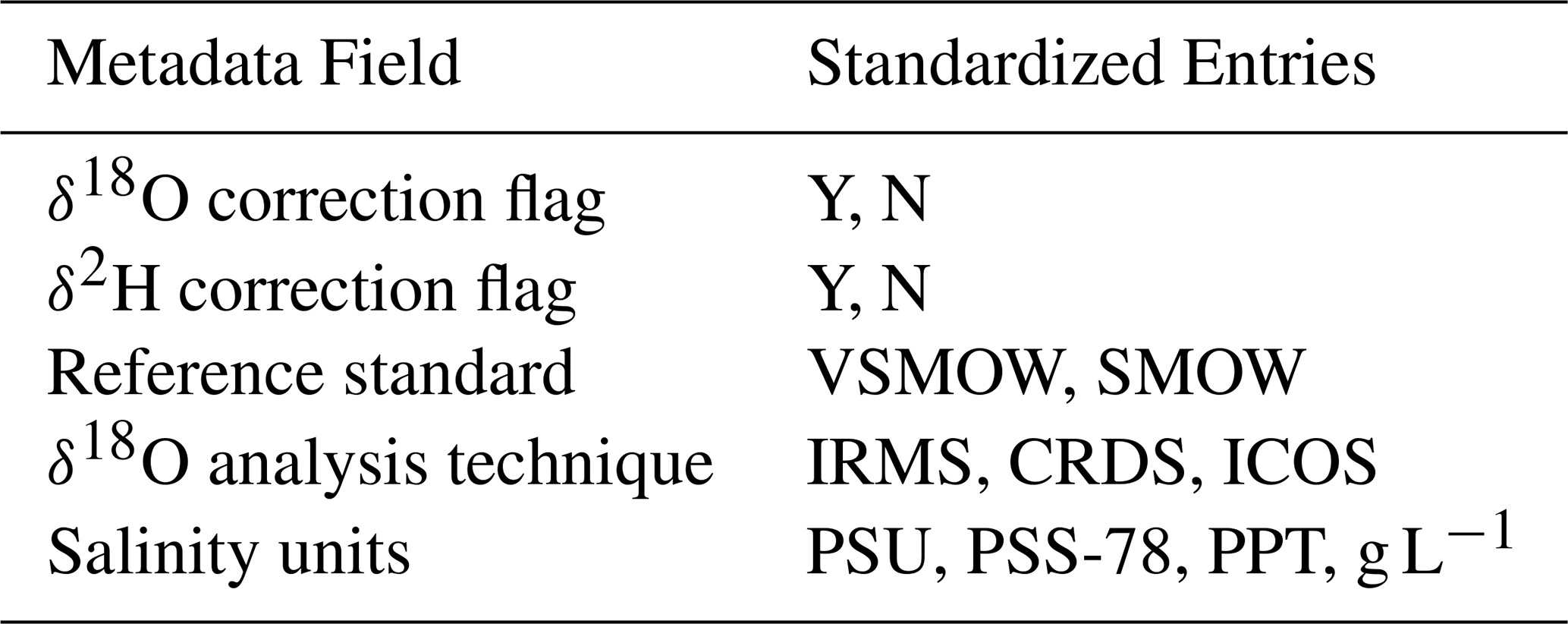
Level 1 fields are required for inclusion in the database and they contain standardized vocabularies, according to Table 2. They are recommended as primary fields for filtering and querying records in the database. They were subject to the highest Quality Control (QC) standard. Examples of Level 1 metadata are: “Collection year”, “Collection month”, “Latitude”, “Longitude”, and “Depth”.
-
Level 2 metadata fields are required for inclusion, but they are not generalizable enough to use standardized vocabularies. They were subject to the highest QC standard and the metadata were obtained from the original publication or data source. An example of Level 2 metadata is “Site name or geographic area”.
-
Level 3 metadata fields add important supplementary information related to the seawater δ18O measurements. They contain standardized vocabularies and can be used as secondary fields for filtering and querying the database; however, they are generally not available for all records and thus not required for inclusion in the database. They were subject to the highest QC standard. Examples of Level 3 metadata are: “Collection day”, “δ18O error”, “δ18O analysis technique”, “Water isotope analysis date”, “δ2H value”, “Temperature value”, and “Salinity value”.
-
Level 4 metadata fields also add important supplementary information related to the seawater δ18O data, but they are not generalizable enough to use standardized vocabularies. They are also generally not available for all records and thus not required for inclusion in the database. They were subject to the highest QC standard. Examples of Level 4 metadata are: “δ18O correction notes”, “δ18O error notes”, “Sample ID”, “Publication citation”, “Dataset citation”, “Cruise ID”, “δ18O analysis location”, “Sample collection, processing, and storage notes”, and “Water isotope analysis notes”.
-
Level 5 metadata fields may be useful to some users of the database, but they are generally not available for all records and thus not required for inclusion in the database. In many cases, these fields contain freeform text with direct quotes from the original publications. During the QC certification process, these fields were checked against the original publication and a quote or summary of the relevant information was provided in the database, but the information provided may not be comprehensive. The Level 5 metadata are: “Location description”, “Location type”, and “Temperature/salinity notes”.
Table 1Description of all metadata fields in the PAGES CoralHydro2k Seawater δ18O Database. Bold text indicates required fields in the database (Level 1 and 2).
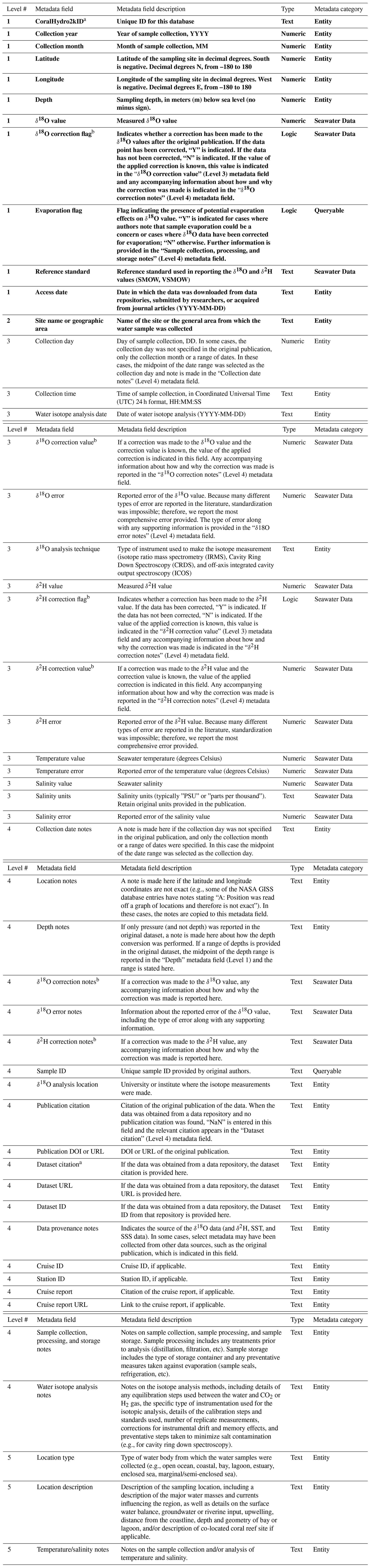
a There are four cases in which datasets obtained from the GISS database were not clearly associated with a publication, or the provided reference did not match the dataset. In those cases, the Schmidt et al. (1999) database citation is provided in the “Dataset citation” (Level 4) metadata field and the author letters “SC” are used in the unique CoralHydro2k ID to reference that citation (SC99AO0001, SC99PO0001, SC99IO0001, SC99GI0001). Additional details about the citations and data provenance appear in the “Data provenance notes” (Level 4) metadata field. b Corrections were applied to the δ18O data in several datasets in the NASA GISS δ18Osw database to standardize the data based on deep water masses to correct for changes in standards, different analysis techniques, and other systematic errors. Corrections were also applied to the δ18O and δ2H data in the Reverdin et al. (2022) LOCEAN database to account for the effect of salt on the IRMS and CRDS analyses (Benetti et al., 2017b). According to Reverdin et al. (2022): “these corrections could present differences with datasets processed in other institutions without this proposed adjustment of up to 0.10 ‰ in δ18O and 0.20 ‰ in δ2H.” The adjusted LOCEAN CRDS δ18O data thus may be higher (more enriched in heavy isotopes) than other CRDS and IRMS data. Corrections were also applied to some of the samples in the LOCEAN database to adjust for minor evaporation biases, based on the deviation from the expected relationship between d-excess and salinity (see Sect. 2.5 in Reverdin et al. (2022) and Appendix B in Benetti et al. (2017a)). The correction values were reported in the GISS database, but not the LOCEAN database. In the current CoralHydro2k database, all corrections are noted by the δ18O and δ2H correction flags and, where available, the values of the corrections are reported in the “δ18O correction values” and “δ2H correction values” (Level 3) metadata fields so the user can remove the corrections if desired. Any accompanying information about how and why the correction was made is reported in the “δ18O correction notes” and δ2H correction notes” (Level 4) metadata fields.
Table 2Standardized controlled vocabulary options for metadata fields in the database.
3.1 Spatial and temporal coverage of the database
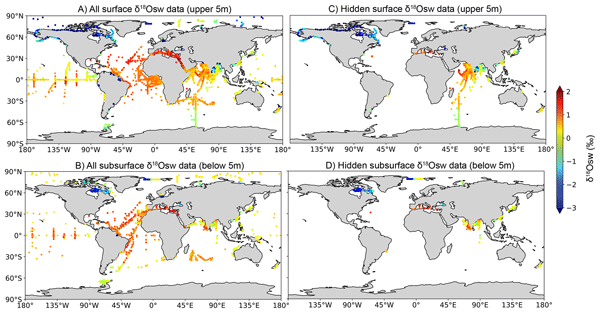
The CoralHydro2k Seawater δ18O Database contains 18 598 data points from 106 datasets (Fig. 1A, B). 53 % of the data (9862 data points) is categorized as “hidden” data (i.e., data not currently available in public databases or public repositories; Fig. 1C, D), and the remaining 47 % of the data is from public databases or public repositories (Table 3). 10,407 measurements (56 %) are from the sea surface (depth ≤ 5 m; Fig. 1A), 3693 (20 %) are from the mixed layer (between 5–50 m), and 4498 (24 %) are below 50 m. The time span of the database covers 1972 to 2021 (Fig. 2) and the depth range covers the surface to 5797 m below sea level. The earliest data point in the database was collected in September 1972 and the most recent data point was collected on 8 October 2021. 3480 data points (19 %) were collected before the year 2000, and 15 118 data points (81 %) were collected on or after the year 2000 (Fig. 2). Because the addition of public datasets focused on the region between 35° N and 35° S, 75 % of the measurements in the database are located within the tropical-subtropical region.
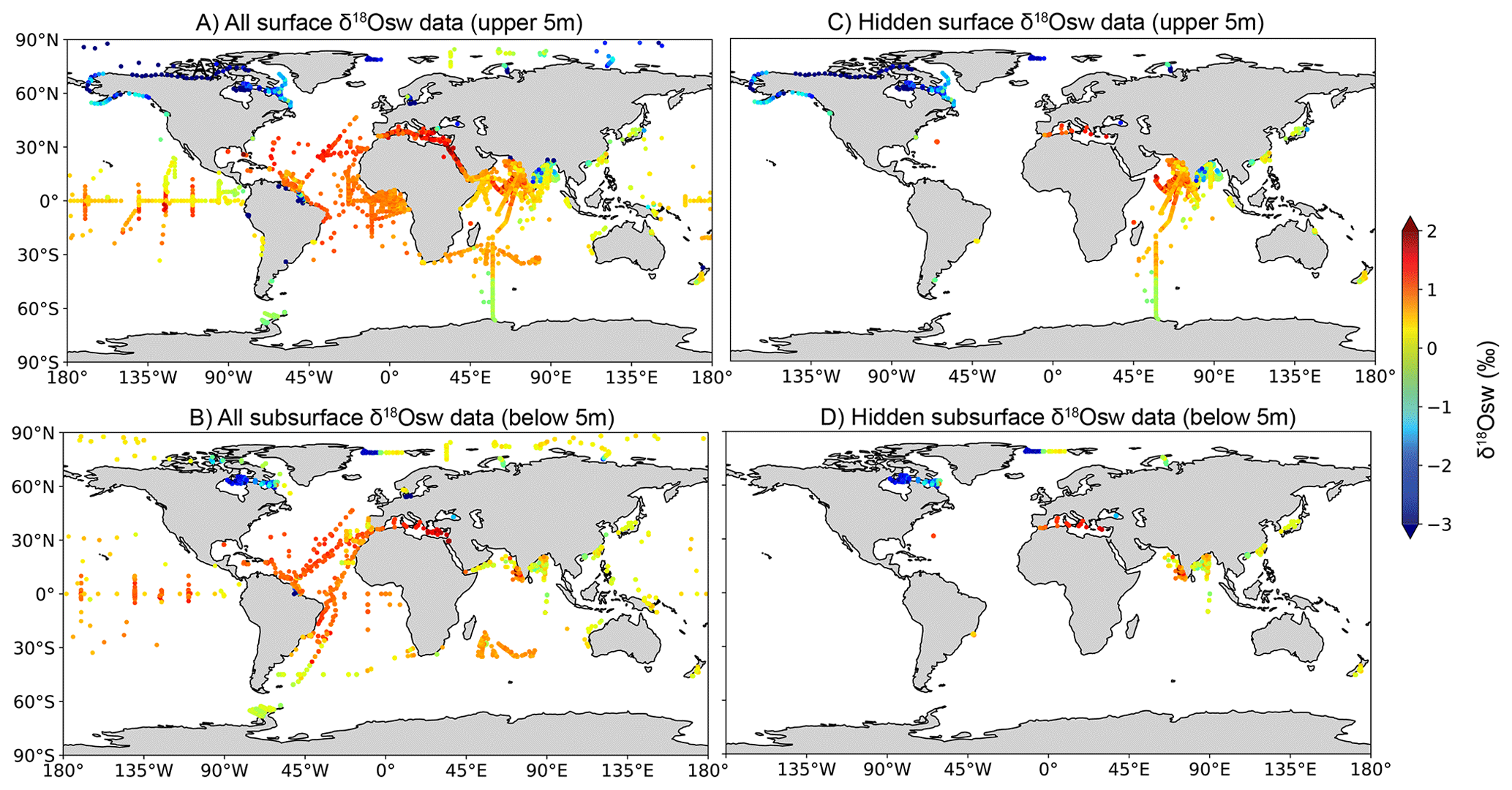
Figure 1Locations and seawater δ18O values of data in the database: (A) all surface ocean data (upper 5 m of the water column), (B) all subsurface ocean data (below 5 m), (C) the hidden surface ocean data only (upper 5 m), (D) the hidden subsurface ocean data only (below 5 m).
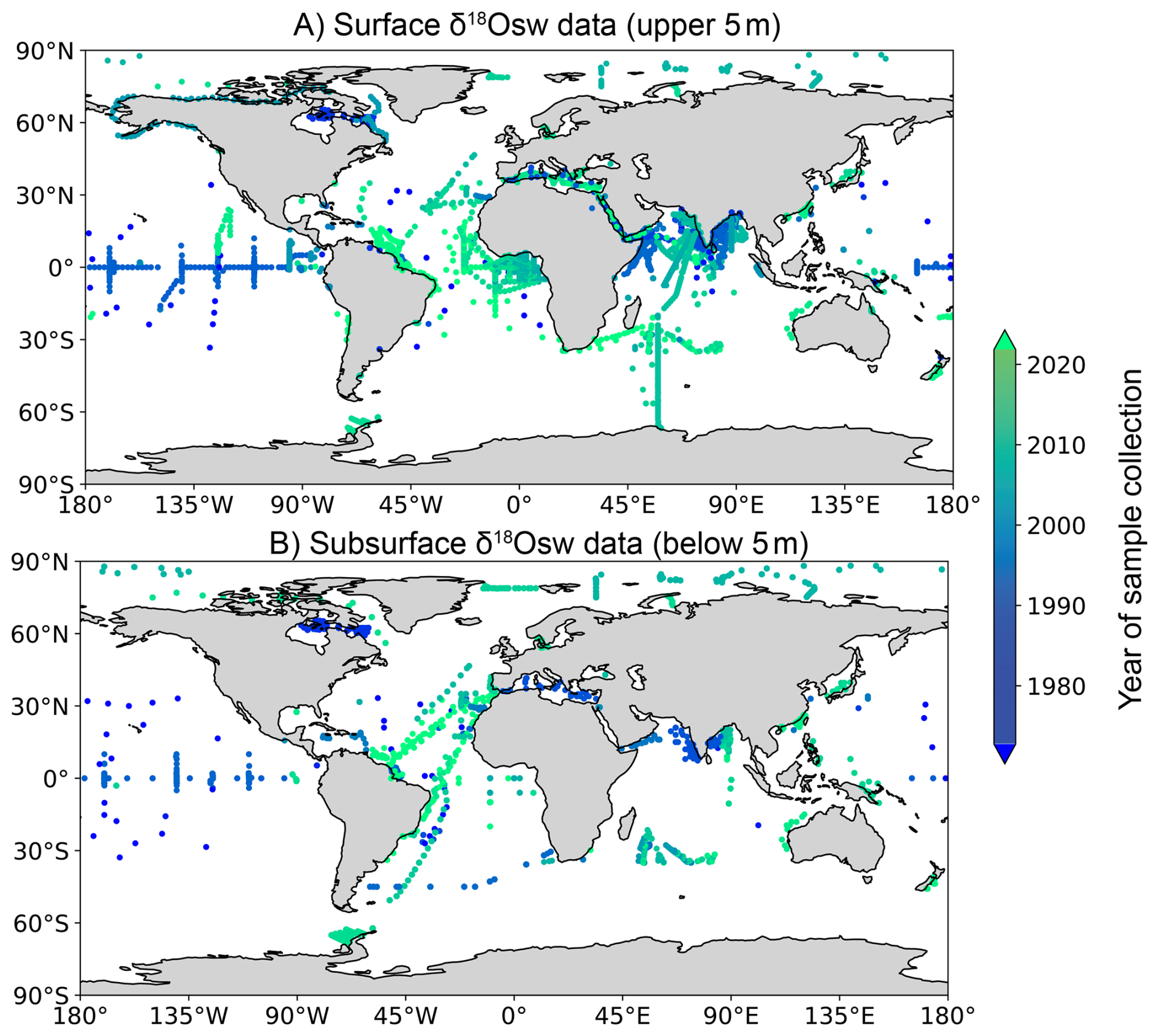
Figure 2Sample collection dates of the seawater δ18O data in the database from (A) the surface ocean (upper 5 m) and (B) the subsurface ocean (below 5 m).
In addition to δ18O measurements, the database also includes paired δ2H, salinity, and temperature measurements when available. 16 098 data points (87 %) have paired salinity values (Fig. 3A), 13 871 data points (75 %) have paired temperature values (Fig. 3B), and 9769 data points (53 %) have paired δ2H measurements (Fig. 3C). 185 measurements have an evaporation flag (Fig. 3D), which allows the user to filter out samples that may be influenced by post-collection evaporation from the database.
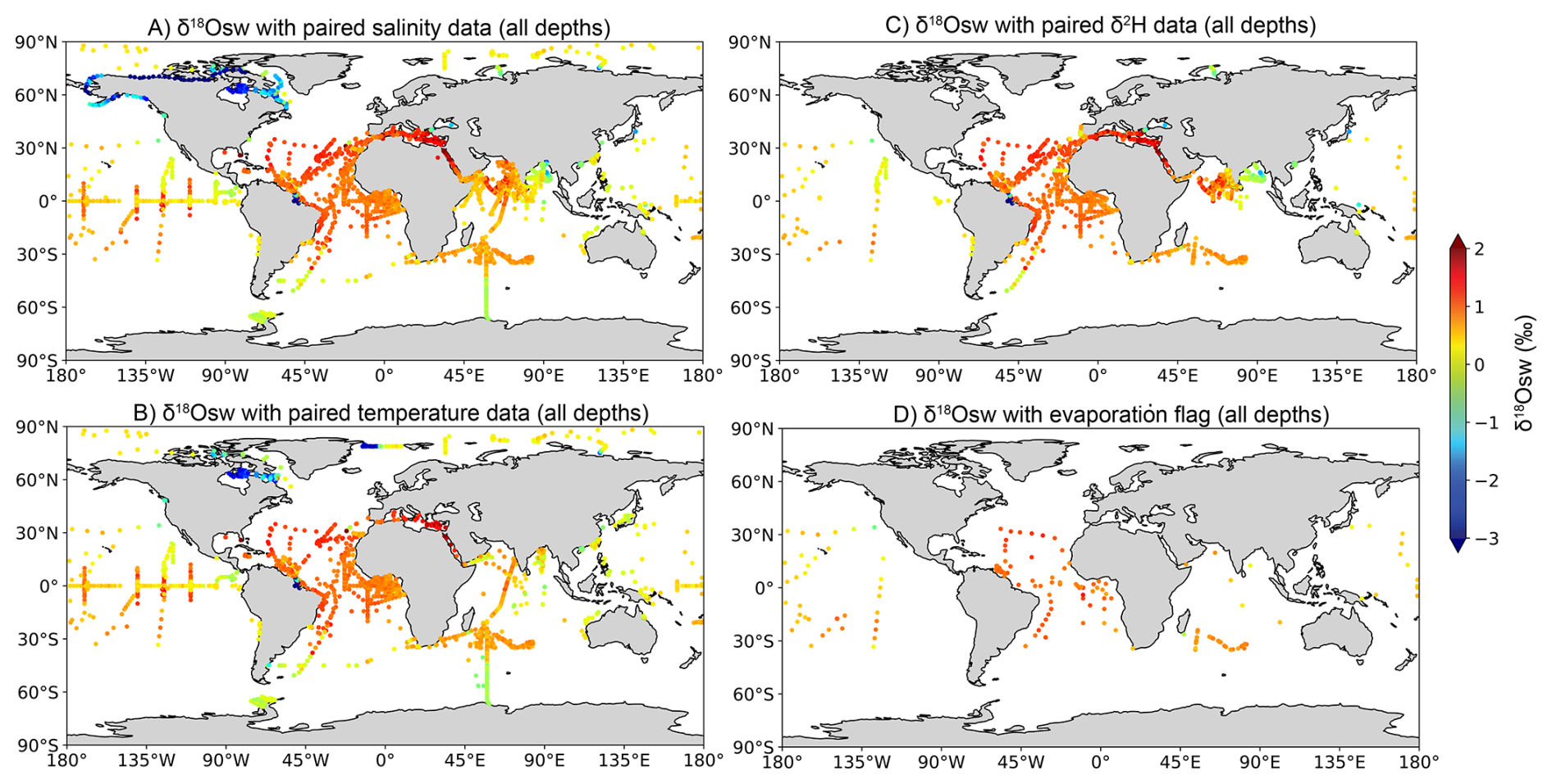
Figure 3Locations and seawater δ18O values of the data in the database with (A) paired salinity measurements, (B) paired temperature measurements, (C) paired δ2H measurements, and (D) an evaporation flag.
Compared to the seawater δ18O database presented in LeGrande and Schmidt (2006), data coverage in the surface ocean (upper 5 m) is substantially improved in the tropics and subtropics, particularly in the northern Indian Ocean, the eastern Atlantic Ocean, the northeast coast of South America, the Mediterranean Sea, and the equatorial Pacific Ocean. However, poor data coverage still exists in the western Pacific Ocean and Maritime Continent region, the southeastern Indian Ocean, and the subtropical Pacific Ocean regions in both hemispheres. Below 5 m depth, the data coverage is even more limited (Fig. 1B). At all depths, regions with reasonable spatial coverage of δ18Osw data contain limited temporal coverage (Fig. 4A). Typically, only a few years of regular measurements are available from the most highly sampled regions. For example, only 21 % of locations contain at least 12 measurements spanning two years within a 2° latitude × 2° longitude grid box and only 8 % of the grid boxes contain data that cover at least 50 % of the annual cycle (i.e., 6/12 months of the calendar year; Fig. 4B). While the coverage of seawater isotope data has been growing over the last decade, these measurements are still sparse in space and time, thus highlighting the need for globally coordinated sampling campaigns and archiving efforts.
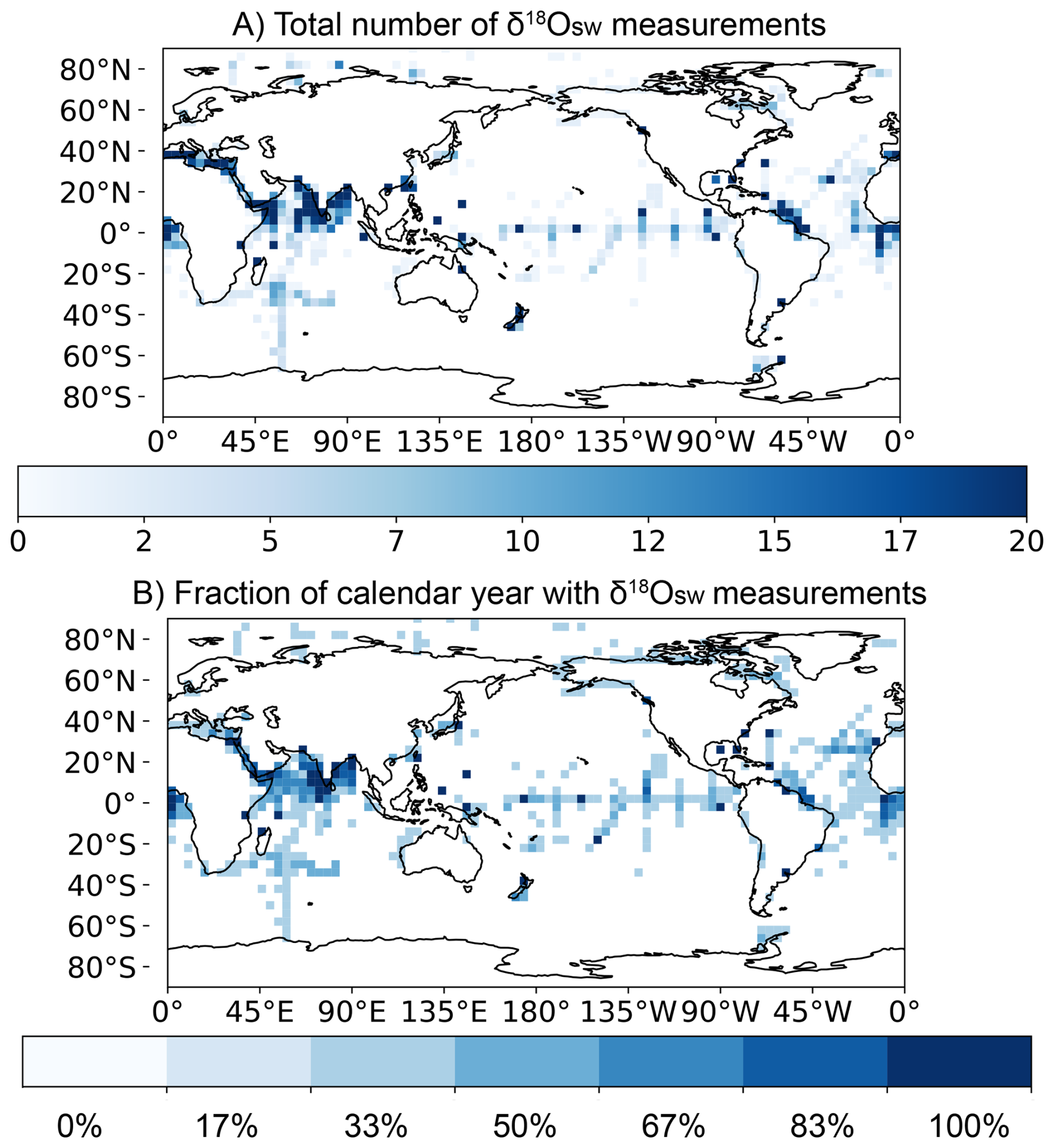
Figure 4Temporal distribution of near-surface (upper 5 m) δ18Osw measurements in the database, aggregated in 2° × 2° (latitude × longitude) grid boxes. (A) Total number of δ18Osw measurements in each grid box. (B) Fraction of calendar year with δ18Osw measurements.
Outside of the tropics and subtropics, the coverage of δ18O data in the CoralHydro2k Seawater δ18O Database is sparser, since only hidden datasets were collected from all latitudes and all depths across the global ocean, while datasets from public repositories were only incorporated into the database if the measurements were made in the upper 50 m between 35° N and 35° S. Future database development efforts will include incorporating additional hidden and public datasets.
3.2 Data-model comparisons of the seawater δ18O data
To assess how the δ18Osw data in the database compares with isotope-enabled climate model simulations and other products, we compare the climatological annual cycle in δ18Osw at different island sites using four data products: two simulations of isotope-enabled General Circulation Models (the National Center for Atmospheric Research Community Earth System Model Last Millennium Ensemble (1000 years; Brady et al., 2019) and the NASA Goddard Institute for Space Studies E2-R last millennium simulation (ensemble member E4rhLMgTck; 255 years; Colose et al., 2016)), a regional ocean model of the Pacific called isoROMS (44 years; Stevenson et al., 2018), and a gridded dataset of global monthly mean δ18Osw based on data assimilation with the MITgcm (Breitkreuz et al., 2018). The Breitkreuz dataset is based on a 400-year quasi-equilibrated simulation of a water isotope-enabled global ocean general circulation model constrained by global monthly δ18Osw data collected from 1950 to 2011 and climatological salinity and temperature data collected from 1951 to 1980.
The characteristics of δ18Osw variability at the four selected sites in the tropical Pacific and Atlantic Oceans vary widely across the different data products and the δ18Osw observations from the CoralHydro2k Seawater δ18O Database, with large differences in both the amplitude and phase of the annual cycle of δ18Osw (Fig. 5). These differences could be due to deficiencies in the models (associated with subgrid-scale parameterizations, treatment of atmospheric exchange and ocean mixing processes, and/or the limited spatial resolution of the models not capturing the local influence of evaporation, precipitation, runoff, and upwelling at the sampling sites), and/or uncertainties in the observational data given the low temporal resolution of the δ18Osw measurements. Clearly, more observational data is needed to determine the source of the discrepancies, pointing to the need for more coordinated and sustained seawater isotope sampling programs. Seawater isotope sampling at multinational observing systems that are already in place, such as the Tropical Pacific Observing System (TPOS), Bermuda Atlantic Time-series Study (BATS), GO-SHIP, and GEOTRACES, could expand and complement existing observational programs. For example, incorporating new sampling devices such as long-term osmotically pumped fluid samplers (Jannasch et al., 2004; Khare et al., 2021) could provide a relatively straightforward way to add δ18Osw measurements to existing programs. The development of sustained seawater isotope measurements at a network of observational hotspots around the global ocean would provide powerful new constraints on hydrologic changes in the modern ocean, generating data that could be used to test theoretical predictions, assess climate model performance and skill, and calibrate paleoclimate proxies for improved paleoclimate reconstruction.
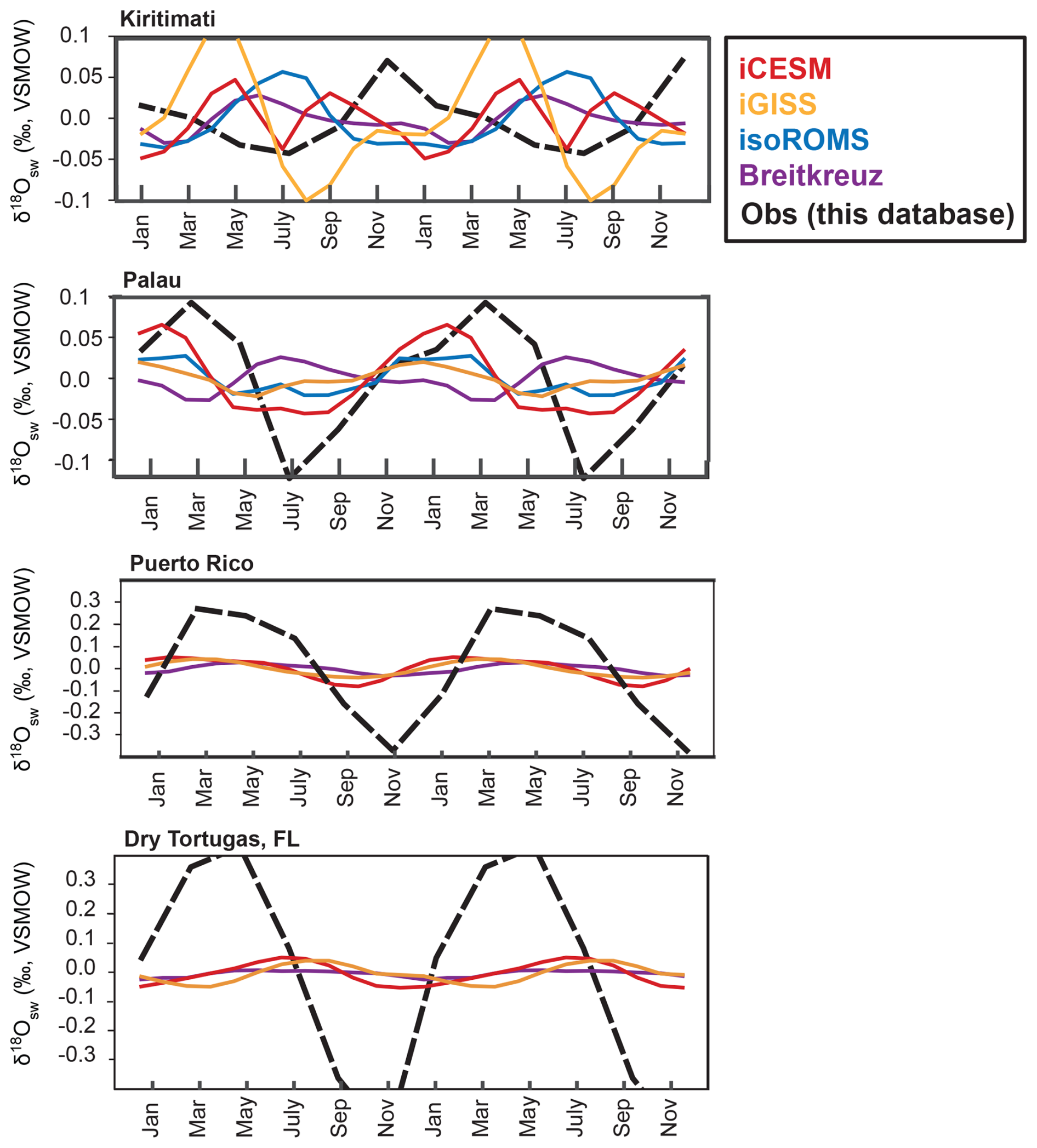
Figure 5Monthly climatology of δ18Osw at four island locations: Kiritimati Atoll in the Central Pacific Ocean, Palau in the western Pacific Ocean, Puerto Rico in the Caribbean Sea, and Dry Tortugas in the Gulf of Mexico. Five data sources are shown: observed δ18Osw (from this database; black dashed line), simulated δ18Osw from iCESM, iGISS, and isoROMS, and δ18Osw from the reanalysis product of Breitkreuz et al. (2018) (purple; monthly climatology constrained by observed monthly δ18Osw data collected from 1950 to 2011 and climatological salinity and temperature data collected from 1951 to 1980). The three Earth system models are the National Center for Atmospheric Research Community Earth System Model Last Millennium Ensemble (1000 years; red) (Brady et al., 2019), the NASA Goddard Institute for Space Studies E2-R last millennium simulation (ensemble member E4rhLMgTck; 255 years; yellow) (Colose et al., 2016), and the isoROMs Pacific Ocean simulation (44 years; blue) (Stevenson et al., 2018).
While the primary motivation of the CoralHydro2k Seawater δ18O Database was for coral paleoclimate research, this database was designed to be useful to researchers from a wide range of disciplines, including paleoceanography and paleoclimatology, oceanography, marine biology, Earth science, and climatology. Of relevance to paleoclimate applications, the pairing of seawater oxygen isotope data with salinity data can provide transfer equations for reconstructing past salinity variations (e.g., Gagan et al., 1998; Kilbourne et al., 2004; McCulloch et al., 1994; Ren et al., 2003). For example: coral , a temperature proxy, paired with coral δ18O, a proxy for both temperature and δ18Osw, can be used to remove the temperature component from the coral δ18O signal. The derived δ18Osw can then be converted to salinity using the local δ18Osw to salinity transfer equation (e.g., Kilbourne et al., 2004). The same method can be applied to foraminifera and δ18O records to reconstruct salinity variations and can also potentially be applied to bivalves, coralline algae, ostracods, and otoliths (e.g., Light et al., 2018; Schmidt and Lynch-Stieglitz, 2011; Stott et al., 2004; Trofimova et al., 2020; Warner et al., 2022). Many studies have used this paired approach to reconstruct δ18Osw variations for a wide range of time scales (e.g., Brocas et al., 2019; Felis et al., 2009; Giry et al., 2013; Gorman et al., 2012; Hereid et al., 2013; Knebel et al., 2024; Wu et al., 2013); however, few studies have been able to validate their reconstructions with observed δ18Osw records that span more than one year (Conroy et al., 2017; O'Connor et al., 2021). Instead, most studies use reanalysis products such as Simple Ocean Data Assimilation (SODA) (Carton et al., 2000, 2018), or satellite-derived sea surface salinity (SSS) products (e.g., NASA Aquarius, NASA SMOS) (Boutin et al., 2021) for validating the reconstructions (e.g., Cahyarini et al., 2008; Harbott et al., 2023; Hetzinger et al., 2006). Typically, these applications assume that the salinity versus δ18Osw relationship is stable in time; however, this assumption has been shown to break down in many instances: e.g., with temporal variations observed between monsoon and non-monsoon seasons (Ghosh et al., 2013; McConnell et al., 2009), in regions affected by sea ice formation and melting (Strain and Tan, 1993), and under variations in ocean advection, upwelling, and ocean-atmosphere interactions (Conroy et al., 2017; Rohling and Bigg, 1998).
The CoralHydro2k Seawater δ18O database can be leveraged to explore the relationship between these two parameters by combining the seawater δ18O data with the paired salinity data in the database (e.g., Conroy et al., 2017; Durack et al., 2012; LeGrande and Schmidt, 2006; Wagner and Slowey, 2011). In this way, the Seawater δ18O Database also has important applications to modern oceanography. By allowing these relationships to be more comprehensively assessed across space and time, this database (alongside future improvements in data coverage) will have important applications to resolving past and present oceanographic variations and change.
Additionally, the CoralHydro2k Seawater δ18O Database can be used in proxy-system model development, paleo-data assimilation, and comparison studies between proxy reconstructions and climate model output (Dee et al., 2023; Evans et al., 2013; Reed et al., 2022; Sanchez et al., 2021; Smerdon, 2012; Stevenson et al., 2018; Thompson et al., 2011). Proxy-derived δ18Osw data can be directly compared with simulations from isotope-enabled models as part of the validation process and to understand oxygen isotope fractionation processes within the hydrological cycle (Dee et al., 2015; Stevenson et al., 2015, 2023). Furthermore, the proxy-derived salinity reconstructions can be compared with reanalysis and other salinity data products, such as SODA, as a separate validation step (e.g., Cahyarini et al., 2008). Finally, the Seawater δ18O Database offers the opportunity for improved proxy system models with rigorous uncertainty quantification of proxy-derived estimates of salinity. With such estimates, long reconstructions of salinity would provide valuable insights into the low frequency variability of the hydrological cycle over the data sparse tropical oceans. This Seawater δ18O Database is the most comprehensive to date and will be updated as new datasets are published to support ongoing research (see Sect. 6).
5.1 Accessing the database
The CoralHydro2k Seawater δ18O Database follows the FAIR data principles (Wilkinson et al., 2016) that strive to make scholarly data findable, accessible, interoperable, and reusable. The CoralHydro2k Seawater δ18O Database uses the Comma Separated Values (*.CSV) file format, a machine-readable format for archiving and describing seawater isotope data. Access to the database has been granted for reviewers and editors during the review phase. The data are also available upon request for members of the public that wish to participate in the review process by emailing the corresponding author. The database is available on the NOAA NCEI World Data Service for Paleoclimatology landing page: https://www.ncei.noaa.gov/access/paleo-search/study/34575 (last access: 11 February 2026) (https://doi.org/10.25921/ap7d-2k16, Atwood et al., 2026). We recommend accessing the database through the NOAA NCEI landing page to find the latest instructions on using the database.
5.2 Code availability
Example Jupyter notebooks and MATLAB scripts are available on the CoralHydro2k Seawater Database GitHub page: https://github.com/CoralHydro2k/ch2kSeawater_Database (last access: 11 February 2026, and Zenodo at https://doi.org/10.5281/zenodo.18828491, Hargreaves, 2026) to help users search, filter, and visualize the database. We encourage users of the database to share their scripts on GitHub as well for improved access.
5.3 Underlying data sources
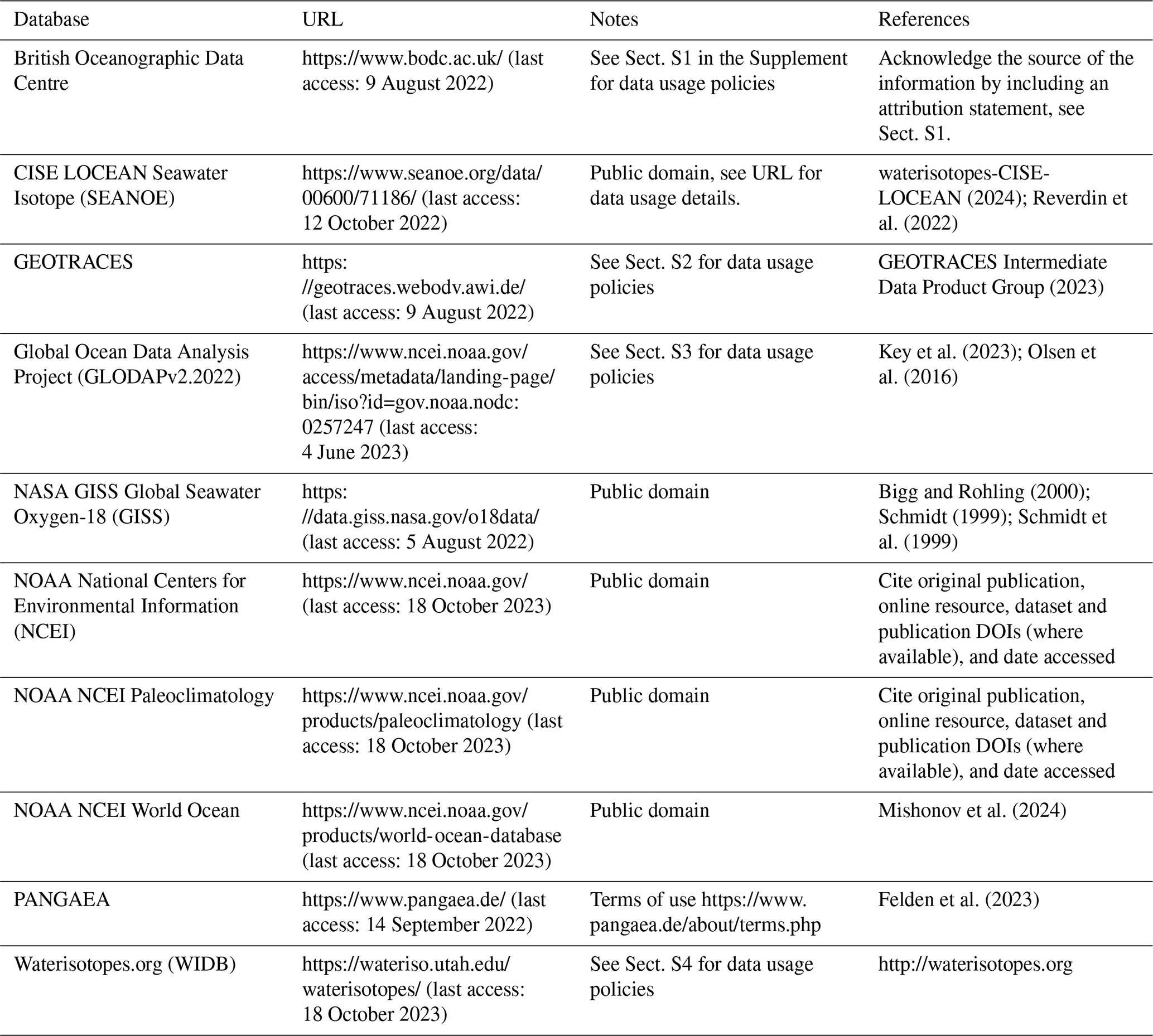
The CoralHydro2k Seawater δ18O Database includes records (0–50 mbsl, 35° N to 35° S) from ten international databases, including GEOTRACES, NASA GISS, PANGAEA, CISE LOCEAN, GLODAPv2, WIDB, NOAA NCEI, and BODC (Table 3). Literature searches were also conducted to find hidden seawater δ18O data (from all depths and latitudes) published only in tables and supplemental data files of published papers, theses, and dissertations. Data was also sourced from author contributions sent directly to this project or the EarthChem community (2026): https://earthchem.org/communities/seawater-oxygen-isotopes (last access: 11 February 2026). Users of this database should adhere to the data use policies for the underlying data sources (see Table 3 and Supplement Sects. S1–S4).
The CoralHydro2k Seawater δ18O project will accept data submissions for updates to the database. All seawater δ18O observations are welcomed regardless of location or water depth. To facilitate this process, a Seawater Oxygen Isotopes Community was developed within the EarthChem Library, an open-access repository for geochemical datasets (https://earthchem.org/communities/seawater-oxygen-isotopes, last access: 11 February 2026), where researchers can submit their seawater isotope data and obtain a dataset DOI. The Seawater Oxygen Isotopes Community contains a template that can be downloaded to help researchers submit their data. This template is aligned with the CoralHydro2k Seawater δ18O Database to facilitate future updates to the database. The template has a README tab in the Microsoft Excel file with details on the template and an example. We hope that the creation of this site helps researchers publish their seawater isotope datasets, thus minimizing the number of ”hidden” datasets.
The initial release of the CoralHydro2k Seawater δ18O Database is Version 1.0.0 for this publication. With new submissions, the database will grow as new datasets are added. Database users who find errors in the database can use the “Report an issue” option in the GitHub site. Datasets submitted to the Seawater Oxygen Isotopes Community within the EarthChem Library (https://earthchem.org/communities/seawater-oxygen-isotopes) can be updated through that site.
As the CoralHydro2k Seawater δ18O Database is updated, it will be versioned following the scheme used by other PAGES data collection projects (Ahmed et al., 2013; Emile-Geay et al., 2017; Kaufman et al., 2020; McKay and Kaufman, 2014; Walter et al., 2023). The version number has three counters in the following form: C1.C2.C3, where C1, C2, and C3 are incrementing integers. When C1 increases, C2 and C3 reset to zero. When C2 increases, C3 resets to zero. C1 represents the number of publications describing the database. C2 increments each time the set of records in the database changes (addition or removal of a dataset). C3 increments when the data or metadata within the dataset changes, but the set of records remains the same. Upon updates, extensions, or corrections to the database, rather than issuing errata to this publication, changes will be included in subsequent versions of the database and updated and described through the online data repository.
This CoralHydro2k Seawater δ18O Database descriptor publication should be cited when the database is used in whole or in part, including its metadata fields, for subsequent studies. We encourage end users of this database to also cite the original publications and/or data sources of the underlying primary data (Table 3). To facilitate this process, citation information for every data point is included in the metadata, including a full citation and DOI of the original publication, as well as a dataset citation and DOI for the original public archive of the data. Researchers should also adhere to the data use policies for the underlying data sources (see Supplement Sects. S1–S4).
Observational seawater δ18O and δ2H data can place powerful constraints on the global water cycle, providing valuable information on the exchange of water between the ocean, atmosphere, and cryosphere, as well as on ocean-mixing processes. As such, these data provide an additional set of constraints for understanding the complex hydrologic system, beyond what standard oceanographic variables like temperature and salinity can offer. They also provide a “common currency” that links paleoclimate reconstructions, modern climate observations, and isotope-enabled model simulations, allowing hydrologic processes to be evaluated on a wide range of time and spatial scales. Given the broad value of this data, and the growing number of seawater δ18O and δ2H datasets that have been generated since 2011, the CoralHydro2k Seawater δ18O Database was developed to improve the accessibility of seawater isotope data for the Earth Science research community. This new, machine-readable, and metadata-rich database contains over 18 600 observational seawater δ18O data points, paired with seawater δ2H and salinity data and extensive metadata that makes the database suitable for a myriad of research applications. The metadata template also provides a set of best practices for reporting seawater isotope data in future studies.
The CoralHydro2k Seawater δ18O Database and its extensive metadata can provide insight into the multiple processes that impact seawater δ18O and δ2H. Furthermore, the database can be used to better constrain the relationship between δ18Osw and salinity in the global ocean, and (in conjunction with future improvements in data coverage) provide insight into how this relationship varies in space and time. The database also provides updated seawater δ18O and δ2H data critical for the calibration and validation of paleoclimate reconstructions using δ18O and δ2H to reconstruct past ocean temperature and salinity variations. For example, recent paleoclimate data assimilation efforts would greatly benefit from a spatial network of observational δ18Osw data for training the proxy system models that underlie those efforts. This database could also be used to construct a new gridded dataset of δ18Osw to update that of LeGrande and Schmidt (2006), which has been widely used for providing climate model boundary conditions and to assess model performance and skill in resolving key features of the hydrologic cycle. In this way, the PAGES CoralHydro2k Seawater δ18O Database can be used in a wide variety of applications to bolster our understanding of the modern climate system, while also providing new insights into past and future climate variability and change.
The supplement related to this article is available online at https://doi.org/10.5194/essd-18-1921-2026-supplement.
AA, KD, AM, TF, SL, SCS, and ED designed the database, AA, AM, RP, SL, KD, JH, CM, SS, and AV entered data and/or metadata into the database, AA, AM, SL, RP, JH, CM, and ED performed quality control on the database, AA and KD prepared the manuscript, with contributions from all co-authors, RP developed the example Python code, and JH developed the Github site for the database.
The contact author has declared that none of the authors has any competing interests.
Publisher's note: Copernicus Publications remains neutral with regard to jurisdictional claims made in the text, published maps, institutional affiliations, or any other geographical representation in this paper. The authors bear the ultimate responsibility for providing appropriate place names. Views expressed in the text are those of the authors and do not necessarily reflect the views of the publisher.
We gratefully acknowledge the many researchers, funding agencies, and international project teams responsible for the collection, quality control, and publication of the seawater isotope data, including GEOTRACES and GLODAP. The GEOTRACES 2021 Intermediate Data Product version 2 (IDP2021v2) represents an international collaboration and is endorsed by the Scientific Committee on Oceanic Research (SCOR). The many researchers and funding agencies responsible for the collection of data and quality control are thanked for their contributions to the IDP2021v2. This manuscript also contains data supplied by the Natural Environment Research Council.
We thank the PAGES CoralHydro2k team for their encouragement and effort in building this database, especially the helpful comments and suggestions from Amy Wagner and Hali Kilbourne. We also thank Gilles Reverdin for useful discussions about the database. Many thanks to Erika Ornouski for her work in finding hidden δ18Osw data files in the early stages of the project. We are grateful to Kerstin Lehnert and the EarthChem team at Lamont Doherty Earth Observatory and Carrie Morrill and Edward Gille and Bruce Bauer at NOAA/WDS Paleoclimatology for providing opportunities to host the new database. We also recognize the efforts of Gavin Schmidt, Eelco Rohling, Grant Bigg, and Allegra LeGrande in building and maintaining the first seawater δ18O database (https://data.giss.nasa.gov/o18data/, last access: 20 February 2026), as well as Gabriel Bowen at the University of Utah (waterisotopes.org) and Gilles Reverdin at LOCEAN-IPSL (https://www.locean.ipsl.fr/?lang=fr, last access: 12 October 2022) for their data collection and compiling efforts in continuing to make such data publicly available.
PAGES provided funding support for this project through the PAGES Data Stewardship Scholarship (DSS_104 and DSS_114 awarded to AA). Additional support for this research came from the National Science Foundation awards OCE-1903640 and OCE-2437076 to AA, OCE-2303245 to SM, OCE-2303565 to SS, and NSF-2102931, Department of the Interior South Central Climate Adaptation Science Center Cooperative Agreement G19AC00086, and Louisiana Board of Regents LEQSF(2021-22)-ENH-DE-05 to KD. JH and TF acknowledge Deutsche Forschungsgemeinschaft (DFG, German Research Foundation) – Project number 469906366 (TF) – SPP 2299/Project number 441832482.
This research has been supported by the Past Global Changes Data Stewardship Scholarship (grant nos. DSS_104 and DSS_114), the National Science Foundation (grant nos. OCE-1903640, OCE-2437076, OCE-2303245, OCE-2303565, and NSF-2102931), the U.S. Department of the Interior (grant no. G19AC00086), the Louisiana Board of Regents (grant no. LEQSF(2021-22)-ENH-DE-05), and the Deutsche Forschungsgemeinschaft (grant nos. 469906366 and 441832482).
This paper was edited by Attila Demény and reviewed by Alessio Rovere and one anonymous referee.
Ahmed, M., Anchukaitis, K. J., Asrat, A., Borgaonkar, H. P., Braida, M., Buckley, B. M., Büntgen, U., Chase, B. M., Christie, D. A., Cook, E. R., Curran, M. A. J., Diaz, H. F., Esper, J., Fan, Z.-X., Gaire, N. P., Ge, Q., Gergis, J., González-Rouco, J. F., Goosse, H., Grab, S. W., Graham, N., Graham, R., Grosjean, M., Hanhijärvi, S. T., Kaufman, D. S., Kiefer, T., Kimura, K., Korhola, A. A., Krusic, P. J., Lara, A., Lézine, A.-M., Ljungqvist, F. C., Lorrey, A. M., Luterbacher, J., Masson-Delmotte, V., McCarroll, D., McConnell, J. R., McKay, N. P., Morales, M. S., Moy, A. D., Mulvaney, R., Mundo, I. A., Nakatsuka, T., Nash, D. J., Neukom, R., Nicholson, S. E., Oerter, H., Palmer, J. G., Phipps, S. J., Prieto, M. R., Rivera, A., Sano, M., Severi, M., Shanahan, T. M., Shao, X., Shi, F., Sigl, M., Smerdon, J. E., Solomina, O. N., Steig, E. J., Stenni, B., Thamban, M., Trouet, V., Turney, C. S. M., Umer, M., van Ommen, T., Verschuren, D., Viau, A. E., Villalba, R., Vinther, B. M., von Gunten, L., Wagner, S., Wahl, E. R., Wanner, H., Werner, J. P., White, J. W. C., Yasue, K., Zorita, E., and PAGES 2k Consortium: Continental-scale temperature variability during the past two millennia, Nature Geoscience, 6, 339–346, https://doi.org/10.1038/ngeo1797, 2013.
Akhoudas, C. H., Sallée, J.-B., Haumann, F. A., Meredith, M. P., Garabato, A. N., Reverdin, G., Jullion, L., Aloisi, G., Benetti, M., Leng, M. J., and Arrowsmith, C.: Ventilation of the abyss in the Atlantic sector of the Southern Ocean, Scientific Reports, 11, 6760, https://doi.org/10.1038/s41598-021-86043-2, 2021.
Atwood, A., Moore, A. L., DeLong, K. L., Long, S. E., Sanchez, S. C., Hargreaves, J. A., Morris, C. A., Pauly, R. E., Dassié, E. P., Felis, T., Voelker, A. H. L., Murty, S. A., and Cobb, K. M.: PAGES CoralHydro2k Seawater d18O Database, NOAA National Centers for Environmental Information [data set], https://doi.org/10.25921/ap7d-2k16, 2026.
Atwood, A. R., Moore, A. L., Long, S., Pauly, R., DeLong, K., Wagner, A., and Hargreaves, J. A.: The CoralHydro2k Seawater δ18O Database, PAGES Magazine, 32, 59, https://doi.org/10.22498/pages.32.1.59, 2024.
Benetti, M., Reverdin, G., Pierre, C., Merlivat, L., Risi, C., Steen-Larsen, H. C., and Vimeux, F.: Deuterium excess in marine water vapor: Dependency on relative humidity and surface wind speed during evaporation, Journal of Geophysical Research: Atmospheres, 119, 584–593, https://doi.org/10.1002/2013JD020535, 2014.
Benetti, M., Reverdin, G., Pierre, C., Khatiwala, S., Tournadre, B., Olafsdottir, S., and Naamar, A.: Variability of sea ice melt and meteoric water input in the surface Labrador Current off Newfoundland, Journal of Geophysical Research: Oceans, 121, 2841–2855, https://doi.org/10.1002/2015JC011302, 2016.
Benetti, M., Reverdin, G., Lique, C., Yashayaev, I., Holliday, N. P., Tynan, E., Torres-Valdes, S., Lherminier, P., Tréguer, P., and Sarthou, G.: Composition of freshwater in the spring of 2014 on the southern Labrador shelf and slope, Journal of Geophysical Research: Oceans, 122, 1102–1121, https://doi.org/10.1002/2016JC012244, 2017a.
Benetti, M., Sveinbjörnsdóttir, A. E., Ólafsdóttir, R., Leng, M. J., Arrowsmith, C., Debondt, K., Fripiat, F., and Aloisi, G.: Inter-comparison of salt effect correction for δ18O and δ2H measurements in seawater by CRDS and IRMS using the gas-H2O equilibration method, Marine Chemistry, 194, 114–123, https://doi.org/10.1016/j.marchem.2017.05.010, 2017b.
Benway, H. M. and Mix, A. C.: Oxygen isotopes, upper-ocean salinity, and precipitation sources in the eastern tropical Pacific, Earth and Planetary Science Letters, 224, 493–507, https://doi.org/10.1016/j.epsl.2004.05.014, 2004.
Biddle, L. C., Loose, B., and Heywood, K. J.: Upper Ocean Distribution of Glacial Meltwater in the Amundsen Sea, Antarctica, Journal of Geophysical Research: Oceans, 124, 6854–6870, https://doi.org/10.1029/2019JC015133, 2019.
Bigg, G. R. and Rohling, E. J.: An oxygen isotope data set for marine waters, Journal of Geophysical Research: Oceans, 105, 8527–8535, https://doi.org/10.1029/2000JC900005, 2000.
Blossey, P. N., Kuang, Z., and Romps, D. M.: Isotopic composition of water in the tropical tropopause layer in cloud-resolving simulations of an idealized tropical circulation, Journal of Geophysical Research: Atmospheres, 115, https://doi.org/10.1029/2010JD014554, 2010.
Bong, H., Cauquoin, A., Okazaki, A., Chang, E.-C., Werner, M., Wei, Z., Yeo, N., and Yoshimura, K.: Process-Based Intercomparison of Water Isotope-Enabled Models and Reanalysis Nudging Effects, Journal of Geophysical Research: Atmospheres, 129, e2023JD038719, https://doi.org/10.1029/2023JD038719, 2024.
Bony, S., Risi, C., and Vimeux, F.: Influence of convective processes on the isotopic composition (δ18O and δD) of precipitation and water vapor in the tropics: 1. Radiative-convective equilibrium and Tropical Ocean–Global Atmosphere–Coupled Ocean-Atmosphere Response Experiment (TOGA-COARE) simulations, Journal of Geophysical Research: Atmospheres, 113, https://doi.org/10.1029/2008JD009942, 2008.
Boutin, J., Reul, N., Koehler, J., Martin, A., Catany, R., Guimbard, S., Rouffi, F., Vergely, J. L., Arias, M., Chakroun, M., Corato, G., Estella-Perez, V., Hasson, A., Josey, S., Khvorostyanov, D., Kolodziejczyk, N., Mignot, J., Olivier, L., Reverdin, G., Stammer, D., Supply, A., Thouvenin-Masson, C., Turiel, A., Vialard, J., Cipollini, P., Donlon, C., Sabia, R., and Mecklenburg, S.: Satellite-Based Sea Surface Salinity Designed for Ocean and Climate Studies, Journal of Geophysical Research: Oceans, 126, e2021JC017676, https://doi.org/10.1029/2021JC017676, 2021.
Brady, E., Stevenson, S., Bailey, D., Liu, Z., Noone, D., Nusbaumer, J., Otto-Bliesner, B. L., Tabor, C., Tomas, R., Wong, T., Zhang, J., and Zhu, J.: The Connected Isotopic Water Cycle in the Community Earth System Model Version 1, Journal of Advances in Modeling Earth Systems, 11, 2547–2566, https://doi.org/10.1029/2019MS001663, 2019.
Breitkreuz, C., Paul, A., Kurahashi-Nakamura, T., Losch, M., and Schulz, M.: A Dynamical Reconstruction of the Global Monthly Mean Oxygen Isotopic Composition of Seawater, Journal of Geophysical Research: Oceans, 123, 7206–7219, https://doi.org/10.1029/2018JC014300, 2018.
Brocas, W. M., Felis, T., and Mudelsee, M.: Tropical Atlantic Cooling and Freshening in the Middle of the Last Interglacial From Coral Proxy Records, Geophysical Research Letters, 46, 8289–8299, https://doi.org/10.1029/2019GL083094, 2019.
Cahyarini, S. Y., Pfeiffer, M., Timm, O., Dullo, W.-C., and Schönberg, D. G.: Reconstructing seawater δ18O from paired coral δ18O and ratios: Methods, error analysis and problems, with examples from Tahiti (French Polynesia) and Timor (Indonesia), Geochimica et Cosmochimica Acta, 72, 2841–2853, https://doi.org/10.1016/j.gca.2008.04.005, 2008.
Carton, J. A., Chepurin, G. A., and Chen, L.: SODA3: A New Ocean Climate Reanalysis, Journal of Climate, 31, 6967–6983, https://doi.org/10.1175/JCLI-D-18-0149.1, 2018.
Carton, J. A., Chepurin, G., Cao, X., and Giese, B.: A Simple Ocean Data Assimilation Analysis of the Global Upper Ocean 1950–95. Part I: Methodology, Journal of Physical Oceanography, 30, 294–309, https://doi.org/10.1175/1520-0485(2000)030<0294:ASODAA>2.0.CO;2, 2000.
Cauquoin, A., Werner, M., and Lohmann, G.: Water isotopes – climate relationships for the mid-Holocene and preindustrial period simulated with an isotope-enabled version of MPI-ESM, Climate of the Past, 15, 1913–1937, https://doi.org/10.5194/cp-15-1913-2019, 2019.
Chamberlain, K. J., Lehnert, K. A., McIntosh, I. M., Morgan, D. J., and Worner, G.: Time to change the data culture in geochemistry, Nature Reviews Earth & Environment, 2, 737–739, https://doi.org/10.1038/s43017-021-00237-w, 2021.
Colose, C. M., LeGrande, A. N., and Vuille, M.: Hemispherically asymmetric volcanic forcing of tropical hydroclimate during the last millennium, Earth System Dynamics, 7, 681–696, https://doi.org/10.5194/esd-7-681-2016, 2016.
Conroy, J. L., Thompson, D. M., Cobb, K. M., Noone, D., Rea, S., and Legrande, A. N.: Spatiotemporal variability in the δ18O-salinity relationship of seawater across the tropical Pacific Ocean, Paleoceanography, 32, 484–497, https://doi.org/10.1002/2016PA003073, 2017.
Craig, H. and Gordon, L. I.: Stable Isotopes in Oceanographic Studies and Palaeotemperatures. Deuterium and oxygen-18 variations in the ocean and the marine atmosphere, Laboritorio di Geologia Nucleare, 9–130, 1965.
Dansgaard, W.: The O18-abundance in fresh water, Geochimica et Cosmochimica Acta, 6, 241–260, https://doi.org/10.1016/0016-7037(54)90003-4, 1954.
Dansgaard, W.: Stable isotopes in precipitation, Tellus, 16, 436–468, 1964.
Dee, S., Noone, D., Buenning, N., Emile-Geay, J., and Zhou, Y.: SPEEDY-IER: A fast atmospheric GCM with water isotope physics, Journal of Geophysical Research: Atmospheres, 120, 73–91, https://doi.org/10.1002/2014JD022194, 2015.
Dee, S., Bailey, A., Conroy, J. L., Atwood, A., Stevenson, S., Nusbaumer, J., and Noone, D.: Water isotopes, climate variability, and the hydrological cycle: recent advances and new frontiers, Environmental Research: Climate, 2, 022002, https://doi.org/10.1088/2752-5295/accbe1, 2023.
DeLong, K., Atwood, A., Moore, M., and Sanchez, S.: Clues from the Sea Paint a Picture of Earth's Water Cycle, Eos, 103, https://doi.org/10.1029/2022EO220231, 2022.
Dexter, P. and Summerhayes, C. P.: Chapter 11 in Ocean Observations – the Global Ocean Observing System (GOOS), in: Troubled Waters: Ocean Science and Governance, Cambridge, 161–178, ISBN 978-0-521-76581-7, 2010.
Diekmann, C. J., Schneider, M., Ertl, B., Hase, F., García, O., Khosrawi, F., Sepúlveda, E., Knippertz, P., and Braesicke, P.: The global and multi-annual MUSICA IASI {H2O, δD} pair dataset, Earth System Science Data, 13, 5273–5292, https://doi.org/10.5194/essd-13-5273-2021, 2021.
Doubleday, Z. A., Martino, J. C., and Trueman, C.: Harnessing universal chemical markers to trace the provenance of marine animals, Ecological Indicators, 144, 109481, https://doi.org/10.1016/j.ecolind.2022.109481, 2022.
Durack, P. J., Wijffels, S. E., and Matear, R. J.: Ocean Salinities Reveal Strong Global Water Cycle Intensification During 1950 to 2000, Science, 336, 455–458, https://doi.org/10.1126/science.1212222, 2012.
EarthChem Seawater Oxygen Isotopes Community: EarthChem, https://earthchem.org/communities/seawater-oxygen-isotopes, last access: 2 March 2026.
Eglinton, T. I. and Eglinton, G.: Molecular proxies for paleoclimatology, Earth and Planetary Science Letters, 275, 1–16, https://doi.org/10.1016/j.epsl.2008.07.012, 2008.
Emile-Geay, J., McKay, N. P., Kaufman, D. S., von Gunten, L., Wang, J., Anchukaitis, K. J., Abram, N. J., Addison, J. A., Curran, M. A. J., Evans, M. N., Henley, B. J., Hao, Z., Martrat, B., McGregor, H. V., Neukom, R., Pederson, G. T., Stenni, B., Thirumalai, K., Werner, J. P., Xu, C., Divine, D. V., Dixon, B. C., Gergis, J., Mundo, I. A., Nakatsuka, T., Phipps, S. J., Routson, C. C., Steig, E. J., Tierney, J. E., Tyler, J. J., Allen, K. J., Bertler, N. A. N., Björklund, J., Chase, B. M., Chen, M.-T., Cook, E., de Jong, R., DeLong, K. L., Dixon, D. A., Ekaykin, A. A., Ersek, V., Filipsson, H. L., Francus, P., Freund, M. B., Frezzotti, M., Gaire, N. P., Gajewski, K., Ge, Q., Goosse, H., Gornostaeva, A., Grosjean, M., Horiuchi, K., Hormes, A., Husum, K., Isaksson, E., Kandasamy, S., Kawamura, K., Kilbourne, K. H., Koç, N., Leduc, G., Linderholm, H. W., Lorrey, A. M., Mikhalenko, V., Mortyn, P. G., Motoyama, H., Moy, A. D., Mulvaney, R., Munz, P. M., Nash, D. J., Oerter, H., Opel, T., Orsi, A. J., Ovchinnikov, D. V., Porter, T. J., Roop, H. A., Saenger, C., Sano, M., Sauchyn, D., Saunders, K. M., Seidenkrantz, M.-S., Severi, M., Shao, X., Sicre, M.-A., Sigl, M., Sinclair, K., St. George, S., St. Jacques, J.-M., Thamban, M., Kuwar Thapa, U., Thomas, E. R., Turney, C., Uemura, R., Viau, A. E., Vladimirova, D. O., Wahl, E. R., White, J. W. C., Yu, Z., Zinke, J., and PAGES2k Consortium: A global multiproxy database for temperature reconstructions of the Common Era, Scientific Data, 4, 170088, https://doi.org/10.1038/sdata.2017.88, 2017.
Evans, M. N., Tolwinski-Ward, S. E., Thompson, D. M., and Anchukaitis, K. J.: Applications of proxy system modeling in high resolution paleoclimatology, Quaternary Science Reviews, 76, 16–28, https://doi.org/10.1016/j.quascirev.2013.05.024, 2013.
Felden, J., Möller, L., Schindler, U., Huber, R., Schumacher, S., Koppe, R., Diepenbroek, M., and Glöckner, F. O.: PANGAEA – Data Publisher for Earth & Environmental Science, Scientific Data, 10, 347, https://doi.org/10.1038/s41597-023-02269-x, 2023.
Felis, T., Suzuki, A., Kuhnert, H., Dima, M., Lohmann, G., and Kawahata, H.: Subtropical coral reveals abrupt early-twentieth-century freshening in the western North Pacific Ocean, Geology, 37, 527–530, https://doi.org/10.1130/G25581A.1, 2009.
Field, R. D., Kim, D., LeGrande, A. N., Worden, J., Kelley, M., and Schmidt, G. A.: Evaluating climate model performance in the tropics with retrievals of water isotopic composition from Aura TES, Geophysical Research Letters, 41, 6030–6036, https://doi.org/10.1002/2014GL060572, 2014.
Finkenbiner, C. E., Li, B., Spencer, L., Butler, Z., Haagsma, M., Fiorella, R. P., Allen, S. T., Anderegg, W., Still, C. J., Noone, D., Bowen, G. J., and Good, S. P.: The NEON Daily Isotopic Composition of Environmental Exchanges Dataset, Scientific Data, 9, 353, https://doi.org/10.1038/s41597-022-01412-4, 2022.
Fiorella, R. P., Siler, N., Nusbaumer, J., and Noone, D. C.: Enhancing Understanding of the Hydrological Cycle via Pairing of Process-Oriented and Isotope Ratio Tracers, Journal of Advances in Modeling Earth Systems, 13, e2021MS002648, https://doi.org/10.1029/2021MS002648, 2021.
Frew, R. D., Dennis, P. F., Heywood, K. J., Meredith, M. P., and Boswell, S. M.: The oxygen isotope composition of water masses in the northern North Atlantic, Deep Sea Research Part I: Oceanographic Research Papers, 47, 2265–2286, https://doi.org/10.1016/S0967-0637(00)00023-6, 2000.
Gagan, M. K., Ayliffe, L. K., Hopley, D., Cali, J. A., Mortimer, G. E., Chappell, J., McCulloch, M. T., and Head, M. J.: Temperature and Surface-Ocean Water Balance of the Mid-Holocene Tropical Western Pacific, Science, 279, 1014–1018, https://doi.org/10.1126/science.279.5353.1014, 1998.
Galewsky, J., Steen-Larsen, H. C., Field, R. D., Worden, J., Risi, C., and Schneider, M.: Stable isotopes in atmospheric water vapor and applications to the hydrologic cycle, Reviews of Geophysics, 54, 809–865, https://doi.org/10.1002/2015RG000512, 2016.
Gat, J. R.: OXYGEN AND HYDROGEN ISOTOPES IN THE HYDROLOGIC CYCLE, Annual Review of Earth and Planetary Sciences, 24, 225–262, https://doi.org/10.1146/annurev.earth.24.1.225, 1996.
GEOTRACES Intermediate Data Product Group: The GEOTRACES Intermediate Data Product 2021 version 2 (IDP2021v2), British Oceanographic Data Centre [data set], https://doi.org/10.5285/ff46f034-f47c-05f9-e053-6c86abc0dc7e, 2023.
Ghosh, P., Chakrabarti, R., and Bhattacharya, S. K.: Short- and long-term temporal variations in salinity and the oxygen, carbon and hydrogen isotopic compositions of the Hooghly Estuary water, India, Chemical Geology, 335, 118–127, https://doi.org/10.1016/j.chemgeo.2012.10.051, 2013.
Giry, C., Felis, T., Kölling, M., Wei, W., Lohmann, G., and Scheffers, S.: Controls of Caribbean surface hydrology during the mid- to late Holocene: insights from monthly resolved coral records, Climate of the Past, 9, 841–858, https://doi.org/10.5194/cp-9-841-2013, 2013.
Gorman, M. K., Quinn, T. M., Taylor, F. W., Partin, J. W., Cabioch, G., Austin Jr., J. A., Pelletier, B., Ballu, V., Maes, C., and Saustrup, S.: A coral-based reconstruction of sea surface salinity at Sabine Bank, Vanuatu from 1842 to 2007 CE, Paleoceanography, 27, https://doi.org/10.1029/2012PA002302, 2012.
Gupta, P., Noone, D., Galewsky, J., Sweeney, C., and Vaughn, B. H.: Demonstration of high-precision continuous measurements of water vapor isotopologues in laboratory and remote field deployments using wavelength-scanned cavity ring-down spectroscopy (WS-CRDS) technology, Rapid Communications in Mass Spectrometry, 23, 2534–2542, https://doi.org/10.1002/rcm.4100, 2009.
Harbott, M., Wu, H. C., Kuhnert, H., Jimenez, C., González-Díaz, P., and Rixen, T.: A Warming Southern Gulf of Mexico: Reconstruction of Anthropogenic Environmental Changes From a Siderastrea siderea Coral on the Northern Coast of Cuba, Paleoceanography and Paleoclimatology, 38, e2023PA004717, https://doi.org/10.1029/2023PA004717, 2023.
Hargreaves, J.: CoralHydro2k/ch2kSeawater_Database: GitHub release – The PAGES CoralHydro2k Seawater δ18O Database: a FAIR-aligned compilation of seawater δ18O data to uncover “hidden” insights from the global ocean (v.1.0.0), Zenodo [code], https://doi.org/10.5281/zenodo.18828491, 2026.
Hargreaves, J., DeLong, K., Felis, T., Abram, N., Cobb, K., and Sayani, H.: Tropical ocean hydroclimate and temperature from coral archives, PAGES Magazine, 28, https://doi.org/10.22498/pages.28.1.29, 2020.
Henze, D., Noone, D., and Toohey, D.: Aircraft measurements of water vapor heavy isotope ratios in the marine boundary layer and lower troposphere during ORACLES, Earth System Science Data, 14, 1811–1829, https://doi.org/10.5194/essd-14-1811-2022, 2022.
Hereid, K. A., Quinn, T. M., and Okumura, Y. M.: Assessing spatial variability in El Niño–Southern Oscillation event detection skill using coral geochemistry, Paleoceanography, 28, 14–23, https://doi.org/10.1029/2012PA002352, 2013.
Hetzinger, S., Pfeiffer, M., Dullo, W.-C., Ruprecht, E., and Garbe-Schönberg, D.: and δ18O in a fast-growing Diploria strigosa coral: Evaluation of a new climate archive for the tropical Atlantic, Geochemistry, Geophysics, Geosystems, 7, https://doi.org/10.1029/2006GC001347, 2006.
Imbrie, J., Hays, J. D., Martinsen, D. G., McIntyre, A., Mix, A. C., Morley, J. J., Pisias, N. G., Prell, W. L., and Shackleton, N. J.: The Orbital Theory of Pleistocene Climate: Support from a Revised Chronology, of the Marine δ18O Record, edited by: Berger, A., Milankovitch and Climate, Part 1, Springer, New York, 269–305, ISBN 978-90-277-1778-8, 1984.
Jacobs, S. S., Fairbanks, R. G., Horibe, Y., and Jacobs, S. S.: Origin and evolution of water masses near the Antarctic continental margin: Evidence from H218O/H216O ratios in seawater, vol. 43, American Geophysical Union, Washington, D.C., 59–85, https://doi.org/10.1029/ar043p0059, 1985.
Jannasch, H. W., Wheat, C. G., Plant, J. N., Kastner, M., and Stakes, D. S.: Continuous chemical monitoring with osmotically pumped water samplers: OsmoSampler design and applications, Limnology and Oceanography: Methods, 2, 102–113, https://doi.org/10.4319/lom.2004.2.102, 2004.
Kaufman, D., McKay, N., Routson, C., Erb, M., Dätwyler, C., Sommer, P. S., Heiri, O., and Davis, B.: Holocene global mean surface temperature, a multi-method reconstruction approach, Scientific Data, 7, 201, https://doi.org/10.1038/s41597-020-0530-7, 2020.
Key, R. M., Olsen, A., van Heuven, S., Lauvset, S. K., Velo, A., Lin, X., Schirnick, C., Kozyr, A., Tanhua, T., Hoppema, M., Jutterstrom, S., Steinfeldt, R., Jeansson, E., Ishii, M., Perez, F. F., and Suzuki, T.: Global Ocean Data Analysis Project, Version 2 (GLODAPv2), ORNL/CDIAC-162, NDP-093, Carbon Dioxide Information Analysis Center, Oak Ridge National Laboratory, US Department of Energy [data set], Oak Ridge, Tennessee, https://doi.org/10.3334/CDIAC/OTG.NDP093_GLODAPv2, 2023.
Khare, A., Hughes, H. P., Kilbourne, K. H., and Schijf, J.: An ICP-AES method for routine high-precision measurement of seawater ratios to validate coral paleothermometry calibrations, Limnology and Oceanography: Methods, 19, 416–430, https://doi.org/10.1002/lom3.10434, 2021.
Kilbourne, K. H., Quinn, T. M., Taylor, F. W., Delcroix, T., and Gouriou, Y.: El Niño–Southern Oscillation–related salinity variations recorded in the skeletal geochemistry of a Porites coral from Espiritu Santo, Vanuatu, Paleoceanography, 19, https://doi.org/10.1029/2004PA001033, 2004.
Knebel, O., Felis, T., Asami, R., Deschamps, P., Kölling, M., and Scholz, D.: Last Deglacial Environmental Change in the Tropical South Pacific From Tahiti Corals, Paleoceanography and Paleoclimatology, 39, e2022PA004585, https://doi.org/10.1029/2022PA004585, 2024.
Konecky, B. L., McKay, N. P., Churakova (Sidorova), O. V., Comas-Bru, L., Dassié, E. P., DeLong, K. L., Falster, G. M., Fischer, M. J., Jones, M. D., Jonkers, L., Kaufman, D. S., Leduc, G., Managave, S. R., Martrat, B., Opel, T., Orsi, A. J., Partin, J. W., Sayani, H. R., Thomas, E. K., Thompson, D. M., Tyler, J. J., Abram, N. J., Atwood, A. R., Cartapanis, O., Conroy, J. L., Curran, M. A., Dee, S. G., Deininger, M., Divine, D. V., Kern, Z., Porter, T. J., Stevenson, S. L., von Gunten, L., and Iso2k Project Members: The Iso2k database: a global compilation of paleo-δ18O and δ2H records to aid understanding of Common Era climate, Earth System Science Data, 12, 2261–2288, https://doi.org/10.5194/essd-12-2261-2020, 2020.
Konecky, B. L., McKay, N. P., Falster, G. M., Stevenson, S. L., Fischer, M. J., Atwood, A. R., Thompson, D. M., Jones, M. D., Tyler, J. J., DeLong, K. L., Martrat, B., Thomas, E. K., Conroy, J. L., Dee, S. G., Jonkers, L., Churakova (Sidorova), O. V., Kern, Z., Opel, T., Porter, T. J., Sayani, H. R., Skrzypek, G., Abram, N. J., Braun, K., Carré, M., Cartapanis, O., Comas-Bru, L., Curran, M. A., Dassié, E. P., Deininger, M., Divine, D. V., Incarbona, A., Kaufman, D. S., Kaushal, N., Klaebe, R. M., Kolus, H. R., Leduc, G., Managave, S. R., Mortyn, P. G., Moy, A. D., Orsi, A. J., Partin, J. W., Roop, H. A., Sicre, M.-A., von Gunten, L., Yoshimura, K., and Iso2k Project Members: Globally coherent water cycle response to temperature change during the past two millennia, Nature Geoscience, 16, 997–1004, https://doi.org/10.1038/s41561-023-01291-3, 2023.
Kurita, N., Noone, D., Risi, C., Schmidt, G. A., Yamada, H., and Yoneyama, K.: Intraseasonal isotopic variation associated with the Madden-Julian Oscillation, Journal of Geophysical Research: Atmospheres, 116, https://doi.org/10.1029/2010JD015209, 2011.
Lee, J. and Fung, I.: “Amount effect” of water isotopes and quantitative analysis of post-condensation processes, Hydrological Processes, 22, 1–8, https://doi.org/10.1002/hyp.6637, 2008.
LeGrande, A. N. and Schmidt, G. A.: Global gridded data set of the oxygen isotopic composition in seawater, Geophysical Research Letters, 33, https://doi.org/10.1029/2006GL026011, 2006.
LeGrande, A. N. and Schmidt, G. A.: Water isotopologues as a quantitative paleosalinity proxy, Paleoceanography, 26, https://doi.org/10.1029/2010PA002043, 2011.
Light, T., Williams, B., Halfar, J., Hou, A., Zajacz, Z., Tsay, A., and Adey, W.: Advancing Analysis of Coralline Algae as a Climate Proxy by Assessing LA-ICP-OES Sampling and Coupled -δ18O Analysis, Geochemistry, Geophysics, Geosystems, 19, 2876–2894, https://doi.org/10.1029/2018GC007504, 2018.
Lisiecki, L. E. and Raymo, M. E.: A Pliocene-Pleistocene stack of 57 globally distributed benthic δ18O records, Paleoceanography, 20, https://doi.org/10.1029/2004PA001071, 2005.
McConnell, M. C., Thunell, R. C., Lorenzoni, L., Astor, Y., Wright, J. D., and Fairbanks, R.: Seasonal variability in the salinity and oxygen isotopic composition of seawater from the Cariaco Basin, Venezuela: Implications for paleosalinity reconstructions, Geochemistry, Geophysics, Geosystems, 10, https://doi.org/10.1029/2008GC002035, 2009.
McCulloch, M. T., Gagan, M. K., Mortimer, G. E., Chivas, A. R., and Isdale, P. J.: A high-resolution and δ18O coral record from the Great Barrier Reef, Australia, and the 1982–1983 El Niño, Geochimica et Cosmochimica Acta, 58, 2747–2754, https://doi.org/10.1016/0016-7037(94)90142-2, 1994.
McKay, N. P. and Kaufman, D. S.: An extended Arctic proxy temperature database for the past 2,000 years, Scientific Data, 1, 140026, https://doi.org/10.1038/sdata.2014.26, 2014.
Meredith, M. P., Grose, K. E., McDonagh, E. L., Heywood, K. J., Frew, R. D., and Dennis, P. F.: Distribution of oxygen isotopes in the water masses of Drake Passage and the South Atlantic, Journal of Geophysical Research: Oceans, 104, 20949–20962, https://doi.org/10.1029/98JC02544, 1999.
Mishonov A. V., Boyer, T. P., Baranova, O. K., Bouchard, C. N., Cross, S., Garcia, H. E., Locarnini, R. A., Paver, C. R., Reagan, J. R., Wang, Z., Seidov, D., Grodsky, A. I., and Beauchamp, J. G.: World Ocean Database 2023, edited by: Bouchard, C., NOAA Atlas NESDIS 97, 206 pp., https://doi.org/10.25923/z885-h264, 2024.
Noone, D. and Simmonds, I.: Associations between δ18O of Water and Climate Parameters in a Simulation of Atmospheric Circulation for 1979–95, Journal of Climate, 15, 3150–3169, https://doi.org/10.1175/1520-0442(2002)015%253C3150:ABOOWA%253E2.0.CO;2, 2002.
Nusbaumer, J., Wong, T. E., Bardeen, C., and Noone, D.: Evaluating hydrological processes in the Community Atmosphere Model Version 5 (CAM5) using stable isotope ratios of water, Journal of Advances in Modeling Earth Systems, 9, 949–977, https://doi.org/10.1002/2016MS000839, 2017.
O'Connor, G. K., Cobb, K. M., Sayani, H. R., Atwood, A. R., Grothe, P. R., Stevenson, S., Baum, J. K., Chen, T., Claar, D. C., Hitt, N. T., Lynch-Stieglitz, J., Mortlock, R. A., Schmidt, G. A., and Walter, R.: Coral Oxygen Isotopic Records Capture the 2015/2016 El Niño Event in the Central Equatorial Pacific, Geophysical Research Letters, 48, e2021GL094036, https://doi.org/10.1029/2021GL094036, 2021.
Olsen, A., Key, R. M., van Heuven, S., Lauvset, S. K., Velo, A., Lin, X., Schirnick, C., Kozyr, A., Tanhua, T., Hoppema, M., Jutterström, S., Steinfeldt, R., Jeansson, E., Ishii, M., Pérez, F. F., and Suzuki, T.: The Global Ocean Data Analysis Project version 2 (GLODAPv2) – an internally consistent data product for the world ocean, Earth System Science Data, 8, 297–323, https://doi.org/10.5194/essd-8-297-2016, 2016.
PAGES 2k Network Coordinators: Understanding the climate of the past 2000 years: Phase 3 of the PAGES 2k Network, PAGES Magazine, 25, 110–110, 2017.
Reed, E. V., Thompson, D. M., and Anchukaitis, K. J.: Coral-Based Sea Surface Salinity Reconstructions and the Role of Observational Uncertainties in Inferred Variability and Trends, Paleoceanography and Paleoclimatology, 37, e2021PA004371, https://doi.org/10.1029/2021PA004371, 2022.
Ren, L., Linsley, B. K., Wellington, G. M., Schrag, D. P., and Hoegh-guldberg, O.: Deconvolving the δ18O seawater component from subseasonal coral δ18O and at Rarotonga in the southwestern subtropical Pacific for the period 1726 to 1997, Geochimica et Cosmochimica Acta, 67, 1609–1621, https://doi.org/10.1016/S0016-7037(02)00917-1, 2003.
Reverdin, G., Waelbroeck, C., Pierre, C., Akhoudas, C., Aloisi, G., Benetti, M., Bourlès, B., Danielsen, M., Demange, J., Diverrès, D., Gascard, J.-C., Houssais, M.-N., Le Goff, H., Lherminier, P., Lo Monaco, C., Mercier, H., Metzl, N., Morisset, S., Naamar, A., Reynaud, T., Sallée, J.-B., Thierry, V., Hartman, S. E., Mawji, E. W., Olafsdottir, S., Kanzow, T., Velo, A., Voelker, A., Yashayaev, I., Haumann, F. A., Leng, M. J., Arrowsmith, C., and Meredith, M.: The CISE-LOCEAN seawater isotopic database (1998–2021), Earth System Science Data, 14, 2721–2735, https://doi.org/10.5194/essd-14-2721-2022, 2022.
Risi, C., Bony, S., Vimeux, F., and Jouzel, J.: Water-stable isotopes in the LMDZ4 general circulation model: Model evaluation for present-day and past climates and applications to climatic interpretations of tropical isotopic records, Journal of Geophysical Research: Atmospheres, 115, https://doi.org/10.1029/2009JD013255, 2010.
Risi, C., Muller, C., and Blossey, P.: What Controls the Water Vapor Isotopic Composition Near the Surface of Tropical Oceans? Results From an Analytical Model Constrained by Large-Eddy Simulations, Journal of Advances in Modeling Earth Systems, 12, e2020MS002106, https://doi.org/10.1029/2020MS002106, 2020.
Risi, C., Muller, C., and Blossey, P.: Rain Evaporation, Snow Melt, and Entrainment at the Heart of Water Vapor Isotopic Variations in the Tropical Troposphere, According to Large-Eddy Simulations and a Two-Column Model, Journal of Advances in Modeling Earth Systems, 13, e2020MS002381, https://doi.org/10.1029/2020MS002381, 2021.
Rohling, E. J. and Bigg, G. R.: Paleosalinity and δ18O: A critical assessment, Journal of Geophysical Research: Oceans, 103, 1307–1318, https://doi.org/10.1029/97JC01047, 1998.
Sanchez, S. C., Hakim, G. J., and Saenger, C. P.: Climate Model Teleconnection Patterns Govern the Niño-3.4 Response to Early Nineteenth-Century Volcanism in Coral-Based Data Assimilation Reconstructions, Journal of Climate, 34, 1863–1880, https://doi.org/10.1175/JCLI-D-20-0549.1, 2021.
Schmidt, G. A.: Forward modeling of carbonate proxy data from planktonic foraminifera using oxygen isotope tracers in a global ocean model, Paleoceanography, 14, 482–497, https://doi.org/10.1029/1999PA900025, 1999.
Schmidt, G. A., Bigg, G. R., and Rohling, E. J.: Global Seawater Oxygen-18 Database – v1.22, 1999.
Schmidt, G. A., LeGrande, A. N., and Hoffmann, G.: Water isotope expressions of intrinsic and forced variability in a coupled ocean-atmosphere model, Journal of Geophysical Research: Atmospheres, 112, https://doi.org/10.1029/2006JD007781, 2007.
Schmidt, M. W. and Lynch-Stieglitz, J.: Florida Straits deglacial temperature and salinity change: Implications for tropical hydrologic cycle variability during the Younger Dryas, Paleoceanography, 26, https://doi.org/10.1029/2011PA002157, 2011.
Schneider, M., Ertl, B., Diekmann, C. J., Khosrawi, F., Weber, A., Hase, F., Höpfner, M., García, O. E., Sepúlveda, E., and Kinnison, D.: Design and description of the MUSICA IASI full retrieval product, Earth System Science Data, 14, 709–742, https://doi.org/10.5194/essd-14-709-2022, 2022.
Smerdon, J. E.: Climate models as a test bed for climate reconstruction methods: pseudoproxy experiments, WIREs Climate Change, 3, 63–77, https://doi.org/10.1002/wcc.149, 2012.
Stevenson, S., Powell, B. S., Merrifield, M. A., Cobb, K. M., Nusbaumer, J., and Noone, D.: Characterizing seawater oxygen isotopic variability in a regional ocean modeling framework: Implications for coral proxy records, Paleoceanography, 30, 1573–1593, https://doi.org/10.1002/2015PA002824, 2015.
Stevenson, S., Powell, B., Cobb, K. M., Nusbaumer, J., Merrifield, M., and Noone, D.: Twentieth Century Seawater δ18O Dynamics and Implications for Coral-Based Climate Reconstruction, Paleoceanography and Paleoclimatology, 33, 606–625, https://doi.org/10.1029/2017PA003304, 2018.
Stevenson, S., Cobb, K. M., Merrifield, M., Powell, B., Sanchez, S., Nusbaumer, J., O'Connor, G., and Atwood, A.: Contrasting Central Equatorial Pacific Oxygen Isotopic Signatures of the 2014/2015 and 2015/2016 El Niño Events, Geophysical Research Letters, 50, e2023GL104454, https://doi.org/10.1029/2023GL104454, 2023.
Stott, L., Cannariato, K., Thunell, R., Haug, G. H., Koutavas, A., and Lund, S.: Decline of surface temperature and salinity in the western tropical Pacific Ocean in the Holocene epoch, Nature, 431, 56–59, https://doi.org/10.1038/nature02903, 2004.
Strain, P. M. and Tan, F. C.: Seasonal evolution of oxygen isotope-salinity relationships in high-latitude surface waters, Journal of Geophysical Research: Oceans, 98, 14589–14598, https://doi.org/10.1029/93JC01182, 1993.
Tada, M., Yoshimura, K., and Toride, K.: Improving weather forecasting by assimilation of water vapor isotopes, Scientific Reports, 11, 18067, https://doi.org/10.1038/s41598-021-97476-0, 2021.
Tardif, R., Hakim, G. J., Perkins, W. A., Horlick, K. A., Erb, M. P., Emile-Geay, J., Anderson, D. M., Steig, E. J., and Noone, D.: Last Millennium Reanalysis with an expanded proxy database and seasonal proxy modeling, Climate of the Past, 15, 1251–1273, https://doi.org/10.5194/cp-15-1251-2019, 2019.
Thompson, D. M., Ault, T. R., Evans, M. N., Cole, J. E., and Emile-Geay, J.: Comparison of observed and simulated tropical climate trends using a forward model of coral δ 18O, Geophysical Research Letters, 38, https://doi.org/10.1029/2011GL048224, 2011.
Tierney, J. E., Abram, N. J., Anchukaitis, K. J., Evans, M. N., Giry, C., Kilbourne, K. H., Saenger, C. P., Wu, H. C., and Zinke, J.: Tropical sea surface temperatures for the past four centuries reconstructed from coral archives, Paleoceanography, 30, 226–252, https://doi.org/10.1002/2014PA002717, 2015.
Trofimova, T., Alexandroff, S. J., Mette, M. J., Tray, E., Butler, P. G., Campana, S. E., Harper, E. M., Johnson, A. L. A., Morrongiello, J. R., Peharda, M., Schöne, B. R., Andersson, C., Andrus, C. F. T., Black, B. A., Burchell, M., Carroll, M. L., DeLong, K. L., Gillanders, B. M., Grønkjær, P., Killam, D., Prendergast, A. L., Reynolds, D. J., Scourse, J. D., Shirai, K., Thébault, J., Trueman, C., and de Winter, N.: Fundamental questions and applications of sclerochronology: Community-defined research priorities, Estuarine, Coastal and Shelf Science, 245, 106977, https://doi.org/10.1016/j.ecss.2020.106977, 2020.
Wagner, A. J. and Slowey, N. C.: Oxygen isotopes in seawater from the Texas-Louisiana Shelf, Bulletin of Marine Science, 87, 1–12, https://doi.org/10.5343/bms.2010.1004, 2011.
Walter, R. M., Sayani, H. R., Felis, T., Cobb, K. M., Abram, N. . J., Arzey, A. K., Atwood, A., Brenner, L. D., Dassie, E. P., DeLong, K. L., Ellis, B., Fischer, M. J., Goodkin, N. F., Hargreaves, J. A., Kilbourne, K. H., Krawczyk, H. A., McKay, N. P., Murty, S. A., Ramos, R. D., Reed, E. V., Samata, D., Sanchez, S. C., Zinke, J., and PAGES CoralHydro2k Project Members: NOAA/WDS Paleoclimatology – CoralHydro2k Database (Common Era coral d18O and data compilation), NOAA National Centers for Environmental Information, https://doi.org/10.25921/yp94-v135, 2022.
Walter, R. M., Sayani, H. R., Felis, T., Cobb, K. M., Abram, N. J., Arzey, A. K., Atwood, A. R., Brenner, L. D., Dassié, É. P., DeLong, K. L., Ellis, B., Emile-Geay, J., Fischer, M. J., Goodkin, N. F., Hargreaves, J. A., Kilbourne, K. H., Krawczyk, H., McKay, N. P., Moore, A. L., Murty, S. A., Ong, M. R., Ramos, R. D., Reed, E. V., Samanta, D., Sanchez, S. C., Zinke, J., and the PAGES CoralHydro2k Project Members: The CoralHydro2k database: a global, actively curated compilation of coral δ18O and Sr/Ca proxy records of tropical ocean hydrology and temperature for the Common Era, Earth System Science Data, 15, 2081–2116, https://doi.org/10.5194/essd-15-2081-2023, 2023.
Warner, J. P., DeLong, K. L., Chicoine, D., Thirumalai, K., and Andrus, C. F. T.: Investigating the influence of temperature and seawater δ18O on Donax obesulus (Reeve, 1854) shell δ18O, Chemical Geology, 588, 120638, https://doi.org/10.1016/j.chemgeo.2021.120638, 2022.
waterisotopes-CISE-LOCEAN: Water isotopes of sea water analyzed since 1998 at LOCEAN, SEANOE [data set], https://doi.org/10.17882/71186, 2024.
Wei, Z., Lee, X., and Patton, E. G.: ISOLESC: A Coupled Isotope-LSM-LES-Cloud Modeling System to Investigate the Water Budget in the Atmospheric Boundary Layer, Journal of Advances in Modeling Earth Systems, 10, 2589–2617, https://doi.org/10.1029/2018MS001381, 2018.
Werner, M., Langebroek, P. M., Carlsen, T., Herold, M., and Lohmann, G.: Stable water isotopes in the ECHAM5 general circulation model: Toward high-resolution isotope modeling on a global scale, Journal of Geophysical Research: Atmospheres, 116, https://doi.org/10.1029/2011JD015681, 2011.
Wilkinson, M. D., Dumontier, M., Aalbersberg, Ij. J., Appleton, G., Axton, M., Baak, A., Blomberg, N., Boiten, J.-W., da Silva Santos, L. B., Bourne, P. E., Bouwman, J., Brookes, A. J., Clark, T., Crosas, M., Dillo, I., Dumon, O., Edmunds, S., Evelo, C. T., Finkers, R., Gonzalez-Beltran, A., Gray, A. J. G., Groth, P., Goble, C., Grethe, J. S., Heringa, J., 't Hoen, P. A. C., Hooft, R., Kuhn, T., Kok, R., Kok, J., Lusher, S. J., Martone, M. E., Mons, A., Packer, A. L., Persson, B., Rocca-Serra, P., Roos, M., van Schaik, R., Sansone, S.-A., Schultes, E., Sengstag, T., Slater, T., Strawn, G., Swertz, M. A., Thompson, M., van der Lei, J., van Mulligen, E., Velterop, J., Waagmeester, A., Wittenburg, P., Wolstencroft, K., Zhao, J., and Mons, B.: The FAIR Guiding Principles for scientific data management and stewardship, Scientific Data, 3, 160018, https://doi.org/10.1038/sdata.2016.18, 2016.
Wong, A. P. S., Wijffels, S. E., Riser, S. C., Pouliquen, S., Hosoda, S., Roemmich, D., Gilson, J., Johnson, G. C., Martini, K., Murphy, D. J., Scanderbeg, M., Bhaskar, T. V. S. U., Buck, J. J. H., Merceur, F., Carval, T., Maze, G., Cabanes, C., André, X., Poffa, N., Yashayaev, I., Barker, P. M., Guinehut, S., Belbéoch, M., Ignaszewski, M., Baringer, M. O., Schmid, C., Lyman, J. M., McTaggart, K. E., Purkey, S. G., Zilberman, N., Alkire, M. B., Swift, D., Owens, W. B., Jayne, S. R., Hersh, C., Robbins, P., West-Mack, D., Bahr, F., Yoshida, S., Sutton, P. J. H., Cancouët, R., Coatanoan, C., Dobbler, D., Juan, A. G., Gourrion, J., Kolodziejczyk, N., Bernard, V., Bourlès, B., Claustre, H., D'Ortenzio, F., Le Reste, S., Le Traon, P.-Y., Rannou, J.-P., Saout-Grit, C., Speich, S., Thierry, V., Verbrugge, N., Angel-Benavides, I. M., Klein, B., Notarstefano, G., Poulain, P.-M., Vélez-Belchí, P., Suga, T., Ando, K., Iwasaska, N., Kobayashi, T., Masuda, S., Oka, E., Sato, K., Nakamura, T., Sato, K., Takatsuki, Y., Yoshida, T., Cowley, R., Lovell, J. L., Oke, P. R., van Wijk, E. M., Carse, F., Donnelly, M., Gould, W. J., Gowers, K., King, B. A., Loch, S. G., Mowat, M., Turton, J., Rama Rao, E. P., Ravichandran, M., Freeland, H. J., Gaboury, I., Gilbert, D., Greenan, B. J. W., Ouellet, M., Ross, T., Tran, A., Dong, M., Liu, Z., Xu, J., Kang, K., Jo, H., Kim, S.-D., and Park H.-M.: Argo Data 1999–2019: Two Million Temperature-Salinity Profiles and Subsurface Velocity Observations From a Global Array of Profiling Floats, Frontiers in Marine Science, 7-2020, https://doi.org/10.3389/fmars.2020.00700, 2020.
Worden, J. R., Kulawik, S. S., Fu, D., Payne, V. H., Lipton, A. E., Polonsky, I., He, Y., Cady-Pereira, K., Moncet, J.-L., Herman, R. L., Irion, F. W., and Bowman, K. W.: Characterization and evaluation of AIRS-based estimates of the deuterium content of water vapor, Atmospheric Measurement Techniques, 12, 2331–2339, https://doi.org/10.5194/amt-12-2331-2019, 2019.
Wu, H. C., Linsley, B. K., Dassié, E. P., Schiraldi, B., and deMenocal, P. B.: Oceanographic variability in the South Pacific Convergence Zone region over the last 210 years from multi-site coral records, Geochemistry, Geophysics, Geosystems, 14, 1435–1453, https://doi.org/10.1029/2012GC004293, 2013.
Yoshimura, K., Kanamitsu, M., Noone, D., and Oki, T.: Historical isotope simulation using Reanalysis atmospheric data, Journal of Geophysical Research: Atmospheres, 113, https://doi.org/10.1029/2008JD010074, 2008.
- Abstract
- Introduction
- Methods
- Key characteristics of the seawater δ18O data
- Applications of the database
- Code and data availability
- Submission of new datasets and versioning scheme
- Citation
- Conclusions and anticipated applications of the Seawater δ18O Database
- Author contributions
- Competing interests
- Disclaimer
- Acknowledgements
- Financial support
- Review statement
- References
- Supplement
- Abstract
- Introduction
- Methods
- Key characteristics of the seawater δ18O data
- Applications of the database
- Code and data availability
- Submission of new datasets and versioning scheme
- Citation
- Conclusions and anticipated applications of the Seawater δ18O Database
- Author contributions
- Competing interests
- Disclaimer
- Acknowledgements
- Financial support
- Review statement
- References
- Supplement