Articles | Volume 18, issue 3
https://doi.org/10.5194/essd-18-1905-2026
© Author(s) 2026. This work is distributed under
the Creative Commons Attribution 4.0 License.
https://doi.org/10.5194/essd-18-1905-2026
© Author(s) 2026. This work is distributed under
the Creative Commons Attribution 4.0 License.
A new method for estimating atmospheric turbulence from global high-resolution radiosonde data and comparison with the Thorpe method

Han-Chang Ko
Department of Atmospheric Sciences, Yonsei University, Seoul, South Korea
now at: Department of Atmospheric Sciences, University of Hawai'i at Manoa, Honolulu, HI, Hawai'i
Hye-Yeong Chun
CORRESPONDING AUTHOR
Department of Atmospheric Sciences, Yonsei University, Seoul, South Korea
Related authors
No articles found.
Ji-Hee Yoo and Hye-Yeong Chun
Atmos. Chem. Phys., 25, 13651–13664, https://doi.org/10.5194/acp-25-13651-2025, https://doi.org/10.5194/acp-25-13651-2025, 2025
Short summary
Short summary
This study revisits the Southern Hemisphere's only major sudden stratospheric warming in September 2002, marked by an unprecedented polar vortex split. In addition to upward-propagating planetary wave 2 (PW2), westward PW2 generated in-situ by barotropic–baroclinic instability, contributed to the vortex split. Unstable PW2 growth resulted from nonlinear wave-wave interactions and over-reflection. Vortex destabilization occurred as the anomalously poleward-shifted vortex reversed to easterlies.
Ji-Hee Yoo, Hye-Yeong Chun, and Min-Jee Kang
Atmos. Chem. Phys., 23, 10869–10881, https://doi.org/10.5194/acp-23-10869-2023, https://doi.org/10.5194/acp-23-10869-2023, 2023
Short summary
Short summary
The January 2021 sudden stratospheric warming was preceded by unusual double westerly jets with polar stratospheric and subtropical mesospheric cores. This wind structure promotes anomalous dissipation of tropospheric planetary waves between the two maxima, leading to unusually strong shear instability. Shear instability generates the westward-propagating planetary waves with zonal wavenumber 2 in situ, thereby splitting the polar vortex just before the onset.
Soo-Hyun Kim, Jeonghoe Kim, Jung-Hoon Kim, and Hye-Yeong Chun
Atmos. Meas. Tech., 15, 2277–2298, https://doi.org/10.5194/amt-15-2277-2022, https://doi.org/10.5194/amt-15-2277-2022, 2022
Short summary
Short summary
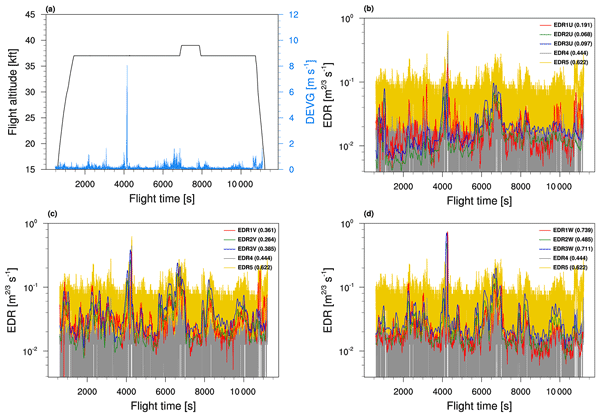
The cube root of the energy dissipation rate (EDR), as a standard reporting metric of atmospheric turbulence, is estimated using 1 Hz commercial quick access recorder data from Korean-based national air carriers with two different types of aircraft. Various EDRs are estimated using zonal, meridional, and derived vertical wind components and the derived equivalent vertical gust. Characteristics of the observed EDR estimates using 1 Hz flight data are examined to observe strong turbulence cases.
Min-Jee Kang and Hye-Yeong Chun
Atmos. Chem. Phys., 21, 9839–9857, https://doi.org/10.5194/acp-21-9839-2021, https://doi.org/10.5194/acp-21-9839-2021, 2021
Short summary
Short summary
In winter 2019/20, the westerly quasi-biennial oscillation (QBO) phase was disrupted again by easterly winds. It is found that strong Rossby waves from the Southern Hemisphere weaken the jet core in early stages, and strong mixed Rossby–gravity waves reverse the wind in later stages. Inertia–gravity waves and small-scale convective gravity waves also provide negative forcing. These strong waves are attributed to an anomalous wind profile, barotropic instability, and slightly strong convection.
Cited articles
Bechtold, P., Bramberger, M., Dörnbrack, A., Isaksen, L., and Leutbecher, M.: Experimenting with a clear air turbulence (CAT) index from the IFS, ECMWF Tech. Memo. 874, https://doi.org/10.21957/4l34tqljm, 2021.
Birner, T.: Fine-scale structure of the extratropical tropopause region, J. Geophys. Res.-Atmos., 111, https://doi.org/10.1029/2005JD006301, 2006.
Chun, H. Y. and Baik, J. J.: Momentum flux by thermally induced internal gravity waves and its approximation for large-scale models, J. Atmos. Sci., 55, 3299–3310, https://doi.org/10.1175/1520-0469(1998)055<3299:MFBTII>2.0.CO;2, 1998.
Clayson, C. A. and Kantha, L.: On turbulence and mixing in the free atmosphere inferred from high-resolution soundings, J. Atmos. Ocean. Tech., 25, 833–852, https://doi.org/10.1175/2007JTECHA992.1, 2008.
Deardorff, J. W.: Stratocumulus-capped mixed layers derived from a three-dimensional model, Bound.-Lay. Meteorol., 18, 495–527, https://doi.org/10.1007/BF00119502, 1980.
Dewan, E. M.: Turbulent vertical transport due to thin intermittent mixing layers in the stratosphere and other stable fluids, Science, 211, 1041–1042, https://doi.org/10.1126/science.211.4486.1041, 1981.
ECMWF: ERA5 reanalysis datasets, European Centre for Medium-Range Weather forecasts [data set], https://doi.org/10.24381/cds.bd0915c6, 2020.
Faber, J., Gerding, M., Schneider, A., Dörnbrack, A., Wilms, H., Wagner, J., and Lübken, F.-J.: Evaluation of wake influence on high-resolution balloon-sonde measurements, Atmos. Meas. Tech., 12, 4191–4210, https://doi.org/10.5194/amt-12-4191-2019, 2019.
Guo, J., Miao, Y., Zhang, Y., Liu, H., Li, Z., Zhang, W., He, J., Lou, M., Yan, Y., Bian, L., and Zhai, P.: The climatology of planetary boundary layer height in China derived from radiosonde and reanalysis data, Atmos. Chem. Phys., 16, 13309–13319, https://doi.org/10.5194/acp-16-13309-2016, 2016.
Hersbach, H., Bell, B., Berrisford, P., Hirahara, S., Horányi, A., Muñoz-Sabater, J., Nicolas, J., Peubey, C., Radu, R., Schepers, D., Simmons, A., Soci, C., Abdalla, S., Abellan, X., Balsamo, G., Bechtold, P., Biavati, G., Bidlot, J., Bonavita, M., De Chiara, G., Dahlgren, P., Dee, D., Diamantakis, M., Dragani, R., Flemming, J., Forbes, R., Fuentes, M., Geer, A., Haimberger, L., Healy, S., Hogan, R. J., Hólm, E., Janisková, M., Keeley, S., Laloyaux, P., Lopez, P., Lupu, C., Radnoti, G., de Rosnay, P., Rozum, I., Vamborg, F., Villaume, S., and Thépaut, J.-N.: The ERA5 global reanalysis, Q. J. Roy. Meteor. Soc., 146, 1999–2049, https://doi.org/10.1002/qj.3803, 2020.
Hoblit, F. M.: Gust loads on aircraft: Concepts and applications, American Institute of Aeronautics and Astronautics, Washington, D.C., ISBN 0930403452, 1988.
Holton, J. R. and Hakim, G. J.: An introduction to dynamic meteorology, in: vol. 88, Academic Press, ISBN 0123848660, 2013.
Houchi, K., Stoffelen, A., Marseille, G. J., and De Kloe, J.: Comparison of wind and wind shear climatologies derived from high-resolution radiosondes and the ECMWF model, J. Geophys. Res.-Atmos., 115, https://doi.org/10.1029/2009JD013196, 2010.
ICAO: Meteorological service for international air navigation, 206 pp., https://www.nabavke.com/tdoc-cejn/documents/47277-2023-06-05-12-45-3.Annex_3_75.pdf (last access: 9 March 2026), 2010.
Ingleby, B., Pauley, P., Kats, A., Ator, J., Keyser, D., Doerenbecher, A., Fucile, E., Hasegawa, J., Toyoda, E., Kleinert, T., and Qu, W.: Progress toward high-resolution, real-time radiosonde reports, B. Am. Meteorol. Soc., 97, 2149–2161, https://doi.org/10.1175/BAMS-D-15-00169.1, 2016.
Janjić, Z. I.: Nonsingular implementation of the Mellor-Yamada level 2.5 scheme in the NCEP Meso model, NCEP Office Note No. 437, NCEP Office, 61 pp., https://repository.library.noaa.gov/view/noaa/11409 (last access: 9 March 2026), 2001.
Kantha, L.: Reinterpretation of the Thorpe length scale, J. Atmos. Sci., 81, 1495–1510, https://doi.org/10.1175/JAS-D-23-0137.1, 2024.
Ki, M. O. and Chun, H. Y.: Characteristics and sources of inertia-gravity waves revealed in the KEOP-2007 radiosonde data, Asia-Pac. J. Atmos. Sci., 46, 261–277, https://doi.org/10.1007/s13143-010-1001-4, 2010.
Kim, J. H., Chun, H. Y., Sharman, R. D., and Keller, T. L.: Evaluations of upper-level turbulence diagnostics performance using the Graphical Turbulence Guidance (GTG) system and pilot reports (PIREPs) over East Asia, J. Appl. Meteorol. Clim., 50, 1936–1951, https://doi.org/10.1175/JAMC-D-10-05017.1, 2011.
Kim, S. H., Chun, H. Y., Sharman, R. D., and Trier, S. B.: Development of near-cloud turbulence diagnostics based on a convective gravity wave drag parameterization, J. Appl. Meteorol. Clim., 58, 1725–1750, https://doi.org/10.1175/JAMC-D-18-0300.1, 2019.
Knox, J. A.: Possible mechanisms of clear-air turbulence in strongly anticyclonic flows, Mon. Weather Rev., 125, 1251–1259, https://doi.org/10.1175/1520-0493(1997)125<1251:PMOCAT>2.0.CO;2, 1997.
Ko, H. C. and Chun, H. Y.: Potential sources of atmospheric turbulence estimated using the Thorpe method and operational radiosonde data in the United States, Atmos. Res., 265, 105891, https://doi.org/10.1016/j.atmosres.2021.105891, 2022.
Ko, H. C. and Chun, H. Y.: Atmospheric turbulence estimation from high vertical-resolution radiosonde data (HVRRD) using the minimum Richardson number. Part 1, Zenodo [data set], https://doi.org/10.5281/zenodo.16899801, 2025a.
Ko, H. C. and Chun, H. Y.: Atmospheric turbulence estimation from high vertical-resolution radiosonde data (HVRRD) using the minimum Richardson number. Part 2, Zenodo [data set], https://doi.org/10.5281/zenodo.16899803, 2025b.
Ko, H. C. and Chun, H. Y.: Atmospheric turbulence estimation from high vertical-resolution radiosonde data (HVRRD) using the minimum Richardson number. Part 3, Zenodo [data set], https://doi.org/10.5281/zenodo.16899805, 2025c.
Ko, H. C. and Chun, H. Y.: Atmospheric turbulence estimation from high vertical-resolution radiosonde data (HVRRD) using the minimum Richardson number. Part 4, Zenodo [data set], https://doi.org/10.5281/zenodo.16810246, 2025d.
Ko, H. C. and Chun, H. Y.: Atmospheric turbulence estimation from high vertical-resolution radiosonde data (HVRRD) using the minimum Richardson number. Part 5, Zenodo [data set], https://doi.org/10.5281/zenodo.16899789, 2025e.
Ko, H. C., Chun, H. Y., Wilson, R., and Geller, M. A.: Characteristics of atmospheric turbulence retrieved from high vertical-resolution radiosonde data in the United States, J. Geophys. Res.-Atmos., 124, 7553–7579, https://doi.org/10.1029/2019JD030287, 2019.
Ko, H. C., Chun, H. Y., Sharman, R. D., and Kim, J. H.: Comparison of eddy dissipation rate estimated from operational radiosonde and commercial aircraft observations in the United States, J. Geophys. Res.-Atmos., 128, e2023JD039352, https://doi.org/10.1029/2023JD039352, 2023.
Ko, H. C., Chun, H. Y., Geller, M. A., and Ingleby, B.: Global distributions of atmospheric turbulence estimated using operational high vertical-resolution radiosonde data, B. Am. Meteorol. Soc., 105, E2551–E2566, https://doi.org/10.1175/BAMS-D-23-0193.1, 2024.
Ko, H. C., Chun, H. Y., and Bechtold, P.: Evaluation and improvement of the ECMWF aviation turbulence forecasts, J. Geophys. Res.-Atmos., 130, e2024JD043158, https://doi.org/10.1029/2024JD043158, 2025.
Koch, P., Wernli, H., and Davies, H. C.: An event-based jet-stream climatology and typology, Int. J. Climatol., 26, 283–301, https://doi.org/10.1002/joc.1255, 2006.
Kohma, M., Sato, K., Tomikawa, Y., Nishimura, K., and Sato, T.: Estimate of turbulent energy dissipation rate from the VHF radar and radiosonde observations in the Antarctic, J. Geophys. Res.-Atmos., 124, 2976–2993, https://doi.org/10.1029/2018JD029521, 2019.
Lane, T. P. and Sharman, R. D.: Some influences of background flow conditions on the generation of turbulence due to gravity wave breaking above deep convection, J. Appl. Meteorol. Clim., 47, 2777–2796, https://doi.org/10.1175/2008JAMC1787.1, 2008.
Lee, D. B., Chun, H. Y., and Kim, J. H.: Evaluation of multimodel-based ensemble forecasts for clear-air turbulence, Weather Forecast., 35, 507–521, https://doi.org/10.1175/WAF-D-19-0155.1, 2020.
Lee, D. B., Chun, H. Y., Kim, S. H., Sharman, R. D., and Kim, J. H.: Development and evaluation of global Korean aviation turbulence forecast systems based on an operational numerical weather prediction model and in situ flight turbulence observation data, Weather Forecast., 37, 371–392, https://doi.org/10.1175/WAF-D-21-0095.1, 2022a.
Lee, S.-W., Kim, S., Lee, Y.-S., Choi, B. I., Kang, W., Oh, Y. K., Park, S., Yoo, J.-K., Lee, J., Lee, S., Kwon, S., and Kim, Y.-G.: Radiation correction and uncertainty evaluation of RS41 temperature sensors by using an upper-air simulator, Atmos. Meas. Tech., 15, 1107–1121, https://doi.org/10.5194/amt-15-1107-2022, 2022b.
Lee, Y. S., Chun, H. Y., and Ko, H. C.: Lower tropospheric states revealed in high vertical-resolution radiosonde data in Korea and synoptic patterns for instability based on a self-organizing map, Atmos. Res., 295, 107037, https://doi.org/10.1016/j.atmosres.2023.107037, 2023.
Li, Q., Rapp, M., Schrön, A., Schneider, A., and Stober, G.: Derivation of turbulent energy dissipation rate with the Middle Atmosphere Alomar Radar System (MAARSY) and radiosondes at Andøya, Norway, Ann. Geophys., 34, 1209–1229, https://doi.org/10.5194/angeo-34-1209-2016, 2016.
Lilly, D.: On the application of the eddy viscosity concept in the inertial sub-range of turbulence, NCAR report, NCAR, https://doi.org/10.5065/D67H1GGQ, 1966.
Lilly, D. K.: On the numerical simulation of buoyant convection, Tellus, 14, 148–172, https://doi.org/10.3402/tellusa.v14i2.9537, 1962.
Lindzen, R. S.: Turbulence and stress owing to gravity wave and tidal breakdown, J. Geophys. Res.-Oceans, 86, 9707–9714, https://doi.org/10.1029/JC086iC10p09707, 1981.
Moeng, C. H. and Wyngaard, J. C.: Spectral analysis of large-eddy simulations of the convective boundary layer, J. Atmos. Sci., 45, 3573–3587, https://doi.org/10.1175/1520-0469(1988)045<3573:SAOLES>2.0.CO;2, 1988.
Muhsin, M., Sunilkumar, S. V., Ratnam, M. V., Parameswaran, K., Murthy, B. K., Ramkumar, G., and Rajeev, K.: Diurnal variation of atmospheric stability and turbulence during different seasons in the troposphere and lower stratosphere derived from simultaneous radiosonde observations at two tropical stations, in the Indian Peninsula, Atmos. Res., 180, 12–23, https://doi.org/10.1016/j.atmosres.2016.04.021, 2016.
Muñoz-Esparza, D., Sharman, R. D., and Trier, S. B.: On the consequences of PBL scheme diffusion on UTLS wave and turbulence representation in high-resolution NWP models, Mon. Weather Rev., 148, 4247–4265, https://doi.org/10.1175/MWR-D-20-0102.1, 2020.
NCEI: High vertical-resolution radiosonde data, National Centers for Environmental Information [data set], https://www.ncei.noaa.gov/data/ecmwf-global-upper-air-bufr/ (last access: 9 March 2026), 2025.
NOAA MADIS: In-situ flight EDR data, National Oceanic and Atmospheric Administration [data set], https://madis-data.cprk.ncep.noaa.gov/madisPublic1/data/archive/ (last access: 9 March 2026), 2025.
Osman, M. K., Hocking, W. K., and Tarasick, D. W.: Parameterization of large-scale turbulent diffusion in the presence of both well-mixed and weakly mixed patchy layers, J. Atmos. Sol.-Terr. Phy., 143, 14–36, https://doi.org/10.1016/j.jastp.2016.02.025, 2016.
Palmer, T. N., Shutts, G. J., and Swinbank, R.: Alleviation of a systematic westerly bias in general circulation and numerical weather prediction models through an orographic gravity wave drag parametrization, Q. J. Roy. Meteor. Soc., 112, 1001–1039, https://doi.org/10.1002/qj.49711247406, 1986.
Sharman, R., Tebaldi, C., Wiener, G., and Wolff, J.: An integrated approach to mid-and upper-level turbulence forecasting, Weather Forecast., 21, 268–287, https://doi.org/10.1175/WAF924.1, 2006.
Sharman, R. D. and Pearson, J. M.: Prediction of energy dissipation rates for aviation turbulence. Part I: Forecasting nonconvective turbulence, J. Appl. Meteorol. Clim., 56, 317–337, https://doi.org/10.1175/JAMC-D-16-0205.1, 2017.
Sharman, R. D., Cornman, L. B., Meymaris, G., Pearson, J., and Farrar, T.: Description and derived climatologies of automated in situ eddy-dissipation-rate reports of atmospheric turbulence, J. Appl. Meteorol. Clim., 53, 1416–1432, https://doi.org/10.1175/JAMC-D-13-0329.1, 2014.
Shin, H. H. and Hong, S. Y.: Intercomparison of planetary boundary-layer parametrizations in the WRF model for a single day from CASES-99, Bound.-Lay. Meteorol., 139, 261–281, https://doi.org/10.1007/s10546-010-9583-z, 2011.
Shin, H. H., Deierling, W., and Sharman, R.: A comparative study of various approaches for producing probabilistic forecasts of upper-level aviation turbulence, Weather Forecast., 38, 139–161, https://doi.org/10.1175/WAF-D-22-0086.1, 2023.
Smagorinsky, J.: General circulation experiments with the primitive equations: I. The basic experiment, Mon. Weather Rev., 91, 99–164, https://doi.org/10.1175/1520-0493(1963)091<0099:GCEWTP>2.3.CO;2, 1963.
Sunilkumar, S. V., Muhsin, M., Venkat Ratnam, M., Parameswaran, K., Krishna Murthy, B. V., and Emmanuel, M.: Boundaries of tropical tropopause layer (TTL): A new perspective based on thermal and stability profiles, J. Geophys. Res.-Atmos., 122, 741–754, https://doi.org/10.1002/2016JD025217, 2017.
Thorpe, S. A.: Turbulence and mixing in a Scottish loch, Philos. T. R. Soc. S. A, 286, 125–181, https://doi.org/10.1098/rsta.1977.0112, 1977.
Thorpe, S. A.: The turbulent ocean, Cambridge University Press, https://doi.org/10.1017/CBO9780511819933, 2005.
von Rohden, C., Sommer, M., Naebert, T., Motuz, V., and Dirksen, R. J.: Laboratory characterisation of the radiation temperature error of radiosondes and its application to the GRUAN data processing for the Vaisala RS41, Atmos. Meas. Tech., 15, 383–405, https://doi.org/10.5194/amt-15-383-2022, 2022.
Wang, L. and Geller, M. A.: Temperature fluctuations of different vertical scales in raw and processed US high vertical-resolution radiosonde data, J. Atmos. Ocean. Tech., 42, 309–317, https://doi.org/10.1175/JTECH-D-24-0012.1, 2025.
Wilson, R., Luce, H., Dalaudier, F., and Lefrère, J.: Turbulence patch identification in potential density or temperature profiles, J. Atmos. Ocean. Tech., 27, 977–993, https://doi.org/10.1175/2010JTECHA1357.1, 2010.
Wilson, R., Dalaudier, F., and Luce, H.: Can one detect small-scale turbulence from standard meteorological radiosondes?, Atmos. Meas. Tech., 4, 795–804, https://doi.org/10.5194/amt-4-795-2011, 2011.
Wilson, R., Luce, H., Hashiguchi, H., Shiotani, M., and Dalaudier, F.: On the effect of moisture on the detection of tropospheric turbulence from in situ measurements, Atmos. Meas. Tech., 6, 697–702, https://doi.org/10.5194/amt-6-697-2013, 2013.
WMO: Definition of the tropopause, WMO Bull. 6, 125–167, https://library.wmo.int/idurl/4/42003 (last access: 9 March 2026), 1957.
Yoo, J. H., Song, I. S., Chun, H. Y., and Song, B. G.: Inertia-gravity waves revealed in radiosonde data at Jang Bogo Station, Antarctica (74°37′ S, 164°13′ E): 2. Potential sources and their relation to inertia-gravity waves, J. Geophys. Res.-Atmos., 125, e2019JD032260, https://doi.org/10.1029/2019JD032260, 2020.
Zhang, J., Chen, H., Li, Z., Fan, X., Peng, L., Yu, Y., and Cribb, M.: Analysis of cloud layer structure in Shouxian, China using RS92 radiosonde aided by 95 GHz cloud radar, J. Geophys. Res.-Atmos., 115, https://doi.org/10.1029/2010JD014030, 2010.
Zhang, J., Zhang, S. D., Huang, C. M., Huang, K. M., Gong, Y., Gan, Q., and Zhang, Y. H.: Statistical study of atmospheric turbulence by Thorpe analysis, J. Geophys. Res.-Atmos., 124, 2897–2908, https://doi.org/10.1029/2018JD029686, 2019.
Zhang, J., Guo, J., Zhang, S., and Shao, J.: Inertia-gravity wave energy and instability drive turbulence: evidence from a near-global high-resolution radiosonde dataset, Clim. Dynam., 58, 2927–2939, https://doi.org/10.1007/s00382-021-06075-2, 2022.
Short summary
We developed a new method to detect turbulence in the atmosphere using global high-resolution balloon measurements of temperature and wind. Unlike earlier methods, ours can detect turbulence not only in unstable air but also in stable layers with strong wind changes. This approach better matches aircraft turbulence reports and reveals global patterns, such as seasonal shifts linked to jet streams and convection, helping improve flight safety and our understanding of extreme weather.
We developed a new method to detect turbulence in the atmosphere using global high-resolution...
Altmetrics
Final-revised paper
Preprint