Articles | Volume 18, issue 2
https://doi.org/10.5194/essd-18-1463-2026
© Author(s) 2026. This work is distributed under
the Creative Commons Attribution 4.0 License.
the Creative Commons Attribution 4.0 License.
https://doi.org/10.5194/essd-18-1463-2026
© Author(s) 2026. This work is distributed under
the Creative Commons Attribution 4.0 License.
the Creative Commons Attribution 4.0 License.
Data description article
| 
25 Feb 2026
Data description article |
| 25 Feb 2026
| 25 Feb 2026
More than a century of oceanic hydrography observations reveals profound climate-related changes in the Northwest Atlantic Ocean and its Arctic Gateways
Jonathan Coyne
CORRESPONDING AUTHOR

Northwest Atlantic Fisheries Centre, Fisheries and Oceans Canada, St. John's, NL, Canada
Centre for Fisheries and Ecosystem Research, Fisheries and Marine Institute of Memorial University, St. John's, NL, Canada
formerly at: Northwest Atlantic Fisheries Centre, Fisheries and Oceans Canada, St. John’s, NL, Canada
Sheila Atchison
Freshwater Institute, Fisheries and Oceans Canada, Winnipeg, MB, Canada
Charlie Bishop
Northwest Atlantic Fisheries Centre, Fisheries and Oceans Canada, St. John's, NL, Canada
Sébastien Donnet
Institut National des Sciences et Techniques de la Mer, Cherbourg, France
Peter S. Galbraith
Maurice-Lamontagne Institute, Fisheries and Oceans Canada, Mont-Joli, QC, Canada
Maxime Geoffroy
Centre for Fisheries and Ecosystem Research, Fisheries and Marine Institute of Memorial University, St. John's, NL, Canada
Department of Arctic and Marine Biology, UiT, The Arctic University of Norway, Tromsø, Norway
David Hebert
Bedford Institute of Oceanography, Fisheries and Oceans Canada, Dartmouth, NS, Canada
Chantelle Layton
Bedford Institute of Oceanography, Fisheries and Oceans Canada, Dartmouth, NS, Canada
Andry Ratsimandresy
Northwest Atlantic Fisheries Centre, Fisheries and Oceans Canada, St. John's, NL, Canada
Jose-Luis del Rio Iglesias
Servicios Centrales, Instituto Español de Oceanografía, Madrid, Spain
Jean-Luc Shaw
Maurice-Lamontagne Institute, Fisheries and Oceans Canada, Mont-Joli, QC, Canada
Stephen Snook
Northwest Atlantic Fisheries Centre, Fisheries and Oceans Canada, St. John's, NL, Canada
Nancy Soontiens
Northwest Atlantic Fisheries Centre, Fisheries and Oceans Canada, St. John's, NL, Canada
Elena Tel
Centro Oceanografío de Vigo, Instituto Español de Oceanografía, Vigo, Spain
Wojciech Walkusz
Freshwater Institute, Fisheries and Oceans Canada, Winnipeg, MB, Canada
Related authors
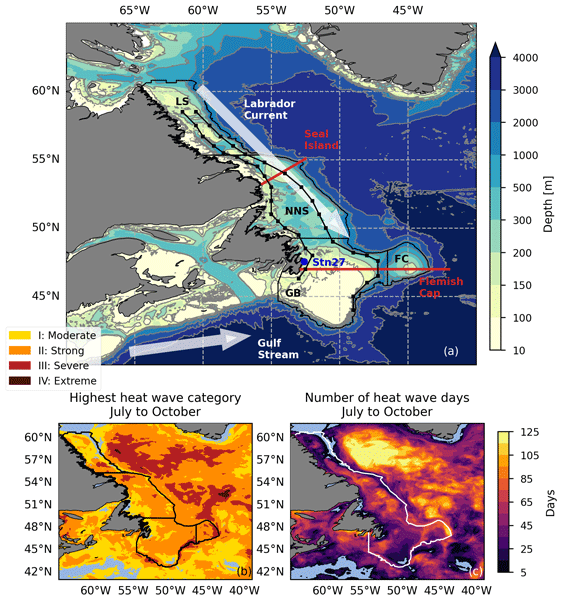
Nancy Soontiens, Heather J. Andres, Jonathan Coyne, Frédéric Cyr, Peter S. Galbraith, and Jared Penney
State Planet, 6-osr9, 12, https://doi.org/10.5194/sp-6-osr9-12-2025, https://doi.org/10.5194/sp-6-osr9-12-2025, 2025
Short summary
Short summary
In this study, we explored a series of surface marine heat waves over the Newfoundland and Labrador Shelf in the summer and fall of 2023. We connected these marine heat waves to environmental conditions and found that low winds, high freshwater density, and high stratification were factors contributing to the unusually high sea surface temperature anomalies. We explored the vertical structure of temperature anomalies and found that the heat waves were confined near the surface for most of the summer.
Youyu Lu, Li Zhai, Xianmin Hu, Chantelle Layton, David Brickman, Blair Greenan, and Gilles Garric
State Planet Discuss., https://doi.org/10.5194/sp-2026-26, https://doi.org/10.5194/sp-2026-26, 2026
Preprint under review for SP
Short summary
Short summary
Ocean temperature is a key factor influencing marine ecosystem. On Scotian Shelf, the observed ocean bottom temperatures show strong year-to-year variations of 2–5 degrees in Celsius, and a decade-long warm phase ended since summer of 2023. Analysis of a numerical modelling product revealed causes of warm and cool events including winter heat loss at sea surface and lateral water transport by ocean flows. The influence of complicated ocean dynamics calls for innovative methods for prediction.
Manuel Vargas-Yáñez, Orens Pasqueron de Fommervault, Emanuela Clementi, Christian Ferrarin, Svitlana Liubertseva, Diego Álvarez-Berastegui, Baptiste Mourre, Salvatore Aronica, Rosa Balbin, Joaquín Ballabrera-Poy, Sana Ben Ismail, Nathaniel Benssousan, Ismail Bessa, Alicia Blanco, Anthony Bosse, Evi Bourma, François Bourrin, Carlo Brandini, Fulvio Capodici, Clara Casals-Baixas, Branko Cermelj, Giuseppe Ciraolo, Pascal Conan, Laurent Coppola, Lorenzo Corgnati, Joaquín del Río, Emilie Diamond Riquier, Lara Diaz-Barroso, Bartolomeo Doronzo, Xavier Durrieu de Madron, Milad Fakhri, Costantine Frangoulis, Claudia Fratianni, Emilio García-Ladona, Jesus García-Lafuente, M. Carmen García-Martínez, Joaquín Garrabou, Josep Gasol, Adam Gauci, Frédéric Gazeau, Gerard Gregory, Abed El Raman Hassoun, Jordi Isern-Fontanet, Dominique Lefevre, Nadia Lo Bue, Guiomar López, Pablo Lorente, Deny Malengros, Ramon Massana, Sinan Mavruk, Stefano Miserocchi, Behzad Mostajir, Laure Mousseau, Francina Moya, Antonio Novellino, Arianna Orasi, Emanuele Organelli, Vicent Ouisse, Tal Ozer, Begoña Pérez-Gómez, Susana Pérez-Rubio, Leonidas Perivoliotis, Georges Petihakis, Anne Petrenko, Sebastien Pinel, Xavier Pitarch, Angela Pomaro, Lucía Quirós-Collazos, Emma Reyes, Simone Sammartino, Anna Sánchez-Vidal, Katrin Schroeder, Stefano Taddei, Elena Tel, Pierre Testor, Marco Torri, Daniela Turk, Laura Ursella, Dimitris Velaoras, Francesca Vidussi, Ivica Vilivić, Enrico Zambiachi, D. Nikolaos Zarokanellos, George Zodiatis, and Vanessa Cardin
EGUsphere, https://doi.org/10.5194/egusphere-2026-2632, https://doi.org/10.5194/egusphere-2026-2632, 2026
Short summary
Short summary
This work compiles current marine observation capabilities in the Mediterranean Sea, making this information accessible to scientists, organizations, stakeholders, and environmental policymakers. It supports initiatives such as Copernicus Marine Service, EMODNet, the European Ocean Pact, and EU directives. It is intended as a living resource to be updated, identifying strengths and gaps in Mediterranean observation systems.
Mireia G. Mingote, Frédéric Cyr, Eve Galimany, Ricardo Santos-Bethencourt, Jordi Isern-Fontanet, Jordi Ribera-Altimir, Joan Sala-Coromina, Mariona Panisello-Garriga, and Joan B. Company
EGUsphere, https://doi.org/10.5194/egusphere-2026-1554, https://doi.org/10.5194/egusphere-2026-1554, 2026
This preprint is open for discussion and under review for Biogeosciences (BG).
Short summary
Short summary
We studied more than fifty years of Norway lobster catches in the northwestern Mediterranean to understand why they have dropped since the mid 2010s. By combining fishing records with ocean data, we found that warmer and saltier mid-depth waters are strongly linked to lower catches and slight shifts to deeper areas. Changes in ocean currents also play a role. These results show that climate change, not just fishing, is affecting this resource and should be included in management decisions.
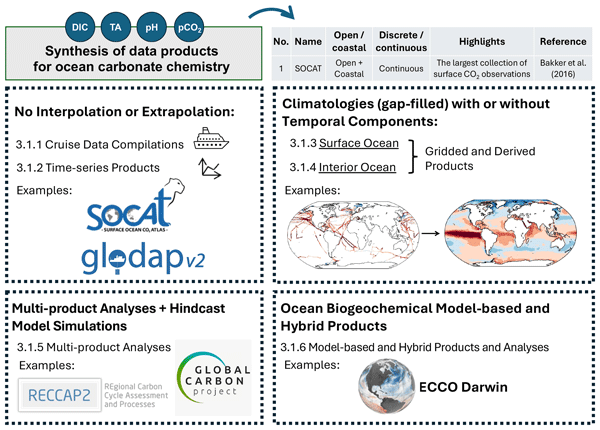
Li-Qing Jiang, Amanda Fay, Jens Daniel Müller, Luke Gregor, Alizée Roobaert, Lydia Keppler, Dustin Carroll, Siv K. Lauvset, Tim DeVries, Judith Hauck, Christian Rödenbeck, Nicolas Metzl, Andrea J. Fassbender, Jean-Pierre Gattuso, Peter Landschützer, Rik Wanninkhof, Christopher Sabine, Simone R. Alin, Mario Hoppema, Are Olsen, Matthew P. Humphreys, Kunal Chakraborty, Ana C. Franco, Kumiko Azetsu-Scott, Dorothee C. E. Bakker, Leticia Barbero, Nicholas R. Bates, Nicole Besemer, Henry C. Bittig, Albert E. Boyd, Daniel Broullón, Wei-Jun Cai, Brendan R. Carter, Thi-Tuyet-Trang Chau, Chen-Tung Arthur Chen, Frédéric Cyr, John E. Dore, Ian Enochs, Richard A. Feely, Hernan E. Garcia, Marion Gehlen, Prasanna Kanti Ghoshal, Lucas Gloege, Melchor González-Dávila, Nicolas Gruber, Debby Ianson, Yosuke Iida, Masao Ishii, Apurva Padamnabh Joshi, Esther Kennedy, Alex Kozyr, Nico Lange, Claire Lo Monaco, Derek P. Manzello, Galen A. McKinley, Natalie M. Monacci, Xose A. Padin, Ana M. Palacio-Castro, Fiz F. Pérez, J. Magdalena Santana-Casiano, Jonathan Sharp, Adrienne Sutton, Jim Swift, Toste Tanhua, Maciej Telszewski, Jens Terhaar, Ruben van Hooidonk, Anton Velo, Andrew J. Watson, Angelicque E. White, Zelun Wu, Liang Xue, Hyelim Yoo, Jiye Zeng, and Guorong Zhong
Earth Syst. Sci. Data, 18, 1405–1462, https://doi.org/10.5194/essd-18-1405-2026, https://doi.org/10.5194/essd-18-1405-2026, 2026
Short summary
Short summary
This review article provides an overview of 68 existing ocean carbonate chemistry data products and data product sets, encompassing a broad range of types, including compilations of cruise datasets, gap-filled observational products, model simulations, and more. It is designed to help researchers identify and access the data products that best support their scientific objectives, thereby facilitating progress in understanding the ocean's changing carbonate chemistry.
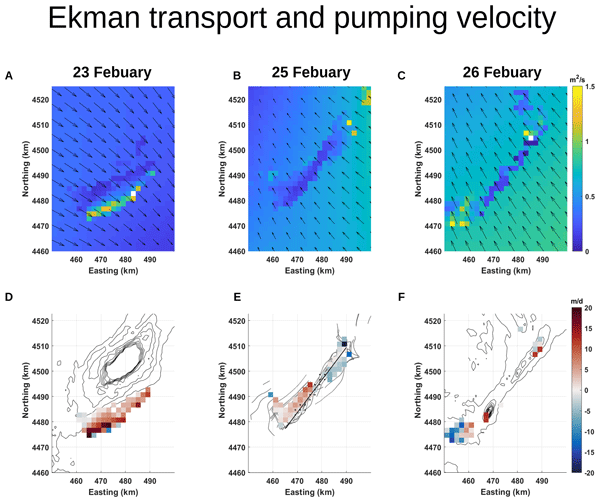
Sebastien Donnet, Helga S. Huntley, Maristella Berta, Luca Centurioni, Leo Middleton, Tamay Özgökmen, Pierre-Marie Poulain, Alex Kinsella, and Annalisa Griffa
Ocean Sci., 21, 3221–3240, https://doi.org/10.5194/os-21-3221-2025, https://doi.org/10.5194/os-21-3221-2025, 2025
Short summary
Short summary
Oceanographic and atmospheric data is used to study the properties and evolution of an eddy in the Balearic Sea. During the period of observation, this eddy elongates and splits. The unusually dense set of observations from satellites, drifters, and ship-mounted instruments provide insight into this splitting process. In particular, the contribution from the wind is assessed. These mechanisms are known to impact the vertical exchanges of oxygen, carbon dioxide, nutrients, and pollutants.
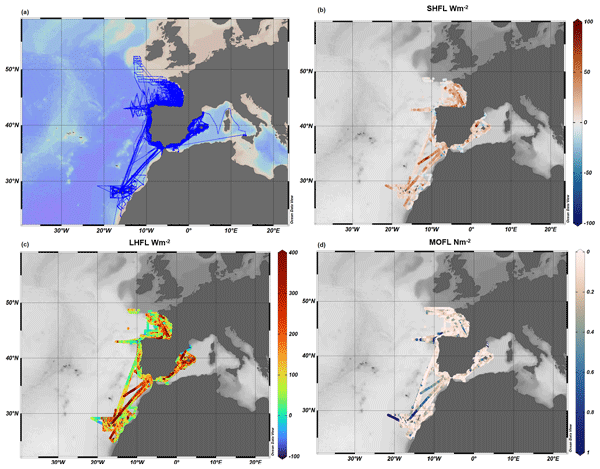
Ángel Sánchez-Lorente, Elena Tel, Lucía Sanz-Pinilla, and Gonzalo González-Nuevo González
Earth Syst. Sci. Data, 17, 5729–5744, https://doi.org/10.5194/essd-17-5729-2025, https://doi.org/10.5194/essd-17-5729-2025, 2025
Short summary
Short summary
This study has been done within the framework of JAE INTRO-ICU fellowship of the Instituto Español de Oceanografía, with an interest in understanding the interaction between the ocean and atmosphere in a climate change context using experimental measurements aboard research vessels over Spanish waters. The distinct behaviour in the different basins of the Spanish waters is reflected, and the need for further investment in experimental observations due to its great usefulness is also evidenced.
Nancy Soontiens, Heather J. Andres, Jonathan Coyne, Frédéric Cyr, Peter S. Galbraith, and Jared Penney
State Planet, 6-osr9, 12, https://doi.org/10.5194/sp-6-osr9-12-2025, https://doi.org/10.5194/sp-6-osr9-12-2025, 2025
Short summary
Short summary
In this study, we explored a series of surface marine heat waves over the Newfoundland and Labrador Shelf in the summer and fall of 2023. We connected these marine heat waves to environmental conditions and found that low winds, high freshwater density, and high stratification were factors contributing to the unusually high sea surface temperature anomalies. We explored the vertical structure of temperature anomalies and found that the heat waves were confined near the surface for most of the summer.
Adam M. Cook, Youyu Lu, Xianmin Hu, David Brickman, David Hebert, Chantelle Layton, and Gilles Garric
State Planet, 6-osr9, 8, https://doi.org/10.5194/sp-6-osr9-8-2025, https://doi.org/10.5194/sp-6-osr9-8-2025, 2025
Short summary
Short summary
Ocean bottom temperatures from a global ocean reanalysis product are found to be consistent with in situ observations on the Scotian Shelf. Statistical analysis reveals a positive relationship between changes in lobster catch rate and ocean bottom temperature off the southwest coast of Nova Scotia during 2008–2023. A standardized lobster catch rate index with the influence of bottom temperature included is more consistent with available stock biomass compared to the index without such an influence.
Igor A. Dmitrenko, Vladislav Petrusevich, Andreas Preußer, Ksenia Kosobokova, Caroline Bouchard, Maxime Geoffroy, Alexander S. Komarov, David G. Babb, Sergei A. Kirillov, and David G. Barber
Ocean Sci., 20, 1677–1705, https://doi.org/10.5194/os-20-1677-2024, https://doi.org/10.5194/os-20-1677-2024, 2024
Short summary
Short summary
The diel vertical migration (DVM) of zooplankton is one of the largest species migrations to occur globally and is a key driver of regional ecosystems. Here, time series of acoustic data collected at the circumpolar Arctic polynya system were used to examine the annual cycle of DVM. We revealed that the formation of polynya open water disrupts DVM. This disruption is attributed to a predator avoidance behavior of zooplankton in response to higher polar cod abundance attracted by the polynya.
Olivia Gibb, Frédéric Cyr, Kumiko Azetsu-Scott, Joël Chassé, Darlene Childs, Carrie-Ellen Gabriel, Peter S. Galbraith, Gary Maillet, Pierre Pepin, Stephen Punshon, and Michel Starr
Earth Syst. Sci. Data, 15, 4127–4162, https://doi.org/10.5194/essd-15-4127-2023, https://doi.org/10.5194/essd-15-4127-2023, 2023
Short summary
Short summary
The ocean absorbs large quantities of carbon dioxide (CO2) released into the atmosphere as a result of the burning of fossil fuels. This, in turn, causes ocean acidification, which poses a major threat to global ocean ecosystems. In this study, we compiled 9 years (2014–2022) of ocean carbonate data (i.e., ocean acidification parameters) collected in Atlantic Canada as part of the Atlantic Zone Monitoring Program.
Jean-Philippe Paquin, François Roy, Gregory C. Smith, Sarah MacDermid, Ji Lei, Frédéric Dupont, Youyu Lu, Stephanne Taylor, Simon St-Onge-Drouin, Hauke Blanken, Michael Dunphy, and Nancy Soontiens
EGUsphere, https://doi.org/10.5194/egusphere-2023-42, https://doi.org/10.5194/egusphere-2023-42, 2023
Preprint withdrawn
Short summary
Short summary
This paper present the Coastal Ice-Ocean Prediction System implemented operationally at Environment and climate change Canada. The objective is to enhance the numerical guidance in coastal areas to support electronic navigation and response to environmental emergencies in the aquatic environment. Model evaluation against observations shows improvements for most surface ocean variables in the coastal system compared to current coarser-resolution operational systems.
Stéphanie Barrillon, Robin Fuchs, Anne A. Petrenko, Caroline Comby, Anthony Bosse, Christophe Yohia, Jean-Luc Fuda, Nagib Bhairy, Frédéric Cyr, Andrea M. Doglioli, Gérald Grégori, Roxane Tzortzis, Francesco d'Ovidio, and Melilotus Thyssen
Biogeosciences, 20, 141–161, https://doi.org/10.5194/bg-20-141-2023, https://doi.org/10.5194/bg-20-141-2023, 2023
Short summary
Short summary
Extreme weather events can have a major impact on ocean physics and biogeochemistry, but their study is challenging. In May 2019, an intense storm occurred in the north-western Mediterranean Sea, during which in situ multi-platform measurements were performed. The results show a strong impact on the surface phytoplankton, highlighting the need for high-resolution measurements coupling physics and biology during these violent events that may become more common in the context of global change.
Begoña Pérez Gómez, Ivica Vilibić, Jadranka Šepić, Iva Međugorac, Matjaž Ličer, Laurent Testut, Claire Fraboul, Marta Marcos, Hassen Abdellaoui, Enrique Álvarez Fanjul, Darko Barbalić, Benjamín Casas, Antonio Castaño-Tierno, Srđan Čupić, Aldo Drago, María Angeles Fraile, Daniele A. Galliano, Adam Gauci, Branislav Gloginja, Víctor Martín Guijarro, Maja Jeromel, Marcos Larrad Revuelto, Ayah Lazar, Ibrahim Haktan Keskin, Igor Medvedev, Abdelkader Menassri, Mohamed Aïssa Meslem, Hrvoje Mihanović, Sara Morucci, Dragos Niculescu, José Manuel Quijano de Benito, Josep Pascual, Atanas Palazov, Marco Picone, Fabio Raicich, Mohamed Said, Jordi Salat, Erdinc Sezen, Mehmet Simav, Georgios Sylaios, Elena Tel, Joaquín Tintoré, Klodian Zaimi, and George Zodiatis
Ocean Sci., 18, 997–1053, https://doi.org/10.5194/os-18-997-2022, https://doi.org/10.5194/os-18-997-2022, 2022
Short summary
Short summary
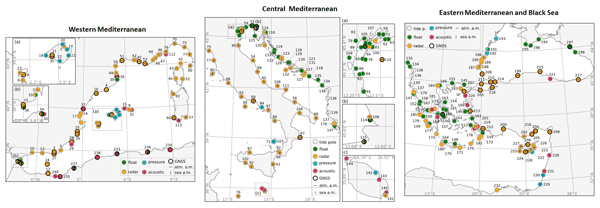
This description and mapping of coastal sea level monitoring networks in the Mediterranean and Black seas reveals the existence of 240 presently operational tide gauges. Information is provided about the type of sensor, time sampling, data availability, and ancillary measurements. An assessment of the fit-for-purpose status of the network is also included, along with recommendations to mitigate existing bottlenecks and improve the network, in a context of sea level rise and increasing extremes.

Roxane Tzortzis, Andrea M. Doglioli, Stéphanie Barrillon, Anne A. Petrenko, Francesco d'Ovidio, Lloyd Izard, Melilotus Thyssen, Ananda Pascual, Bàrbara Barceló-Llull, Frédéric Cyr, Marc Tedetti, Nagib Bhairy, Pierre Garreau, Franck Dumas, and Gérald Gregori
Biogeosciences, 18, 6455–6477, https://doi.org/10.5194/bg-18-6455-2021, https://doi.org/10.5194/bg-18-6455-2021, 2021
Short summary
Short summary
This work analyzes an original high-resolution data set collected in the Mediterranean Sea. The major result is the impact of a fine-scale frontal structure on the distribution of phytoplankton groups, in an area of moderate energy with oligotrophic conditions. Our results provide an in situ confirmation of the findings obtained by previous modeling studies and remote sensing about the structuring effect of the fine-scale ocean dynamics on the structure of the phytoplankton community.
Cynthia Evelyn Bluteau, Peter S. Galbraith, Daniel Bourgault, Vincent Villeneuve, and Jean-Éric Tremblay
Ocean Sci., 17, 1509–1525, https://doi.org/10.5194/os-17-1509-2021, https://doi.org/10.5194/os-17-1509-2021, 2021
Short summary
Short summary
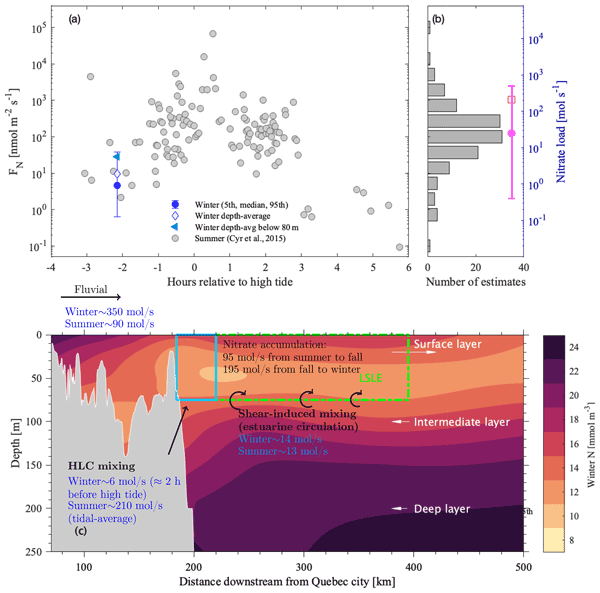
In 2018, the Canadian Coast Guard approved a science team to sample in tandem with its ice-breaking and ship escorting operations. This collaboration provided the first mixing observations during winter that covered the largest spatial extent of the St. Lawrence Estuary and the Gulf of St. Lawrence ever measured in any season. Contrary to previous assumptions, we demonstrate that fluvial nitrate inputs from upstream (i.e., Great Lakes) are the most significant source of nitrate in the estuary.
Cited articles
Andres, H. J., Soontiens, N., Penney, J., and Cyr, F.: Seasonal variations of the cold intermediate layer on the Newfoundland and Labrador Shelf, Progress in Oceanography, 229, 103379, https://doi.org/10.1016/j.pocean.2024.103379, 2024. a
Belkin, I. M.: Propagation of the “Great Salinity Anomaly” of the 1990s around the northern North Atlantic, Geophysical Research Letters, 31, 4–7, https://doi.org/10.1029/2003GL019334, 2004. a
Belkin, I. M., Levitus, S., Antonov, J., and Malmberg, S. A.: “Great Salinity Anomalies” in the North Atlantic, Progress in Oceanography, 41, 1–68, https://doi.org/10.1016/S0079-6611(98)00015-9, 1998. a
Boyer, T., Domingues, C. M., Good, S. A., Johnson, G. C., Lyman, J. M., Ishii, M., Gouretski, V., Willis, J. K., Antonov, J., Wijffels, S., Church, J. A., Cowley, R., and Bindoff, N. L.: Sensitivity of Global Upper-Ocean Heat Content Estimates to Mapping Methods , XBT Bias Corrections , and Baseline Climatologies, Journal of Climate, 29, 4817–4842, https://doi.org/10.1175/JCLI-D-15-0801.1, 2016. a
Casas, J., Roman Marcote, E., Del rio, J., Blanco Perez, R., and Tel, E.: NAFO-EU-Spain-SL, An ocean variables dataset from the Spanish Oceanographic Surveys at NAFO Regulatory Area, SEANOE [data set], https://doi.org/10.17882/108300, 2025. a
Chen, K., Gawarkiewicz, G., and Yang, J.: Mesoscale and Submesoscale Shelf-Ocean Exchanges Initialize an Advective Marine Heatwave, Journal of Geophysical Research: Oceans, 127, https://doi.org/10.1029/2021JC017927, 2022. a
Cheng, L., Abraham, J., Goni, G., Boyer, T., Wijffels, S., Cowley, R., Gouretski, V., Reseghetti, F., Kizu, S., Dong, S., Bringas, F., Goes, M., Houpert, L., Sprintall, J., and Zhu, J.: XBT science: Assessment of instrumental biases and errors, Bulletin of the American Meteorological Society, 97, 923–933, https://doi.org/10.1175/BAMS-D-15-00031.1, 2016. a, b, c
Cheng, L., Luo, H., Boyer, T., Cowley, R., Abraham, J., Gouretski, V., Reseghetti, F., and Zhu, J.: How Well Can We Correct Systematic Errors in Historical XBT Data ?, Journal of Atmospheric and Oceanic Technology, 35, 1103–1125, https://doi.org/10.1175/JTECH-D-17-0122.1, 2018. a
Clark, D., Politis, P., Beazley, L., Foley, C., Kostovick, P., MacMahon, M., Martin, R., and Melrose, C.: Working Group on Northwest Atlantic Ecosystem Observations (WGNAEO), ICES Scientific Reports, 4, https://doi.org/10.17895/ices.pub.20473014, 2022. a, b
Cowley, R., Wijffels, S., Cheng, L., Boyer, T., and Kizu, S.: Biases in Expendable Bathythermograph Data: A New View Based on Historical Side-by-Side Comparisons, Journal of Atmospheric and Oceanic Technology, 30, 1195–1225, https://doi.org/10.1175/JTECH-D-12-00127.1, 2013. a
Coyne, J.: jn533213/CASTS: CASTS Data Product Code, Zenodo [code], https://doi.org/10.5281/zenodo.18701275, 2026. a
Coyne, J., Cyr, F., Donnet, S., Galbraith, P., Geoffroy, M., Hebert, D., Layton, C., Ratsimandresy, A., Snook, S., Soontiens, N., and Walkusz, W.: Canadian Atlantic Shelf Temperature-Salinity (CASTS), Federated Research Data Repository (FRDR) [data set], https://doi.org/10.20383/103.01462, 2023. a, b, c, d, e
Cyr, F. and Galbraith, P. S.: A climate index for the Newfoundland and Labrador shelf, Earth Syst. Sci. Data, 13, 1807–1828, https://doi.org/10.5194/essd-13-1807-2021, 2021. a, b, c
Cyr, F. and Galbraith, P. S.: Newfoundland-Labrador Shelf, in: ICES Report on ocean climate, edited by: González-Pola, C., Larsen, K. M. H., Fratantoni, P., and Beszczynska-Möller, A., ICES Cooperative Research Reports, Copenhagen, DK, 358, chap. 4.3, 36–39, https://doi.org/10.17895/ices.pub.24755574, 2023. a
Cyr, F., Adamack, A., Bélanger, D., Mullowney, D., Murphy, H., and Pepin, P.: Environmental Control on the Productivity of a Heavily Fished Ecosystem, Research Square [preprint], https://doi.org/10.21203/rs.3.rs-4108948/v1, 2024a. a
Cyr, F., Coyne, J., Snook, S., Bishop, C., Galbraith, P. S., Chen, N., and Han, G.: Physical Oceanographic Conditions on the Newfoundland and Labrador Shelf during 2023, vol. 382, ISBN 9780660488059, 2024b. a
Cyr, F., Adamack, A. T., Bélanger, D., Koen-Alonso, M., Mullowney, D., Murphy, H., Regular, P., and Pepin, P.: Environmental control on the productivity of a heavily fished ecosystem, Nature Communications, 16, 5277, https://doi.org/10.1038/s41467-025-60453-6, 2025. a, b
Deser, C., Alexander, M. A., Xie, S. P., and Phillips, A. S.: Sea surface temperature variability: Patterns and mechanisms, Annual Review of Marine Science, 2, 115–143, https://doi.org/10.1146/annurev-marine-120408-151453, 2010. a, b
Desplanque, C. and Mossman, D. J.: Bay of fundy tides, Geoscience Canada, 28, 1–11, 2001. a
DeYoung, B. and Rose, G.: On Recruitment and Distribution of Atlantic Cod (Gadus morhua) off Newfoundland, Can. J. Fish. Aquat. Sci., 50, 2729–2741, 1993. a
Dickson, R. R., Meincke, J., Malmberg, S. A., and Lee, A.: The “great salinity anomaly” in the northern North Atlantic 1968–1982, Progress in Oceanography, 20, 103–151, 1988. a
Donnet, S., Ratsimandresy, A. W., Goulet, P., Doody, C., Burke, S., and Cross, S.: Coast of Bays Metrics: Geography, Hydrology and Physical Oceanography of an Aquaculture Area of the South Coast of Newfoundland, DFO Can. Sci. Advis. Sec. Res. Doc, 2017/076, 109 pp., http://www.dfo-mpo.gc.ca/csas-sccs/ (last access: 19 February 2026), 2018. a, b
Drinkwater, K. F.: Atmospheric and oceanic variability in the northwest Atlantic during the 1980s and early 1990s, Journal of Northwest Atlantic Fishery Science, 18, 77–97, https://doi.org/10.2960/J.v18.a6, 1996. a
Emery, W. J., Lee, W., Zenk, W., and Meincke, J.: A Low-Cost Digital XBT System and its Application to the Real-Time Computation of Dynamic Height, Journal of Atmospheric and Oceanic Technology, 3, 75–83, 1986. a
Florindo-López, C., Bacon, S., Aksenov, Y., Chafik, L., Colbourne, E., and Holliday, N. P.: Arctic Ocean and Hudson Bay Freshwater Exports: New Estimates from Seven Decades of Hydrographic Surveys on the Labrador Shelf, Journal of Climate, 33, 8849–8868, https://doi.org/10.1175/JCLI-D-19-0083.1, 2020. a, b, c, d
Galbraith, P., Lizotte, M., Blais, M., Bélanger, D., Casault, B., Coyne, J., Layton, C., Azetsu-Scott, K., Beazley, L., Chassé, J., Clay, S., Cyr, F., Devred, E., Fudge, A., Gabriel, C.-E., Greenan, B., Hébert, A.-J., Johnson, C., Maillet, G., Penney, J., Rastin, S., Ringuette, M., Shaw, J.-L., Snook, S., and Starr, M.: Oceanographic conditions in the Atlantic zone in 2024, Can. Tech. Rep. Hydrogr. Ocean. Sci., v + x pp., https://doi.org/10.60825/e92v-d229, 2025. a, b, c
Galbraith, P. S., Chassé, J., Shaw, J.-L., Dumas, J., and Bourassa, M.-N.: Physical Oceanographic Conditions in the Gulf of St. Lawrence during 2023, Can. Tech. Rep. Hydrogr. Ocean Sci., 378, v + 91 p., 13. https://doi.org/10.60825/eznq-0815, 2024. a
GEBCO Bathymetric Compilation Group: The GEBCO_2023 Grid – a continuous terrain model of the global oceans and land, NERC EDS British Oceanographic Data Centre NOC [data set], https://doi.org/10.5285/f98b053b-0cbc-6c23-e053-6c86abc0af7b, 2023. a
Gilbert, D., Sundby, B., Gobeil, C., Mucci, A., and Tremblay, G. H.: A seventy-two-year record of diminishing deep-water oxygen in the St. Lawrence estuary: The northwest Atlantic connection, Limnology and Oceanography, 50, 1654–1666, https://doi.org/10.4319/lo.2005.50.5.1654, 2005. a
Gregory, D.: Climate: A database of Temperature and salinity Observations for the Northwest Atlantic, Can. Sci. Advis. Sec. Res. Doc., 2004/075, http://www.dfo-mpo.gc.ca/csas/%5Cnhttp://scholar.google.com/scholar?hl=en&btnG=Search&q=intitle:Climate:+A+database+of+Temperature+and+salinity+Observations+for+the+Northwest+Atlantic#0 (last access; 18 September 2015), 2004. a, b, c, d, e, f
Haine, T. W. N., Curry, B., Gerdes, R., Hansen, E., Karcher, M., Lee, C., Rudels, B., Spreen, G., Steur, L. D., Stewart, K. D., and Woodgate, R.: Arctic freshwater export: Status, mechanisms, and prospects, Global and Planetary Change, 125, 13–35, https://doi.org/10.1016/j.gloplacha.2014.11.013, 2015. a
Han, G., Colbourne, E., Pepin, P., and Xie, Y.: Statistical Projections of Ocean Climate Indices off Newfoundland and Labrador, Atmosphere-Ocean, 1–15, https://doi.org/10.1080/07055900.2015.1047732, 2015. a
Holliday, N. P., Bersch, M., Berx, B., Chafik, L., Cunningham, S., Florindo-López, C., Hátún, H., Johns, W., Josey, S. A., Larsen, K. M. H., Mulet, S., Oltmanns, M., Reverdin, G., Rossby, T., Thierry, V., Valdimarsson, H., and Yashayaev, I.: Ocean circulation causes the largest freshening event for 120 years in eastern subpolar North Atlantic, Nature Communications, 11, https://doi.org/10.1038/s41467-020-14474-y, 2020. a
Intergovernmental Oceanographic Commission: GTSPP Real-Time Quality Control Manual. Revised edition 2010, https://doi.org/10.25607/OBP-1425, 2010. a
Ishii, M. and Kimoto, M.: Reevaluation of Historical Ocean Heat Content Variations with Time-Varying XBT and MBT Depth Bias Corrections, Journal of Oceanography, 65, 287–299, 2009. a
Johnson, C., Inall, M., Gary, S., and Cunningham, S.: Significance of Climate Indices to Benthic Conditions Across the Northern North Atlantic and Adjacent Shelf Seas, Frontiers in Marine Science, 7, https://doi.org/10.3389/fmars.2020.00002, 2020. a
Jutras, M., Mucci, A., Chaillou, G., Nesbitt, W. A., and Wallace, D. W. R.: Temporal and spatial evolution of bottom-water hypoxia in the St Lawrence estuarine system, Biogeosciences, 20, 839–849, https://doi.org/10.5194/bg-20-839-2023, 2023. a, b
Loder, J. W.: Summertime Bottom Temperatures on the Southeast Shoal of the Grand Banks, and Implications for Exchange Rates, Canadian Journal of Fisheries and Aquatic Sciences, 48, 1316–1325, 1991. a
Loder, J. W. and Wang, Z.: Trends and Variability of Sea Surface Temperature in the Northwest Atlantic from Three Historical Gridded Datasets, Atmosphere-Ocean, 53, 510–528, https://doi.org/10.1080/07055900.2015.1071237, 2015. a, b, c, d
Loder, J. W., Petrie, B., and Gawarkiewicz, G.: The coastal ocean off northeastern North America: A large-scale view, in: The Sea, volume 11: the global coastal ocean – regional studies and syntheses, edited by: Robinson, A. R. and Brink, K. H., John Wiley & Sons, Inc., vol. 11, chap. 5, 105–133, ISBN 0-471-11545-2, 1998. a
Marine Environmental Data Section: Maritimes Region Atlantic Zone Monitoring Program (AZMP) Rosette Vertical Profiles, Canadian Integrated Ocean Observing System [data set], https://catalogue.cioosatlantic.ca/dataset/ca-cioos_9a4bd73f-12a2-40ff-a7c7-b961a1d11311?local=en (last access: 27 March 2025), 2023a. a
Marine Environmental Data Section: Maritimes Region Atlantic Zone Off-Shelf Monitoring Program (AZOMP) Rosette Vertical Profiles, Canadian Integrated Ocean Observing System [data set], https://catalogue.cioosatlantic.ca/dataset/ca-cioos_15f90eab-21ed-447d-aea7-8fe98ea27fe5?local=en (last access: 27 March 2025), 2023b. a
Marine Environmental Data Section: Maritimes Region Ecosystem Survey Rosette Vertical Profiles, Canadian Integrated Ocean Observing System [data set], https://catalogue.cioosatlantic.ca/dataset/ca-cioos_0270f89c-1b0a-43ea-b687-829a011c089e?local=en (last access: 27 March 2025), 2023c. a
Marine Environmental Data Section: Newfoundland and Labrador Region Atlantic Zone Monitoring Program (AZMP) Rosette Vertical Profiles, Canadian Integrated Ocean Observing System [data set], https://catalogue.cioosatlantic.ca/dataset/ca-cioos_e4ac21ff-414c-40e0-a943-21f664c92e7e?local=en (last access: 8 January 2025), 2024a. a, b
Marine Environmental Data Section: Newfoundland and Labrador Region Hydrographic Data Collection 1980- Present, Canadian Integrated Ocean Observing System [data set], https://catalogue.cioosatlantic.ca/dataset/ca-cioos_9859f53e-92b8-411d-880a-fdec32b9dc2e?local=en (last access: 8 January 2025), 2024b. a, b
Marine Environmental Data Section: Newfoundland and Labrador Region Multi-Species Survey Trawl-Mounted CTD Profiles, Canadian Integrated Ocean Observing System [data set], https://catalogue.cioosatlantic.ca/dataset/ca-cioos_dabda19f-fe2f-45a8-8fee-01805364fc43?local=en (last access: 8 January 2025), 2024c. a, b
Mishonov, A. V., Boyer, T. P., Baranova, O. K., Bouchard, C. N., Cross, S. L., Garcia, H. E., Locarnini, R. A., Paver, C. R., Reagan, J. R., Wang, Z., Seidov, D., Grodsky, A. I., and Beauchamp, J. G.: World Ocean Database 2023, NOAA Atlas NESDIS 97, https://doi.org/10.25923/z885-h264, 2024. a, b, c
Oka, E.: Long-term Sensor Drift Found in Recovered Argo Pro- filing Floats, Journal of Oceanography, 61, 775–781, 2005. a
Oliver, E. C.: Mean warming not variability drives marine heatwave trends, Climate Dynamics, 53, 1653–1659, https://doi.org/10.1007/s00382-019-04707-2, 2019. a
Paquin, J. P., Roy, F., Smith, G. C., MacDermid, S., Lei, J., Dupont, F., Lu, Y., Taylor, S., St-Onge-Drouin, S., Blanken, H., Dunphy, M., and Soontiens, N.: A new high-resolution Coastal Ice-Ocean Prediction System for the East Coast of Canada, Ocean Dynamics, 74, 799–826, https://doi.org/10.1007/s10236-024-01634-7, 2024. a
Percival, D. B. and Rothrock, D. A.: “Eyeballing” trends in climate time series: A cautionary note, Journal of Climate, 18, 886–891, https://doi.org/10.1175/JCLI-3300.1, 2005. a
Petrie, B. and Anderson, C.: Circulation on the Newfoundland Continental Shelf, Atmosphere-Ocean, 21, 207–226, https://doi.org/10.1080/07055900.1983.9649165, 1983. a
Petrie, B., Akenhead, S. A., Lazier, S. A., and Loder, J.: The cold intermediate layer on the Labrador and Northeast Newfoundland Shelves, 1978–86, NAFO Science Council Studies, 12, 57–69, 1988. a
Petrie, B., Loder, J., Akenhead, S., and Lazier, J.: Temperature and salinity variability on the eastern Newfoundland shelf: The annual harmonic, Atmosphere-Ocean, 29, 14–36, https://doi.org/10.1080/07055900.1992.9649433, 1991. a
Petrie, B., Loder, J., Lazier, J., and Akenhead, S.: Temperature and salinity variability on the eastern Newfoundland shelf: The residual field, Atmosphere-Ocean, 30, 120–139, https://doi.org/10.1080/07055900.1992.9649433, 1992. a
Plourde, S., Joly, P., St-Amand, L., and Starr, M.: La station de monitorage de Rimouski: plus de 400 visites et 18 ans de monitorage et de recherche, Atlantic Zone Monitoring Program Bulletin, Dept. of Fisheries and Oceans Canada, 51–55, http://waves-vagues.dfo-mpo.gc.ca/Library/365689.pdf (last access: 23 February 2026), 2009. a
Pörtner, H.-O., Roberts, D. C., Masson-Delmotte, V., Zhai, P., Tignor, M., Poloczanska, E., Mintenbeck, K., Nicolai, M., Okem, A., Petzold, J., Rama, B., and Weyer, N. M.: IPCC special report on the ocean and cryosphere in a changing climate, IPCC Intergovernmental Panel on Climate Change (IPCC), https://doi.org/10.1017/9781009157964, 2019. a
Ranasinghe, R.: Climate Change 2021: Summary for all, vol. 2022, Intergovernmental Panel on Climate Change, 3rd edn., https://www.ipcc.ch/report/ar6/wg1/downloads/outreach/IPCC_AR6_WGI_SummaryForAll.pdf (last access: 23 February 2026), 2022. a
Rose, G., DeYoung, B., Kulka, D., Goddard, S., and Fletcher, G.: Distribution shifts and overfishing the northern cod (Gadus morhua): a view from the ocean, Canadian Journal of Fisheries and Aquatic Sciences, 57, 644–663, https://doi.org/10.1139/cjfas-57-3-644, 2000. a
Rosi, E. J., Bernhardt, E. S., Solomon, C. T., Likens, G. E., McDowell, W. H., and Creed, I. F.: Give long-term datasets World Heritage status, Science, 378, 1180–1181, 2022. a
Schiller-Weiss, I., Martin, T., and Schwarzkopf, F. U.: Emerging Influence of Enhanced Greenland Melting on Boundary Currents and Deep Convection Regimes in the Labrador and Irminger Seas, Geophysical Research Letters, 51, 1–12, https://doi.org/10.1029/2024GL109022, 2024. a
Sharpe, H., Gallardi, D., Gurney-Smith, H., Guyondet, T., McKindsey, C. W., and Lacoursière-Roussel, A.: Ecological insight of seasonal plankton succession to monitor shellfish aquaculture ecosystem interactions, Frontiers in Marine Science, 11, https://doi.org/10.3389/fmars.2024.1448718, 2024. a
Simard, A., Rail, M. E., and Gratton, Y.: Distribution of temperature and salinity in the Canadian Arctic Archipelago during the 2006 ARCTICNET sampling expeditions (from 22 August to 9 November 2006), Report No R1127, INRS-ETE, Québec (Qc), vii + 79 p., ISBN 978-2-89146-743-8, 2010. a
Smith, E. H., Soule, F. M., and Mosby, O.: The Marion and General Green Expeditions, Bull. US Coast Guard, 19, 1–259, 1937. a
Soontiens, N., Andres, H. J., Coyne, J., Cyr, F., Galbraith, P. S., and Penney, J.: An analysis of the 2023 summer and fall marine heat waves on the Newfoundland and Labrador Shelf, in: 9th edition of the Copernicus Ocean State Report (OSR9), edited by: Karina von Schuckmann (Mercator Ocean International, France), Lorena Moreira (Nologin, Spain), Álvaro de Pascual Collar (Nologin, Spain), Marilaure Grégoire (University of Liège, Belgium), Pierre Brasseur (CNRS, France), Gilles Garric (Mercator Ocean International, France), Johannes Karstensen (GEOMAR Helmholtz Centre for Ocean Research Kiel, Germany), Piero Lionello (University of Salento, Italy), Marta Marcos (University of the Balearic Islands, Spain), Pierre-Marie Poulain (Istituto Nazionale di Oceanografia e di Geofisica Sperimentale (OGS), Italy), and Joanna Staneva (Helmholtz-Zentrum Hereon, Germany), Copernicus Publications, State Planet, 6-osr9, 12, https://doi.org/10.5194/sp-6-osr9-12-2025, 2025. a
Sun, C., Thresher, A., Keeley, R., Hall, N., Hamilton, M., Chinn, P., Tran, A., Goni, G., Petit de la Villeon, L., Carval, T., Cowen, L., Manzella, G., Gopalakrishna, V., Guerrero, R., Reseghetti, F., Kanno, Y., Klein, B., Rickards, L., Baldoni, A., Lin, S., F, J., and Nagaya, Y.: The Data Management System for the Global Temperature and Salinity Profile Programme, 931–938, https://doi.org/10.5270/oceanobs09.cwp.86, 2010. a, b, c
Therriault, J., Petrie, B., Pepin, P., Gagnon, J., Gregory, D., Helbig, J., Herman, A., Lefaivre, D., Mitchell, M., Pelchat, B., Runge, J., and Sameoto, D.: Proposal for a northwest zonal monitoring program, Canadian Technical Report of Hydrographic and Ocean Sciences, 194, p. vii + 57, https://waves-vagues.dfo-mpo.gc.ca/Library/224076.pdf (last access: 23 February 2026), 1998. a, b, c
Wong, A. P. S., Wijffels, S. E., Riser, S. C., Pouliquen, S., Hosoda, S., Roemmich, D., Gilson, J., Johnson, G. C., Martini, K., Murphy, D. J., Scanderbeg, M., Bhaskar, T. V. S. U., Buck, J. J. H., Merceur, F., Carval, T., Maze, G., Cabanes, C., André, X., Belbéoch, M., Ignaszewski, M., Baringer, M. O. N., Schmid, C., Lyman, J. M., Mctaggart, K. E., Purkey, S. G., Zilberman, N., Alkire, M. B., Swift, D., Owens, W. B., Jayne, S. R., Hersh, C., Robbins, P., West-mack, D., Bahr, F., Yoshida, S., Sutton, P. J. H., Cancouët, R., Coatanoan, C., Dobbler, D., Juan, A. G., Gourrion, J., Kolodziejczyk, N., Bernard, V., Bourlès, B., Loch, S. G., Mowat, M., Turton, J., Rao, E. P. R., Ravichandran, M., Freeland, H. J., Gaboury, I., Gilbert, D., Greenan, B. J., Ouellet, M., Ross, T., Tran, A., Dong, M., Liu, Z., Xu, J., Kang, K., Jo, H., Kim, S.-D., and Park, H.-M.: Argo Data 1999–2019: Two Million Temperature-Salinity Profiles and Subsurface Velocity Observations From a Global Array of Profiling Floats, Frontiers in Marine Science, 7, 1–23, https://doi.org/10.3389/fmars.2020.00700, 2020. a, b, c
World Meteorological Organization: WMO guidelines on the calculation of climate normals, Tech. rep., Geneva, Switzerland, ISBN 9789263112033, https://library.wmo.int/doc_num.php?explnum_id=4166 (last access: 24 September 2025), 2017. a
Yashayaev, I.: Intensification and shutdown of deep convection in the Labrador Sea were caused by changes in atmospheric and freshwater dynamics, Communications Earth and Environment, 5, https://doi.org/10.1038/s43247-024-01296-9, 2024. a, b, c
Short summary
As part of the new Fisheries Act, Fisheries and Oceans Canada (DFO) has made it a priority to make oceanographic data publicly available. The Canadian Atlantic Shelf Temperature-Salinity (CASTS) aims to address this priority, by creating an open-access data product that includes most of the historical temperature and salinity profiles in Atlantic Canada and its Arctic gateways since 1873.
As part of the new Fisheries Act, Fisheries and Oceans Canada (DFO) has made it a priority to...


Altmetrics
Final-revised paper
Preprint