Articles | Volume 18, issue 2
https://doi.org/10.5194/essd-18-1367-2026
© Author(s) 2026. This work is distributed under
the Creative Commons Attribution 4.0 License.
the Creative Commons Attribution 4.0 License.
https://doi.org/10.5194/essd-18-1367-2026
© Author(s) 2026. This work is distributed under
the Creative Commons Attribution 4.0 License.
the Creative Commons Attribution 4.0 License.
Data description article
| 
23 Feb 2026
Data description article |
| 23 Feb 2026
| 23 Feb 2026
A gridded (0.1° × 0.1°) methane emission dataset for India for 2023 to redefine global climate studies
Ashirbad Mishra
Dept. of Environmental Science, Berhampur University, India
Poonam Mangaraj
Research Institute for Humanity and Nature, Kyoto, Japan
Sustainable Futures Collaborative (SFC), New Delhi, India
Pallavi Sahoo
Dept. of Environmental Science, Berhampur University, India
Gufran Beig
National Institute of Advanced Studies, Indian Institute of Science-Campus, Bangalore, India
Rajesh Janardanan
Satellite Observation Center, National Institute for Environmental Studies, Tsukuba, Japan

Dept. of Environmental Science, Berhampur University, India
Related authors
Saroj Kumar Sahu, Poonam Mangaraj, Gufran Beig, Marianne T. Lund, Bjørn Hallvard Samset, Pallavi Sahoo, and Ashirbad Mishra
Earth Syst. Sci. Data Discuss., https://doi.org/10.5194/essd-2023-310, https://doi.org/10.5194/essd-2023-310, 2023
Revised manuscript not accepted
Short summary
Short summary
Elevated emission of particulate matter is not limited to urban areas, led to poor air quality across the country. Emission Inventory is the first line of defensive tools for air quality management and understanding and identification of the source of pollutants. The present work is an attempt to develop a high-resolution (~10 km) national inventory of particulate pollutants in India for 2020 using IPCC methodology. The developed dataset is vital piece of information for mitigation strategies.
Fenjuan Wang, Shamil Maksyutov, Rajesh Janardanan, Dmitry A. Belikov, Prabir K. Patra, Ruosi Liang, Yuzhong Zhang, Ge Ren, Hong Lin, Nicole Montenegro, Antoine Berchet, Marielle Saunois, Adrien Martinez, Sara Hyvärinen, Aki Tsuruta, Samuel Takele Kenea, Miao Liang, Xin Lan, Yukio Terao, M. Kawser Ahmed, Manish Naja, Akihiko Ito, Isamu Morino, Yukio Yoshida, Yu Someya, Tazu Saeki, and Tsuneo Matsunaga
Earth Syst. Sci. Data Discuss., https://doi.org/10.5194/essd-2026-420, https://doi.org/10.5194/essd-2026-420, 2026
Preprint under review for ESSD
Short summary
Short summary
Methane is a potent greenhouse gas driving climate change, yet Asian emissions remain highly uncertain. We conducted the first Methane Inversion inter-Comparison for Asia (MICA) combining seven models to estimate methane across Asia from 2010 to 2021 using satellite and ground data. We found that emissions are generally lower than prior inventories, though some countries underreport. This study provides a comprehensive, transparent dataset to quantify regional methane budgets across Asia.
Marielle Saunois, Adrien Martinez, Benjamin Poulter, Zhen Zhang, Peter A. Raymond, Pierre Regnier, Josep G. Canadell, Robert B. Jackson, Prabir K. Patra, Philippe Bousquet, Philippe Ciais, Edward J. Dlugokencky, Xin Lan, George H. Allen, David Bastviken, David J. Beerling, Dmitry A. Belikov, Donald R. Blake, Simona Castaldi, Monica Crippa, Bridget R. Deemer, Fraser Dennison, Giuseppe Etiope, Nicola Gedney, Lena Höglund-Isaksson, Meredith A. Holgerson, Peter O. Hopcroft, Gustaf Hugelius, Akihiko Ito, Atul K. Jain, Rajesh Janardanan, Matthew S. Johnson, Thomas Kleinen, Paul B. Krummel, Ronny Lauerwald, Tingting Li, Xiangyu Liu, Kyle C. McDonald, Joe R. Melton, Jens Mühle, Jurek Müller, Fabiola Murguia-Flores, Yosuke Niwa, Sergio Noce, Shufen Pan, Robert J. Parker, Changhui Peng, Michel Ramonet, William J. Riley, Gerard Rocher-Ros, Judith A. Rosentreter, Motoki Sasakawa, Arjo Segers, Steven J. Smith, Emily H. Stanley, Joël Thanwerdas, Hanqin Tian, Aki Tsuruta, Francesco N. Tubiello, Thomas S. Weber, Guido R. van der Werf, Douglas E. J. Worthy, Yi Xi, Yukio Yoshida, Wenxin Zhang, Bo Zheng, Qing Zhu, Qiuan Zhu, and Qianlai Zhuang
Earth Syst. Sci. Data, 17, 1873–1958, https://doi.org/10.5194/essd-17-1873-2025, https://doi.org/10.5194/essd-17-1873-2025, 2025
Short summary
Short summary
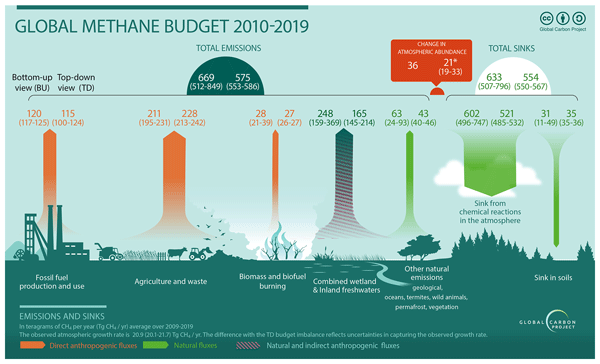
Methane (CH4) is the second most important human-influenced greenhouse gas in terms of climate forcing after carbon dioxide (CO2). A consortium of multi-disciplinary scientists synthesise and update the budget of the sources and sinks of CH4. This edition benefits from important progress in estimating emissions from lakes and ponds, reservoirs, and streams and rivers. For the 2010s decade, global CH4 emissions are estimated at 575 Tg CH4 yr-1, including ~65 % from anthropogenic sources.
Zhu Deng, Philippe Ciais, Liting Hu, Adrien Martinez, Marielle Saunois, Rona L. Thompson, Kushal Tibrewal, Wouter Peters, Brendan Byrne, Giacomo Grassi, Paul I. Palmer, Ingrid T. Luijkx, Zhu Liu, Junjie Liu, Xuekun Fang, Tengjiao Wang, Hanqin Tian, Katsumasa Tanaka, Ana Bastos, Stephen Sitch, Benjamin Poulter, Clément Albergel, Aki Tsuruta, Shamil Maksyutov, Rajesh Janardanan, Yosuke Niwa, Bo Zheng, Joël Thanwerdas, Dmitry Belikov, Arjo Segers, and Frédéric Chevallier
Earth Syst. Sci. Data, 17, 1121–1152, https://doi.org/10.5194/essd-17-1121-2025, https://doi.org/10.5194/essd-17-1121-2025, 2025
Short summary
Short summary
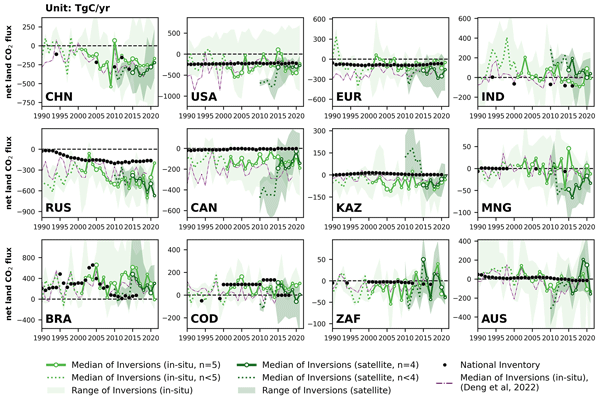
This study reconciles national greenhouse gas (GHG) inventories with updated atmospheric inversion results to evaluate discrepancies for three principal GHG fluxes at the national level. Compared to our previous study, new satellite-based CO2 inversions were included and an updated mask of managed lands was used, improving agreement for Brazil and Canada. The proposed methodology can be regularly applied as a check to assess the gap between top-down inversions and bottom-up inventories.
Ailish M. Graham, Richard J. Pope, Martyn P. Chipperfield, Sandip S. Dhomse, Matilda Pimlott, Wuhu Feng, Vikas Singh, Ying Chen, Oliver Wild, Ranjeet Sokhi, and Gufran Beig
Atmos. Chem. Phys., 24, 789–806, https://doi.org/10.5194/acp-24-789-2024, https://doi.org/10.5194/acp-24-789-2024, 2024
Short summary
Short summary
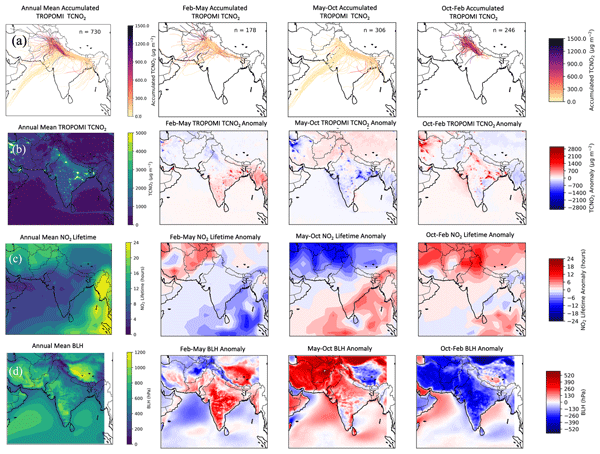
Our paper uses novel satellite datasets and high-resolution emissions datasets alongside a back-trajectory model to investigate the balance of local and external sources influencing NOx air pollution changes in Delhi. We find in the post-monsoon season that NOx from local and non-local transport emissions contributes most to poor air quality in Delhi. Therefore, air quality mitigation strategies in Delhi and surrounding regions are used to control this issue.
Saroj Kumar Sahu, Poonam Mangaraj, Gufran Beig, Marianne T. Lund, Bjørn Hallvard Samset, Pallavi Sahoo, and Ashirbad Mishra
Earth Syst. Sci. Data Discuss., https://doi.org/10.5194/essd-2023-310, https://doi.org/10.5194/essd-2023-310, 2023
Revised manuscript not accepted
Short summary
Short summary
Elevated emission of particulate matter is not limited to urban areas, led to poor air quality across the country. Emission Inventory is the first line of defensive tools for air quality management and understanding and identification of the source of pollutants. The present work is an attempt to develop a high-resolution (~10 km) national inventory of particulate pollutants in India for 2020 using IPCC methodology. The developed dataset is vital piece of information for mitigation strategies.
Saroj Kumar Sahu, Poonam Mangaraj, and Gufran Beig
Earth Syst. Sci. Data, 15, 3183–3202, https://doi.org/10.5194/essd-15-3183-2023, https://doi.org/10.5194/essd-15-3183-2023, 2023
Short summary
Short summary
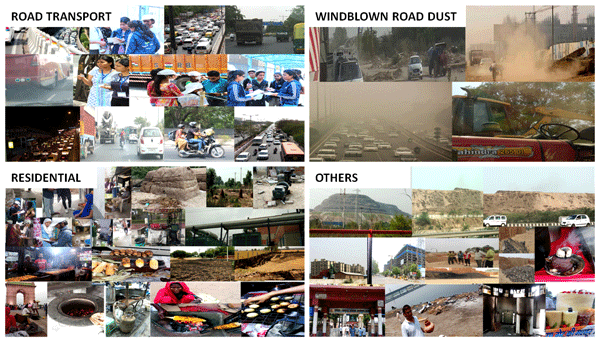
The developed emission inventory identifies all the potential anthropogenic sources active in the Delhi NCR. The decadal change (2010–2020) and the changing policies have also been illustrated to observe the modulation in the sectorial emission trend. Emission hotspots with possible source-specific mitigation strategies have also been highlighted to improve the air quality of the Delhi NCR. The provided dataset is a vital tool for air quality and chemical transport modeling studies.
Brendan Byrne, David F. Baker, Sourish Basu, Michael Bertolacci, Kevin W. Bowman, Dustin Carroll, Abhishek Chatterjee, Frédéric Chevallier, Philippe Ciais, Noel Cressie, David Crisp, Sean Crowell, Feng Deng, Zhu Deng, Nicholas M. Deutscher, Manvendra K. Dubey, Sha Feng, Omaira E. García, David W. T. Griffith, Benedikt Herkommer, Lei Hu, Andrew R. Jacobson, Rajesh Janardanan, Sujong Jeong, Matthew S. Johnson, Dylan B. A. Jones, Rigel Kivi, Junjie Liu, Zhiqiang Liu, Shamil Maksyutov, John B. Miller, Scot M. Miller, Isamu Morino, Justus Notholt, Tomohiro Oda, Christopher W. O'Dell, Young-Suk Oh, Hirofumi Ohyama, Prabir K. Patra, Hélène Peiro, Christof Petri, Sajeev Philip, David F. Pollard, Benjamin Poulter, Marine Remaud, Andrew Schuh, Mahesh K. Sha, Kei Shiomi, Kimberly Strong, Colm Sweeney, Yao Té, Hanqin Tian, Voltaire A. Velazco, Mihalis Vrekoussis, Thorsten Warneke, John R. Worden, Debra Wunch, Yuanzhi Yao, Jeongmin Yun, Andrew Zammit-Mangion, and Ning Zeng
Earth Syst. Sci. Data, 15, 963–1004, https://doi.org/10.5194/essd-15-963-2023, https://doi.org/10.5194/essd-15-963-2023, 2023
Short summary
Short summary
Changes in the carbon stocks of terrestrial ecosystems result in emissions and removals of CO2. These can be driven by anthropogenic activities (e.g., deforestation), natural processes (e.g., fires) or in response to rising CO2 (e.g., CO2 fertilization). This paper describes a dataset of CO2 emissions and removals derived from atmospheric CO2 observations. This pilot dataset informs current capabilities and future developments towards top-down monitoring and verification systems.
Cited articles
Chandra, N., Patra, P. K., Bisht, J. S. H., Ito, A., Umezawa, T., Saigusa, N., Morimoto, S., Aoki, S., Janssens-Maenhout, G., Fujita, R., Takigawa, M., Watanabe, S., Saitoh, N., and Canadell, J. G.: Emissions from the Oil and Gas Sectors, Coal Mining and Ruminant Farming Drive Methane Growth over the Past Three Decades, Journal of the Meteorological Society of Japan. Ser. II, 99, 309–337, https://doi.org/10.2151/jmsj.2021-015, 2021.
EDGAR – The Emissions Database for Global Atmospheric Research: GHG emissions of all world countries – JRC/IEA 2023 Report, https://edgar.jrc.ec.europa.eu/report_2023 (last access: 15 June 2024), 2023.
European Commission: Methane emissions, https://energy.ec.europa.eu/topics/carbon-management-and-fossil-fuels/methane-emissions_en (last access: 17 June 2024), 2023.
Ganesan, A. L., Rigby, M., Lunt, M. F., Parker, R. J., Boesch, H., Goulding, N., Umezawa, T., Zahn, A., Chatterjee, A., Prinn, R. G., Tiwari, Y. K., Marcel, and Krummel, P. B.: Atmospheric observations show accurate reporting and little growth in India's methane emissions, Nature Communications, 8, https://doi.org/10.1038/s41467-017-00994-7, 2017.
Garg, A., Bhattacharya, S., Shukla, P. R., and Dadhwal, V. K.: Regional and sectoral assessment of greenhouse gas emissions in India, Atmospheric Environment, 35, 2679–2695, https://doi.org/10.1016/s1352-2310(00)00414-3, 2001.
Garg, A., Shukla, P. R., and Kapshe, M.: The sectoral trends of multigas emissions inventory of India, Atmospheric Environment, 40, 4608–4620, https://doi.org/10.1016/j.atmosenv.2006.03.045, 2006.
Garg, A., Kankal, B., and Shukla, P. R.: Methane emissions in India: Sub-regional and sectoral trends, Atmospheric Environment, 45, 4922–4929, https://doi.org/10.1016/j.atmosenv.2011.06.004, 2011.
Janardanan, R., Maksyutov, S., Wang, F., Nayagam, L., Sahu, S. K., Mangaraj, P., Saunois, M., Lan, X., and Matsunaga, T.: Country-level methane emissions and their sectoral trends during 2009–2020 estimated by high-resolution inversion of GOSAT and surface observations, Environmental Research Letters, 19, 034007–034007, https://doi.org/10.1088/1748-9326/ad2436, 2024.
Mangaraj, P., Sahu, S. K., Beig, G., and Yadav, R.: A comprehensive high-resolution gridded emission inventory of anthropogenic sources of air pollutants in Indian megacity Kolkata, SN Applied Sciences, 4, https://doi.org/10.1007/s42452-022-05001-3, 2022a.
Mangaraj, P., Sahu, S. K., Beig, G., and Samal, B.: Development and assessment of inventory of air pollutants that deteriorate the air quality in Indian megacity Bengaluru, Journal of Cleaner Production, 360, 132209, https://doi.org/10.1016/j.jclepro.2022.132209, 2022b.
Mangaraj, P., Sahu, S. K., and Beig, G.: Development of emission inventory for air quality assessment and mitigation strategies over most populous Indian megacity, Mumbai, Urban Climate, 55, 101928–101928, https://doi.org/10.1016/j.uclim.2024.101928, 2024a.
Mangaraj, P., Sahu, S. K., Beig, G., Mishra, A., and Sharma, S.: What Makes the Indian Megacity Chennai's Air Unhealthy? – A Bottom-up Approach to Understand the Sources of Air Pollutants, Aerosol and Air Quality Research, 24, 240089–240089, https://doi.org/10.4209/aaqr.240089, 2024b.
Miller, S. M., Michalak, A. M., Detmers, R. G., Hasekamp, O. P., Bruhwiler, L. M. P., and Schwietzke, S.: China's coal mine methane regulations have not curbed growing emissions, Nature Communications, 10, https://doi.org/10.1038/s41467-018-07891-7, 2019.
MoA & FW: Ministry of Agriculture and Farmers Welfare: Production Of Important Crops in Three Largest Producing States in 2023-24* (Production in Million Tonnes), Government of India, https://www.indiabudget.gov.in/budget2024-25/economicsurvey/doc/stat/tab118.pdf (last access: 12 June 2024), 2024.
MoEFCC: India Third Biennial Update Report to The United Nations Framework Convention on Climate Change, https://moef.gov.in/uploads/2024/01/INDIA_BUR-3.pdf (last access: 12 June 2024), 2021.
MoEFCC: Ministry of Environment, Forest and Climate Change, Measures to Reduce Methane Emissions, https://pib.gov.in/PressReleaseIframePage.aspx?PRID=1942106#:~:text=Government of India promotes green (last access: 7 September 2024), 2023.
MoHA: Ministry of Home Affairs. Census of India 2011, National Population Register & Socio Economic and Caste Census – India, https://censusindia.gov.in/nada/index.php/catalog/42619 (last access: 9 September 2024), 2011.
NOAA: Global Monitoring Laboratory – Carbon Cycle Greenhouse Gases: https://gml.noaa.gov/ccgg/trends_ch4 (last access: 12 August 2024), 2024.
Pandey, A., Sadavarte, P., Rao, A. B., and Venkataraman, C.: Trends in multi-pollutant emissions from a technology-linked inventory for India: II. Residential, agricultural and informal industry sectors, Atmospheric Environment, 99, 341–352, https://doi.org/10.1016/j.atmosenv.2014.09.080, 2014.
Parashar, D. C., Mitra, A. P., Gupta, P. K., Rai, J., Sharma, R. C., Singh, N., Koul, S., Ray, H. S., Das, S. N., Parida, K. M., Rao, S. B., Kanungo, S. P., Ramasami, T., Nair, B. U., Swamy, M., Singh, G., Gupta, S. K., Singh, A. R., Saikia, B. K., and Batua, A. K. S.: Methane budget from paddy fields in India, Chemosphere, 33, 737–757, https://doi.org/10.1016/0045-6535(96)00223-8, 1996.
Rosentreter, J. A., Borges, A. V., Deemer, B. R., Holgerson, M. A., Liu, S., Song, C., Melack, J., Raymond, P. A., Duarte, C. M., Allen, G. H., Olefeldt, D., Poulter, B., Battin, T. I., and Eyre, B. D.: Half of global methane emissions come from highly variable aquatic ecosystem sources, Nature Geoscience, 14, 225–230, https://doi.org/10.1038/s41561-021-00715-2, 2021.
Sahoo, P., Sahu, S. K., Mangaraj, P., Mishra, A., Beig, G., and Gunthe, S. S.: Reporting of Gridded Ammonia Emission and Assessment of Hotspots across India: A comprehensive study of 24 anthropogenic sources, Journal of Hazardous Materials, 479, 135557–135557, https://doi.org/10.1016/j.jhazmat.2024.135557, 2024.
Sahu, S. K., Mangaraj, P., Beig, G., Samal, A., Pradhan, C., Dash, S., and Tyagi, B.: Quantifying the high resolution seasonal emission of air pollutants from crop residue burning in India, Environmental Pollution, 286, 117165, https://doi.org/10.1016/j.envpol.2021.117165, 2021.
Sahu, S. K.: Methane Emission Data, Zenodo [data set], https://doi.org/10.5281/zenodo.14089138, 2024.
Sahu, S. K., Mangaraj, P., and Beig, G.: Decadal growth in emission load of major air pollutants in Delhi, Earth Syst. Sci. Data, 15, 3183–3202, https://doi.org/10.5194/essd-15-3183-2023, 2023a.
Sahu, S. K., Mangaraj, P., Beig, G., Lund, M. T., Samset, B. H., Sahoo, P., and Mishra, A.: Development and comprehensive analysis of spatially resolved technological high resolution (0.1°×0.1°) Emission Inventory of Particulate Matter for India: A step Towards Air Quality Mitigation, Earth Syst. Sci. Data Discuss. [preprint], https://doi.org/10.5194/essd-2023-310, 2023b.
Sahu, S. K., Mishra, M., Mishra, A., Mangaraj, P., and Beig, G.: Quantification and assessment of hazardous mercury emission from industrial process and other unattended sectors in India: A step towards mitigation, Journal of Hazardous Materials, 470, 134103–134103, https://doi.org/10.1016/j.jhazmat.2024.134103, 2024.
Samal, A., Sahu, S. K., Mishra, A., Mangaraj, P., Pani, S. K., and Beig, G.: Assessment and Quantification of Methane Emission from Indian Livestock and Manure Management, Aerosol and air quality research, 24, 230204–230204, https://doi.org/10.4209/aaqr.230204, 2024.
Saunois, M., Martinez, A., Poulter, B., Zhang, Z., Raymond, P. A., Regnier, P., Canadell, J. G., Jackson, R. B., Patra, P. K., Bousquet, P., Ciais, P., Dlugokencky, E. J., Lan, X., Allen, G. H., Bastviken, D., Beerling, D. J., Belikov, D. A., Blake, D. R., Castaldi, S., Crippa, M., Deemer, B. R., Dennison, F., Etiope, G., Gedney, N., Höglund-Isaksson, L., Holgerson, M. A., Hopcroft, P. O., Hugelius, G., Ito, A., Jain, A. K., Janardanan, R., Johnson, M. S., Kleinen, T., Krummel, P. B., Lauerwald, R., Li, T., Liu, X., McDonald, K. C., Melton, J. R., Mühle, J., Müller, J., Murguia-Flores, F., Niwa, Y., Noce, S., Pan, S., Parker, R. J., Peng, C., Ramonet, M., Riley, W. J., Rocher-Ros, G., Rosentreter, J. A., Sasakawa, M., Segers, A., Smith, S. J., Stanley, E. H., Thanwerdas, J., Tian, H., Tsuruta, A., Tubiello, F. N., Weber, T. S., van der Werf, G. R., Worthy, D. E. J., Xi, Y., Yoshida, Y., Zhang, W., Zheng, B., Zhu, Q., Zhu, Q., and Zhuang, Q.: Global Methane Budget 2000–2020, Earth Syst. Sci. Data, 17, 1873–1958, https://doi.org/10.5194/essd-17-1873-2025, 2025.
Short summary
This study refines India’s methane inventory, addressing data gaps and improving climate research. It identifies 25 sources, including agriculture, wetlands, and fossil fuels, enhancing India’s global data representation. Emissions peak in the Indo-Gangetic Plain and coastal states, highlighting mitigation priorities. Urban emissions are lower, suggesting underestimation. This dataset helps policymakers design targeted reduction strategies, supporting India’s climate goals and global efforts.
This study refines India’s methane inventory, addressing data gaps and improving climate...


Altmetrics
Final-revised paper
Preprint