Articles | Volume 18, issue 2
https://doi.org/10.5194/essd-18-1307-2026
© Author(s) 2026. This work is distributed under
the Creative Commons Attribution 4.0 License.
the Creative Commons Attribution 4.0 License.
https://doi.org/10.5194/essd-18-1307-2026
© Author(s) 2026. This work is distributed under
the Creative Commons Attribution 4.0 License.
the Creative Commons Attribution 4.0 License.
Data description article
| 
19 Feb 2026
Data description article |
| 19 Feb 2026
| 19 Feb 2026
Optical complexity of North Sea, Baltic Sea, and adjacent coastal and inland waters derived from Sentinel-3 OLCI satellite data
Martin Hieronymi
CORRESPONDING AUTHOR
Department of Optical Oceanography, Institute of Carbon Cycles, Helmholtz-Zentrum Hereon, 21502 Geesthacht, Germany
Daniel Behr
Department of Optical Oceanography, Institute of Carbon Cycles, Helmholtz-Zentrum Hereon, 21502 Geesthacht, Germany
Department of Optical Oceanography, Institute of Carbon Cycles, Helmholtz-Zentrum Hereon, 21502 Geesthacht, Germany
State Key Laboratory of Lake Science and Environment, Nanjing Institute of Geography and Limnology, Chinese Academy of Sciences, Nanjing 210008, China
Rüdiger Röttgers
Department of Optical Oceanography, Institute of Carbon Cycles, Helmholtz-Zentrum Hereon, 21502 Geesthacht, Germany
Related authors
Annabeth McCall, Martin Hieronymi, P. Paul Overduin, Lisa Bröder, Julie Lattaud, Rüdiger Röttgers, Irina Overeem, Anne Morgenstern, Guido Grosse, and Bennet Juhls
Biogeosciences, 23, 5921–5942, https://doi.org/10.5194/bg-23-5921-2026, https://doi.org/10.5194/bg-23-5921-2026, 2026
Short summary
Short summary
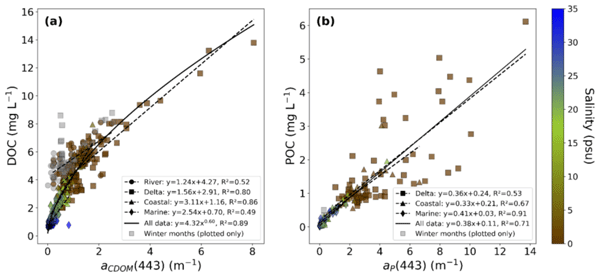
This study examines how carbon and sediments move from the Mackenzie River, through its delta, and into the Beaufort Sea. We use data from 2009–2024 and show that major changes in carbon concentrations unfold in low-salinity mixing zones. As the optical properties of the water also shift, satellite estimates of carbon will require more tailored methods. These findings will improve our understanding of Arctic carbon fluxes and influences on the greater Arctic Ocean carbon budget.
Annabeth McCall, Martin Hieronymi, P. Paul Overduin, Lisa Bröder, Julie Lattaud, Rüdiger Röttgers, Irina Overeem, Anne Morgenstern, Guido Grosse, and Bennet Juhls
Biogeosciences, 23, 5921–5942, https://doi.org/10.5194/bg-23-5921-2026, https://doi.org/10.5194/bg-23-5921-2026, 2026
Short summary
Short summary
This study examines how carbon and sediments move from the Mackenzie River, through its delta, and into the Beaufort Sea. We use data from 2009–2024 and show that major changes in carbon concentrations unfold in low-salinity mixing zones. As the optical properties of the water also shift, satellite estimates of carbon will require more tailored methods. These findings will improve our understanding of Arctic carbon fluxes and influences on the greater Arctic Ocean carbon budget.
Salem Ibrahim Salem, Andre Valente, Shubha Sathyendranath, Andrei Chuprin, Théo Renard, Jaime Pitarch, Ruth Airs, Moreno Ana, Maria-Manuel Angelico, David Antoine, Robert Arnone, Florinda Artuso, Paulo O. Oliveira, William Balch, Kathryn Barker, Ray Barlow, Simon Bélanger, Marco Bellacicco, Jean-François Berthon, Şükrü Beşiktepe, Francesco Bignami, Yngve Borsheim, Astrid Bracher, Federica Braga, Vittorio Brando, Robert J. W. Brewin, Vanda Brotas, Elisabetta Canuti, Francisco P. Chavez, Andrés Cianca, Hervé Claustre, Lesley Clementson, Simone Colella, Raul Costa, Cristina Nunes, Richard Crout, Emmanuel Devred, Annalisa Di Cicco, Federico Falcini, Ivan Farace, Afonso Ferreira, Scott Freeman, Robert Frouin, Carlos García-Soto, Isabella Giardina, Stuart W. Gibb, Arthur Gleason, Ralf Goericke, Richard Gould, Michael Grant, Nathalie Guillocheau, Hiroto Higa, Stanford B. Hooker, Chuamin Hu, Joji Ishizaka, Thomas Jackson, Mati Kahru, Milton Kampel, Bokyung Kim, Holger Klein, Piotr Kowalczuk, Susanne Kratzer, Raphael Kudela, Antonia Lai, Rosario Lavezza, Jesus Ledesma, Huiwon Lee, Steven Lohrenz, Hubert Loisel, Vivian Lutz, Antonio Mannino, Francesca Margiotta, Victor Martinez-Vicente, Salvatore Marullo, Luca Massi, Patricia Matrai, Atsushi Matsuoka, David McKee, Chiara Melillo, Carlos B. Mendes, Brian G. Mitchell, Tiffany Moisan, Enrique Montes, Frank Muller-Karger, Aimee Neeley, Michael Novak, Leonie O'Dowd, Michael Ondrusek, Emanuele Organelli, Heeyoon Park, Trevor Platt, Francesca Polonelli, Alex Poulton, Mariella Ragni, Michel Repecaud, Maurizio Ribera d’Alcalà, Tamara Rodriguez-Ramos, Rüdiger Röttgers, Manuel Ruiz-Villarreal, Michela Sammartino, Rosalia Santoleri, Gian Marco Scarpa, Thomas Schroeder, Valeria Segura, Timothy Smyth, Denise Smythe-Wright, Heidi M. Sosik, Joanna Stoń-Egiert, Malcolm Taberner, Jing Tan, Rob Thomas, Crystal Thomas, Gavin Tilstone, Andreia Tracana, Michael Twardowski, Vincenzo Vellucci, Gianluca Volpe, Kenneth Voss, Jeremy Werdell, Marcel Wernand, Bozena Wojtasiewicz, Simon Wright, Sunmi Yang, Giuseppe Zibordi, Maria Laura Zoffoli, and Steve Groom
Earth Syst. Sci. Data Discuss., https://doi.org/10.5194/essd-2026-539, https://doi.org/10.5194/essd-2026-539, 2026
Preprint under review for ESSD
Short summary
Short summary
This paper presents the fourth version of the ESA Ocean Colour Climate Change Initiative global in situ bio-optical database. The updated compilation combines observations from many international data sources collected between 1996 and 2025 and includes major expansions in coverage and variables. The dataset provides a consistent reference for validating satellite ocean-colour products and supports algorithm development and long-term climate studies.
Claudia Thölen, Jochen Wollschläger, Michael G. Novak, Rüdiger Röttgers, and Oliver Zielinski
Biogeosciences, 23, 3697–3721, https://doi.org/10.5194/bg-23-3697-2026, https://doi.org/10.5194/bg-23-3697-2026, 2026
Short summary
Short summary
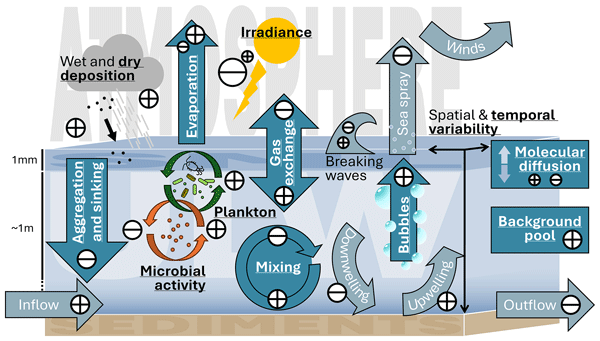
In a mesocosm study, the investigation of colored and fluorescent dissolved organic matter provided information on its transformation, enrichment, and exchange processes within the sea-surface microlayer and the underlying water. Photodegradation was suggested as the main sink, exceeding microbial alteration, and indicating that light and biological processes, such as the induced phytoplankton bloom, jointly shaped organic matter composition under strong vertical mixing.
Riaz Bibi, Mariana Ribas-Ribas, Leonie Jaeger, Carola Lehners, Lisa Gassen, Edgar Fernando Cortés-Espinoza, Jochen Wollschläger, Claudia Thölen, Hannelore Waska, Jasper Zöbelein, Thorsten Brinkhoff, Isha Athale, Rüdiger Röttgers, Michael Novak, Anja Engel, Theresa Barthelmeß, Josefine Karnatz, Thomas Reinthaler, Dmytro Spriahailo, Gernot Friedrichs, Falko Asmussen Schäfer, and Oliver Wurl
Biogeosciences, 22, 7563–7589, https://doi.org/10.5194/bg-22-7563-2025, https://doi.org/10.5194/bg-22-7563-2025, 2025
Short summary
Short summary
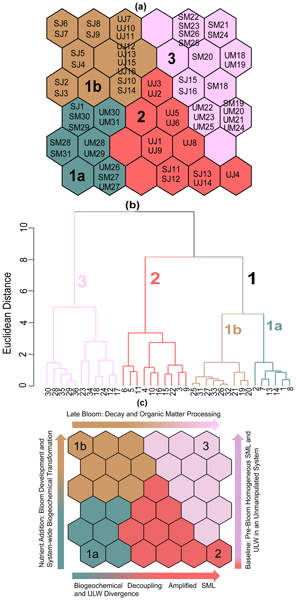
A multidisciplinary mesocosm study was conducted to investigate biogeochemical processes and their relationships in the sea-surface microlayer and underlying water during an induced phytoplankton bloom. Phytoplankton-derived organic matter, fuelled microbial activity and biofilm formation, supporting high bacterial abundance. Distinct temporal patterns in biogeochemical parameters and greater variability in the sea-surface microlayer highlight its influence on air–sea interactions.
Vlad A. Macovei, Louise C. V. Rewrie, Rüdiger Röttgers, and Yoana G. Voynova
Biogeosciences, 22, 3375–3396, https://doi.org/10.5194/bg-22-3375-2025, https://doi.org/10.5194/bg-22-3375-2025, 2025
Short summary
Short summary
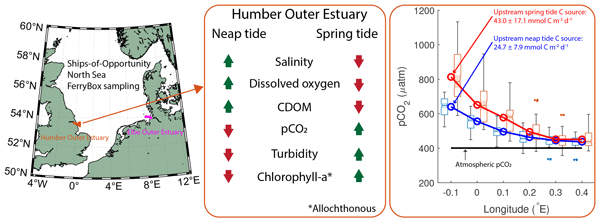
We found that biogeochemical variability at the land–sea interface (LSI) in two major temperate estuaries is modulated by the 14 d spring–neap tidal cycle, with large effects on dissolved inorganic and organic carbon concentrations and distribution. As this effect increases the strength of the carbon source to the atmosphere by up to 74 % during spring tide, it should be accounted for in regional models, which aim to resolve biogeochemical processing at the LSI.
André Valente, Shubha Sathyendranath, Vanda Brotas, Steve Groom, Michael Grant, Thomas Jackson, Andrei Chuprin, Malcolm Taberner, Ruth Airs, David Antoine, Robert Arnone, William M. Balch, Kathryn Barker, Ray Barlow, Simon Bélanger, Jean-François Berthon, Şükrü Beşiktepe, Yngve Borsheim, Astrid Bracher, Vittorio Brando, Robert J. W. Brewin, Elisabetta Canuti, Francisco P. Chavez, Andrés Cianca, Hervé Claustre, Lesley Clementson, Richard Crout, Afonso Ferreira, Scott Freeman, Robert Frouin, Carlos García-Soto, Stuart W. Gibb, Ralf Goericke, Richard Gould, Nathalie Guillocheau, Stanford B. Hooker, Chuamin Hu, Mati Kahru, Milton Kampel, Holger Klein, Susanne Kratzer, Raphael Kudela, Jesus Ledesma, Steven Lohrenz, Hubert Loisel, Antonio Mannino, Victor Martinez-Vicente, Patricia Matrai, David McKee, Brian G. Mitchell, Tiffany Moisan, Enrique Montes, Frank Muller-Karger, Aimee Neeley, Michael Novak, Leonie O'Dowd, Michael Ondrusek, Trevor Platt, Alex J. Poulton, Michel Repecaud, Rüdiger Röttgers, Thomas Schroeder, Timothy Smyth, Denise Smythe-Wright, Heidi M. Sosik, Crystal Thomas, Rob Thomas, Gavin Tilstone, Andreia Tracana, Michael Twardowski, Vincenzo Vellucci, Kenneth Voss, Jeremy Werdell, Marcel Wernand, Bozena Wojtasiewicz, Simon Wright, and Giuseppe Zibordi
Earth Syst. Sci. Data, 14, 5737–5770, https://doi.org/10.5194/essd-14-5737-2022, https://doi.org/10.5194/essd-14-5737-2022, 2022
Short summary
Short summary
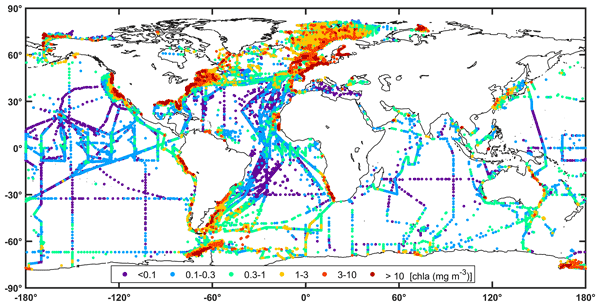
A compiled set of in situ data is vital to evaluate the quality of ocean-colour satellite data records. Here we describe the global compilation of bio-optical in situ data (spanning from 1997 to 2021) used for the validation of the ocean-colour products from the ESA Ocean Colour Climate Change Initiative (OC-CCI). The compilation merges and harmonizes several in situ data sources into a simple format that could be used directly for the evaluation of satellite-derived ocean-colour data.
Tristan Petit, Børge Hamre, Håkon Sandven, Rüdiger Röttgers, Piotr Kowalczuk, Monika Zablocka, and Mats A. Granskog
Ocean Sci., 18, 455–468, https://doi.org/10.5194/os-18-455-2022, https://doi.org/10.5194/os-18-455-2022, 2022
Short summary
Short summary
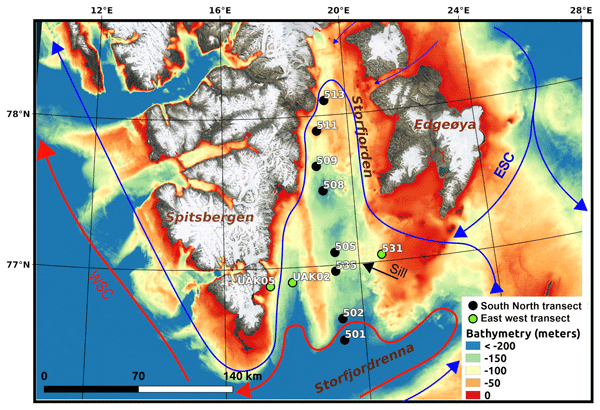
We provide the first insights on bio-optical processes in Storfjorden (Svalbard). Information on factors controlling light propagation in the water column in this arctic fjord becomes crucial in times of rapid sea ice decline. We find a significant contribution of dissolved matter to light absorption and a subsurface absorption maximum linked to phytoplankton production. Dense bottom waters from sea ice formation carry elevated levels of dissolved and particulate matter.
Cited articles
Albert, M. F. M. A., Anguelova, M. D., Manders, A. M. M., Schaap, M., and de Leeuw, G.: Parameterization of oceanic whitecap fraction based on satellite observations, Atmos. Chem. Phys., 16, 13725–13751, https://doi.org/10.5194/acp-16-13725-2016, 2016.
Ansper-Toomsalu, A., Uusõue, M., Kangro, K., Hieronymi, M., and Alikas, K.: Suitability of different in-water algorithms for eutrophic and absorbing waters applied to Sentinel-2 MSI and Sentinel-3 OLCI data, Front. Remote Sens., 5, 1423332, https://doi.org/10.3389/frsen.2024.1423332, 2024.
Atwood, E. C., Jackson, T., Laurenson, A., Jönsson, B. F., Spyrakos, E., Jiang, D., Sent, G., Selmes, N., Simis, S., Danne, O., Tyler, A., and Groom, S.: Framework for Regional to Global Extension of Optical Water Types for Remote Sensing of Optically Complex Transitional Water Bodies, Remote Sens., 16, 3267, https://doi.org/10.3390/rs16173267, 2024.
Balch, W. M. and Mitchell, C.: Remote sensing algorithms for particulate inorganic carbon (PIC) and the global cycle of PIC, Earth-Sci. Rev., 239, 104363, https://doi.org/10.1016/j.earscirev.2023.104363, 2023.
Begouen Demeaux, C., Boss, E., Graff, J. R., Behrenfeld, M. J., and Westberry, T. K.: Phytoplanktonic photoacclimation under clouds, Geophys. Res. Let., 52, e2024GL112274, https://doi.org/10.1029/2024GL112274, 2025.
Bi, S. and Hieronymi, M.: Holistic optical water type classification for ocean, coastal, and inland waters, Limnol. Oceanogr., 69, 1547–1561, https://doi.org/10.1002/lno.12606, 2024.
Bi, S., Li, Y., Liu, G., Song, K., Xu, J., Dong, X., Cai, X., Mu, M., Miao, S., and Lyu, H.: Assessment of algorithms for estimating chlorophyll-a concentration in inland waters: a round-robin scoring method based on the optically fuzzy clustering, IEEE Trans. Geosci. Remote, 60, 1–17, https://doi.org/10.1109/TGRS.2021.3058556, 2021.
Bi, S., Hieronymi, M., and Röttgers, R.: Bio-geo-optical modelling of natural waters, Front. Mar. Sci., 10, 1196352, https://doi.org/10.3389/fmars.2023.1196352, 2023.
Bi, S., Hieronymi, M., Behr, D., Buurman, M., and Konkol, M.: pyOWT: python library for Optical Water Type classification (v0.66), Zenodo [code], https://doi.org/10.5281/zenodo.18645698, 2026.
Bracher, A., Bouman, H. A., Brewin, R. J., Bricaud, A., Brotas, V., Ciotti, A. M., Clementson, L., Devred, E., Di Cicco, A., Dutkiewicz, S., Hardman-Mountford, N. J., Hickman, A. E., Hieronymi, M., Hirata, T., Losa, S. N., Mouw, C. B., Organelli, E., Raitsos, D. E., Uitz, J., Vogt, M., and Wolanin, A.: Obtaining phytoplankton diversity from ocean color: a scientific roadmap for future development, Front. Mar. Sci., 4, 55, https://doi.org/10.3389/fmars.2017.00055, 2017.
Brando, V. E., Santoleri, R., Colella, S., Volpe, G., Di Cicco, A., Sammartino, M., González Vilas, L., Lapucci, C., Böhm, E., Zoffoli, M. L., Cesarini, C., Forneris, V., La Padula, F., Mangin, A., Jutard, Q., Bretagnon, M., Bryère, P., Demaria, J., Calton, B., Netting, J., Sathyendranath, S., D'Alimonte, D., Kajiyama, T., Van der Zande, D., Vanhellemont, Q., Stelzer, K., Böttcher, M., and Lebreton, C.: Overview of Operational Global and Regional Ocean Colour Essential Ocean Variables Within the Copernicus Marine Service, Remote Sens., 16, 4588, https://doi.org/10.3390/rs16234588, 2024.
Brewin, R. J., Sathyendranath, S., Müller, D., Brockmann, C., Deschamps, P. Y., Devred, E., Doerffer, R., Fomferra, N., Franz, B., Grant, M., Groom, S., Horseman, A., Hu, C., Krasemann, H., Lee, Z., Maritorena, S., Mélin, F., Peters, M., Platt, T., Regner, P., Smyth, T., Steinmetz, F., Swinton, J., Werdell, J., and White III, G. N.: The Ocean Colour Climate Change Initiative: III. A round-robin comparison on in-water bio-optical algorithms, Remote Sens. Environ., 162, 271–294, https://doi.org/10.1016/j.rse.2013.09.016, 2015.
Brewin, R. J. W., Sathyendranath, S., Kulk, G., Rio, M.-H., Concha, J. A., Bell, T. G., Bracher, A., Fichot, C., Frölicher, T. L., Galí, M., Hansell, D. A., Kostadinov, T. S., Mitchell, C., Neeley, A. R., Organelli, E., Richardson, K., Rousseaux, C., Shen, F., Stramski, D., Tzortziou, M., Watson, A. J., Addey, C. I., Bellacicco, M., Bouman, H., Carroll, D., Cetinić, I., Dall'Olmo, G., Frouin, R., Hauck, J., Hieronymi, M., Hu, C., Ibello, V., Jönsson, B., Kong, C. E., Kovač, Ž., Laine, M., Lauderdale, J., Lavender, S., Livanou, E., Llort, J., Lorinczi, L., Nowicki, M., Pradisty, N. A., Psarra, S., Raitsos, D. E., Ruescas, A. B., Russell, J. L., Salisbury, J., Sanders, R., Shutler, J. D., Sun, X., Taboada, F. G., Tilstone, G., Wei, X., and Woolf, D. K.: Ocean carbon from space: Current status and priorities for the next decade, Earth-Sci. Rev., 104386, https://doi.org/10.1016/j.earscirev.2023.104386, 2023.
Brockmann, C., Doerffer, R., Peters, M., Kerstin, S., Embacher, S., and Ruescas, A.: Evolution of the C2RCC neural network for Sentinel 2 and 3 for the retrieval of ocean colour products in normal and extreme optically complex waters, in: vol. SP-740, ESA-SP Volume 740, Living Planet Symposium, Proceedings of the conference, 9–13 May 2016, Prague, Czech Republic, edited by: Ouwehand, L., ISBN 978-92-9221-305-3, 2016.
Cazzaniga, I., Zibordi, G., and Mélin, F.: Spectral variations of the remote sensing reflectance during coccolithophore blooms in the Western black Sea, Remote Sens. Environ., 264, 112607, https://doi.org/10.1016/j.rse.2021.112607, 2021.
CLMS S2: European Union's Copernicus Land Monitoring Service information: Lake Water Quality (raster 100 m), global, 10-daily – version 2, CLMS S2 [data set], https://doi.org/10.2909/deae3db1-a214-4375-8d1a-63c42498050e, 2024.
CLMS S3: European Union's Copernicus Land Monitoring Service information: Lake Water Quality 2024–present (raster 300 m), global, 10-daily – version 2, CLMS S3 [data set], https://doi.org/10.2909/801137b8-9575-43ef-a073-140b663cc61c, 2024.
CMEMS BAL: European Union's Copernicus Marine Service information: Baltic Sea, Bio-Geo-Chemical, L3, daily observation, CMEMS BAL [data set], https://doi.org/10.48670/moi-00079, 2025.
CMEMS NWS: European Union's Copernicus Marine Service information: North West Shelf Region, Bio-Geo-Chemical, L3, daily observation, CMEMS NWS [data set], https://doi.org/10.48670/moi-00118, 2025.
Devreker, D., Wacquet, G., and Lefebvre, A.: A 45-year hydrological and planktonic time series in the South Bight of the North Sea, Earth Syst. Sci. Data, 17, 1173–1189, https://doi.org/10.5194/essd-17-1173-2025, 2025.
Doerffer, R. and Schiller, H.: The MERIS case 2 water algorithm, Int. J. Remote Sens., 28, 517–535, https://doi.org/10.1080/01431160600821127, 2007.
El Kassar, J., Juhls, B., Hieronymi, M., Preusker, R., Morgenstern, A., Fischer, J., and Overduin, P. P.: Optical remote sensing (Sentinel-3 OLCI) used to monitor dissolved organic carbon in the Lena River, Russia, Front. Mar. Sci., 10, 1082109, https://doi.org/10.3389/fmars.2023.1082109, 2023.
González Vilas, L., Brando, V. E., Di Cicco, A., Colella, S., D'Alimonte, D., Kajiyama, T., Attila., J., and Schroeder, T.: Assessment of ocean color atmospheric correction methods and development of a regional ocean color operational dataset for the Baltic Sea based on Sentinel-3 OLCI, Front. Mar. Sci., 10, 1256990, https://doi.org/10.3389/fmars.2023.1256990, 2024.
Hess, M., Koepke, P., and Schult, I.: Optical properties of aerosols and clouds: The software package OPAC, B. Am. Meteorol. Soc., 79, 831–844, https://doi.org/10.1175/1520-0477(1998)079<0831:OPOAAC>2.0.CO;2, 1998.
Hieronymi, M.: Polarized reflectance and transmittance distribution functions of the ocean surface, Opt. Express, 24, A1045–A1068, https://doi.org/10.1364/OE.24.0A1045, 2016.
Hieronymi, M. and Macke, A.: On the influence of wind and waves on underwater irradiance fluctuations, Ocean Sci., 8, 455–471, https://doi.org/10.5194/os-8-455-2012, 2012.
Hieronymi, M., Müller, D., and Doerffer, R.: The OLCI neural network swarm (ONNS): A bio-geo-optical algorithm for open ocean and coastal waters, Front. Mar. Sci., 4, 140, https://doi.org/10.3389/fmars.2017.00140, 2017.
Hieronymi, M., Bi, S., Müller, D., Schütt, E. M., Behr, D., Brockmann, C., Lebreton, C., Steinmetz, F., Stelzer, K., and Vanhellemont, Q.: Ocean color atmospheric correction methods in view of usability for different optical water types, Front. Mar. Sci., 10, 1129876, https://doi.org/10.3389/fmars.2023.1129876, 2023a.
Hieronymi, M., Röttgers, R., Alikas, K., Kratzer, S., Ansko, I., Behr, D., Bi, S., Burmester, H., Heymann, K., Novak, M., Pramlall, S., Rahn, I.-A., Roux, P., Thölen, C., and Voynova, Y. G.: Biogeo-optical and-chemical characterization of cyanobacterial blooms in the Baltic Sea for ocean colour satellite remote sensing, Alkor Cruise Report No. AL597, GEOMAR, 24 pp., https://doi.org/10.3289/CR_AL597, 2023b.
Hieronymi, M., Bi, S., and Behr, D.: Sentinel-3 OLCI daily averaged earth observation data of water constituents (Version 2), World Data Center for Climate (WDCC) at DKRZ [data set], https://doi.org/10.26050/WDCC/AquaINFRA_Sentinel3_v2, 2025.
IOCCG: Uncertainties in Ocean Colour Remote Sensing, edited by: Mélin, F., IOCCG Report Series No. 18, International Ocean Colour Coordinating Group, Dartmouth, Canada., https://doi.org/10.25607/OBP-696, 2019.
Jackson, T., Sathyendranath, S., and Mélin, F.: An improved optical classification scheme for the ocean colour essential climate variable and its applications, Remote Sens. Environ., 203, 152–161, https://doi.org/10.1016/j.rse.2017.03.036, 2017.
Juhls, B., Overduin, P. P., Hölemann, J., Hieronymi, M., Matsuoka, A., Heim, B., and Fischer, J.: Dissolved organic matter at the fluvial–marine transition in the Laptev Sea using in situ data and ocean colour remote sensing, Biogeosciences, 16, 2693–2713, https://doi.org/10.5194/bg-16-2693-2019, 2019.
Kieber, R. J., Whitehead, R. F., Reid, S. N., Willey, J. D., and Seaton, P. J.: Chromophoric dissolved organic matter (CDOM) in rainwater, southeastern North Carolina, USA, J. Atmos. Chem., 54, 21–41, https://doi.org/10.1007/s10874-005-9008-4, 2006.
King, M. D., Platnick, S., Menzel, W. P., Ackerman, S. A., and Hubanks, P. A.: Spatial and temporal distribution of clouds observed by MODIS onboard the Terra and Aqua satellites, IEEE T. Geosci. Remote, 51, 3826–3852, https://doi.org/10.1109/TGRS.2012.2227333, 2013.
Kordubel, K., Martínez-Rincón, R. O., Baschek, B., Boersma, M., Hieronymi, M., Johns, D. G., Kirstein, I. V., Voynova, Y. G., and Möller, K. O.: Long-term changes in spatiotemporal distribution of Noctiluca scintillans in the southern North Sea, Harmful Algae, 138, 102699, https://doi.org/10.1016/j.hal.2024.102699, 2024.
Kutser, T., Paavel, B., Verpoorter, C., Ligi, M., Soomets, T., Toming, K., and Casal, G.: Remote sensing of black lakes and using 810 nm reflectance peak for retrieving water quality parameters of optically complex waters, Remote Sens., 8, 497, https://doi.org/10.3390/rs8060497, 2016.
Lehmann, M. K., Schütt, E. M., Hieronymi, M., Dare, J., and Krasemann, H.: Analysis of recurring patchiness in satellite-derived chlorophyll a to aid the selection of representative sites for lake water quality monitoring, Int. J. Appl. Earth Obs. Geoinf., 104, 102547, https://doi.org/10.1016/j.jag.2021.102547, 2021.
Lellouche, J.-M., Greiner, E., Le Galloudec, O., Garric, G., Regnier, C., Drevillon, M., Benkiran, M., Testut, C.-E., Bourdalle-Badie, R., Gasparin, F., Hernandez, O., Levier, B., Drillet, Y., Remy, E., and Le Traon, P.-Y.: Recent updates to the Copernicus Marine Service global ocean monitoring and forecasting real-time 1/12° high-resolution system, Ocean Sci., 14, 1093–1126, https://doi.org/10.5194/os-14-1093-2018, 2018.
Loisel, H., Duforêt-Gaurier, L., Tran, T. K., Schaffer Ferreira Jorge, D., Steinmetz, F., Mangin, A., Bretagnon, M., and Hembise Fanton d'Andon, O.: Characterization of the organic vs. inorganic fraction of suspended particulate matter in coastal waters based on ocean color radiometry remote sensing, in: 7th edition of the Copernicus Ocean State Report (OSR7), edited by: von Schuckmann, K., Moreira, L., Le Traon, P.-Y., Grégoire, M., Marcos, M., Staneva, J., Brasseur, P., Garric, G., Lionello, P., Karstensen, J., and Neukermans, G., Copernicus Publications, State Planet, 1-osr7, 11, https://doi.org/10.5194/sp-1-osr7-11-2023, 2023.
Lomas, M. W., Neeley, A. R., Vandermeulen, R., Mannino, A., Thomas, C., Novak, M. G., and Freeman, S. A.: Phytoplankton optical fingerprint libraries for development of phytoplankton ocean color satellite products, Sci. Data, 11, 168, https://doi.org/10.1038/s41597-024-03001-z, 2024.
Mélin, F. and Vantrepotte, V.: How optically diverse is the coastal ocean?, Remote Sens. Environ., 160, 235–251, https://doi.org/10.1016/j.rse.2015.01.023, 2015.
Moore, T. S., Campbell, J. W., and Feng, H.: A fuzzy logic classification scheme for selecting and blending satellite ocean color algorithms, IEEE T. Geosci., 39, 1764–1776, https://doi.org/10.1109/36.942555, 2001.
Moore, T. S., Dowell, M. D., Bradt, S., and Verdu, A. R.: An optical water type framework for selecting and blending retrievals from bio-optical algorithms in lakes and coastal waters, Remote Sens. Environ., 143, 97–111, https://doi.org/10.1016/j.rse.2013.11.021, 2014.
Müller, D., Krasemann, H., Brewin, R. J., Brockmann, C., Deschamps, P. Y., Doerffer, R., Fomferra, N., Franz, B. A., Grant, M. G., Groom, S. B., Mélin, F., Platt, T., Regner, P., Sathyendranath, S., Steinmetz, F., and Swinton, J.: The Ocean Colour Climate Change Initiative: I. A methodology for assessing atmospheric correction processors based on in situ measurements, Remote Sens. Environ., 162, 242–256, https://doi.org/10.1016/j.rse.2013.11.026, 2015.
Müller, D., Hieronymi, M., Ruescas, A.B., Peters, M., Röttgers, R., König, M., Lebreton, C., Stelzer, K., Brockmann, C., and Doerffer, R., Case 2 Regional Coast Colour: a neural network-based framework for atmospheric correction and in-water retrievals across multiple ocean colour satellite sensors, Front. Remote Sens., 7, 1710758, https://doi.org/10.3389/frsen.2026.1710758, 2026.
Nelson, N. B. and Siegel, D. A.: The global distribution and dynamics of chromophoric dissolved organic matter, Annu. Rev. Mar. Sci., 5, 447–476, https://doi.org/10.1146/annurev-marine-120710-100751, 2013.
Novak, M. G. and Röttgers, R.: Spectral variability in particulate light backscattering in the sea: Resolving fine-scale optical features and their biogeochemical significance, Opt. Express, 34, 5619–5635, https://doi.org/10.1364/OE.579542, 2026.
O'Kane, S., McCarthy, T., Fealy, R., and Kratzer, S.: A Validation of OLCI Sentinel-3 Water Products in the Baltic Sea and an Evaluation of the Effect of System Vicarious Calibration (SVC) on the Level-2 Water Products, Remote Sens., 16, 3932, https://doi.org/10.3390/rs16213932, 2024.
Röttgers, R., Bi, S., Burmester, H., Heymann, K., Hieronymi, M., Krasemann, H., and Schönfeld, W.: Water inherent optical properties and concentrations of water constituents from the German Bight and adjacent regions: spectral data of the phytoplankton light absorption coefficient [dataset], PANGAEA [data set], https://doi.org/10.1594/PANGAEA.954981, 2023.
Schrum, C., Hübner, U., Jacob, D., and Podzun, R.: A coupled atmosphere/ice/ocean model for the North Sea and the Baltic Sea, Clim. Dynam., 21, 131–151, https://doi.org/10.1007/s00382-003-0322-8, 2003.
Sent, G., Antunes, C., Spyrakos, E., Jackson, T., Atwood, E. C., and Brito, A. C.: What time is the tide? The importance of tides for ocean colour applications to estuaries, Remote Sens. Appl.: Soc. Environ., 37, 101425, https://doi.org/10.1016/j.rsase.2024.101425, 2025.
Smith, M. E., Robertson Lain, L., and Bernard, S.: An optimized chlorophyll a switching algorithm for MERIS and OLCI in phytoplankton-dominated waters, Remote Sens. Environ., 215, 217–227, https://doi.org/10.1016/j.rse.2018.06.002, 2018.
Spyrakos, E., O'Donnell, R., Hunter, P. D., Miller, C., Scott, M., Simis, S. G. H., Neil, C., Barbosa, C. C. F., Binding, C. E., Bradt, S., Bresciani, M., Dall'Olmo, G., Giardino, C., Gitelson, A. A., Kutser, T., Li, L., Matsushita, B., Martinez-Vicente, V., Matthews, M. W., Ogashawara, I., Ruiz-Verdú, A., Schalles, J. F., Tebbs, E., Zhang, Y., and Tyler, A. N.: Optical types of inland and coastal waters, Limnol. Oceanogr., 63, 846–870, https://doi.org/10.1002/lno.10674, 2018.
Stramski, D., Reynolds, R. A., Babin, M., Kaczmarek, S., Lewis, M. R., Röttgers, R., Sciandra, A., Stramska, M., Twardowski, M. S., Franz, B. A., and Claustre, H.: Relationships between the surface concentration of particulate organic carbon and optical properties in the eastern South Pacific and eastern Atlantic Oceans, Biogeosciences, 5, 171–201, https://doi.org/10.5194/bg-5-171-2008, 2008.
van Oostende, M., Hieronymi, M., Krasemann, H., Baschek, B., and Röttgers, R.: Correction of inter-mission inconsistencies in merged ocean colour satellite data, Front. Remote Sens., 3, 882418, https://doi.org/10.3389/frsen.2022.882418, 2022.
van Oostende, M., Hieronymi, M., Krasemann, H., and Baschek, B.: Global ocean colour trends in biogeochemical provinces, Front. Mar. Sci., 10, 1052166, https://doi.org/10.3389/fmars.2023.1052166, 2023.
Vantrepotte, V., Loisel, H., Dessailly, D., and Mériaux, X.: Optical classification of contrasted coastal waters, Remote Sens. Environ., 123, 306–323, https://doi.org/10.1016/j.rse.2012.03.004, 2012.
Xi, H., Hieronymi, M., Röttgers, R., Krasemann, H., and Qiu, Z.: Hyperspectral differentiation of phytoplankton taxonomic groups: a comparison between using remote sensing reflectance and absorption spectra, Remote Sens., 7, 14781–14805, https://doi.org/10.3390/rs71114781, 2015.
Short summary
We present a scientific description of a satellite-based dataset and its novel processing chain. The dataset provides water quality parameters for lakes, rivers, coastal waters, as well as the entire North Sea and Baltic Sea. It further includes a novel estimate of organic carbon across diverse water bodies and the results of an optical water type classification. The dataset and its underlying algorithm provide a valuable foundation for future oceanographic and limnological analyses.
We present a scientific description of a satellite-based dataset and its novel processing chain....


Altmetrics
Final-revised paper
Preprint