Articles | Volume 17, issue 12
https://doi.org/10.5194/essd-17-7119-2025
© Author(s) 2025. This work is distributed under
the Creative Commons Attribution 4.0 License.
the Creative Commons Attribution 4.0 License.
https://doi.org/10.5194/essd-17-7119-2025
© Author(s) 2025. This work is distributed under
the Creative Commons Attribution 4.0 License.
the Creative Commons Attribution 4.0 License.
Data description article
| 
12 Dec 2025
Data description article |
| 12 Dec 2025
| 12 Dec 2025
A Black Hole Eddy dataset of North Pacific Ocean based on satellite altimetry
Fenglin Tian
State Key Laboratory of Physical Oceanography, College of Marine Technology, Ocean University of China, Qingdao, 266100, China
Laboratory for regional Oceanography and Numerical Modelling, Department of Ocean Big Data and Prediction, Laoshan Laboratory, Qingdao, 266237, China
Yingying Zhao
State Key Laboratory of Physical Oceanography, College of Marine Technology, Ocean University of China, Qingdao, 266100, China
Lan Qin
State Key Laboratory of Physical Oceanography, College of Marine Technology, Ocean University of China, Qingdao, 266100, China
Shuang Long
Guangxi Key Laboratory of Beibu Gulf Marine Resources, Environment and Sustainable Development, Fourth Institute of Oceanography, Ministry of Natural Resources, Beihai, 536000, China
Ge Chen
CORRESPONDING AUTHOR

State Key Laboratory of Physical Oceanography, College of Marine Technology, Ocean University of China, Qingdao, 266100, China
Laboratory for regional Oceanography and Numerical Modelling, Department of Ocean Big Data and Prediction, Laoshan Laboratory, Qingdao, 266237, China
Related authors
Fenglin Tian, Xiangwen Kong, Yingying Zhao, and Ge Chen
Earth Syst. Sci. Data, 18, 3935–3958, https://doi.org/10.5194/essd-18-3935-2026, https://doi.org/10.5194/essd-18-3935-2026, 2026
Short summary
Short summary
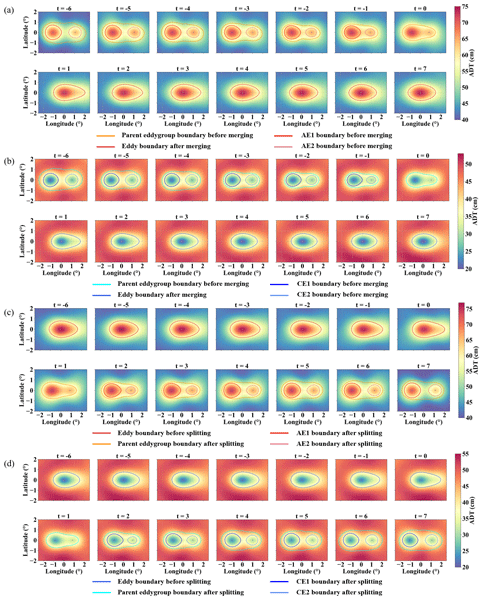
We developed a global method to identify and track ocean mesoscale eddies using satellite data from 1993 to 2023 and generated the corresponding dataset. The analysis reveals stable and persistent eddytree structures linked to major ocean currents. It also shows that common eddygroup boundaries play a key role in how eddies split and merge, highlighting the reciprocal nature of these dynamic ocean processes.
Shuang Long, Fenglin Tian, Junwu Tang, Fangjie Yu, Fang Zhang, Wei Ma, Xinglong Zhang, and Ge Chen
Earth Syst. Sci. Data Discuss., https://doi.org/10.5194/essd-2025-276, https://doi.org/10.5194/essd-2025-276, 2025
Revised manuscript not accepted
Short summary
Short summary
Oceanic mesoscale eddies are known to form dipoles from time to time. When dipoles are asymmetric in strength, the stronger dipole eddies generally drive weaker ones to move around, resulting in a reduction of discrepancies in their kinematic properties, which is referred to as the “gear-like” process. An integrated observation of an asymmetric eddy dipole was conducted in the South China Sea in April 2023, which evidences the “gear-like” process.
Meng Hou, Nan Luo, Jie Yang, and Ge Chen
Earth Syst. Sci. Data Discuss., https://doi.org/10.5194/essd-2026-475, https://doi.org/10.5194/essd-2026-475, 2026
Preprint under review for ESSD
Short summary
Short summary
This paper systematically investigates submesoscale eddy identification and ecological effects based on multi-source remote sensing. Using three different types of data and multiple methods established different eddy datasets respectively. Then, a comparative analysis of three datasets was conducted to explore their characteristics, applicability, strengths, and weaknesses.
Fenglin Tian, Xiangwen Kong, Yingying Zhao, and Ge Chen
Earth Syst. Sci. Data, 18, 3935–3958, https://doi.org/10.5194/essd-18-3935-2026, https://doi.org/10.5194/essd-18-3935-2026, 2026
Short summary
Short summary
We developed a global method to identify and track ocean mesoscale eddies using satellite data from 1993 to 2023 and generated the corresponding dataset. The analysis reveals stable and persistent eddytree structures linked to major ocean currents. It also shows that common eddygroup boundaries play a key role in how eddies split and merge, highlighting the reciprocal nature of these dynamic ocean processes.
Xinyuan Xi, Jiahui Chen, Ge Chen, Yuemei Li, Chunyong Ma, and Yijie Gai
Earth Syst. Sci. Data Discuss., https://doi.org/10.5194/essd-2025-822, https://doi.org/10.5194/essd-2025-822, 2026
Preprint under review for ESSD
Short summary
Short summary
This study uses the SWOT satellite to detect internal waves across 13 global regions from 2023 to 2025. A deep learning model was developed for automatic detection, creating a dataset of over 3,200 signals. The results show that SWOT outperforms other satellites in data availability, accuracy, and spatial coverage, providing valuable data for oceanographic studies and environmental monitoring.
Jian Hui Li, Jie Yang, and Ge Chen
Biogeosciences, 22, 5635–5650, https://doi.org/10.5194/bg-22-5635-2025, https://doi.org/10.5194/bg-22-5635-2025, 2025
Short summary
Short summary
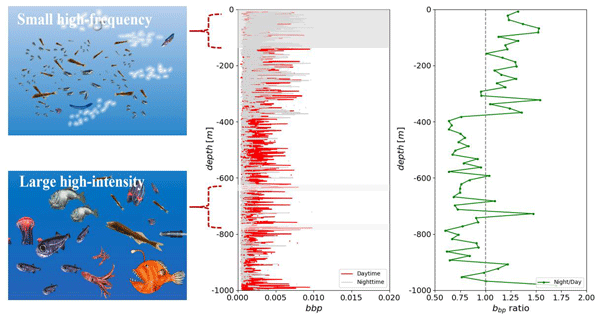
This study examines how environmental factors, particularly temperature, affect the seasonal and spatial distribution of mesopelagic organisms in the North Atlantic. Using data from 720 BGC-Argo floats, we identified distinct daily and seasonal migration patterns. Temperature was the key driver, followed by salinity and dissolved oxygen. These findings enhance our understanding of mesopelagic ecosystems, with potential implications for fisheries management.
Shuang Long, Fenglin Tian, Junwu Tang, Fangjie Yu, Fang Zhang, Wei Ma, Xinglong Zhang, and Ge Chen
Earth Syst. Sci. Data Discuss., https://doi.org/10.5194/essd-2025-276, https://doi.org/10.5194/essd-2025-276, 2025
Revised manuscript not accepted
Short summary
Short summary
Oceanic mesoscale eddies are known to form dipoles from time to time. When dipoles are asymmetric in strength, the stronger dipole eddies generally drive weaker ones to move around, resulting in a reduction of discrepancies in their kinematic properties, which is referred to as the “gear-like” process. An integrated observation of an asymmetric eddy dipole was conducted in the South China Sea in April 2023, which evidences the “gear-like” process.
Yan Wang, Ge Chen, Jie Yang, Zhipeng Gui, and Dehua Peng
Earth Syst. Sci. Data, 16, 5737–5752, https://doi.org/10.5194/essd-16-5737-2024, https://doi.org/10.5194/essd-16-5737-2024, 2024
Short summary
Short summary
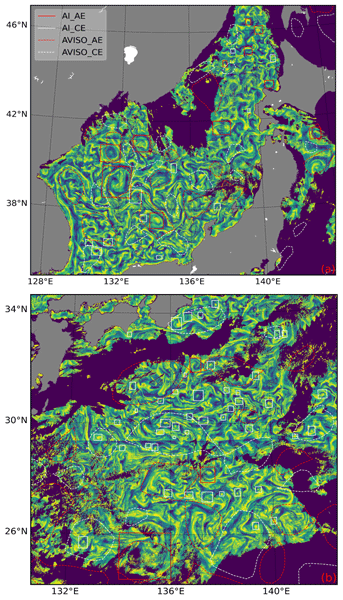
Mesoscale eddies are ubiquitous in the ocean and account for 90 % of its kinetic energy, but their generation and dissipation are difficult to observe using current remote sensing technology. Our submesoscale eddy dataset, formed by suppressing large-scale circulation signals and enhancing small-scale chlorophyll structures, has important implications for understanding marine environments and ecosystems, as well as improving climate model predictions.
Linyao Ge, Guiyu Wang, Baoxiang Huang, Chuanchuan Cao, Xiaoyan Chen, and Ge Chen
Earth Syst. Sci. Data Discuss., https://doi.org/10.5194/essd-2024-190, https://doi.org/10.5194/essd-2024-190, 2024
Manuscript not accepted for further review
Short summary
Short summary
High precision in reconstructing sea surface currents is vital for understanding ocean dynamics. Our paper introduces GEST (Geostrophic-Ekman-Stokes-Tide), a 15 m depth sea current product. GEST, generated by a neural network, captures Ekman, geostrophic currents, Stokes drift, and TPXO9 tidal currents. Its design accounts for complex ocean surface dynamics, surpassing OSCAR and GlobCurrent by 10.4 cm/s and 8.81 cm/s, respectively.
Meng Hou, Jie Yang, Ge Chen, Guiyan Han, Yan Wang, and Kai Wu
EGUsphere, https://doi.org/10.5194/egusphere-2023-1735, https://doi.org/10.5194/egusphere-2023-1735, 2023
Preprint archived
Short summary
Short summary
In this study, we mainly utilized BGC-Argo data to investigate the relationships between chlorophyll levels and environmental factors (CPhyto, Nitrate, Temperature and Light) and its underlying dynamic mechanisms of mesoscale eddies in South Pacific Ocean. We show that, the mechanism of chlorophyll levels are different at different depth of seawater.
Yan Wang, Jie Yang, Kai Wu, Meng Hou, and Ge Chen
Earth Syst. Sci. Data Discuss., https://doi.org/10.5194/essd-2023-138, https://doi.org/10.5194/essd-2023-138, 2023
Revised manuscript not accepted
Short summary
Short summary
Mesoscale eddies are ubiquitous in the ocean and account for 90 % of its kinetic energy, but their generation and dissipation struggle to observe with current remote sensing technology. Our submesoscale eddy dataset, formed by suppressing large-scale circulation signals and enhancing small-scale chlorophyll structures, has important implications for understanding marine environments and ecosystems, as well as improving climate model predictions.
Guiyu Wang, Ge Chen, Chuanchuan Cao, Xiaoyan Chen, and Baoxiang Huang
Earth Syst. Sci. Data Discuss., https://doi.org/10.5194/essd-2023-107, https://doi.org/10.5194/essd-2023-107, 2023
Revised manuscript not accepted
Short summary
Short summary
We present an accurate product of ocean surface current at 15 m depth based on multi-scale physical processes. Following a training process using remote sensing observations and in situ data, the derived current field with a 1/4° resolution captures more details neglected in the 1° ones and demonstrates higher accuracy over other global surface current products at low to middle latitudes.
Cited articles
Abernathey, R. and Haller, G.: Transport by Lagrangian Vortices in the Eastern Pacific, Journal of Physical Oceanography, 48, 667–685, https://doi.org/10.1175/JPO-D-17-0102.1, 2018.
Aurell, E., Boffetta, G., Crisanti, A., Paladin, G., and Vulpiani, A.: Predictability in the large: An extension of the concept of Lyapunov exponent, Journal of Physics A-Mathematical and General, 30, 1–26, https://doi.org/10.1088/0305-4470/30/1/003, 1997.
Beron-Vera, F. J., Olascoaga, M. J., Brown, M. G., Koçak, H., and Rypina, II: Invariant-tori-like Lagrangian coherent structures in geophysical flows, Chaos, 20, https://doi.org/10.1063/1.3271342, 2010.
Beron-Vera, F. J., Olascoaga, M. J., Brown, M. G., and Koçak, H.: Zonal Jets as Meridional Transport Barriers in the Subtropical and Polar Lower Stratosphere, Journal of the Atmospheric Sciences, 69, 753–767, https://doi.org/10.1175/JAS-D-11-084.1, 2012.
Beron-Vera, F. J., Wang, Y., Olascoaga, M. J., Goni, G. J., and Haller, G.: Objective Detection of Oceanic Eddies and the Agulhas Leakage, Journal of Physical Oceanography, 43, 1426–1438, https://doi.org/10.1175/JPO-D-12-0171.1, 2013.
Chaigneau, A., Gizolme, A., and Grados, C.: Mesoscale eddies off Peru in altimeter records: Identification algorithms and eddy spatio-temporal patterns, Progress in Oceanography, 79, 106–119, https://doi.org/10.1016/j.pocean.2008.10.013, 2008.
Chaigneau, A., Eldin, G., and Dewitte, B.: Eddy activity in the four major upwelling systems from satellite altimetry (1992–2007), Progress in Oceanography, 83, 117–123, https://doi.org/10.1016/j.pocean.2009.07.012, 2009.
Chelton, D. B., Schlax, M. G., Samelson, R. M., and de Szoeke, R. A.: Global observations of large oceanic eddies, Geophysical Research Letters, 34, https://doi.org/10.1029/2007GL030812, 2007.
Chelton, D. B., Gaube, P., Schlax, M. G., Early, J. J., and Samelson, R. M.: The Influence of Nonlinear Mesoscale Eddies on Near-Surface Oceanic Chlorophyll, Science, 334, 328–332, https://doi.org/10.1126/science.1208897, 2011a.
Chelton, D. B., Schlax, M. G., and Samelson, R. M.: Global observations of nonlinear mesoscale eddies, Progress in Oceanography, 91, 167–216, https://doi.org/10.1016/j.pocean.2011.01.002, 2011b.
Chen, G. and Han, G.: Contrasting short-lived with long-lived mesoscale eddies in the global ocean, Journal of Geophysical Research: Oceans, 124, 3149–3167, https://doi.org/10.1029/2019JC014983, 2019.
Chen, G., Yang, J., and Han, G. Y.: Eddy morphology: Egg-like shape, overall spinning, and oceanographic implications, Remote Sensing of Environment, 257, https://doi.org/10.1016/j.rse.2021.112348, 2021.
Chen, G. X., Gan, J. P., Xie, Q., Chu, X. Q., Wang, D. X., and Hou, Y. J.: Eddy heat and salt transports in the South China Sea and their seasonal modulations, Journal of Geophysical Research-Oceans, 117, https://doi.org/10.1029/2011JC007724, 2012.
Delcroix, T., Chaigneau, A., Soviadan, D., Boutin, J., and Pegliasco, C.: Eddy-Induced Salinity Changes in the Tropical Pacific, Journal of Geophysical Research-Oceans, 124, 374–389, https://doi.org/10.1029/2018JC014394, 2019.
Copernicus Climate Change Service (C3S): Ocean colour daily data from 1997 to present derived from satellite observations, Climate Data Store (CDS) [data set], https://doi.org/10.24381/cds.f85b319d, 2019.
Deogharia, R., Gupta, H., Sil, S., Gangopadhyay, A., and Shee, A.: On the evidence of helico-spiralling recirculation within coherent cores of eddies using Lagrangian approach, Scientific Report, 14, 11014, https://doi.org/10.1038/s41598-024-61744-6, 2024.
d'Ovidio, F., Fernández, V., Hernández-García, E., and López, C.: Mixing structures in the Mediterranean Sea from finite-size Lyapunov exponents, Geophysical Research Letters, 31, L17203, https://doi.org/10.1029/2004GL020328, 2004.
Dong, C. M., McWilliams, J. C., Liu, Y., and Chen, D. K.: Global heat and salt transports by eddy movement, Nature Communications, 5, https://doi.org/10.1038/ncomms4294, 2014.
Early, J. J., Samelson, R. M., and Chelton, D. B.: The Evolution and Propagation of Quasigeostrophic Ocean Eddies, Journal of Physical Oceanography, 41, 1535–1555, https://doi.org/10.1175/2011JPO4601.1, 2011.
Faghmous, J. H., Frenger, I., Yao, Y. S., Warmka, R., Lindell, A., and Kumar, V.: A daily global mesoscale ocean eddy dataset from satellite altimetry, Scientific Data, 2, https://doi.org/10.1038/sdata.2015.28, 2015.
Gaube, P., Chelton, D. B., Strutton, P. G., and Behrenfeld, M. J.: Satellite observations of chlorophyll, phytoplankton biomass, and Ekman pumping in nonlinear mesoscale eddies, Journal of Geophysical Research-Oceans, 118, 6349–6370, https://doi.org/10.1002/2013JC009027, 2013.
Haller, G.: A variational theory of hyperbolic Lagrangian Coherent Structures, Physica D-Nonlinear Phenomena, 240, 574–598, https://doi.org/10.1016/j.physd.2010.11.010, 2011.
Haller, G.: Lagrangian Coherent Structures, Annual Review of Fluid Mechanics, 47, 137–162, https://doi.org/10.1146/annurev-fluid-010313-141322, 2015.
Haller, G. and Beron-Vera, F. J.: Geodesic theory of transport barriers in two-dimensional flows, Physica D-Nonlinear Phenomena, 241, 1680–1702, https://doi.org/10.1016/j.physd.2012.06.012, 2012.
Haller, G. and Beron-Vera, F. J.: Coherent Lagrangian vortices: the black holes of turbulence, Journal of Fluid Mechanics, 731, https://doi.org/10.1017/jfm.2013.391, 2013.
Haller, G., Hadjighasem, A., Farazmand, M., and Huhn, F.: Defining coherent vortices objectively from the vorticity, Journal of Fluid Mechanics, 795, 136–173, https://doi.org/10.1017/jfm.2016.151, 2016.
Haller, G., Karrasch, D., and Kogelbauer, F.: Material barriers to diffusive and stochastic transport, Proceedings of the National Academy of Sciences of the United States of America, 115, 9074–9079, https://doi.org/10.1073/pnas.1720177115, 2018.
Hausmann, U. and Czaja, A.: The observed signature of mesoscale eddies in sea surface temperature and the associated heat transport, Deep-Sea Res. Pt. I, 70, 60–72, https://doi.org/10.1016/j.dsr.2012.08.005, 2012.
He, Q., Tian, F. L., Yang, X. K., and Chen, G.: Lagrangian eddies in the Northwestern Pacific Ocean, Journal of Oceanology and Limnology, 40, 66–77, https://doi.org/10.1007/s00343-021-0392-7, 2022.
Henson, S. A. and Thomas, A. C.: A census of oceanic anticyclonic eddies in the Gulf of Alaska, Deep-Sea Research Part I-Oceanographic Research Papers, 55, 163–176, https://doi.org/10.1016/j.dsr.2007.11.005, 2008.
Huang, B., Liu, C., Banzon, V.,Freeman, E., Graham, G., Hankins, B., Smith, T., and Zhang, H.-M.: Improvements of the Daily Optimum Interpolation Sea Surface Temperature (DOISST) Version 2.1, NOAA PSL [data set], https://doi.org/10.1175/JCLI-D-20-0166.1, 2021.
Jia, Y., Calil, P. H. R., Chassignet, E. P., Metzger, E. J., Potemra, J. T., Richards, K. J., and Wallcraft, A. J.: Generation of mesoscale eddies in the lee of the Hawaiian Islands, Journal of Geophysical Research-Oceans, 116, https://doi.org/10.1029/2011JC007305, 2011.
Jones-Kellett, A. E. and Follows, M. J.: A Lagrangian coherent eddy atlas for biogeochemical applications in the North Pacific Subtropical Gyre, Earth Syst. Sci. Data, 16, 1475–1501, https://doi.org/10.5194/essd-16-1475-2024, 2024.
Joseph, B. and Legras, B.: Relation between kinematic boundaries, stirring, and barriers for the Antarctic polar vortex, Journal of the Atmospheric Sciences, 59, 1198–1212, https://doi.org/10.1175/1520-0469(2002)059<1198:RBKBSA>2.0.CO;2, 2002.
Karrasch, D. and Schilling, N.: Fast and robust computation of coherent Lagrangian vortices on very large two-dimensional domains, The SMAI Journal of computational mathematics, 6, 101–124, https://doi.org/10.5802/smai-jcm.63, 2020.
Karrasch, D., Huhn, F., and Haller, G.: Automated detection of coherent Lagrangian vortices in two-dimensional unsteady flows, Proceedings of the Royal Society A-Mathematical Physical and Engineering Sciences, 471, https://doi.org/10.1098/rspa.2014.0639, 2015.
Liu, T. Y. and Abernathey, R.: A global Lagrangian eddy dataset based on satellite altimetry (GLED v1.0), Zenodo [data set], https://doi.org/10.5281/zenodo.7349753, 2022.
Liu, T. and Abernathey, R.: A global Lagrangian eddy dataset based on satellite altimetry, Earth Syst. Sci. Data, 15, 1765–1778, https://doi.org/10.5194/essd-15-1765-2023, 2023.
Mason, E., Pascual, A., and McWilliams, J. C.: A New Sea Surface Height-Based Code for Oceanic Mesoscale Eddy Tracking, Journal of Atmospheric and Oceanic Technology, 31, 1181–1188, https://doi.org/10.1175/JTECH-D-14-00019.1, 2014.
McGillicuddy, D. J., Anderson, L. A., Bates, N. R., Bibby, T., Buesseler, K. O., Carlson, C. A., Davis, C. S., Ewart, C., Falkowski, P. G., Goldthwait, S. A., Hansell, D. A., Jenkins, W. J., Johnson, R., Kosnyrev, V. K., Ledwell, J. R., Li, Q. P., Siegel, D. A., and Steinberg, D. K.: Eddy/wind interactions stimulate extraordinary mid-ocean plankton blooms, Science, 316, 1021–1026, https://doi.org/10.1126/science.1136256, 2007.
Nencioli, F., Dong, C. M., Dickey, T., Washburn, L., and McWilliams, J. C.: A Vector Geometry-Based Eddy Detection Algorithm and Its Application to a High-Resolution Numerical Model Product and High-Frequency Radar Surface Velocities in the Southern California Bight, Journal of Atmospheric and Oceanic Technology, 27, 564–579, https://doi.org/10.1175/2009JTECHO725.1, 2010.
Onu, K., Huhn, F., and Haller, G.: LCS Tool: A computational platform for Lagrangian coherent structures, Journal of Computational Science, 7, 26–36, https://doi.org/10.1016/j.jocs.2014.12.002, 2015.
Peacock, T. and Haller, G.: Lagrangian coherent structures The hidden skeleton of fluid flows, Physics Today, 66, 41–47, https://doi.org/10.1063/PT.3.1886, 2013.
Pegliasco, C., Delepoulle, A., Mason, E., Morrow, R., Faugère, Y., and Dibarboure, G.: META3.1exp: a new global mesoscale eddy trajectory atlas derived from altimetry, Earth Syst. Sci. Data, 14, 1087–1107, https://doi.org/10.5194/essd-14-1087-2022, 2022.
Provenzale, A.: Transport by coherent barotropic vortices, Annual Review of Fluid Mechanics, 31, 55–93, https://doi.org/10.1146/annurev.fluid.31.1.55, 1999.
Qiu, B. and Chen, S. M.: Eddy-induced heat transport in the subtropical North Pacific from Argo, TMI, and altimetry measurements, Journal of Physical Oceanography, 35, 458–473, https://doi.org/10.1175/JPO2696.1, 2005.
Qiu, B., Chen, S. M., Klein, P., Sasaki, H., and Sasai, Y.: Seasonal Mesoscale and Submesoscale Eddy Variability along the North Pacific Subtropical Countercurrent, Journal of Physical Oceanography, 44, 3079–3098, https://doi.org/10.1175/JPO-D-14-0071.1, 2014.
Sadarjoen, I. A. and Post, F. H.: Detection, quantification, and tracking of vortices using streamline geometry, Computers & Graphics-UK, 24, 333–341, https://doi.org/10.1016/S0097-8493(00)00029-7, 2000.
Serra, M. and Haller, G.: Objective Eulerian coherent structures, Chaos, 26, https://doi.org/10.1063/1.4951720, 2016.
Serra, M. and Haller, G.: Efficient computation of null geodesics with applications to coherent vortex detection, Proceedings of the Royal Society A-Mathematical Physical and Engineering Sciences, 473, https://doi.org/10.1098/rspa.2016.0807, 2017.
Shadden, S. C., Lekien, F., and Marsden, J. E.: Definition and properties of Lagrangian coherent structures from finite-time Lyapunov exponents in two-dimensional aperiodic flows, Physica D-Nonlinear Phenomena, 212, 271–304, https://doi.org/10.1016/j.physd.2005.10.007, 2005.
SSALTO/DUACS: Mesoscale Eddy Trajectories Atlas (META3.1 DT), AVISO+ [data set], https://doi.org/10.24400/527896/a01-2021.001, 2021.
Tian, F. L., He, Q., Liu, Z. P., and Chen, G.: Extracting Lagrangian coherent structures in the Kuroshio current system, Ocean Dynamics, 69, 641–656, https://doi.org/10.1007/s10236-019-01262-6, 2019.
Tian, F. L., Wang, M. J., Liu, X., He, Q., and Chen, G.: SLA-Based Orthogonal Parallel Detection of Global Rotationally Coherent Lagrangian Vortices, Journal of Atmospheric and Oceanic Technology, 39, 823–836, https://doi.org/10.1175/JTECH-D-21-0103.1, 2022.
Tian, F. L., Wu, D., Yuan, L. M., and Chen, G.: Impacts of the efficiencies of identification and tracking algorithms on the statistical properties of global mesoscale eddies using merged altimeter data, International Journal of Remote Sensing, 41, 2835–2860, https://doi.org/10.1080/01431161.2019.1694724, 2020.
Tian, F. L., Zhao, Y. Y., Long, S., and Chen, G.: A Black Hole Eddy Dataset of North Pacific Ocean Based on Satellite Altimetry (BHE v1.0), Zenodo [data set], https://doi.org/10.5281/zenodo.15597447, 2025a.
Tian, F. L., Zhao, Y. Y., Long, S., and Chen, G.: Comparison of the coherence between Eulerian Eddy, RCLVs and Black Hole Eddy, TIB AV-Portal [video], https://doi.org/10.5446/70890, 2025b.
Tian, F. L., Zhao, Y. Y., Long, S., and Chen, G.: Analysis of the coherence of Naked Black Hole Eddy, TIB AV-Portal [video], https://doi.org/10.5446/70891, 2025c.
Travis, S. and Qiu, B.: Decadal Variability in the South Pacific Subtropical Countercurrent and Regional Mesoscale Eddy Activity, Journal of Physical Oceanography, 47, 499–512, https://doi.org/10.1175/JPO-D-16-0217.1, 2017.
Trott, C. B., Subrahmanyam, B., Chaigneau, A., and Roman-Stork, H. L.: Eddy-Induced Temperature and Salinity Variability in the Arabian Sea, Geophysical Research Letters, 46, 2734-2742, https://doi.org/10.1029/2018GL081605, 2019.
Wang, H. L., Qiu, B., Liu, H. R., and Zhang, Z. G.: Doubling of surface oceanic meridional heat transport by non-symmetry of mesoscale eddies, Nature Communications, 14, https://doi.org/10.1038/s41467-023-41294-7, 2023.
Williams, S., Hecht, M., Petersen, M., Strelitz, R., Maltrud, M., Ahrens, J., Hlawitschka, M., and Hamann, B.: Visualization and Analysis of Eddies in a Global Ocean Simulation, Computer Graphics Forum, 30, 991–1000, https://doi.org/10.1111/j.1467-8659.2011.01948.x, 2011.
Wu, B. L. and Gan, J. P.: Seasonal Modulation of the Eddy Kinetic Energy and Subtropical Countercurrent Near the Western North Pacific Boundary, Journal of Geophysical Research-Oceans, 128, https://doi.org/10.1029/2022JC019160, 2023.
Xia, Q., Dong, C. M., He, Y. J., Li, G. C., and Dong, J. H.: Lagrangian Study of Several Long-Lived Agulhas Rings, Journal of Physical Oceanography, 52, 1049–1072, https://doi.org/10.1175/JPO-D-21-0079.1, 2022.
Yang, Y. K., Guo, Y. M., Zeng, L. L., and Wang, Q.: Eddy-induced sea surface salinity changes in the South China Sea, Frontiers in Marine Science, 10, https://doi.org/10.3389/fmars.2023.1113752, 2023.
Zhai, X. M., Greatbatch, R. J., and Kohlmann, J. D.: On the seasonal variability of eddy kinetic energy in the Gulf Stream region, Geophysical Research Letters, 35, https://doi.org/10.1029/2008GL036412, 2008.
Zhang, Z. G., Wang, W., and Qiu, B.: Oceanic mass transport by mesoscale eddies, Science, 345, 322–324, https://doi.org/10.1126/science.1252418, 2014.
Short summary
Black Hole Eddy (BHE) is vital for transporting materials but were previously hard to identify efficiently. This study introduces an efficient method to identify BHE, 13 times quicker, firstly enables the creation of BHE dataset in the North Pacific from 1993 to 2023. We verified BHE maintains strong coherence and contributes to westward transport about 1.5 Sv. We found some previously unidentified coherent eddies and analyzed their coherence. This represents first comprehensive analysis of BHE.
Black Hole Eddy (BHE) is vital for transporting materials but were previously hard to identify...


Altmetrics
Final-revised paper
Preprint