Articles | Volume 17, issue 5
https://doi.org/10.5194/essd-17-1781-2025
© Author(s) 2025. This work is distributed under
the Creative Commons Attribution 4.0 License.
the Creative Commons Attribution 4.0 License.
https://doi.org/10.5194/essd-17-1781-2025
© Author(s) 2025. This work is distributed under
the Creative Commons Attribution 4.0 License.
the Creative Commons Attribution 4.0 License.
Data description article
| 
06 May 2025
Data description article |
| 06 May 2025
| 06 May 2025
The 20 m Africa rice distribution map of 2023
Jingling Jiang
Key Laboratory of Digital Earth Science, Aerospace Information Research Institute, Chinese Academy of Sciences, Beijing 100094, China
International Research Center of Big Data for Sustainable Development Goals, Beijing 100049, China
College of Resources and Environment, University of Chinese Academy of Sciences, Beijing 100049, China
Hong Zhang
CORRESPONDING AUTHOR

International Research Center of Big Data for Sustainable Development Goals, Beijing 100049, China
Key Laboratory of Digital Earth Science, Aerospace Information Research Institute, Chinese Academy of Sciences, Beijing 100094, China
College of Resources and Environment, University of Chinese Academy of Sciences, Beijing 100049, China
Ji Ge
Key Laboratory of Digital Earth Science, Aerospace Information Research Institute, Chinese Academy of Sciences, Beijing 100094, China
International Research Center of Big Data for Sustainable Development Goals, Beijing 100049, China
College of Resources and Environment, University of Chinese Academy of Sciences, Beijing 100049, China
Lijun Zuo
Key Laboratory of Digital Earth Science, Aerospace Information Research Institute, Chinese Academy of Sciences, Beijing 100094, China
Key Laboratory of Digital Earth Science, Aerospace Information Research Institute, Chinese Academy of Sciences, Beijing 100094, China
International Research Center of Big Data for Sustainable Development Goals, Beijing 100049, China
Mingyang Song
Key Laboratory of Digital Earth Science, Aerospace Information Research Institute, Chinese Academy of Sciences, Beijing 100094, China
International Research Center of Big Data for Sustainable Development Goals, Beijing 100049, China
College of Resources and Environment, University of Chinese Academy of Sciences, Beijing 100049, China
Yinhaibin Ding
Key Laboratory of Digital Earth Science, Aerospace Information Research Institute, Chinese Academy of Sciences, Beijing 100094, China
International Research Center of Big Data for Sustainable Development Goals, Beijing 100049, China
College of Resources and Environment, University of Chinese Academy of Sciences, Beijing 100049, China
Yazhe Xie
Key Laboratory of Digital Earth Science, Aerospace Information Research Institute, Chinese Academy of Sciences, Beijing 100094, China
International Research Center of Big Data for Sustainable Development Goals, Beijing 100049, China
College of Resources and Environment, University of Chinese Academy of Sciences, Beijing 100049, China
Wenjiang Huang
Key Laboratory of Digital Earth Science, Aerospace Information Research Institute, Chinese Academy of Sciences, Beijing 100094, China
College of Resources and Environment, University of Chinese Academy of Sciences, Beijing 100049, China
Related authors
Mingyang Song, Lu Xu, Ji Ge, Hong Zhang, Lijun Zuo, Jingling Jiang, Yinhaibin Ding, Yazhe Xie, and Fan Wu
Earth Syst. Sci. Data, 17, 661–683, https://doi.org/10.5194/essd-17-661-2025, https://doi.org/10.5194/essd-17-661-2025, 2025
Short summary
Short summary
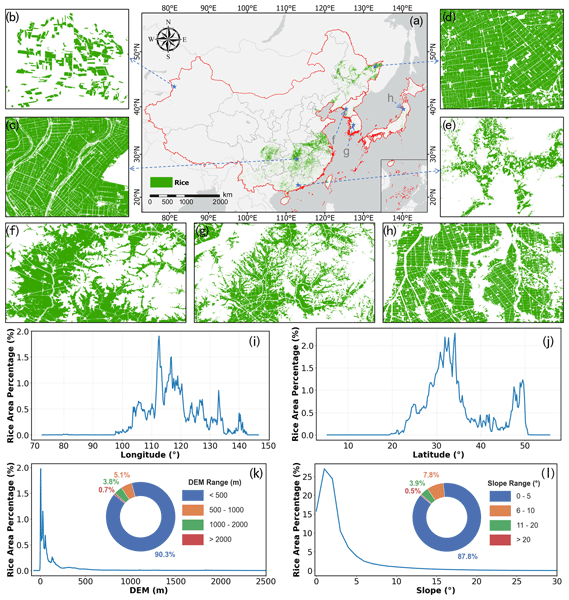
We created a 10 m resolution rice distribution map for East Asia in 2023 (EARice10), achieving an overall accuracy (OA) of 90.48 % on validation samples. EARice10 shows strong consistency with statistical data (coefficient of determination, R2: 0.94–0.98) and existing datasets (R2: 0.79–0.98). It is the most up-to-date map, covering the four major rice-producing countries in East Asia at 10 m resolution.
Chunling Sun, Hong Zhang, Lu Xu, Ji Ge, Jingling Jiang, Lijun Zuo, and Chao Wang
Earth Syst. Sci. Data, 15, 1501–1520, https://doi.org/10.5194/essd-15-1501-2023, https://doi.org/10.5194/essd-15-1501-2023, 2023
Short summary
Short summary
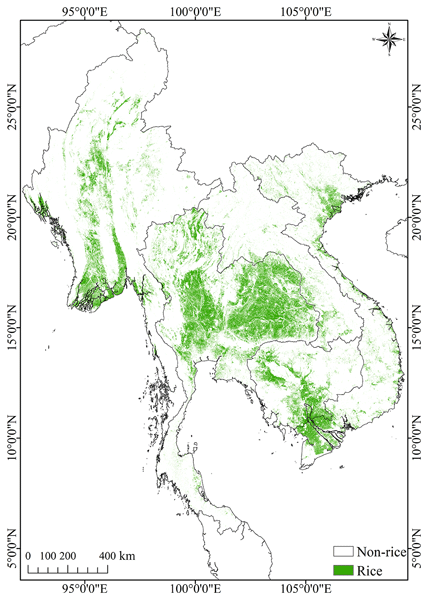
Over 90 % of the world’s rice is produced in the Asia–Pacific region. In this study, a rice-mapping method based on Sentinel-1 data for mainland Southeast Asia is proposed. A combination of spatiotemporal features with strong generalization is selected and input into the U-Net model to obtain a 20 m resolution rice area map of mainland Southeast Asia in 2019. The accuracy of the proposed method is 92.20 %. The rice area map is concordant with statistics and other rice area maps.
Hong Zhang, Mingyang Song, Yinhaibin Ding, Yazhe Xie, Huadong Guo, Lu Xu, Ji Ge, Yafei Zhu, Shenghan Wang, Zihuan Guo, Zhe Wang, Haoxuan Duan, Lijun Zuo, and Wenjiang Huang
Earth Syst. Sci. Data Discuss., https://doi.org/10.5194/essd-2026-24, https://doi.org/10.5194/essd-2026-24, 2026
Revised manuscript under review for ESSD
Short summary
Short summary
Accurate rice farming data is vital for global food security. We created GlobalRice20, a global map of paddy rice at 20-meter resolution for 2015 and 2024. By utilizing satellite imagery and advanced processing to overcome cloud issues, this dataset fills a critical gap in agricultural monitoring. It provides a reliable baseline for analyzing food production trends and helps policymakers track progress toward the Sustainable Development Goal of Zero Hunger.
Mingyang Song, Lu Xu, Ji Ge, Hong Zhang, Lijun Zuo, Jingling Jiang, Yinhaibin Ding, Yazhe Xie, and Fan Wu
Earth Syst. Sci. Data, 17, 661–683, https://doi.org/10.5194/essd-17-661-2025, https://doi.org/10.5194/essd-17-661-2025, 2025
Short summary
Short summary
We created a 10 m resolution rice distribution map for East Asia in 2023 (EARice10), achieving an overall accuracy (OA) of 90.48 % on validation samples. EARice10 shows strong consistency with statistical data (coefficient of determination, R2: 0.94–0.98) and existing datasets (R2: 0.79–0.98). It is the most up-to-date map, covering the four major rice-producing countries in East Asia at 10 m resolution.
Chunling Sun, Hong Zhang, Lu Xu, Ji Ge, Jingling Jiang, Lijun Zuo, and Chao Wang
Earth Syst. Sci. Data, 15, 1501–1520, https://doi.org/10.5194/essd-15-1501-2023, https://doi.org/10.5194/essd-15-1501-2023, 2023
Short summary
Short summary
Over 90 % of the world’s rice is produced in the Asia–Pacific region. In this study, a rice-mapping method based on Sentinel-1 data for mainland Southeast Asia is proposed. A combination of spatiotemporal features with strong generalization is selected and input into the U-Net model to obtain a 20 m resolution rice area map of mainland Southeast Asia in 2019. The accuracy of the proposed method is 92.20 %. The rice area map is concordant with statistics and other rice area maps.
Cited articles
Achanta, R. and Susstrunk, S.: Superpixels and polygons using simple non-iterative clustering, in: Proceedings of the IEEE conference on computer vision and pattern recognition, 21–26 July 2017, Honolulu, HI, USA, 4651–4660, https://doi.org/10.1109/cvpr.2017.520, 2017.
AfricaRice – Africa Rice Center: Transformation of Rice-based Agri-food Systems for Food and Nutrition Security in Africa: 2030 rice research and innovation strategy for Africa, Abidjan, Côte d'Ivoire, vi+58 pp., https://www.africarice.org/strategy (last access: 9 April 2024), 2023.
Ajala, A. and Gana, A.: Analysis of challenges facing rice processing in Nigeria, J. Food Process., 2015, 893673, https://doi.org/10.1155/2015/893673, 2015.
Arouna, A., Fatognon, I. A., Saito, K., and Futakuchi, K.: Moving toward rice self-sufficiency in sub-Saharan Africa by 2030: Lessons learned from 10 years of the Coalition for African Rice Development, World Dev. Perspect., 21, 100291, https://doi.org/10.1016/j.wdp.2021.100291, 2021.
Avcı, C., Budak, M., Yağmur, N., and Balçık, F.: Comparison between random forest and support vector machine algorithms for LULC classification, Int. J. Eng. Geosci., 8, 1–10, https://doi.org/10.26833/ijeg.987605, 2023.
Balasubramanian, V., Sie, M., Hijmans, R. J., and Otsuka, K.: Increasing Rice Production in Sub-Saharan Africa: Challenges and Opportunities, in: Advances in Agronomy, edited by: Sparks, D. L., Academic Press, 55–133, https://doi.org/10.1016/S0065-2113(06)94002-4, 2007.
Barro, M., Kassankogno, A. I., Wonni, I., Sereme, D., Somda, I., Kabore, H. K., Bena, G., Brugidou, C., Tharreau, D., and Tollenaere, C.: Spatiotemporal Survey of Multiple Rice Diseases in Irrigated Areas Compared to Rainfed Lowlands in the Western Burkina Faso, Plant Dis., 105, 3889–3899, https://doi.org/10.1094/PDIS-03-21-0579-RE, 2021.
Bhogapurapu, N., Dey, S., Mandal, D., Bhattacharya, A., Karthikeyan, L., McNairn, H., and Rao, Y.: Soil moisture retrieval over croplands using dual-pol L-band GRD SAR data, Remote Sens. Environ., 271, 112900, https://doi.org/10.1016/j.rse.2022.112900, 2022.
CARD – Coalition for African Rice Development: Countries, https://riceforafrica.net/ (last access: 1 February 2024), 2020/2021.
CARD – Coalition for African Rice Development: Countries, https://riceforafrica.net/ (last access: 1 February 2024), 2022.
Chang, J. G., Shoshany, M., and Oh, Y.: Polarimetric radar vegetation index for biomass estimation in desert fringe ecosystems, IEEE T. Geosci. Remote, 56, 7102–7108, https://doi.org/10.1109/tgrs.2018.2848285, 2018.
Chhabra, A., Rüdiger, C., Yebra, M., Jagdhuber, T., and Hilton, J.: RADAR-Vegetation Structural Perpendicular Index (R-VSPI) for the Quantification of Wildfire Impact and Post-Fire Vegetation Recovery, Remote Sens., 14, 3132, https://doi.org/10.3390/rs14133132, 2022.
de Lima, I. P., Jorge, R. G., and de Lima, J. L. P.: Remote sensing monitoring of rice fields: Towards assessing water saving irrigation management practices, Front. Remote Sens., 2, 762093, https://doi.org/10.3389/frsen.2021.762093, 2021.
Diuk-Wasser, M. A., Toure, M. B., Dolo, G., Bagayoko, M., Sogoba, N., Sissoko, I., Traoré, S. F., and Taylor, C. E.: Effect of rice cultivation patterns on malaria vector abundance in rice-growing villages in Mali, Am. J. Trop. Med. Hyg., 76, 869, https://doi.org/10.4269/ajtmh.2007.76.869, 2007.
FAO: Crops and livestock products, https://www.fao.org/faostat/en/#data/QCL (last access: 1 February 2024), 2022.
FAO: World Food and Agriculture – Statistical Yearbook 2023, https://doi.org/10.4060/cc8166en, 2023.
FEWSNET: Livelihoods Zone Map and Descriptions for South Sudan, https://pdf.usaid.gov/pdf_docs/PA00TGSD.pdf (last access: 4 February 2024), 2018.
Field, C. B. and Barros, V. R.: Climate change 2014 – Impacts, adaptation and vulnerability: Regional aspects, Cambridge University Press, 1199–1206, https://doi.org/10.1017/CBO9781107415386, 2014.
Frolking, S., Wisser, D., Grogan, D., Proussevitch, A., and Glidden, S.: GAEZ+_2015 Crop Harvest Area (V4), Harvard Dataverse [data set], https://doi.org/10.7910/DVN/KAGRFI, 2020.
Ginting, F. I., Rudiyanto, R., Fatchurahman, Mohd Shah, R., Che Soh, N., Giap, S. G. E., Fiantis, D., Setiawan, B. I., Schiller, S., Davitt, A., and Minasny, B.: SEA-Rice-Ci10: High-resolution Mapping of Rice Cropping Intensity and Harvested Area Across Southeast Asia using the Integration of Sentinel-1 and Sentinel-2 Data, Earth Syst. Sci. Data Discuss. [preprint], https://doi.org/10.5194/essd-2024-90, 2024.
Gorelick, N., Hancher, M., Dixon, M., Ilyushchenko, S., Thau, D., and Moore, R.: Google Earth Engine: Planetary-scale geospatial analysis for everyone, Remote Sens. Environ., 202, 18–27, https://doi.org/10.1016/j.rse.2017.06.031, 2017.
Guan, X., Huang, C., Liu, G., Meng, X., and Liu, Q.: Mapping Rice Cropping Systems in Vietnam Using an NDVI-Based Time-Series Similarity Measurement Based on DTW Distance, Remote Sens., 8, 19, https://doi.org/10.3390/rs8010019, 2016.
Guo, Y., Jia, X., Paull, D., and Benediktsson, J. A.: Nomination-favoured opinion pool for optical-SAR-synergistic rice mapping in face of weakened flooding signals, ISPRS J. Photogram. Remote Sens., 155, 187–205, https://doi.org/10.1016/j.isprsjprs.2019.07.008, 2019.
Han, J., Zhang, Z., Luo, Y., Cao, J., Zhang, L., Cheng, F., Zhuang, H., Zhang, J., and Tao, F.: NESEA-Rice10: high-resolution annual paddy rice maps for Northeast and Southeast Asia from 2017 to 2019, Earth Syst. Sci. Data, 13, 5969–5986, https://doi.org/10.5194/essd-13-5969-2021, 2021.
Hussain, S., Huang, J., Huang, J., Ahmad, S., Nanda, S., Anwar, S., Shakoor, A., Zhu, C., Zhu, L., and Cao, X.: Rice production under climate change: adaptations and mitigating strategies, Environment, climate, plant and vegetation growth, 659–686, Springer Nature, https://doi.org/10.1007/978-3-030-49732-3_26, 2020.
International Food Policy Research: Spatially-Disaggregated Crop Production Statistics Data in Africa South of the Sahara for 2017 (V3), Harvard Dataverse [data set], https://doi.org/10.7910/DVN/FSSKBW, 2020.
Jiang, J., Zhang, H., Ge, J., Zuo, L., Xu, L., Song, M., Ding, Y., Xie, Y., and Huang, W.: 20 m Africa rice distribution map in 2023 [dataset], Zenodo [data set], https://doi.org/10.5281/zenodo.13729353, 2024.
Kajisa, K. and Vu, T. T.: The importance of farm management training for the African rice Green Revolution: Experimental evidence from rainfed lowland areas in Mozambique, Food Policy, 114, 102401, https://doi.org/10.1016/j.foodpol.2022.102401, 2023.
Kuenzer, C. and Knauer, K.: Remote sensing of rice crop areas, Int. J. Remote Sens., 34, 2101–2139, https://doi.org/10.1080/01431161.2012.738946, 2013.
Kwesiga, J., Grotelüschen, K., Neuhoff, D., Senthilkumar, K., Döring, T. F., and Becker, M.: Site and management effects on grain yield and yield variability of rainfed lowland rice in the Kilombero Floodplain of Tanzania, Agronomy, 9, 632, https://doi.org/10.3390/agronomy9100632, 2019.
Laborte, A. G., Gutierrez, M. A., Balanza, J. G., Saito, K., Zwart, S. J., Boschetti, M., Murty, M. V. R., Villano, L., Aunario, J. K., Reinke, R., Koo, J., Hijmans, R. J., and Nelson, A.: RiceAtlas, a spatial database of global rice calendars and production, Sci. Data, 4, 170074, https://doi.org/10.1038/sdata.2017.74, 2017.
Li, J. and Wang, S.: Using SAR-Derived Vegetation Descriptors in a Water Cloud Model to Improve Soil Moisture Retrieval, Remote Sens., 10, 1370, https://doi.org/10.3390/rs10091370, 2018.
Liang, S., Li, Y., Zheng, Z., Cui, C., and Zhao, J.: Development Suggestions and Cultivation Performance of Chinese Hybrid Rice Varieties in Chad, Hubei Agricult. Sci., 56, 1422–1426, https://doi.org/10.14088/j.cnki.issn0439-8114.2017.08.006, 2017.
Liu, X., Zhai, H., Shen, Y., Lou, B., Jiang, C., Li, T., Hussain, S. B., and Shen, G.: Large-scale crop mapping from multisource remote sensing images in google earth engine, IEEE J. Select. Top. Appl.Earth Obs. Remote Sens., 13, 414–427, https://doi.org/10.1109/jstars.2019.2963539, 2020.
Liu, X., Zheng, J., Yu, L., Hao, P., Chen, B., Xin, Q., Fu, H., and Gong, P.: Annual dynamic dataset of global cropping intensity from 2001 to 2019, Sci. Data, 8, 283, https://doi.org/10.1038/s41597-021-01065-9, 2021.
Loko, Y. L. E., Gbemavo, C. D. S. J., Djedatin, G., Ewedje, E.-E., Orobiyi, A., Toffa, J., Tchakpa, C., Sedah, P., and Sabot, F.: Characterization of rice farming systems, production constraints and determinants of adoption of improved varieties by smallholder farmers of the Republic of Benin, Sci. Rep., 12, 3959, https://doi.org/10.1038/s41598-022-07946-2, 2022.
Luo, K., Lu, L., Xie, Y., Chen, F., Yin, F., and Li, Q.: Crop type mapping in the central part of the North China Plain using Sentinel-2 time series and machine learning, Comput. Elect. Agricult., 205, 107577, https://doi.org/10.1016/j.compag.2022.107577, 2023.
Mathieu, R.: Mapping of Rice Areas in Egypt using SAR Imagery, Zenodo [report], https://doi.org/10.5281/zenodo.7539805, 2022.
Menge, D. M., Musila, R. N., Kagito, S., Bii, L., Gichuki, J., Gichuhi, E., Kundu, C. A., Murori, R., Ismail, A., and Panchbhai, A.: Using principal component analysis to assess soil chemical properties in the mwea irrigation Scheme, Kenya: Implications for rice agronomic management, Int. J. Plant Soil Sci., 36, 106–126, https://doi.org/10.9734/ijpss/2024/v36i54508, 2024.
Mwakyusa, L., Dixit, S., Herzog, M., Heredia, M. C., Madege, R. R., and Kilasi, N. L.: Flood-tolerant rice for enhanced production and livelihood of smallholder farmers of Africa, Front. Sustain. Food Syst., 7, 1244460, https://doi.org/10.3389/fsufs.2023.1244460, 2023.
Ogisi, O. D. and Begho, T.: Adoption of climate-smart agricultural practices in sub-Saharan Africa: A review of the progress, barriers, gender differences and recommendations, Farm. Syst., 1, 100019, https://doi.org/10.1016/j.farsys.2023.100019, 2023.
Panda, D. and Barik, J.: Flooding tolerance in rice: Focus on mechanisms and approaches, Rice Sci., 28, 43–57, https://doi.org/10.1016/j.rsci.2020.11.006, 2021.
Qiu, B., Li, W., Tang, Z., Chen, C., and Qi, W.: Mapping paddy rice areas based on vegetation phenology and surface moisture conditions, Ecol. Indic., 56, 79–86, https://doi.org/10.1016/j.ecolind.2015.03.039, 2015.
Saad El Imanni, H., El Harti, A., Hssaisoune, M., Velastegui-Montoya, A., Elbouzidi, A., Addi, M., El Iysaouy, L., and El Hachimi, J.: Rapid and automated approach for early crop mapping using Sentinel-1 and Sentinel-2 on Google earth engine; a case of a highly heterogeneous and fragmented agricultural region, J. Imag., 8, 316, https://doi.org/10.3390/jimaging8120316, 2022.
Seck, P. A., Diagne, A., Mohanty, S., and Wopereis, M. C.: Crops that feed the world 7: Rice, Food Secur., 4, 7–24, https://doi.org/10.1007/s12571-012-0168-1, 2012.
Shen, R., Pan, B., Peng, Q., Dong, J., Chen, X., Zhang, X., Ye, T., Huang, J., and Yuan, W.: High-resolution distribution maps of single-season rice in China from 2017 to 2022, Earth Syst. Sci. Data, 15, 3203–3222, https://doi.org/10.5194/essd-15-3203-2023, 2023.
Singh, R. K., Rizvi, J., Behera, M. D., and Biradar, C.: Automated crop type mapping using time-weighted dynamic time warping – A basis to derive inputs for enhanced food and Nutritional Security, Curr. Res. Environ. Sustain., 3, 100032, https://doi.org/10.1016/j.crsust.2021.100032, 2021.
Sun, C., Zhang, H., Xu, L., Ge, J., Jiang, J., Zuo, L., and Wang, C.: Twenty-meter annual paddy rice area map for mainland Southeast Asia using Sentinel-1 synthetic-aperture-radar data, Earth Syst. Sci. Data, 15, 1501–1520, https://doi.org/10.5194/essd-15-1501-2023, 2023.
Sun, C., Zhang, H., Xu, L., Ge, J., Jiang, J., Song, M., and Wang, C.: Rice yield prediction using radar vegetation indices from Sentinel-1 data and multiscale one-dimensional convolutional long-and short-term memory network model, J. Appl. Remote Sens., 18, 024505, https://doi.org/10.1117/1.jrs.18.024505, 2024.
Tang, F. H. M., Nguyen, T. H., Conchedda, G., Casse, L., Tubiello, F. N., and Maggi, F.: CROPGRIDS: A global geo-referenced dataset of 173 crops circa 2020, Earth Syst. Sci. Data Discuss. [preprint], https://doi.org/10.5194/essd-2023-130, 2023.
Tassi, A. and Vizzari, M.: Object-oriented lulc classification in google earth engine combining snic, glcm, and machine learning algorithms, Remote Sens., 12, 3776, https://doi.org/10.3390/rs12223776, 2020.
Tian, G., Li, H., Feng, X., Jiang, Q., Li, N., Guo, Z., Zhao, J., and Yang, H.: An automatic method for rice mapping in Taishan, China using Sentinel-1A Time-series images, Remote Sens. Lett., 15, 99–109, https://doi.org/10.1080/2150704x.2024.2302946, 2024.
United Nations: Standard country or area codes for statistical use (M49)/Geographic Regions, https://unstats.un.org/unsd/methodology/m49 (last access: 6 April 2024), 2013.
USDA: Foreign Agricultural Service, https://ipad.fas.usda.gov/countrysummary (last access: 1 February 2024), 2023.
Voahanyinirina, R. and Elie, R.: Effects of planting location and storage time on lipids and fatty acids contents of some Madagascan rice varieties, Afr. J. Agricult. Res., 2, 349–355, 2007.
Waleed, M., Mubeen, M., Ahmad, A., Habib-ur-Rahman, M., Amin, A., Farid, H. U., Hussain, S., Ali, M., Qaisrani, S. A., and Nasim, W.: Evaluating the efficiency of coarser to finer resolution multispectral satellites in mapping paddy rice fields using GEE implementation, Sci. Rep., 12, 13210, https://doi.org/10.1038/s41598-022-17454-y, 2022.
Wang, G., Meng, D., Chen, R., Yang, G., Wang, L., Jin, H., Ge, X., and Feng, H.: Automatic Rice Early-Season Mapping Based on Simple Non-Iterative Clustering and Multi-Source Remote Sensing Images, Remote Sens., 16, 277, https://doi.org/10.3390/rs16020277, 2024.
Wang, Y., Zang, S., and Tian, Y.: Mapping paddy rice with the random forest algorithm using MODIS and SMAP time series, Chaos Solit. Fract., 140, 110116, https://doi.org/10.1016/j.chaos.2020.110116, 2020.
Wei, J., Cui, Y., Luo, W., and Luo, Y.: Mapping paddy rice distribution and cropping intensity in China from 2014 to 2019 with landsat images, effective flood signals, and google earth engine, Remote Sens., 14, 759, https://doi.org/10.3390/rs14030759, 2022.
Wu, H., Zhang, J., Zhang, Z., Han, J., Cao, J., Zhang, L., Luo, Y., Mei, Q., Xu, J., and Tao, F.: AsiaRiceYield4km: seasonal rice yield in Asia from 1995 to 2015, Earth Syst. Sci. Data, 15, 791–808, https://doi.org/10.5194/essd-15-791-2023, 2023.
Yamamoto, Y., Tsujimoto, Y., Fujihara, Y., Sakagami, J.-i., Ochi, S., and Fosu, M.: Assessing the probability of land submergence for lowland rice cultivation in Africa using satellite imagery and geospatial data, Environ. Dev. Sustain., 14, 955–971, https://doi.org/10.1007/s10668-012-9363-7, 2012.
You, N., Dong, J., Huang, J., Du, G., Zhang, G., He, Y., Yang, T., Di, Y., and Xiao, X.: The 10-m crop type maps in Northeast China during 2017–2019, Sci. Data, 8, 41, https://doi.org/10.1038/s41597-021-00827-9, 2021.
Yu, Q., You, L., Wood-Sichra, U., Ru, Y., Joglekar, A. K., Fritz, S., Xiong, W., Lu, M., Wu, W., and Yang, P.: A cultivated planet in 2010 – Part 2: The global gridded agricultural-production maps, Earth Syst. Sci. Data, 12, 3545–3572, https://doi.org/10.5194/essd-12-3545-2020, 2020.
Yuan, S., Saito, K., van Oort, P. A. J., van Ittersum, M. K., Peng, S., and Grassini, P.: Intensifying rice production to reduce imports and land conversion in Africa, Nat. Commun., 15, 835, https://doi.org/10.1038/s41467-024-44950-8, 2024.
Zhan, P., Zhu, W., and Li, N.: An automated rice mapping method based on flooding signals in synthetic aperture radar time series, Remote Sens. Environ., 252, 112112, https://doi.org/10.1016/j.rse.2020.112112, 2021.
Zhang, B., Liu, X., Liu, M., and Meng, Y.: Detection of Rice Phenological Variations under Heavy Metal Stress by Means of Blended Landsat and MODIS Image Time Series, Remote Sens., 11, 13, https://doi.org/10.3390/rs11010013, 2019.
Zhang, M., Wu, B., Zeng, H., He, G., Liu, C., Tao, S., Zhang, Q., Nabil, M., Tian, F., Bofana, J., Beyene, A. N., Elnashar, A., Yan, N., Wang, Z., and Liu, Y.: GCI30: a global dataset of 30 m cropping intensity using multisource remote sensing imagery, Earth Syst. Sci. Data, 13, 4799–4817, https://doi.org/10.5194/essd-13-4799-2021, 2021.
Zhang, W., Liu, H., Wu, W., Zhan, L., and Wei, J.: Mapping rice paddy based on machine learning with Sentinel-2 multi-temporal data: Model comparison and transferability, Remote Sens., 12, 1620, https://doi.org/10.3390/rs12101620, 2020.
Zhang, X., Shen, R., Zhu, X., Pan, B., Fu, Y., Zheng, Y., Chen, X., Peng, Q., and Yuan, W.: Sample-free automated mapping of double-season rice in China using Sentinel-1 SAR imagery, Front. Environ. Sci., 11, 1207882, https://doi.org/10.3389/fenvs.2023.1207882, 2023.
Zhu, A.-X., Zhao, F.-H., Pan, H.-B., and Liu, J.-Z.: Mapping rice paddy distribution using remote sensing by coupling deep learning with phenological characteristics, Remote Sens., 13, 1360, https://doi.org/10.3390/rs13071360, 2021.
Zoungrana, L. E., Barbouchi, M., Toukabri, W., Babasy, M. O., Khatra, N. B., Annabi, M., and Bahri, H.: Sentinel SAR-optical fusion for improving in-season wheat crop mapping at a large scale using machine learning and the Google Earth engine platform, Appl. Geomat., 16, 147–160, https://doi.org/10.1007/s12518-023-00545-4, 2024.
Short summary
This study uses temporal synthetic aperture radar (SAR) data and optical imagery to conduct rice-mapping experiments in 34 African countries with rice-planting areas exceeding 5000 ha in 2022, achieving a 20 m resolution spatial distribution mapping for 2023. The average classification accuracy based on the validation set exceeded 85 %, and the R2; values for linear fitting with existing statistical data all surpassed 0.9, demonstrating the effectiveness of the proposed mapping method.
This study uses temporal synthetic aperture radar (SAR) data and optical imagery to conduct...


Altmetrics
Final-revised paper
Preprint