the Creative Commons Attribution 4.0 License.
the Creative Commons Attribution 4.0 License.
 | 19 May 2026
ICEland-1: a geochronological database for reconstructing Late Quaternary glacier, relative sea level, and paleoclimate patterns in Iceland
David J. Harning
Áslaug Geirsdóttir
John T. Andrews
Aaron M. Barth
Ingibjörg Jónsdóttir
We present a detailed and quality-controlled chronological database for past glacier, relative sea level, and paleoclimate changes in Iceland during the Late Quaternary (∼60 ka): ICEland-1. The curated database includes 1744 data points and metadata from 442 sites located in the marine and terrestrial realm, with dates derived from radiocarbon (14C), tephrochronology, and terrestrial cosmogenic nuclides (TCN). Each date's reliability has been assessed using a three-tier ranking system, following explicitly defined criteria modified from other recent ice sheet chronology databases. This filtering approach reveals significant spatiotemporal gaps in our understanding of Late Quaternary ice sheet, relative sea level, and paleoclimate chronology in and around Iceland. We highlight several key avenues for future research that can help minimize existing spatiotemporal uncertainties and biases in the empirical data. The implementation of ICEland-1 for local ice sheet model calibrations and data-model comparisons will improve our understanding of past and future changes of ice sheets in the North Atlantic and Antarctica. The curated database is openly available at https://doi.org/10.5281/zenodo.19376039 (Harning et al., 2026).
- Article
(7835 KB) - Full-text XML
- BibTeX
- EndNote


Quaternary glacier, relative sea level, and paleoclimate histories provide important context for the sensitivity and vulnerability of the cryosphere under modern anthropogenic warming (Clark et al., 2009; Batchelor et al., 2019; Gowan et al., 2021). The Icelandic Ice Sheet (IIS) is one of the smallest Quaternary ice sheets, yet critical to fully quantify, for example, patterns of eustatic sea level rise (Patton et al., 2017; Aðalgeirsdóttir et al., 2020), North Atlantic climate variability (Geirsdóttir et al., 2009a), postglacial plant migration (Alsos et al., 2016, 2021; Harning et al., 2023), and Earth rheology (Sigmundsson, 1991). Moreover, the position of Iceland atop both the Mid-Atlantic Ridge and a hotspot result in large fluxes of geothermal heat and frequent volcanism (Thordarson and Larsen, 2007), which contribute to enhanced basal strain rates and/or basal lubrication (Patton et al., 2017), most notably observed as glacial outburst floods (i.e., jökulhlaups, Geirsdóttir et al., 2000, 2022). Hence, the Quaternary evolution of glaciers in Iceland is significant for understanding the evolution of larger contemporary glaciers that occupy areas of high geothermal heat flux, such as the Northeast Greenland Ice Stream (Rysgaard et al., 2018; Smith-Johnsen et al., 2020) and West Antarctic Ice Sheet (Maule et al., 2005; Fisher et al., 2015; Burton-Johnson et al., 2020). However, understanding the deglacial response of the IIS to climate and environmental change depends on high-quality, spatially distributed geologic data.
Empirical data for the IIS and subsequent Holocene glacier history varies substantially in terms of spatiotemporal density. Geomorphological mapping from marine shelf bathymetric surveys provides our best estimate on the IIS's footprint during the Last Glacial Maximum (LGM, ∼ 28–22 ka BP, e.g., Ólafsdóttir, 1975; Boulton et al., 1988; Syvitski et al., 1999; Spagnolo and Clark, 2009). However, chronologies on the subsequent deglaciation of the marine-based IIS are limited to the radiocarbon (14C)-dated sediments from the west and north Iceland shelf (e.g., Andrews et al., 2000; Eiríksson, 2000a; Jennings et al., 2000; Geirsdóttir et al., 2002; Andrews and Helgadóttir, 2003). These data along with high marine limit shorelines suggest that the disintegration of marine-based components of the IIS occurred rapidly due to rapidly rising sea level and loss of grounding lines by ∼15 ka BP (e.g., Norðdahl and Ingólfsson, 2015). Coastal regions then emerged, with chronological control derived from 14C-dated lake sediment records (e.g., Björck et al., 1992; Geirsdóttir et al., 2022; Harning et al., 2024) and terrestrial cosmogenic radionuclides (TCN) exposure ages from bedrock and erratics (Principato et al., 2006; Brynjólfsson et al., 2015b; Andrés et al., 2019) – both largely limited to north Iceland. Following brief periods of glacier readvance and/or standstills during the Younger Dryas and Preboreal evidenced by sea level regressions (e.g., Hjartarson and Ingólfsson, 1988; Geirsdóttir et al., 1997; Norðdahl and Einarsson, 2001), the IIS rapidly retreated into the central highlands where most residual ice likely vanished during the warmer-than-present Holocene Thermal Maximum (e.g., Larsen et al., 2012; Geirsdóttir et al., 2013, 2019, 2022; Harning et al., 2016a, 2020). The subsequent Holocene chronology of glaciers and ice caps is based on 14C and tephra-dated lake sediments, soils, and rooted dead vegetation (Dugmore, 1989; Stötter, 1991; Harning et al., 2016b, 2018b), annual lake sediment varves (Striberger et al., 2011; Larsen et al., 2011, 2012), and TCN exposure ages (Fernández-Fernández et al., 2019; Andrés et al., 2025).
While these empirical datasets vary in terms of their spatiotemporal coverage, they provide critical targets for glacier models that can simulate the configuration and subsequent pattern of deglaciation for the entire IIS, as well as subsequent Holocene glaciation. To date, a range of models of been developed and tuned against these datasets, including relatively simple Holocene equilibrium line altitude models (Mackintosh et al., 2002; Anderson et al., 2019), 2D shallow ice and 3D time-dependent models for Holocene ice caps (Flowers et al., 2007, 2008; Anderson et al., 2018), and 3D time-dependent ice sheet models that incorporate vital boundary conditions, such as geothermal heat flux (Hubbard, 2006; Patton et al., 2017; Goffin et al., 2026). Despite the need for high-quality, spatially distributed empirical data constraint in Iceland, only one study has performed quality assessment analyses of relevant geologic data but was not exhaustive (Goffin et al., 2026). Recent efforts have demonstrated the value of systematically collating and quality assessing large geochronological databases for the Eurasian, Greenland, Antarctic, and Patagonia ice sheets (Hughes et al., 2016; Davies et al., 2020; Farnsworth et al., 2020; Dalton et al., 2023; Lecavalier et al., 2023; Leger et al., 2024).
Given these empirical data gaps, we introduce the first version of Iceland's glacier geochronological database, termed ICEland-1. In addition to providing a detailed and quality-assessed database for reconstructing Late Quaternary patterns of glaciers and relative sea level, the data are also valuable for constraining postglacial sedimentary archives and their quantitative proxy records that provide relevant paleoclimate context. Dates are derived primarily from radiocarbon (14C) and terrestrial cosmogenic nuclides (TCN), as well as two tephra widespread Early Holocene tephra layers that feature diagnostic stratigraphical and geochemical attributes and have independent age estimates (G10ka Series and Askja S). Given the half-life of 14C and the fact that most TCNs were removed by glacier erosion during the LGM, ICEland-1 is restricted to the last ∼60 ka. Our primary aim for ICEland-1 is to focus on the quality of geochronological data rather than delimit ice margins, which are currently subject to large uncertainties due to uneven spatial coverage and existing dating techniques, as summarized in the following text. However, we do provide several key takeaways from our assessment that may help revise Iceland's known glacier patterns as well as offer several suggestions for future research that can leverage recent analytical advances to improve the spatiotemporal constraint of Iceland's glacier and climate history.
2.1 Data Compilation
The ICEland-1 curated database is compiled from existing peer-reviewed publications, book chapters, PhD and MSc theses, radiocarbon date lists previously compiled by the Institute of Arctic and Alpine Research (University of Colorado Boulder), and our unpublished data. Dates and metadata (see Table 1) obtained from compilations are cited as well as the original source. In many cases, geographical coordinates were not provided in the original publication. Where maps were provided with site locations, we georeferenced these figures in Google Earth to derive estimated coordinates. All site locations have been reformatted and included as decimal degrees (° N, ° E, WGS84). Where neither coordinates nor maps locations were given, we exclude the data from our database. Each terrestrial date's “Region” follows the eight currently recognized regions of Iceland: Northeast, Northwest, Westfjords, West, Capital Region, Southern Peninsula, South, and East.
Table 1Metadata recorded for each data entry. These metadata form the basis for our quality control assessment and paleoglaciological classifications as defined by the DATED-1 database (modified from Hughes et al., 2016).
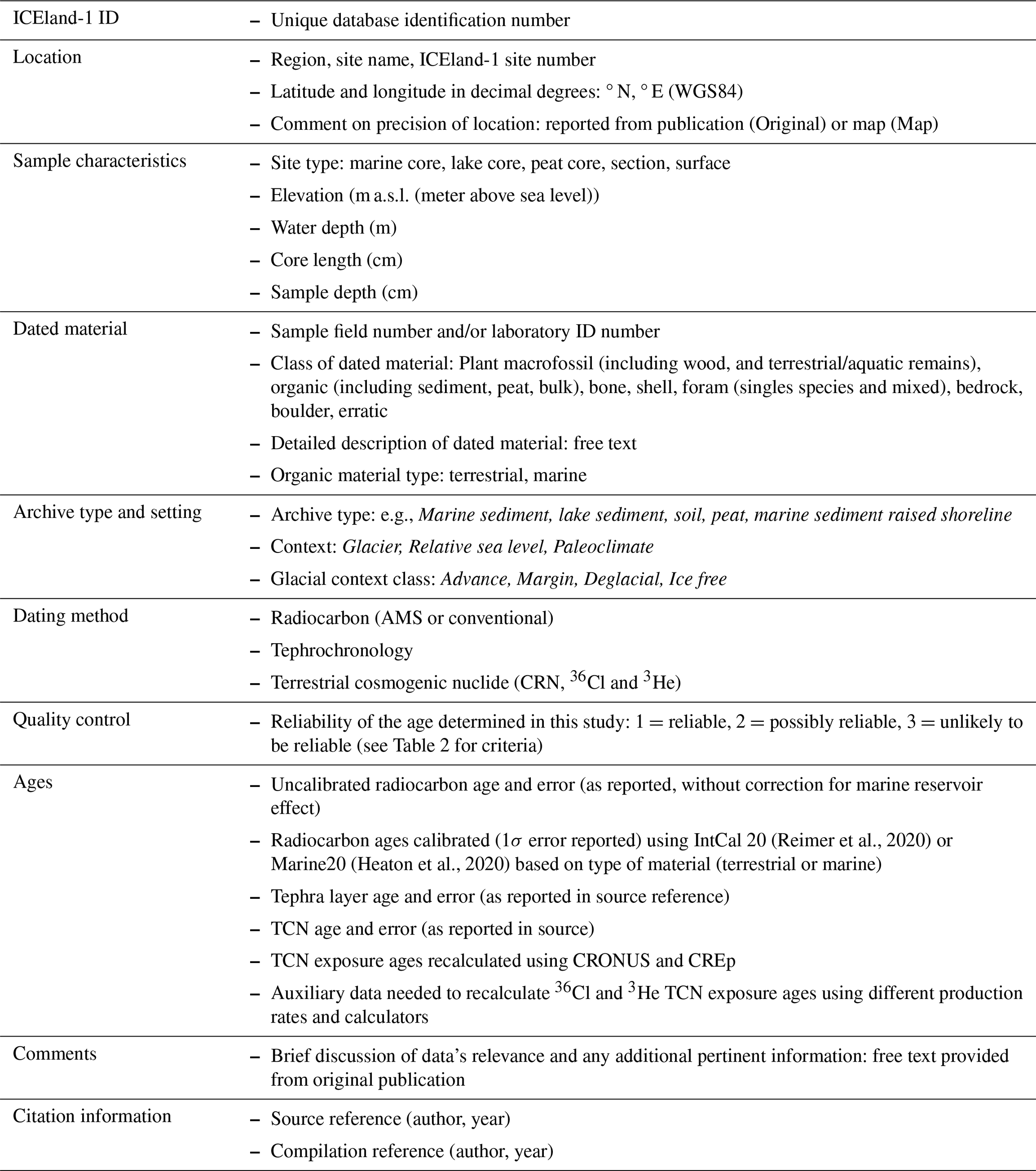
The ICEland-1 curated database covers the marine and terrestrial realms of Iceland and includes geochronological data derived from 14C (conventional and AMS), select Early Holocene marker tephra layers of known age, and TCN exposure ages (36Cl and 3He). In this first version of ICEland-1, we elected to omit most tephra layers and all paleomagnetic secular variation correlation tie points (e.g., Geirsdóttir et al., 2013; Ólafsdóttir et al., 2013). As both methods rely on user correlation, there is an inherent degree of subjectivity in assigning an age and our primary aim is to focus on the most objective, radiogenic toolsets. However, we do include two marker tephra layers because they feature diagnostic stratigraphical and compositional attributes and are relevant for delineating Early Holocene ice sheet limits: the Askja S tephra layer (10 887–10 773 cal yr BP, Bronk Ramsey et al., 2015) and the G10ka Series (10 400–9900 cal yr BP, Óladóttir et al., 2020). As the G10ka Series was the product of up to 13 eruptions from the Grímsvötn volcanic system that were dispersed in varying directions (Harning et al., 2025b), there is some regional variability in limiting ages and are noted as such in the database where relevant (e.g., Harning et al., 2018a, 2019b, 2025b; this study). While the ∼12 ka BP Vedde Ash has previously been included in Icelandic deglacial stratigraphies, particularly in the marine realm (e.g., Geirsdóttir et al., 2002, 2022; Eiríksson et al., 2004), we omit this marker as recent evidence from Iceland and abroad (Lane et al., 2012; Harning et al., 2024) demonstrate that multiple tephra layers with indistinguishable geochemical composition were produced in the Late Glacial and Early Holocene, leading to high temporal uncertainty without supporting chronological control. As the G10ka Series and Askja S tephra layers are both dated using 14C, they are included alongside 14C analyses in ICEland-1.
To ensure that our curated database follows FAIR (Findable, Accessible, Interoperable, and Reusable) data management principles (Wilkinson et al., 2016), we followed data synthesis approaches and standards first established for other ice sheet geochronologies (DATED-1, Hughes et al., 2016). This includes both the metadata and quality control criteria (Tables 1 and 2), with some minor modifications to suit Iceland's specific datasets (e.g., tephra and TCN exposure ages from basalt), so that future efforts can integrate ICEland-1 with other ice sheet databases and improve interoperability. Our database is hosted on Zenodo and Ghub (Tulenko et al., 2025), ensuring that our database is findable and accessible by the research community and public. Finally, to ensure reusability, we provide all raw data for 14C and TCN datasets so that ages can be recalibrated pending future developments in calibrations and calculators. The ICEland-1 has a census date of 1 January 2026, meaning that calibrated ages reflect the state-of-the-art at the time of publication as described in the following sections. Dates and associated metadata published after 1 January 2026, will be included in subsequent iterations to be formally described and submitted to a peer-reviewed data journal (e.g., Earth System Science Data).
2.2 Radiocarbon (14C)
In addition to published 14C ages, we report 32 new 14C dates from marine sediment and 17 new 14C from lake sediment and peat, which include 10 new 14C dates from Trjáviðurlækur constraining max/min ages of the Hekla 5 tephra and a minimum regional age for the G10ka Series tephra in south Iceland. New marine 14C ages were measured on shells and foraminifera and new terrestrial 14C ages were measured on plant macrofossils and humic acids. All samples were extracted (for humic acids, Abbott and Stafford, 1996) and graphitized at the Laboratory for AMS Radiocarbon Preparation and Research (NSRL), University of Colorado Boulder, and measured by AMS at the W.M. Keck Carbon Cycle AMS Laboratory, University of California Irvine. We recalibrated all 14C ages, including those previously published, using the latest terrestrial (IntCal20, Reimer et al., 2020) and marine calibration curves (Marine20, Heaton et al., 2020), with no corrections for variable reservoir age (ΔR), in OxCal Version 4.4 (Bronk Ramsey, 2009) and report uncertainty to 1σ (68 %). Compared to conventional 14C dates, AMS 14C dates are more reliable due to requiring less sample material and greater precision and accuracy within 14C calibration windows (Bronk Ramsey et al., 2004; Heaton et al., 2020; Reimer et al., 2020).
Marine20 differs from prior marine 14C calibrations in that it attempts to take large scale ΔR effects into account (Heaton et al., 2022) and therefore does not require local corrections for ΔR. However, Marine20 was also not designed for subpolar regions, such as Iceland, where sea ice extent, ocean upwelling and air–sea gas exchange may cause larger changes in ΔR through time. Evidence from an absolutely dated, annually resolved marine shell chronology on the North Iceland Shelf show centennial-scale ΔR variability over the last 1300 years (Wanamaker et al., 2012), similar to 14C-tephra layer comparisons from marine sediments over the last 4500 years (Eiríksson et al., 2004). This centennial-scale ΔR variability is consistent with Late Holocene water mass variability inferred from paleoceanographic reconstructions on the North Iceland Shelf (Kristjánsdóttir et al., 2017; Harning et al., 2021). Recent PSV-dated sediment records from Iceland's shelf demonstrate that when using Marine20 for the Holocene, a ΔR correction of 0 yields age estimates within uncertainty of Holocene tephra layers and annual marine shell chronologies (Reilly et al., 2023). However, as previously noted, some tephra layers are not well-constrained (e.g., Vedde Ash), leaving large uncertainties in past variation of ΔR on Iceland's shelf, particularly during the Late Glacial. As a result, 14C-dated marine sediments from glacial periods are likely too old, possibly by millennia (Heaton et al., 2023), and therefore, reflect maximum ages. 14C dates from sediment-feeding molluscs (e.g., Yoldia) may also be stratigraphically too old due to the update of old carbon in the sediment compared to suspension feeders (e.g., Mya truncata, England et al., 2013).
Bulk and humic acid 14C dates from the terrestrial realm may also be older than their stratigraphic position due to the incorporation of pre-existing organic carbon on the landscape, particularly during the Late Holocene (e.g., Geirsdóttir et al., 2009b). One way to test for potential offsets is through the comparison of bulk 14C dates with tephra layers of known age, which for some settings show basal bulk 14C dates consistent with the tephra ages, suggesting that potential offsets may be less of an issue shortly after deglaciation due to removal of pre-existing organic carbon by the IIS (e.g., Harning et al., 2024). However, in some instances where carbon content is low, basal bulk 14C deglaciation can yield substantially older ages than the expected timing of deglaciation (Brader et al., 2015), suggesting that not all carbon was removed from the landscape during the last glacial period. Hence, bulk 14C ages are generally less reliable and require careful consideration alongside other stratigraphic and dating constraints.
2.3 Terrestrial cosmogenic nuclides (TCN)
There is current debate and preference over which calculators yield the most accurate TCN exposure ages from 36Cl and 3He. For 36Cl, most dates included in ICEland-1 have used the development version of CREp (Martin et al., 2017; https://crep-dev.otelo.univ-lorraine.fr/#/init, last access: 1 February 2026), although there is generally no a priori reason stated as to why a given calculator was chosen over the others. Therefore, to be the most objective and maintain consistency across the database, we recalculated all ages where possible using the CRONUS-Earth online calculator v.3 (Balco et al., 2008), CRONUScalc (Marrero et al., 2016), and the development version of CREp (Martin et al., 2017; https://crep-dev.otelo.univ-lorraine.fr/#/init, last access: 1 February 2026). All metadata and geochemical constraints from the literature are provided in ICEland-1 required to recalculate ages pending future advances in the field. For most dates, we made some basic assumptions about samples, such as year of collection, rock density, formation age, and major and trace element concentrations and uncertainties that were not provided in the original publication. For example, we use the publication date for the year of collection, a rock formation age of 10±1 Ma, and density of 2.7 g cm−3 following assumptions in the literature. Major and trace element concentrations and uncertainties not reported were assumed to be 0. To maintain consistency with other recent ice sheet chronology curated databases (e.g., DATED-1, Hughes et al., 2016), we do not make corrections for post exposure uplift, erosion, or snow cover. For 3He exposure ages measured on tuyas, or tabletop mountains, we report rebound age adjustment correction factors (range 0.6 %–3.0 %, Licciardi et al., 2007) under the “Rebound_corr_perc” column, that if applied, will render a slightly older apparent exposure age. All recalculated age errors are reported as both internal analytical precision and total uncertainty that includes those from production rates and scaling schemes, and both reflect 1σ (68 %). All dates also include the originally reported age (“Orig_age”), in addition to information on the production rate (e.g., “Ca_spall_ref”) and calculator (“Calc_ref”) references used for that calculation. Only three studies did not provide enough data to recalculate 36Cl exposure ages (Principato et al., 2006; Schomacker et al., 2012; Hout, 2016), and therefore, were flagged for reduced reliability with brief discussion provided in the corresponding “Comment” column. We note that Licciardi et al. (2006, 2008) did not report 36Cl and 3He exposure ages as those samples were independently dated and used for production rate calculations.
2.4 Context
Each ICEland-1 date is first classified in terms of its “Context”: Glacier, Relative sea level, and/or Paleoclimate. This classification is largely taken from the source publication's original interpretation; however, we do use some continuous sediment records (e.g., marine and lake) that recovered complete postglacial sediment sequences and have basal ages near the glaciomarine/glaciolacustrine to postglacial mud transition. These records may have originally been published as paleoclimate records, but we consider there stratigraphies and dates to also be useful for “Glacier context” (i.e., Deglacial). This first-order classification will allow the user to immediately understand the relevant purposes of the data entry and how it can be used in our three focus areas. Glacier dates are then classified in terms of their “Glacial context”, i.e., how it constrains ice growth, retreat, or the past position of the margin based on its stratigraphy: Advance, Margin, Deglacial, Ice free, and/or Glacial. In addition, some TCN dates constrain more complex glacier dynamics and processes requiring several additional “Glacier context” classifications based on interpretations from their original publications: Rock glacier stabilization, Debris-covered glacier stabilization, Debris-covered glacier collapse, and Jökulhlaup drainage. The Ice-free classification is also important for most relative sea level data as well as continuous postglacial sediments that provide targets for paleoceanographic and paleoclimate proxy records. Our classification broadly follows that used for the Eurasian ice sheets (DATED-1, Hughes et al., 2016) as described with minor modifications below. Sediment descriptions and terminologies used here and in the “Comments” column of the database follow those previously used to describe marine sediments on the Iceland shelf (Syvitski et al., 1999).
2.4.1 Advance
Ages that constrain glacier advances derive from 14Ctephra dates of organic material in sedimentary records and from the modern glacier margin. More specifically, ages date the advance of a glacier (1) over marine ice-contact sediments (e.g., diamicton and till) resulting in reworked and compacted sediment packages (e.g., Geirsdóttir et al., 2002; Andrews and Helgadóttir, 2003; Norðdahl and Pétursson, 2005; Sigfúsdóttir and Benediktsson, 2020), (2) into a lake catchment, whereby the sediment transitions from organic postglacial mud to minerogenic (or varved) glaciolacustrine mud (Striberger et al., 2011; Larsen et al., 2011, 2012; Harning et al., 2016b), and (3) over rooted plants that are preserved until ice margin recession during the year of collection (Harning et al., 2016a, 2018b). For dates that underlie sedimentary ice-contact, glaciomarine, and glaciolacustrine sediments, ages provide maximum constraint on the glacier advance (e.g., Andrews and Helgadóttir, 2003; Harning et al., 2016a), which in some cases, may reflect a substantial amount of time between ice free and ice-covered conditions. We take the 14C ages of rooted dead plants to closely reflect the timing of ice advance over that site (Miller et al., 2013). As these plants are rooted in growth position, these dates also reflect precise spatiotemporal constraint on past ice margin positions. In cases where multiple dates constrain one glacier advance, the youngest Q1 date should be taken as most reliable.
2.4.2 Margin
Ages that constrain ice margins must be associated with an ice-margin position, such as glacier erratics and boulders from a moraine, glaciodeltaic and glaciolacustrine sediments, or ice-contact marine sediments that were not overridden by ice (e.g., uncompacted glacier diamicton). Glacier erratics and moraine boulders are most commonly dated using TCN. For moraine boulders, the TCN exposure age most conservatively reflects a minimum age as there is an unconstrained amount of time that elapsed between ice retreat from this maximum extent and stabilization of the moraine. In some cases, moraines in Iceland are also dated using 14Ctephra dates from sediments below, reworked into, or above the feature (Stötter, 1991; Schomacker et al., 2012; Brynjólfsson et al., 2015a). Dated sediments from below or reworked into the moraine reflect maximum ages of the ice margin (Schomacker et al., 2012; Brynjólfsson et al., 2015a), whereas dated sediments that overlie the moraine provide minimum age constraint (Stötter, 1991). Glaciodeltaics sediments, such as those from the Búði complex in southwest Iceland (Hjartarson and Ingólfsson, 1988; Geirsdóttir et al., 1997), reflect ages associated with the ice margin's position similar to tephra layers identified within glaciolacustrine sediment, which indicate that the glacier is still present within the lake catchment (Harning et al., 2016a, 2018a). The latter glaciolacustrine dates also constrain deglaciation processes, i.e., the lake basin had already deglaciated by the time of tephra layer deposition and thus provide minimum deglacial dates. Ice-contact sediments on the northwest marine shelf also likely reflect ages coincident with a proximal ice position (Andrews et al., 2000; Andrews and Helgadóttir, 2003).
2.4.3 Deglacial
Ages that constrain the timing of deglaciation are associated with glacially polished bedrock and sediments that possess stratigraphic information indicating ice-free conditions closely following ice cover. For bedrock, these dates are currently derived from 36Cl exposure ages, however, caution must be exercised in their interpretation as these exposure ages may reflect both exposure and subsequent burial. If the bedrock site has experienced burial following initial deglaciation, then the TCN exposure age will be too young (Heyman et al., 2011). On the other hand, if the bedrock was not sufficiently eroded, as is often the case under cold-based ice, TCN inheritance can result in artificially old exposure ages (Brynjólfsson et al., 2015b). For sediments, deglaciation is often seen as a transition from ice-contact to glaciomarine sediments (marine) and glaciolacustrine to postglacial muds (lake), where the dates (shells, macrofossils, and tephra layers) are sampled from basal portions of the overlying organic postglacial mud (e.g., Jennings et al., 2000; Harning et al., 2016a). Hence, these dates provide minimum age constraint on deglaciation. In cases where multiple dates constrain one glacier retreat, the oldest Q1 date should be taken as most reliable, and not averaged with the others.
2.4.4 Ice free
Ages that constrain periods of ice-free conditions are derived from sediments that show no precise association with glacier margin position. These include organic postglacial sediments from marine, lakes, peat, and soil sections, as well as raised shorelines, and comprise the bulk of ICEland-1's database (78 %). These archives serve several important purposes. First, the continuous sedimentation of non-glacial organic material provides robust evidence for no glacier presence at the site. Second, dated isolation basins, raised shorelines and marine sediment sections provide sea level index points and limiting ages that constrain patterns of relative sea level due to glacioisostatic rebound (Hijma et al., 2015). Third, these collective sedimentary records can be used to develop qualitative and quantitative records of local paleoceanography, paleoclimate (e.g., air temperature and precipitation), and relative sea level that support reconstructions and modeling of past ice dynamics (e.g., Jiang et al., 2015; Norðdahl and Ingólfsson, 2015; Anderson et al., 2018, 2019; Harning et al., 2020; Curtin, 2021).
2.4.5 Glacial
Finally, we introduce a new category not included in prior glacier chronology databases: glacial. This classification indicates that the date is associated with ice cover at that time and, in ICEland-1, is strictly used for 3He exposure ages (TCN). The 3He exposure ages are derived from tuyas, or table mountains, which are surfaces that formed due to subglacial volcanic eruptions that eventually melt through the ice (Kjartansson, 1943; Mathews, 1947). In addition to constraining the timing of ice cover, surficial tuya dates also provide rare constraint on past ice sheet thickness within its interior (Bourgeois et al., 1998; Licciardi et al., 2007). However, as in the case of 36Cl exposure ages, any subsequent burial of the site will result in an age that is too young (Heyman et al., 2011). On the other hand, as these tuyas are formed as new lava flows, inheritance due to insufficient glacier erosion is not an issue, meaning that all ages should be treated as maximums (Licciardi et al., 2007). For clusters of ages at individual sites, the oldest age in a cluster should be used rather than an average.
2.5 Data quality control
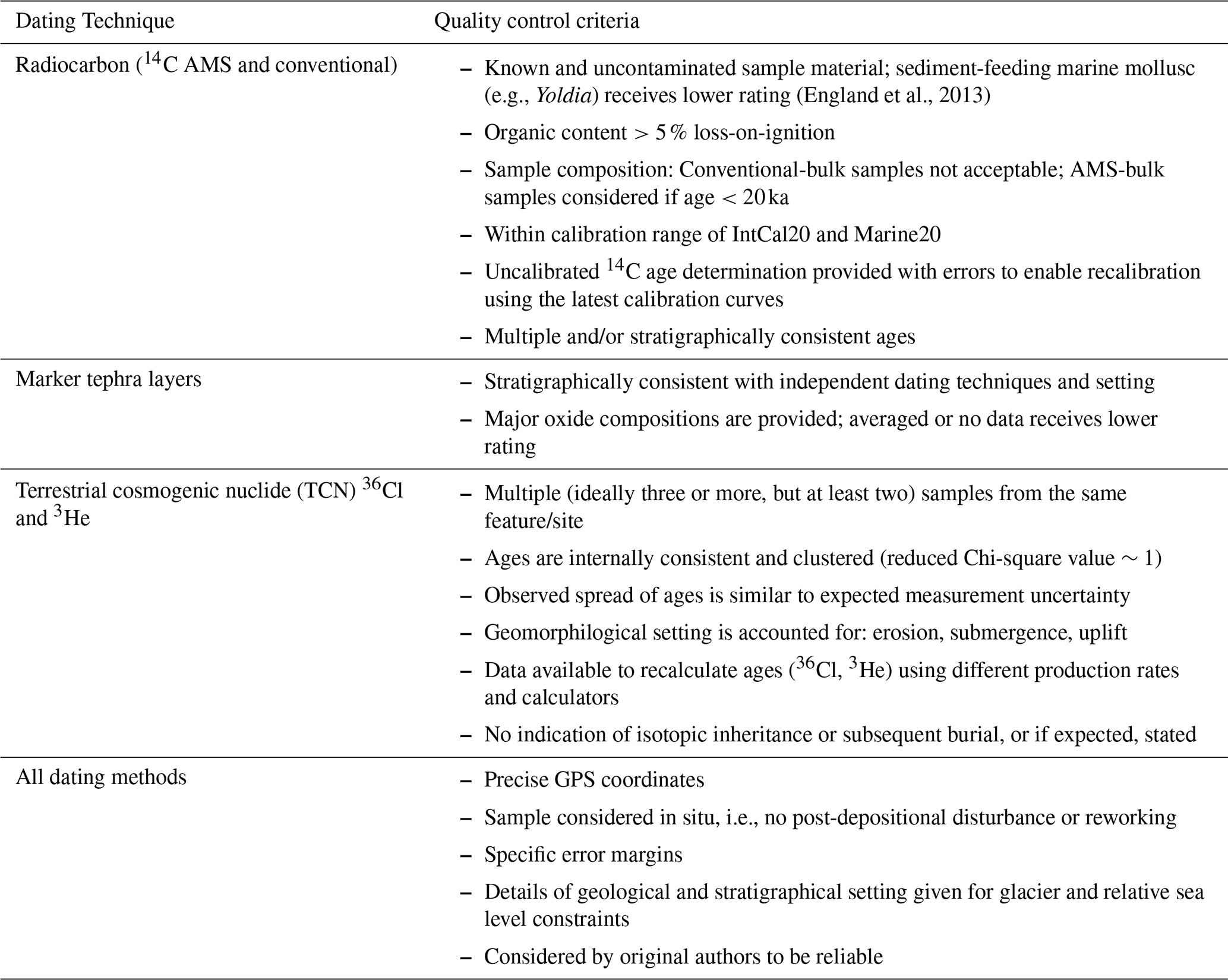
To assess the reliability of ICEland-1, we leverage the data quality control criteria first developed for DATED-1 (Hughes et al., 2016) with some minor modifications relevant for tephra layers (Davies et al., 2020) – see Table 2. These quality control criteria include those specific to individual dating techniques that address analytical considerations as well as criteria that apply for all dating methods, such as coordinate location and description of geologic setting. We assign each date included in ICEland-1 a qualitative quality control (QC) score on a scale of 1–3, where 1 is most reliable and 3 is least reliable. For dates to receive a QC rating of 1, they must satisfy all criteria. Taking a step forward from DATED-1 (Hughes et al., 2016), for every criterium that is not met, the date's QC rating is reduced by 1, meaning that dates with a QC rating of 3 have two or more unsatisfied criteria. While this approach may result in fewer “reliable” dates, it is in our opinion the most objective and conservative. However, we also acknowledge that while some dates with QC rating of 3 may not date ice sheet processes closely, they can still provide relevant information for where the IIS was in the past and its basal temperatures. For example, reworked ice-contact sediments on the marine shelf signify past ice sheet presence at the site, likely during the LGM, and inherited 36Cl exposure ages of LGM age likely indicate past cold-based ice. In this sense, we urge users to take a careful look at the “Comments” column for recommended use of individual data points as described in the original publication.
Table 2Age quality control criteria (adapted from Wohlfarth, 2009; Heyman et al., 2011; England et al., 2013; Davies et al., 2020; Reimer et al., 2020). Ages within ICEland-1 are given a quality control (QC) rating based on the criteria specific to the dating method. QC=1, all criteria are satisfied; QC=2, one criterium is not satisfied; QC=3, two or more criteria are not satisfied. Modified from Hughes et al. (2016).
3.1 Dataset inventory
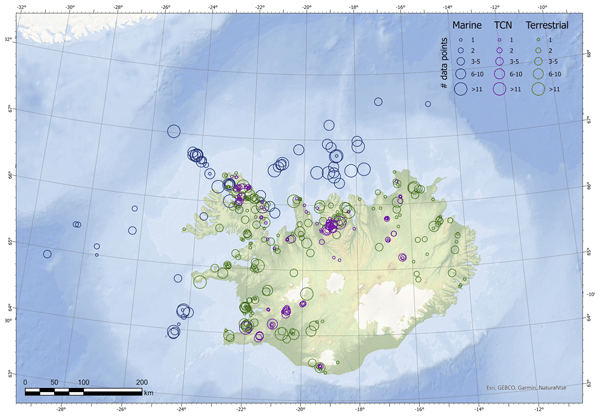
ICEland-1 provides a detailed inventory of geochronological data from an array of geologic sites across Iceland's marine and terrestrial realms (Fig. 1). In terms of the primary context classifications, the database includes 567 glacier dates, 257 relative sea level dates, and 1119 paleoclimates, with some dates fitting two or three of the context classifications. In the marine realm, ICEland-1 includes 70 different sediment core locations, with 672 individual 14C and tephra layer data points. For the terrestrial realm, chronological data include 14Ctephra layers from sedimentary archives and glacier margins and TCN exposure ages from bedrock, erratics, and boulders. Terrestrial 14Ctephra layer data are included from 249 sites, totalling 830 data points, and TCN data come from 123 sites, totalling 242 data points. Combined, ICEland-1 covers 442 sites and includes 1744, quality-assessed data points from 165 sources that can be used to constrain glacier, relative sea level, and paleoclimate patterns during the Late Quaternary.
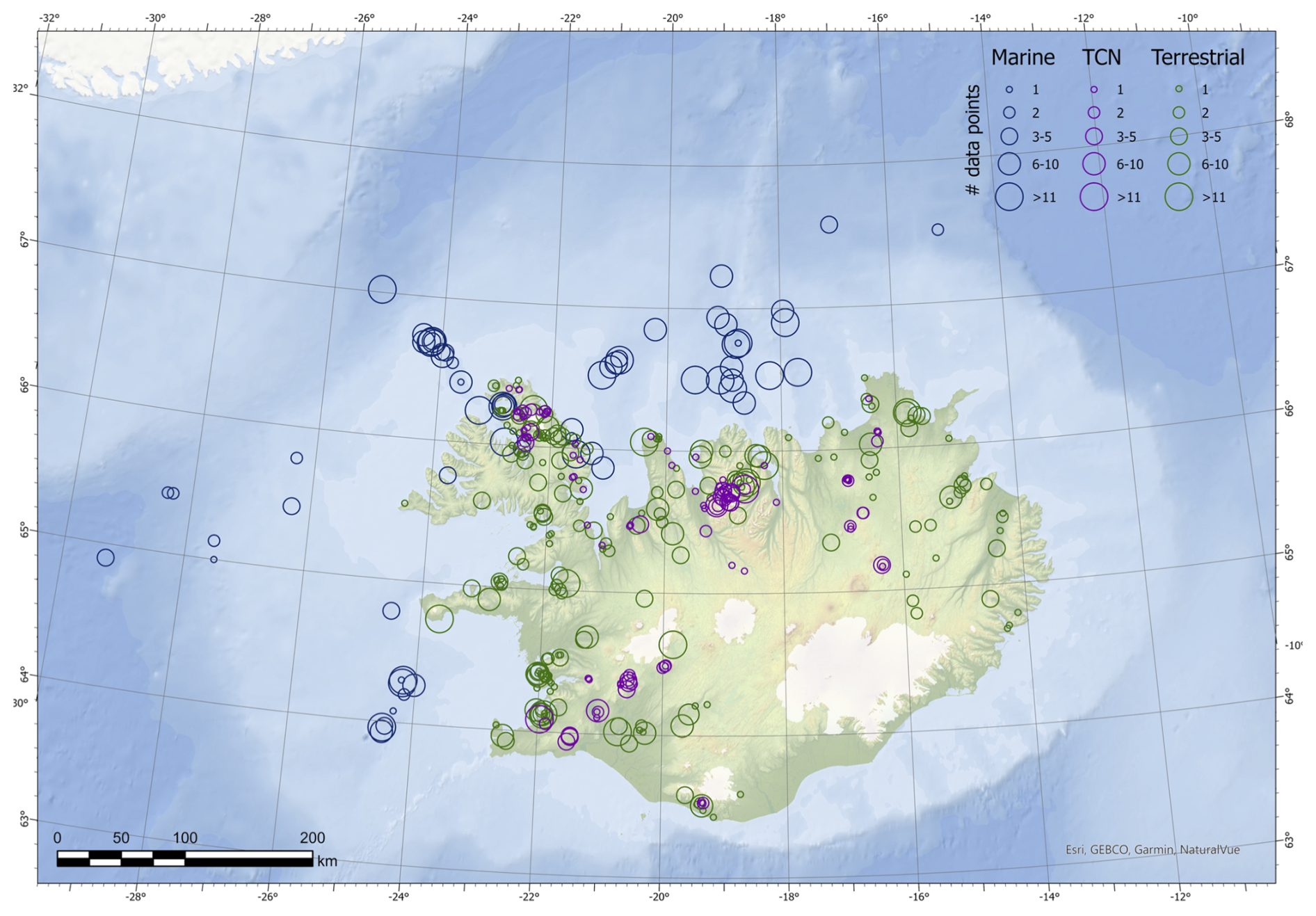
Figure 1Spatial distribution of all dates in the ICEland-1 curated database. Color and size of circles reflect the dating method (i.e., marine 14C, terrestrial 14C, and TCN) and number of data points at that site, respectively. Note that while the largest number of data points bin is >11, sites contain as many as 64 data points. Sources: Esri, GEBCO, Garmin, NaturalVue | Powered by Esri (ESRI, 2026; Natural Science Institute of Iceland, 2026).
3.2 Temporal distribution
The temporal distribution of ICEland-1 dates varies between the marine and terrestrial realms and with dating techniques. In the marine realm, the majority of 14C dates are younger than 16 ka BP (Fig. 2). The distribution of these younger dates is bimodal with peaks in the number of dates occurring around 12–10 ka BP and then during the Late Holocene (last 4.2 ka BP) (Fig. 2). The oldest marine 14C dates are >52 ka BP, and dates spanning are relatively few per 1000 year bin (Fig. 2). Many of these older dates received QC ratings below 1; the oldest reliable (QC 1) marine 14C date is 41.9 ka BP, from site V30-130 on the Iceland Plateau that signifies, along with its stratigraphy and position, ice never reached this location during the LGM (this study). On land, the majority of 14C and tephra layer dates are younger than 15 ka BP, with the highest number of dates occurring in the 11–10 ka BP bin (Fig. 3). The oldest terrestrial 14C dates span up to 39.2 ka BP, measured on whale bone from Rauðamelur (Fig. 3). Some of the dates older than 15 ka BP are from humic acids (20.4 and 17.5 ka BP) and have been previously deemed unreliable due to likely contamination from older carbon (Brader et al., 2015). The oldest reliable (QC 1) date is 14.7 ka BP, from the basal, fossiliferous sediments in Melasveit, a coastal marine sediment section in West Iceland (Sigfúsdóttir and Benediktsson, 2020). For TCN, most exposure ages are younger than 16 ka, with the highest number of dates occurring in the 11–10 ka bin (Fig. 4). The oldest exposure age is >62 ka, although this date as well as many over 15 ka likely incorporate some degree of nuclide inheritance that reduce the date's reliability (e.g., Principato et al., 2006; Brynjólfsson et al., 2015b). The oldest reliable exposure age is from an erratic on the Hornstrandi peninsula, northwest Iceland (Brynjólfsson et al., 2015b), and ranges from 14.2–17.6 ka, depending on choice of calculator (Balco et al., 2008; Marrero et al., 2016; Schimmelpfennig et al., 2022).
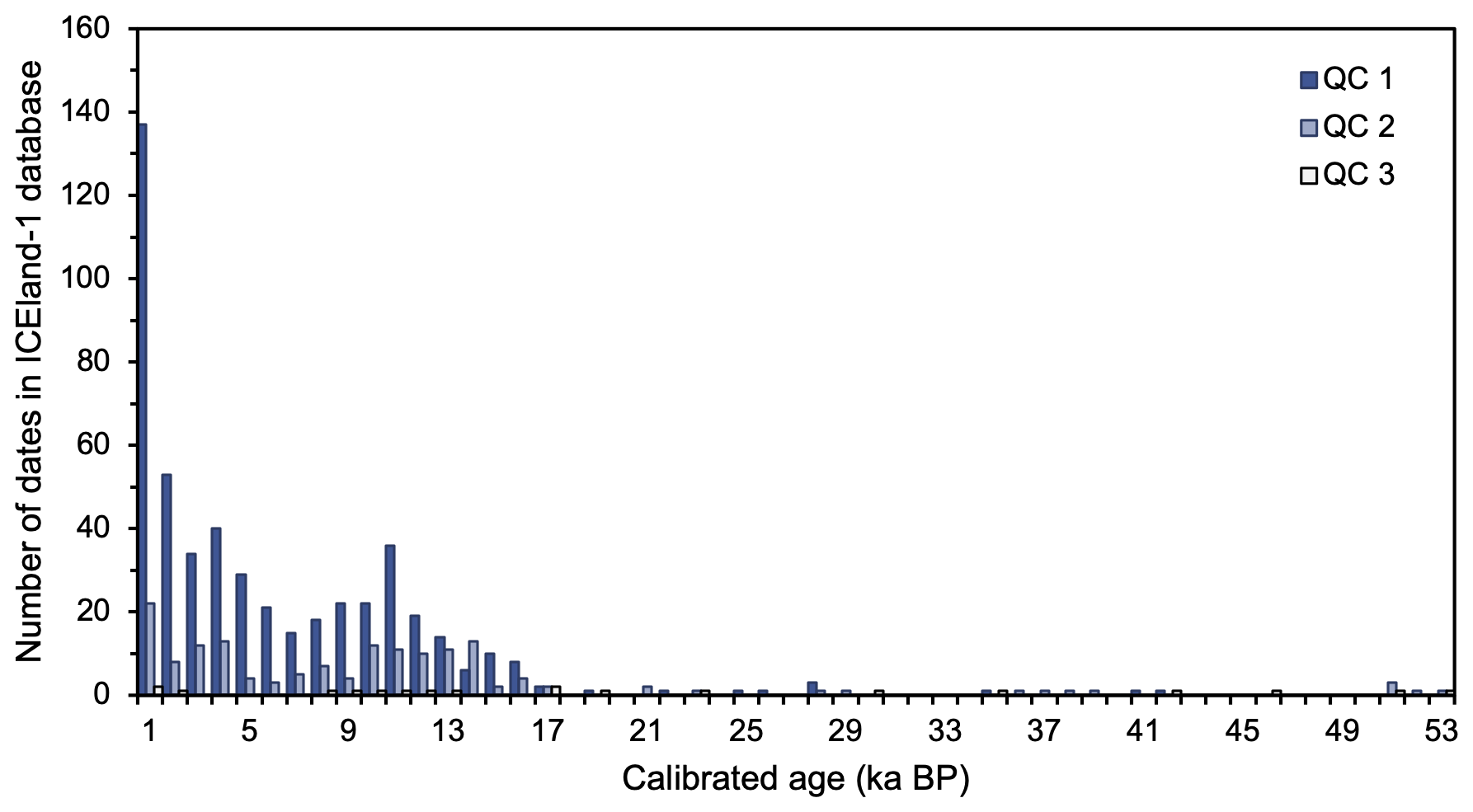
Figure 2Histogram of marine sediment 14C and tephra layer ages in the ICEland-1 curated database in 1000 year bins. Each bin is separated into the three quality control (QC) ratings, where QC 1 is dark blue, QC 2 is medium blue, and QC 3 is light blue. Note the different x axis range compared to Figs. 3 and 4.
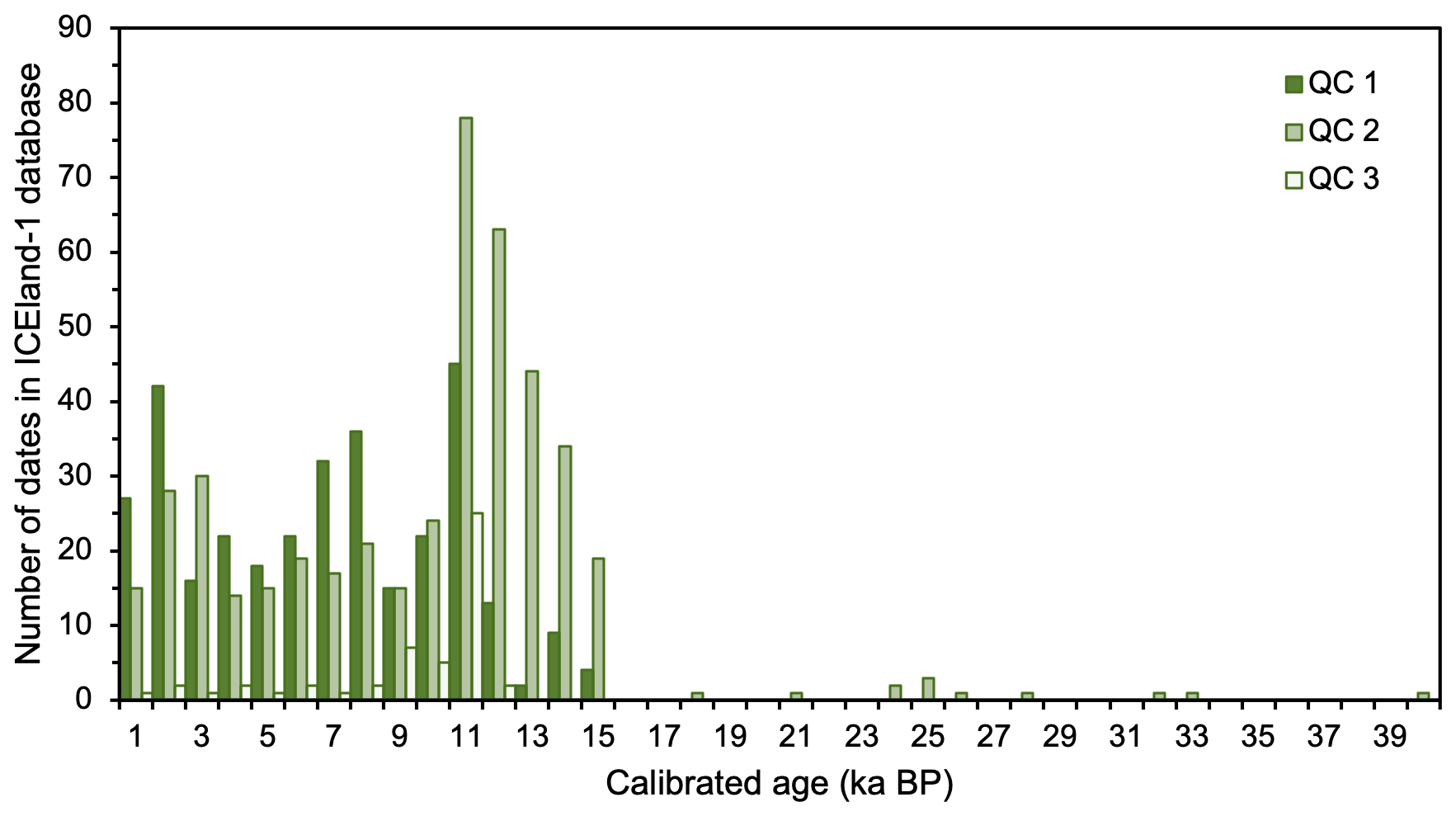
Figure 3Histogram of terrestrial sediment 14C and tephra layer ages in the ICEland-1 curated database in 1000 year bins. Each bin is separated into the three quality control (QC) ratings, where QC 1 is dark green, QC 2 is medium green, and QC 3 is light green. Note the different x axis range compared to Figs. 2 and 4.
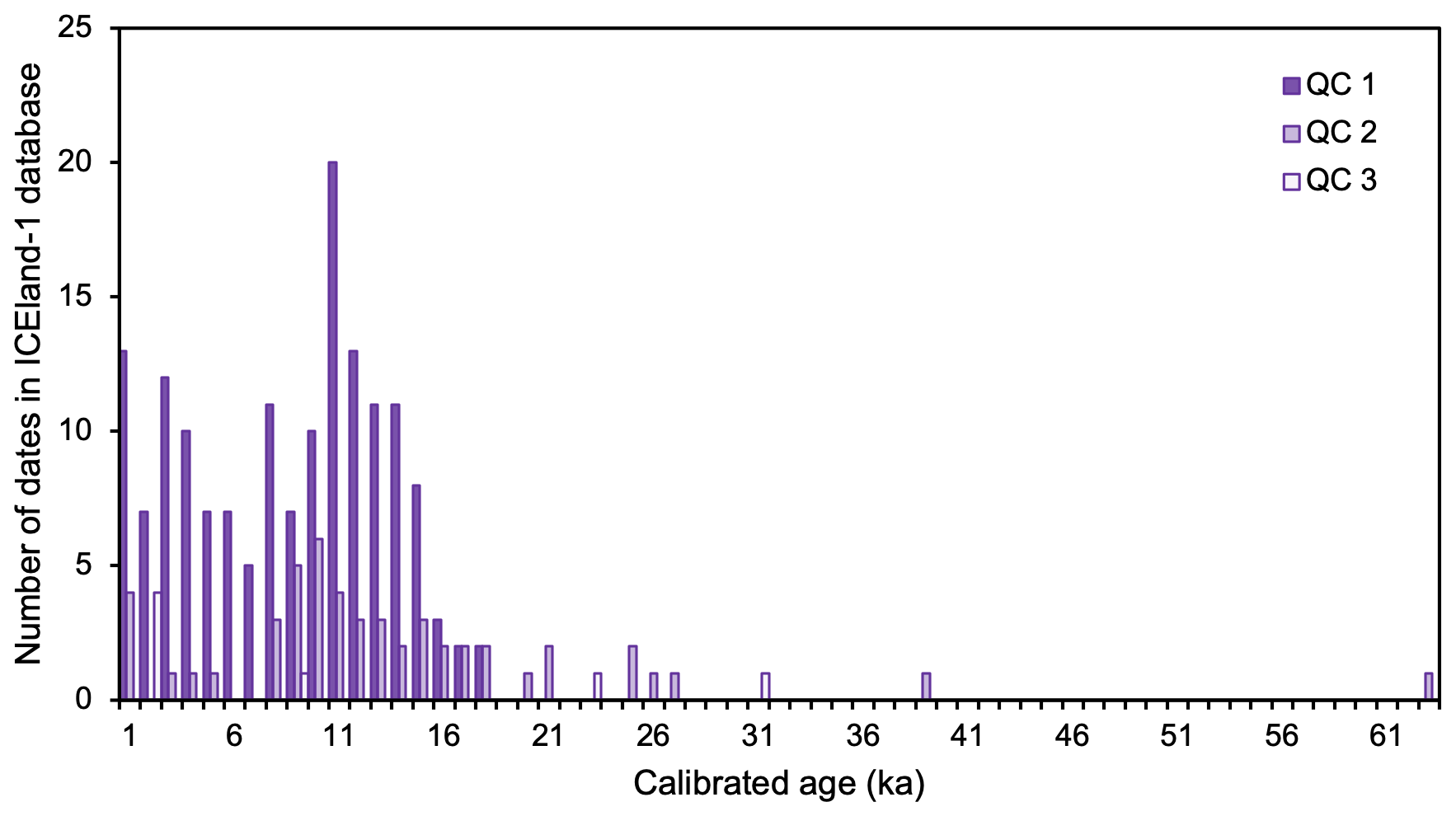
Figure 4Histogram of 36Cl and 3He TCN exposure ages in the ICEland-1 curated database in 1000 year bins. For 36Cl ages, we use recalculated dates after CREp (Schimmelpfennig et al., 2022) and for dates that could not be recalculated, we report them as in the original publication. For 3He ages, we use recalculated ages after CRONUS (Balco et al., 2008). Each bin is separated into the three quality control (QC) ratings, where QC 1 is dark purple, QC 2 is medium purple, and QC 3 is light purple. Note the different x axis range compared to Figs. 2 and 3.
3.3 Spatial distribution
ICEland-1's data coverage is variable across the marine and terrestrial realms. For the marine realm, while 14C data are limited to the western and northern shelf, the coverage is relatively dense. No chronological data currently exist from the eastern and southern shelf (Fig. 1). For the terrestrial realm, 14C and tephra layer data exist from all eight regions: Northeast (158), Northwest (114), Westfjords (149), West (155), Capital Region (65), Southern Peninsula (12), South (132), and East (45) (Fig. 1). For TCN, exposure data are largely restricted to the Northeast (43), Northwest (82), and Westfjords (43). The bulk of TCN data in South Iceland constrains Ca spallation and 3He production rates, rather than glacial processes explicitly (Licciardi et al., 2006, 2007) (Fig. 1). While not included in ICEland-1's chronological database, a variety of geomorphological data exist from bathymetric surveys along Iceland's shelf that constrain the spatial footprint of past ice limits (e.g., Ólafsdóttir, 1975; Boulton et al., 1988; Syvitski et al., 1999; Spagnolo and Clark, 2009) and can be used alongside ICEland-1 dates to reconstruct past ice sheet patterns (Fig. 5).
3.4 Assessment of data quality
ICEland-1 provides quality control (QC) assessment of each date and detailed information as to its reliability and interpretation in the context of glacier and paleoclimate history. For marine 14C dates, 496 dates received a QC 1 rating (74 %), 151 dates for QC 2 (22 %), and 25 dates for QC 3 (4 %) (Fig. 2). For terrestrial 14C dates and tephra layers, 329 dates received a QC 1 rating (40 %), 449 dates for QC 2 (54 %), and 52 dates for QC 3 (6 %) (Fig. 3). For TCN dates, 184 dates received a QC 1 rating (76 %), 49 dates for QC 2 (20 %), and 7 dates for QC 3 (3 %) (Fig. 4). Combined, dates with a QC 1 rating represent 58 % of the entire dataset, with QC 2 dates representing 37 %, and QC 3 dates representing 5 %. We suggest dataset users rely on the QC 1 as these have been assessed to be the most reliable, along with QC 2 dates at the user's discretion (Fig. 5). QC 3 dates should not be used for chronological constraint. However, some QC 3 dates, such as ice-contact sediments on the marine shelf that have been reworked (e.g., MD99-2264) or not (e.g., B997-322), provide useful spatial constraints on potential limits of the IIS during the LGM (Fig. 5).
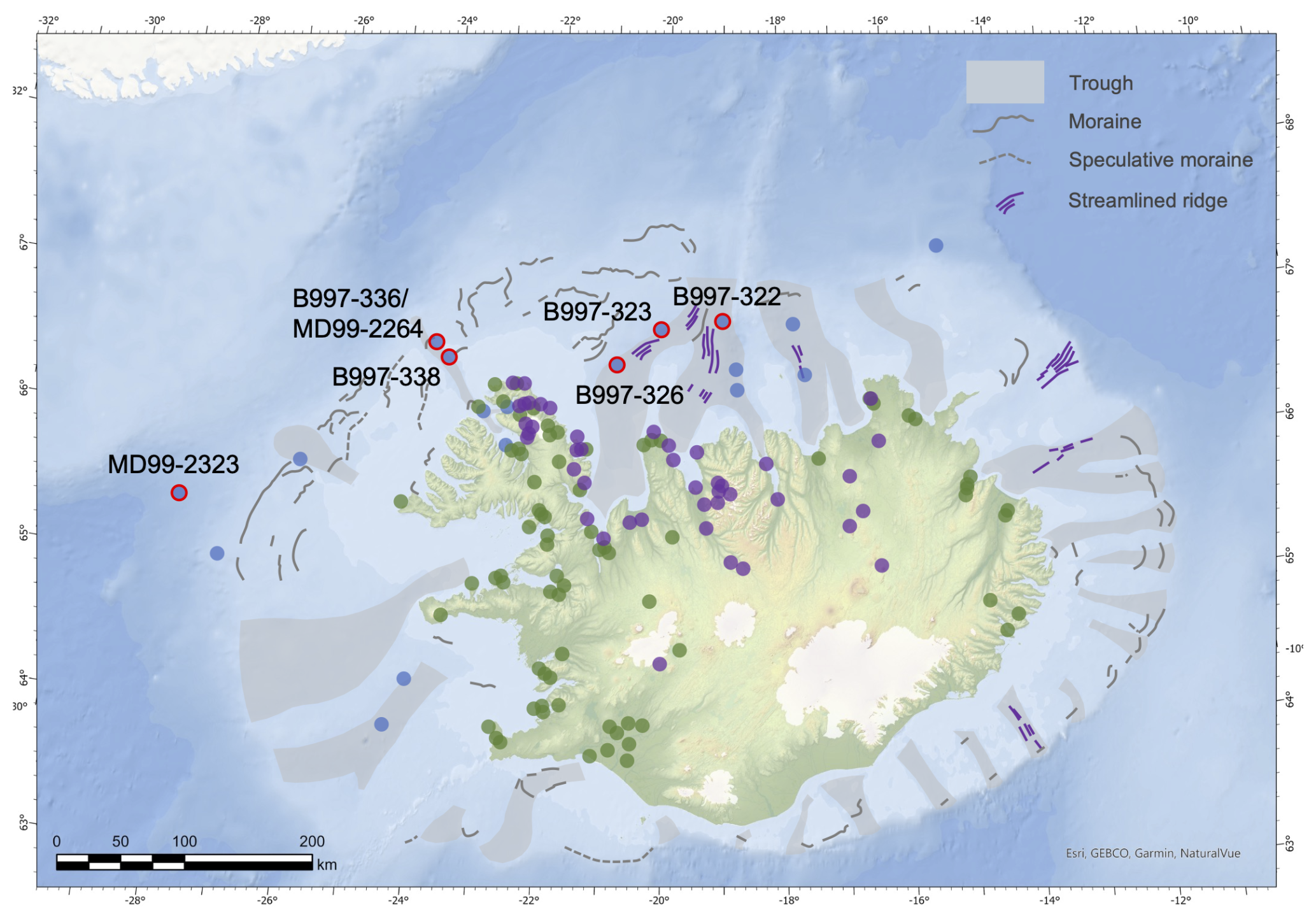
Figure 5Map of combined QC 1 and 2 14C and TCN dates in the marine and terrestrial realms relevant for reconstructing IIS deglaciation (i.e., Glacier and Relative sea level contexts, see Sect. 2.4). Most dots reflect a single date and their color follows those for dating techniques as shown in Fig. 1. We omit peat and soil sites from this map as their deposition is not necessarily continuous following local deglaciation. Tephra sites are shown in Fig. 6. Glacier geomorphology (i.e., moraines, troughs, and stream-lined ridges) are also mapped on the marine shelf for reference (Spagnolo and Clark, 2009; Patton et al., 2017). Sites mentioned in the text are highlighted with red borders and labeled. Sources: Esri, GEBCO, Garmin, NaturalVue | Powered by Esri (ESRI, 2026; Natural Science Institute of Iceland, 2026).
3.5 Sources of uncertainty and bias
Where possible, temporal uncertainties are explicitly quantified and reported in ICEland-1. These uncertainties primarily relate to the analytical measurements used for 14C and TCN and their calibrated and calculated ages, respectively. All quantified temporal uncertainties are reported at the 1σ (68 %) confidence level. However, it is important to remember that there is also unquantified uncertainty in dates as well. For example, due to unconstrained ΔR corrections, 14C dates in glacial age marine sediments are likely too old, possibly by millennia (Heaton et al., 2023). Similarly, bulk and humic acid 14C dates from the terrestrial realm may also be older than their stratigraphic position due to the incorporation of pre-existing organic carbon on the landscape (e.g., Geirsdóttir et al., 2009b). In some cases, the relative impact of old 14C bias can be accounted for in terrestrial sediments by comparing bulk 14C dates with tephra layers of known age that have been independently dated elsewhere (e.g., Harning et al., 2024). Apparent TCN exposure ages can be too old or too young due to inheritance or subsequent burial, but these factors cannot be quantified for current entries in ICEland-1 due to the single isotope approach used. Moreover, different TCN exposure age calculators yield a spectrum of apparent ages most likely due to the choice of various production rates used in age calculations. While CREp permits the selection of productions rates for 36Cl (e.g., Ca spallation, K spallation, etc.), both CRONUScalc and CRONUS Earth calculator v.3 (a developmental version at the time of this writing) are coded to use specific production rates that may differ from each other, thus resulting in the range of exposure observed between calculators. Furthermore, the utilization of CREp permits the input of specific production rates allowing users to incorporate values calibrated from source material more representative of their data (e.g., Ca spallation from Icelandic rocks, Licciardi et al., 2008) thus increasing reliability of the resulting TCN exposure ages. While previous studies have relied on a single calculator for simplicity (e.g., CREp), we suggest that all ages are treated as possibilities and reported as a range.
In addition to temporal, the other major source of uncertainty and bias is in the spatial metadata. First, 248 dates (14 %) have coordinate locations estimated from georeferenced maps in Google Earth. While this reduces the reliability of the date in our quality control assessment, it is challenging to accurately quantify the error associated with these inferred coordinates. Generally, the datum's map location point from the original source publication yields a diameter up to 5 km, meaning that ±2.5 km is a reasonable spatial uncertainty estimate for map-inferred coordinates. Second, robust relative sea level data, such as sea level index points, require specific indicative meaning that describe where the sea-level indicator formed with respect to tide levels, reference water levels, and elevation metadata (Hijma et al., 2015). In Iceland, sea level index points are generally found from isolation basins with varying degrees of uncertainty reported for key metadata (Lloyd et al., 2009; Brader et al., 2015, 2017). All pertinent relative sea level metadata provided in original publications is reported in ICEland-1's “Comment” column. The final spatial uncertainty is for dates from sediments that have been mobilized or reworked from their initial deposition site. We cannot provide spatial uncertainty estimates for these dates, and therefore, substantially reduces their reliability for dating purposes.
ICEland-1 provides detailed acknowledgement of spatial and temporal uncertainties for each data point. For example, spatial uncertainties related to inferred coordinates and reworked stratigraphies and temporal uncertainties related to bulk 14C and expected TCN inheritance/burial are incorporated into the quality control assessment and noted in the “QC_comment” column. Temporal uncertainties for analytical measurements and age calculations are provided to the extent that the data were available in the original source publication. We also provide detailed notes in the “Comment” column where dates should be treated as maximum and minimum as it relates to both 1) dating techniques (e.g., glacial age marine sediment and terrestrial bulk sediment 14C), and 2) stratigraphy. For the latter, it is important to remember that in most cases, 14C dates do not date the exact moment of glacier or relative sea level change at the site. Using deglacial 14C dates as an example, the organic material dated is deposited after the date the glacier retreats from the site and/or catchment, leaving an unconstrained amount of time between the two. Hence, these are limiting ages.
ICEland-1 is available on the online data repository Zenodo (https://doi.org/10.5281/zenodo.19376039, Harning et al., 2026). The dataset is provided as an .xslx file, with 4 individual tabs separating data types: marine radiocarbon, terrestrial radiocarbon, 36Cl TCN and 3He TCN. For each tab, we provide metadata on date location, sample characteristics, dated material, stratigraphic context and setting, quality control, all available data needed to recalculate ages pending new calibrations and calculators for different dating methods, and comments on additional information relevant for interpretation of the data. Each row in the curated database file is an individual data entry with the first column providing its ID number. When using ICEland-1, this paper and curated database should both be cited. Please contact DJH (david.harning@colorado.edu) to submit new data or revisions for future database iterations.
References for ICEland-1
The curated database was compiled using the following sources: Alsos et al. (2021); Andersen et al. (1989); Andrés et al. (2019, 2025); Andresen et al. (2005); Andrews et al. (2000, 2001, 2002a, b, 2009, 2021a, b); Andrews and Giraudeau (2003); Andrews and Helgadóttir (2003); Ardenghi et al. (2024); Ásbjörnsdóttir and Norðdahl (1995); Ashwell (1967, 1975); Axford et al. (2007, 2009); Bender (2020); Bendle and Rosell-Melé (2007); Bergþórsdóttir (2014); Björck et al. (1992); Black (2008); Blair et al. (2015); Brader et al. (2015, 2017); Brynjólfsson et al. (2015a, b); Caseldine et al. (2003, 2006); Castañeda et al. (2004); Coquin et al. (2016); Decaulne et al. (2016); Doner (2003); Dugmore (1989); Dunhill et al. (2004); Eddudóttir et al. (2015, 2016); Einarsson (1961, 1964); Eiríksson et al. (1997, 2000a, b, 2004); Erlendsson and Edwards (2009); Erlendsson et al. (2009); Farnsworth et al. (2025); Fernández-Fernández et al. (2019, 2020); Gathorne-Hardy et al. (2009); Gehrels et al. (2006); Geirsdóttir and Eiríksson (1994); Geirsdóttir et al. (1997, 2002, 2009b, 2022); Gudmundsdóttir et al. (2011); Gunnarson (2017); Håkansson (1987); Hannesdóttir (2006); Hansom and Briggs (1991); Hardardóttir et al. (2001); Harning et al. (2016a, b, 2018a, b, 2019a, b, 2023, 2024, 2025a, b c); Helgadóttir (1984); Hellqvist et al. (2020); Hjartarson (1989, 1993); Hjartarson and Ingólfsson (1988); Hjort et al. (1985); Holmes et al. (2016); Hout (2016); Hunt (1992); Ingólfsson (1985, 1987, 1988); Ingólfsson and Norðdahl (2001); Ingólfsson et al. (1995); Jennings et al. (2000); Jiang et al. (2015); Jóhannesson et al. (1994, 1997); Jóhannsdóttir (2007); John (1974); Jónsdóttir et al. (2015); Kaldal (1993); Karlsdóttir et al. (2012, 2014); Knudsen and Eiríksson (2002); Kirkbride et al. (2006); Kjartansson (1966); Kjartansson et al. (1964); Larsen et al. (2012); Larsen et al. (2024); Licciardi et al. (2006, 2007); Lloyd et al. (2009); Magnúsdóttir and Norðdahl (2000); Maizels (1991); Manley and Jennings (1996); Mercier et al. (2013, 2017); Norðdahl (1991); Norðdahl and Hjort (1987, 1993); Norðdahl and Ásbjörnsdóttir (1995); Norðdahl and Sæmundsson (1999); Norðdahl and Einarsson (2001); Norðdahl and Pétursson (2005); Norðdahl et al. (2019); Óladóttir et al. (2020); Ólafsdóttir et al. (2010); Olsson et al. (1969); Palacios et al. (2021); Pétursson (1986, 1991, 1997); Phillips and Plummer (1996); Phillips et al. (1996, 2001); Principato (2003, 2008); Principato et al. (2006); Quillmann et al. (2009, 2010); Richardson (1997); Riddell et al. (2018, 2024); Roy et al. (2018); Rundgren (1995, 1998); Rundgren et al. (1997); Sæmundsson (1995); Sæmundsson and Jóhannesson (2005); Sæmundsson et al. (2012); Santo-González et al. (2025); Schimmelpfennig et al. (2009, 2019); Schomacker et al. (2003, 2012, 2016); Sigfúsdóttir and Benediktsson (2020); Sigurgeirsson (1993, 2016); Sigurgeirsson and Leósson (1993); Sigvaldason (2002); Símonarson and Leifsdóttir (2002); Smith and Licht (2000); Stone (2000); Stoner et al. (2007); Stone (2000); Stötter (1991); Striberger et al. (2011); Sveinbjörnsdóttir and Johnsen (1991); Sveinbjörnsdóttir et al. (1993, 1998); Swanson and Caffee (2001), Tanarro et al. (2021); Thorarinsson (1956); Thors and Helgadóttir (1991); van der Bilt et al. (2021); Vilmundardóttir et al. (1979); Wanamaker et al. (2012); Wastl (2000); Wastl et al. (2001); Wells et al. (2025).
ICEland-1 provides a detailed and quality-assessed resource to facilitate future research in understanding the patterns of the IIS, Holocene glaciers, and their climate forcings. For instance, ICEland-1 may help to delineate glacier margins at discrete time slices, improve data-model comparisons using the next generation of ensemble glacier system models (e.g., Tarasov et al., 2025; Goffin et al., 2026), and highlight existing sediment records that can be used to develop new quantitative understanding of paleoceanography and climate (air temperature and precipitation). In the following, we briefly summarize some examples that highlight our vision for implementing ICEland-1 for research in understanding glacier, relative sea level, and paleoclimate in Iceland during the Late Quaternary, as well as opportunities for future research that can help minimize existing spatiotemporal uncertainties.
ICEland-1 provides a significant advancement from prior efforts using empirical evidence and modeling to reconstruct past glacier margins in Iceland. First, while glacier systems models deemed it glaciologically plausible that the IIS connected to the Greenland Ice Sheet during the LGM via an ice bridge (Goffin et al., 2026), 14C-dated sediment cores from the Snorri Drift (MD99-2323, Fig. 5) demonstrate that this did not occur at least in the last ∼240 ka BP (Andrews et al., 2021b). Second, QC 1 and 2 14C dates predating the LGM from compacted ice-contact sediments in Djúpáll, on the northwest Iceland shelf (e.g., MD99-2264, Geirsdóttir et al., 2002; B997-338, Smith and Licht, 2000) demonstrate that the IIS extended over this site during the LGM, similar to evidence from two 14C-dated, ice-contact marine sediments in Reykjafjarðaráll (B997-323 and 326, Andrews and Helgadóttir, 2003, Fig. 5). Along with Djúpáll site B997-336, these records suggest ice began to retreat from the outer shelf by . Third and finally, the distribution of diagnostic tephra layers in sediments offers a compelling tool to reconstruct and map glacier margins (e.g., Harning et al., 2016a; Geirsdóttir et al., 2022). ICEland-1's focus of the G10ka Series and Askja S tephra layers provides a more complete, as well as quality-controlled, synthesis of these two tephra layers Iceland compared to prior reviews (Óladóttir et al., 2020; Larsen et al., 2024). For instance, for the G10ka Series, we include 11 more sites not compiled by Óladóttir et al. (2020). Our quality control for these tephra layers is also critical as the prior reviews included sites that did not always contain major oxide composition, which were previously noted as such, and/or did not include the compositional data where presumably measured. While the use of the Askja S for mapping glacier margins at ∼10.8 ka BP is limited to Northeast Iceland due to ash trajectories, the G10ka Series covered the entirety of Iceland, meaning that it's presence/absence may be used to delineate glacier margins at (Fig. 6). Importantly, continuous lake sediment records that contain these tephra layers in their basal deglacial units can pinpoint the ice sheet's margin to a relatively small lake catchment at these times (i.e., Svartárgilsvatn, SVG, and Heiðarvatn, HEID, Harning et al., 2016a, 2025c, Fig. 6).
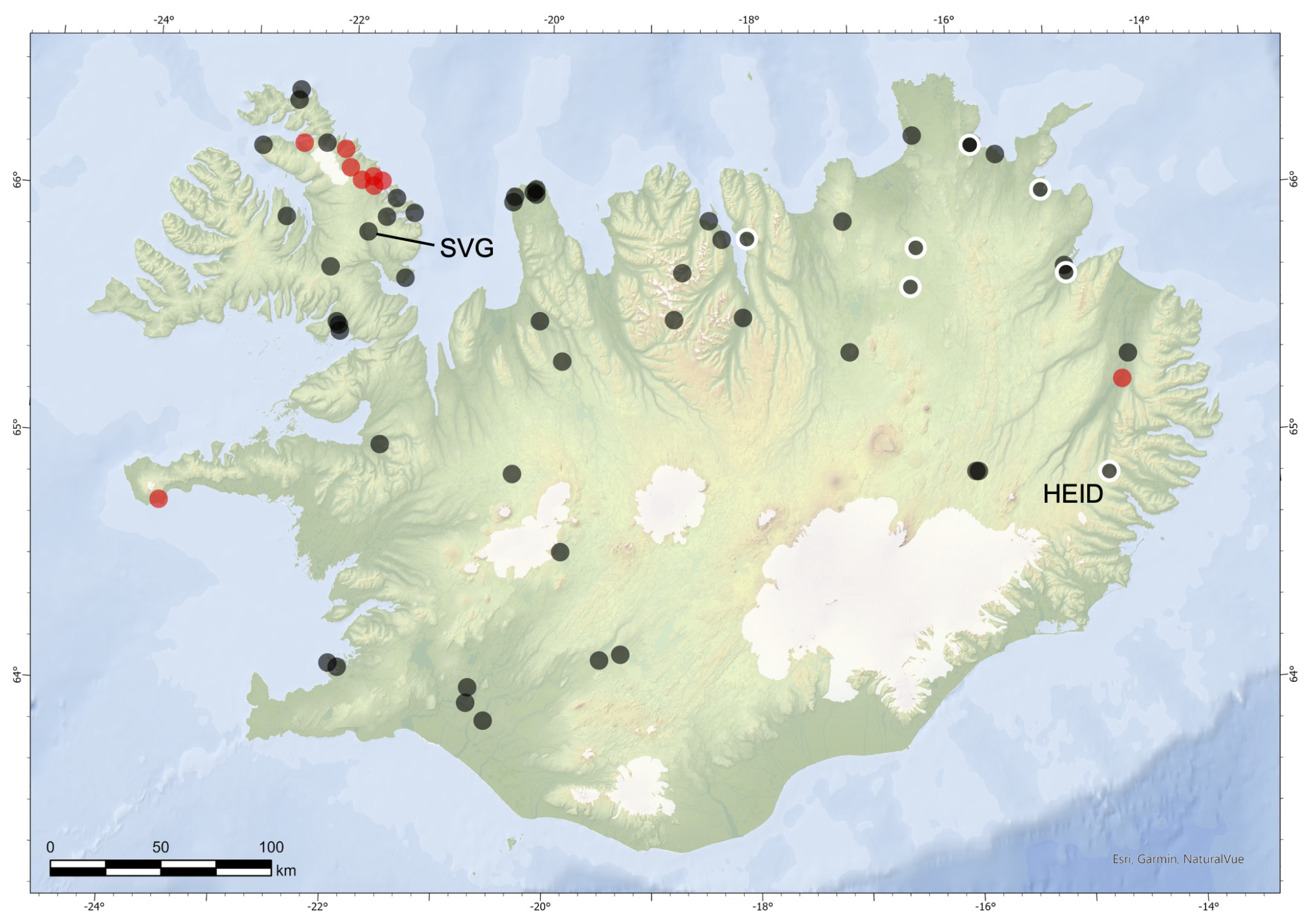
Figure 6Map of combined QC 1 and 2 tephra dates on land, where each dot reflects a single date. Black and red dots reflect an expanded dataset for the presence and absence of the G10ka Series tephra, respectively (10.4–9.9 ka BP, e.g., Óladóttir et al., 2020). Sites with a white border include the 10.8 ka BP Askja S tephra layer, whose deposition was restricted to Northeast Iceland due to its ash plume trajectory. The widespread presence of the G10ka Series indicates that the IIS had largely retreated to the central highlands by 10.4–9.9 ka BP. SVG=Svartárgilsvatn and HEID=Heiðarvatn. Sources: Esri, Garmin, NaturalVue | Powered by Esri (ESRI, 2026; Natural Science Institute of Iceland, 2026).
For paleoclimate, quantitative temperature records from the marine and terrestrial realms have largely focused on subfossil assemblage-based proxies (e.g., Axford et al., 2007; Jiang et al., 2015). At least for land, however, Holocene temperature records derived from chironomid assemblages have proven to be challenging due a variety of confounding factors including variable carbon content in the substrate, limited taxonomic resolution, and post-settlement erosion (Lawson et al., 2007; Langdon et al., 2008; Holmes et al., 2016). More recent studies have demonstrated the promise that lipid biomarkers and their stable isotopes hold for reconstructing temperature and precipitation histories in Iceland (Moossen et al., 2015) and their relation to Holocene glacier patterns (Harning et al., 2020; Curtin, 2021). Naturally, expanding the geographic range of these terrestrial, lake-based lipid biomarker and stable isotope records is needed to understand the spatiotemporal variability of climate and its impact on glacier evolution. Developing new quantitative paleoclimate records from the marine realm that extend these Holocene records through the LGM is also of high priority (e.g., Xiao et al., 2017). Not only will these quantitative paleoclimate records support empirical reconstructs of IIS evolution, but they can also be used as local forcings for time-dependent glacier models. This is particularly important as existing IIS models use Greenland ice core δ18O records and climate model output as paleoclimate forcings (Hubbard, 2006; Patton et al., 2017; Goffin et al., 2026), which need not reflect local Icelandic climate.
For the empirical data itself, ICEland-1 highlights several key priorities for future research. First, clear spatial gaps exist in the distribution of dates, whereby the northern portions of the marine and terrestrial realms are disproportionally represented. While these regions should not be neglected, future efforts can specifically focus on the east and south shelf and the Southern, Eastern and central highland regions of Iceland's terrestrial realm to improve our understanding of glacier and climate patterns in these sectors. Given the relatively larger age uncertainty associated with TCN exposure ages, macrofossil 14Ctephra-dated lake sediment records and rooted dead vegetation currently offer the most reliable tool for reconstructing glacier patterns during deglaciation and the Holocene. Second, 14C dates that constrain the deglaciation of marine-based components of the IIS are likely too old due to large yet unconstrained ΔR values during glacial periods (Heaton et al., 2023). Renewed focus on improving the constraint of deglacial age tephra layer groups of similar geochemical composition (e.g., Vedde-like and Borrobol-like) that can be independently dated elsewhere (e.g., Greenland ice and mainland Europe) may help derive local estimates of deglacial ΔR values. Similarly, improved age estimates for Holocene tephra layers, such as for the Hekla 5 tephra layer in this study (6.8–7.1 ka BP), can improve subsequent ΔR values, as well as the precision and correlation of Holocene chronologies. Finally, TCN exposure dating in Iceland has only employed a single nuclide approach (36Cl or 3He), which hinders our ability to decipher complex exposure-burial histories and understand whether existing dates may be too old or young. This is particularly relevant given the observed mobility of soils during the Holocene (e.g., Geirsdóttir et al., 2020) that may have resulted in some TCN sites experiencing varying degrees of burial since initial exposure. In contrast, using multiple radioactive isotopes with different decay rates and forward modeling can yield probabilistic exposure-burial histories (e.g., Vickers et al., 2020; Jones et al., 2025). With recent advances in TCN extraction procedures for mafic rocks, radioactive 10Be can now be measured alongside 36Cl (Balter-Kennedy et al., 2023), opening the door for more detailed interpretations of TCN exposure ages and improved chronological constraint of the IIS and Holocene glaciers where suitable 14C-based records may be lacking.
DJH led the compilation and quality assessment of the curated database with expert feedback from ÁG, JTA and AMB; ÁG and JTA contributed unpublished terrestrial and marine sediment 14C dates, respectively; AMB helped compile and recalculate TCN data and exposure ages; and IJ produced the maps. All authors reviewed the database and contributed to the manuscript.
The contact author has declared that none of the authors has any competing interests.
Publisher's note: Copernicus Publications remains neutral with regard to jurisdictional claims made in the text, published maps, institutional affiliations, or any other geographical representation in this paper. The authors bear the ultimate responsibility for providing appropriate place names. Views expressed in the text are those of the authors and do not necessarily reflect the views of the publisher.
We extend deep gratitude to the many individuals who have generated the data synthesized in this curated database and planted the seeds for continued research. Specifically, we thank Anne Jennings, Nancy Weiner, Kate Zalzal, and Gifford Miller for their contributions to new 14C dates published herein.
Many of the marine shell dates (JTA) were supported by a succession of NSF grants. DJH and ÁG acknowledge current support from NSF award OCE-2405185.
This paper was edited by Dalei Hao and reviewed by Joseph Tulenko, Anna L. C. Hughes, and one anonymous referee.
Abbott, M. B. and Stafford, T. W. J.: Radiocarbon geochemistry of modern and ancient arctic lake systems, Baffin Island, Canada, Quaternary Res., 45, 300–311, https://doi.org/10.1006/qres.1996.0031, 1996.
Aðalgeirsdóttir, G. Th., Magnússon, E., Pálsson, F., Thorsteinsson, Th., Belart, J. M. C., Jóhannesson, T., Hannesdóttir, H., Sigurðsson, O., Gunnarsson, A., Einarsson, B., Berthier, E., Schmidt, L. S., Haraldsson, H. H., and Björnsson, H.: Glacier changes in Iceland from ∼1890 to 2019, Front. Earth Sci., 8, https://doi.org/10.3389/feart.2020.523646, 2020.
Alsos, I. G., Ehrich, D., Seidenkrantz, M.-S., Bennike, O., Kirchhefer, A. J., and Geirsdóttir, Á.: The role of sea ice for vascular plant dispersal in the Arctic, Biol. Lett.-UK, 12, 20160264, https://doi.org/10.1098/rsbl.2016.0264, 2016.
Alsos, I. G., Lammers, Y., Kjellman, S. E., Merkel, M. K. F., Bender, E. M., Rouillard, A., Erlendsson, E., Guðmundsdóttir, E. R., Benediktsson, I. Ö., Farnsworth, W. F., Brynjólfsson, S., Gísladóttir, G., Eddudóttir, S. D., and Schomacker, A.: Ancient sedimentary DNA shows rapid post-glacial colonisation of Iceland followed by relatively stable vegetation until the Norse settlement (Landnám) AD 870, Quaternary Sci. Rev., 259, 106903, https://doi.org/10.1016/j.quascirev.2021.106903, 2021.
Andersen, G. J., Heinemeier, J. A. N., Nielsen, H. L., Rud, N., Thomsen, M. S., Johnsen, S., Sveinbjórnsdoðttir, Á., and Hjartarson, Á.: AMS 14C Dating on the Fossvogur Sediments, Iceland, Radiocarbon, 31, 592–600, https://doi.org/10.1017/s0033822200012182, 1989.
Anderson, L. S., Flowers, G. E., Jarosch, A. H., Aðalgeirsdóttir, G. Th., Geirsdóttir, Á., Miller, G. H., Harning, D. J., Thorsteinsson, T., Magnússon, E., and Pálsson, F.: Holocene glacier and climate variations in Vestfirðir, Iceland, from the modeling of Drangajökull ice cap, Quaternary Sci. Rev., 190, 39–56, https://doi.org/10.1016/j.quascirev.2018.04.024, 2018.
Anderson, L. S., Geirsdóttir, Á., Flowers, G. E., Wickert, A. D., Aðalgeirsdóttir, G. Th., and Thorsteinsson, T.: Controls on the lifespans of Icelandic ice caps, Earth Planet. Sc. Lett., 527, 115780, https://doi.org/10.1016/j.epsl.2019.115780, 2019.
Ardenghi, N., Harning, D. J., Raberg, J. H., Holman, B. R., Thordarson, T., Geirsdóttir, Á., Miller, G. H., and Sepúlveda, J.: A Holocene history of climate, fire, landscape evolution, and human activity in northeastern Iceland, Clim. Past, 20, 1087–1123, https://doi.org/10.5194/cp-20-1087-2024, 2024.
Andrés, N., Palacios, D., Sæmundsson, Þ., Brynjólfsson, S., and Fernández-Fernández, J. M.: The rapid deglaciation of Skagafjörður fjord, northern Iceland, Boreas, 48, 92–106, https://doi.org/10.1111/bor.12341, 2019.
Andrés, N., Fernández-Fernández, J. M., Palacios, D., Schimmelpfennig, I., Sancho, L. G., Brynjólfsson, S., Sæmundsson, Þ., Farnsworth, W. R., Tanarro, L. M., Brito, M., Santos-González, J., González-González, R. B., ASTER Team, Aumaître, G., and Keddadouche, K.: Late-Holocene evolution of a small Sub-Arctic glacier, Gljúfurárjökull (Tröllaskagi, northern Iceland), Boreas, https://doi.org/10.1111/bor.70030, 2025.
Andresen, C. S., Bond, G., Kuijpers, A., Knutz, P. C., and Björck, S.: Holocene climate variability at multidecadal time scales detected by sedimentological indicators in a shelf core NW off Iceland, Mar. Geol., 214, 323–338, https://doi.org/10.1016/j.margeo.2004.11.010, 2005.
Andrews, J. T. and Giraudeau, J.: Multi-proxy records showing significant Holocene environmental variability: the inner N. Iceland Shelf (Húnaflói), Quaternary Sci. Rev., 22, 175–193, https://doi.org/10.1016/s0277-3791(02)00035-5, 2003.
Andrews, J. T. and Helgadóttir, G.: Late Quaternary ice cap extent and deglaciation of Húnaflóaáll, northwest Iceland: evidence from marine cores, Arct. Antarct. Alp. Res., 35, 218–232, https://doi.org/10.1657/1523-0430(2003)035[0218:LQICEA]2.0.CO;2, 2003.
Andrews, J. T., Hardardóttir, J., Helgadóttir, G., Jennings, A. E., Geirsdóttir, Á., Sveinbjörnsdóttir, Á. E., Schoolfield, S., Kristjánsdóttir, G. B., Smith, L. M., Thors, K., and Syvitski, J.: The N and W Iceland Shelf: Insights into Last Glacial Maximum ice extent and deglaciation based on acoustic stratigraphy and basal radiocarbon AMS dates, Quaternary Sci. Rev., 19, 619–631, https://doi.org/10.1016/S0277-3791(99)00036-0, 2000.
Andrews, J. T., Helgadóttir, G., Geirsdóttir, Á., and Jennings, A. E.: Multicentury-scale records of carbonate (hydrographic) variability on the northern Iceland margin over the last 5000 years, Quaternary Res., 56, 199–206, https://doi.org/10.1006/qres.2001.2253, 2001.
Andrews, J. T., Hardardóttir, J., Geirsdóttir, Á., and Helgadóttir, G.: Late Quaternary ice extent and glacial history from the Djúpáll trough, off Vestfirdir peninsula, north-west Iceland: a stacked 36 cal Ky environmental record, Polar Res., 21, 211–226, https://doi.org/10.3402/polar.v21i2.6481, 2002a.
Andrews, J. T., Geirsdóttir, Á., Hardardóttir, J., Principato, S., Grönvold, K., Kristjánsdóttir, G. B., Helgadóttir, G., Drexler, J., and Sveinbjörnsdóttir, Á.: Distribution, sediment magnetism and geochemistry of the Saksunarvatn (10 180±60 cal yr BP) tephra in marine, lake, and terrestrial sediments, northwest Iceland, J. Quaternary Sci., 17, 731–745, https://doi.org/10.1002/jqs.727, 2002b.
Andrews, J. T., Belt, S. T., Ólafsdóttir, S., Massé, G., and Vare, L. L.: Sea ice and marine climate variability for NW Iceland/Denmark Strait over the last 2000 cal yr BP, Holocene, 19, 775–784, https://doi.org/10.1177/0959683609105302, 2009.
Andrews, J. T., Smik, L., Belt, S. T., Sicre, M.-A., McCave, I. N.: Ocean surface and bottom water conditions, ice berg drift and sediment transport on the North Iceland margin during MIS 3 and MIS 2, Quaternary Sci. Rev., 252, 106722, https://doi.org/10.1016/j.quascirev.2020.106722, 2021a.
Andrews, J. T., McCave, I. N., and Syvitski, J.: A ∼240 ka record of Ice Sheet and Ocean interactions on the Snorri Drift, SW of Iceland, Global Planet. Change, 201, 103498, https://doi.org/10.1016/j.gloplacha.2021.103498, 2021b.
Ásbjörnsdóttir, L. and Norðdahl, H.: Götungar í sjávarsetlögum við Mela á Skarðsströnd (In Icelandic), in: Eyjar í Eldhafi, edited by: Hróarsson, B., Jónsson, D., and Jónsson, S. S., Gott mál, Reykjavík, 179–188, 1995.
Ashwell, I. Y.: Radiocarbon ages of shells in the glaciomarine deposits of Western Iceland, Geogr. J., 133, 48–50, https://doi.org/10.2307/1794362, 1967.
Ashwell, I. Y.: Glacial and Late Glacial processes in Western Iceland, Geogr. Ann., 57, 225–245, https://doi.org/10.1080/04353676.1975.11879918, 1975.
Axford, Y., Miller, G. H., Geirsdóttir, Á., and Langdon, P.: Holocene temperature history of northern Iceland inferred from subfossil midges, Quaternary Sci. Rev., 26, 3344–3358, https://doi.org/10.1016/j.quascirev.2007.09.003, 2007.
Axford, Y., Geirsdóttir, Á., Miller, G. H., and Langdon, P.: Climate of the Little Ice Age and the past 2000 years in northeast Iceland inferred from chironomids and other lake sediment proxies, J. Paleolimnol., 41, 7–24, https://doi.org/10.1007/s10933-008-9251-1, 2009.
Balco, G., Stone, J. O., Lifton, N. A., and Dunai, T. J.: A complete and easily accessible means of calculating surface exposure ages or erosion rates from 10Be and 26Al measurements, Quat. Geochronol., 3, 174–195, https://doi.org/10.1016/j.quageo.2007.12.001, 2008.
Balter-Kennedy, A., Schaefer, J. M., Schwartz, R., Lamp, J. L., Penrose, L., Middleton, J., Hanley, J., Tibari, B., Blard, P.-H., Winckler, G., Hidy, A. J., and Balco, G.: Cosmogenic 10Be in pyroxene: laboratory progress, production rate systematics, and application of the 10Be–3He nuclide pair in the Antarctic Dry Valleys, Geochronology, 5, 301–321, https://doi.org/10.5194/gchron-5-301-2023, 2023.
Batchelor, C. L., Margold, M., Krapp, M., Murton, D. K., Dalton, A. S., Gibbard, P. L., Stokes, C. R., Murton, J. B., and Manica, A.: The configuration of Northern Hemisphere ice sheets through the Quaternary, Nat. Commun., 10, 3713, https://doi.org/10.1038/s41467-019-11601-2, 2019.
Bender, E. M.: Late Quaternary tephra stratigraphy and paleoenvironmental reconstruction based on lake sediments from North and Northeast Iceland, MS thesis, UiT The Arctic University of Norway, 2020.
Bendle, J. A. P. and Rosell-Melé, A.: High-resolution alkenone sea surface temperature variability on the North Icelandic Shelf: implications for Nordic Seas palaeoclimatic development during the Holocene, Holocene, 17, 9–24, https://doi.org/10.1177/0959683607073269, 2007.
Bergþórsdóttir, H. B.: A 3000 year high resolution multi-proxy record of environmental change from lake Gripdeild, eastern Iceland, MSc thesis, University of Iceland, 2014.
Björck, S., Ingólfsson, Ó., Haflidason, H., Hallsdóttir, M., and Anderson, N. J.: Lake Torfadalsvatn: a high resolution record of the North Atlantic ash zone I and the last glacial–interglacial environmental changes in Iceland, Boreas, 21, 15–22, https://doi.org/10.1111/j.1502-3885.1992.tb00009.x, 1992.
Black, J.: Holocene climate change in South Central Iceland: a multiproxy lacustrine record from glacial lake Hvítárvatn, PhD thesis, University of Colorado Boulder, 2008.
Blair, C. L., Geirsdóttir, Á., and Miller, G. H.: A high-resolution multi-proxy lake record of Holocene environmental change in southern Iceland, J. Quaternary Sci., 30, 281–292, https://doi.org/10.1002/jqs.2780, 2015.
Boulton, G. S., Thors, K., and Jarvis, J.: Dispersal of glacially derived sediment over part of the continental shelf of south Iceland and the geometry of the resultant sediment bodies, Mar. Geol., 83, 193–223, https://doi.org/10.1016/0025-3227(88)90058-8, 1988.
Bourgeois, O., Dauteuil, O., and Van Vliet-Lanoë, B.: Pleistocene subglacial volcanism in Iceland: tectonic implications, Earth Planet. Sc. Lett., 164, 165–178, https://doi.org/10.1016/S0012-821X(98)00201-5, 1998.
Brader, M. D., Lloyd, J. M., Bentley, M. J., and Newton, A. J.: Lateglacial to Holocene relative sea-level changes in the Stykkishólmur area, northern Snæfellsnes, Iceland, J. Quaternary Sci., 30, 497–507, https://doi.org/10.1002/jqs.2795, 2015.
Brader, M. D., Lloyd, J. M., Barlow, N. L. M., Norðdahl, H., Bentley, M. J., and Newton, A. J.: Postglacial relative sea-level changes in northwest Iceland: evidence from isolation basins, coastal lowlands and raised shorelines, Quaternary Sci. Rev., 169, 114–130, https://doi.org/10.1016/j.quascirev.2017.05.022, 2017.
Bronk Ramsey, C.: Bayesian analysis of radiocarbon dates, Radiocarbon, 51, 337–360, https://doi.org/10.1017/S0033822200033865, 2009.
Bronk Ramsey, C., Higham, T., and Leach, P.: Towards high-precision AMS: Progress and limitations, Radiocarbon, 46, 17–24, https://doi.org/10.1017/S0033822200039308, 2004.
Bronk Ramsey, C., Albert, P. G., Blockley, S. P. E., Hardiman, M., Housley, R. A., Lane, C. S., Lee, S., Matthews, I. P., Smith, V. C., and Lowe, J. J.: Improved age estimates for key Late Quaternary European tephra horizons in the RESET lattice, Quaternary Sci. Rev., 118, 18–32, https://doi.org/10.1016/j.quascirev.2014.11.007, 2015.
Brynjólfsson, S., Schomacker, A., Guðmundsdóttir, E. R., and Ingólfsson, Ó.: A 300 year surge history of the Drangajökull ice cap, northwest Iceland, and its maximum during the “Little Ice Age”, Holocene, 25, 1076–1092, https://doi.org/10.1177/0959683615576232, 2015a.
Brynjólfsson, S., Schomacker, A., Ingólfsson, O., and Keiding, J. K.: Cosmogenic 36Cl exposure ages reveal a 9.3 ka BP glacier advance and the Late Weichselian-Early Holocene glacial history of the Drangajökull region, northwest Iceland, Quaternary Sci. Rev., 126, 140–157, https://doi.org/10.1016/j.quascirev.2015.09.001, 2015b.
Burton-Johnson, A., Dziadek, R., and Martin, C.: Review article: Geothermal heat flow in Antarctica: current and future directions, The Cryosphere, 14, 3843–3873, https://doi.org/10.5194/tc-14-3843-2020, 2020.
Caseldine, C., Geirsdóttir, Á., and Langdon, P. G.: Efstadalsvatn – a multi-proxy study of a Holocene lacustrine sequence from NW Iceland, J. Paleolimnol., 30, 55–73, https://doi.org/10.1023/A:1024781918181, 2003.
Caseldine, C., Langdon, P., and Holmes, N.: Early Holocene climate variability and the timing and extent of the Holocene thermal maximum (HTM) in northern Iceland, Quaternary Sci. Rev., 25, 2314–2331, https://doi.org/10.1016/j.quascirev.2006.02.003, 2006.
Castañeda, I. S., Smith, L. M., Kristjánsdóttir, G. B., and Andrews, J. T.: Temporal changes in Holocene δ18O records from the northwest and central North Iceland Shelf, J. Quaternary Sci., 19, 321–334, https://doi.org/10.1002/jqs.841, 2004.
Clark, P. U., Dyke, A. S., Shakun, J. D., Carlson, A. E., Clark, J., Wohlfarth, B., Mitrovica, J. X., Hostetler, S. W., and McCabe, A. M.: The Last Glacial Maximum, Science, 325, 710–714, https://doi.org/10.1126/science.1172873, 2009.
Coquin, J., Mercier, D., Bourgeois, O., Feuillet, T., and Decaulne, A.: Is the gravitational spreading a precursor of the landslide of Stífluhólar (Skagafjörður, Northern Iceland)?, Géomorphologie, 22, 9–24, https://doi.org/10.4000/geomorphologie.11295, 2016.
Curtin, L.: Climate and human history of the North Atlantic: Perspectives from lipid biomarkers in lake sediments, PhD thesis, Columbia University, 2021.
Dalton, A. S., Dulfer, H. E., Margold, M., Heyman, J., Clague, J. J., Froese, D. G., Gauthier, M. S., Hughes, A. L. C., Jennings, C. E., Norris, S. L., and Stoker, B. J.: Deglaciation of the north American ice sheet complex in calendar years based on a comprehensive database of chronological data: NADI-1, Quaternary Sci. Rev., 321, 108345, https://doi.org/10.1016/j.quascirev.2023.108345, 2023.
Davies, B. J., Darvill, C. M., Lovell, H., Bendle, J. M., Dowdeswell, J. A., Fabel, D., García, J.-L., Geiger, A., Glasser, N. F., Gheorghiu, D. M., Harrison, S., Hein, A. S., Kaplan, M. R., Martin, J. R. V., Mendelova, M., Palmer, A., Pelto, M., Rodés, Á., Sagredo, E. A., Smedley, R., Smellie, J. L., and Thorndycraft, V. R.: The evolution of the Patagonian Ice Sheet from 35 ka to the present day (PATICE), Earth-Sci. Rev., 204, 103152, https://doi.org/10.1016/j.earscirev.2020.103152, 2020.
Decaulne, A., Cossart, E., Mercier, D., Coquin, J., Feuillet, T., and Jónsson, H. P.: An early Holocene age for the Vatn landslide (Skagafjörður, central northern Iceland): insights into the role of postglacial landsliding on slope development, Holocene, 26, 1304–1318, https://doi.org/10.1177/0959683616638432, 2016.
Doner, L.: Late-Holocene paleoenvironments of northwest Iceland from lake sediments, Palaeogeogr. Palaeocl., 193, 535–560, https://doi.org/10.1016/S0031-0182(03)00265-7, 2003.
Dugmore, A. J.: Tephrochronological studies of Holocene glacier fluctuations in South Iceland, in: Glacier Fluctuations and Climatic Change, edited by: Oerlemans, J., Springer, Dordrecht, 37–55, https://doi.org/10.1007/978-94-015-7823-3_3, 1989.
Dunhill, G., Andrews, J. T., and Kristjánsdóttir, G. B.: Radiocarbon Date List X: Baffin Bay, Baffin Island, Iceland, Labrador Sea, and the Northern North Atlantic, Occasional Paper No. 56, Institute of Arctic and Alpine Research, University of Colorado Boulder, 2004.
Eddudóttir, S. D., Erlendsson, E., and Gísladóttir, G.: Life on the periphery is tough: Vegetation in Northwest Iceland and its responses to early-Holocene warmth and later climate fluctuations, Holocene, 25, 1437–1453, https://doi.org/10.1177/0959683615585839, 2015.
Eddudóttir, S. D., Erlendsson, E., Tinganelli, L., and Gísladóttir, G.: Climate change and human impact in a sensitive ecosystem: the Holocene environment of the Northwest Icelandic highland margin, Boreas, 45, 715–728, https://doi.org/10.1111/bor.12184, 2016.
Einarsson, Th.: Pollenanalytische Untersuchungen zur spät- und postglazialen Klimageschichte Islands, Sonderveröffentlichungen des Geologischen Institutes der Universität Köln, 6, 1–52, 1961.
Einarsson, Þ.: Aldursákvarðanir á fornskeljum (English Summary: Radiocarbon dating of subfossil shells), in: C14-aldursákvarðanir á sýnishornum varðandi íslenzka kvarterjarðfræði (English Summary: C14 datings of Quaternary deposits in Iceland), edited by: Kjartansson, G., Þórarinsson, S., and Einarsson, Þ., Náttúrufræðingurinn, 34, 127–134, 1964.
Eiríksson, J., Símonarson, L. A., Knudsen, K. L., and Kristensen, P.: Fluctuations of the Weichselian ice sheet in SW Iceland: a glaciomarine sequence from Sudurnes, Seltjarnarnes, Quaternary Sci. Rev., 16, 221–240, https://doi.org/10.1016/S0277-3791(96)00052-2, 1997.
Eiríksson, J., Knudsen, K. L., Haflidason, H., and Henriksen, P.: Late-glacial and Holocene palaeoceanography of the North Icelandic shelf, J. Quaternary Sci., 15, 23–42, https://doi.org/10.1002/(SICI)1099-1417(200001)15:1<23::AID-JQS476>3.0.CO;2-8, 2000a.
Eiríksson, J., Knudsen, K. L., Haflidason, H., and Heinemeier, J.: Chronology of the late Holocene climatic events in the northern North Atlantic based on AMS 14C dates and tephra markers from the volcano Hekla, Iceland, J. Quaternary Sci., 15, 573–580, https://doi.org/10.1002/1099-1417(200009)15:6%3C573::AID-JQS554%3E3.0.CO;2-A, 2000b.
Eiríksson, J., Larsen, G., Knudsen, K. L., Heinemeier, J., and Símonarson, L. A.: Marine reservoir age variability and water mass distribution in the Iceland Sea, Quaternary Sci. Rev., 23, 2247–2268, https://doi.org/10.1016/j.quascirev.2004.08.002, 2004.
England, J., Dyke, A. S., Coulthard, R. D., McNeely, R., and Aitken, A.: The exaggerated radiocarbon age of deposit-feeding molluscs in calcareous environments, Boreas, 42, 362–373, https://doi.org/10.1111/j.1502-3885.2012.00256.x, 2013.
Erlendsson, E. and Edwards, K. J.: The timing and causes of the final pre-settlement expansion of Betula pubescens in Iceland, Holocene, 19, 1083–1091, https://doi.org/10.1177/0959683609341001, 2009.
Erlendsson, E., Edwards, K. J., and Buckland, P. C.: Vegetational response to human colonisation of the coastal and volcanic environments of Ketilsstaðir, southern Iceland, Quaternary Res., 72, 174–187, https://doi.org/10.1016/j.yqres.2009.05.005, 2009.
ESRI: World Ocean Base (GEBCO, GARMIN, NaturalVue), Scale 1:3 400 000, Accessed through ArcGIS Pro, https://www.esri.com/en-us/arcgis/products/arcgis-pro/overview, last access: 15 January 2026.
Farnsworth, W. R., Allaart, L., Ingólfsson, O., Alexanderson, H., Forwick, M., Noormets, R., Retelle, M., and Schomacker, A: Holocene glacial history of Svalbard – Status, perspectives and challenges, Earth-Sci. Rev., 208, 103249, https://doi.org/10.1016/j.earscirev.2020.103249, 2020.
Farnsworth, W. R., Áradóttir, N., Bryjólfsson, S., Eddudóttir, S. D., Erlendsson, E., Guðfinnsson, G. H., Guðmundsdóttir, E. R., Kalliokoski, M., Larsen, G., Rúnarsdóttir, R. H., Ruter, A. H., Siggaard-Andersen, M.-L., Steinþórsson, S., Larsen, N. K., and Kjær, K. H.: Explosive volcanic history of Snæfellsjökull, West Iceland: Geochemistry, chronology, and tephra distribution, Quaternary Sci. Rev., 359, 109346, https://doi.org/10.1016/j.quascirev.2025.109346, 2025.
Fernández-Fernández, J. M., Palacios, D., Andrés, N., Schimmelpfennig, I., Brynjólfsson, S., Sancho, L. G., Zamorano, J. J., Heiðmarsson, S., Sæmundsson, Þ., and ASTER Team: A multi-proxy approach to Late Holocene fluctuations of Tungnahryggsjökull glaciers in the Tröllaskagi peninsula (northern Iceland), Sci. Total Environ., 664, 499–517, https://doi.org/10.1016/j.scitotenv.2019.01.364, 2019.
Fernández-Fernández, J. M., Palacios, D., Andrés, N., Schimmelpfennig, I., Tanarro, L. M., Brynjólfsson, S., López-Acevedo, F. J., Sæmundsson, Þ., and ASTER Team: Constraints on the timing of debris-covered and rock glaciers: an exploratory case study in the Hólar area, northern Iceland, Geomorphology, 361, 107196, https://doi.org/10.1016/j.geomorph.2020.107196, 2020.
Fisher, A. T., Mankoff, K. D., Tulaczyk, S. M., Tyler, S. W., and Foley, N.: High geothermal heat flux measured below the West Antarctic Ice Sheet, Sci. Adv., 1, e1500093, https://doi.org/10.1126/sciadv.1500093, 2015.
Flowers, G. E., Björnsson, H., Geirsdóttir, Á., Miller, G. H., and Clarke, G. K. C.: Glacier fluctuation and inferred climatology of Langjökull ice cap through the Little Ice Age, Quaternary Sci. Rev., 22, 2337–2353, https://doi.org/10.1016/j.quascirev.2007.07.016, 2007.
Flowers, G. E., Björnsson, H., Geirsdóttir, Á., Miller, G. H., Black, J. L., and Clarke, G. K. C.: Holocene climate conditions and glacier variation in central Iceland from physical modelling and empirical evidence, Quaternary Sci. Rev., 27, 797–813, https://doi.org/10.1016/j.quascirev.2007.12.004, 2008.
Gathorne-Hardy, F. J., Erlendsson, E., Langdon, P. G., and Edwards, K. J.: Lake sediment evidence for late Holocene climate change and landscape erosion in western Iceland, J. Paleolimnol., 42, 413–426, https://doi.org/10.1007/s10933-008-9285-4, 2009.
Gehrels, W. R., Marshall, W. A., Gehrels, M. J., Larsen, G., Kirby, J. R., Eiriíksson, J., Heinemeier, J., and Shimmield, T.: Rapid sea-level rise in the North Atlantic Ocean since the first half of the nineteenth century, Holocene, 16, 949–965, https://doi.org/10.1177/0959683606hl986rp, 2006.
Geirsdóttir, Á., and Eiríksson, J.: Sedimentary facies and environmental history of the Late-glacial glaciomarine Fossvogur sediments in Reykjavík, Iceland, Boreas, 23, 164–176, https://doi.org/10.1111/j.1502-3885.1994.tb00597.x, 1994.
Geirsdóttir, Á., Hardardóttir, J., and Eiríksson, J.: The Depositional History of the Younger Dryas – Preboreal Búdi Moraines in South-Central Iceland, Arctic Alpine Res., 29, 13–23, https://doi.org/10.1080/00040851.1997.12003211, 1997.
Geirsdóttir, A., Hardardóttir, J., and Sveinbjörnsdóttir, Á. E.: Glacial extent and catastrophic meltwater events during the deglaciation of Southern Iceland, Quaternary Sci. Rev., 19, 1749–1761, https://doi.org/10.1016/S0277-3791(00)00092-5, 2000.
Geirsdóttir, Á., Andrews, J. T., Ólafsdóttir, S., Helgadóttir, G., and Hardardóttir, J.: A 36 ka record of iceberg rafting and sedimentation from north-west Iceland, Polar Res., 21, 291–298, https://doi.org/10.3402/polar.v21i2.6490, 2002.
Geirsdóttir, Á., Miller, G. H., Axford, Y., and Ólafsdóttir, S.: Holocene and latest Pleistocene climate and glacier fluctuations in Iceland, Quaternary Sci. Rev., 28, 2107–2118, https://doi.org/10.1016/j.quascirev.2009.03.013, 2009a.
Geirsdóttir, Á., Miller, G. H., Thordarson, T., and Ólafsdóttir, K. B.: A 2000 year record of climate variations reconstructed from Haukadalsvatn, West Iceland, J. Paleolimnol., 41, 95–115, https://doi.org/10.1007/s10933-008-9253-z, 2009b.
Geirsdóttir, Á., Miller, G. H., Larsen, D. J., and Ólafsdóttir, S.: Abrupt Holocene climate transitions in the northern North Atlantic region recorded by synchronized lacustrine records in Iceland, Quaternary Sci. Rev., 70, 48–62, https://doi.org/10.1016/j.quascirev.2013.03.010, 2013.
Geirsdóttir, Á., Miller, G. H., Andrews, J. T., Harning, D. J., Anderson, L. S., Florian, C., Larsen, D. J., and Thordarson, T.: The onset of Neoglaciation in Iceland and the 4.2 ka event, Clim. Past, 15, 25–40, https://doi.org/10.5194/cp-15-25-2019, 2019.
Geirsdóttir, Á., Harning, D. J., Miller, G. H., Andrews, J. T., Zhong, Y., and Caseldine, C.: Holocene history of landscape instability in Iceland: Can we deconvolve the impacts of climate, volcanism, and human activity?, Quaternary Sci. Rev., 249, 106633, https://doi.org/10.1016/j.quascirev.2020.106633, 2020.
Geirsdóttir, Á., Miller, G. H., Harning, D. J., Hannesdóttir, H., Thordarson, T., and Jónsdóttir, I.: Evidence for recurrent outburst floods and active volcanism in Icelandic lacustrine settings during dynamic Younger Dryas-Early Holocene deglaciation, J. Quaternary Res., 37, 1006–1023, https://doi.org/10.1002/jqs.3344, 2022.
Goffin, A. A., Tarasov, L., Benediktsson, Í. Ö., and Licciardi, J. M.: Growth and decay of the Iceland Ice Sheet through the last glacial cycle, Clim. Past, 22, 825–843, https://doi.org/10.5194/cp-22-825-2026, 2026.
Gowan, E. J., Zhang, X., Khosravi, S., Rovere, A., Stocchi, P., Hughes, A. L. C., Gyllencreutz, R., Mangerud, J., Svendsen, J.-I., and Lohmann, G.: A new global ice sheet reconstruction for the past 80 000 years, Nat. Commun., 12, 1199, https://doi.org/10.1038/s41467-021-21469-w, 2021.
Gudmundsdóttir, E. R., Larsen, G., and Eiríksson, J.: Two new Icelandic tephra markers: the Hekla Ö tephra layer, 6060 cal yr BP, and Hekla DH tephra layer, ∼6650 cal yr BP. Land–sea correlation of mid-Holocene tephra markers, Holocene, 21, 629–639, https://doi.org/10.1177/0959683610391313, 2011.
Gunnarson, S.: Holocene climate and landscape evolution in the west Central Highlands, Iceland, MSc thesis, University of Iceland, 2017.
Håkansson, S.: University of Lund Radiocarbon Dates XX, Radiocarbon, 29, 353–379, 1987.
Hannesdóttir, H.: Reconstructing environmental change in South Iceland during the last 12 000 cal yr based on sedimentological and seismostratigraphical studies in lake Hestvatn, MSc thesis, University of Iceland, 2006.
Hansom, J. D. and Briggs, D. J.: Sea-level change in Vestfirðir, north west Iceland. in: Environmental Changes in Iceland: Past and Present, edited by: Maizels, J. K. and Caseldine, C., Kluwer Academic Publishers, Dordrecht, 79–92, 1991.
Hardardóttir, J., Geirsdóttir, Á., and Thórdarson, T.: Tephra layers in a sediment core from Lake Hestvatn, southern Iceland: implications for evaluating sedimentation processes and environmental impacts on a lacustrine system caused by tephra fall deposits in the surrounding watershed, Spec. Publs int. Ass. Sediment., 30, 224–246, https://doi.org/10.1002/9781444304251.ch11, 2001.
Harning, D. J., Geirsdóttir, Á., Miller, G. H., and Zalzal, K.: Early Holocene deglaciation of Drangajökull, Vestfirðir, Iceland, Quaternary Sci. Rev., 153, 192–198, https://doi.org/10.1016/j.quascirev.2016.09.030, 2016a.
Harning, D. J., Geirsdóttir, Á., Miller, G. H., and Anderson, L. S.: Episodic expansion of Drangajökull, Vestfirðir, Iceland over the last 3 ka culminating in its maximum dimension during the Little Ice Age, Quaternary Sci. Rev., 152, 118–131, https://doi.org/10.1016/j.quascirev.2016.10.001, 2016b.
Harning, D. J., Thordarson, T., Geirsdóttir, Á., and Zalzal, K.: Provenance, stratigraphy and chronology of Holocene tephra from Vestfirðir, Iceland, Quat. Geochronol., 46, 59–76, https://doi.org/10.1016/j.quageo.2018.03.007, 2018a.
Harning, D. J., Geirsdóttir, Á., and Miller, G. H.: Punctuated Holocene climate of Vestfirðir, Iceland, linked to internal/external variables and oceanographic conditions, Quaternary Sci. Rev., 189, 31–42, https://doi.org/10.1016/j.quascirev.2018.04.009, 2018b.
Harning, D. J., Andrews, J. T., Belt, S. T., Cabedo-Sanz, P., Geirsdóttir, Á., Dildar, N., Miller, G. H., and Sepúlveda, J.: Sea ice control on winter subsurface temperatures of the North Iceland Shelf during the Little Ice Age: A TEX86 calibration case study, Paleoceanogr. Paleoclimatol., 34, 1006–2021, https://doi.org/10.1029/2018PA003523, 2019a.
Harning, D. J., Curtin, L., Geirsdóttir, Á., D’Andrea, W. J., Miller, G. H., and Sepúlveda, J.: Lipid biomarkers quantify Holocene summer temperature and ice cap sensitivity in Icelandic lakes, Geophys. Res. Lett., 47, e2019GL085728, https://doi.org/10.1029/2019GL085728, 2020.
Harning, D. J., Thordarson, T., Geirsdóttir, Á., Miller, G. H., and Ólafsdóttir, S.: Marker tephra in Haukadalsvatn lake sediment: A key to the Holocene tephra stratigraphy of Northwest Iceland, Quaternary Sci. Rev., 219, 154–170, https://doi.org/10.1016/j.quascirev.2019.07.019, 2019b.
Harning, D. J., Curtin, L., Geirsdóttir, Á., D’Andrea, W. J., Miller, G. H., and Sepúlveda, J.: Lipid biomarkers quantify Holocene summer temperature and ice cap sensitivity in Icelandic lakes, Geophys. Res. Lett., 47, e2019GL085728, https://doi.org/10.1029/2019GL085728, 2020.
Harning, D. J., Jennings, A. E., Köseoğlu, D., Belt, S. T., Geirsdóttir, Á., and Sepúlveda, J.: Response of biological productivity to North Atlantic marine front migration during the Holocene, Clim. Past, 17, 379–396, https://doi.org/10.5194/cp-17-379-2021, 2021.
Harning, D. J., Sacco, S., Anamthawat-Jónsson, K., Ardenghi, N., Thordarson, T., Raberg, R. H., Sepúlveda, J., Geirsdóttir, Á., Shapiro, B., and Miller, G. H.: Delayed postglacial colonization of Betula in Iceland and the circum North Atlantic, eLife, 12, 1–23, https://doi.org/10.7554/eLife.87749.3, 2023.
Harning, D. J., Thordarson, T., Geirsdóttir, Á., Miller, G. H., and Florian, C. R.: Repeated Early Holocene eruptions of Katla, Iceland, limit the temporal resolution of the Vedde Ash, B. Volcanol., 86, 2, https://doi.org/10.1007/s00445-023-01690-9, 2024.
Harning, D. J., Sacco, S., Raberg, J. H., Ardenghi, N., Sepúlveda, J., Shapiro, B., Miller, G. H., and Geirsdóttir, Á.: Both redox potential and climate control molecular proxies in Icelandic Holocene lake sediments, Comm. Earth Environ., 6, 763, https://doi.org/10.1038/s43247-025-02701-7, 2025a.
Harning, D. J., Florian, C. R., Geirsdóttir, Á., Thordarson, T., Miller, G. H., Axford, Y., and Ólafsdóttir, S.: High-resolution Holocene record based on detailed tephrochronology from Torfdalsvatn, north Iceland, reveals natural and anthropogenic impacts on terrestrial and aquatic environments, Clim. Past, 21, 795–815, https://doi.org/10.5194/cp-21-795-2025, 2025b.
Harning, D. J., Sacco, S., Raberg, J. H., Ardenghi, N., Thordarson, T., Sepúlveda, J., Miller, G. H., and Geirsdóttir, Á.: Ancient DNA and lipid biomarkers quantify the climate sensitivity of highland shrubification in Iceland, EarthArXiv [preprint], https://doi.org/10.31223/X5S165, 2025c.
Harning, D., Geirsdóttir, Á., Andrews, J., Barth, A., and Jónsdóttir, I.: ICEland-1: A geochronological database for reconstructing Late Quaternary glacier, relative sea level, and paleoclimate patterns in Iceland, Zenodo [data set], https://doi.org/10.5281/zenodo.19376039, 2026.
Heaton, T. J., Köhler, P., Butzin, M., Bard, E., Reimer, R. W., Austin, W. E. N., Bronk Ramsey, C., Grootes, P. M., Hughen, K. A., Kromer, B., Reimer, P. J., Adkins, J., Burke, A., Cook, M. S., Olsen, J., and Skinner, L. C.: Marine20 – The marine radiocarbon age calibration curve (0–55 000 cal BP), Radiocarbon, 62, 779–820, https://doi.org/10.1017/rdc.2020.68, 2020.
Heaton, T. J., Bard, E., Bronk Ramsey, C., Butzin, M., Hatté, C., Hughen, K. A., Köhler, P., and Reimer, P. J.: A response to community questions on the Marine20 radiocarbon age calibration curve: Marine reservoir ages and the calibration of 14C samples from the oceans, Radiocarbon, 65, 247–273, https://doi.org/10.1017/RDC.2022.66, 2022.
Heaton, T. J., Butzin, M., Bard, E., Bronk Ramsey, C., Hughen, K. A., Köhler, P., and Reimer, P. J.: Marine radiocarbon calibration in polar regions: A simple approximate approach using Marine20, Radiocarbon, 65, 848–875, https://doi.org/10.1017/RDC.2023.42, 2023.
Helgadóttir, G.: Senkvartaere Foraminifer og Sedimenter i Faxafloi-Jokuldjupomradet Vest for Island, PhD thesis, University of Oslo, 1984.
Hellqvist, M., Hättestrand, M., Norström, E., Almgren, E., Johansson, J. N., and Traustadóttir, R.: Environment and climate change during the late Holocene in Hjaltadalur, Skagafjörður, northern Iceland, Geogr. Ann. A, 102, 1–15, https://doi.org/10.1080/04353676.2020.1723984, 2020.
Heyman, J., Stroeven, A. P., Harbor, J. M., and Caffee, M. W.: Too young or too old: evaluating cosmogenic exposure dating based on an analysis of compiled boulder exposure ages, Earth Planet Sc. Lett., 302, 71–80, https://doi.org/10.1016/j.epsl.2010.11.040, 2011.
Hijma, M. P., Engelhart, S. E., Törnqvist, T. E., Horton, B. P., Hu, P., and Hill, D. F.: A protocol for a geological sea-level database, in: Handbook of Sea-Level Research, edited by: Shennan, I., Long, A. J., and Horton, B. P., 536–553, https://doi.org/10.1002/9781118452547.ch34, 2015.
Hjartarson, Á.: The ages of the Fossvogur layers and the Álftanes end-moraine, SW-Iceland, Jökull, 39, 21–31, 1989.
Hjartarson, Á.: Ísaldarlok í Reykjavík, Natturufraedingurinn, 62, 209–219, 1993.
Hjartarson, Á. and Ingólfsson, Ó.: Preboreal Glaciation of Southern Iceland, Jökull, 38, 1–16, https://doi.org/10.33799/jokull1988.38.001, 1988.
Hjort, C., Ingólfsson, Ó., and Norðdahl, H.: Late Quaternary Geology and Glacial History of Hornstrandir, Northwest Iceland: A Reconnaissance Study, Jökull, 35, 9–29, https://doi.org/10.33799/jokull1985.35.009, 1985.
Holmes, N., Langdon, P. G., Caseldine, C. J., Wastegård, S., Leng, M. J., Croudace, I. W., and Davies, S. M.: Climatic variability during the last millennium in Western Iceland from lake sediment records, Holocene, 26, 756–771, https://doi.org/10.1177/0959683615618260, 2016.
Hout, A. N.: Reconstructing the glacial history of the Húnaflói Bay region in northwest Iceland using cosmogenic 36Cl surface exposure dating, MSc thesis, University of New Hampshire, 2016.
Hubbard, A.: The validation and sensitivity of a model of the Icelandic ice sheet, Quaternary Sci. Rev., 25, 2297–2313, https://doi.org/10.1016/j.quascirev.2006.04.005, 2006.
Hughes, A. L. C., Gyllencreutz, R., Lohne, Ø. S., Mangerud, J., and Svendsen, J. I.: The last Eurasian ice sheets – a chronological database and time-slice reconstruction, DATED-1, Boreas, 45, 1–45, https://doi.org/10.1111/bor.12142, 2016.
Hunt, J.: The Saksunarvatn tephra: a reassessment of the distribution and importance of an early Holocene isochron, in: Abstracts: 20th Nordic Geological Winter Meeting, edited by: Geirsdóttir, Á., Norðdahl, H., and Helgadóttir, G., 1992.
Ingólfsson, Ó.: Late Weichselian Glacial Geology of the Lower Borgarfjördur Region, Western Iceland: A preliminary report, Arctic, 38, 210–213, https://www.jstor.org/stable/40510384, 1985.
Ingólfsson, Ó.: The Late Weichselian glacial geology of the Melabakkar – Ásbakkar coastal cliffs, Borgarfjördur, W-Iceland, Jökull, 37, 57–80, https://doi.org/10.33799/jokull1987.37.057, 1987.
Ingólfsson, Ó.: Glacial history of the lower Borgarfjördur area, Western Iceland, Geol. Foren. Stock. For., 110, 293–309, https://doi.org/10.1080/11035898809452664, 1988.
Ingólfsson, Ó. and Norðdahl, H.: High Relative Sea Level during the Bölling Interstadial in Western Iceland: A Reflection of Ice-sheet Collapse and Extremely Rapid Glacial Unloading, Arct. Antarct. Alp. Res., 33, 231–243, https://doi.org/10.1080/15230430.2001.12003426, 2001.
Ingólfsson, Ó., Norðdahl, H., and Haflidason, H.: A rapid isostatic rebound in South-western Iceland at the end of the last glaciation, Boreas, 24, 245–259, https://doi.org/10.1111/j.1502-3885.1995.tb00777.x, 1995.
Jennings, A., Syvitski, J., Gerson, L., Grönvold, K., Geirsdóttir, Á., Hardardóttir, J., Andrews, J. T., and Hagen, S.: Chronology and paleoenvironments during the late Weichselian deglaciation of the southwest Iceland shelf, Boreas, 29, 167–183, https://doi.org/10.1111/j.1502-3885.2000.tb00976.x, 2000.
Jiang, H., Muscheler, R., Björck, S., Seidenkrantz, M.-S.,Olsen, J., Sha, L., Sjolte, J., Eiríkson, J., Ran, L., Knudsen, M.-L., and Knudsen, M. F.: Solar forcing of Holocene summer sea-surface temperatures in the northern North Atlantic, Geology, 43, 203–206, https://doi.org/10.1130/g36377.1, 2015.
Jóhannesson, H., Grönvold, K., and Sveinbjörnsdóttir, Á. E.: Ófærugilöskulagasnið neðan, in: Abstract Volume, Geoscience Society of Iceland, 1994.
Jóhannesson, H., Sæmundsson, K., Sveinbjörnsdóttir, Á. E., and Símonarson, L. A.: Nýjar aldursgreiningar á skeljum á Reykjanesskaganum (In Icelandic), Spring Meeting 1997, Geoscience Society of Iceland, 29–30, 1997.
Jóhannsdóttir, G. E.: Mid Holocene to Late Glacial Tephrochronology in West Iceland as Revealed in Three Lacustrine Environments, MSc thesis, University of Iceland, 2007.
John, B. S.: Northwest Iceland reconnaissance 1973 (Durham University Vestfirðir Project), Department of Geography, Durham University Special Publication, 1974.
Jones, A. G., Marcott, S. A., Shakun, J. D., Lifton, N. A., Gorin, A. L., Hidy, A. J., Zimmerman, S. R. H., Stock, G. M., Kennedy, T. M., Goehring, B. M., and Caffee, M. A.: Glaciers in California's Sierra Nevada are likely disappearing for the first time in the Holocene, Sci. Adv., 11, https://doi.org/10.1126/sciadv.adx9442, 2025.
Jónsdóttir, I. R., Ólafsdóttir, S., and Geirsdóttir, Á.: Marine climate variability from Arnarfjörður, NW Iceland during Medieval Warm period and early/middle Little Ice Age, Jökull, 65, 73–87, https://doi.org/10.33799/jokull2015.65.073, 2015.
Kaldal, I.: Fróðleiksmolar um gamla gjósku í Búðarhálsi. Vorráðstefna Jarðfræðafélags Íslands. Reykjavík, 20th April, 1993.
Karlsdóttir, L., Hallsdóttir, M., Thórsson, Æ. T., and Anamthawat-Jónsson, K.: Early Holocene hybridisation between Betula pubescens and B. nana in relation to birch vegetation in Southwest Iceland, Rev. Palaeobot. Palyno., 181, 1–10, https://doi.org/10.1016/j.revpalbo.2012.05.001, 2012.
Karlsdóttir, L., Hallsdóttir, M., Eggertsson, Ó., Thórsson, Æ. T., and Anamthawat-Jónsson, K.: Birch hybridization in Thistilfjördur, North-east Iceland during the Holocene, Iceland. Agr. Sci., 27, 95–109, 2014.
Kirkbride, M. P., Dugmore, A. J., and Brazier, V.: Radiocarbon dating of mid-Holocene megaflood deposits in the Jökulsá á Fjöllum, north Iceland, Holocene, 16, 605–609, https://doi.org/10.1191/0959683606hl956rr, 2006.
Kjartansson, G.: Árnesingasaga I: Árnesingafélagið í Reykjavík, 268 pp., 1943.
Kjartansson, G.: Nokkrar nýjar C14-aldursákvarðanir (English Summary: Some new C14 datings in Iceland), Náttúrufræðingurinn, 36, 126–141, 1966.
Kjartansson, G., Thorarinsson, S., and Einarsson, Th.: C-14 aldursákuvarðanir á sýnishornum varðandi íslenska kvarterjarðfræði, Náttúrufræðingurinn, 34, 97–145, 1964.
Knudsen, K. L. and Eiríksson, J.: Application of tephrochronology to the timing and correlation of palaeoceanographic events recorded in Holocene and Late Glacial shelf sediments off North Iceland, Mar. Geol., 191, 165–188, 2002.
Kristjánsdóttir, G. B., Moros, M., Andrews, J. T., and Jennings, A. E.: Holocene Mg/Ca, alkenones, and light stable isotope measurements on the outer North Iceland shelf (MD99–2269): A comparison with other multi-proxy data and sub-division of the Holocene, Holocene, 26, 55–62, https://doi.org/10.1177/0959683616652703, 2017.
Lane, C. S., Blockley, S. P. E., Mangerud, J., Smith, V. C., Lohne, Ø. S., Tomlinson, E. L., Matthews, I. P., and Lotter, A. F.: Was the 12.1 ka Icelandic Vedde Ash one of a kind?, Quaternary Sci. Rev., 33, 87–99, https://doi.org/10.1016/j.quascirev.2011.11.011, 2012.
Langdon, P. G., Leng, M. J., Holmes, N., and Caseldine, C. J.: Environmental controls on modern chironomid faunas from NW Iceland and implications for reconstructing climate change, J. Paleolimnol., 40, 273–293, https://doi.org/10.1007/s10933-007-9157-3, 2008.
Larsen, D. J., Miller, G. H., Geirsdóttir, Á., and Thordarson, T.: A 3000 year varved record of glacier activity and climate change from the proglacial lake Hvítárvatn, Iceland, Quaternary Sci. Rev., 30, 2715–2731, https://doi.org/10.1016/j.quascirev.2011.05.026, 2011.
Larsen, D. J., Miller, G. H., Geirsdóttir, Á., and Ólafsdóttir, S.: Non-linear Holocene climate evolution in the North Atlantic: a high-resolution, multi-proxy record of glacier activity and environmental change from Hvítárvatn, central Iceland, Quaternary Sci. Rev., 39, 14–25, https://doi.org/10.1016/j.quascirev.2012.02.006, 2012.
Larsen, G., Eiríksson, J., Guðmundsdóttir, E. R., and Knudsen, Ó.: Timing of two paleo-positions of the Iceland Ice Sheet margin in Northeast Iceland, at 10.9 and 10.3 ka, indicated by tephrochronology, Jökull, 74, 47–70, https://doi.org/10.33799/jokull2024.74.047, 2024.
Lawson, I. T., Gathorne-Hardy, F. J., Church, M. J., Newton, A. J., Edwards, K. J., Dugmore, A. J., and Einarsson, Á.: Environmental impacts of the Norse settlement: Palaeoenvironmental data from Mývatnssveit, northern Iceland, Boreas, 36,1–19, https://doi.org/10.1111/j.1502-3885.2007.tb01176.x, 2007.
Lecavalier, B. S., Tarasov, L., Balco, G., Spector, P., Hillenbrand, C.-D., Buizert, C., Ritz, C., Leduc-Leballeur, M., Mulvaney, R., Whitehouse, P. L., Bentley, M. J., and Bamber, J.: Antarctic Ice Sheet paleo-constraint database, Earth Syst. Sci. Data, 15, 3573–3596, https://doi.org/10.1016/j.quascirev.2023.108345, 2023.
Leger, T. P. M., Clark, C. D., Huynh, C., Jones, S., Ely, J. C., Bradley, S. L., Diemont, C., and Hughes, A. L. C.: A Greenland-wide empirical reconstruction of paleo ice sheet retreat informed by ice extent markers: PaleoGrIS version 1.0, Clim. Past, 20, 701–755, https://doi.org/10.5194/cp-20-701-2024, 2024.
Licciardi, J. M., Kurz, M. D., and Curtice, J. M.: Cosmogenic 3He production rates from Holocene lava flows in Iceland, Earth Planet. Sc. Lett., 246, 251–264, https://doi.org/10.1016/j.epsl.2006.03.016, 2006.
Licciardi, J. M., Kurz, M. D., and Curtice, J. M.: Glacial and volcanic history of Icelandic table mountains from cosmogenic 3He exposure ages, Quaternary Sci. Rev., 26, 1529–1546, https://doi.org/10.1016/j.quascirev.2007.02.016, 2007.
Licciardi, J. M., Denoncourt, C. L., and Finkel, R. C.: Cosmogenic 36Cl production rates from Ca spallation in Iceland, Earth Planet. Sc. Lett., 267, 365–377, https://doi.org/10.1016/j.epsl.2007.11.036, 2008.
Lloyd, J. M., Norðdahl, H., Bentley, M. J., Newton, A. J., Tucker, O., and Zong, Y.: Lateglacial to Holocene relative sea-level changes in the Bjarkarlundur area near Reykhólar, North West Iceland, J. Quaternary Sci., 24, 816–831, https://doi.org/10.1002/jqs.1272, 2009.
Mackintosh, A. N., Dugmore, A. J., and Hubbard, A. L.: Holocene climatic changes in Iceland: evidence from modelling glacier length fluctuations at Sólheimajökull, Quatern. Int., 91, 39–52, https://doi.org/10.1016/S1040-6182(01)00101-X, 2002.
Magnúsdóttir, B. and Norðdahl, H.: Aldur hvalbeins og fornra fjörumarka í Akrafjalli (English summary: Re-examination of the deglaciation history of the area around Akrafjall in South-western Iceland), Náttúrufræðingurinn, 69, 177–188, 2000.
Maizels, J.: The origin and evolution of Holocene sandur deposits in areas of jökulhlaup drainage, Iceland, in: Environmental Changes in Iceland: Past and Present, edited by: Maizels, J. K. and Caseldine, C., Kluwer Academic Publishers, Dordrecht, 267–302, ISBN 9780792312093, 1991.
Manley, W. F. and Jennings, A. E.: Radiocarbon Date List VIII: Eastern Canadian Arctic, Labrador, Northern Quebec, East Greenland Shelf, Iceland Shelf, and Antarctica, Occasional Paper No. 50, Institute of Arctic and Alpine Research, University of Colorado Boulder, 1996.
Marrero, S. M., Phillips, F. M., Caffee, M. W., and Gosse, J. C.: CRONUS – Earth cosmogenic 36Cl calibration, Quat. Geochronol., 31, 199–219, https://doi.org/10.1016/j.quageo.2015.10.002, 2016.
Martin, L. C. P., Blard, P.-H., Balco, G., Lavé, J., Delunel, R., Lifton, N., and Laurent, V.: The CREp program and the ICE-D production rate calibration database: A fully parameterizable and updated online tool to compute cosmic-ray exposure ages, Quat. Geochronol., 38, 25–49, https://doi.org/10.1016/j.quageo.2016.11.006, 2017.
Mathews, W. H.: “Tuyas,” flat-topped volcanoes in northern British Columbia, Am. J. Sci., 245, 560–570, 1947.
Maule, C. F., Purucker, M. E., Olsen, N., and Mosegaard, K.: Heat flux anomalies in Antarctica revealed by satellite magnetic data, Science, 309, 464–467, https://doi.org/10.1126/science.1106888, 2005.
Mercier, D., Cossart, E., Decaulne, A., Feuillet, T., Jónsson, H. P., and Sæmundsson, Þ.: The Höfðahólar rock avalanche (sturzström): chronological constraint of paraglacial landsliding on an Icelandic hillslope, Holocene, 23, 432–446, https://doi.org/10.1177/0959683612463104, 2013.
Mercier, D., Coquin, J., Feuillet, T., Decaulne, A., Cossart, E., Jónsson, H. P., and Sæmundsson, Þ.: Are Icelandic rock-slope failures paraglacial? Age evaluation of seventeen rock-slope failures in the Skagafjörður area, based on geomorphilogical stacking, radiocarbon dating and tephrochronology, Geomorphology, 296, 45–58, https://doi.org/10.1016/j.geomorph.2017.08.011, 2017.
Miller, G. H., Briner, J. P., Refsnider, K. A., Lehman, S. J., Geirsdóttir, Á., Larsen, D. J., and Southon, J. R.: Substantial agreement on the timing and magnitude of Late Holocene ice cap expansion between East Greenland and the Eastern Canadian Arctic: a commentary on Lowell et al., 2013, Quaternary Sci. Rev., 77, 239–245, https://doi.org/10.1016/j.quascirev.2013.04.019, 2013.
Moossen, H., Bendle, J., Seki, O., Quillmann, U., and Kawamura, K.: North Atlantic Holocene climate evolution recorded by high-resolution terrestrial and marine biomarker records, Quaternary Sci. Rev., 129,111–127, https://doi.org/10.1016/j.quascirev.2015.10.013, 2015.
Natural Science Institute of Iceland: Digital Elevation Model and Hillshade, https://www.natt.is/is/midlun/opin-gogn/nidurhal-gagna, last access: 15 January 2026.
Norðdahl, H.: Late Weichselian and early Holocene deglaciation history of Iceland, Jökull, 40, 27–50, https://doi.org/10.33799/jokull1990.40.027, 1991.
Norðdahl, H. and Ásbjörnsdóttir, L.: Ísaldarlok í Hvammsfirði (In Icelandic). in: Eyjar í Eldhafi, edited by: Hróarsson, B., Jónsson, D., and Jónsson, S. S., Gott mál, Reykjavík, 117–131, 1995.
Norðdahl, H. and Einarsson, Th.: Concurrent changes of relative sea-level and glacier extent at the Weichselian – Holocene boundary in Berufjörður, Eastern Iceland, Quaternary Sci. Rev., 20, 1607–1622, https://doi.org/10.1016/S0277-3791(01)00006-3, 2001.
Norðdahl, H. and Hjort, C.: Aldur jökulhörfunar í Vopnafirði (In Icelandic), Spring Meeting 1987, Geoscience Society of Iceland, 18–19, 1987.
Norðdahl, H. and Hjort, C.: Lateglacial raised beaches and glacier recession in the Þistilfjörður-Bakkaflói area, North-eastern Iceland, Jökull, 43, 32–44, 1993.
Norðdahl, H. and Ingólfsson, Ó.: Collapse of the Icelandic ice sheet controlled by sea-level rise?, Arktos, 1, 1–13, https://doi.org/10.1007/s41063-015-0020-x, 2015.
Norðdahl, H. and Pétursson, H. G.: Relative sea-level changes in Iceland: new aspects of the Weichselian deglaciation of Iceland. in: Iceland – Modern processes and past environments, edited by: Caseldine, C., Russel, A., Harðardóttir, J., and Knudsen, Ó., Dev. Quat. Sci., 5, 25–78, ISBN 9780444506528, 2005.
Norðdahl, H. and Sæmundsson, Þ.: Jarðsaga Rauðamels og nágrennis, Spring Meeting 1999, Geoscience Society of Iceland, 34–35, 1999 (in Icelandic).
Norðdahl, H., Ingólfsson, Ó., Vogler, E., Steingrímsson, B, and Hjartarson, Á.: Glacio-isostatic age modelling and Late Weichselian deglaciation of the Lögurinn basin, East Iceland, Boreas, 48, 563–580, https://doi.org/10.1111/bor.12366, 2019.
Óladóttir, B. A., Thordarson, T., Geirsdóttir, Á., Jóhannsdóttir, G. E., and Mangerud, J.: The Saksunarvatn Ash and the G10ka series tephra. Review and current state of knowledge, Quat. Geochronol., 56, 101041, https://doi.org/10.1016/j.quageo.2019.101041, 2020.
Ólafsdóttir, T.: Jökulgardur á sjávarbotni af Breidafirdi (English summary: A moraine ridge on the Iceland shelf, west of Breidafjördur), Náttúrufrædingurinn, 45, 247–271, 1975.
Ólafsdóttir, S., Jennings, A. E., Geirsdóttir, Á., Andrews, J., and Miller, G. H.: Holocene variability of the North Atlantic Irminger current on the south- and northwest shelf of Iceland, Mar. Micropaleontol., 77, 101–118, https://doi.org/10.1016/j.marmicro.2010.08.002, 2010.
Ólafsdóttir, S., Geirsdóttir, Á., Miller, G. H., Stoner, J. S., and Channell, J. E. T.: Synchronizing Holocene lacustrine and marine sediment records using paleomagnetic secular variation, Geology, 14, 535–538, https://doi.org/10.1130/G33946.1, 2013.
Olsson, I. U., El-Gammal, S., and Gösku, Y.: Uppsala Radiocarbon Measurements 9, Radiocarbon, 11, 515–544, https://doi.org/10.1017/S0033822200011401, 1969.
Palacios, D., Rodríguez-Mena, M., Fernández-Fernández, J. M., Schimmelpfennig, I., Tanarro, L. M., Zamorano, J. J., Andrés, N., Úbeda, J., Sæmundsson, Þ., Brynjólfsson, S., Oliva, M., and ASTER Team: Reversible glacial-periglacial transition in response to climate changes and paraglacial dynamics: a case study from Héðinsdalsjökull (northern Iceland), Geomorphology 388, 107787, https://doi.org/10.1016/j.geomorph.2021.107787, 2021.
Patton, H., Hubbard, A., Bradwell, T., and Schomacker, A.: The configuration, sensitivity and rapid retreat of the Late Weichselian Icelandic ice sheet, Earth-Sci. Rev., 166, 223–245, https://doi.org/10.1016/j.earscirev.2017.02.001, 2017.
Pétursson, H. G.: Kvartergeologiske undersökelser på Vest-Melrakkaslétta, Nordöst Island (In Norwegian), PhD thesis, University of Tromsø, 1986.
Pétursson, H. G.: The Weichselian Glacial History of West Melrakkaslétta, North-eastern Iceland. in: Environmental Changes in Iceland: Past and Present, edited by: Maizels, J. K. and Caseldine, C., Kluwer Academic Publishers, Dordrecht, 49–65, ISBN 9780792312093, 1991.
Pétursson, H. G.: Jarðfræðikönnun Vegna Sorpurðunar Við Kópasker: Skýrsla Náttúrufræðistofnunar NÍ-97008, , 1997.
Phillips, F. M. and Plummer, M. A.: CHLOE: a program for interpreting in situ cosmogenic nuclide data for surface exposure dating and erosion studies, Radiocarbon, 38, 98–99, 1996.
Phillips, F. M., Zreda, M. G., Flinsch, M. R., Elmore, D., and Sharma, P.: A reevaluation of cosmogenic 36Cl production rates in terrestrial rocks, Geophys. Res. Lett., 23, 949–952, https://doi.org/10.1029/96GL00960, 1996.
Phillips, F. M., Stone, W. D., and Fabryka-Martin, J. T.: An improved approach to calculating low-energy cosmic-ray neutron fluxes near the land/atmosphere interface, Chem. Geol., 175, 689–701, https://doi.org/10.1016/S0009-2541(00)00329-6, 2001.
Principato, S. M.: The Late Quaternary history of Eastern Vestfirdir, NW Iceland, PhD thesis, University of Colorado Boulder, 2003.
Principato, S. M.: Geomorphic evidence for Holocene glacial advances and sea level fluctuations on eastern Vestfirðir, northwest Iceland, Boreas, 37, 132–145, https://doi.org/10.1111/j.1502-3885.2007.00003.x, 2008.
Principato, S. M., Geirsdóttir, Á., Jóhannsdóttir, G. E., and Andrews, J. T.: Late Quaternary glacial and deglacial history of eastern Vestfirðir, Iceland using cosmogenic isotope (36Cl) exposure ages and marine cores, J. Quaternary Sci., 21, 271–285, https://doi.org/10.1002/jqs.978, 2006.
Quillmann, U., Andrews, J. T., and Jennings, A. E.: Radiocarbon Date List XI: Radiocarbon dates from marine sediment cores of the Iceland, Greenland, and Northeast Canadian Arctic Shelves and Nares Strait, Occasional Paper No. 59, Institute of Arctic and Alpine Research, University of Colorado Boulder, 2009.
Quillmann, U., Jennings, A., and Andrews, J. T.: Reconstructing Holocene palaeoclimate and palaeoceanography in Ísafjarðardjúp, northwest Iceland, from two fjord records overprinted by relative sea-level and local hydrographic changes, J. Quaternary Sci., 25, 1144–1159, https://doi.org/10.1002/jqs.1395, 2010.
Reilly, B. T., Stoner, J. S., Ólafsdóttir, J. S., Jennings, A., Hatfield, R., Kristjánsdóttir, G. B., and Geirsdóttir, Á.: The amplitude and timescales of 0–15 ka paleomagnetic secular variation in the Northern North Atlantic, J. Geophys. Res.-Sol. Ea., 128, e2023JB026891, https://doi.org/10.1029/2023JB026891, 2023.
Reimer, P. J., Austin, W. E. N., Bard, E., Bayliss, A., Blackwell, P. G., Bronk Ramsey, C., Butzin, M., Cheng, H., Edwards, R. L., Friedrich, M., Grootes, P. M., Guilderson, T. P., Hajdas, I., Heaton, T. J., Hogg, A. G., Hughen, K. A., Kromer, B., Manning, S. W., Muscheler, R., Palmer, J. G., Pearson, C., van der Plicht, J., Reimer, R. W., Richards, D. A., Scott, E. M., Southon, J. R., Turney, C. S. M., Wacker, L., Adolphi, F., Büntgen, U., Capano, M., Fahrni, S. M., Fogtmann-Schulz, A., Friedrich, R., Köhler, P., Kudsk, S., Miyake, F., Olsen, J., Reinig, F., Sakamoto, M., Sookdeo, A., and Talamo, S.: The IntCal20 northern hemisphere radiocarbon age calibration curve (0–55 cal kBP), Radiocarbon, 62, 725–757, https://doi.org/10.1017/RDC.2020.41, 2020.
Richardson, S.: Deglaciation and shoreline displacement adjacent to a spreading ridge, N. E. Iceland, PhD thesis, Royal Holloway University of London, 1997.
Riddell, S. J., Erlendsson, E., Eddudóttir, S. D., Gísladóttir, G., and Kristjánsdóttir, S.: Pollen, plague and protestants: The Medieval monastery of Þingeyrar (Þingeyraklaustur) in Northern Iceland, Environ. Archaeol., 27, 193–210, https://doi.org/10.1080/14614103.2018.1531191, 2018.
Riddell, S. J., Eddudóttir, S. D., Erlendsson, E., Farnsworth, W. R., Gísladóttir, G., and Kristjánsdóttir, S.: Saga, settlement and sediments at Helgafell, western Iceland, Veg. Hist. Archaeobot., 33, 607–628, https://doi.org/10.1007/s00334-024-00993-x, 2024.
Roy, N., Bhiry, N., Woollett, J., and Fréchette, B.: Vegetation history since the mid-Holocene in northeastern Iceland, Écoscience, 25, 109–123, https://doi.org/10.1080/11956860.2018.1443419, 2018.
Rundgren, M.: Biostratigraphic evidence of the Allerød-Younger Dryas-Preboreal Oscillation in Northern Iceland, Quaternary Res., 44, 405–416, https://doi.org/10.1006/qres.1995.1085, 1995.
Rundgren, M.: Early Holocene vegetation of north- ern Iceland: pollen and plant macrofossil evidence from the Skagi peninsula, Holocene, 5, 553–564, https://doi.org/10.1191/095968398669995117, 1998.
Rundgren, M., Ingólfsson, Ó., Björck, S., Jiang, H., and Haflidason, H.: Dynamic sea-level change during the last deglaciation of Northern Iceland, Boreas, 26, 201–215, https://doi.org/10.1111/j.1502-3885.1997.tb00852.x, 1997.
Rysgaard, S., Bendtsen, J., Mortensen, J., and Sejr, M. K.: High geothermal heat flux in close proximity to the Northeast Greenland Ice Stream, Sci. Rep., 8, 1344, https://doi.org/10.1038/s41598-018-19244-x, 2018.
Sæmundsson, Th.: Deglaciation and shoreline displacement in Vopnafjörður, North-eastern Iceland, Lundqua Thesis 33, , 1995.
Sæmundsson, K. and Jóhannesson, H.: Inspection of Faults at Kárahnjúkar, Landsvirkjun Report LV-2005/071, 2005.
Sæmundsson, K., Sigurgeirsson, M. Á., and Grönvold, K.: þeistareykir. Jarðfræðirannsóknir 2011 (þeistareykir. Geological Study 2011). ÍSOR (Iceland Geosurvey) Report 2012/024, 2012.
Santo-González, J., Palacios, D., González-Gutiérrez, R. B., Fernández-Fernández, J. M., Schimmelpfennig, I., Peña-Pérez, S., Tanarro, L. M., Andrés, N., Melón-Nava, A., Farnsworth, W. F., Brynjólfsson, S., Sæmundsson, Þ., Aumaître, G., and Keddadouche, K.: Holocene glacial-paraglacial-periglacial transitions of a sub-Arctic glacial cirque, Fremri-Grasárdalur, Northern Iceland, Permafrost Periglac., 37, 78–106, https://doi.org/10.1002/ppp.70017, 2025.
Schimmelpfennig, I., Benedetti, L., Finkel, R., Pik, R., Blard, P.-H., Bourles, D., Burnard, P., and Williams, A.: Sources of in-situ 36Cl in basaltic rocks. Implications for calibration of production rates, Quat. Geochronol., 4, 441–461, https://doi.org/10.1016/j.quageo.2009.06.003, 2009.
Schimmelpfennig, I., Tesson, J., Blard, P. H., Benedetti, L., Zakari, M., and Balco, G.: The CREp Chlorine-36 Exposure Age and Depth Profile Calculator, Goldschmidt 2019, Barcelona, Spain, https://goldschmidtabstracts.info/2019/2996.pdf (last access: 1 February 2026), 2019.
Schimmelpfennig, I., Blard, P.-H., Tesson, J., Zakari, M., Benedetti, L., Balco, G., Martin, L. C. P., Simon, Q., and Lavé, J. 2022: The CREp 36Cl exposure age calculator: development version “dev”, EarthArXiv [preprint], https://doi.org/10.31223/X5QH03, 2022.
Schomacker, A., Krüger, J., and Larsen, G.: An extensive late Holocene glacier advance of Kötlujökull, central south Iceland, Quaternary Sci. Rev., 22, 1427–1434, https://doi.org/10.1016/S0277-3791(03)00090-8, 2003.
Schomacker, A., Benediktsson, Í.Ö, Ingólfsson, Ó., Friis, B., Korsgaard, N. J., Kjær, K. H., and Keiding, J. K.: Late Holocene and modern glacier changes in the marginal zone of Sólheimajökull, South Iceland, Jökull, 62, 111–130, https://doi.org/10.33799/jokull2012.62.111, 2012.
Schomacker, A., Brynjólfsson, S., Andreassen, J. M., Gudmundsdóttir, E. R., Olsen, J., Odgaard, B. V., Håkansson, L., Ingólfsson, Ó., and Larsen, N. K.: The Drangajökull ice cap, northwest Iceland, persisted into the early-mid Holocene, Quaternary Sci. Rev., 148, 68–84, https://doi.org/10.1016/j.quascirev.2016.07.007, 2016.
Sigfúsdóttir, T. and Benediktsson, Í. Ö.: Refining the history of Younger Dryas and Early Holocene glacier oscillations in the Borgarfjörður region, western Iceland, Boreas, 49, 296–314, https://doi.org/10.1111/bor.12424, 2020.
Sigmundsson, F.: Post-glacial rebound and asthenosphere viscosity in Iceland, Geophys. Res. Lett., 18, 1131–1134, https://doi.org/10.1029/91GL01342, 1991.
Sigurgeirsson, M. Á.: Gjóskulög Í Innanverðum Eyjafjarðardal (Tephra Layers from Eyjafjarðardalur). Vorráðstefna Jarðfræðafélags Íslands, Reykjavík, 20th April, 1993.
Sigurgeirsson, M. Á. and Leósson, M. A.: Gjóskulög í Sogamýri. Tvö gjóskulög frá upphafi nútíma, Náttúrufræðingurinn 62, 129–137, 1993.
Sigurgeirsson, M. Á.: Eldar í Öskjukerfi fyrir um 11 þúsund árum, Náttúrufræðingurinn, 86, 76–90, 2016.
Sigvaldason, G. E.: Volcanic and tectonic processes coinciding with glaciations and crustal rebound: an early Holocene rhyolitic eruption in the Dyngjufjöll volcanic centre and the formation of the Askja caldera, north Iceland, B. Volcanol., 64, 192–205, https://doi.org/10.1007/s00445-002-0204-7, 2002.
Símonarson, L. A. and Leifsdóttir, Ó. E.: Late-Holocene sea-level changes in south and southwest Iceland reconstructed from littoral molluscan stratigraphy, Holocene, 12, 149–158, https://doi.org/10.1191/0959683602hl530rp, 2002.
Smith, L. M. and Licht, K. J.: Radiocarbon Date List IX: Antarctica, Arctic Ocean, and the Northern North Atlantic, Occasional Paper No. 54, Institute of Arctic and Alpine Research, University of Colorado Boulder, 2000.
Smith-Johnsen, S., Schlegel, N.-J., de Fleurian, B., and Nisancioglu, K. H.: Sensitivity of the Northeast Greenland Ice Stream to geothermal heat, J. Geophys. Res.-Earth, 125, e2019JF005252, https://doi.org/10.1029/2019JF005252, 2020.
Spagnolo, M. and Clark, C. D.: A geomorphological overview of glacial landforms on the Icelandic continental shelf, J. Maps, 5, 37–52, https://doi.org/10.4113/jom.2009.1049, 2009.
Stone, J. O.: Air pressure and cosmogenic isotope production, J. Geophys. Res., 105, 23753–23759, https://doi.org/10.1029/2000JB900181, 2000.
Stoner, J. S., Jennings, A., Kristjánsdóttir, G. B., Dunhill, G., Andrews, J. T., and Hardardóttir, J.: A paleomagnetic approach to- ward refining Holocene radiocarbon-based chronologies: Paleoceanographic records from the north Iceland (MD99-2269) and east Greenland (MD99-2322) margins, Paleoceanography, 22, 1–23, https://doi.org/10.1029/2006PA001285, 2007.
Stötter, J.: New observations on the postglacial glacial history of Tröllaskagi, northern Iceland. in: Environmental Change in Iceland: Past and Present, edited by: Maizels, J. K. and Caseldine, C., Springer, Dordrecht, 181–192, https://doi.org/10.1007/978-94-011-3150-6_12, 1991.
Striberger, J., Björck, S., Benediktsson, Í. Ö., Snowball, I., Uvo, C. B., Ingólfsson, Ó., and Kjær, K. H.: Climatic control of the surge periodicity of an Icelandic outlet glacier, J. Quaternary Sci., 26, 561–565, https://doi.org/10.1002/jqs.1527, 2011.
Sveinbjörnsdóttir, Á. E. and Johnsen, S. J.: The late glacial history of Iceland. Comparison with isotopic data from Greenland and Europe, and deep sea sediments, Jökull, 40, 83–96, https://doi.org/10.33799/jokull1990.40.083, 1991.
Sveinbjörnsdóttir, Á. E., Eiríksson, J., Geirsdóttir, Á., Heinemeier, J., and Rud, N.: The Fossvogur marine sediments in SW Iceland – confined to the Alleröd/ Younger Dryas transition by AMS 14C dating, Boreas, 22, 147–157, https://doi.org/10.1111/j.1502-3885.1993.tb00174.x, 1993.
Sveinbjörnsdóttir, Á. E., Heinemeier, J., Kristensen, P., Rud, N., Geirsdóttir, Á., and Harðardóttir, J.: 14C dating of Icelandic lake sediments, Radiocarbon, 40, 865–872, https://doi.org/10.1017/S003382220001883X, 1998.
Swanson, T. W. and Caffee, M. L.: Determination of 36Cl production rates derived from the well dated deglaciation surfaces of Whidbey and Fidalgo Islands, Washington, Quaternary Res., 56, 366–382, https://doi.org/10.1006/qres.2001.2278, 2001.
Syvitski, J. P., Jennings, A. E., and Andrews, J. T.: High-resolution seismic evidence for multiple glaciation across the southwest Iceland shelf, Arct. Antarct. Alp. Res., 31, 50–57, https://doi.org/10.2307/1552622, 1999.
Tanarro, L. M., Palacios, D., Fernández-Fernández, J. M., Andrés, N., Oliva, M., Rodríguez-Mena, M., Schimmelpfennig, I., Brynjólfsson, S., Sæmundsson, T., Zamorano, J. J., Úbeda, J., and ASTER Team: Origins of the divergent evolution ofmountain glaciers during deglaciation: Hofsdalur cirques, Northern Iceland, Quaternary Sci. Rev., 273, 107248, https://doi.org/10.1016/j.quascirev.2021.107248, 2021.
Tarasov, L., Lecavalier, B. S., Hank, K., and Pollard, D.: The glacial systems model (GSM) Version 25G, Geosci. Model Dev., 18, 9565–9603, https://doi.org/10.5194/gmd-18-9565-2025, 2025.
Thorarinsson, S.: Mórinn í Seltjörn, Náttúrufræðingurinn, 26, 179–193, 1956.
Thordarson, T. and Larsen, G.: Volcanism in Iceland in historical time: volcano types, eruption styles and eruptive history, J. Geodyn., 43, 118–152, https://doi.org/10.1016/j.jog.2006.09.005, 2007.
Thors, K. and Helgadóttir, G.: Evidence from South West Iceland of Low Sea Level in Early Flandrian Times, in: Environmental Change in Iceland: Past and Present, edited by: Maizels, J. K. and Caseldine, C., Springer, Dordrecht, 93–104, https://doi.org/10.1007/978-94-011-3150-6_12, 1991.
Tulenko, J. P., Goliber, S. A., Jones-Ivey, R., Quinn, J., Patra, A., Poinar, K., Nowicki, S., Csatho, B. M., and Briner, J. P.: Brief communication: Enabling open cryosphere research with Ghub, The Cryosphere, 19, 4327–4333, https://doi.org/10.5194/tc-19-4327-2025, 2025.
van der Bilt, W. G. M., Barr, I. D., Berben, S. M. P., Hennekam, R., Lane, T., Adamson, K., and Bakke, J.: Late Holocene canyon-carving floods in northern Iceland were smaller than previously reported, Comm. Earth Environ., 2, 86, https://doi.org/10.1038/s43247-021-00152-4, 2021.
Vickers, A. C., Shakun, J. D., Goehring, B. M., Gorin, A., Kelly, M. A., Jackson, M. S., Doughty, A., and Russell, J.: Similar Holocene glaciation histories in tropical South America and Africa, Geology, 49, 140–144, https://doi.org/10.1130/G48059.1, 2020.
Vilmundardóttir, E. G., Pálsson, S., and Guðmundsson, Á.: Búðarhálsvirkjun. Borhola ST-15: Setgreining (Búðarháls Powerplant. Borehole ST-15. Sediments). OS79025/ROD08, Orkustofnun, Reykjavík, 1979.
Wanamaker, A. D., Butler, B. G., Scourse, J. D., Heinemeier, J., Eiríksson, J., Knudsen, K. L., and Richardson, C. A.: Surface changes in the North Atlantic meridional overturning circulation during the last millennium, Nat. Commun., 3, 899, https://doi.org/10.1038/ncomms1901, 2012.
Wastl, M.: Reconstruction of Holocene Palaeoclimatic Conditions in Northern Iceland Based on Investigations of Glacier and Vegetation History, PhD thesis, University of Innsbruck, 2000.
Wastl, M., Stötter, J., and Caseldine, C.: Reconstruction of Holocene variations of the upper limit of tree or shrub birch growth in northern Iceland based on evidence from Vesturárdalur-Skíðadalur, Tröllaskagi, Arct. Antarct. Alp. Res., 33, 191–203, https://doi.org/10.1080/15230430.2001.12003422, 2001.
Wells, G. H., Sæmundsson, Þ., Baynes, E. R. C., Beach, T., and Luzzadder-Beach, S.: Early Holocene jökulhlaup chronology and deglaciation dynamics in central Iceland, Boreas, https://doi.org/10.1111/bor.70028, 2025.
Wilkinson, M. D., Dumontier, M., Aalbersberg, I. J., Appleton, G., Axton, M., Baak, A., Blomberg, N., Boiten, J.-W., da Silva Santos, L. B., Bourne, P. E., Bouwman, J., Brookes, A. J., Clark, T., Crosas, M., Dillo, I., Dumon, O., Edmunds, S., Evelo, C. T., Finkers, R., Gonzalez-Beltran, A., Gray, A. J. G., Groth, P., Goble, C., Grethe, J. S., Herina, J., Hoen, P. A. C., Hooft, R., Kuhn, T., Kok, J., Lusher, S. J., Martone, M. E., Mons, A., Packer, A. L., Persson, B., Rocca-Serra, P., Roos, M., van Schaik, R., Sanson, S.-A., Schultes, E., Sengstag, T., Slater, T., Strawn, G., Swertz, M. A., Thompson, M., van der Lei, J., van Mulligen, E., Velterop, J., Waagmeester, A., Wittenburg, P., Wolstencroft, K., Zhao, J., and Mons, B.: The FAIR Guiding Principles for scientific data management and stewardship, Sci. Data, 15, 160018, https://doi.org/10.1038/sdata.2016.18, 2016.
Wohlfarth, B.: Ice-free conditions in Fennoscandia during Marine Oxygen Isotope Stage 3?, Technical Report: TR-09-12, Swedish Nuclear Fuel and Waste Management Company, Stockholm, 2009.
Xiao, X., Zhao, M., Knudsen, K. L., Sha, L., Eiríksson, J., Gudmundsdóttir, E., Jiang, H., and Guo, Z.: Deglacial and Holocene sea–ice variability north of Iceland and response to ocean circulation changes, Earth Planet. Sc. Lett., 472, 14–24, https://doi.org/10.1016/j.epsl.2017.05.006, 2017.