Articles | Volume 18, issue 5
https://doi.org/10.5194/essd-18-3355-2026
© Author(s) 2026. This work is distributed under
the Creative Commons Attribution 4.0 License.
https://doi.org/10.5194/essd-18-3355-2026
© Author(s) 2026. This work is distributed under
the Creative Commons Attribution 4.0 License.
Riverine phosphorus gain and loss across the conterminous United States
Ohio Agricultural Research and Development Center, School of Environment and Natural Resources, The Ohio State University, Wooster, OH 44691, USA
Xuesong Zhang
CORRESPONDING AUTHOR
USDA-ARS Hydrology and Remote Sensing Laboratory, Beltsville, MD 20705-2350, USA
Kaiguang Zhao
Ohio Agricultural Research and Development Center, School of Environment and Natural Resources, The Ohio State University, Wooster, OH 44691, USA
Robert D. Sabo
United States Environmental Protection Agency, Office of Research and Development, Center for Public Health and Environmental Assessment, Health and Environmental Effects Assessment Division, Washington, DC 20460, USA
Yuxin Miao
Precision Agriculture Center, Department of Soil, Water and Climate, University of Minnesota, St. Paul, MN 55108, USA
Christopher M. Clark
United States Environmental Protection Agency, Office of Research and Development, Center for Public Health and Environmental Assessment, Health and Environmental Effects Assessment Division, Washington, DC 20460, USA
Related authors
No articles found.
Daniel T. Myers, David Jones, Diana Oviedo-Vargas, John Paul Schmit, Darren L. Ficklin, and Xuesong Zhang
Hydrol. Earth Syst. Sci., 28, 5295–5310, https://doi.org/10.5194/hess-28-5295-2024, https://doi.org/10.5194/hess-28-5295-2024, 2024
Short summary
Short summary
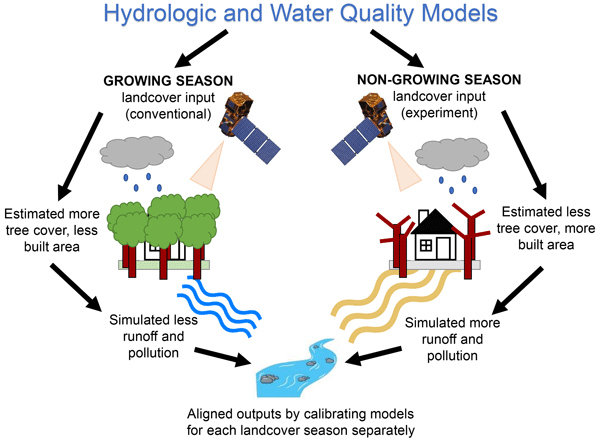
We studied how streamflow and water quality models respond to land cover data collected by satellites during the growing season versus the non-growing season. The land cover data showed more trees during the growing season and more built areas during the non-growing season. We next found that the use of non-growing season data resulted in a higher modeled nutrient export to streams. Knowledge of these sensitivities would be particularly important when models inform water resource management.
Han Qiu, Dalei Hao, Yelu Zeng, Xuesong Zhang, and Min Chen
Earth Syst. Dynam., 14, 1–16, https://doi.org/10.5194/esd-14-1-2023, https://doi.org/10.5194/esd-14-1-2023, 2023
Short summary
Short summary
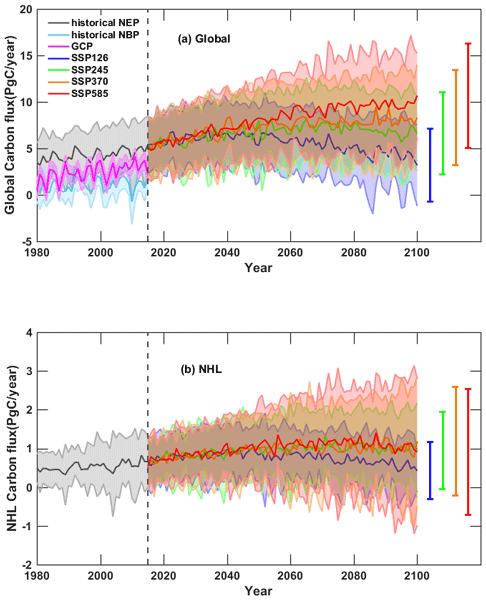
The carbon cycling in terrestrial ecosystems is complex. In our analyses, we found that both the global and the northern-high-latitude (NHL) ecosystems will continue to have positive net ecosystem production (NEP) in the next few decades under four global change scenarios but with large uncertainties. NHL ecosystems will experience faster climate warming but steadily contribute a small fraction of the global NEP. However, the relative uncertainty of NHL NEP is much larger than the global values.
Tao Zhang, Yuyu Zhou, Kaiguang Zhao, Zhengyuan Zhu, Gang Chen, Jia Hu, and Li Wang
Earth Syst. Sci. Data, 14, 5637–5649, https://doi.org/10.5194/essd-14-5637-2022, https://doi.org/10.5194/essd-14-5637-2022, 2022
Short summary
Short summary
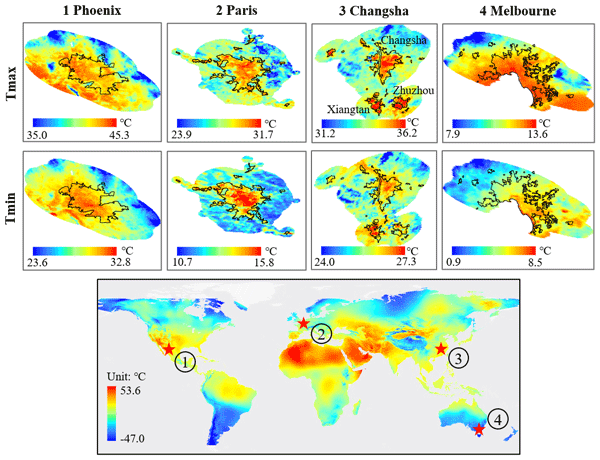
We generated a global 1 km daily maximum and minimum near-surface air temperature (Tmax and Tmin) dataset (2003–2020) using a novel statistical model. The average root mean square errors ranged from 1.20 to 2.44 °C for Tmax and 1.69 to 2.39 °C for Tmin. The gridded global air temperature dataset is of great use in a variety of studies such as the urban heat island phenomenon, hydrological modeling, and epidemic forecasting.
Sangchul Lee, Dongho Kim, Gregory W. McCarty, Martha Anderson, Feng Gao, Fangni Lei, Glenn E. Moglen, Xuesong Zhang, Haw Yen, Junyu Qi, Wade Crow, In-Young Yeo, and Liang Sun
Hydrol. Earth Syst. Sci. Discuss., https://doi.org/10.5194/hess-2022-187, https://doi.org/10.5194/hess-2022-187, 2022
Manuscript not accepted for further review
Short summary
Short summary
Watershed modeling is important to protect water resources. However, errors are involved in watershed modeling. To reduce errors, remotely sensed evapotranspiration data are widely used. However, the use of remotely sensed evapotranspiration data still includes errors. This study applied two remotely sensed data (evapotranspiration and leaf area index) into watershed modeling to reduce errors. The results showed advancement of watershed modeling by two remotely sensed data.
Cited articles
Arheimer, B. and Lidén, R.: Nitrogen and phosphorus concentrations from agricultural catchments – influence of spatial and temporal variables, J. Hydrol., 227, 140–159, https://doi.org/10.1016/S0022-1694(99)00177-8, 2000.
Breiman, L.: Random Forests, Mach. Learn., 45, 5–32, https://doi.org/10.1023/A:1010933404324, 2001.
Brownlie, W. J., Sutton, M. A., Heal, K. V, Reay, D. S., and Spears, B.: Our phosphorus future: towards global phosphorus sustainability, UK Centre for Ecology & Hydrology, 371 pp., 2022.
Carpenter, S. R., Caraco, N. F., Correll, D. L., Howarth, R. W., Sharpley, A. N., and Smith, V. H.: Nonpoint pollution of surface waters with phosphorus and nitrogen, Ecol. Appl., 8, 559–568, https://doi.org/10.2307/2641247, 1998.
Diaz, R. J. and Rosenberg, R.: Spreading Dead Zones and Consequences for Marine Ecosystems, Science, 321, 926–929, https://doi.org/10.1126/science.1156401, 2008.
Dodds, W. K.: The role of periphyton in phosphorus retention in shallow freshwater aquatic systems, J. Phycol., 39, 840–849, https://doi.org/10.1046/j.1529-8817.2003.02081.x, 2003.
Falcone, J. A. and USG Survey: GAGES-II: Geospatial Attributes of Gages for Evaluating Streamflow, Reston, VA, https://doi.org/10.3133/70046617, 2011.
Hamed, K. H. and Rao, A. R.: A modified Mann-Kendall trend test for autocorrelated data, J. Hydrol., 204, 182–196, 1998.
Hirsch, R. M., Moyer, D. L., and Archfield, S. A.: Weighted Regressions on Time, Discharge, and Season (WRTDS), with an Application to Chesapeake Bay River Inputs 1, JAWRA J. Am. Water Resour. Assoc., 46, 857–880, https://doi.org/10.1111/j.1752-1688.2010.00482.x, 2010.
Homer, C. G., Fry, J. A., and Barnes, C. A.: The national land cover database, U.S. Geological Survey, https://doi.org/10.3133/fs20123020, 2012.
Houser, J. N. and Richardson, W. B.: Nitrogen and phosphorus in the Upper Mississippi River: Transport, processing, and effects on the river ecosystem, Hydrobiologia, 640, 71–88, https://doi.org/10.1007/s10750-009-0067-4, 2010.
Jarvie, H. P., Sharpley, A. N., Scott, J. T., Haggard, B. E., Bowes, M. J., and Massey, L. B.: Within-River Phosphorus Retention: Accounting for a Missing Piece in the Watershed Phosphorus Puzzle, Environ. Sci. Technol., 46, 13284–13292, https://doi.org/10.1021/es303562y, 2012.
Maavara, T., Parsons, C. T., Ridenour, C., Stojanovic, S., Dürr, H. H., Powley, H. R., and Van Cappellen, P.: Global phosphorus retention by river damming, P. Natl. Acad. Sci. USA, 112, 15603–15608, https://doi.org/10.1073/pnas.1511797112, 2015.
Page, M. J., Moher, D., Bossuyt, P. M., Boutron, I., Hoffmann, T. C., Mulrow, C. D., Shamseer, L., Tetzlaff, J. M., Akl, E. A., Brennan, S. E., Chou, R., Glanville, J., Grimshaw, J. M., Hróbjartsson, A., Lalu, M. M., Li, T., Loder, E. W., Mayo-Wilson, E., Mcdonald, S., Mcguinness, L. A., Stewart, L. A., Thomas, J., Tricco, A. C., Welch, V. A., Whiting, P., and Mckenzie, J. E.: PRISMA 2020 explanation and elaboration: updated guidance and exemplars for reporting systematic reviews, BMJ, 372, https://doi.org/10.1136/BMJ.N160, 2021.
Qiu, H., Zhang, X., Yang, A., Wickland, K. P., Stets, E. G., and Chen, M.: Watershed carbon yield derived from gauge observations and river network connectivity in the United States, Sci. Data, 10, 1–13, https://doi.org/10.1038/s41597-023-02162-7, 2023.
Read, E. K., Carr, L., De Cicco, L., Dugan, H. A., Hanson, P. C., Hart, J. A., Kreft, J., Read, J. S., and Winslow, L. A.: Water quality data for national-scale aquatic research: The Water Quality Portal, Water Resour. Res., 53, 1735–1745, https://doi.org/10.1002/2016WR019993, 2017.
Ringeval, B., Demay, J., Goll, D. S., He, X., Wang, Y. P., Hou, E., Matej, S., Erb, K. H., Wang, R., Augusto, L., Lun, F., Nesme, T., Borrelli, P., Helfenstein, J., McDowell, R. W., Pletnyakov, P., and Pellerin, S.: A global dataset on phosphorus in agricultural soils, Sci. Data, 11, 1–34, https://doi.org/10.1038/s41597-023-02751-6, 2024.
Robertson, D. M. and Saad, D. A.: Spatially referenced models of streamflow and nitrogen, phosphorus, and suspended-sediment loads in streams of the midwestern United States, Scientific Investigations Report 2019-5114, U.S. Geological Survey, https://doi.org/10.3133/sir20195114, 2019.
Royer, T. V., David, M. B., and Gentry, L. E.: Timing of Riverine Export of Nitrate and Phosphorus from Agricultural Watersheds in Illinois: Implications for Reducing Nutrient Loading to the Mississippi River, Environ. Sci. Technol., 40, 4126–4131, https://doi.org/10.1021/es052573n, 2006.
Runkel, R. L., Crawford, C. G., and Cohn, T. A.: Load Estimator (LOADEST): A FORTRAN program for estimating constituent loads in streams and rivers, USGS Numbered Series, https://doi.org/10.3133/tm4A5, 2004.
Sabo, R. D., Clark, C. M., Gibbs, D. A., Metson, G. S., Todd, M. J., LeDuc, S. D., Greiner, D., Fry, M. M., Polinsky, R., Yang, Q., Tian, H., and Compton, J. E.: Phosphorus Inventory for the Conterminous United States (2002–2012), J. Geophys. Res.-Biogeo., 126, https://doi.org/10.1029/2020JG005684, 2021.
Sabo, R. D., Pickard, B., Lin, J., Washington, B., Clark, C. M., Compton, J. E., Pennino, M., Bierwagen, B., LeDuc, S. D., Carleton, J. N., Weber, M., Fry, M., Hill, R., Paulsen, S., Herlihy, A., and Stoddard, J. L.: Comparing drivers of spatial variability in US lake and stream phosphorus concentrations, J. Geophys. Res.-Biogeo., 128, e2022JG007227, https://doi.org/10.1029/2022JG007227, 2023.
Singh, N. K., Van Meter, K. J., and Basu, N. B.: Widespread increases in soluble phosphorus concentrations in streams across the transboundary Great Lakes Basin, Nat. Geosci., 16, 893–900, https://doi.org/10.1038/s41561-023-01257-5, 2023.
Skinner, K. D. and Maupin, M. A.: Point-source nutrient loads to streams of the conterminous United States, 2012, Data Series, https://doi.org/10.3133/DS1101, 2019.
Stackpoole, S. M., Stets, E. G., and Sprague, L. A.: Variable impacts of contemporary versus legacy agricultural phosphorus on US river water quality, P. Natl. Acad. Sci. USA, 116, 20562–20567, https://doi.org/10.1073/PNAS.1903226116, 2019.
UNEP: Understanding phosphorus: global challenges and solutions, https://www.unep.org/news-and-stories/story/what-phosphorus-and-why-are-concerns-mounting-about-its-environmental-impact, last access: 26 February 2025.
U.S. Geological Survey (USGS): Annual NLCD Collection 1 Science Products (ver. 1.1, June 2025), U.S. Geological Survey data release, https://doi.org/10.5066/P94UXNTS, 2024.
Wang, F., Li, S., Yan, W., Yu, Q., Tian, S., Yan, J., Zhou, D., and Shao, Y.: Dependence of riverine total phosphorus retention and fluxes on hydrology and river size at river network scale, J. Hydrol., 652, 132676, https://doi.org/10.1016/j.jhydrol.2025.132676, 2025a.
Wang, Y., Zhang, X., and Zhao, K.: A dataset of riverine nitrogen yield across watersheds in the Conterminous United States, Sci. Data, 11, 1–8, https://doi.org/10.1038/s41597-024-03552-1, 2024a.
Wang, Y., Zhang, X., Zhao, K., and Singh, D.: Streamflow in the United States: Characteristics, trends, regime shifts, and extremes, Sci. Data, 11, 788, https://doi.org/10.1038/s41597-024-03618-0, 2024b.
Wang, Y., Zhang, X., Zhao, K., Sabo, R. D., Miao, Y., and Clark, C. M.: Riverine Phosphorus Gain and Loss across the conterminous United States, figshare [data set], https://doi.org/10.6084/m9.figshare.28509317, 2025b.
Wilson, D. J.: The harmonic mean p-value for combining dependent tests, P. Natl. Acad. Sci. USA, 116, 1195–1200, https://doi.org/10.1073/pnas.1814092116, 2019.
Withers, P. J. A. and Jarvie, H. P.: Delivery and cycling of phosphorus in rivers: A review, Sci. Total Environ., 400, 379–395, https://doi.org/10.1016/j.scitotenv.2008.08.002, 2008.
Wurtsbaugh, W. A., Paerl, H. W., and Dodds, W. K.: Nutrients, eutrophication and harmful algal blooms along the freshwater to marine continuum, WIREs Water, 6, https://doi.org/10.1002/wat2.1373, 2019.
Xia, Y., Zhang, M., Tsang, D. C. W., Geng, N., Lu, D., Zhu, L., Igalavithana, A. D., Dissanayake, P. D., Rinklebe, J., Yang, X., and Ok, Y. S.: Recent advances in control technologies for non-point source pollution with nitrogen and phosphorous from agricultural runoff: current practices and future prospects, Appl. Biol. Chem., 63, 8, https://doi.org/10.1186/s13765-020-0493-6, 2020.
Zhang, Q. and Hirsch, R. M.: River Water-Quality Concentration and Flux Estimation Can be Improved by Accounting for Serial Correlation Through an Autoregressive Model, Water Resour. Res., 55, 9705–9723, https://doi.org/10.1029/2019WR025338, 2019.
Zhang, W., Jin, X., Liu, D., Lang, C., and Shan, B.: Temporal and spatial variation of nitrogen and phosphorus and eutrophication assessment for a typical arid river – Fuyang River in northern China, J. Environ. Sci., 55, 41–48, https://doi.org/10.1016/J.JES.2016.07.004, 2017.
Short summary
Excess riverine phosphorus is a worldwide threat to water quality. Leveraging 51 394 phosphate (PO₄³⁻) and 285 675 total phosphorus (TP) data points and hydrological topology information, we developed a new dataset mapping PO₄³⁻ and TP gain/loss across catchments in the conterminous United States. The new net phosphorus gain/loss maps allow us to assess sources, drivers, and model fidelity, thereby supporting future research and management of phosphorus contamination.
Excess riverine phosphorus is a worldwide threat to water quality. Leveraging 51 394 phosphate...
Altmetrics
Final-revised paper
Preprint