the Creative Commons Attribution 4.0 License.
the Creative Commons Attribution 4.0 License.
 | 05 May 2026
The PALMOD 130k marine palaeoclimate data synthesis version 2
Martina Hollstein
Michael Siccha
Michal Kucera
Palaeoclimate data hold the unique promise of providing a long-term perspective on climate change and as such can serve as an important benchmark for climate models. However, palaeoclimate data have generally been archived with insufficient standardisation and metadata to allow for transparent and consistent uncertainty assessment in an automated way. Thanks to improved computation capacity, transient palaeoclimate simulations are now possible, calling for data products containing multi-parameter time series rather than information on a single parameter for a single time slice. To confront transient simulations that span the last glacial-interglacial cycle with palaeoclimate data, we have compiled a multi-parameter marine palaeoclimate data synthesis that contains time series spanning 0 to 130 000 years ago. Jonkers et al. (2020) published the first version of the PALMOD 130k marine palaeoclimate data synthesis and described the data synthesis strategy and the contents and format of the data product in detail. Here we present a major update of the data product that markedly increases both the spatial and temporal coverage. Version 2 of the synthesis contains 2286 time series of eight palaeoclimate parameters from 475 individual sites, each associated with rich metadata, age–depth model ensembles, and information to refine and update the chronologies. It contains 468 time series of benthic foraminifera δ18O; 357 of benthic foraminifera δ13C; 423 of near sea surface temperature; 482 and 273 of planktonic foraminifera δ18O and δ13C; and 128, 111 and 44 of carbonate, organic carbon and biogenic silica content, respectively. Compared to version 1, all radiocarbon ages have been recalibrated and the age-depth models updated. In addition, near sea surface temperature estimates based on planktonic foraminifera and on have been recalculated using a single calibration thus ensuring global comparability and comprehensive assessment of their uncertainty. The data product is available in two formats (R and LiPD) facilitating use across different software and operating systems and can be downloaded at https://doi.org/10.1594/PANGAEA.984602 (Jonkers et al., 2026). This data descriptor presents our updating methodology and describes the contents and format of the data product in detail and concludes with recommendations on palaeodata stewardship to increase the reusability of such data.
- Article
(4442 KB) - Full-text XML
- Companion paper
- BibTeX
- EndNote


This article describes an update of the PALMOD 130k multiproxy marine palaeoclimate data synthesis (Jonkers et al., 2020). Palaeoclimate data hold the unique promise to inform about climate states and climate variability on time scales beyond the instrumental period. As such, they may help to characterise natural climate variability, shed light on the mechanisms of climate change and provide analogues for future climate; all crucial insights in a rapidly changing world. Marine sediments and the compounds and fossils contained in them allow the reconstructions of largely continuous, long records of past ocean physical and chemical conditions. Consequently, the multiproxy, global-scale PALMOD 130k synthesis provides a basis to evaluate the importance of the ocean for regulating Earth's climate and biogeochemical cycles on a global scale.
The synthesis contains palaeoceanographic and sedimentological data from sediment cores that cover the last glacial–interglacial cycle (up to approximately 130 000 years ago). During this time Earth has undergone marked changes in climate that involve the atmosphere, continental ice sheets and the ocean (Jonkers et al., 2023; NGRIP Members, 2004; Waelbroeck et al., 2002). Up to the influence of humans on global climate, which accelerated around 1950 CE (Steffen et al., 2015), these changes were ultimately controlled by variations in the Earth's orbit around the Sun (Hays et al., 1976). This orbital forcing triggered a multitude of (non-linear) feedback mechanisms causing global and regional climate to vary much faster than the forcing. A large amount of palaeoclimate data that span this period has been collected over the past decades, rendering the last glacial–interglacial cycle well-suited to study the natural variability of ocean and climate conditions across timescales and in particular the interaction between the cryosphere and the rest of the climate system. This is especially relevant given the projected, but uncertain, (partial) disappearance of continental ice-sheets with ongoing anthropogenic warming. The high-density data availability also makes the period an excellent test-bed for climate model simulations.
Whilst for a long time, palaeoclimate modelling focussed on the simulation of timeslices, increasing computational power now also enables long transient simulations. For instance, the paleoclimate modelling intercomparison project (PMIP) now also provides protocols for the simulation of the last deglaciation (Ivanovic et al., 2016) and several simulations spanning this period exist (Liu et al., 2009; Mikolajewicz et al., 2025). This development allows investigating climate dynamics in a new way, but also puts new demands on the (palaeo)observational data needed for model benchmarking. Specifically, paleoclimate time series need to be associated with comprehensive and consistent estimates of their (chronological) uncertainty. Moreover, the stochastic aspects of climate also call for new ways of comparing transient simulations with observations. For instance, given the uncertainty about whether suborbital abrupt climate variability is forced or unforced, the observed temporal evolution of climate may represent just one of many possible trajectories. Therefore, data-model comparison strategies that are independent of the exact timing of events need to be considered (Weitzel et al., 2024).
A particular strength of paleoceanographic data is their multiproxy nature. We can hence gain a more comprehensive insight into the climate system by studying it from a multi-proxy, or multi-parameter, perspective. Moreover, a multi-parameter approach is also likely to be more diagnostic for model performance than a single climate parameter approach (Kurahashi-Nakamura et al., 2017). However, at present, multi-parameter approaches are difficult because different parameters from the same archive (sediment core) have often been generated in different studies, and the current poor state of data archiving poses serious challenges for reuse. These challenges arise mainly from the non-standardised and fragmented way palaeoceanographic data (and palaeoclimate data in general) are archived and the scarcity of machine-readable metadata included in datafiles. Automated and reproducible analyses of palaeoceanographic data thus remain time consuming, even though efforts are underway to alleviate these problems and increase the ease of data reuse (Emile-Geay and Eshleman, 2013; Morrill et al., 2021). Still, such approaches require standardisation and synthesis of raw and inferred data and of metadata from various sources.
The PALMOD 130k marine palaeoclimate data synthesis is an attempt to overcome the fragmented archiving of paleoceanographic data sets and contains multiple climate-relevant parameters in a single framework. The synthesis combines data on sediment composition (carbonate, total organic carbon and opal content), planktonic and benthic foraminifera stable oxygen and carbon isotope ratios and estimates of seawater temperature based on various proxies. These parameters were selected following discussions within the PALMOD project. They include physically and biogeochemically relevant parameters that can be directly compared with climate model simulations and for which reasonable spatiotemporal coverage could be achieved. All data have been compiled on a single depth scale per sediment core allowing for robust alignment of the various parameters and for reproducible updating and changing of chronologies. Whenever possible, the synthesis contains raw observational data together with the inferred data to enable revision of the latter. All data are associated with rich metadata to facilitate interpretation and for comprehensive uncertainty estimates. The synthesis is designed to facilitate evaluation of transient climate model simulations, but the data product can also be used to study climate change over the last glacial–interglacial cycle directly, independent from climate model simulations. Whilst the intended use of the synthesis has remained unchanged, version 1 was limited in spatial and temporal coverage, thus warranting an update to increase its usefulness. This article describes this update of the data synthesis and complements an earlier description of the data product (Jonkers et al., 2020).
Briefly, version 2 of the PALMOD 130k marine palaeoclimate data synthesis contains 1736 additional time series from 332 individual sites, markedly increasing both the spatial and temporal coverage of the data. Age-depth models presented in version 1 that were based on radiocarbon ages are revised using calendar ages calculated with the IntCal20 radiocarbon calibration curve (Hogg et al., 2020; Reimer et al., 2020). In addition, we harmonised seawater temperature estimates based on geochemical proxies and provide uncertainty estimates that are consistent and comparable across the different time series. This version also corrects several errors in the metadata associated with time series included in version 1 and contains two additional metadata fields to facilitate filtering of the data. Finally, we made slight changes in the structure of the data to prevent errors during use.
3.1 Data synthesis strategy
The synthesis strategy of this version follows that of the previous version (Jonkers et al., 2020). We compiled time series from marine sediment cores that contained benthic or planktonic foraminifera stable oxygen and carbon isotope data, estimates of seawater temperature and information on total organic carbon, opal and carbonate content. We followed a sequential updating strategy guided by the availability of time series with information needed to develop an age depth model for the sediment cores of interest. Version 1 contained time series dated with radiocarbon and benthic foraminifera δ18O. Version 2 integrates two steps in the update process, it contains time series with any of the parameters of interest with age control solely based on benthic foraminifera δ18O and it contains time series that had at least an estimate of seawater temperature and age control based on radiocarbon or other absolute dates. Data was compiled from public repositories following the two-step approach of bulk data download and subsequent filtering out of relevant time series as described in Jonkers et al. (2020). To increase the number of time series from the Indo-Pacific domain we made 19 previously unpublished datasets available on PANGAEA and included them here. Given the lack of metadata associated with most data in public repositories, metadata was in general manually compiled from the publications associated with the datasets.
3.2 Age-depth modelling
All time series in this compilation have updated and harmonised age-depth models with consistent estimates of uncertainty. The updated age-depth models are based on the most recent regional benthic foraminifera δ18O stacks and radiocarbon calibration curve, together with estimates of marine reservoir ages that are globally consistent and physically plausible. We follow the same hybrid strategy of relying on both absolute age control points (e.g. radiocarbon ages, tephra horizons) and hypothesis-based age modelling as in version 1.
For this version, benthic foraminifera δ18O were manually aligned to the relevant regional stacks of Lisiecki and Stern (2016) using mainly the marine isotope stage boundaries as tie points for consistency among the time series and to avoid inflating the chronological confidence. In addition, all radiocarbon ages have been recalibrated to calendar years using IntCal20 (Hogg et al., 2020; Reimer et al., 2020) and model-based estimates of the reservoir age (Butzin et al., 2017). The age-depth models were constructed using the Bayesian algorithm BACON (Blaauw and Christen, 2011) implemented in PDV (Langner and Mulitza, 2019) and are presented as separate elements in the compilation. To avoid extrapolation, we only provide age models for the core depths bracketed by age control points. Age-depth models presented in the original studies may thus extend further to either side. The age-depth information includes mean, median and the 95 % confidence interval of the ages as well as the necessary information to rerun the age-depth models in BACON and 1000 posterior age-depth models that can be used for further analysis.
3.3 Seawater temperature estimates
In order to homogenise seawater temperature estimates and to provide a consistent estimate of their uncertainty associated with the calibration and, in case of planktonic ratios, of the confounding effects of salinity and pH, temperature estimates were recalculated. For seawater temperatures based on the alkenone unsaturation index we used the BAYSPLINE calibration (Tierney and Tingley, 2018) and applied the suggested prior for the standard deviation of sea surface temperature of 5 °C. The resulting estimates represent in general annual mean sea surface temperature. However, for specific regions the temperatures are seasonal averages (Tierney and Tingley, 2018). This seasonality of the estimate is indicated in the metadata.
Whenever available, or whenever values could be calculated from inferred seawater temperatures, planktonic foraminifera ratios were converted to calcification temperature using MgCaRB (Gray and Evans, 2019). In this way we account for the effects of salinity and pH on the ratios based on sensitivities determined from culture studies. However, as the past salinity and pH variability is unknown for most time series in the synthesis, we, like Gray and Evans (2019) and Tierney et al. (2019), approximate the temporal evolution of salinity using a scaling to sea level and of pH based on atmospheric pCO2 from ice cores and the constant disequilibrium from atmospheric CO2 (ΔpCO2) and alkalinity fixed at pre-industrial and modern levels respectively. For each site, we obtained modern sea surface salinity and temperature (needed for the calculation of ΔpCO2) from the World Ocean Atlas 2023 (Reagan et al., 2023) from within a circle with a radius of 100 km. Carbonate system parameters (total dissolved inorganic carbon (DIC), its anthropogenic contribution (DIC_anthro) and total alkalinity were derived from the GLODAPv2 gridded data product (Lauvset et al., 2016) in the same way. Since GLODAPv2 does not cover the Gulf of Mexico and the Caribbean Sea, we used the median surface DIC and alkalinity from the GLODAPv2.2023 (Olsen et al., 2016) adjusted cruise data from the area between 10 and 30° N west of 80° W (Barbero et al., 2016a, b, 2019; Jiang et al., 2020; Salisbury, 2017; Salisbury and Shellito, 2019; Wanninkhof et al., 2007, 2014) for the affected time series. For simplicity we assumed global mean DIC_anthro for those sites. Local ocean pCO2 was subsequently calculated using pre-industrial DIC (DIC-DIC_anthro), alkalinity, salinity and temperature using SeaCarb (Gattuso et al., 2024). Finally, ΔpCO2 was calculated as the difference between the calculated oceanic pCO2 and pre-industrial atmospheric pCO2 (280 ppm). For the species Globigerinoides ruber, Trilobatus sacculifer, Globigerina bulloides we used the sensitivity of to temperature, salinity and pH as provided in Gray and Evans (2019). For Neogloboquadrina pachyderma and N. incompta we used the temperature and salinity sensitivity as used in Boscolo-Galazzo et al. (2025) and ignored the effect of pH as this is poorly constrained for these species. We used the generic calibration for all other species. To account for Mg loss in foraminifera tests that were treated by reductive and oxidative cleaning, we multiplied the respective ratios by 1.1 to make them comparable with ratios measured on samples that only underwent oxidative cleaning (Barker et al., 2003).
For seawater temperatures derived from both proxies, estimates are presented as the median and 95 % confidence intervals. The recalculated values are indicated using the strings “recalc_UKSST” or “recalc_mgcaSST” and accompanied by a note containing the text “Recalculated for PALMOD”. For further analysis, 1000 ensemble time series of seawater temperature are provided separately.
Unlike for the two proxy types mentioned above, seawater temperature estimates based on microfossil assemblages were not harmonised. This is because in too many cases the calibration that was used to generate the reported temperature estimates and/or the fossil abundance data on which the estimates are based are not publicly available.
The structure of the synthesis has slightly changed since version 1. The main change is the inclusion of the revised age information directly with the proxy data. These were kept separate in version 1 to highlight the fact that observations on the (core) depth scale are static, whereas the age-depth model can be updated or revised as per user demand. However, this separation into raw and derived data rendered use of the data more complex and we have hence decided to include the revised age data directly with the proxy data. The second change in the structure is the addition of ensembles of seawater temperature time series.
The synthesis is organised by site, which usually is the sediment core from which the data were extracted, but it may also refer to a spliced record comprising multiple sediment cores. Depending on the availability of alkenone or -derived seawater temperature estimates, each site is associated with information on seven or eight themes. Names in square brackets below are those used in the data files.
-
Geographic data [site] includes the position of the site in decimal degrees and its water depth in m and, new in this version, the ocean basin in which the site is located. The basin assignment is based on the Global Oceans and Seas dataset, version 1 (Flanders Marine Institute (VLIZ), Belgium, 2021). This theme also contains additional notes that apply to the entire site.
-
Metadata [meta] contains the original and standardised variable name, units where applicable, information about the origin of the data and where applicable information about the proxy sensor and the seasonal or vertical attribution (as specified in the original publications) and the calibration. A complete list of metadata terms is provided in Table 1. Metadata are only included if they were available in the dataset or could be obtained from the accompanying publication. Not all fields are relevant for all parameters (e.g. species is not defined for parameters that are not based on measurements on organisms) and fields that are completely empty for a site are excluded. The metadata now also includes a unique identifier for each time series to facilitate cross-referencing.
-
Chronological data [chron] includes the information to revise the age-depth model of the site. It contains raw radiocarbon ages, ages based on tephra layers and palaeomagnetics, as provided by the data generators and the ages of the tie points identified for this study. The calendar ages of all tie points are based on the approach outlined above (section Age-depth modelling). Information about the source and the citation of the chronological information is provided. A full list of chronological data terms is provided in Table 2.
-
Proxy data [data] are presented on a common depth scale. Original ages and original seawater temperature estimates are included, updated seawater temperature estimates are flagged in the notes field using the string “Recalculated for PALMOD”. The standardised parameter names are provided in Table 3.
-
Age-depth model ensembles [AgeEnsemblesBACON]. 1000 posterior age-depth models inferred from sediment accumulation rates as modelled using BACON.
-
Seawater temperature ensembles [SurfaceTempEnsembles]. 1000 sea water temperature time series for each or time series. The ensembles are accompanied by metadata describing the algorithm settings and information about the confidence of the resulting temperature estimates (expressed as convergence, see Tierney and Tingley (2018) for further explanation) and details on the species in the case of .
Table 1Metadata fields.
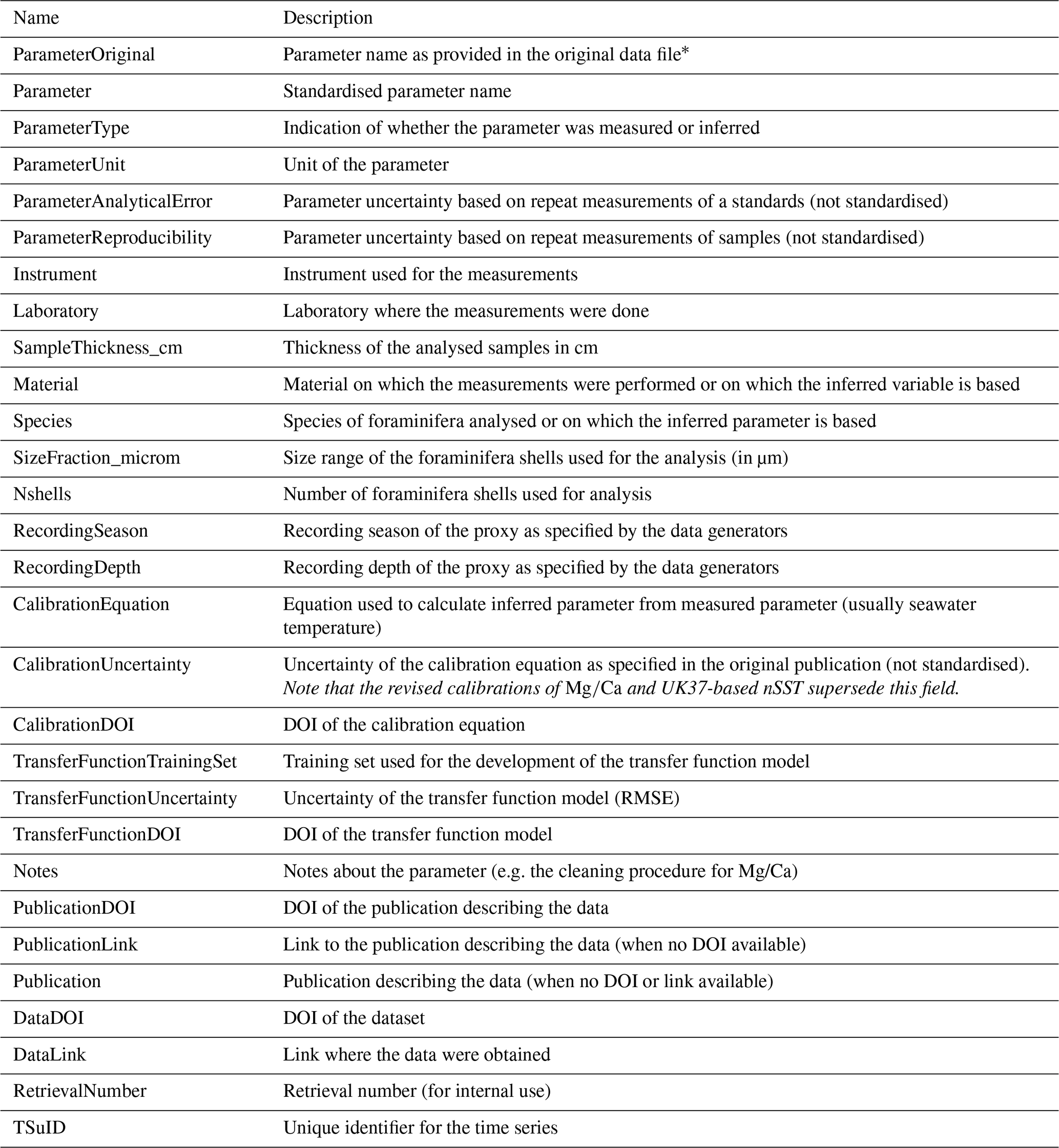
* Original parameter names are preserved even when they contain errors. These errors have been corrected in the standardised parameter name and additional metadata.
Each site also contains information about the version, import date and date at which the age-depth model was last updated. These fields are largely for internal use.
The data are available in serialised R format (*RDS) and structured as a list where the elements contain the information about the themes indicated above. RDS files can be easily read using the open source software R. To ensure interoperability the data product is also available as (simple) JSON formatted data following the LiPD structure and vocabulary. Resources for reading and querying the data are provided in the Sect. 7 Usage notes.
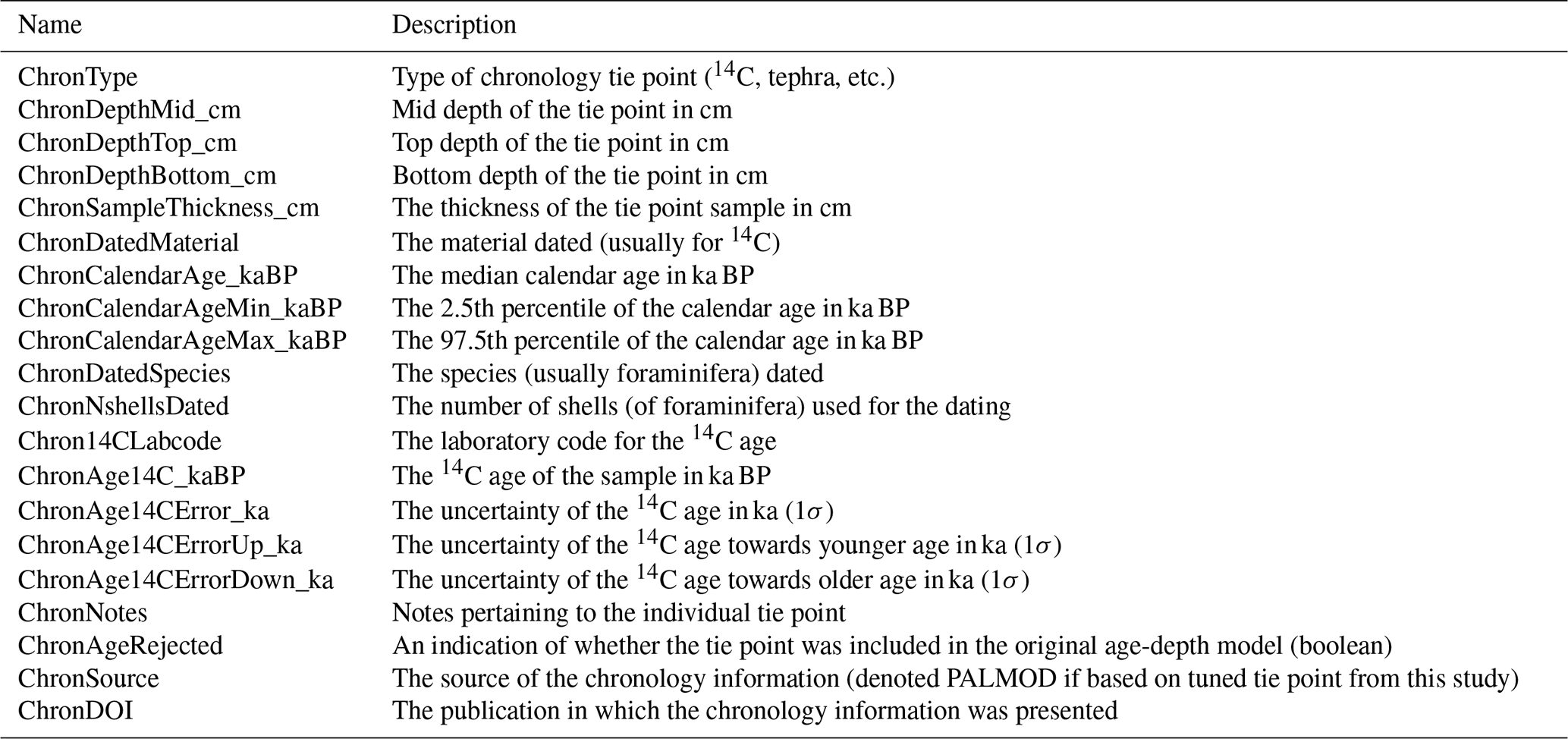
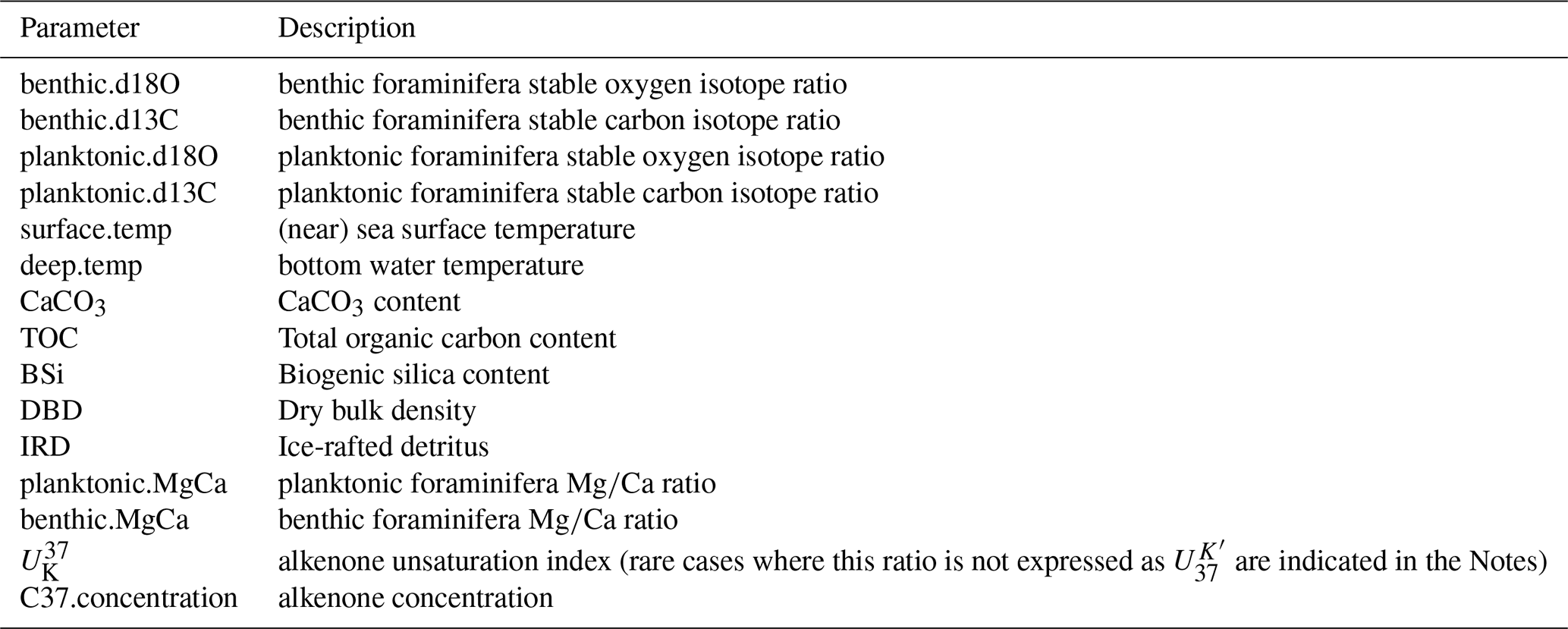
5.1 Spatial data coverage
Version 2 of the PALMOD marine palaeoclimate data synthesis contains 2286 time series with one of the eight synthesised climate-relevant variables each, originating from 475 unique sites (Fig. 1, Table 4). The majority of the newly added time series in this version stem from the tropics. Most time series are of planktonic foraminifera δ18O (n= 482), with often multiple time series from different species (each with potentially different vertical and seasonal recording preferences) per site. The number of time series with benthic foraminifera δ18O and with near sea surface temperature closely follow the number of time series with benthic δ18O (n= 468 and n= 423, respectively). Time series of the other variables are considerably fewer in number. For all variables but biogenic silica content, the highest density of sites is in the Atlantic Ocean. Coverage in the Pacific and the southern hemisphere remains relatively poor, reflecting both historical research focus and the (logistical) challenges of obtaining sediment cores far offshore. In general, sites tend to be located close to the continents, where higher sedimentation rates facilitate the recovery of records with higher temporal resolution.
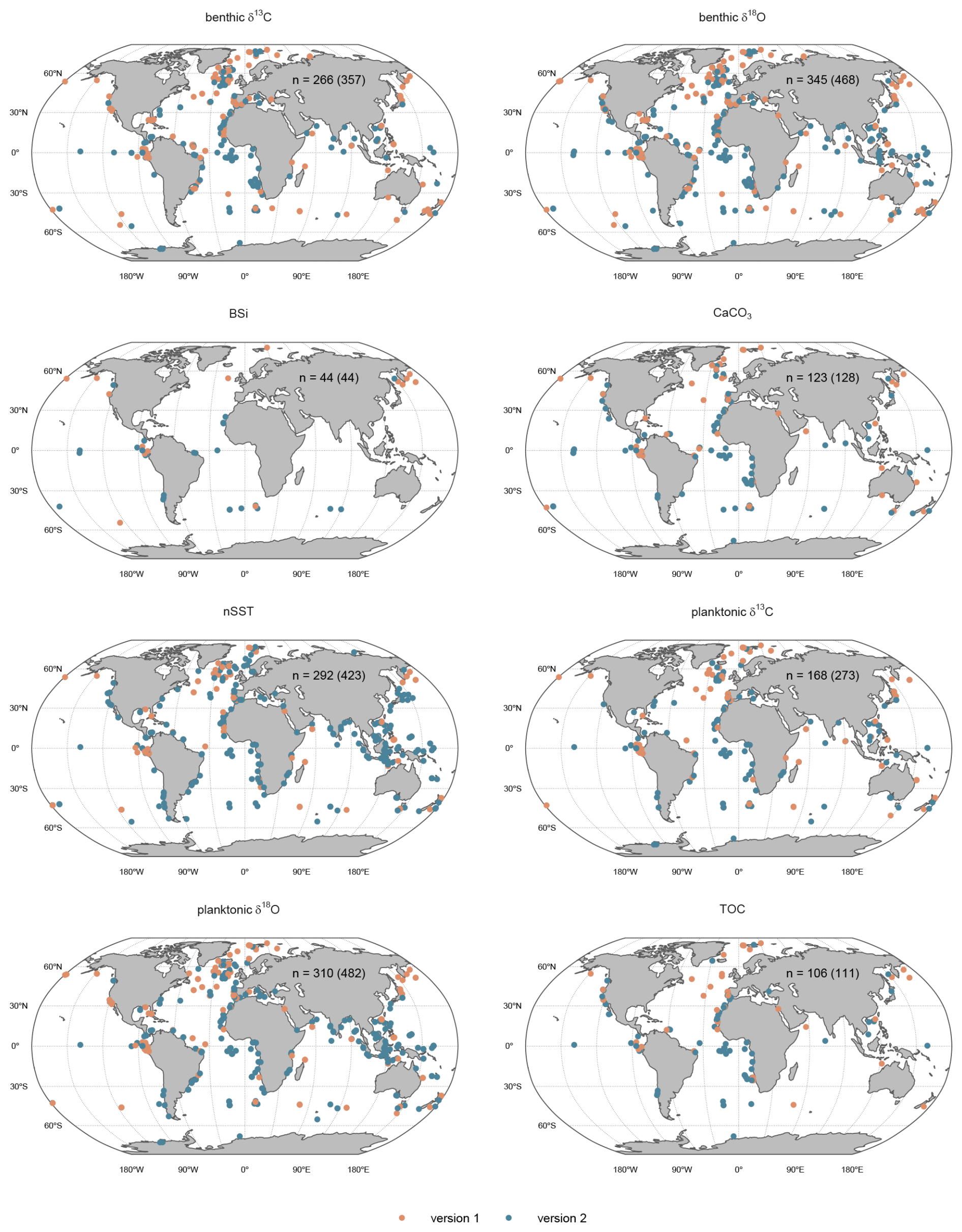
Figure 1Spatial distribution of sites with time series of the eight parameters. Locations are coloured by the version in which they were first included (version 2 also includes all data of version 1). The total number of sites and time series are indicated in brackets.
5.2 Temporal data coverage
Compared to version 1, the temporal coverage has approximately doubled over the 130 kyr time frame and for all variables (Fig. 2). The temporal distribution of data reflects research focus on the last deglaciation, with the highest data density between 10–25 ka BP. Importantly, the coverage does not markedly drop off beyond approximately 40 ka BP, facilitating continuous analysis across the entire last glacial cycle. This coverage pattern is consistent across all variables and has not substantially changed in version 2.
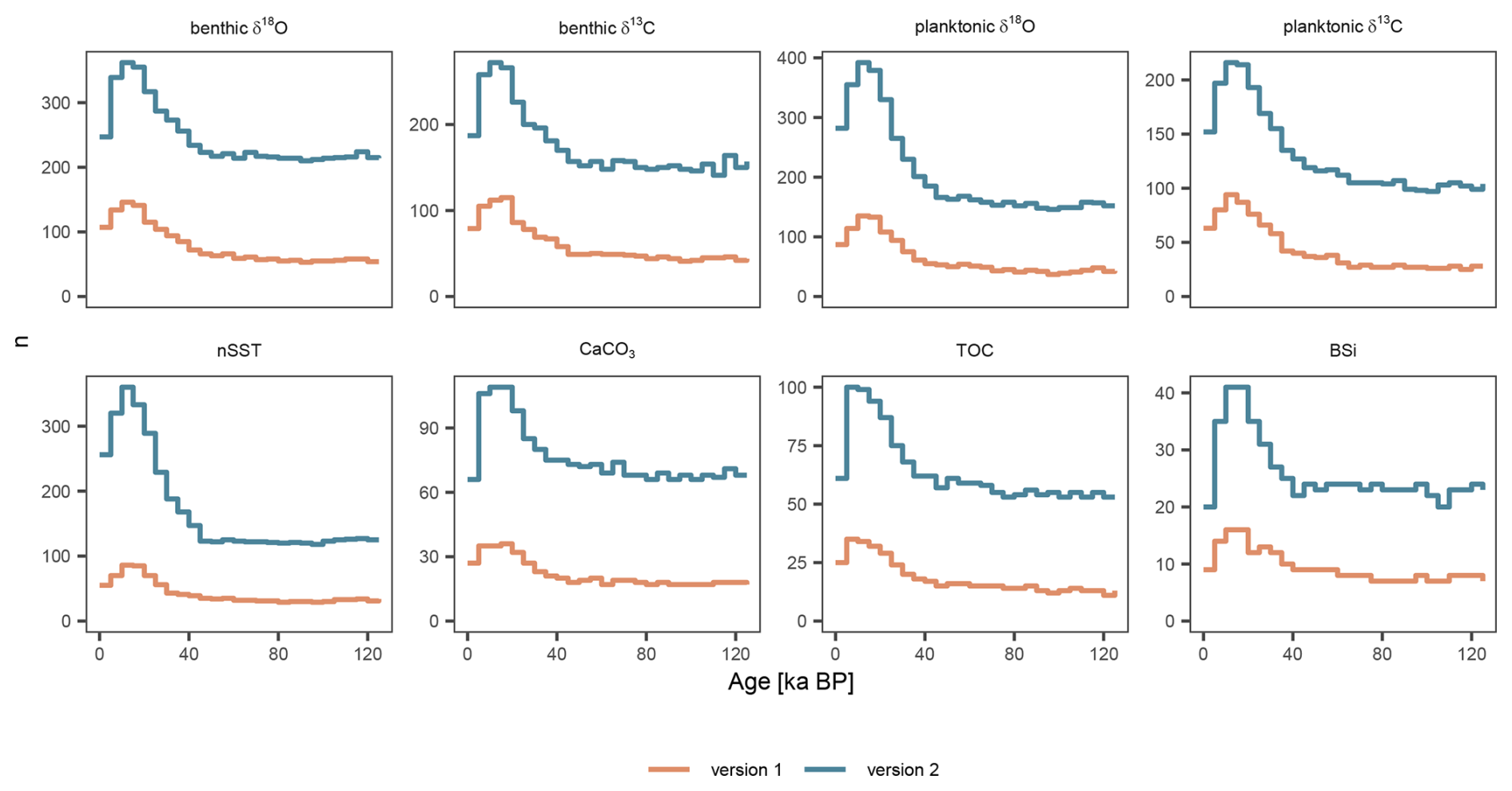
Figure 2Temporal distribution of temporal coverage of each parameter. Lines show the number of time series per 5 kyr bin, colour show the total number of time series for each version. Like in the previous version, version 2 shows highest coverage during the last deglaciation. Note the different scaling on the y axes.
The length of the time series shows a clear bimodal distribution across all variables (Fig. 3). Most time series are shorter than 40 kyr or longer than 110 kyr, reflecting the research focus on investigating either the transition from the last glacial to the Holocene, or glacial-interglacial cycles on long(er) time scales.
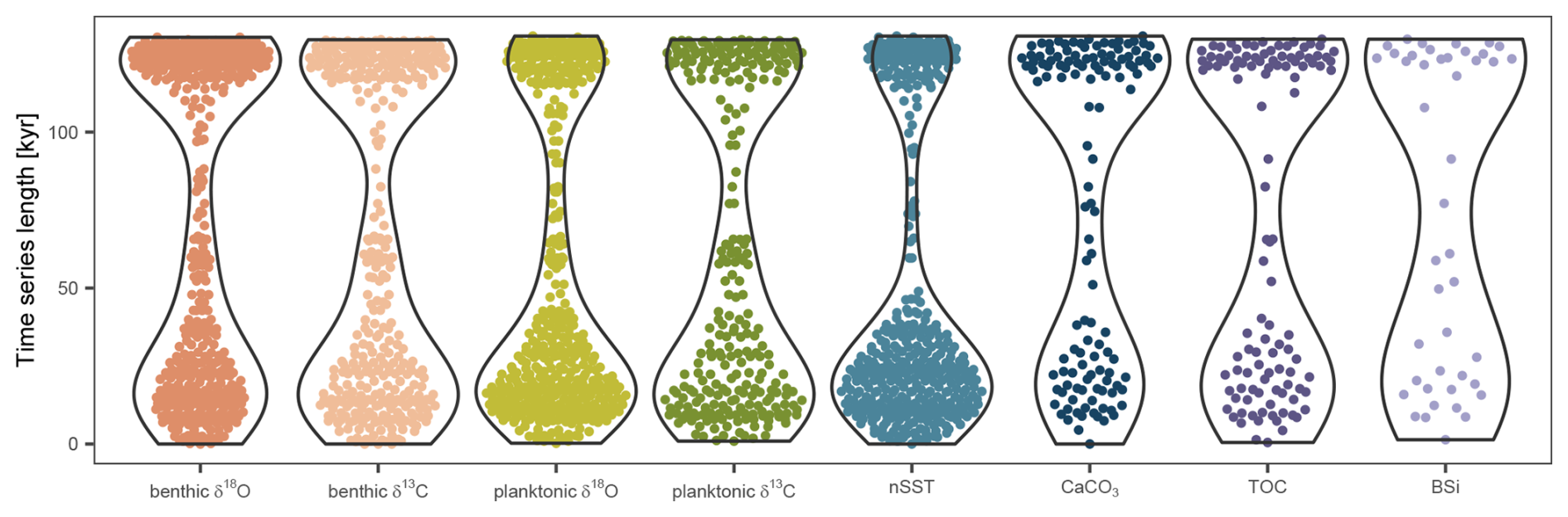
Figure 3Distribution of time series length split by parameter. Time series between 40 and 110 kyr long are uncommon across all parameters.
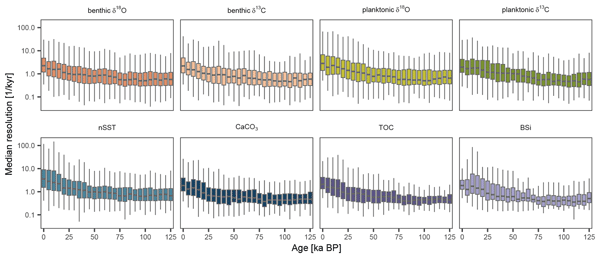
The temporal resolution of the time series varies considerably, but the median temporal resolution of the time series tends to be below 3 kyr (Fig. 4). In general, the highest temporal resolution of the time series is in the youngest part of the 130 kyr time frame (Fig. 4). Even though the resolution decreases with age, this decrease generally stops or reduces around 75 ka BP. The resolution of the time series is, to a first order, related to their length (Fig. 5), reflecting both the challenge of obtaining long sediment cores in high accumulation settings and the amount of work involved in generating the data.
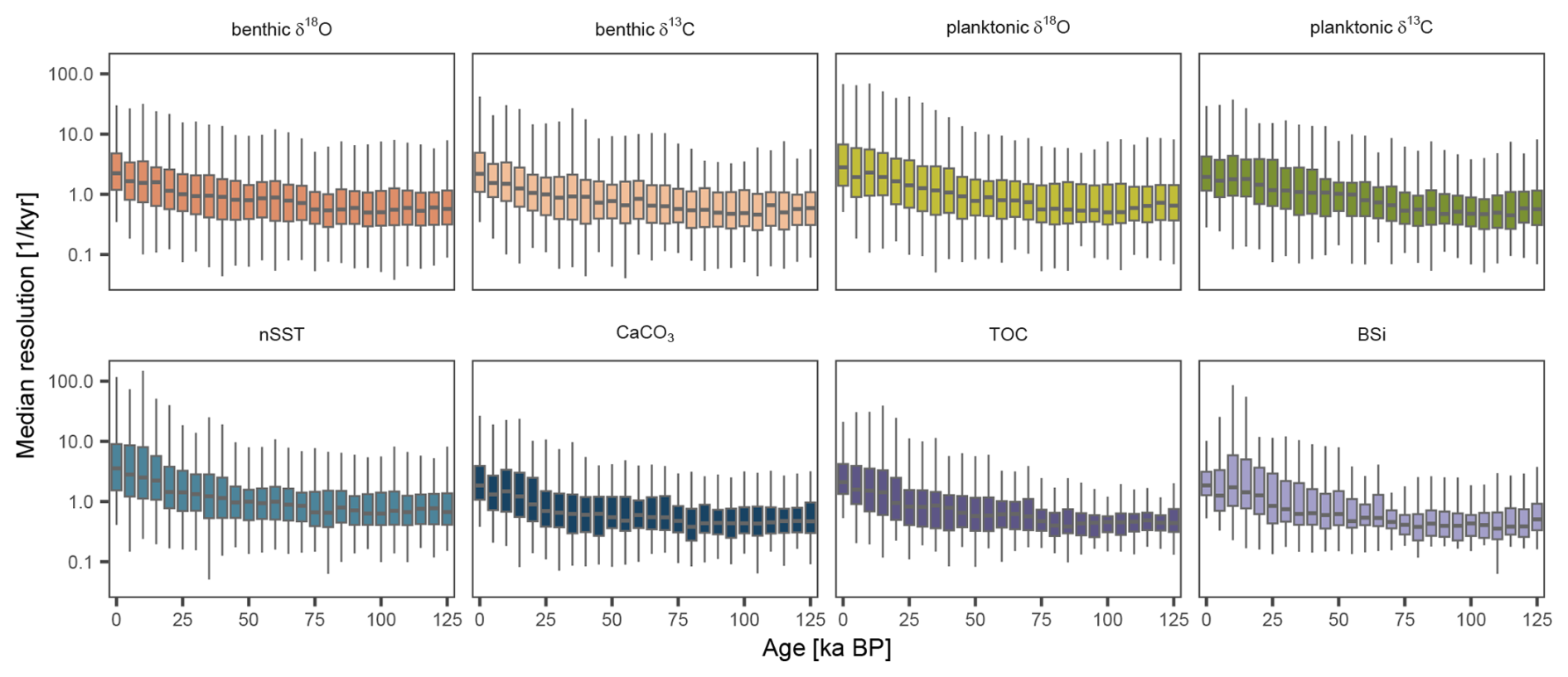
Figure 4Temporal resolution (observations per kyr) of the time series split by parameter. The general trend shows decreasing resolution until approximately 75 ka BP, after which resolution remains more or less constant. Even though there is considerable spread, the median resolution is below 3 kyr across all parameters. Box-whisker plots show distribution of median resolution per 5 kyr bin; thick lines indicate median values, boxes show interquartile range and whiskers extend to 1.5 times this range.
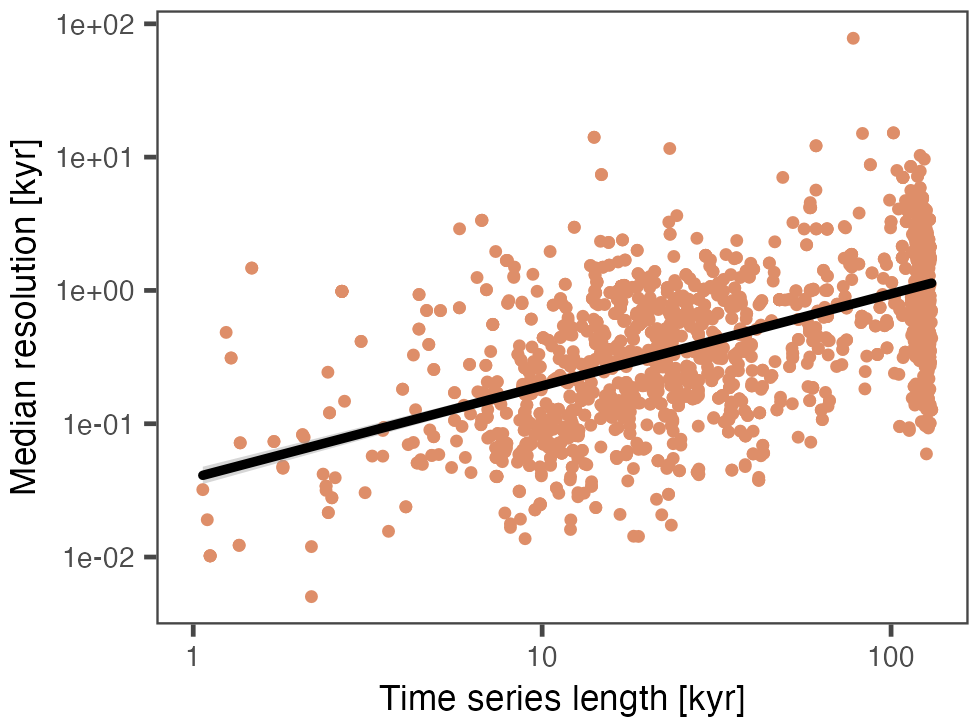
Figure 5Longer time series tend to have lower resolution. Cross plot of median resolution (time between consecutive observations) and time series length. The linear fit (black line) is shown to highlight the general trend; 14 time series shorter than 1 kyr are not shown.
5.3 Chronology
Nearly 90 % of the time series have an age-depth model based on exclusively radiocarbon dating and tuning of benthic foraminifera δ18O (Fig. 6a). Only five time series have age-depth models entirely based on other – e.g. tephra, biostratigraphy or palaeomagnetics – age controls. The age uncertainty shows to some degree the nature of the dating methods, it tends to be low up to approximately 20 ka BP, reflecting the prevalence of radiocarbon dating within this interval (Fig. 6b). Beyond ca. 20 ka BP, the age uncertainty shows the structure of the benthic foraminifera δ18O tuning targets with reduced uncertainties near the marine isotope stage boundaries that were used as tie points.
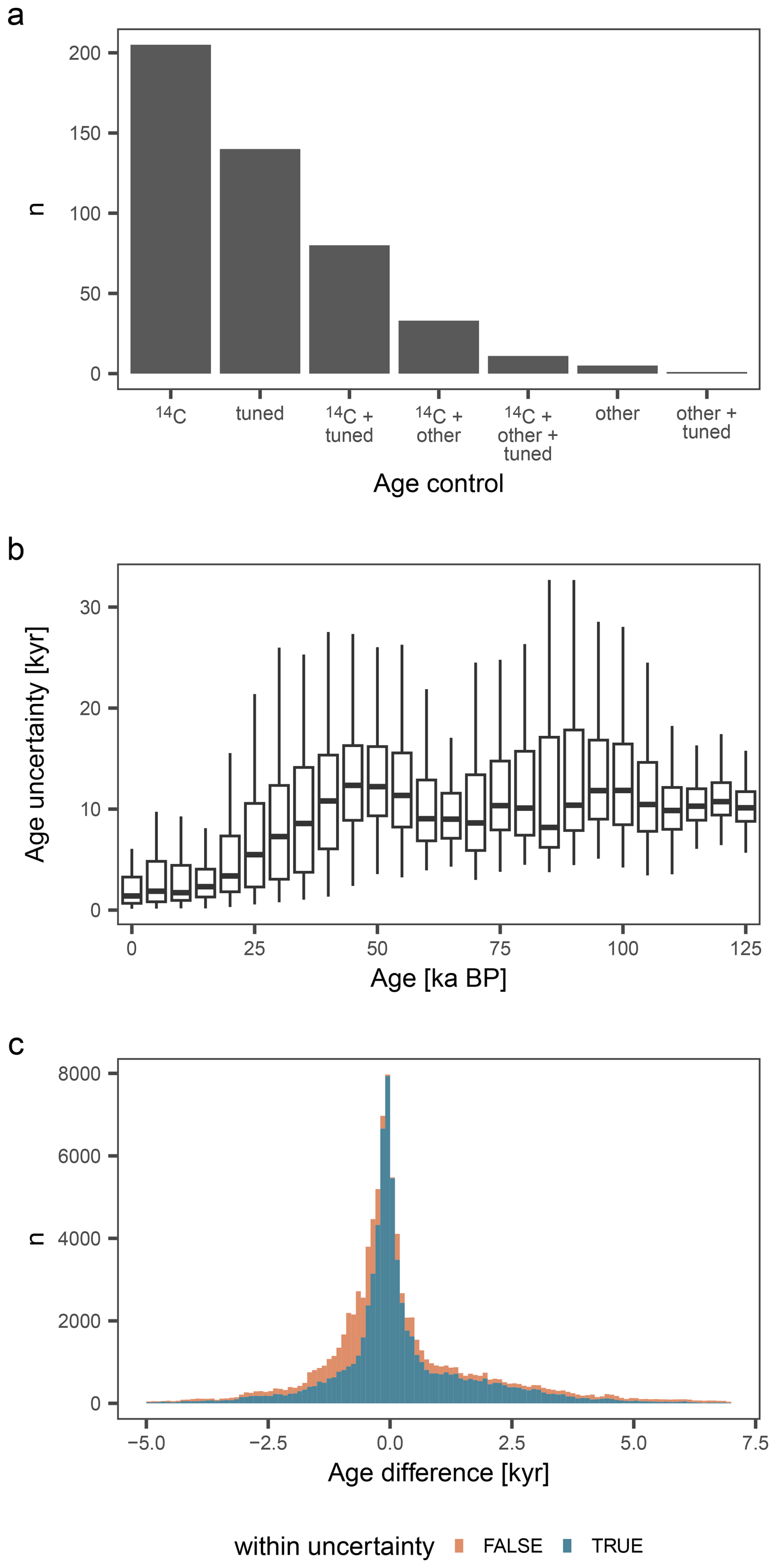
Figure 6Type of age control tie points across all sites (a), age uncertainty across the time series in the dataproduct (b) and differences between the original and updated age-depth models (c). The category “other” in panel a includes tephra, palaeomagnetics and biostratigraphy. Low age uncertainties (b) up to approximately 25 ka BP reflect the prevalence of radiocarbon ages within this interval. The age uncertainty in the older parts of the time series tends to be lower near the boundaries of the marine isotope stages that were used in the construction of the age depth models. Box-whisker plots show the distribution of median age uncertainty (95 % confidence interval) across the sites per 5 kyr bin. Further explanation of the plots is provided in Fig. 4. Colours in c show whether or not the difference between the age estimates is within the 95 % CI of the revised age-depth model. In 2 % of the data points the difference is outside the range shown here.
The revised age-depth models differ in many cases from the original age-depth models (Fig. 6c). However, these differences are small, the median difference (revised – original) is −0.07 kyr (−3.28–5.24, 95 % CI) and for 74 % of all data points the difference is within the uncertainty of the revised age-depth model. These differences are to some degree due to the different approaches used to model the age-depth relationship and/or to differences in the radiocarbon calibration curve, the applied reservoir age, the tuning parameters and the tuning targets.
5.4 Near sea surface temperature
The majority of the near sea surface temperature time series (n= 173) is based on planktonic foraminifera (Fig. 7a). Near sea surface temperature estimates based on alkenone unsaturation indices and microfossil assemblages (predominantly planktonic foraminifera) make up approximately equal proportions (n= 119 and 115, respectively). Only 16 time series are based on other proxies, including TEX86 (Schouten et al., 2002) and the long chain diol index (Rampen et al., 2012). Twenty-nine sites have near sea surface temperature estimates based on the of more than one species of planktonic foraminifera and 55 sites have near sea surface temperature time series based on more than one proxy (Fig. 7a), thus potentially allowing for comparison and/or the reconstruction of seasonal or vertical temperature gradients. The uncertainty of the revised near sea surface temperature estimates (1 SD) remains approximately constant through time and its median value across all samples is 0.93 °C (0.64–2.44 °C, 95 %).
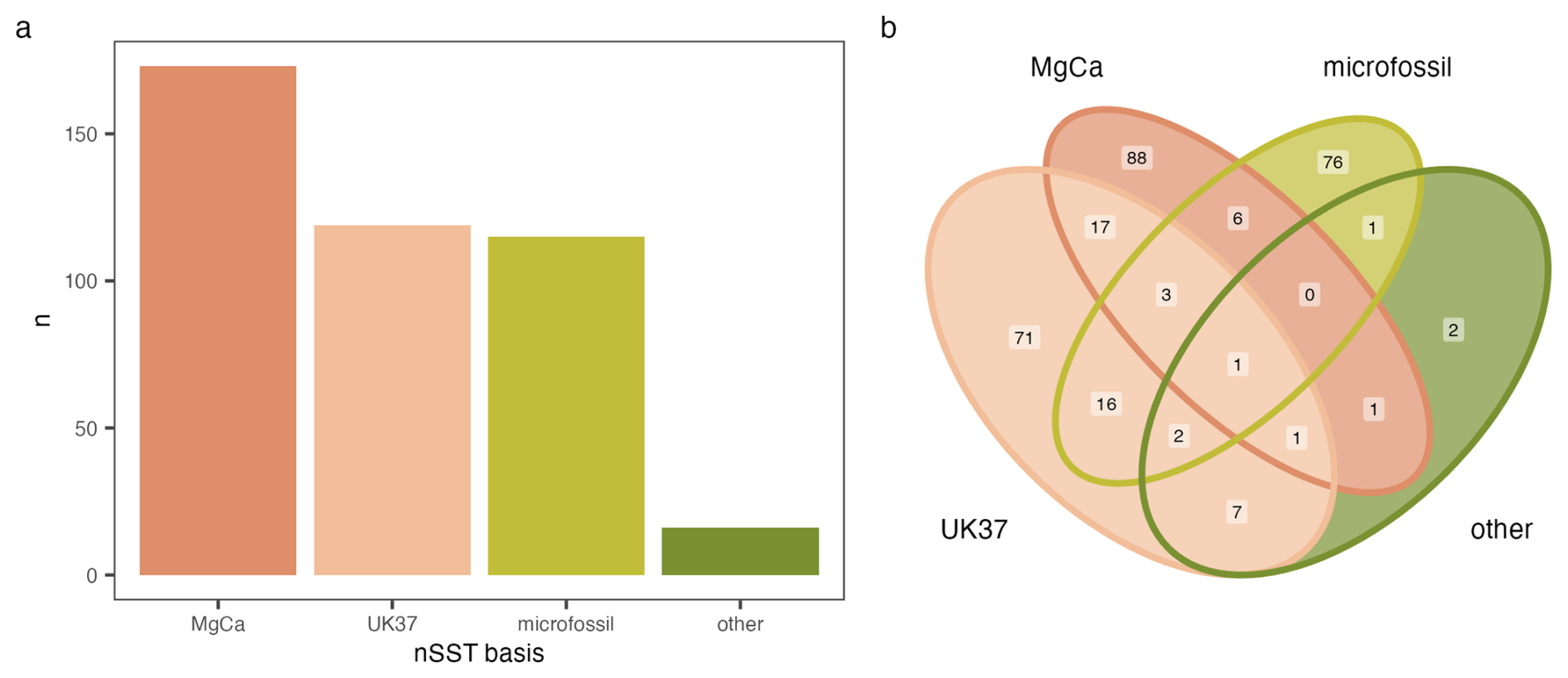
Figure 7Number of the near sea surface temperature time series sorted by proxy (a) and a Venn diagram showing the overlap among records based on different proxies across the sites (b; numbers indicated). In total 55 sites have near sea surface temperature data based on more than one proxy.
General instructions on data usage and potential applications can be found in Jonkers et al. (2020). The PALMOD synthesis contains data about sediment composition (calcium carbonate, organic carbon and biogenic silica content) that is relatively straightforward to interpret. The data product also contains information derived from measurements on biological material (foraminifera stable carbon and oxygen isotope ratios) and estimates of seawater derived indirectly from the chemical or species composition of microfossils or from biomarkers. The biological origin of the data renders its interpretation less straightforward as environmental preferences of the organisms may affect the recorded climate signal. A detailed description of the proxy sensors and the intricacies of the proxies is provided in the data descriptor of version 1 (Jonkers et al., 2020). We encourage users to read the relevant section. A general proxy system modelling framework for marine sediment time series can e.g. be found in Dolman and Laepple (2018). In this section we focus on the main advance compared to version 1 that is relevant to usage: the harmonisation of seawater temperature estimates.
Estimates of near sea surface temperature based on planktonic foraminifera and have been updated and harmonised whenever possible. For , these updated estimates required relatively little user input, but the use of different priors may affect the results. Since planktonic foraminifera is not only affected by seawater temperature, the inference of -based temperatures is more complex. Estimates of salinity and pH are indirect and, by necessity, rather crude as they ignore existing, but unknown, spatiotemporal variation. Importantly, the estimates of salinity and pH depend on the age and updates to the age-depth model therefore require recalculation of the inferred temperatures. The influence of these nuisance factors can in principle also be corrected using measured estimates of ocean pH based on boron isotope ratios (Gray and Evans, 2019) or indirectly by using oxygen isotopes (Morley et al., 2024), but this requires additional data that is not available for all time series. We have hence chosen a correction approach that is consistent across all time series. Whilst for the species Globigerinoides ruber, Trilobatus sacculifer, Globigerina bulloides, Neogloboquadrina pachyderma and N. incompta the sensitivity of to temperature, salinity and pH is well constrained, this is not the case for other, generally deeper dwelling species. For these other species we have used the generic calibration. Care thus needs to be taken with the temperature estimates based on this calibration and we encourage the use of anomalies, rather than reliance on absolute values. To allow users to compare the harmonised seawater temperature estimates with the values provided by the data generators, the original temperature values are included in the data product. With regard to the estimated uncertainty of the inferred temperatures, it is important to note that the range of possible nSST trajectories may be overestimated as temporal autocorrelation in the temperature and its uncertainty are ignored in the calibration. Whether such autocorrelation would be preserved in sedimentary time series and how large the effect would be, remains to be investigated. For this, and other reasons, users may also want to use different calibration schemes. To this end, the synthesis also contains the raw and values.
Seawater temperatures based on microfossil assemblage composition are included in the synthesis only in the form reported by the authors. Because of the fragmentary nature of the required metadata, the originally reported estimates could not be updated to a common standard and are associated with uncertainty estimates only where the data generators provided them. From the accompanying publications it is not always clear how the uncertainty has been derived and the methods certainly vary among the different studies because of personal preferences and methodological progress on how to deal with issues like spatial autocorrelation. In light of new insights regarding the uncertainty of seawater temperature estimates based on microfossil assemblages (Telford et al., 2013; Trachsel and Telford, 2016), the reported uncertainties are likely too optimistic. Interested users can refer to Jonkers et al. (2023) for an example of comprehensive estimates of calibration uncertainty associated with planktonic foraminifera assemblage derived seawater temperatures.
Whenever publicly available, the original age-depth models are included in the data product, but they almost universally lack uncertainty estimates. Still, these original age estimates can be used for a comparison of the revised and original age models. Future updates to the radiocarbon calibration curve, to the reservoir age estimates, or the stacks may require updating the age-depth models. The raw chronology data provided in the data product enables this updating in an automated fashion. Please note that the -based temperature estimates depend on the age of the samples for a correction of the effects of salinity and pH. The temperature estimates thus need to be updated if the age-depth model is revised. Uncertainty estimates on the chronology are to some degree method dependent, but the Bayesian approach we utilised appears to provide reasonable results (Trachsel and Telford, 2017). However, our approach ignores additional uncertainty caused by bioturbation and uncertainty related to alignment of the benthic foraminifera δ18O records. Recent work suggests ways to incorporate these sources of uncertainty (Lee et al., 2023). Other approaches may thus provide different results and the user may wish to compare age-depth models using different age-depth modelling strategies like for instance done by Comas-Bru et al. (2020).
The availability of age and nSST ensembles offers the possibility to estimate the joint chronological and calibration uncertainty of the seawater temperature estimates. A possible way to do so is through combining the age and nSST ensembles in a Markov Chain Monte Carlo approach (Cartapanis et al., 2022; Khider et al., 2017), by randomly joining ensembles (Fig. 8a). However, the large number of ensembles potentially renders this approach excessive and computationally expensive as 106 unique combinations of the ensembles are possible. A preliminary analysis suggests that 500–1000 random combinations of age and nSST ensembles are sufficient to capture the combined age and calibration uncertainty (Fig. 8b). We caution however against universal application of this number as the distributions of age and calibration uncertainty likely vary by time series and different research questions may require different approaches. We hence encourage users to carefully consider the chosen number of ensemble combinations. Alternatively, the joint uncertainty may be quantified analytically, but such an approach needs to consider the potential complexity in the probability density distributions of chronological and calibration uncertainty.
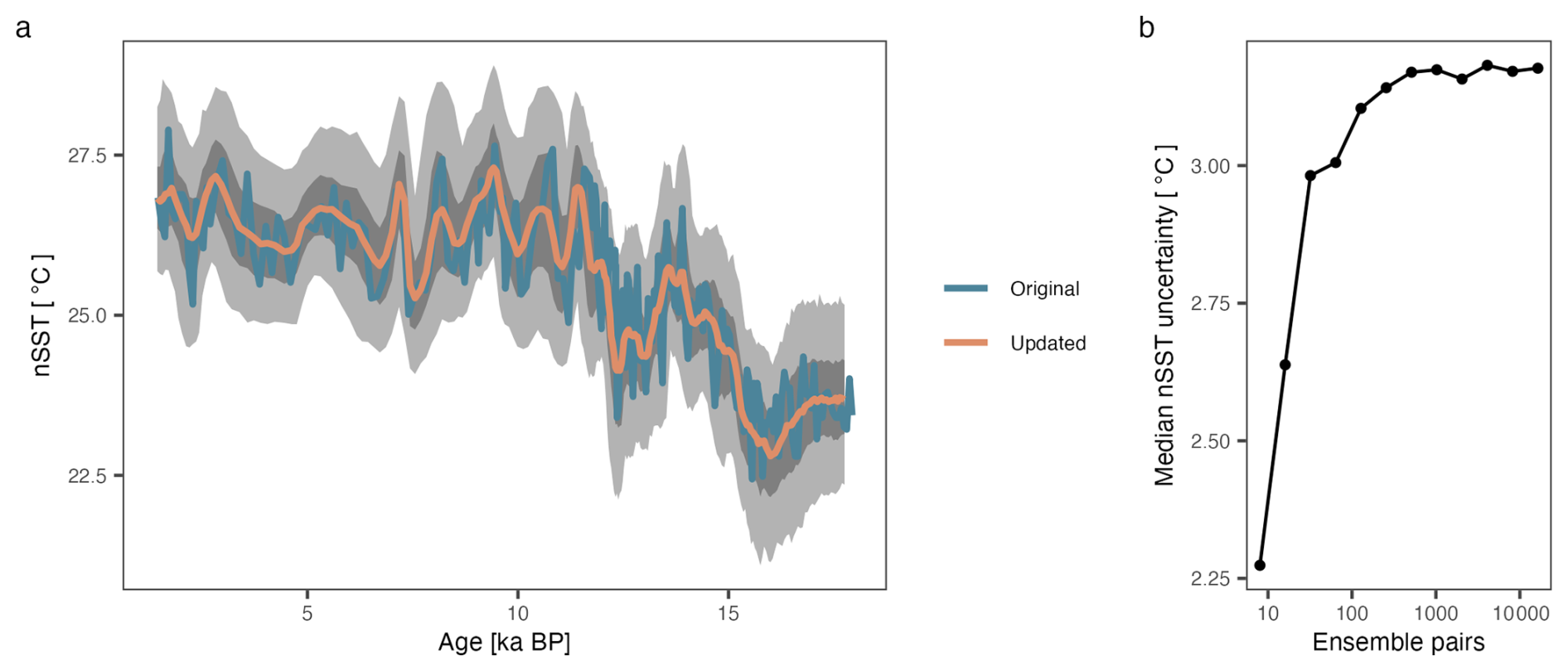
Figure 8An example of joint estimation of chronological and calibration uncertainty of nSST timeseries. Panel (a) shows the original nSST time series of site A7 in the North Pacific that is based on the ratio of Globigerinoides ruber albus (Sun et al., 2005) as well as the updated time series with uncertainty estimated as described in the main text. The solid line shows the median nSST and the light and dark grey are 90 % and 50 % central percentiles, respectively. Panel (b) shows the median uncertainty of all nSST (90 %) values of the entire time series as a function of the number of ensemble pairs (age and nSST). This example shows that out of 1 000 000 possible pairs about 500–1000 are sufficient to characterise the uncertainty of this time series. The number of ensemble pairs required for other time series, or other purposes, needs to be evaluated on a case-by-case basis.
Some example scripts for filtering the data product by location, length, resolution and age control are available from the lead author's GitHub repository (https://github.com/lukasjonkers/PALMODutils, last access: 22 January 2026). Example code to estimate the uncertainty of the nSST time series based on the age and temperature ensembles is available at the same location. An extensive documentation of the LiPD format is available at https://lipdverse.org (last access: 23 May 2025) and utilities to interact with LiPD files in R are available at https://github.com/nickmckay/lipdR (last access: 20 January 2026) and a user guide to the lipdR package is available at https://nickmckay.org/lipdR/ (last access 20 January 2026). Python users can use the PyLiPD package (https://pylipd.readthedocs.io/en/latest/, last access: 20 January 2026), which is documented at https://linked.earth/pylipdTutorials/intro.html (last access: 20 January 2026). Resources for Matlab users are available at https://github.com/nickmckay/LiPD-utilities (last access: 23 May 2025).
Whilst we have done our best to address errors and omissions and aimed for standardisation across the entire data product, it comes with the guarantee of remaining errors and inconsistencies. Users are encouraged to report those to the lead author by email so they can be corrected. Updates to the data synthesis will be published on PANGAEA and linked to the current version. Minor updates with corrections only will not be associated with a new data descriptor. The updating and versioning strategy is described in detail in Jonkers et al. (2020).
The PALMOD 130k marine palaeoclimate data synthesis version 2 is freely available at https://doi.org/10.1594/PANGAEA.984602 (Jonkers et al., 2026). The data can also be visualised and downloaded in LiPD format from https://lipdverse.org/PalMod/current_version/ (last access: 30 September 2025). Python and Matlab serialisations of the data as well as csv files of the palaeoclimate and chronological data can also be downloaded from the lipdverse website. We explicitly encourage users to also cite the original data when using this data product to provide credit to the data generators. For instance, when using a selection of the time series from this data product, we recommend including a statement like “We selected time series from the PALMOD 130k marine palaeoclimate synthesis version 2 (Jonkers et al., 2026). The time series that meet our selection criteria, including their original publications, are detailed in the table below”. See Weitzel et al. (2024) for an additional example and Smith et al. (2023) for a general discussion on the issue of crediting data generators.
This synthesis would not have been possible without good data stewardship of the marine palaeoclimate science community. For many decades researchers have been sharing their research data through (dedicated) publicly accessible data repositories. Even so, this synthesis makes a lot of invaluable metadata and chronological information publicly available for the first time. This is because such metadata and chronology data are often not directly associated with the primary proxy data, but reported in accompanying publications instead. When these publications are publicly accessible, this important information to interpret and reuse the data can be retrieved with considerable additional effort. However, more often than not, the publications are not publicly available and the information remains hidden behind the paywalls of publishers, rendering the data difficult to reuse.
Community guidelines on how to report general palaeoclimate data are available (Khider et al., 2019), as are more specific guidelines for microfossil assemblage data (Jonkers et al., 2025). However, legacy datasets invariably do not adhere to such guidelines, thus necessitating (community) effort to increase the reusability of these data. For new datasets, we recommend data sharing not only from the point of view of reproducing single studies, but explicitly consider reuse when sharing data and ensure that that research data files are scientific works that are comprehensible in themselves. In this way, reuse and reinterpretation of scientific data and knowledge is greatly facilitated, allowing our field to address new questions that cannot be answered using a single palaeoclimate time series.
With the National Climate Data Center (NCDC) at NOAA and PANGAEA the palaeoclimate community has access to at least two dedicated data repositories that enforce standardisation and perform data curation. This is a tremendously advantageous position to facilitate the reusability of palaeoclimate data and we explicitly encourage data generators to continue sharing their data through these recognised and specific data repositories. Nevertheless and despite the existence of the LinkedEarth ontology (https://linked.earth/ontology/, last access: 20 January 2026) and the PaST thesaurus (Morrill et al., 2021), the lack of adaptation of a single standardised vocabulary and consistent ontology across the repositories remains a hurdle to reusability. The PaST thesaurus is used at NCDC, but standardisation is only performed under the hood at PANGAEA (Felden et al., 2023), where structured and standardised data can be accessed in xml format. Synthesis efforts benefit from such standardisation, but increased harmonisation across the repositories, or tools to do so, would further facilitate synthesis efforts and the reusability of data.
The value of this data product arguably not only lies in the standardisation of the format and vocabulary, but also in the updating and standardisation of the age-depth models and of the seawater temperature estimates. Such updating and standardisation is only possible when raw chronology and proxy data are available on a depth scale. Radiocarbon data are often publicly available or can, with additional effort, be scraped from publications. However, information on aligned chronologies, including ages and uncertainty on tuning tie points is seldom reported, rendering reevaluation of such chronologies difficult. Regarding proxy data, measured and can, provided the calibration equation is known, be calculated from reported seawater temperatures, but ambiguities are likely to remain and the chance of deriving erroneous values is non-negligible (especially when the calibration equation is not explicitly included in the data file, or provided in the associated publication). For seawater temperatures based on microfossil assemblage the situation is different. Raw assemblage data are not as often shared as geochemical proxy data and due to the multi-dimensional character of the data, raw assemblage data cannot be inferred from the temperature estimates. This not only prevents revising temperature estimates reported without the underlying raw count data, but also prevents reuse of such assemblage data in other contexts, such as for estimates of past biodiversity change (e.g. Strack et al., 2024). This is unfortunate given the tremendous effort that went into generating such species assemblage data. In our opinion, the amount of work and the relevance of such data is so large that it would justify a coordinated international action to rescue the unpublished microfossil counts underlying seawater temperature reconstructions.
Table 4Sites included in the PALMOD 130k marine palaeoclimate data synthesis version 2.

LJ Conceptualization, Data Curation, Funding Acquisition, Visualization, Writing – Original Draft. MH Data Curation, Writing – Review & Editing. MS Data Curation, Writing – Review & Editing. MK Conceptualization, Funding Acquisition, Writing – Review & Editing.
The contact author has declared that none of the authors has any competing interests.
Publisher's note: Copernicus Publications remains neutral with regard to jurisdictional claims made in the text, published maps, institutional affiliations, or any other geographical representation in this paper. The authors bear the ultimate responsibility for providing appropriate place names. Views expressed in the text are those of the authors and do not necessarily reflect the views of the publisher.
We are grateful to all researchers who generously shared their data and responded to requests for information. We thank Nick McKay for help with converting the data product to LiPD format and Anjuly Janßen for help with sorting out the bibliography.
This project was supported by the German Federal Ministry of Research, Technology and Space (BMFTR) as a Research for Sustainability initiative (FONA) through the PALMOD project (grant nos. 01LP1922A and 01LP2308A). MH received funding by the Deutsche Forschungsgemeinschaft (DFG, German Research Foundation), Cluster of Excellence “The Ocean Floor – Earth's Uncharted Interface” (EXC 2077, grant no. 390741603).
The article processing charges for this open-access publication were covered by the University of Bremen.
This paper was edited by Attila Demény and reviewed by two anonymous referees.
Abrantes, F., Baas, J., Haflidason, H., Rasmussen, T., Klitgaard, D., Loncaric, N., and Gaspar, L.: Sediment fluxes along the northeastern European Margin: inferring hydrological changes between 20 and 8 kyr, Mar. Geol., 152, 7–23, 1998.
Abrantes, F., Lebreiro, S., Rodrigues, T., Gil, I., Bartels-Jónsdóttir, H., Oliveira, P., Kissel, C., and Grimalt, J. O.: Shallow-marine sediment cores record climate variability and earthquake activity off Lisbon (Portugal) for the last 2000 years, Quaternary Sci. Rev., 24, 2477–2494, 2005.
Adegbie, A. T.: Reconstruction of paleoenvironmental conditions in Equatorial Atlantic and the Gulf of Guinea Basins for the last 245.000 years, Universität Bremen, https://nbn-resolving.de/urn:nbn:de:gbv:46-ep000103077 (last access: 22 April 2026), 2001.
Adegbie, A. T., Schneider, R. R., Röhl, U., and Wefer, G.: Glacial millennial-scale fluctuations in central African precipitation recorded in terrigenous sediment supply and freshwater signals offshore Cameroon, Palaeogeogr. Palaeoclimatol. Palaeoecol., 197, 323–333, 2003.
Ahmad, S. M., Babu, G. A., Padmakumari, V. M., and Raza, W.: Surface and deep water changes in the northeast Indian Ocean during the last 60 ka inferred from carbon and oxygen isotopes of planktonic and benthic foraminifera, Palaeogeogr. Palaeoclimatol. Palaeoecol., 262, 182–188, 2008.
Alexer, I., Kroon, D., and Thompson, R.: Late Quaternary paleoenvironmental change on the northeast Australian margin as evidenced in oxygen isotope stratigraphy, mineral magnetism, and sedimentology, in: Proceedings of the Ocean Drilling Program, Ocean Drilling Program, https://doi.org/10.2973/odp.proc.sr.133.224.1993, 1993.
Ali, S., Hathorne, E. C., Frank, M., Gebregiorgis, D., Stattegger, K., Stumpf, R., Kutterolf, S., Johnson, J. E., and Giosan, L.: South Asian monsoon history over the past 60 kyr recorded by radiogenic isotopes and clay mineral assemblages in the Andaman Sea, Geochem. Geophys. Geosyst., 16, 505–521, 2015.
Allen, J. R. M., Brandt, U., Brauer, A., Hubberten, H.-W., Huntley, B., Keller, J., Kraml, M., Mackensen, A., Mingram, J., Negendank, J. F. W., Nowaczyk, N. R., Oberhänsli, H., Watts, W. A., Wulf, S., and Zolitschka, B.: Rapid environmental changes in southern Europe during the last glacial period, Nature, 400, 740–743, 1999.
Alt-Epping, U.: Late Quaternary Sedimentation Processes and Sediment Accumulation Changes off Portugal, Universität Bremen, https://nbn-resolving.de/urn:nbn:de:gbv:46-diss000111503 (last access: 22 April 2026), 2008.
Anand, P., Kroon, D., Singh, A. D., Ganeshram, R. S., Ganssen, G., and Elderfield, H.: Coupled sea surface temperature–seawater δ18O reconstructions in the Arabian Sea at the millennial scale for the last 35 ka, Paleoceanography, 23, https://doi.org/10.1029/2007pa001564, 2008.
Andersen, M. B., Vance, D., Archer, C., Anderson, R. F., Ellwood, M. J., and Allen, C. S.: The Zn abundance and isotopic composition of diatom frustules, a proxy for Zn availability in ocean surface seawater, Earth Planet. Sc. Lett., 301, 137–145, 2011.
Anderson, R. F.: Radionuclides of sediment core TT013_18, PANGAEA [data set], https://doi.org/10.1594/PANGAEA.125543, 2003a.
Anderson, R. F.: Radionuclides of sediment core TT013_72, PANGAEA [data set], https://doi.org/10.1594/PANGAEA.125550, 2003b.
Anderson, R. F., Barker, S., Fleisher, M., Gersonde, R., Goldstein, S. L., Kuhn, G., Mortyn, P. G., Pahnke, K., and Sachs, J. P.: Biological response to millennial variability of dust and nutrient supply in the Subantarctic South Atlantic Ocean, Philos. Trans. A Math. Phys. Eng. Sci., 372, 20130054, https://doi.org/10.1098/rsta.2013.0054, 2014.
Andreasen, D. H., Flower, M., Harvey, M., Chang, S., and Ravelo, A. C.: Data Report: Late Pleistocene oxygen and carbon isotopic records from Sites 1011, 1012, and 1018, in: Proceedings of the Ocean Drilling Program, Ocean Drilling Program, https://www-odp.tamu.edu/publications/167_SR/chap_08/c8_.htm (last access: 22 April 2026), 2000.
Arz, H. W., Pätzold, J., and Wefer, G.: Correlated millennial-scale changes in surface hydrography and terrigenous sediment yield inferred from last-glacial marine deposits off northeastern Brazil, Quaternary Res., 50, 157–166, 1998.
Arz, H. W., Pätzold, J., and Wefer, G.: Climatic changes during the last deglaciation recorded in sediment cores from the northeastern Brazilian Continental Margin, Geo-Mar. Lett., 19, 209–218, 1999a.
Arz, H. W., Pätzold, J., and Wefer, G.: The deglacial history of the western tropical Atlantic as inferred from high resolution stable isotope records off northeastern Brazil, Earth Planet. Sc. Lett., 167, 105–117, 1999b.
Arz, H. W., Gerhardt, S., Pätzold, J., and Röhl, U.: Millennial-scale changes of surface- and deep-water flow in the western tropical Atlantic linked to Northern Hemisphere high-latitude climate during the Holocene, Geology, 29, 239, https://doi.org/10.1130/0091-7613(2001)029<0239:mscosa>2.0.co;2, 2001.
Arz, H. W., Pätzold, J., Müller, P. J., and Moammar, M. O.: Influence of Northern Hemisphere climate and global sea level rise on the restricted Red Sea marine environment during termination I, Paleoceanography, 18, https://doi.org/10.1029/2002pa000864, 2003.
Arz, H. W., Lamy, F., Ganopolski, A., Nowaczyk, N., and Pätzold, J.: Dominant Northern Hemisphere climate control over millennial-scale glacial sea-level variability, Quaternary Sci. Rev., 26, 312–321, 2007.
Auffret, G., Zaragosi, S., Dennielou, B., Cortijo, E., Van Rooij, D., Grousset, F., Pujol, C., Eynaud, F., and Siegert, M.: Terrigenous fluxes at the Celtic margin during the last glacial cycle, Mar. Geol., 188, 79–108, 2002.
Baas, J. H., Mienert, J., Abrantes, F., and Prins, M. A.: Late Quaternary sedimentation on the Portuguese continental margin: climate-related processes and products, Palaeogeogr. Palaeoclimatol. Palaeoecol., 130, 1–23, 1997.
Bahr, A., Nürnberg, D., Schönfeld, J., and Garbe-Schönberg, D.: Hydrological variability in Florida Straits during Marine Isotope Stage 5 cold events, Paleoceanography, 26, https://doi.org/10.1029/2010pa002015, 2011.
Bahr, A., Nürnberg, D., Karas, C., and Grützner, J.: Millennial-scale versus long-term dynamics in the surface and subsurface of the western North Atlantic Subtropical Gyre during Marine Isotope Stage 5, Glob. Planet. Change, 111, 77–87, 2013.
Bahr, A., Hoffmann, J., Schönfeld, J., Schmidt, M. W., Nürnberg, D., Batenburg, S. J., and Voigt, S.: Low-latitude expressions of high-latitude forcing during Heinrich Stadial 1 and the Younger Dryas in northern South America, Glob. Planet. Change, 160, 1–9, 2018.
Bakke, J., Lie, Ø., Heegaard, E., Dokken, T., Haug, G. H., Birks, H. H., Dulski, P., and Nilsen, T.: Rapid oceanic and atmospheric changes during the Younger Dryas cold period, Nat. Geosci., 2, 202–205, 2009.
Ballalai, J. M., Santos, T. P., Lessa, D. O., Venancio, I. M., Chiessi, C. M., Johnstone, H. J. H., Kuhnert, H., Claudio, M. R., Toledo, F., Costa, K. B., and Albuquerque, A. L. S.: Tracking spread of the Agulhas Leakage into the western South Atlantic and its northward transmission during the Last Interglacial, Paleoceanogr. Paleoclimatol., 34, 1744–1760, 2019.
Barbero, L., Wanninkhof, R., Pierrot, D., and Zhang, J.-Z.: Dissolved inorganic carbon, total alkalinity, pH, and other variables collected from surface and discrete observations using Niskin bottle, flow-through pump and other instruments from F. G. Walton Smith in the Gulf of Mexico (east coast of Florida near the Keys) from 1–5 December 2014 (NCEI Accession 0154383), NOAA National Centers for Environmental Information, https://doi.org/10.7289/V5JH3J8K, 2016a.
Barbero, L., Wanninkhof, R., and Pierrot, D.: Dissolved inorganic carbon, total alkalinity, pH, nutrients, and other variables collected from surface discrete observations using Niskin bottle and other instruments from R/V F. G. Walton Smith in the west coast of Florida within Gulf of Mexico from 21–25 September to 2015 (NCEI Accession 0157025), NOAA National Centers for Environmental Information, https://doi.org/10.7289/V5WS8R98, 2016b.
Barbero, L., Pierrot, D., Wanninkhof, R., Baringer, M. O., Byrne, R. H., Langdon, C., Zhang, J.-Z., and Stauffer, B. A.: Dissolved inorganic carbon, total alkalinity, nutrients, and other variables collected from CTD profile, discrete bottle, and surface underway observations using CTD, Niskin bottle, flow-through pump, and other instruments from NOAA Ship Ronald H. Brown in the Gulf of Mexico, Southeastern coast of the United States, and Mexican and Cuban coasts during the third Gulf of Mexico and East Coast Carbon (GOMECC-3) Cruise from 18 July to 20 August 2017 (NCEI Accession 0188978), NOAA National Centers for Environmental Information, https://doi.org/10.25921/YY5K-DW60, 2019.
Bard, E., Fairbanks, R., Arnold, M., Maurice, P., Duprat, J., Moyes, J., and Duplessy, J.-C.: Sea-level estimates during the last deglaciation based on δ18O and accelerator mass spectrometry 14C ages measured in Globigerina bulloides, Quaternary Res., 31, 381–391, 1989.
Bard, E., Rostek, F., Turon, J. L., and Gendreau, S.: Hydrological impact of heinrich events in the subtropical northeast atlantic, Science, 289, 1321–1324, 2000.
Barker, S., Greaves, M., and Elderfield, H.: A study of cleaning procedures used for foraminiferal paleothermometry, Geochem. Geophys. Geosyst., 4, 8407, https://doi.org/10.1029/2003GC000559, 2003.
Barker, S., Chen, J., Gong, X., Jonkers, L., Knorr, G., and Thornalley, D.: Icebergs not the trigger for North Atlantic cold events, Nature, 520, 333–336, 2015.
Barron, J. A., Heusser, L., Herbert, T., and Lyle, M.: High-resolution climatic evolution of coastal northern California during the past 16,000 years, Paleoceanography, 18, https://doi.org/10.1029/2002pa000768, 2003.
Barrows, T. T., Juggins, S., De Deckker, P., Calvo, E., and Pelejero, C.: Long-term sea surface temperature and climate change in the Australian-New Zealand region, Paleoceanography, 22, https://doi.org/10.1029/2006pa001328, 2007.
Bartels-Jónsdóttir, H. B., Voelker, A. H. L., Abrantes, F. G., Salgueiro, E., Rodrigues, T., and Knudsen, K. L.: High-frequency surface water changes in the Tagus prodelta off Lisbon, eastern North Atlantic, during the last two millennia, Mar. Micropaleontol., 117, 13–24, 2015.
Bartels, M., Titschack, J., Fahl, K., Stein, R., Seidenkrantz, M.-S., Hillaire-Marcel, C., and Hebbeln, D.: Atlantic Water advection vs. glacier dynamics in northern Spitsbergen since early deglaciation, Clim. Past, 13, 1717–1749, https://doi.org/10.5194/cp-13-1717-2017, 2017.
Bartels, M., Titschack, J., Fahl, K., Stein, R., and Hebbeln, D.: Wahlenbergfjord, eastern Svalbard: a glacier-surrounded fjord reflecting regional hydrographic variability during the Holocene?, Boreas, 47, 1003–1021, 2018.
Bauch, H. A., Mueller-Lupp, T., Taldenkova, E., Spielhagen, R. F., Kassens, H., Grootes, P. M., Thiede, J., Heinemeier, J., and Petryashov, V. V.: Chronology of the Holocene transgression at the North Siberian margin, Glob. Planet. Change, 31, 125–139, 2001.
Benway, H. M., Mix, A. C., Haley, B. A., and Klinkhammer, G. P.: Eastern Pacific Warm Pool paleosalinity and climate variability: 0–30 kyr, Paleoceanography, 21, https://doi.org/10.1029/2005pa001208, 2006.
Benz, V., Esper, O., Gersonde, R., Lamy, F., and Tiedemann, R.: Last Glacial Maximum sea surface temperature and sea-ice extent in the Pacific sector of the Southern Ocean, Quaternary Sci. Rev., 146, 216–237, 2016.
Berger, W. H., Bickert, T., Schmidt, H., and Wefer, G.: Quaternary oxygen isotope record of pelagic foraminifers: Site 806, ontong java plateau, in: Proceedings of the Ocean Drilling Program, 130 Scientific Results, Ocean Drilling Program, https://www-odp.tamu.edu/publications/130_SR/VOLUME/CHAPTERS/sr130_22.pdf (last access: 22 April 2026), 1993.
Berger, W. H., Yasuda, M. K., Bickert, T., and Wefer, G.: Reconstruction of atmospheric CO2 from ice-core data and the deep-sea record of ontong Java plateau: the Milankovitch chron, Geol. Rundsch., 85, 466–495, 1996.
Beveridge, N. A. S., Elderfield, H., and Shackleton, N. J.: Deep thermohaline circulation in the low-latitude Atlantic during the Last Glacial, Paleoceanography, 10, 643–660, 1995.
Bickert, T. and Wefer, G.: Late Quaternary Deep Water circulation in the south Atlantic: Reconstruction from carbonate dissolution and benthic stable isotopes, in: The South Atlantic, Springer Berlin Heidelberg, Berlin, Heidelberg, 599–620, https://doi.org/10.1007/978-3-642-80353-6_30, 1996.
Bickert, T., Berger, W. H., Burke, S., Schmidt, H., and Wefer, G.: Late Quaternary stable isotope record of benthic foraminifers: Sites 805 and 806, ontong java plateau, in: Proceedings of the Ocean Drilling Program, 130 Scientific Results, Ocean Drilling Program, https://www-odp.tamu.edu/publications/130_SR/VOLUME/CHAPTERS/sr130_24.pdf (last access: 22 April 2026), 1993.
Bickert, T., Curry, W. B., and Wefer, G.: Late Pliocene to Holocene (2.6–0 Ma) western equatorial Atlantic deep-water circulation: inferences from benthic stable isotopes, in: Proceedings of the Ocean Drilling Program, Ocean Drilling Program, https://www-odp.tamu.edu/publications/154_SR/16_CHAP.PDF (last access: 22 April 2026), 1997.
Blaauw, M. and Christen, J. A.: Flexible paleoclimate age-depth models using an autoregressive gamma process, Bayesian Anal., 6, 457–474, 2011.
Bohrmann, G.: Opal of Site PS2082-1, PANGAEA [data set], https://doi.org/10.1594/PANGAEA.57592, 2005.
Bolliet, T., Holbourn, A., Kuhnt, W., Laj, C., Kissel, C., Beaufort, L., Kienast, M., Andersen, N., and Garbe-Schönberg, D.: Mindanao Dome variability over the last 160 kyr: Episodic glacial cooling of the West Pacific Warm Pool, Paleoceanography, 26, https://doi.org/10.1029/2010pa001966, 2011.
Bond, G., Showers, W., Cheseby, M., Lotti, R., Almasi, P., deMenocal, P., Priore, P., Cullen, H., Hajdas, I., and Bonani, G.: A pervasive millennial-scale cycle in North Atlantic Holocene and glacial climates, Science, 278, 1257–1266, 1997.
Boscolo-Galazzo, F., Evans, D., Mawbey, E. M., Gray, W. R., Pearson, P. N., and Wade, B. S.: Exploring macroevolutionary links in multi-species planktonic foraminiferal and δ18O from 15 Ma to recent, Biogeosciences, 22, 1095–1113, https://doi.org/10.5194/bg-22-1095-2025, 2025.
Bostock, H. C., Opdyke, B. N., Gagan, M. K., and Fifield, L. K.: Carbon isotope evidence for changes in Antarctic Intermediate Water circulation and ocean ventilation in the southwest Pacific during the last deglaciation, Paleoceanography, 19, https://doi.org/10.1029/2004pa001047, 2004.
Bostock, H. C., Opdyke, B. N., Gagan, M. K., and Fifield, L. K.: Late Quaternary siliciclastic/carbonate sedimentation model for the Capricorn Channel, southern Great Barrier Reef province, Australia, Mar. Geol., 257, 107–123, 2009.
Bostock, H. C., Hayward, B. W., Neil, H. L., Sabaa, A. T., and Scott, G. H.: Changes in the position of the Subtropical Front south of New Zealand since the last glacial period, Paleoceanography, 30, 824–844, 2015.
Bouimetarhan, I., Groeneveld, J., Dupont, L., and Zonneveld, K.: Low- to high-productivity pattern within Heinrich Stadial 1: Inferences from dinoflagellate cyst records off Senegal, Glob. Planet. Change, 106, 64–76, 2013.
Bova, S. C., Herbert, T., Rosenthal, Y., Kalansky, J., Altabet, M., Chazen, C., Mojarro, A., and Zech, J.: Links between eastern equatorial Pacific stratification and atmospheric CO2 rise during the last deglaciation, Paleoceanography, 30, 1407–1424, 2015.
Boyle, E. A.: Cadmium in benthic foraminifera and abyssal hydrography: Evidence for a 41 Kyr obliquity cycle, in: Climate Processes and Climate Sensitivity, American Geophysical Union, Washington, D. C., 360–368, https://doi.org/10.1029/gm029p0360, 1984.
Boyle, E. A. and Keigwin, L. D.: Comparison of Atlantic and Pacific paleochemical records for the last 215,000 years: changes in deep ocean circulation and chemical inventories, Earth Planet. Sc. Lett., 76, 135–150, 1985.
Brathauer, U. and Abelmann, A.: Late Quaternary variations in sea surface temperatures and their relationship to orbital forcing recorded in the Southern Ocean (Atlantic sector), Paleoceanography, 14, 135–148, 1999.
Broecker, W., Klas, M., Ragano-Beavan, N., Mathieu, G., Mix, A., Andree, M., Oeschger, H., Wölfli, W., Suter, M., Bonani, G., Hofmann, H. J., Nessi, M., and Morenzoni, E.: Introduction, Radiocarbon, 30, 261–263, 1988a.
Broecker, W. S., Andree, M., Bonani, G., Wolfli, W., Oeschger, H., and Klas, M.: Can the Greenland climatic jumps be identified in records from ocean and land?, Quaternary Res., 30, 1–16, 1988b.
Broecker, W. S., Andree, M., Bonani, G., Wolfli, W., Klas, M., Mix, A., and Oeschger, H.: Comparison between radiocarbon ages obtained on coexisting planktonic foraminifera, Paleoceanography, 3, 647–657, 1988c.
Brooks, G. R., Hine, A. C., Mallinson, D., and Drexler, T. M.: Data report: Texture and composition of Quaternary upper-slope sediments in the great Australian bight: Sites 1130 and 1132, in: Proceedings of the Ocean Drilling Program, 182 Scientific Results, Ocean Drilling Program, https://www-odp.tamu.edu/publications/182_SR/VOLUME/CHAPTERS/003.PDF (last access: 22 April 2026), 2002.
Brunelle, B. G., Sigman, D. M., Cook, M. S., Keigwin, L. D., Haug, G. H., Plessen, B., Schettler, G., and Jaccard, S. L.: Evidence from diatom-bound nitrogen isotopes for subarctic Pacific stratification during the last ice age and a link to North Pacific denitrification changes, Paleoceanography, 22, https://doi.org/10.1029/2005pa001205, 2007.
Bunzel, D., Schmiedl, G., Lindhorst, S., Mackensen, A., Reolid, J., Romahn, S., and Betzler, C.: A multi-proxy analysis of Late Quaternary ocean and climate variability for the Maldives, Inner Sea, Clim. Past, 13, 1791–1813, https://doi.org/10.5194/cp-13-1791-2017, 2017.
Butzin, M., Köhler, P., and Lohmann, G.: Marine radiocarbon reservoir age simulations for the past 50,000 years, Geophys. Res. Lett., 44, 8473–8480, 2017.
Cacho, I., Grimalt, J. O., Pelejero, C., Canals, M., Sierro, F. J., Flores, J. A., and Shackleton, N.: Dansgaard-Oeschger and Heinrich event imprints in Alboran Sea paleotemperatures, Paleoceanography, 14, 698–705, 1999.
Cacho, I., Grimalt, J. O., Canals, M., Sbaffi, L., Shackleton, N. J., Schönfeld, J., and Zahn, R.: Variability of the western Mediterranean Sea surface temperature during the last 25,000 years and its connection with the Northern Hemisphere climatic changes, Paleoceanography, 16, 40–52, 2001.
Cacho, I., Shackleton, N., Elderfield, H., Sierro, F. J., and Grimalt, J. O.: Glacial rapid variability in deep-water temperature and δ18O from the Western Mediterranean Sea, Quaternary Sci. Rev., 25, 3294–3311, 2006.
Caley, T., Kim, J.-H., Malaizé, B., Giraudeau, J., Laepple, T., Caillon, N., Charlier, K., Rebaubier, H., Rossignol, L., Castañeda, I. S., Schouten, S., and Sinninghe Damsté, J. S.: High-latitude obliquity as a dominant forcing in the Agulhas current system, Clim. Past, 7, 1285–1296, https://doi.org/10.5194/cp-7-1285-2011, 2011.
Caley, T., Extier, T., Collins, J. A., Schefuß, E., Dupont, L., Malaizé, B., Rossignol, L., Souron, A., McClymont, E. L., Jimenez-Espejo, F. J., García-Comas, C., Eynaud, F., Martinez, P., Roche, D. M., Jorry, S. J., Charlier, K., Wary, M., Gourves, P.-Y., Billy, I., and Giraudeau, J.: A two-million-year-long hydroclimatic context for hominin evolution in southeastern Africa, Nature, 560, 76–79, 2018.
Came, R. E., Oppo, D. W., and McManus, J. F.: Amplitude and timing of temperature and salinity variability in the subpolar North Atlantic over the past 10 k.y, Geology, 35, 315–318, 2007.
Campos, M. C., Chiessi, C. M., Prange, M., Mulitza, S., Kuhnert, H., Paul, A., Venancio, I. M., Albuquerque, A. L. S., Cruz, F. W., and Bahr, A.: A new mechanism for millennial scale positive precipitation anomalies over tropical South America, Quaternary Sci. Rev., 225, 105990, https://doi.org/10.1016/j.quascirev.2019.105990, 2019.
Campos, M. C., Chiessi, C. M., Venancio, I. M., Pinho, T. M. L., Crivellari, S., Kuhnert, H., Schmiedl, G., Díaz, R. A., Albuquerque, A. L. S., Portilho-Ramos, R. C., Bahr, A., and Mulitza, S.: Constraining millennial-scale changes in northern component water ventilation in the western tropical south Atlantic, Paleoceanogr. Paleoclimatol., 35, https://doi.org/10.1029/2020pa003876, 2020.
Caniupán, M., Lamy, F., Lange, C. B., Kaiser, J., Arz, H., Kilian, R., Baeza Urrea, O., Aracena, C., Hebbeln, D., Kissel, C., Laj, C., Mollenhauer, G., and Tiedemann, R.: Millennial-scale sea surface temperature and Patagonian Ice Sheet changes off southernmost Chile (53° S) over the past ∼ 60 kyr, Paleoceanography, 26, https://doi.org/10.1029/2010pa002049, 2011.
Carlson, A. E., Oppo, D. W., Came, R. E., LeGrande, A. N., Keigwin, L. D., and Curry, W. B.: Subtropical Atlantic salinity variability and Atlantic meridional circulation during the last deglaciation, Geology, 36, 991, https://doi.org/10.1130/g25080a.1, 2008.
Cartapanis, O., Jonkers, L., Moffa-Sanchez, P., Jaccard, S. L., and de Vernal, A.: Complex spatio-temporal structure of the Holocene Thermal Maximum, Nat. Commun., 13, 1–11, 2022.
Carter, L., Manighetti, B., Ganssen, G., and Northcote, L.: Southwest Pacific modulation of abrupt climate change during the Antarctic Cold Reversal–Younger Dryas, Palaeogeogr. Palaeoclimatol. Palaeoecol., 260, 284–298, 2008.
Castañeda, I. S., Smith, L. M., Kristjánsdóttir, G. B., and Andrews, J. T.: Temporal changes in Holocene δ18O records from the northwest and central North Iceland Shelf, J. Quaternary Sci., 19, 321–334, 2004.
Castañeda, I. S., Mulitza, S., Schefuss, E., Lopes dos Santos, R. A., Sinninghe Damsté, J. S., and Schouten, S.: Wet phases in the Sahara/Sahel region and human migration patterns in North Africa, P. Natl. Acad. Sci. USA, 106, 20159–20163, 2009.
Castañeda, I. S., Schefuß, E., Pätzold, J., Sinninghe Damsté, J. S., Weldeab, S., and Schouten, S.: Millennial-scale sea surface temperature changes in the eastern Mediterranean (Nile River Delta region) over the last 27,000 years, Paleoceanography, 25, https://doi.org/10.1029/2009pa001740, 2010.
Castañeda, I. S., Caley, T., Dupont, L., Kim, J.-H., Malaizé, B., and Schouten, S.: Middle to Late Pleistocene vegetation and climate change in subtropical southern East Africa, Earth Planet. Sc. Lett., 450, 306–316, 2016.
Caulle, C., Penaud, A., Eynaud, F., Zaragosi, S., Roche, D. M., Michel, E., Boulay, S., and Richter, T.: Sea-surface hydrographical conditions off South Faeroes and within the North-Eastern North Atlantic through MIS 2: the response of dinocysts, J. Quaternary Sci., 28, 217–228, 2013.
Cayre, O., Lancelot, Y., Vincent, E., and Hall, M. A.: Paleoceanographic reconstructions from planktonic foraminifera off the Iberian Margin: Temperature, salinity, and Heinrich events, Paleoceanography, 14, 384–396, 1999.
Chang, A. S., Pedersen, T. F., and Hendy, I. L.: Effects of productivity, glaciation, and ventilation on late Quaternary sedimentary redox and trace element accumulation on the Vancouver Island margin, western Canada, Paleoceanography, 29, 730–746, 2014.
Channell, J. E. T., Hodell, D. A., and Lehman, B.: Relative geomagnetic paleointensity and δ18O at ODP Site 983 (Gardar Drift, North Atlantic) since 350 ka, Earth Planet. Sc. Lett., 153, 103–118, 1997.
Chapman, M. R. and Shackleton, N. J.: Global ice-volume fluctuations, North Atlantic ice-rafting events, and deep-ocean circulation changes between 130 and 70 ka, Geology, 27, 795, https://doi.org/10.1130/0091-7613(1999)027<0795:givfna>2.3.co;2, 1999.
Chapman, M. R., Shackleton, N. J., Zhao, M., and Eglinton, G.: Faunal and alkenone reconstructions of subtropical North Atlantic surface hydrography and paleotemperature over the last 28 kyr, Paleoceanography, 11, 343–357, https://doi.org/10.1029/96PA00041, 1996.
Charles, C. D. and Fairbanks, R. G.: Evidence from Southern Ocean sediments for the effect of North Atlantic deep-water flux on climate, Nature, 355, 416–419, 1992.
Charles, C. D., Froelich, P. N., Zibello, M. A., Mortlock, R. A., and Morley, J. J.: Biogenic opal in Southern Ocean sediments over the last 450,000 years: Implications for surface water chemistry and circulation, Paleoceanography, 6, 697–728, 1991.
Charles, C. D., Lynch-Stieglitz, J., Ninnemann, U. S., and Fairbanks, R. G.: Climate connections between the hemisphere revealed by deep sea sediment core/ice core correlations, Earth Planet. Sc. Lett., 142, 19–27, 1996.
Cheng, X., Zhao, Q., Wang, J., Jain, Z., Xia, P., Huang, B., Fang, D., Xu, J., Zhou, Z., and Wang, P.: Data Report: Stable Isotopes from Sites 1147 and 1148, in: Proceedings of the Ocean Drilling Program, Ocean Drilling Program, https://www-odp.tamu.edu/publications/184_SR/223/223.htm (last access: 22 April 2026), 2004.
Cheng, Z., Weng, C., Steinke, S., and Mohtadi, M.: Anthropogenic modification of vegetated landscapes in southern China from 6,000 years ago, Nat. Geosci., 11, 939–943, 2018.
Chen, J., Farrell, J. W., Murray, D. W., and Prell, W. L.: Timescale and paleoceanographic implications of a 3.6 m.y. oxygen isotope record from the northeast Indian Ocean (Ocean Drilling Program Site 758), Paleoceanography, 10, 21–47, 1995.
Chen, M.-T., Shiau, L.-J., Yu, P.-S., Chiu, T.-C., Chen, Y.-G., and Wei, K.-Y.: 500 000-Year records of carbonate, organic carbon, and foraminiferal sea-surface temperature from the southeastern South China Sea (near Palawan Island), Palaeogeogr. Palaeoclimatol. Palaeoecol., 197, 113–131, 2003.
Chiessi, C. M., Mulitza, S., Paul, A., Pätzold, J., Groeneveld, J., and Wefer, G.: South Atlantic interocean exchange as the trigger for the Bølling warm event, Geology, 36, 919, https://doi.org/10.1130/g24979a.1, 2008.
Chiessi, C. M., Mulitza, S., Groeneveld, J., Silva, J. B., Campos, M. C., and Gurgel, M. H. C.: Variability of the Brazil Current during the late Holocene, Palaeogeogr. Palaeoclimatol. Palaeoecol., 415, 28–36, 2014.
Chiessi, C. M., Mulitza, S., Mollenhauer, G., Silva, J. B., Groeneveld, J., and Prange, M.: Thermal evolution of the western South Atlantic and the adjacent continent during Termination 1, Clim. Past, 11, 915–929, https://doi.org/10.5194/cp-11-915-2015, 2015.
Clemens, S. C.: Data report: Site U1448 Pleistocene benthic foraminiferal stable isotopes, Andaman Sea, IODP Expedition 353, in: Volume 353: Indian Monsoon Rainfall, International Ocean Discovery Program, https://doi.org/10.14379/iodp.proc.353.203.2022, 2022.
Clemens, S. C. and Prell, W. L.: Data report: Oxygen and carbon isotopes from site 1146, northern South China sea, in: Proceedings of the Ocean Drilling Program, Ocean Drilling Program, https://doi.org/10.2973/odp.proc.sr.184.214.2003, 2003.
Clemens, S. C., Holbourn, A., Kubota, Y., Lee, K. E., Liu, Z., Chen, G., Nelson, A., and Fox-Kemper, B.: Precession-band variance missing from East Asian monsoon runoff, Nat. Commun., 9, 3364, https://doi.org/10.1038/s41467-018-05814-0, 2018.
Clemens, S. C., Yamamoto, M., Thirumalai, K., Giosan, L., Richey, J. N., Nilsson-Kerr, K., Rosenthal, Y., Anand, P., and McGrath, S. M.: Remote and local drivers of Pleistocene South Asian summer monsoon precipitation: A test for future predictions, Sci. Adv., 7, eabg3848, https://doi.org/10.1126/sciadv.abg3848, 2021.
Cléroux, C., Debret, M., Cortijo, E., Duplessy, J.-C., Dewilde, F., Reijmer, J., and Massei, N.: High-resolution sea surface reconstructions off Cape Hatteras over the last 10 ka, Paleoceanography, 27, https://doi.org/10.1029/2011pa002184, 2012.
CLIMAP: NOAA/WDS Paleoclimatology – CLIMAP 18K Database, NOAA [data set], https://doi.org/10.25921/YXK7-3D97, 2005.
CLIMAP Project Members: The surface of the ice-age Earth, Science, 191, 1131–1137, 1976.
CLIMAP Project Members: Stable isotopes measured on foraminifera from the 120 kyr time slice reconstruction in sediment core V25-59, PANGAEA [data set], https://doi.org/10.1594/PANGAEA.358947, 2006a.
CLIMAP Project Members: Stable isotopes measured on foraminifera from the 120 kyr time slice reconstruction in sediment core V28-14, PANGAEA [data set] https://doi.org/10.1594/PANGAEA.358951, 2006b.
CLIMAP Project Members: Stable isotopes measured on foraminifera from the 120 kyr time slice reconstruction in sediment core V28-127, PANGAEA [data set] https://doi.org/10.1594/PANGAEA.358950, 2006c.
Cline, R. M. L., Hays, J. D., Prell, W. L., Ruddiman, W. F., Moore, T. C., Kipp, N. G., Molfino, B. E., Denton, G. H., Hughes, T. J., Balsam, W. L., Brunner, C. A., Duplessy, J.-C., Esmay, A. G., Fastook, J. L., Imbrie, J., Keigwin, L. D., Kellogg, T. B., McIntyre, A., Matthews, R. K., Mix, A. C., Morley, J. J., Shackleton, N. J., Streeter, S. S., and Thompson, P. R.: The last interglacial ocean, Quaternary Res., 21, 123–224, 1984.
Comas-Bru, L., Rehfeld, K., Roesch, C., Amirnezhad-Mozhdehi, S., Harrison, S. P., Atsawawaranunt, K., Ahmad, S. M., Brahim, Y. A., Baker, A., Bosomworth, M., Breitenbach, S. F. M., Burstyn, Y., Columbu, A., Deininger, M., Demény, A., Dixon, B., Fohlmeister, J., Hatvani, I. G., Hu, J., Kaushal, N., Kern, Z., Labuhn, I., Lechleitner, F. A., Lorrey, A., Martrat, B., Novello, V. F., Oster, J., Pérez-Mejías, C., Scholz, D., Scroxton, N., Sinha, N., Ward, B. M., Warken, S., Zhang, H., and SISAL Working Group members: SISALv2: a comprehensive speleothem isotope database with multiple age–depth models, Earth Syst. Sci. Data, 12, 2579–2606, https://doi.org/10.5194/essd-12-2579-2020, 2020.
Combourieu Nebout, N., Turon, J. L., Zahn, R., Capotondi, L., Londeix, L., and Pahnke, K.: Enhanced aridity and atmospheric high-pressure stability over the western Mediterranean during the North Atlantic cold events of the past 50 k.y, Geology, 30, 863, https://doi.org/10.1130/0091-7613(2002)030<0863:eaaahp>2.0.co;2, 2002.
Cook, M. S., Keigwin, L. D., and Sancetta, C. A.: The deglacial history of surface and intermediate water of the Bering Sea, Deep Sea Res. Part 2 Top. Stud. Oceanogr., 52, 2163–2173, 2005.
Cortese, G., Abelmann, A., and Gersonde, R.: The last five glacial-interglacial transitions: A high-resolution 450,000-year record from the subantarctic Atlantic, Paleoceanography, 22, https://doi.org/10.1029/2007pa001457, 2007.
Cortijo, E., Lehman, S., Keigwin, L., Chapman, M., Paillard, D., and Labeyrie, L.: Changes in meridional temperature and salinity gradients in the North Atlantic Ocean (30°–72° N) during the last interglacial period, Paleoceanography, 14, 23–33, 1999.
Cosma, T. N., Hendy, I. L., and Chang, A. S.: Chronological constraints on Cordilleran Ice Sheet glaciomarine sedimentation from core MD02-2496 off Vancouver Island (western Canada), Quaternary Sci. Rev., 27, 941–955, 2008.
Crivellari, S., Chiessi, C. M., Kuhnert, H., Häggi, C., da Costa Portilho-Ramos, R., Zeng, J.-Y., Zhang, Y., Schefuß, E., Mollenhauer, G., Hefter, J., Alexandre, F., Sampaio, G., and Mulitza, S.: Increased Amazon freshwater discharge during late Heinrich Stadial 1, Quaternary Sci. Rev., 181, 144–155, 2018.
Crivellari, S., Chiessi, C. M., Kuhnert, H., Häggi, C., Mollenhauer, G., Hefter, J., Portilho-Ramos, R., Schefuß, E., and Mulitza, S.: Thermal response of the western tropical Atlantic to slowdown of the Atlantic Meridional Overturning Circulation, Earth Planet. Sc. Lett., 519, 120–129, 2019.
Curran, M. J., Rosenthal, Y., Wright, J. D., and Morley, A.: Atmospheric response to mid-Holocene warming in the northeastern Atlantic: Implications for future storminess in the Ireland/UK region, Quaternary Sci. Rev., 225, 106004, https://doi.org/10.1016/j.quascirev.2019.106004, 2019.
Curry, W. B.: Late Quaternary deep circulation in the western equatorial Atlantic, in: The South Atlantic, Springer Berlin Heidelberg, Berlin, Heidelberg, 577–598, https://doi.org/10.1007/978-3-642-80353-6_29, 1996.
Curry, W. B.: Stable isotope analysis on sediment core RC13-228, PANGAEA [data set], https://doi.org/10.1594/PANGAEA.139596, 2004a.
Curry, W. B.: Stable isotope analysis on sediment core RC13-229, PANGAEA [data set], https://doi.org/10.1594/PANGAEA.139597, 2004b.
Curry, W. B. and Oppo, D. W.: Synchronous, high-frequency oscillations in tropical sea surface temperatures and North Atlantic Deep Water production during the Last Glacial Cycle, Paleoceanography, 12, 1–14, 1997.
Curry, W. B. and Oppo, D. W.: Glacial water mass geometry and the distribution of δ13C of ΣCO2 in the western Atlantic Ocean, Paleoceanography, 20, PA1017, https://doi.org/10.1029/2004PA001021, 2005.
Curry, W. B., Duplessy, J. C., Labeyrie, L. D., and Shackleton, N. J.: Changes in the distribution of δ13C of deep water ΣCO2 between the Last Glaciation and the Holocene, Paleoceanography, 3, 317–341, 1988.
Curry, W. B., Marchitto, T. M., McManus, J. F., Oppo, D. W., and Laarkamp, K. L.: Millennial-scale changes in ventilation of the thermocline, intermediate, and deep waters of the glacial North Atlantic, in: Mechanisms of Global Climate Change at Millennial Time Scales, American Geophysical Union, Washington, D. C., 59–76, https://doi.org/10.1029/GM112p0059, 1999.
Dang, H., Jian, Z., Bassinot, F., Qiao, P., and Cheng, X.: Decoupled Holocene variability in surface and thermocline water temperatures of the Indo-Pacific Warm Pool, Geophys. Res. Lett., 39, https://doi.org/10.1029/2011gl050154, 2012.
Dang, H., Jian, Z., Kissel, C., and Bassinot, F.: Precessional changes in the western equatorial Pacific Hydroclimate: A 240 kyr marine record from the Halmahera Sea, East Indonesia, Geochem. Geophys. Geosyst., 16, 148–164, 2015.
Dang, H., Wu, J., Xiong, Z., Qiao, P., Li, T., and Jian, Z.: Orbital and sea-level changes regulate the iron-associated sediment supplies from Papua New Guinea to the equatorial Pacific, Quaternary Sci. Rev., 239, 106361, https://doi.org/10.1016/j.quascirev.2020.106361, 2020a.
Dang, H., Jian, Z., Wang, Y., Mohtadi, M., Rosenthal, Y., Ye, L., Bassinot, F., and Kuhnt, W.: Pacific warm pool subsurface heat sequestration modulated Walker circulation and ENSO activity during the Holocene, Sci. Adv., 6, https://doi.org/10.1126/sciadv.abc0402, 2020b.
Daniau, A.-L., Sánchez Goñi, M. F., Martinez, P., Urrego, D. H., Bout-Roumazeilles, V., Desprat, S., and Marlon, J. R.: Orbital-scale climate forcing of grassland burning in southern Africa, P. Natl. Acad. Sci. USA, 110, 5069–5073, 2013.
de Abreu, L., Shackleton, N. J., Schönfeld, J., Hall, M., and Chapman, M.: Millennial-scale oceanic climate variability off the Western Iberian margin during the last two glacial periods, Mar. Geol., 196, 1–20, 2003.
De Deckker, P., Moros, M., Perner, K., and Jansen, E.: Influence of the tropics and southern westerlies on glacial interhemispheric asymmetry, Nat. Geosci., 5, 266–269, 2012.
De Deckker, P., Barrows, T. T., Stuut, J.-B. W., van der Kaars, S., Ayress, M. A., Rogers, J., and Chaproniere, G.: Land–sea correlations in the Australian region: 460 ka of changes recorded in a deep-sea core offshore Tasmania. Part 2: the marine compared with the terrestrial record, Aust. J. Earth Sci., 66, 17–36, 2019.
De Deckker, P., Moros, M., Perner, K., Blanz, T., Wacker, L., Schneider, R., Barrows, T. T., O'Loingsigh, T., and Jansen, E.: Climatic evolution in the Australian region over the last 94 ka – spanning human occupancy –, and unveiling the Last Glacial Maximum, Quaternary Sci. Rev., 249, 106593, https://doi.org/10.1016/j.quascirev.2020.106593, 2020.
de Garidel-Thoron, T., Beaufort, L., Linsley, B. K., and Dannenmann, S.: Millennial-scale dynamics of the east Asian winter monsoon during the last 200,000 years, Paleoceanography, 16, 491–502, 2001.
de Garidel-Thoron, T., Rosenthal, Y., Beaufort, L., Bard, E., Sonzogni, C., and Mix, A. C.: A multiproxy assessment of the western equatorial Pacific hydrography during the last 30 kyr, Paleoceanography, 22, https://doi.org/10.1029/2006pa001269, 2007.
deMenocal, P., Ortiz, J., Guilderson, T., Adkins, J., Sarnthein, M., Baker, L., and Yarusinsky, M.: Abrupt onset and termination of the African Humid Period, Quaternary Sci. Rev., 19, 347–361, 2000a.
deMenocal, P., Ortiz, J., Guilderson, T., and Sarnthein, M.: Coherent high- and low-latitude climate variability during the holocene warm period, Science, 288, 2198–2202, 2000b.
Dickson, A. J., Beer, C. J., Dempsey, C., Maslin, M. A., Bendle, J. A., McClymont, E. L., and Pancost, R. D.: Oceanic forcing of the Marine Isotope Stage 11 interglacial, Nat. Geosci., 2, 428–433, 2009.
Dittert, N.: Late Quaternary planktic foraminifera assemblages in the South Atlantic Ocean: quantitative determination and preservational aspects, Universität Bremen, https://nbn-resolving.de/urn:nbn:de:gbv:46-ep000102451 (last access: 22 April 2026), 1998.
Diz, P., Hall, I. R., Zahn, R., and Molyneux, E. G.: Paleoceanography of the southern Agulhas Plateau during the last 150 ka: Inferences from benthic foraminiferal assemblages and multispecies epifaunal carbon isotopes, Paleoceanography, 22, PA4218, https://doi.org/10.1029/2007pa001511, 2007.
Dokken, T. M. and Jansen, E.: Rapid changes in the mechanism of ocean convection during the last glacial period, Nature, 401, 458–461, 1999.
Dokken, T. M., Nisancioglu, K. H., Li, C., Battisti, D. S., and Kissel, C.: Dansgaard-Oeschger cycles: Interactions between ocean and sea ice intrinsic to the Nordic seas, Paleoceanography, 28, 491–502, 2013.
Dolman, A. M. and Laepple, T.: Sedproxy: a forward model for sediment-archived climate proxies, Clim. Past, 14, 1851–1868, https://doi.org/10.5194/cp-14-1851-2018, 2018.
Dolven, J. K., Cortese, G., and Bjørklund, K. R.: A high-resolution radiolarian-derived paleotemperature record for the Late Pleistocene-Holocene in the Norwegian Sea, Paleoceanography, 17, 24-1–24-13, 2002.
Dong, L., Li, L., Li, Q., Wang, H., and Zhang, C. L.: Hydroclimate implications of thermocline variability in the southern South China Sea over the past 180,000 yr, Quaternary Res., 83, 370–377, 2015.
Dubois-Dauphin, Q., Montagna, P., Siani, G., Douville, E., Wienberg, C., Hebbeln, D., Liu, Z., Kallel, N., Dapoigny, A., Revel, M., Pons-Branchu, E., Taviani, M., and Colin, C.: Hydrological variations of the intermediate water masses of the western Mediterranean Sea during the past 20 ka inferred from neodymium isotopic composition in foraminifera and cold-water corals, Clim. Past, 13, 17–37, https://doi.org/10.5194/cp-13-17-2017, 2017.
Dubois, N., Kienast, M., Normandeau, C., and Herbert, T. D.: Eastern equatorial Pacific cold tongue during the Last Glacial Maximum as seen from alkenone paleothermometry, Paleoceanography, 24, https://doi.org/10.1029/2009pa001781, 2009.
Dubois, N., Kienast, M., Kienast, S., Normandeau, C., Calvert, S. E., Herbert, T. D., and Mix, A.: Millennial-scale variations in hydrography and biogeochemistry in the Eastern Equatorial Pacific over the last 100 kyr, Quaternary Sci. Rev., 30, 210–223, 2011.
Du, J., Huang, B., and Zhou, L.: Global deepwater circulation between 2.4 and 1.7 Ma and its connection to the onset of Northern Hemisphere Glaciation, Paleoceanography, 31, 1480–1497, 2016.
Duplessy, J.-C.: (Table 3) Stable carbon and oxygen isotope ratios of Melonis sp. from sediment core MD73-025, PANGAEA [data set], https://doi.org/10.1594/PANGAEA.726208, 1982a.
Duplessy, J.-C.: (Table 6) Stable carbon and oxygen isotope ratios of Cibicides species from sediment core CH73-139, PANGAEA [data set], https://doi.org/10.1594/PANGAEA.726215, 1982b.
Duplessy, J.-C.: NOAA/WDS Paleoclimatology – Surface and deep circulation of the N. Atlantic during the past 150,000 years, Duplessy, NOAA [data set], https://doi.org/10.25921/9XVW-PR91, 1996.
Duplessy, J. C., Shackleton, N. J., Fairbanks, R. G., Labeyrie, L., Oppo, D., and Kallel, N.: Deepwater source variations during the last climatic cycle and their impact on the global deepwater circulation, Paleoceanography, 3, 343–360, 1988.
Duplessy, J. C., Bard, E., Arnold, M., Shackleton, N. J., Duprat, J., and Labeyrie, L.: How fast did the ocean–atmosphere system run during the last deglaciation?, Earth Planet. Sc. Lett., 103, 27–40, 1991.
Duplessy, J. C., Labeyrie, L., Arnold, M., Paterne, M., Duprat, J., and van Weering, T. C. E.: Changes in surface salinity of the North Atlantic Ocean during the last deglaciation, Nature, 358, 485–488, 1992.
Duplessy, J. C., Cortijo, E., Ivanova, E., Khusid, T., Labeyrie, L., Levitan, M., Murdmaa, I., and Paterne, M.: Paleoceanography of the Barents Sea during the Holocene, Paleoceanography, 20, https://doi.org/10.1029/2004pa001116, 2005.
Dupont, L. M., Behling, H., and Kim, J.-H.: Thirty thousand years of vegetation development and climate change in Angola (Ocean Drilling Program Site 1078), Clim. Past, 4, 107–124, https://doi.org/10.5194/cp-4-107-2008, 2008.
Dürkop, A., Holbourn, A., Kuhnt, W., Zuraida, R., Andersen, N., and Grootes, P. M.: Centennial-scale climate variability in the Timor Sea during Marine Isotope Stage 3, Mar. Micropaleontol., 66, 208–221, 2008.
Dyez, K. A., Ravelo, A. C., and Mix, A. C.: Evaluating drivers of Pleistocene eastern tropical Pacific sea surface temperature, Paleoceanography, 31, 1054–1069, 2016.
Ehrmann, W., Schmiedl, G., Hamann, Y., Kuhnt, T., Hemleben, C., and Siebel, W.: Clay minerals in late glacial and Holocene sediments of the northern and southern Aegean Sea, Palaeogeogr. Palaeoclimatol. Palaeoecol., 249, 36–57, 2007.
Elderfield, H. and Ganssen, G.: Past temperature and δ18O of surface ocean waters inferred from foraminiferal ratios, Nature, 405, 442–445, 2000.
Elderfield, H., Ferretti, P., Greaves, M., Crowhurst, S., McCave, I. N., Hodell, D., and Piotrowski, A. M.: Evolution of ocean temperature and ice volume through the mid-Pleistocene climate transition, Science, 337, 704–709, 2012.
Elliot, M., Labeyrie, L., Bond, G., Cortijo, E., Turon, J.-L., Tisnerat, N., and Duplessy, J.-C.: Millennial-scale iceberg discharges in the Irminger Basin during the Last Glacial Period: Relationship with the Heinrich events and environmental settings, Paleoceanography, 13, 433–446, 1998.
Elliot, M., Labeyrie, L., Dokken, T., and Manthé, S.: Coherent patterns of ice-rafted debris deposits in the Nordic regions during the last glacial (10–60 ka), Earth Planet. Sc. Lett., 194, 151–163, 2001.
Elliot, M., Labeyrie, L., and Duplessy, J.-C.: Changes in North Atlantic deep-water formation associated with the Dansgaard–Oeschger temperature oscillations (60–10 ka), Quaternary Sci. Rev., 21, 1153–1165, 2002.
Emeis, K.-C., Struck, U., Schulz, H.-M., Rosenberg, R., Bernasconi, S., Erlenkeuser, H., Sakamoto, T., and Martinez-Ruiz, F.: Temperature and salinity variations of Mediterranean Sea surface waters over the last 16,000 years from records of planktonic stable oxygen isotopes and alkenone unsaturation ratios, Palaeogeogr. Palaeoclimatol. Palaeoecol., 158, 259–280, 2000.
Emeis, K.-C., Struck, U., Blanz, T., Kohly, A., and Voß, M.: Salinity changes in the central Baltic Sea (NW Europe) over the last 10000 years, Holocene, 13, 411–421, 2003.
Emile-Geay, J. and Eshleman, J. A.: Toward a semantic web of paleoclimatology, Geochem. Geophys. Geosyst., 14, 457–469, 2013.
Etourneau, J., Schneider, R., Blanz, T., and Martinez, P.: Intensification of the Walker and Hadley atmospheric circulations during the Pliocene–Pleistocene climate transition, Earth Planet. Sc. Lett., 297, 103–110, 2010.
Eynaud, F., de Abreu, L., Voelker, A., Schönfeld, J., Salgueiro, E., Turon, J.-L., Penaud, A., Toucanne, S., Naughton, F., Sánchez Goñi, M. F., Malaizé, B., and Cacho, I.: Position of the Polar Front along the western Iberian margin during key cold episodes of the last 45 ka, Geochem. Geophys. Geosyst., 10, Q07U05, https://doi.org/10.1029/2009GC002398, 2009.
Eynaud, F., Malaizé, B., Zaragosi, S., de Vernal, A., Scourse, J., Pujol, C., Cortijo, E., Grousset, F. E., Penaud, A., Toucanne, S., Turon, J.-L., and Auffret, G.: New constraints on European glacial freshwater releases to the North Atlantic Ocean, Geophys. Res. Lett., 39, L15601, https://doi.org/10.1029/2012gl052100, 2012.
Fan, W., Jian, Z., Bassinot, F., and Chu, Z.: Holocene centennial-scale changes of the Indonesian and South China Sea throughflows: Evidences from the Makassar Strait, Glob. Planet. Change, 111, 111–117, 2013.
Fan, W., Jian, Z., Chu, Z., Dang, H., Wang, Y., Bassinot, F., Han, X., and Bian, Y.: Variability of the Indonesian Throughflow in the Makassar Strait over the Last 30 ka, Sci. Rep., 8, https://doi.org/10.1038/s41598-018-24055-1, 2018.
Farmer, E. C., deMenocal, P. B., and Marchitto, T. M.: Holocene and deglacial ocean temperature variability in the Benguela upwelling region: Implications for low-latitude atmospheric circulation, Paleoceanography, 20, https://doi.org/10.1029/2004pa001049, 2005.
Farrell, J. W. and Janecek, T. R.: Late Neogene paleoceanography and paleoclimatology of the northeast Indian ocean (site 758), in: Proceedings of the Ocean Drilling Program, 121 Scientific Results, Ocean Drilling Program, https://doi.org/10.2973/odp.proc.sr.121.124.1991, 1991.
Felden, J., Möller, L., Schindler, U., Huber, R., Schumacher, S., Koppe, R., Diepenbroek, M., and Glöckner, F. O.: PANGAEA – Data Publisher for Earth & Environmental Science, Sci. Data, 10, 347, https://doi.org/10.1038/s41597-023-02269-x, 2023.
Feng, H., Tian, J., Lyle, M., Westerhold, T., and Wilkens, R.: High resolution benthic foraminiferal δ18O and δ13C records at ODP site 807 over the past 5 Ma, Ontong Java Plateau: Evolution of North Pacific ventilation, Pliocene to Holocene, Glob. Planet. Change, 217, 103945, https://doi.org/10.1016/j.gloplacha.2022.103945, 2022.
Fink, H. G., Wienberg, C., De Pol-Holz, R., Wintersteller, P., and Hebbeln, D.: Cold-water coral growth in the Alboran Sea related to high productivity during the Late Pleistocene and Holocene, Mar. Geol., 339, 71–82, 2013.
Flanders Marine Institute (VLIZ): Global Oceans and Seas, version 1, VLIZ [data set], https://doi.org/10.14284/542, 2021.
Fraser, N., Kuhnt, W., Holbourn, A., Bolliet, T., Andersen, N., Blanz, T., and Beaufort, L.: Precipitation variability within the West Pacific Warm Pool over the past 120 ka: Evidence from the Davao Gulf, southern Philippines, Paleoceanography, 29, 1094–1110, 2014.
Freeman, E., Skinner, L. C., Tisserand, A., Dokken, T., Timmermann, A., Menviel, L., and Friedrich, T.: An Atlantic–Pacific ventilation seesaw across the last deglaciation, Earth Planet. Sc. Lett., 424, 237–244, 2015.
Freudenthal, T., Meggers, H., Henderiks, J., Kuhlmann, H., Moreno, A., and Wefer, G.: Upwelling intensity and filament activity off Morocco during the last 250,000 years, Deep Sea Res. Part 2 Top. Stud. Oceanogr., 49, 3655–3674, 2002.
Frigola, J., Moreno, A., Cacho, I., Canals, M., Sierro, F. J., Flores, J. A., and Grimalt, J. O.: Evidence of abrupt changes in Western Mediterranean Deep Water circulation during the last 50 kyr: A high-resolution marine record from the Balearic Sea, Quat. Int., 181, 88–104, 2008.
Frozza, C. F., Pivel, M. A. G., Suárez-Ibarra, J. Y., Ritter, M. N., and Coimbra, J. C.: Bioerosion on late Quaternary planktonic Foraminifera related to paleoproductivity in the western south Atlantic, Paleoceanogr. Paleoclimatol., 35, https://doi.org/10.1029/2020pa003865, 2020.
Gardner, J. V., Dean, W. E., and Dartnell, P.: Biogenic sedimentation beneath the California Current System for the past 30 kyr and its paleoceanographic significance, Paleoceanography, 12, 207–225, 1997.
Gattuso, J.-P., Epitalon, J.-M., Lavigne, H., and Orr, J.: seacarb: Seawater Carbonate Chemistry, R package version 3.3.3, https://doi.org/10.32614/CRAN.package.seacarb, 2024.
Gebhardt, H., Sarnthein, M., Grootes, P. M., Kiefer, T., Kuehn, H., Schmieder, F., and Röhl, U.: Paleonutrient and productivity records from the subarctic North Pacific for Pleistocene glacial terminations I to V, Paleoceanography, 23, PA4212, https://doi.org/10.1029/2007pa001513, 2008.
Gebregiorgis, D., Hathorne, E. C., Sijinkumar, A. V., Nath, B. N., Nürnberg, D., and Frank, M.: South Asian summer monsoon variability during the last ∼ 54 kyrs inferred from surface water salinity and river runoff proxies, Quaternary Sci. Rev., 138, 6–15, 2016.
Gebregiorgis, D., Hathorne, E. C., Giosan, L., Clemens, S., Nürnberg, D., and Frank, M.: Southern Hemisphere forcing of South Asian monsoon precipitation over the past ∼ 1 million years, Nat. Commun., 9, 4702, https://doi.org/10.1038/s41467-018-07076-2, 2018.
Ge, H.-M., Li, Q.-Y., Cheng, X.-R., Zheng, H.-B., and He, J.: Late Quaternary High Resolution Monsoon Records in Planktonic Stable Isotopes from Northern South China Sea, Earth Sci., 35, 515, https://doi.org/10.3799/dqkx.2010.067, 2010.
Gersonde, R., Hodell, D. A., Blum, P., Andersson, C., Austin, W. E., Billups, K., Channell, J. E., Charles, C. D., Diekmann, B., Filippelli, G. M., Flores, J. A., Hewitt, A. T., Howard, W. R., Ikehara, M., Janecek, T. R., Kanfoush, S. L., Kemp, A. E., King, S. L., Kleiven, H. F., Kuhn, G., Marino, M., Ninnemann, U. S., O'Connell, S., Ortiz, J., Stoner, J. S., Sugiyama, K., Warnke, D. A., and Zielinski, U. (Eds.): Proceedings of the ocean drilling program, 177 initial reports, Ocean Drilling Program, https://doi.org/10.2973/odp.proc.ir.177.1999, 1999.
Gherardi, J.-M., Labeyrie, L., Nave, S., Francois, R., McManus, J. F., and Cortijo, E.: Glacial-interglacial circulation changes inferred from Th sedimentary record in the North Atlantic region, Paleoceanography, 24, PA2204, https://doi.org/10.1029/2008pa001696, 2009.
Gibbons, F. T., Oppo, D. W., Mohtadi, M., Rosenthal, Y., Cheng, J., Liu, Z., and Linsley, B. K.: Deglacial δ18O and hydrologic variability in the tropical Pacific and Indian Oceans, Earth Planet. Sc. Lett., 387, 240–251, 2014.
Gingele, F., De Deckker, P., and Norman, M.: Late Pleistocene and Holocene climate of SE Australia reconstructed from dust and river loads deposited offshore the River Murray Mouth, Earth Planet. Sc. Lett., 255, 257–272, 2007.
Giraudeau, J., Cremer, M., Manthé, S., Labeyrie, L., and Bond, G.: Coccolith evidence for instabilities in surface circulation south of Iceland during Holocene times, Earth Planet. Sc. Lett., 179, 257–268, 2000.
Godad, S. P., Naidu, P. D., and Malmgren, B. A.: Sea surface temperature changes during May and August in the western Arabian Sea over the last 22 kyr: Implications as to shifting of the upwelling season, Mar. Micropaleontol., 78, 25–29, 2011.
Gottschalk, J., Skinner, L. C., and Waelbroeck, C.: Contribution of seasonal sub-Antarctic surface water variability to millennial-scale changes in atmospheric CO2 over the last deglaciation and Marine Isotope Stage 3, Earth Planet. Sc. Lett., 411, 87–99, 2015.
Gottschalk, J., Skinner, L. C., Lippold, J., Vogel, H., Frank, N., Jaccard, S. L., and Waelbroeck, C.: Biological and physical controls in the Southern Ocean on past millennial-scale atmospheric CO2 changes, Nat. Commun., 7, 11539, https://doi.org/10.1038/ncomms11539, 2016a.
Gottschalk, J., Vázquez Riveiros, N., Waelbroeck, C., Skinner, L. C., Michel, E., Duplessy, J.-C., Hodell, D., and Mackensen, A.: Carbon isotope offsets between benthic foraminifer species of the genus Cibicides (Cibicidoides) in the glacial sub-Antarctic Atlantic, Paleoceanography, 31, 1583–1602, 2016b.
Gottschalk, J., Skinner, L. C., Jaccard, S. L., Menviel, L., Nehrbass-Ahles, C., and Waelbroeck, C.: Southern Ocean link between changes in atmospheric CO2 levels and northern-hemisphere climate anomalies during the last two glacial periods, Quaternary Sci. Rev., 230, 106067, https://doi.org/10.1016/j.quascirev.2019.106067, 2020.
Govil, P. and Naidu, P. D.: Variations of Indian monsoon pre- cipitation during the last 32 kyr reflected in the surface hydrog- raphy of the Western Bay of Bengal, Quaternary Sci. Rev., 30, 3871–3879, 2011.
Govil, P. and Naidu, P. D.: Evaporation-precipitation changes in the eastern Arabian Sea for the last 68 ka: Implications on monsoon variability, Paleoceanography, 25, https://doi.org/10.1029/2008pa001687, 2010.
Govin, A., Michel, E., Labeyrie, L., Waelbroeck, C., Dewilde, F., and Jansen, E.: Evidence for northward expansion of Antarctic Bottom Water mass in the Southern Ocean during the last glacial inception, Paleoceanography, 24, https://doi.org/10.1029/2008pa001603, 2009.
Govin, A., Braconnot, P., Capron, E., Cortijo, E., Duplessy, J.-C., Jansen, E., Labeyrie, L., Landais, A., Marti, O., Michel, E., Mosquet, E., Risebrobakken, B., Swingedouw, D., and Waelbroeck, C.: Persistent influence of ice sheet melting on high northern latitude climate during the early Last Interglacial, Clim. Past, 8, 483–507, https://doi.org/10.5194/cp-8-483-2012, 2012.
Govin, A., Varma, V., and Prange, M.: Astronomically forced variations in western African rainfall (21° N–20° S) during the Last Interglacial period, Geophys. Res. Lett., 41, 2117–2125, 2014a.
Govin, A., Chiessi, C. M., Zabel, M., Sawakuchi, A. O., Heslop, D., Hörner, T., Zhang, Y., and Mulitza, S.: Terrigenous input off northern South America driven by changes in Amazonian climate and the North Brazil Current retroflection during the last 250 ka, Clim. Past, 10, 843–862, https://doi.org/10.5194/cp-10-843-2014, 2014b.
Gray, W. R. and Evans, D.: Nonthermal influences on mg/ca in planktonic Foraminifera: A review of culture studies and application to the last glacial maximum, Paleoceanogr. Paleoclimatol., 34, 306–315, 2019.
Gray, W. R., Rae, J. W. B., Wills, R. C. J., Shevenell, A. E., Taylor, B., Burke, A., Foster, G. L., and Lear, C. H.: Deglacial upwelling, productivity and CO2 outgassing in the North Pacific Ocean, Nat. Geosci., 11, 340–344, 2018.
Grazzini, C. V. and Pierre, C.: High fertility in the Alboran Sea since the last glacial maximum, Paleoceanography, 6, 519–536, 1991.
Grobe, H. and Mackensen, A.: Late Quaternary climatic cycles as recorded in sediments from the antarctic continental margin, in: Antarctic Research Series, American Geophysical Union, Washington, D. C., 349–376, https://doi.org/10.1029/ar056p0349, 2013.
Groeneveld, J. and Chiessi, C. M.: ofGloborotalia inflataas a recorder of permanent thermocline temperatures in the South Atlantic, Paleoceanography, 26, https://doi.org/10.1029/2010pa001940, 2011.
Grousset, F. E., Pujol, C., Labeyrie, L., Auffret, G., and Boelaert, A.: Were the North Atlantic Heinrich events triggered by the behavior of the European ice sheets?, Geology, 28, 123, https://doi.org/10.1130/0091-7613(2000)28<123:wtnahe>2.0.co;2, 2000.
Gupta, A. K., Anderson, D. M., and Overpeck, J. T.: Abrupt changes in the Asian southwest monsoon during the Holocene and their links to the North Atlantic Ocean, Nature, 421, 354–357, 2003.
Hagen, S. and Hald, M.: Variation in surface and deep water circulation in the Denmark Strait, North Atlantic, during marine isotope stages 3 and 2, Paleoceanography, 17, 13-1–13-16, 2002.
Hahn, A., Compton, J. S., Meyer-Jacob, C., Kirsten, K. L., Lucasssen, F., Pérez Mayo, M., Schefuß, E., and Zabel, M.: Holocene paleo-climatic record from the South African Namaqualand mudbelt: A source to sink approach, Quat. Int., 404, 121–135, 2016.
Hald, M., Ebbesen, H., Forwick, M., Godtliebsen, F., Khomenko, L., Korsun, S., Ringstad Olsen, L., and Vorren, T. O.: Holocene paleoceanography and glacial history of the West Spitsbergen area, Euro-Arctic margin, Quaternary Sci. Rev., 23, 2075–2088, 2004.
Hall, I. R. and McCave, I. N.: Palaeocurrent reconstruction, sediment and thorium focussing on the Iberian margin over the last 140 ka, Earth Planet. Sc. Lett., 178, 151–164, 2000.
Hall, I. R., Bianchi, G. G., and Evans, J. R.: Centennial to millennial scale Holocene climate-deep water linkage in the North Atlantic, Quaternary Sci. Rev., 23, 1529–1536, 2004.
Harada, N., Ahagon, N., Sakamoto, T., Uchida, M., Ikehara, M., and Shibata, Y.: Rapid fluctuation of alkenone temperature in the southwestern Okhotsk Sea during the past 120 ky, Glob. Planet. Change, 53, 29–46, 2006.
Hays, J. D., Imbrie, J., and Shackleton, N. J.: Variations in the Earth's orbit: pacemaker of the ice ages, Science, 194, 1121–1132, 1976.
Hayward, B. W., Scott, G. H., Crundwell, M. P., Kennett, J. P., Carter, L., Neil, H. L., Sabaa, A. T., Wilson, K., Rodger, J. S., and Schaefer, G.: The effect of submerged plateaux on Pleistocene gyral circulation and sea-surface temperatures in the Southwest Pacific, Glob. Planet. Change, 63, 309–316, 2008.
Henderiks, J., Freudenthal, T., Meggers, H., Nave, S., Abrantes, F., Bollmann, J., and Thierstein, H. R.: Glacial–interglacial variability of particle accumulation in the Canary Basin: a time-slice approach, Deep Sea Res. Part 2 Top. Stud. Oceanogr., 49, 3675–3705, 2002.
Hendrizan, M., Kuhnt, W., and Holbourn, A.: Variability of Indonesian Throughflow and Borneo Runoff During the Last 14 kyr, Paleoceanography, 32, 1054–1069, 2017.
Hendry, K. R., Gong, X., Knorr, G., Pike, J., and Hall, I. R.: Deglacial diatom production in the tropical North Atlantic driven by enhanced silicic acid supply, Earth Planet. Sc. Lett., 438, 122–129, 2016.
Hendy, I. L. and Kennett, J. P.: Stable isotope stratigraphy and paleoceanography of the last 170 k.y.: Site 1014, Tanner Basin, California, in: Proceedings of the Ocean Drilling Program, Ocean Drilling Program, https://doi.org/10.2973/odp.proc.sr.167.205.2000, 2000.
Herbert, C. T. and Compton, J. S.: Geochronology of Holocene sediments on the western margin of South Africa, South Afr. J. Geol., 110, 327–338, 2007.
Herbert, T. D., Schuffert, J. D., Thomas, D., Lange, C., Weinheimer, A., Peleo-Alampay, A., and Herguera, J.-C.: Depth and seasonality of alkenone production along the California Margin inferred from a core top transect, Paleoceanography, 13, 263–271, 1998.
Herbert, T. D., Schuffert, J. D., Andreasen, D., Heusser, L., Lyle, M., Mix, A., Ravelo, A. C., Stott, L. D., and Herguera, J. C.: Collapse of the California Current during glacial Maxima linked to climate change on land, Science, 293, 71–76, 2001.
Herbert, T. D., Peterson, L. C., Lawrence, K. T., and Liu, Z.: Tropical ocean temperatures over the past 3.5 million years, Science, 328, 1530–1534, 2010.
Hessler, I., Steinke, S., Groeneveld, J., Dupont, L., and Wefer, G.: Impact of abrupt climate change in the tropical southeast Atlantic during Marine Isotope Stage (MIS) 3, Paleoceanography, 26, PA4209, https://doi.org/10.1029/2011pa002118, 2011.
Heusser, L. E., Lyle, M., and Mix, A.: Vegetation and climate of the northwest coast of North America during the last 500 k.y.: high-resolution pollen evidence from the northern California margin, in: Proceedings of the Ocean Drilling Program, Ocean Drilling Program, https://doi.org/10.2973/odp.proc.sr.167.206.2000, 2000.
Hillaire-Marcel, C., Vernal, A. de, Bilodeau, G., and Wu, G.: Isotope stratigraphy, sedimentation rates, deep circulation, and carbonate events in the Labrador Sea during the last ∼ 200 ka, Can. J. Earth Sci., 31, 63–89, 1994.
Hill, H. W., Flower, B. P., Quinn, T. M., Hollander, D. J., and Guilderson, T. P.: Laurentide Ice Sheet meltwater and abrupt climate change during the last glaciation, Paleoceanography, 21, https://doi.org/10.1029/2005pa001186, 2006.
Hillenbrand, C.-D., Smith, J. A., Hodell, D. A., Greaves, M., Poole, C. R., Kender, S., Williams, M., Andersen, T. J., Jernas, P. E., Elderfield, H., Klages, J. P., Roberts, S. J., Gohl, K., Larter, R. D., and Kuhn, G.: West Antarctic Ice Sheet retreat driven by Holocene warm water incursions, Nature, 547, 43–48, 2017.
Hodell, D. A., Charles, C. D., Curtis, J. H., Mortyn, P. G., Ninnemann, U. S., and Venz, K. A.: Data report: Oxygen isotope stratigraphy of ODP Leg 177 Sites 1088, 1089, 1090, 1093, and 1094, in: Proceedings of the Ocean Drilling Program, 177 Scientific Results, Ocean Drilling Program, https://doi.org/10.2973/odp.proc.sr.177.120.2003, 2003a.
Hodell, D. A., Venz, K. A., Charles, C. D., and Ninnemann, U. S.: Pleistocene vertical carbon isotope and carbonate gradients in the South Atlantic sector of the Southern Ocean, Geochem. Geophys. Geosyst., 4, 1–19, 2003b.
Hodell, D. A., Channell, J. E. T., Curtis, J. H., Romero, O. E., and Röhl, U.: Onset of “Hudson Strait” Heinrich events in the eastern North Atlantic at the end of the middle Pleistocene transition (∼ 640 ka)?, Paleoceanography, 23, https://doi.org/10.1029/2008pa001591, 2008.
Hoffmann, J., Bahr, A., Voigt, S., Schv?nfeld, J., Nvornberg, D., and Rethemeyer, J.: Disentangling abrupt deglacial hydrological changes in northern South America: Insolation versus oceanic forcing, Geology, 42, 579–582, 2014.
Hogg, A. G., Heaton, T. J., Hua, Q., Palmer, J. G., Turney, C. S. M., Southon, J., Bayliss, A., Blackwell, P. G., Boswijk, G., Bronk Ramsey, C., Pearson, C., Petchey, F., Reimer, P., Reimer, R., and Wacker, L.: SHCal20 Southern Hemisphere Calibration, 0–55,000 Years cal BP, Radiocarbon, 62, 759–778, 2020.
Holbourn, A., Kuhnt, W., and James, N.: Late Pleistocene bryozoan reef mounds of the Great Australian Bight: Isotope stratigraphy and benthic foraminiferal record, Paleoceanography, 17, 14–1–14–13, 2002.
Holbourn, A., Kuhnt, W., Kawamura, H., Jian, Z., Grootes, P., Erlenkeuser, H., and Xu, J.: Orbitally paced paleoproductivity variations in the Timor Sea and Indonesian Throughflow variability during the last 460 kyr, Paleoceanography, 20, https://doi.org/10.1029/2004pa001094, 2005.
Hollstein, M., Mohtadi, M., Kienast, M., Rosenthal, Y., Groeneveld, J., Oppo, D. W., Southon, J. R., and Lückge, A.: The impact of astronomical forcing on surface and thermocline variability within the western Pacific warm pool over the past 160 kyr, Paleoceanogr. Paleoclimatol., 35, e2019PA003832, https://doi.org/10.1029/2019pa003832, 2020.
Hoogakker, B. A. A., Chapman, M. R., McCave, I. N., Hillaire-Marcel, C., Ellison, C. R. W., Hall, I. R., and Telford, R. J.: Dynamics of North Atlantic Deep Water masses during the Holocene, Paleoceanography, 26, https://doi.org/10.1029/2011pa002155, 2011.
Hoogakker, B. A. A., McCave, I. N., Elderfield, H., Hillaire-Marcel, C., and Simstich, J.: Holocene climate variability in the Labrador Sea, J. Geol. Soc. London, 172, 272–277, 2015.
Hoogakker, B. A. A., Lu, Z., Umling, N., Jones, L., Zhou, X., Rickaby, R. E. M., Thunell, R., Cartapanis, O., and Galbraith, E.: Glacial expansion of oxygen-depleted seawater in the eastern tropical Pacific, Nature, 562, 410–413, 2018.
Ho, S. L., Mollenhauer, G., Lamy, F., Martínez-Garcia, A., Mohtadi, M., Gersonde, R., Hebbeln, D., Nunez-Ricardo, S., Rosell-Melé, A., and Tiedemann, R.: Sea surface temperature variability in the Pacific sector of the Southern Ocean over the past 700 kyr, Paleoceanography, 27, https://doi.org/10.1029/2012pa002317, 2012.
Hou, A., Bahr, A., Schmidt, S., Strebl, C., Albuquerque, A. L., Chiessi, C. M., and Friedrich, O.: Forcing of western tropical South Atlantic sea surface temperature across three glacial-interglacial cycles, Glob. Planet. Change, 188, 103150, https://doi.org/10.1016/j.gloplacha.2020.103150, 2020a.
Hou, A., Bahr, A., Raddatz, J., Voigt, S., Greule, M., Albuquerque, A. L., Chiessi, C. M., and Friedrich, O.: Insolation and greenhouse gas forcing of the south American monsoon system across three glacial-interglacial cycles, Geophys. Res. Lett., 47, https://doi.org/10.1029/2020gl087948, 2020b.
Huang, C.-Y., Wu, S.-F., Zhao, M., Chen, M.-T., Wang, C.-H., Tu, X., and Yuan, P. B.: Surface ocean and monsoon climate variability in the South China Sea since the last glaciation, Mar. Micropaleontol., 32, 71–94, 1997.
Huang, E. and Tian, J.: Sea-level rises at Heinrich stadials of early Marine Isotope Stage 3: Evidence of terrigenous n-alkane input in the southern South China Sea, Glob. Planet. Change, 94–95, 1–12, 2012.
Huang, E., Chen, Y., Schefuß, E., Steinke, S., Liu, J., Tian, J., Martínez-Méndez, G., and Mohtadi, M.: Precession and glacial-cycle controls of monsoon precipitation isotope changes over East Asia during the Pleistocene, Earth Planet. Sc. Lett., 494, 1–11, 2018.
Hu, D., Böning, P., Köhler, C. M., Hillier, S., Pressling, N., Wan, S., Brumsack, H. J., and Clift, P. D.: Deep sea records of the continental weathering and erosion response to East Asian monsoon intensification since 14ka in the South China Sea, Chem. Geol., 326–327, 1–18, 2012.
Hull, P. M., Franks, P. J. S., and Norris, R. D.: Mechanisms and models of iridium anomaly shape across the Cretaceous–Paleogene boundary, Earth Planet. Sc. Lett., 301, 98–106, 2011.
Hüls, C. M.: Millennial-scale SST variability as inferred from planktonic foraminiferal census counts in the western subtropical Atlantic, Christian-Albrechts-Universität, https://doi.org/10.3289/GEOMAR_REP_95_1999, 1999.
Incarbona, A., Sprovieri, M., Lirer, F., and Sprovieri, R.: Surface and deep water conditions in the Sicily channel (central Mediterranean) at the time of sapropel S5 deposition, Palaeogeogr. Palaeoclimatol. Palaeoecol., 306, 243–248, 2011.
Ishiwatari, R., Matsumoto, K., Seki, O., and Yamamoto, S.: Variations in organic carbon isotopic composition in sediments at Site 1017 during the last 25 k.y, in: Proceedings of the Ocean Drilling Program, Ocean Drilling Program, https://doi.org/10.2973/odp.proc.sr.167.210.2000, 2000.
Ivanova, E.: Late weichselian to Holocene paleoenvironments in the Barents sea, Glob. Planet. Change, 34, 209–218, 2002.
Ivanovic, R. F., Gregoire, L. J., Kageyama, M., Roche, D. M., Valdes, P. J., Burke, A., Drummond, R., Peltier, W. R., and Tarasov, L.: Transient climate simulations of the deglaciation 21–9 thousand years before present (version 1) – PMIP4 Core experiment design and boundary conditions, Geosci. Model Dev., 9, 2563–2587, https://doi.org/10.5194/gmd-9-2563-2016, 2016.
Jacobel, A. W., Anderson, R. F., Jaccard, S. L., McManus, J. F., Pavia, F. J., and Winckler, G.: Deep Pacific storage of respired carbon during the last ice age: Perspectives from bottom water oxygen reconstructions, Quaternary Sci. Rev., 230, 106065, https://doi.org/10.1016/j.quascirev.2019.106065, 2020.
Jaeschke, A., Rühlemann, C., Arz, H., Heil, G., and Lohmann, G.: Coupling of millennial-scale changes in sea surface temperature and precipitation off northeastern Brazil with high-latitude climate shifts during the last glacial period, Paleoceanography, 22, https://doi.org/10.1029/2006pa001391, 2007.
Janecek, T. R.: Data report: High-resolution carbonate and bulk grain-size data for sites 803–806 (0–2 ma), in: Proceedings of the Ocean Drilling Program, 130 Scientific Results, Ocean Drilling Program, https://doi.org/10.2973/odp.proc.sr.130.002.1993, 1993.
Jansen, E. and Veum, T.: Evidence for two-step deglaciation and its impact on North Atlantic deep-water circulation, Nature, 343, 612–616, 1990.
Jasper, J. P., Hayes, J. M., Mix, A. C., and Prahl, F. G.: Photosynthetic fractionation of 13C and concentrations of dissolved CO2 in the central equatorial Pacific during the last 255,000 years, Paleoceanography, 9, 781–798, 1994.
Jennings, A., Andrews, J., Pearce, C., Wilson, L., and Ólfasdótttir, S.: Detrital carbonate peaks on the Labrador shelf, a 13–7 ka template for freshwater forcing from the Hudson Strait outlet of the Laurentide Ice Sheet into the subpolar gyre, Quaternary Sci. Rev., 107, 62–80, 2015.
Jia, Q., Li, T., Xiong, Z., Steinke, S., Jiang, F., Chang, F., and Qin, B.: Hydrological variability in the western tropical Pacific over the past 700 kyr and its linkage to Northern Hemisphere climatic change, Palaeogeogr. Palaeoclimatol. Palaeoecol., 493, 44–54, 2018.
Jian, Z., Wang, L., Kienast, M., Sarnthein, M., Kuhnt, W., Lin, H., and Wang, P.: Benthic foraminiferal paleoceanography of the South China Sea over the last 40,000 years, Mar. Geol., 156, 159–186, 1999.
Jian, Z., Wang, Y., Dang, H., Lea, D. W., Liu, Z., Jin, H., and Yin, Y.: Half-precessional cycle of thermocline temperature in the western equatorial Pacific and its bihemispheric dynamics, P. Natl. Acad. Sci. USA, 117, 7044–7051, 2020.
Jian, Z., Wang, Y., Dang, H., Mohtadi, M., Rosenthal, Y., Lea, D. W., Liu, Z., Jin, H., Ye, L., Kuhnt, W., and Wang, X.: Warm pool ocean heat content regulates ocean-continent moisture transport, Nature, 612, 92–99, 2022.
Jiang, L.-Q., Feely, R. A., Wanninkhof, R., Greeley, D., Barbero, L., Alin, S. R., Carter, B. R., Pierrot, D., Featherstone, C., Hooper, J., Melrose, D. C., Monacci, N. M., Sharp, J. D., Shellito, S. M., Xu, Y.-Y., Kozyr, A., Byrne, R. H., Cai, W.-J., Cross, J. N., Johnson, G. C., Hales, B., Langdon, C., Mathis, J. T., Salisbury, J. E., and Townsend, D. W.: Coastal Ocean Data Analysis Product in North America (CODAP-NA, version 2021) (NCEI accession 0219960), NOAA [data set], https://doi.org/10.25921/531N-C230, 2020.
Jiménez-Amat, P. and Zahn, R.: Offset timing of climate oscillations during the last two glacial-interglacial transitions connected with large-scale freshwater perturbation, Paleoceanography, 30, 768–788, 2015.
Johnstone, H. J. H., Kiefer, T., Elderfield, H., and Schulz, M.: Calcite saturation, foraminiferal test mass, and -based temperatures dissolution corrected using XDX – A 150 ka record from the western Indian Ocean, Geochem. Geophys. Geosyst., 15, 781–797, 2014.
Jonkers, L., Zahn, R., Thomas, A., Henderson, G., Abouchami, W., François, R., Masque, P., Hall, I. R., and Bickert, T.: Deep circulation changes in the central South Atlantic during the past 145 kyrs reflected in a combined Th, Neodymium isotope and benthic δC13 record, Earth Planet. Sc. Lett., 419, 14–21, 2015.
Jonkers, L., Cartapanis, O., Langner, M., McKay, N., Mulitza, S., Strack, A., and Kucera, M.: Integrating palaeoclimate time series with rich metadata for uncertainty modelling: strategy and documentation of the PalMod 130k marine palaeoclimate data synthesis, Earth Syst. Sci. Data, 12, 1053–1081, https://doi.org/10.5194/essd-12-1053-2020, 2020.
Jonkers, L., Laepple, T., Rillo, M. C., Shi, X., Dolman, A. M., Lohmann, G., Paul, A., Mix, A., and Kucera, M.: Strong temperature gradients in the ice age North Atlantic Ocean revealed by plankton biogeography, Nat. Geosci., 16, 1114–1119, https://doi.org/10.1038/s41561-023-01328-7, 2023.
Jonkers, L., Strack, T., Alonso-Garcia, M., D'haenens, S., Huber, R., Kucera, M., Hernández-Almeida, I., Jones, C. L. C., Metcalfe, B., Saraswat, R., Silye, L., Verma, S. K., Abd Malek, M. N., Auer, G., Barbosa, C. F., Barcena, M. A., Baumann, K.-H., Boscolo-Galazzo, F., Calvelo, J. A. S., Capotondi, L., Caratelli, M., Cardich, J., Carvajal-Chitty, H., Chroustová, M., Coxall, H. K., de Mello, R. M., de Vernal, A., Diz, P., Edgar, K. M., Filipsson, H. L., Fraguas, Á., Furlong, H. L., Galli, G., García Chapori, N. L., Granger, R., Groeneveld, J., Imam, A., Jackson, R., Lazarus, D., Meilland, J., Molčan Matejová, M., Morard, R., Morigi, C., Nielsen, S. N., Ochoa, D., Petrizzo, M. R., Rigual-Hernández, A. S., Rillo, M. C., Staitis, M. L., Tanık, G., Tapia, R., Vats, N., Wade, B. S., and Weinmann, A. E.: Community guidelines to increase the reusability of marine microfossil assemblage data, J. Micropalaeontol., 44, 145–168, 2025.
Jonkers, L., Hollstein, M., Siccha, M., and Kucera, M.: PALMOD 130k marine palaeoclimate data synthesis V2_0_0, PANGAEA [data set], https://doi.org/10.1594/PANGAEA.984602, 2026.
Jullien, E., Grousset, F. E., Hemming, S. R., Peck, V. L., Hall, I. R., Jeantet, C., and Billy, I.: Contrasting conditions preceding MIS3 and MIS2 Heinrich events, Glob. Planet. Change, 54, 225–238, 2006.
Jung, S. J. A.: Wassermassenaustausch zwischen NE-Atlantik und Nordmeer während der letzten 300.000/80.000 Jahre im Abbild stabiler 0- und C-lsotope, Berichte aus dem Sonderforschungsbereich 313; Christian-Albrechts-Universität zu Kiel, https://doi.org/10.2312/REPORTS-SFB313.1996.61, 1996.
Kaiser, A.: Ozeanographie, Produktivität und Meereisverbreitung im Ochotskischen Meer während der letzten ca. 350 ka, Christian-Albrechts-Universität zu Kiel, Kiel, https://nbn-resolving.org/urn:nbn:de:gbv:8-diss-5823 (last access: 24 April 2026), 2002.
Kaiser, J. and Lamy, F.: Links between Patagonian Ice Sheet fluctuations and Antarctic dust variability during the last glacial period (MIS 4-2), Quaternary Sci. Rev., 29, 1464–1471, 2010.
Kaiser, J., Lamy, F., and Hebbeln, D.: A 70-kyr sea surface temperature record off southern Chile (Ocean Drilling Program Site 1233), Paleoceanography, 20, https://doi.org/10.1029/2005pa001146, 2005.
Kallweit, W., Mollenhauer, G., and Zabel, M.: Multi-proxy reconstruction of terrigenous input and sea-surface temperatures in the eastern Gulf of Guinea over the last ∼ 35 ka, Mar. Geol., 319–322, 35–46, 2012.
Kandiano, E. S.: Dynamics of the ocean surface in the polar and subpolar North Atlantic over the last 500,000 years (Dynamik der Ozeanoberfläche im polaren und subpolaren Nordatlantik während der letzten 500 000 Jahre), Alfred-Wegener-Institut für Polar- und Meeresforschung, https://doi.org/10.2312/BZPM_0456_2003, 2003.
Karpuz, N. K. and Jansen, E.: A high-resolution diatom record of the last deglaciation from the SE Norwegian Sea: Documentation of rapid climatic changes, Paleoceanography, 7, 499–520, 1992.
Kawahata, H., Yamamoto, H., Ohkushi, K., Yokoyama, Y., Kimoto, K., Ohshima, H., and Matsuzaki, H.: Changes of environments and human activity at the Sannai-Maruyama ruins in Japan during the mid-Holocene Hypsithermal climatic interval, Quaternary Sci. Rev., 28, 964–974, 2009.
Kawamura, H., Holbourn, A., and Kuhnt, W.: Climate variability and land–ocean interactions in the Indo Pacific Warm Pool: A 460-ka palynological and organic geochemical record from the Timor Sea, Mar. Micropaleontol., 59, 1–14, 2006.
Keigwin, L. D. and Boyle, E. A.: Surface and deep ocean variability in the northern Sargasso Sea during marine isotope stage 3, Paleoceanography, 14, 164–170, 1999.
Keigwin, L. D. and Jones, G. A.: Glacial-Holocene stratigraphy, chronology, and paleoceanographic observations on some North Atlantic sediment drifts, Deep Sea Res. A, 36, 845–867, 1989.
Keigwin, L. D. and Jones, G. A.: Western North Atlantic evidence for millennial-scale changes in ocean circulation and climate, J. Geophys. Res., 99, 12397–12410, 1994.
Keigwin, L. D., Curry, W. B., Lehman, S. J., and Johnsen, S.: The role of the deep ocean in North Atlantic climate change between 70 and 130 kyr ago, Nature, 371, 323–326, 1994.
Keigwin, L. D., Sachs, J. P., Rosenthal, Y., and Boyle, E. A.: The 8200 year B.P. event in the slope water system, western subpolar North Atlantic, Paleoceanography, 20, https://doi.org/10.1029/2004pa001074, 2005.
Kellogg, T. B., Duplessy, J. C., and Shackleton, N. J.: Planktonic foraminiferal and oxygen isotopic stratigraphy and paleoclimatology of Norwegian Sea deep-sea cores, Boreas, 7, 61–73, 1978.
Kennett, J. P., Roark, E. B., Cannariato, K. G., Ingram, B. L., and Tada, R.: Latest Quaternary paleoclimatic and radiocarbon chronology, Hole 1017E, southern California margin, in: Proceedings of the Ocean Drilling Program, Ocean Drilling Program, https://doi.org/10.2973/odp.proc.sr.167.242.2000, 2000.
Khider, D., Ahn, S., Lisiecki, L. E., Lawrence, C. E., and Kienast, M.: The role of uncertainty in estimating lead/lag relationships in marine sedimentary archives: A case study from the tropical Pacific, Paleoceanography, 32, 1275–1290, 2017.
Khider, D., Emile-Geay, J., McKay, N. P., Gil, Y., Garijo, D., Ratnakar, V., Alonso-Garcia, M., Bertrand, S., Bothe, O., Brewer, P., Bunn, A., Chevalier, M., Comas-Bru, L., Csank, A., Dassié, E., DeLong, K., Felis, T., Francus, P., Frappier, A., Gray, W., Goring, S., Jonkers, L., Kahle, M., Kaufman, D., Kehrwald, N. M., Martrat, B., McGregor, H., Richey, J., Schmittner, A., Scroxton, N., Sutherland, E., Thirumalai, K., Allen, K., Arnaud, F., Axford, Y., Barrows, T. T., Bazin, L., Pilaar Birch, S. E., Bradley, E., Bregy, J., Capron, E., Cartapanis, O., Chiang, H. W., Cobb, K., Debret, M., Dommain, R., Du, J., Dyez, K., Emerick, S., Erb, M. P., Falster, G., Finsinger, W., Fortier, D., Gauthier, N., George, S., Grimm, E., Hertzberg, J., Hibbert, F., Hillman, A., Hobbs, W., Huber, M., Hughes, A. L. C., Jaccard, S., Ruan, J., Kienast, M., Konecky, B., Le Roux, G., Lyubchich, V., Novello, V. F., Olaka, L., Partin, J. W., Pearce, C., Phipps, S. J., Pignol, C., Piotrowska, N., Poli, M. S., Prokopenko, A., Schwanck, F., Stepanek, C., Swann, G. E. A., Telford, R., Thomas, E., Thomas, Z., Truebe, S., von Gunten, L., Waite, A., Weitzel, N., Wilhelm, B., Williams, J., Williams, J. J., Winstrup, M., Zhao, N., and Zhou, Y.: PaCTS 1.0: A Crowdsourced Reporting Standard for Paleoclimate Data, Paleoceanography and Paleoclimatology, 34, 1570–1596, 2019.
Kiefer, T.: Produktivität und Temperaturen im subtropischen Nordatlantik: zyklische und abrupte Veränderungen im späten Quartär, Geologisch-Paläontologisches Institut und Museum, Christian-Albrechts-Universität, Kiel, https://doi.org/10.2312/REPORTS-GPI.1998.90, 1998.
Kiefer, T., McCave, I. N., and Elderfield, H.: Antarctic control on tropical Indian Ocean sea surface temperature and hydrography, Geophys. Res. Lett., 33, L24612, https://doi.org/10.1029/2006gl027097, 2006.
Kienast, M., Steinke, S., Stattegger, K., and Calvert, S. E.: Synchronous tropical South China Sea SST change and Greenland warming during deglaciation, Science, 291, 2132–2134, 2001.
Kienast, M., Kienast, S. S., Calvert, S. E., Eglinton, T. I., Mollenhauer, G., François, R., and Mix, A. C.: Eastern Pacific cooling and Atlantic overturning circulation during the last deglaciation, Nature, 443, 846–849, 2006.
Kienast, S. S. and McKay, J. L.: Sea surface temperatures in the subarctic northeast Pacific reflect millennial-scale climate oscillations during the last 16 kyrs, Geophys. Res. Lett., 28, 1563–1566, 2001.
Kienast, S. S., Calvert, S. E., and Pedersen, T. F.: Nitrogen isotope and productivity variations along the northeast Pacific margin over the last 120 kyr: Surface and subsurface paleoceanography, Paleoceanography, 17, 7-1–7-17, 2002.
Kienast, S. S., Kienast, M., Mix, A. C., Calvert, S. E., and François, R.: Thorium-230 normalized particle flux and sediment focusing in the Panama Basin region during the last 30,000 years, Paleoceanography, 22, https://doi.org/10.1029/2006pa001357, 2007.
Kim, J.-H., Schneider, R. R., Müller, P. J., and Wefer, G.: Interhemispheric comparison of deglacial sea-surface temperature patterns in Atlantic eastern boundary currents, Earth Planet. Sc. Lett., 194, 383–393, 2002a.
Kim, J.-H., Schneider, R. R., Hebbeln, D., Müller, P. J., and Wefer, G.: Last deglacial sea-surface temperature evolution in the Southeast Pacific compared to climate changes on the South American continent, Quaternary Sci. Rev., 21, 2085–2097, 2002b.
Kim, J.-H., Schneider, R. R., Mulitza, S., and Müller, P. J.: Reconstruction of SE trade-wind intensity based on sea-surface temperature gradients in the Southeast Atlantic over the last 25 kyr, Geophys. Res. Lett., 30, https://doi.org/10.1029/2003gl017557, 2003.
Kim, J.-H., Rimbu, N., Lorenz, S. J., Lohmann, G., Nam, S.-I., Schouten, S., Rühlemann, C., and Schneider, R. R.: North Pacific and North Atlantic sea-surface temperature variability during the Holocene, Quaternary Sci. Rev., 23, 2141–2154, 2004.
Kim, J.-H., Romero, O. E., Lohmann, G., Donner, B., Laepple, T., Haam, E., and Sinninghe Damsté, J. S.: Pronounced subsurface cooling of North Atlantic waters off Northwest Africa during Dansgaard–Oeschger interstadials, Earth Planet. Sc. Lett., 339-340, 95–102, 2012.
Kirst, G. J., Schneider, R. R., Müller, P. J., von Storch, I., and Wefer, G.: Late Quaternary temperature variability in the Benguela Current System derived from alkenones, Quaternary Res., 52, 92–103, 1999.
Knaack, J.-J. and Sarnthein, M.: Stable isotopes of foraminifera of ODP Hole 108-658C, PANGAEA [data set], https://doi.org/10.1594/PANGAEA.227736, 2005.
Knies, J. and Stein, R.: New aspects of organic carbon deposition and its paleoceanographic implications along the Northern Barents Sea Margin during the last 30,000 years, Paleoceanography, 13, 384–394, 1998.
Knies, J. and Vogt, C.: Freshwater pulses in the eastern Arctic Ocean during Saalian and Early Weichselian ice-sheet collapse, Quaternary Res., 60, 243–251, 2003.
Knies, J., Nowaczyk, N., Müller, C., Vogt, C., and Stein, R.: A multiproxy approach to reconstruct the environmental changes along the Eurasian continental margin over the last 150 000 years, Mar. Geol., 163, 317–344, 2000.
Koizumi, I. and Yamamoto, H.: Paleoceanographic evolution of North Pacific surface water off Japan during the past 150,000years, Mar. Micropaleontol., 74, 108–118, 2010.
Korte, C. and Hesselbo, S. P.: Shallow marine carbon and oxygen isotope and elemental records indicate icehouse-greenhouse cycles during the Early Jurassic, Paleoceanography, 26, https://doi.org/10.1029/2011pa002160, 2011.
Koutavas, A. and Lynch-Stieglitz, J.: Glacial-interglacial dynamics of the eastern equatorial Pacific cold tongue-Intertropical Convergence Zone system reconstructed from oxygen isotope records, Paleoceanography, 18, https://doi.org/10.1029/2003pa000894, 2003.
Koutavas, A. and Sachs, J. P.: Northern timing of deglaciation in the eastern equatorial Pacific from alkenone paleothermometry, Paleoceanography, 23, https://doi.org/10.1029/2008pa001593, 2008.
Kroenke, L. W., Berger, W. H., Janecek, T. R., Backman, J., Bassinot, F., Corfield, R. M., Delaney, M. L., Hagen, R., Jansen, E., Krissek, L. A., Lange, C., Leckie, R. M., Lind, I. L., Lyle, M. W., Mahoney, J. J., Marsters, J. C., Mayer, L., Mosher, D. C., Musgrave, R., Prentice, M. L., Resig, J. M., Schmidt, H., Stax, R., Storey, M., Takahashi, K., Takayama, T., Tarduno, J. A., Wilkens, R. H., and Wu, G. (Eds.): Proceedings of the ocean drilling program, 130 initial reports, Ocean Drilling Program, https://doi.org/10.2973/odp.proc.ir.130.1991, 1991.
Kuhnert, H., Kuhlmann, H., Mohtadi, M., Meggers, H., Baumann, K.-H., and Pätzold, J.: Holocene tropical western Indian Ocean sea surface temperatures in covariation with climatic changes in the Indonesian region, Paleoceanography, 29, 423–437, 2014.
Kuhnt, T., Schmiedl, G., Ehrmann, W., Hamann, Y., and Andersen, N.: Stable isotope composition of Holocene benthic foraminifers from the Eastern Mediterranean Sea, PANGAEA [data set], https://doi.org/10.1594/PANGAEA.701637, 2008.
Kunz-Pirrung, M.: Rekonstruktion der Oberflächenwassermassen der östlichen Laptevsee im Holozän anhand von aquatischen Palynomorphen (Aquatic palynomorphs: Reconstruction of Holocene sea-surface water masses in the eastern Laptev Sea), Alfred-Wegener-Institut für Polar- und Meeresforschung, https://doi.org/10.2312/BZP_0281_1998, 1998.
Kurahashi-Nakamura, T., Paul, A., and Losch, M.: Dynamical reconstruction of the global ocean state during the Last Glacial Maximum, Paleoceanography, 32, 326–350, 2017.
Ku, T.-L., Bischoff, J. L., and Boersma, A.: Age studies of Mid-Atlantic Ridge sediments near 42° N and 20° N, Deep Sea Res. Oceanogr. Abstr., 19, 233–247, 1972.
Kusch, S., Eglinton, T. I., Mix, A. C., and Mollenhauer, G.: Timescales of lateral sediment transport in the Panama Basin as revealed by radiocarbon ages of alkenones, total organic carbon and foraminifera, Earth Planet. Sc. Lett., 290, 340–350, 2010.
Labeyrie, L., Vidal, L., Cortijo, E., Paterne, M., Arnold, M., Duplessy, J. C., Vautravers, M., Labracherie, M., Duprat, J., Turon, J. L., Grousset, F., and Weering, T. V.: Surface and deep hydrology of the Northern Atlantic Ocean during the past 150000 years, Philos. Trans. R. Soc. Lond. B Biol. Sci., 348, 255–264, 1995.
Labeyrie, L., Labracherie, M., Gorfti, N., Pichon, J. J., Vautravers, M., Arnold, M., Duplessy, J.-C., Paterne, M., Michel, E., Duprat, J., Caralp, M., and Turon, J.-L.: Hydrographic changes of the Southern Ocean (southeast Indian Sector) Over the last 230 kyr, Paleoceanography, 11, 57–76, 1996.
Labeyrie, L. D. and Duplessy, J. C.: Changes in the oceanic ratio during the last 140 000 years: High-latitude surface water records, Palaeogeogr. Palaeoclimatol. Palaeoecol., 50, 217–240, 1985.
Labracherie, M., Labeyrie, L. D., Duprat, J., Bard, E., Arnold, M., Pichon, J.-J., and Duplessy, J.-C.: The last deglaciation in the southern ocean, Paleoceanography, 4, 629–638, 1989.
Lamy, F., Hebbeln, D., and Wefer, G.: High-resolution marine record of climatic change in mid-latitude Chile during the last 28,000 years based on terrigenous sediment parameters, Quaternary Res., 51, 83–93, 1999.
Lamy, F., Kaiser, J., Ninnemann, U., Hebbeln, D., Arz, H. W., and Stoner, J.: Antarctic timing of surface water changes off Chile and Patagonian ice sheet response, Science, 304, 1959–1962, 2004.
Lamy, F., Kaiser, J., Arz, H. W., Hebbeln, D., Ninnemann, U., Timm, O., Timmermann, A., and Toggweiler, J. R.: Modulation of the bipolar seesaw in the Southeast Pacific during Termination 1, Earth Planet. Sc. Lett., 259, 400–413, 2007.
Lamy, F., Gersonde, R., Winckler, G., Esper, O., Jaeschke, A., Kuhn, G., Ullermann, J., Martinez-Garcia, A., Lambert, F., and Kilian, R.: Increased dust deposition in the Pacific Southern Ocean during glacial periods, Science, 343, 403–407, 2014.
Langner, M. and Mulitza, S.: Technical note: PaleoDataView – a software toolbox for the collection, homogenization and visualization of marine proxy data, Clim. Past, 15, 2067–2072, https://doi.org/10.5194/cp-15-2067-2019, 2019.
Lauterbach, S., Andersen, N., Wang, Y. V., Blanz, T., Larsen, T., and Schneider, R. R.: An ∼ 130 kyr record of surface water temperature and δ18O from the northern Bay of Bengal: Investigating the linkage between Heinrich events and Weak Monsoon Intervals in Asia, Paleoceanogr. Paleoclimatol., 35, https://doi.org/10.1029/2019pa003646, 2020.
Lauvset, S. K., Key, R. M., Olsen, A., van Heuven, S., Velo, A., Lin, X., Schirnick, C., Kozyr, A., Tanhua, T., Hoppema, M., Jutterström, S., Steinfeldt, R., Jeansson, E., Ishii, M., Perez, F. F., Suzuki, T., and Watelet, S.: A new global interior ocean mapped climatology: the 1° × 1° GLODAP version 2, Earth Syst. Sci. Data, 8, 325–340, https://doi.org/10.5194/essd-8-325-2016, 2016.
Lawrence, K. T., Liu, Z., and Herbert, T. D.: Evolution of the eastern tropical Pacific through Plio-Pleistocene glaciation, Science, 312, 79–83, 2006.
Lawrence, K. T., Herbert, T. D., Brown, C. M., Raymo, M. E., and Haywood, A. M.: High-amplitude variations in North Atlantic sea surface temperature during the early Pliocene warm period, Paleoceanography, 24, https://doi.org/10.1029/2008pa001669, 2009.
Lea, D. W., Pak, D. K., and Spero, H. J.: Climate impact of late quaternary equatorial pacific sea surface temperature variations, Science, 289, 1719–1724, 2000.
Lea, D. W., Martin, P. A., Pak, D. K., and Spero, H. J.: Reconstructing a 350 ky history of sea level using planktonic and oxygen isotope records from a Cocos Ridge core, Quaternary Sci. Rev., 21, 283–293, 2002.
Lea, D. W., Pak, D. K., Belanger, C. L., Spero, H. J., Hall, M. A., and Shackleton, N. J.: Paleoclimate history of Galápagos surface waters over the last 135,000 yr, Quaternary Sci. Rev., 25, 1152–1167, 2006.
Leduc, G., Vidal, L., Tachikawa, K., Rostek, F., Sonzogni, C., Beaufort, L., and Bard, E.: Moisture transport across Central America as a positive feedback on abrupt climatic changes, Nature, 445, 908–911, 2007.
Leduc, G., Herbert, C. T., Blanz, T., Martinez, P., and Schneider, R.: Contrasting evolution of sea surface temperature in the Benguela upwelling system under natural and anthropogenic climate forcings, Geophys. Res. Lett., 37, https://doi.org/10.1029/2010gl044353, 2010.
Lee, T., Rand, D., Lisiecki, L. E., Gebbie, G., and Lawrence, C.: Bayesian age models and stacks: combining age inferences from radiocarbon and benthic δ18O stratigraphic alignment, Clim. Past, 19, 1993–2012, https://doi.org/10.5194/cp-19-1993-2023, 2023.
Lessa, D. V. O., Santos, T. P., Venancio, I. M., and Albuquerque, A. L. S.: Offshore expansion of the Brazilian coastal upwelling zones during Marine Isotope Stage 5, Glob. Planet. Change, 158, 13–20, 2017.
Levi, C., Labeyrie, L., Bassinot, F., Guichard, F., Cortijo, E., Waelbroeck, C., Caillon, N., Duprat, J., de Garidel-Thoron, T., and Elderfield, H.: Low-latitude hydrological cycle and rapid climate changes during the last deglaciation, Geochem. Geophys. Geosyst., 8, Q05N12, https://doi.org/10.1029/2006gc001514, 2007.
Li, D., Zhao, M., Tian, J., and Li, L.: Comparison and implication of TEX86 and U temperature records over the last 356 kyr of ODP Site 1147 from the northern South China Sea, Palaeogeogr. Palaeoclimatol. Palaeoecol., 376, 213–223, 2013.
Li, D., Zhao, M., and Tian, J.: Low-high latitude interaction forcing on the evolution of the 400 kyr cycle in East Asian winter monsoon records during the last 2.8 Myr, Quaternary Sci. Rev., 172, 72–82, 2017.
Li, G., Rashid, H., Zhong, L., Xu, X., Yan, W., and Chen, Z.: Changes in Deep Water oxygenation of the South China sea since the last glacial period, Geophys. Res. Lett., 45, 9058–9066, 2018.
Li, L., Li, Q., Tian, J., Wang, P., Wang, H., and Liu, Z.: A 4-Ma record of thermal evolution in the tropical western Pacific and its implications on climate change, Earth Planet. Sc. Lett., 309, 10–20, 2011.
Linsley, B. K., Rosenthal, Y., and Oppo, D. W.: Holocene evolution of the Indonesian throughflow and the western Pacific warm pool, Nat. Geosci., 3, 578–583, 2010.
Lin, Y.-S., Wei, K.-Y., Lin, I.-T., Yu, P.-S., Chiang, H.-W., Chen, C.-Y., Shen, C.-C., Mii, H.-S., and Chen, Y.-G.: The Holocene Pulleniatina Minimum Event revisited: Geochemical and faunal evidence from the Okinawa Trough and upper reaches of the Kuroshio current, Mar. Micropaleontol., 59, 153–170, 2006.
Lisiecki, L. E. and Stern, J. V.: Regional and global benthic δ18O stacks for the last glacial cycle, Paleoceanography, 31, 1368–1394, 2016.
Little, M. G., Schneider, R. R., Kroon, D., Price, B., Bickert, T., and Wefer, G.: Rapid palaeoceanographic changes in the Benguela Upwelling System for the last 160,000 years as indicated by abundances of planktonic foraminifera, Palaeogeogr. Palaeoclimatol. Palaeoecol., 130, 135–161, 1997.
Liu, J., Steinke, S., Vogt, C., Mohtadi, M., De Pol-Holz, R., and Hebbeln, D.: Temporal and spatial patterns of sediment deposition in the northern South China Sea over the last 50,000 years, Palaeogeogr. Palaeoclimatol. Palaeoecol., 465, 212–224, 2017.
Liu, Y., Lo, L., Shi, Z., Wei, K.-Y., Chou, C.-J., Chen, Y.-C., Chuang, C.-K., Wu, C.-C., Mii, H.-S., Peng, Z., Amakawa, H., Burr, G. S., Lee, S.-Y., DeLong, K. L., Elderfield, H., and Shen, C.-C.: Obliquity pacing of the western Pacific Intertropical Convergence Zone over the past 282,000 years, Nat. Commun., 6, 10018, https://doi.org/10.1038/ncomms10018, 2015.
Liu, Z., Otto-Bliesner, B. L., He, F., Brady, E. C., Tomas, R., Clark, P. U., Carlson, A. E., Lynch-Stieglitz, J., Curry, W., Brook, E., Erickson, D., Jacob, R., Kutzbach, J., and Cheng, J.: Transient Simulation of Last Deglaciation with a New Mechanism for Bolling-Allerod Warming, Science, 325, 310–314, 2009.
LoDico, J. M., Flower, B. P., and Quinn, T. M.: Subcentennial-scale climatic and hydrologic variability in the Gulf of Mexico during the early Holocene, Paleoceanography, 21, https://doi.org/10.1029/2005pa001243, 2006.
Lo Giudice Cappelli, E., Holbourn, A., Kuhnt, W., and Regenberg, M.: Changes in Timor Strait hydrology and thermocline structure during the past 130 ka, Palaeogeogr. Palaeoclimatol. Palaeoecol., 462, 112–124, 2016.
Lo, L., Shen, C.-C., Wei, K.-Y., Burr, G. S., Mii, H.-S., Chen, M.-T., Lee, S.-Y., and Tsai, M.-C.: Millennial meridional dynamics of the Indo-Pacific Warm Pool during the last termination, Clim. Past, 10, 2253–2261, https://doi.org/10.5194/cp-10-2253-2014, 2014.
Lo, L., Chang, S.-P., Wei, K.-Y., Lee, S.-Y., Ou, T.-H., Chen, Y.-C., Chuang, C.-K., Mii, H.-S., Burr, G. S., Chen, M.-T., Tung, Y.-H., Tsai, M.-C., Hodell, D. A., and Shen, C.-C.: Nonlinear climatic sensitivity to greenhouse gases over past 4 glacial/interglacial cycles, Sci. Rep., 7, 4626, https://doi.org/10.1038/s41598-017-04031-x, 2017.
Lo, L., Shen, C.-C., Zeeden, C., Tsai, Y.-H., Yin, Q., Yang, C.-C., Chang, T.-L., Su, Y.-C., Mii, H.-S., Chuang, C.-K., and Chen, Y.-C.: Orbital control on the thermocline structure during the past 568 kyr in the Solomon Sea, southwest equatorial Pacific, Quaternary Sci. Rev., 295, 107756, https://doi.org/10.1016/j.quascirev.2022.107756, 2022.
Lopes dos Santos, R. A., Wilkins, D., De Deckker, P., and Schouten, S.: Late Quaternary productivity changes from offshore Southeastern Australia: A biomarker approach, Palaeogeogr. Palaeoclimatol. Palaeoecol., 363–364, 48–56, 2012.
Lopes dos Santos, R. A., De Deckker, P., Hopmans, E. C., Magee, J. W., Mets, A., Sinninghe Damsté, J. S., and Schouten, S.: Abrupt vegetation change after the Late Quaternary megafaunal extinction in southeastern Australia, Nat. Geosci., 6, 627–631, 2013a.
Lopes dos Santos, R. A., Spooner, M. I., Barrows, T. T., De Deckker, P., Sinninghe Damsté, J. S., and Schouten, S.: Comparison of organic (U, TEX, LDI) and faunal proxies (foraminiferal assemblages) for reconstruction of late Quaternary sea surface temperature variability from offshore southeastern Australia, Paleoceanography, 28, 377–387, 2013b.
Löwemark, L.: Biogenic traces as palaeoceanographic indicators in Late Quarternary sediments from the SW Iberian margin, Institut für Geowissenschaften, Christian-Albrechts-Universität, Kiel, https://doi.org/10.2312/REPORTS-IFG.2001.14, 2001.
Lowry, R. K. and Machin, P.: Compilation of the results of EU-project BOFS, PANGAEA [data set], https://doi.org/10.1594/PANGAEA.859221, 2016.
Lund, D. C. and Mix, A. C.: Millennial-scale deep water oscillations: Reflections of the North Atlantic in the deep Pacific from 10 to 60 ka, Paleoceanography, 13, 10–19, 1998.
Lyle, M., Zahn, R., Prahl, F., Dymond, J., Collier, R., Pisias, N., and Suess, E.: Paleoproductivity and carbon burial across the California Current: The multitracers transect, 42° N, Paleoceanography, 7, 251–272, 1992.
Lyle, M., Mix, A., Ravelo, A. C., Andreasen, D., Heusser, L., and Olivarez, A.: Millennial-scale CaCO3 and Corg events along the northern and central California margins: stratigraphy and origins, in: Proceedings of the Ocean Drilling Program, Ocean Drilling Program, https://doi.org/10.2973/odp.proc.sr.167.214.2000, 2000.
Lyle, M., Mix, A., and Pisias, N.: Patterns of CaCO3 deposition in the eastern tropical Pacific Ocean for the last 150 kyr: Evidence for a southeast Pacific depositional spike during marine isotope stage (MIS) 2, Paleoceanography, 17, 3-1–3-13, 2002.
Lynch-Stieglitz, J., Curry, W. B., and Lund, D. C.: Florida Straits density structure and transport over the last 8000 years, Paleoceanography, 24, PA3209, https://doi.org/10.1029/2008pa001717, 2009.
Mackensen, A.: Late Pleistocene deep-water circulation in the subantarctic eastern Atlantic, Glob. Planet. Change, 30, 197–229, 2001.
Mackensen, A., Grobe, H., Hubberten, H.-W., Spiess, V., and Fütterer, D. K.: Stable isotope stratigraphy from the Antarctic continental margin during the last one million years, Mar. Geol., 87, 315–321, 1989.
Mackensen, A., Grobe, H., Hubberten, H.-W., and Kuhn, G.: Table 2. Sediment core PS2082: benthic and planktic foraminiferal δ18O and δ13C, benthic census and primary productivity, PANGAEA [data set], https://doi.org/10.1594/PANGAEA.50113, 1994.
Manighetti, B., McCave, I. N., Maslin, M., and Shackleton, N. J.: Chronology for climate change: Developing age models for the biogeochemical ocean flux study cores, Paleoceanography, 10, 513–525, 1995.
Marchal, O., Cacho, I., Stocker, T. F., Grimalt, J. O., Calvo, E., Martrat, B., Shackleton, N., Vautravers, M., Cortijo, E., van Kreveld, S., Andersson, C., Koç, N., Chapman, M., Sbaffi, L., Duplessy, J.-C., Sarnthein, M., Turon, J.-L., Duprat, J., and Jansen, E.: Apparent long-term cooling of the sea surface in the northeast Atlantic and Mediterranean during the Holocene, Quaternary Sci. Rev., 21, 455–483, 2002.
Marr, J. P., Carter, L., Bostock, H. C., Bolton, A., and Smith, E.: Southwest Pacific Ocean response to a warming world: Using , , and in foraminifera to track surface ocean water masses during the last deglaciation, Paleoceanography, 28, 347–362, 2013.
Martínez, I., Keigwin, L., Barrows, T. T., Yokoyama, Y., and Southon, J.: La Niña-like conditions in the eastern equatorial Pacific and a stronger Choco jet in the northern Andes during the last glaciation, Paleoceanography, 18, https://doi.org/10.1029/2002pa000877, 2003.
Martínez-Méndez, G., Zahn, R., Hall, I. R., Peeters, F. J. C., Pena, L. D., Cacho, I., and Negre, C.: Contrasting multiproxy reconstructions of surface ocean hydrography in the Agulhas Corridor and implications for the Agulhas Leakage during the last 345,000 years, Paleoceanography, 25, PA4227, https://doi.org/10.1029/2009pa001879, 2010.
Martinson, D. G., Pisias, N. G., Hays, J. D., Imbrie, J., Moore Jr., T. C., and Shackleton, N. J.: Age dating and the orbital theory of the ice ages: Development of a high-resolution 0 to 300,000-year chronostratigraphy, Quaternary Res., 27, 1–29, 1987.
Martrat, B., Grimalt, J. O., Villanueva, J., van Kreveld, S., and Sarnthein, M.: Climatic dependence of the organic matter contributions in the north eastern Norwegian Sea over the last 15,000 years, Org. Geochem., 34, 1057–1070, 2003.
Martrat, B., Jimenez-Amat, P., Zahn, R., and Grimalt, J. O.: Similarities and dissimilarities between the last two deglaciations and interglaciations in the North Atlantic region, Quaternary Sci. Rev., 99, 122–134, 2014.
Mashiotta, T. A., Lea, D. W., and Spero, H. J.: Glacial–interglacial changes in Subantarctic sea surface temperature and δ18O-water using foraminiferal Mg, Earth Planet. Sc. Lett., 170, 417–432, 1999.
Maslin, M. A., Shackleton, N. J., and Pflaumann, U.: Surface water temperature, salinity, and density changes in the northeast Atlantic during the last 45,000 years: Heinrich events, deep water formation, and climatic rebounds, Paleoceanography, 10, 527–544, 1995.
Max, L., Riethdorf, J.-R., Tiedemann, R., Smirnova, M., Lembke-Jene, L., Fahl, K., Nürnberg, D., Matul, A., and Mollenhauer, G.: Sea surface temperature variability and sea-ice extent in the subarctic northwest Pacific during the past 15,000 years, Paleoceanography, 27, https://doi.org/10.1029/2012pa002292, 2012.
Max, L., Lembke-Jene, L., Riethdorf, J.-R., Tiedemann, R., Nürnberg, D., Kühn, H., and Mackensen, A.: Pulses of enhanced North Pacific Intermediate Water ventilation from the Okhotsk Sea and Bering Sea during the last deglaciation, Clim. Past, 10, 591–605, https://doi.org/10.5194/cp-10-591-2014, 2014a.
Max, L., Belz, L., Tiedemann, R., Fahl, K., Nürnberg, D., and Riethdorf, J.-R.: Rapid shifts in subarctic Pacific climate between 138 and 70 ka, Geology, 42, 899–902, 2014b.
McCave, I. N., Kiefer, T., Thornalley, D. J. R., and Elderfield, H.: Deep flow in the Madagascar-Mascarene Basin over the last 150,000 years, Philos. Trans. A Math. Phys. Eng. Sci., 363, 81–99, 2005.
McCave, I. N., Carter, L., and Hall, I. R.: Glacial–interglacial changes in water mass structure and flow in the SW Pacific Ocean, Quaternary Sci. Rev., 27, 1886–1908, 2008.
McKay, C. L., Filipsson, H. L., Romero, O. E., Stuut, J.-B. W., and Donner, B.: Pelagic–benthic coupling within an upwelling system of the subtropical northeast Atlantic over the last 35 ka BP, Quaternary Sci. Rev., 106, 299–315, 2014.
McManus, J. F., Oppo, D. W., and Cullen, J. L.: A 0.5-million-year record of millennial-scale climate variability in the north atlantic, Science, 283, 971–975, 1999.
Medina-Elizalde, M. and Lea, D. W.: The mid-Pleistocene transition in the tropical Pacific, Science, 310, 1009–1012, 2005.
Meinecke, G.: Spätquartäre Oberflächenwassertemperaturen im östlichen äquatorialen Atlantik, Universität Bremen, https://nbn-resolving.de/urn:nbn:de:gbv:46-ep000101647 (last access: 24 April 2026), 1992.
Mienert, J.: Akustostratigraphie im äquatorialen Ostatlantik: zur Entwicklung der Tiefenwasserzirkulation der letzten 3.5 Millionen Jahre, Christian-Albrechts-Universität zu Kiel, https://oceanrep.geomar.de/id/eprint/59114 (last access: 24 April 2026), 1985.
Mikolajewicz, U., Kapsch, M.-L., Schannwell, C., Six, K. D., Ziemen, F. A., Bagge, M., Baudouin, J.-P., Erokhina, O., Gayler, V., Klemann, V., Meccia, V. L., Mouchet, A., and Riddick, T.: Deglaciation and abrupt events in a coupled comprehensive atmosphere–ocean–ice-sheet–solid-earth model, Clim. Past, 21, 719–751, https://doi.org/10.5194/cp-21-719-2025, 2025.
Millo, C., Sarnthein, M., Voelker, A., and Erlenkeuser, H.: Variability of the Denmark strait overflow during the last glacial maximum, Boreas, 35, 50–60, 2008.
Mirzaloo, M., Nürnberg, D., Kienast, M., and van der Lubbe, H. J. L.: Synchronous changes in sediment transport and provenance at the Iceland-Faroe Ridge linked to millennial climate variability from 55 to 6 ka BP, Geochem. Geophys. Geosyst., 20, 4184–4201, 2019.
Mix, A. C.: Stable isotope ratios of G. sacculifer from sediment core V25-59, PANGAEA [data set], https://doi.org/10.1594/PANGAEA.112948, 2003.
Mix, A. C.: Stable oxygen isotope ratios of U. peregrina from sediment core V25-59, PANGAEA [data set], https://doi.org/10.1594/PANGAEA.355355, 2006.
Mix, A. C., Pisias, N. G., Zahn, R., Rugh, W., Lopez, C., and Nelson, K.: Carbon 13 in Pacific deep and intermediate waters, 0–370 ka: Implications for ocean circulation and Pleistocene CO2, Paleoceanography, 6, 205–226, 1991.
Mix, A. C., Le, J., and Shackleton, N. J.: Benthic Foraminiferal Stable Isotope Stratigraphy of Site 846: 0–1.8 Ma, in: Proceedings of the Ocean Drilling Program, 138 Scientific Results, Ocean Drilling Program, 1995a.
Mix, A. C., Pisias, N. G., Rugh, W., Wilson, J., Morey, A., and Hagelberg, T. K.: Benthic Foraminifer Stable Isotope Record from Site 849 (0–5 Ma): Local and Global Climate Changes, in: Proceedings of the Ocean Drilling Program, 138 Scientific Results, Ocean Drilling Program, https://doi.org/10.2973/odp.proc.sr.138.120.1995, 1995b.
Mix, A. C., Lund, D. C., Pisias, N. G., Bodén, P., Bornmalm, L., Lyle, M., and Pike, J.: Rapid climate oscillations in the Northeast Pacific during the last deglaciation reflect Northern and Southern Hemisphere sources, in: Mechanisms of Global Climate Change at Millennial Time Scales, American Geophysical Union, Washington, D. C., 127–148, https://doi.org/10.1029/gm112p0127, 1999.
Mohtadi, M. and Hebbeln, D.: Mechanisms and variations of the paleoproductivity off northern Chile (24° S–33° S) during the last 40,000 years, Paleoceanography, 19, https://doi.org/10.1029/2004pa001003, 2004.
Mohtadi, M., Romero, O. E., Kaiser, J., and Hebbeln, D.: Cooling of the southern high latitudes during the Medieval Period and its effect on ENSO, Quaternary Sci. Rev., 26, 1055–1066, 2007.
Mohtadi, M., Rossel, P., Lange, C. B., Pantoja, S., Böning, P., Repeta, D. J., Grunwald, M., Lamy, F., Hebbeln, D., and Brumsack, H.-J.: Deglacial pattern of circulation and marine productivity in the upwelling region off central-south Chile, Earth Planet. Sc. Lett., 272, 221–230, 2008.
Mohtadi, M., Steinke, S., Lückge, A., Groeneveld, J., and Hathorne, E. C.: Glacial to Holocene surface hydrography of the tropical eastern Indian Ocean, Earth Planet. Sc. Lett., 292, 89–97, 2010a.
Mohtadi, M., Lückge, A., Steinke, S., Groeneveld, J., Hebbeln, D., and Westphal, N.: Late Pleistocene surface and thermocline conditions of the eastern tropical Indian Ocean, Quaternary Sci. Rev., 29, 887–896, 2010b.
Mohtadi, M., Prange, M., Oppo, D. W., De Pol-Holz, R., Merkel, U., Zhang, X., Steinke, S., and Lückge, A.: North Atlantic forcing of tropical Indian Ocean climate, Nature, 509, 76–80, 2014.
Mollier-Vogel, E., Leduc, G., Böschen, T., Martinez, P., and Schneider, R. R.: Rainfall response to orbital and millennial forcing in northern Peru over the last 18 ka, Quaternary Sci. Rev., 76, 29–38, 2013.
Molyneux, E. G., Hall, I. R., Zahn, R., and Diz, P.: Deep water variability on the southern Agulhas Plateau: Interhemispheric links over the past 170 ka, Paleoceanography, 22, https://doi.org/10.1029/2006pa001407, 2007.
Moreno, E., Thouveny, N., Delanghe, D., McCave, I. N., and Shackleton, N. J.: Climatic and oceanographic changes in the Northeast Atlantic reflected by magnetic properties of sediments deposited on the Portuguese Margin during the last 340 ka, Earth Planet. Sc. Lett., 202, 465–480, 2002.
Morley, A., de la Vega, E., Raitzsch, M., Bijma, J., Ninnemann, U., Foster, G. L., Chalk, T. B., Meilland, J., Cave, R. R., Büscher, J. V., and Kucera, M.: A solution for constraining past marine Polar Amplification, Nat. Commun., 15, 9002, https://doi.org/10.1038/s41467-024-53424-w, 2024.
Moros, M. and De Deckker, P.: Planktic foraminifera stable carbon and oxygen isotopes from sediment cores MD03-2611G and MUC-3, PANGAEA [data set], https://doi.org/10.1594/PANGAEA.923026, 2020.
Moros, M., De Deckker, P., Jansen, E., Perner, K., and Telford, R. J.: Holocene climate variability in the Southern Ocean recorded in a deep-sea sediment core off South Australia, Quaternary Sci. Rev., 28, 1932–1940, 2009.
Moros, M., De Deckker, P., Perner, K., Ninnemann, U. S., Wacker, L., Telford, R., Jansen, E., Blanz, T., and Schneider, R.: Hydrographic shifts south of Australia over the last deglaciation and possible interhemispheric linkages, Quaternary Res., 102, 130–141, 2021.
Morrill, C., Thrasher, B., Lockshin, S. N., Gille, E. P., McNeill, S., Shepherd, E., Gross, W. S., and Bauer, B. A.: The Paleoenvironmental Standard Terms (PaST) Thesaurus: Standardizing heterogeneous variables in paleoscience, Paleoceanogr. Paleoclimatol., 36, e2020PA004193, https://doi.org/10.1029/2020pa004193, 2021.
Mortyn, P. G., Thunell, R. C., Anderson, D. M., Stott, L. D., and Le, J.: Sea surface temperature changes in the southern California borderlands during the last glacial-Interglacial cycle, Paleoceanography, 11, 415–429, 1996.
Mulitza, S., Prange, M., Stuut, J.-B., Zabel, M., von Dobeneck, T., Itambi, A. C., Nizou, J., Schulz, M., and Wefer, G.: Sahel megadroughts triggered by glacial slowdowns of Atlantic meridional overturning, Paleoceanography, 23, https://doi.org/10.1029/2008pa001637, 2008.
Mulitza, S., Chiessi, C. M., Schefuß, E., Lippold, J., Wichmann, D., Antz, B., Mackensen, A., Paul, A., Prange, M., Rehfeld, K., Werner, M., Bickert, T., Frank, N., Kuhnert, H., Lynch-Stieglitz, J., Portilho-Ramos, R. C., Sawakuchi, A. O., Schulz, M., Schwenk, T., Tiedemann, R., Vahlenkamp, M., and Zhang, Y.: Synchronous and proportional deglacial changes in Atlantic meridional overturning and northeast Brazilian precipitation, Paleoceanography, 32, 622–633, 2017.
Müller, J. and Stein, R.: High-resolution record of late glacial and deglacial sea ice changes in Fram Strait corroborates ice–ocean interactions during abrupt climate shifts, Earth Planet. Sc. Lett., 403, 446–455, 2014.
Müller, J., Werner, K., Stein, R., Fahl, K., Moros, M., and Jansen, E.: Holocene cooling culminates in sea ice oscillations in Fram Strait, Quaternary Sci. Rev., 47, 1–14, 2012.
Müller, P. J.: Carbon and nitrogen data of sediment core GeoB1710-3, PANGAEA [data set], https://doi.org/10.1594/PANGAEA.57980, 2001.
Müller, P. J.: Carbon and nitrogen data of sediment core GeoB1711-4, PANGAEA [data set], https://doi.org/10.1594/PANGAEA.143593, 2004a.
Müller, P. J.: Carbon and nitrogen data of sediment core GeoB6518-1, PANGAEA [data set], https://doi.org/10.1594/PANGAEA.135708, 2004b.
Müller, P. J., Schneider, R., and Ruhland, G.: Late Quaternary PCO2 variations in the Angola current: Evidence from organic carbon δ13C and alkenone temperatures, in: Carbon Cycling in the Glacial Ocean: Constraints on the Ocean's Role in Global Change, Springer Berlin Heidelberg, Berlin, Heidelberg, 343–366, https://doi.org/10.1007/978-3-642-78737-9_15, 1994.
Müller, P. J., Kirst, G., Ruhland, G., von Storch, I., and Rosell-Melé, A.: Calibration of the alkenone paleotemperature index U based on core-tops from the eastern South Atlantic and the global ocean (60° N–60° S), Geochim. Cosmochim. Acta, 62, 1757–1772, 1998.
Murray, R. W., Knowlton, C., Leinen, M., Mix, A. C., and Polsky, C. H.: Export production and carbonate dissolution in the central equatorial Pacific Ocean over the past 1 Myr, Paleoceanography, 15, 570–592, 2000.
Naidu, P. D. and Govil, P.: New evidence on the sequence of deglacial warming in the tropical Indian Ocean, J. Quaternary Sci., 25, 1138–1143, 2010.
Naidu, P. D. and Malmgren, B. A.: A 2,200 years periodicity in the Asian Monsoon System, Geophys. Res. Lett., 22, 2361–2364, 1995.
Naidu, P. D. and Niitsuma, N.: Carbon and oxygen isotope time series records of planktonic and benthic foraminifera from the Arabian Sea: implications on upwelling processes, Palaeogeogr. Palaeoclimatol. Palaeoecol., 202, 85–95, 2003.
Nam, S.-I.: Late Quaternary glacial history and paleoceanographic reconstructions along the East Greenland continental margin: Evidence from high-resolution records of stable isotopes and ice-rafted debris (Spätquartäre Vereisungsgeschichte und paläozeanographische Rekonstruktionen am ostgrönlandischen Kontinentalrand), Alfred-Wegener-Institut für Polar- und Meeresforschung, https://doi.org/10.2312/BZP_0241_1997, 1997.
Naughton, F., Sanchez Goñi, M. F., Desprat, S., Turon, J.-L., Duprat, J., Malaizé, B., Joli, C., Cortijo, E., Drago, T., and Freitas, M. C.: Present-day and past (last 25 000 years) marine pollen signal off western Iberia, Mar. Micropaleontol., 62, 91–114, 2007.
Naughton, F., Sánchez Goñi, M. F., Kageyama, M., Bard, E., Duprat, J., Cortijo, E., Desprat, S., Malaizé, B., Joly, C., Rostek, F., and Turon, J.-L.: Wet to dry climatic trend in north-western Iberia within Heinrich events, Earth Planet. Sc. Lett., 284, 329–342, 2009.
Nelson, C. S., Cooke, P. J., Hendy, C. H., and Cuthbertson, A. M.: Oceanographic and climatic changes over the past 160,000 years at Deep Sea Drilling Project Site 594 off southeastern New Zealand, southwest Pacific Ocean, Paleoceanography, 8, 435–458, 1993.
Newton, A., Thunell, R., and Stott, L.: Climate and hydrographic variability in the Indo-Pacific Warm Pool during the last millennium, Geophys. Res. Lett., 33, https://doi.org/10.1029/2006gl027234, 2006.
NGRIP Members: High-resolution record of Northern Hemisphere climate extending into the last interglacial period, Nature, 431, 147–151, 2004.
Niebler, H.-S.: Distribution of planktic foraminifera, factor analysis, SST of sediment core PS2495-3, PANGAEA [data set], https://doi.org/10.1594/PANGAEA.55886, 2004a.
Niebler, H.-S.: Distribution of planktic foraminifera, factor analysis, SST of sediment core PS2498-1, PANGAEA [data set], https://doi.org/10.1594/PANGAEA.55887, 2004b.
Niebler, H.-S.: Isotopes (G. bulloides) of sediment core PS2495-3, PANGAEA [data set], https://doi.org/10.1594/PANGAEA.55893, 2004c.
Niebler, H.-S.: Isotopes (G. inflata) of sediment core PS2495-3, PANGAEA [data set], https://doi.org/10.1594/PANGAEA.55891, 2004d.
Niebler, H.-S.: Isotopes (N. pachyderma, dextral) of sediment core PS2495-3, PANGAEA [data set], https://doi.org/10.1594/PANGAEA.55890, 2004e.
Niebler, H.-S.: Stable isotopes measured on Globigerina bulloides of sediment core PS2498-1, PANGAEA [data set], https://doi.org/10.1594/PANGAEA.55892, 2004f.
Niebler, H.-S.: Stable isotopes measured on Globorotalia inflata of sediment core PS2498-1, PANGAEA [data set], https://doi.org/10.1594/PANGAEA.55889, 2004g.
Niebler, H.-S.: Stable isotopes measured on Neogloboquadrina pachyderma sinistral of sediment core PS2498-1, PANGAEA [data set], https://doi.org/10.1594/PANGAEA.55888, 2004h.
Niedermeyer, E. M., Prange, M., Mulitza, S., Mollenhauer, G., Schefuß, E., and Schulz, M.: Extratropical forcing of Sahel aridity during Heinrich stadials, Geophys. Res. Lett., 36, https://doi.org/10.1029/2009gl039687, 2009.
Nilsson-Kerr, K., Anand, P., Holden, P. B., Clemens, S. C., and Leng, M. J.: Dipole patterns in tropical precipitation were pervasive across landmasses throughout Marine Isotope Stage 5, Commun. Earth Environ., 2, https://doi.org/10.1038/s43247-021-00133-7, 2021.
Nilsson-Kerr, K., Anand, P., Sexton, P. F., Leng, M. J., and Naidu, P. D.: Indian Summer Monsoon variability 140–70 thousand years ago based on multi-proxy records from the Bay of Bengal, Quaternary Sci. Rev., 279, 107403, https://doi.org/10.1016/j.quascirev.2022.107403, 2022.
Nowaczyk, N. R., Antonow, M., Knies, J., and Spielhagen, R. F.: Further rock magnetic and chronostratigraphic results on reversal excursions during the last 50 ka as derived from northern high latitudes and discrepancies in precise AMS14C dating, Geophys. J. Int., 155, 1065–1080, 2003.
Nürnberg, D. and Tiedemann, R.: Environmental change in the Sea of Okhotsk during the last 1.1 million years, Paleoceanography, 19, https://doi.org/10.1029/2004pa001023, 2004.
Nürnberg, D., Müller, A., and Schneider, R. R.: Paleo-sea surface temperature calculations in the equatorial east Atlantic from ratios in planktic foraminifera: A comparison to sea surface temperature estimates from U, oxygen isotopes, and foraminiferal transfer function, Paleoceanography, 15, 124–134, 2000.
Nürnberg, D., Schönfeld, J., Dullo, W.-C., and Rühlemann, C. (Eds.): RV SONNE cruise report SO164 RASTA: Rapid climate changes in the western tropical Atlantic – Assessment of the biogenous and sedimentary record, Balboa – Balboa, May 22–June 28, 2002, GEOMAR Forschungszentrum für Marine Geowissenschaften, Kiel und Fachbereich Biologie, Universität Rostock, Kiel, https://doi.org/10.3289/GEOMAR_REP_109_2003, 2003.
Nürnberg, D., Ziegler, M., Karas, C., Tiedemann, R., and Schmidt, M. W.: Interacting Loop Current variability and Mississippi River discharge over the past 400 kyr, Earth Planet. Sc. Lett., 272, 278–289, 2008.
Nürnberg, D., Böschen, T., Doering, K., Mollier-Vogel, E., Raddatz, J., and Schneider, R.: Sea surface and subsurface circulation dynamics off equatorial Peru during the last ∼ 17 kyr, Paleoceanography, 30, 984–999, 2015.
Oba, T. and Murayama, M.: Sea-surface temperature and salinity changes in the northwest Pacific since the Last Glacial Maximum, J. Quaternary Sci., 19, 335–346, 2004.
Oba, T., Irino, T., Yamamoto, M., Murayama, M., Takamura, A., and Aoki, K.: Paleoceanographic change off central Japan since the last 144,000 years based on high-resolution oxygen and carbon isotope records, Glob. Planet. Change, 53, 5–20, 2006.
Ólafsdóttir, S., Jennings, A. E., Geirsdóttir, Á., Andrews, J., and Miller, G. H.: Holocene variability of the North Atlantic Irminger current on the south- and northwest shelf of Iceland, Mar. Micropaleontol., 77, 101–118, 2010.
Olsen, A., Key, R. M., van Heuven, S., Lauvset, S. K., Velo, A., Lin, X., Schirnick, C., Kozyr, A., Tanhua, T., Hoppema, M., Jutterström, S., Steinfeldt, R., Jeansson, E., Ishii, M., Pérez, F. F., and Suzuki, T.: The Global Ocean Data Analysis Project version 2 (GLODAPv2) – an internally consistent data product for the world ocean, Earth Syst. Sci. Data, 8, 297–323, https://doi.org/10.5194/essd-8-297-2016, 2016.
Oppo, D. W. and Fairbanks, R. G.: Variability in the deep and intermediate water circulation of the Atlantic Ocean during the past 25,000 years: Northern Hemisphere modulation of the Southern Ocean, Earth Planet. Sc. Lett., 86, 1–15, 1987.
Oppo, D. W. and Fairbanks, R. G.: Atlantic Ocean thermohaline circulation of the last 150,000 years: Relationship to climate and atmospheric CO2, Paleoceanography, 5, 277–288, 1990.
Oppo, D. W. and Horowitz, M.: Glacial deep water geometry: South Atlantic benthic foraminiferal and δ13C evidence, Paleoceanography, 15, 147–160, 2000.
Oppo, D. W. and Lehman, S. J.: Suborbital timescale variability of North Atlantic Deep Water during the past 200,000 years, Paleoceanography, 10, 901–910, 1995.
Oppo, D. W. and Rosenthal, Y.: changes in a Deep Cape Basin Core over the past 730,000 years: Response of circumpolar deepwater variability to northern hemisphere ice sheet melting?, Paleoceanography, 9, 661–675, 1994.
Oppo, D. W. and Sun, Y.: Amplitude and timing of sea-surface temperature change in the northern South China Sea: Dynamic link to the East Asian monsoon, Geology, 33, 785, https://doi.org/10.1130/g21867.1, 2005.
Oppo, D. W., Fairbanks, R. G., Gordon, A. L., and Shackleton, N. J.: Late Pleistocene Southern Ocean δ13C variability, Paleoceanography, 5, 43–54, 1990.
Oppo, D. W., Horowitz, M., and Lehman, S. J.: Marine core evidence for reduced deep water production during Termination II followed by a relatively stable substage 5e (Eemian), Paleoceanography, 12, 51–63, 1997.
Oppo, D. W., Keigwin, L. D., McManus, J. F., and Cullen, J. L.: Persistent suborbital climate variability in marine isotope stage 5 and termination II, Paleoceanography, 16, 280–292, 2001.
Oppo, D. W., Linsley, B. K., Rosenthal, Y., Dannenmann, S., and Beaufort, L.: Orbital and suborbital climate variability in the Sulu Sea, western tropical Pacific, Geochem. Geophys. Geosyst., 4, 1–20, 2003a.
Oppo, D. W., McManus, J. F., and Cullen, J. L.: Palaeo-oceanography: Deepwater variability in the Holocene epoch, Nature, 422, 277, 2003b.
Oppo, D. W., McManus, J. F., and Cullen, J. L.: Evolution and demise of the Last Interglacial warmth in the subpolar North Atlantic, Quaternary Sci. Rev., 25, 3268–3277, 2006.
Ortiz, J., Mix, A., Harris, S., and O'Connell, S.: Diffuse spectral reflectance as a proxy for percent carbonate content in North Atlantic sediments, Paleoceanography, 14, 171–186, 1999.
Otto, J., Hermelin, R., and Shimmield, G. B.: Impact of productivity events on the benthic foraminiferal fauna in the Arabian Sea over the last 150,000 years, Paleoceanography, 10, 85–116, 1995.
Pahnke, K. and Sachs, J. P.: Sea surface temperatures of southern midlatitudes 0–160 kyr B.P, Paleoceanography, 21, https://doi.org/10.1029/2005pa001191, 2006.
Pahnke, K. and Zahn, R.: Southern Hemisphere water mass conversion linked with North Atlantic climate variability, Science, 307, 1741–1746, 2005.
Pahnke, K., Zahn, R., Elderfield, H., and Schulz, M.: 340,000-year centennial-scale marine record of Southern Hemisphere climatic oscillation, Science, 301, 948–952, 2003.
Pailler, D. and Bard, E.: High frequency palaeoceanographic changes during the past 140 000 yr recorded by the organic matter in sediments of the Iberian Margin, Palaeogeogr. Palaeoclimatol. Palaeoecol., 181, 431–452, 2002.
Panmei, C., Divakar Naidu, P., and Mohtadi, M.: Bay of Bengal exhibits warming trend during the Younger Dryas: Implications of AMOC, Geochem. Geophys. Geosyst., 18, 4317–4325, 2017.
Pedersen, T. F., Pickering, M., Vogel, J. S., Southon, J. N., and Nelson, D. E.: The response of benthic foraminifera to productivity cycles in the eastern equatorial Pacific: Faunal and geochemical constraints on glacial bottom water oxygen levels, Paleoceanography, 3, 157–168, 1988.
Pedersen, T. F., Nielsen, B., and Pickering, M.: Timing of Late Quaternary productivity pulses in the Panama Basin and implications for atmospheric CO2, Paleoceanography, 6, 657–677, 1991.
Pelejero, C., Grimalt, J. O., Heilig, S., Kienast, M., and Wang, L.: High-resolution U temperature reconstructions in the South China Sea over the past 220 kyr, Paleoceanography, 14, 224–231, 1999.
Pena, L. D., Cacho, I., Ferretti, P., and Hall, M. A.: El Niño–Southern Oscillation–like variability during glacial terminations and interlatitudinal teleconnections, Paleoceanography, 23, https://doi.org/10.1029/2008pa001620, 2008.
Perner, K., Moros, M., De Deckker, P., Blanz, T., Wacker, L., Telford, R., Siegel, H., Schneider, R., and Jansen, E.: Heat export from the tropics drives mid to late Holocene palaeoceanographic changes offshore southern Australia, Quaternary Sci. Rev., 180, 96–110, 2018.
Pichevin, L., Martinez, P., Bertrand, P., Schneider, R., Giraudeau, J., and Emeis, K.: Nitrogen cycling on the Namibian shelf and slope over the last two climatic cycles: Local and global forcings, Paleoceanography, 20, https://doi.org/10.1029/2004pa001001, 2005.
Pichon, J.-J., Labeyrie, L. D., Bareille, G., Labracherie, M., Duprat, J., and Jouzel, J.: Surface water temperature changes in the high latitudes of the southern hemisphere over the Last Glacial-Interglacial Cycle, Paleoceanography, 7, 289–318, 1992.
Pierre, C., Saliege, J. F., Urrutiaguer, M. J., and Giraudeau, J.: Stable isotope record of the last 500 k.y. at Site 1087 (Southern Cape Basin), in: Proceedings of the Ocean Drilling Program, Ocean Drilling Program, https://doi.org/10.2973/odp.proc.sr.175.230.2001, 2001.
Piotrowski, A. M., Goldstein, S. L., Hemming, S. R., and Fairbanks, R. G.: Intensification and variability of ocean thermohaline circulation through the last deglaciation, Earth Planet. Sc. Lett., 225, 205–220, 2004.
Pisias, N. G. and Mix, A. C.: Spatial and temporal oceanographic variability of the eastern equatorial Pacific during the Late Pleistocene: Evidence from radiolaria microfossils, Paleoceanography, 12, 381–393, 1997.
Pivel, M. A. G., Santarosa, A. C. A., Toledo, F. A. L., and Costa, K. B.: The Holocene onset in the southwestern South Atlantic, Palaeogeogr. Palaeoclimatol. Palaeoecol., 374, 164–172, 2013.
Poggemann, D.-W., Hathorne, E. C., Nürnberg, D., Frank, M., Bruhn, I., Reißig, S., and Bahr, A.: Rapid deglacial injection of nutrients into the tropical Atlantic via Antarctic Intermediate Water, Earth Planet. Sc. Lett., 463, 118–126, 2017.
Praetorius, S. K., McManus, J. F., Oppo, D. W., and Curry, W. B.: Episodic reductions in bottom-water currents since the last ice age, Nat. Geosci., 1, 449–452, 2008.
Rampen, S. W., Willmott, V., Kim, J.-H., Uliana, E., Mollenhauer, G., Schefuß, E., Sinninghe Damsté, J. S., and Schouten, S.: Long chain 1,13- and 1,15-diols as a potential proxy for palaeotemperature reconstruction, Geochim. Cosmochim. Acta, 84, 204–216, 2012.
Raymo, M. E., Oppo, D. W., and Curry, W.: The Mid-Pleistocene climate transition: A deep sea carbon isotopic perspective, Paleoceanography, 12, 546–559, 1997.
Raymo, M. E., Oppo, D. W., Flower, B. P., Hodell, D. A., McManus, J. F., Venz, K. A., Kleiven, K. F., and McIntyre, K.: Stability of North Atlantic water masses in face of pronounced climate variability during the Pleistocene, Paleoceanography, 19, PA2008, https://doi.org/10.1029/2003pa000921, 2004.
Razik, S., Chiessi, C. M., Romero, O. E., and von Dobeneck, T.: Interaction of the South American Monsoon System and the Southern Westerly Wind Belt during the last 14 kyr, Palaeogeogr. Palaeoclimatol. Palaeoecol., 374, 28–40, 2013.
Reagan, J. R., Boyer, T. P., García, H. E., Locarnini, R. A., Baranova, O. K., Bouchard, C., Cross, S. L., Mishonov, A. V., Paver, C. R., Seidov, D., Wang, Z., and Dukhovskoy, D.: World Ocean Atlas 2023, NOAA National Centers for Environmental Information, https://doi.org/10.25921/VA26-HV25, 2023.
Reimer, P. J., Austin, W. E. N., Bard, E., Bayliss, A., Blackwell, P. G., Ramsey, C. B., Butzin, M., Cheng, H., Lawrence Edwards, R., Friedrich, M., Grootes, P. M., Guilderson, T. P., Hajdas, I., Heaton, T. J., Hogg, A. G., Hughen, K. A., Kromer, B., Manning, S. W., Muscheler, R., Palmer, J. G., Pearson, C., van der Plicht, J., Reimer, R. W., Richards, D. A., Marian Scott, E., Southon, J. R., Turney, C. S. M., Wacker, L., Adolphi, F., Büntgen, U., Capano, M., Fahrni, S. M., Fogtmann-Schulz, A., Friedrich, R., Köhler, P., Kudsk, S., Miyake, F., Olsen, J., Reinig, F., Sakamoto, M., Sookdeo, A., and Talamo, S.: The IntCal20 Northern Hemisphere Radiocarbon Age Calibration Curve (0–55 cal kBP), Radiocarbon, 62, 725–757, 2020.
Reißig, S., Nürnberg, D., Bahr, A., Poggemann, D.-W., and Hoffmann, J.: Southward displacement of the north Atlantic subtropical gyre circulation system during north Atlantic cold spells, Paleoceanogr. Paleoclimatol., https://doi.org/10.1029/2018pa003376, 2019.
Ren, H., Sigman, D. M., Martínez-García, A., Anderson, R. F., Chen, M.-T., Ravelo, A. C., Straub, M., Wong, G. T. F., and Haug, G. H.: Impact of glacial/interglacial sea level change on the ocean nitrogen cycle, P. Natl. Acad. Sci. USA, 114, E6759–E6766, 2017.
Repschläger, J., Weinelt, M., Andersen, N., Garbe-Schönberg, D., and Schneider, R.: Northern source for Deglacial and Holocene deepwater composition changes in the Eastern North Atlantic Basin, Earth Planet. Sc. Lett., 425, 256–267, 2015a.
Repschläger, J., Weinelt, M., Kinkel, H., Andersen, N., Garbe-Schönberg, D., and Schwab, C.: Response of the subtropical North Atlantic surface hydrography on deglacial and Holocene AMOC changes, Paleoceanography, 30, 456–476, 2015b.
Repschläger, J., Garbe-Schönberg, D., Weinelt, M., and Schneider, R.: Holocene evolution of the North Atlantic subsurface transport, Clim. Past, 13, 333–344, https://doi.org/10.5194/cp-13-333-2017, 2017.
Richey, J. N., Poore, R. Z., Flower, B. P., and Quinn, T. M.: 1400 yr multiproxy record of climate variability from the northern Gulf of Mexico, Geology, 35, 423, https://doi.org/10.1130/g23507a.1, 2007.
Richter, T.: Sedimentary fluxes at the Mid-Atlantic Ridge: sediment sources, accumulation rates, and geochemical characterisation, Christian-Albrechts-Universität, Kiel, https://doi.org/10.3289/GEOMAR_REP_73_1998, 1998.
Rickaby, R. E. M. and Elderfield, H.: Evidence from the high-latitude North Atlantic for variations in Antarctic Intermediate water flow during the last deglaciation, Geochem. Geophys. Geosyst., 6, https://doi.org/10.1029/2004gc000858, 2005.
Riethdorf, J.-R., Max, L., Nürnberg, D., Lembke-Jene, L., and Tiedemann, R.: Deglacial development of (sub) sea surface temperature and salinity in the subarctic northwest Pacific: Implications for upper-ocean stratification, Paleoceanography, 28, 91–104, 2013a.
Riethdorf, J.-R., Nürnberg, D., Max, L., Tiedemann, R., Gorbarenko, S. A., and Malakhov, M. I.: Millennial-scale variability of marine productivity and terrigenous matter supply in the western Bering Sea over the past 180 kyr, Clim. Past, 9, 1345–1373, https://doi.org/10.5194/cp-9-1345-2013, 2013b.
Riethdorf, J.-R., Thibodeau, B., Ikehara, M., Nürnberg, D., Max, L., Tiedemann, R., and Yokoyama, Y.: Surface nitrate utilization in the Bering sea since 180 kA BP: Insight from sedimentary nitrogen isotopes, Deep Sea Res. Part 2 Top. Stud. Oceanogr., 125–126, 163–176, 2016.
Rincón-Martínez, D., Lamy, F., Contreras, S., Leduc, G., Bard, E., Saukel, C., Blanz, T., Mackensen, A., and Tiedemann, R.: More humid interglacials in Ecuador during the past 500 kyr linked to latitudinal shifts of the equatorial front and the Intertropical Convergence Zone in the eastern tropical Pacific, Paleoceanography, 25, https://doi.org/10.1029/2009pa001868, 2010.
Rippert, N., Baumann, K.-H., and Pätzold, J.: Thermocline fluctuations in the western tropical Indian Ocean during the past 35 ka, J. Quaternary Sci., 30, 201–210, 2015.
Risebrobakken, B., Dokken, T., and Jansen, E.: Extent and variability of the meridional Atlantic circulation in the eastern Nordic seas during Marine Isotope Stage 5 and its influence on the inception of the last glacial, in: The Nordic Seas: An Integrated Perspective Oceanography, Climatology, Biogeochemistry, and Modeling, American Geophysical Union, Washington, D. C., 323–339, https://doi.org/10.1029/158gm20, 2005.
Risebrobakken, B., Dokken, T., Smedsrud, L. H., Andersson, C., Jansen, E., Moros, M., and Ivanova, E. V.: Early Holocene temperature variability in the Nordic Seas: The role of oceanic heat advection versus changes in orbital forcing, Paleoceanography, 26, https://doi.org/10.1029/2011pa002117, 2011.
Roberts, J., Gottschalk, J., Skinner, L. C., Peck, V. L., Kender, S., Elderfield, H., Waelbroeck, C., Vázquez Riveiros, N., and Hodell, D. A.: Evolution of South Atlantic density and chemical stratification across the last deglaciation, P. Natl. Acad. Sci. USA, 113, 514–519, 2016.
Roberts, J., McCave, I. N., McClymont, E. L., Kender, S., Hillenbrand, C.-D., Matano, R., Hodell, D. A., and Peck, V. L.: Deglacial changes in flow and frontal structure through the Drake Passage, Earth Planet. Sc. Lett., 474, 397–408, 2017.
Rodrigo-Gámiz, M., Martínez-Ruiz, F., Jiménez-Espejo, F. J., Gallego-Torres, D., Nieto-Moreno, V., Romero, O., and Ariztegui, D.: Impact of climate variability in the western Mediterranean during the last 20,000 years: oceanic and atmospheric responses, Quaternary Sci. Rev., 30, 2018–2034, 2011.
Rodrigo-Gámiz, M., Martínez-Ruiz, F., Rampen, S. W., Schouten, S., and Sinninghe Damsté, J. S.: Sea surface temperature variations in the western Mediterranean Sea over the last 20 kyr: A dual-organic proxy ( and LDI) approach, Paleoceanography, 29, 87–98, 2014.
Rodrigues, T., Grimalt, J. O., Abrantes, F. G., Flores, J. A., and Lebreiro, S. M.: Holocene interdependences of changes in sea surface temperature, productivity, and fluvial inputs in the Iberian continental shelf (Tagus mud patch), Geochem. Geophys. Geosyst., 10, https://doi.org/10.1029/2008gc002367, 2009.
Rodrigues, T., Grimalt, J. O., Abrantes, F., Naughton, F., and Flores, J.-A.: The last glacial–interglacial transition (LGIT) in the western mid-latitudes of the North Atlantic: Abrupt sea surface temperature change and sea level implications, Quaternary Sci. Rev., 29, 1853–1862, 2010.
Romahn, S., Mackensen, A., Groeneveld, J., and Pätzold, J.: Deglacial intermediate water reorganization: new evidence from the Indian Ocean, Clim. Past, 10, 293–303, https://doi.org/10.5194/cp-10-293-2014, 2014.
Romero, O. E., Kim, J.-H., and Hebbeln, D.: Paleoproductivity evolution off central Chile from the Last Glacial Maximum to the Early Holocene, Quaternary Res., 65, 519–525, 2006.
Romero, O. E., Kim, J.-H., and Donner, B.: Submillennial-to-millennial variability of diatom production off Mauritania, NW Africa, during the last glacial cycle, Paleoceanography, 23, https://doi.org/10.1029/2008pa001601, 2008.
Ronge, T. A., Steph, S., Tiedemann, R., Prange, M., Merkel, U., Nürnberg, D., and Kuhn, G.: Pushing the boundaries: Glacial/interglacial variability of intermediate and deep waters in the southwest Pacific over the last 350,000 years, Paleoceanography, 30, 23–38, 2015.
Ronge, T. A., Tiedemann, R., Lamy, F., Köhler, P., Alloway, B. V., De Pol-Holz, R., Pahnke, K., Southon, J., and Wacker, L.: Radiocarbon constraints on the extent and evolution of the South Pacific glacial carbon pool, Nat. Commun., 7, 11487, https://doi.org/10.1038/ncomms11487, 2016.
Ruddiman, W. F. and CLIMAP Project Members: Paleotemperature calclulated for the 120 k time slice, PANGAEA [data set], https://doi.org/10.1594/PANGAEA.51931, 1982.
Ruddiman, W. F. and Farrell, J. W.: Calcium carbonate content of sediment core RC13-228, PANGAEA [data set], https://doi.org/10.1594/PANGAEA.51105, 1996a.
Ruddiman, W. F. and Farrell, J. W.: Calcium carbonate content of sediment core RC13-229, PANGAEA [data set], https://doi.org/10.1594/PANGAEA.51106, 1996b.
Ruddiman, W. F. and Farrell, J. W.: Calcium carbonate content of sediment core V25-59, PANGAEA [data set], https://doi.org/10.1594/PANGAEA.51257, 1996c.
Ruddiman, W. F. and Farrell, J. W.: Calcium carbonate content of sediment core V28-14, PANGAEA [data set], https://doi.org/10.1594/PANGAEA.51309, 1996d.
Ruddiman, W. F. and Farrell, J. W.: Calcium carbonate content of sediment core V28-127, PANGAEA [data set], https://doi.org/10.1594/PANGAEA.51306, 1996e.
Ruddiman, W. F. and Farrell, J. W.: Calcium carbonate content of sediment core V30-49, PANGAEA [data set], https://doi.org/10.1594/PANGAEA.51370, 1996f.
Ruddiman, W. F. and Janecek, T. R.: Pliocene-Pleistocene biogenic and terrigenous fluxes at equatorial Atlantic sites 662, 663, and 664, in: Proceedings of the Ocean Drilling Program, 108 Scientific Results, Ocean Drilling Program, https://doi.org/10.2973/odp.proc.sr.108.165.1989, 1989.
Rühlemann, C., Mulitza, S., Müller, P. J., Wefer, G., and Zahn, R.: Warming of the tropical Atlantic Ocean and slowdown of thermohaline circulation during the last deglaciation, Nature, 402, 511–514, 1999.
Russon, T., Elliot, M., Kissel, C., Cabioch, G., De Deckker, P., and Corrège, T.: Middle-late Pleistocene deep water circulation in the southwest subtropical Pacific, Paleoceanography, 24, https://doi.org/10.1029/2009pa001755, 2009.
Russon, T., Elliot, M., Sadekov, A., Cabioch, G., Corrège, T., and De Deckker, P.: The mid-Pleistocene transition in the subtropical southwest Pacific, Paleoceanography, 26, https://doi.org/10.1029/2010pa002019, 2011.
Sachs, J. P.: Cooling of Northwest Atlantic slope waters during the Holocene, Geophys. Res. Lett., 34, https://doi.org/10.1029/2006gl028495, 2007.
Sachs, J. P. and Anderson, R. F.: Increased productivity in the subantarctic ocean during Heinrich events, Nature, 434, 1118–1121, 2005.
Sadatzki, H., Sarnthein, M., and Andersen, N.: Changes in monsoon-driven upwelling in the South China Sea over glacial Terminations I and II: a multi-proxy record, Geol. Rundsch., 105, 1273–1285, 2016.
Sagawa, T., Yokoyama, Y., Ikehara, M., and Kuwae, M.: Shoaling of the western equatorial Pacific thermocline during the last glacial maximum inferred from multispecies temperature reconstruction of planktonic foraminifera, Palaeogeogr. Palaeoclimatol. Palaeoecol., 346–347, 120–129, 2012.
Saikku, R., Stott, L., and Thunell, R.: A bi-polar signal recorded in the western tropical Pacific: Northern and Southern Hemisphere climate records from the Pacific warm pool during the last Ice Age, Quaternary Sci. Rev., 28, 2374–2385, 2009.
Sakamoto, T., Ikehara, M., Uchida, M., Aoki, K., Shibata, Y., Kanamatsu, T., Harada, N., Iijima, K., Katsuki, K., and Asahi, H.: Millennial-scale variations of sea-ice expansion in the southwestern part of the Okhotsk Sea during the past 120 kyr: Age model and ice-rafted debris in IMAGES Core MD01-2412, Glob. Planet. Change, 53, 58–77, 2006.
Salgueiro, E., Voelker, A. H. L., de Abreu, L., Abrantes, F., Meggers, H., and Wefer, G.: Temperature and productivity changes off the western Iberian margin during the last 150 ky, Quaternary Sci. Rev., 29, 680–695, 2010.
Salgueiro, E., Naughton, F., Voelker, A. H. L., de Abreu, L., Alberto, A., Rossignol, L., Duprat, J., Magalhães, V. H., Vaqueiro, S., Turon, J.-L., and Abrantes, F.: Past circulation along the western Iberian margin: a time slice vision from the Last Glacial to the Holocene, Quaternary Sci. Rev., 106, 316–329, 2014.
Salisbury, J. E.: Dissolved inorganic carbon, total alkalinity, pH, nutrients and other variables collected from profile and discrete sample observations during NOAA Ship Gordon Gunter East Coast Ocean Acidification (ECOA-1) cruise GU-15-04 (EXPOCODE 33GG20150619) off the U.S. East Coast, North Atlantic Ocean from 19 June to 23 July 2015 (NCEI Accession 0159428), NOAA National Centers for Environmental Information, https://doi.org/10.7289/V5VT1Q40, 2017.
Salisbury, J. E. and Shellito, S. M.: Dissolved inorganic carbon, total alkalinity, pH, nutrients and other variables collected from discrete profile observations using CTD, Niskin bottle, and other instruments in the East Coast of the U.S. and Canada during the 2nd East Coast Ocean Acidification (ECOA2, or ECOA-2) cruise from 25 June to 29 July 2018 (NCEI Accession 0196419), NOAA National Centers for Environmental Information, https://doi.org/10.25921/F4VG-G356, 2019.
Samson, C. R., Sikes, E. L., and Howard, W. R.: Deglacial paleoceanographic history of the Bay of Plenty, New Zealand, Paleoceanography, 20, https://doi.org/10.1029/2004pa001088, 2005.
Santos, T. P., Lessa, D. O., Venancio, I. M., Chiessi, C. M., Mulitza, S., Kuhnert, H., Govin, A., Machado, T., Costa, K. B., Toledo, F., Dias, B. B., and Albuquerque, A. L. S.: Prolonged warming of the Brazil Current precedes deglaciations, Earth Planet. Sc. Lett., 463, 1–12, 2017a.
Santos, T. P., Lessa, D. O., Venancio, I. M., Chiessi, C. M., Mulitza, S., Kuhnert, H., and Albuquerque, A. L. S.: The impact of the AMOC resumption in the western South Atlantic thermocline at the onset of the Last Interglacial, Geophys. Res. Lett., 44, 11547–11554, 2017b.
Santos, T. P., Ballalai, J. M., Franco, D. R., Oliveira, R. R., Lessa, D. O., Venancio, I. M., Chiessi, C. M., Kuhnert, H., Johnstone, H., and Albuquerque, A. L. S.: Asymmetric response of the subtropical western South Atlantic thermocline to the Dansgaard-Oeschger events of Marine Isotope Stages 5 and 3, Quaternary Sci. Rev., 237, 106307, https://doi.org/10.1016/j.quascirev.2020.106307, 2020.
Saraswat, R., Nigam, R., Weldeab, S., Mackensen, A., and Naidu, P. D.: A first look at past sea surface temperatures in the equatorial Indian Ocean from in foraminifera, Geophys. Res. Lett., 32, https://doi.org/10.1029/2005gl024093, 2005.
Saraswat, R., Lea, D. W., Nigam, R., Mackensen, A., and Naik, D. K.: Deglaciation in the tropical Indian Ocean driven by interplay between the regional monsoon and global teleconnections, Earth Planet. Sc. Lett., 375, 166–175, 2013.
Sarnthein, M.: Stable isotope analysis on planktic foraminifera on sediment core profile GIK17045-2/-3, PANGAEA [data set], https://doi.org/10.1594/PANGAEA.54393, 1997.
Sarnthein, M., Winn, K., Duplessy, J.-C., and Fontugne, M. R.: Global variations of surface ocean productivity in low and mid latitudes: Influence on CO2 reservoirs of the deep ocean and atmosphere during the last 21,000 years, Paleoceanography, 3, 361–399, 1988.
Sarnthein, M., Winn, K., Jung, S. J. A., Duplessy, J.-C., Labeyrie, L., Erlenkeuser, H., and Ganssen, G.: Changes in East Atlantic Deepwater Circulation over the last 30,000 years: Eight time slice reconstructions, Paleoceanography, 9, 209–267, 1994.
Sarnthein, M., Jansen, E., Weinelt, M., Arnold, M., Duplessy, J. C., Erlenkeuser, H., Flatøy, A., Johannessen, G., Johannessen, T., Jung, S., Koc, N., Labeyrie, L., Maslin, M., Pflaumann, U., and Schulz, H.: Variations in Atlantic surface ocean paleoceanography, 50°–80° N: A time-slice record of the last 30,000 years, Paleoceanography, 10, 1063–1094, 1995.
Sarnthein, M., Van Kreveld, S., Erlenkeuser, H., Grootes, P. M., Kucera, M., Pflaumann, U., and Schulz, M.: Centennial-to-millennial-scale periodicities of Holocene climate and sediment injections off the western Barents shelf, 75° N, Boreas, 32, 447–461, 2003.
Sarnthein, M., Gebhardt, H., Kiefer, T., Kucera, M., Cook, M., and Erlenkeuser, H.: Mid Holocene origin of the sea-surface salinity low in the subarctic North Pacific, Quaternary Sci. Rev., 23, 2089–2099, 2004.
Sarnthein, M., Grootes, P. M., Holbourn, A., Kuhnt, W., and Kühn, H.: Tropical warming in the Timor Sea led deglacial Antarctic warming and atmospheric CO2 rise by more than 500yr, Earth Planet. Sc. Lett., 302, 337–348, 2011.
Sarnthein, M., Schneider, B., and Grootes, P. M.: Peak glacial 14C ventilation ages suggest major draw-down of carbon into the abyssal ocean, Clim. Past, 9, 2595–2614, https://doi.org/10.5194/cp-9-2595-2013, 2013.
Sarnthein, M., Balmer, S., Grootes, P. M., and Mudelsee, M.: Planktic and benthic 14C reservoir ages for three ocean basins, calibrated by a suite of 14C plateaus in the glacial-to-deglacial suigetsu atmospheric 14C record, Radiocarbon, 57, 129–151, 2015.
Schefuss, E., Schouten, S., and Schneider, R. R.: Climatic controls on central African hydrology during the past 20,000 years, Nature, 437, 1003–1006, 2005.
Schefuss, E., Kuhlmann, H., Mollenhauer, G., Prange, M., and Pätzold, J.: Forcing of wet phases in southeast Africa over the past 17,000 years, Nature, 480, 509–512, 2011.
Schirrmacher, J., Weinelt, M., Blanz, T., Andersen, N., Salgueiro, E., and Schneider, R. R.: Multi-decadal atmospheric and marine climate variability in southern Iberia during the mid- to late-Holocene, Clim. Past, 15, 617–634, https://doi.org/10.5194/cp-15-617-2019, 2019.
Schirrmacher, J., Kneisel, J., Knitter, D., Hamer, W., Hinz, M., Schneider, R. R., and Weinelt, M.: Spatial patterns of temperature, precipitation, and settlement dynamics on the Iberian Peninsula during the Chalcolithic and the Bronze Age, Quaternary Sci. Rev., 233, 106220, https://doi.org/10.1016/j.quascirev.2020.106220, 2020.
Schlung, S. A., Christina Ravelo, A., Aiello, I. W., Andreasen, D. H., Cook, M. S., Drake, M., Dyez, K. A., Guilderson, T. P., LaRiviere, J. P., Stroynowski, Z., and Takahashi, K.: Millennial-scale climate change and intermediate water circulation in the Bering Sea from 90 ka: A high-resolution record from IODP Site U1340, Paleoceanography, 28, 54–67, 2013.
Schlünz, B., Schneider, R. R., Müller, P. J., and Wefer, G.: Late Quaternary organic carbon accumulation south of Barbados: influence of the Orinoco and Amazon rivers?, Deep Sea Res. Part 1 Oceanogr. Res. Pap., 47, 1101–1124, 2000.
Schmidt, H., Berger, W. H., Bickert, T., and Wefer, G.: Quaternary carbon isotope record of pelagic foraminifers: Site 806, ontong java plateau, in: Proceedings of the Ocean Drilling Program, 130 Scientific Results, Ocean Drilling Program, https://doi.org/10.2973/odp.proc.sr.130.024.1993, 1993.
Schmidt, M. W., Spero, H. J., and Lea, D. W.: Links between salinity variation in the Caribbean and North Atlantic thermohaline circulation, Nature, 428, 160–163, 2004.
Schmiedl, G. and Leuschner, D. C.: Oxygenation changes in the deep western Arabian Sea during the last 190,000 years: Productivity versus deepwater circulation, Paleoceanography, 20, https://doi.org/10.1029/2004pa001044, 2005.
Schmiedl, G. and Mackensen, A.: Late Quaternary paleoproductivity and deep water circulation in the eastern South Atlantic Ocean: Evidence from benthic foraminifera, Palaeogeogr. Palaeoclimatol. Palaeoecol., 130, 43–80, 1997.
Schmiedl, G. and Mackensen, A.: Multispecies stable isotopes of benthic foraminifers reveal past changes of organic matter decomposition and deepwater oxygenation in the Arabian Sea, Paleoceanography, 21, https://doi.org/10.1029/2006pa001284, 2006.
Schneider, R., Dahmke, A., Kölling, A., Müller, P. J., Schulz, H. D., and Wefer, G.: Strong deglacial minimum in the δ13C record from planktonic foraminifera in the Benguela upwelling region: palaeoceanographic signal or early diagenetic imprint?, Geol. Soc. Spec. Publ., 64, 285–297, 1992.
Schneider, R. R., Müller, P. J., and Ruhland, G.: Late Quaternary surface circulation in the east equatorial South Atlantic: Evidence from Alkenone sea surface temperatures, Paleoceanography, 10, 197–219, 1995.
Schneider, R. R., Müller, P. J., Ruhland, G., Meinecke, G., Schmidt, H., and Wefer, G.: Late Quaternary surface temperatures and productivity in the east-equatorial south Atlantic: Response to changes in trade/monsoon wind forcing and surface water advection, in: The South Atlantic, Springer Berlin Heidelberg, Berlin, Heidelberg, 527–551, https://doi.org/10.1007/978-3-642-80353-6_27, 1996.
Schneider, R. R., Price, B., Müller, P. J., Kroon, D., and Alexander, I.: Monsoon related variations in Zaire (Congo) sediment load and influence of fluvial silicate supply on marine productivity in the east equatorial Atlantic during the last 200,000 years, Paleoceanography, 12, 463–481, 1997.
Schneider, R. R., Blanz, T., and De Deckker, P.: Alkenones in sediment core MD03-2611G, PANGAEA [data set], https://doi.org/10.1594/PANGAEA.911840, 2020.
Schönfeld, J., Zahn, R., and de Abreu, L.: Surface and deep water response to rapid climate changes at the Western Iberian Margin, Glob. Planet. Change, 36, 237–264, 2003.
Schouten, S., Hopmans, E. C., Schefuß, E., and Sinninghe Damsté, J. S.: Distributional variations in marine crenarchaeotal membrane lipids: a new tool for reconstructing ancient sea water temperatures?, Earth Planet. Sc. Lett., 204, 265–274, 2002.
Schröder, J. F., Holbourn, A., Kuhnt, W., and Küssner, K.: Variations in sea surface hydrology in the southern Makassar Strait over the past 26 kyr, Quaternary Sci. Rev., 154, 143–156, 2016.
Schröder, J. F., Kuhnt, W., Holbourn, A., Beil, S., Zhang, P., Hendrizan, M., and Xu, J.: Deglacial warming and hydroclimate variability in the central Indonesian archipelago, Paleoceanogr. Paleoclimatol., 33, 974–993, 2018.
Schulz, H.: Meeresoberflächentemperaturen vor 10.000 Jahren – Auswirkungen des frühholozänen Insolationsmaximums, Geologisch-Paläontologisches Institut und Museum, Christian-Albrechts-Universität, Kiel, https://doi.org/10.2312/REPORTS-GPI.1995.73, 1995.
Schwab, C., Kinkel, H., Weinelt, M., and Repschläger, J.: Coccolithophore paleoproductivity and ecology response to deglacial and Holocene changes in the Azores Current System, Paleoceanography, 27, https://doi.org/10.1029/2012pa002281, 2012.
Setiawan, R. Y., Mohtadi, M., Southon, J., Groeneveld, J., Steinke, S., and Hebbeln, D.: The consequences of opening the Sunda Strait on the hydrography of the eastern tropical Indian Ocean, Paleoceanography, 30, 1358–1372, 2015.
Shackleton, N. J. and Hall, M. A.: Oxygen and carbon isotope stratigraphy of deep sea drilling project hole 552A: Plio-Pleistocene glacial history, in: Initial Reports of the Deep Sea Drilling Project, 81, U.S. Government Printing Office, https://doi.org/10.2973/dsdp.proc.81.116.1984, 1984.
Shackleton, N. J. and Pisias, N. G.: Atmospheric carbon dioxide, orbital forcing, and climate, in: The Carbon Cycle and Atmospheric CO2: Natural Variations Archean to Present, American Geophysical Union, Washington, D. C., 303–317, https://doi.org/10.1029/gm032p0303, 2013.
Shackleton, N. J., Berger, A., and Peltier, W. R.: An alternative astronomical calibration of the lower Pleistocene timescale based on ODP Site 677, Trans. R. Soc. Edinb. Earth Sci., 81, 251–261, 1990.
Shackleton, N. J., Hall, M. A., and Vincent, E.: Phase relationships between millennial-scale events 64,000–24,000 years ago, Paleoceanography, 15, 565–569, 2000.
Shiau, L.-J., Yu, P.-S., Wei, K.-Y., Yamamoto, M., Lee, T.-Q., Yu, E.-F., Fang, T.-H., and Chen, M.-T.: Sea surface temperature, productivity, and terrestrial flux variations of the southeastern South China sea over the past 800000 years (IMAGESMD972142), Terr. Atmos. Ocean. Sci., 19, 363, https://doi.org/10.3319/tao.2008.19.4.363(images), 2008.
Shibazaki, Y., Ohtani, E., Terasaki, H., Tateyama, R., Sakamaki, T., Tsuchiya, T., and Funakoshi, K.-I.: Effect of hydrogen on the melting temperature of FeS at high pressure: Implications for the core of Ganymede, Earth Planet. Sc. Lett., 301, 153–158, 2011.
Sierro, F. J., Hodell, D. A., Curtis, J. H., Flores, J. A., Reguera, I., Colmenero-Hidalgo, E., Bárcena, M. A., Grimalt, J. O., Cacho, I., Frigola, J., and Canals, M.: Impact of iceberg melting on Mediterranean thermohaline circulation during Heinrich events, Paleoceanography, 20, https://doi.org/10.1029/2004pa001051, 2005.
Sijinkumar, A. V., Nath, B. N., and Guptha, M. V. S.: Late Quaternary record of pteropod preservation from the Andaman Sea, Mar. Geol., 275, 221–229, 2010.
Sikes, E. L., Howard, W. R., Neil, H. L., and Volkman, J. K.: Glacial-interglacial sea surface temperature changes across the subtropical front east of New Zealand based on alkenone unsaturation ratios and foraminiferal assemblages, Paleoceanography, 17, 2-1–2-13, 2002.
Sikes, E. L., Howard, W. R., Samson, C. R., Mahan, T. S., Robertson, L. G., and Volkman, J. K.: Southern Ocean Seasonal Temperature and Subtropical Front Movement on the South Tasman Rise in the Late Quaternary, Paleoceanography, 24, https://doi.org/10.1029/2008pa001659, 2009.
Simstich, J.: Stable isotopes measured on Elphidium excavatum forma clavata of sediment core BP00-07/05, PANGAEA [data set], https://doi.org/10.1594/PANGAEA.124310, 2010a.
Simstich, J.: Stable isotopes measured on Haynesina orbiculare of sediment core BP00-07/05, PANGAEA [data set], https://doi.org/10.1594/PANGAEA.124311, 2010b.
Simstich, J., Stanovoy, V., Bauch, D., Erlenkeuser, H., and Spielhagen, R. F.: Holocene variability of bottom water hydrography on the Kara Sea shelf (Siberia) depicted in multiple single-valve analyses of stable isotopes in ostracods, Mar. Geol., 206, 147–164, 2004.
Simstich, J., Erlenkeuser, H., Harms, I., Spielhagen, R. F., and Stanovoy, V.: Modern and Holocene hydrographic characteristics of the shallow Kara Sea shelf (Siberia) as reflected by stable isotopes of bivalves and benthic foraminifera, Boreas, 34, 252–263, 2005.
Singh, A. D., Kroon, D., and Ganeshram, R. S.: Millennial Scale Variations in Productivity and OMZ Intensity in the Eastern Arabian Sea, J. Geol. Soc. India, 68, 369–377, 2006.
Sirocko, F.: Zur Akkumulation von Staubsedimenten im nördlichen Indischen Ozean; Anzeiger der Klimageschichte Arabiens und Indiens, Geologisch-Paläontologisches Institut und Museum, Christian-Albrechts-Universität, Kiel, https://doi.org/10.2312/REPORTS-GPI.1989.27, 1989.
Sirocko, F.: Processes controlling trace element geochemistry of Arabian Sea sediments during the last 25,000 years, Glob. Planet. Change, 26, 217–303, 2000.
Sirocko, F., Sarnthein, M., Lange, H., and Erlenkeuser, H.: Atmospheric summer circulation and coastal upwelling in the Arabian Sea during the Holocene and the last glaciation, Quaternary Res., 36, 72–93, 1991.
Sirocko, F., Sarnthein, M., Erlenkeuser, H., Lange, H., Arnold, M., and Duplessy, J. C.: Century-scale events in monsoonal climate over the past 24,000 years, Nature, 364, 322–324, 1993.
Skinner, L. C., Fallon, S., Waelbroeck, C., Michel, E., and Barker, S.: Ventilation of the deep Southern Ocean and deglacial CO2 rise, Science, 328, 1147–1151, 2010.
Smith, J. A., Raja, N. B., Clements, T., Dimitrijević, D., Dowding, E. M., Dunne, E. M., Gee, B. M., Godoy, P. L., Lombardi, E. M., Mulvey, L. P. A., Nätscher, P. S., Reddin, C. J., Shirley, B., Warnock, R. C. M., and Kocsis, Á. T.: Increasing the equitability of data citation in paleontology: capacity building for the big data future, Paleobiology, 1–12, 2023.
Sonzogni, C., Bard, E., and Rostek, F.: Tropical sea-surface temperatures during the last glacial period: A view based on alkenones in Indian ocean sediments, Quaternary Sci. Rev., 17, 1185–1201, 1998.
Southon, J.: Planktic Foram dates from the Indonesian arc: Marine 14C reservoir ages and a mythical AD 535 volcanic eruption, Radiocarbon, 55, https://doi.org/10.2458/azu_js_rc.55.16384, 2013.
Sperling, M., Schmiedl, G., Hemleben, C., Emeis, K. C., Erlenkeuser, H., and Grootes, P. M.: Black Sea impact on the formation of eastern Mediterranean sapropel S1? Evidence from the Marmara Sea, Palaeogeogr. Palaeoclimatol. Palaeoecol., 190, 9–21, 2003.
Spero, H. J., Mielke, K. M., Kalve, E. M., Lea, D. W., and Pak, D. K.: Multispecies approach to reconstructing eastern equatorial Pacific thermocline hydrography during the past 360 kyr, Paleoceanography, 18, 22–21, 2003.
Spielhagen, R. F., Werner, K., Sv?rensen, S. A., Zamelczyk, K., Kandiano, E., Budeus, G., Husum, K., Marchitto, T. M., and Hald, M.: Enhanced modern heat transfer to the Arctic by warm Atlantic Water, Science, 331, 450–453, 2011.
Steffen, W., Broadgate, W., Deutsch, L., Gaffney, O., and Ludwig, C.: The trajectory of the Anthropocene: The Great Acceleration, Anthr. Rev., 2, 81–98, 2015.
Steinke, S., Kienast, M., Pflaumann, U., Weinelt, M., and Stattegger, K.: A high-resolution sea-surface temperature record from the tropical South China Sea (16 500–3000 yr B.p.), Quaternary Res., 55, 352–362, 2001.
Steinke, S., Kienast, M., Groeneveld, J., Lin, L.-C., Chen, M.-T., and Rendle-Bühring, R.: Proxy dependence of the temporal pattern of deglacial warming in the tropical South China Sea: toward resolving seasonality, Quaternary Sci. Rev., 27, 688–700, 2008.
Steinke, S., Glatz, C., Mohtadi, M., Groeneveld, J., Li, Q., and Jian, Z.: Past dynamics of the East Asian monsoon: No inverse behaviour between the summer and winter monsoon during the Holocene, Glob. Planet. Change, 78, 170–177, 2011.
Steinke, S., Mohtadi, M., Prange, M., Varma, V., Pittauerova, D., and Fischer, H. W.: Mid- to Late-Holocene Australian–Indonesian summer monsoon variability, Quaternary Sci. Rev., 93, 142–154, 2014a.
Steinke, S., Prange, M., Feist, C., Groeneveld, J., and Mohtadi, M.: Upwelling variability off southern Indonesia over the past two millennia, Geophys. Res. Lett., 41, 7684–7693, 2014b.
Sternal, B., Szczuciski, W., Forwick, M., Zajączkowski, M., Lorenc, S., and Przytarska, J.: Postglacial variability in near-bottom current speed on the continental shelf off south-west Spitsbergen, J. Quaternary Sci., 29, 767–777, 2014.
Stott, L., Poulsen, C., Lund, S., and Thunell, R.: Super ENSO and global climate oscillations at millennial time scales, Science, 297, 222–226, 2002.
Stott, L., Cannariato, K., Thunell, R., Haug, G. H., Koutavas, A., and Lund, S.: Decline of surface temperature and salinity in the western tropical Pacific Ocean in the Holocene epoch, Nature, 431, 56–59, 2004.
Stott, L., Timmermann, A., and Thunell, R.: Southern Hemisphere and deep-sea warming led deglacial atmospheric CO2 rise and tropical warming, Science, 318, 435–438, 2007.
Stott, L. D.: Comment on “Anomalous radiocarbon ages for foraminifera shells” by W. Broecker et al.: A correction to the western tropical Pacific MD9821-81 record, Paleoceanography, 22, https://doi.org/10.1029/2006pa001379, 2007.
Stott, L. D., Neumann, M., and Hammond, D.: Intermediate water ventilation on the Northeastern Pacific Margin during the Late Pleistocene inferred from benthic foraminiferal δ13C, Paleoceanography, 15, 161–169, 2000.
Strack, T., Jonkers, L., C. Rillo, M., Baumann, K.-H., Hillebrand, H., and Kucera, M.: Coherent response of zoo- and phytoplankton assemblages to global warming since the Last Glacial Maximum, Glob. Ecol. Biogeogr., 33, https://doi.org/10.1111/geb.13841, 2024.
Sun, Y., Oppo, D. W., Xiang, R., Liu, W., and Gao, S.: Last deglaciation in the Okinawa Trough: Subtropical northwest Pacific link to Northern Hemisphere and tropical climate, Paleoceanography, 20, https://doi.org/10.1029/2004pa001061, 2005.
Suzuki, A., Khim, B.-K., and Inoue, M.: Data report: Biogenic opal contents in sediments of the southwest pacific (sites 1123, 1124, and 1125), in: Proceedings of the Ocean Drilling Program, 181 Scientific Results, Ocean Drilling Program, https://doi.org/10.2973/odp.proc.sr.181.205.2002, 2002.
Tachikawa, K., Vidal, L., Sonzogni, C., and Bard, E.: Glacial/interglacial sea surface temperature changes in the Southwest Pacific ocean over the past 360 ka, Quaternary Sci. Rev., 28, 1160–1170, 2009.
Tachikawa, K., Cartapanis, O., Vidal, L., Beaufort, L., Barlyaeva, T., and Bard, E.: The precession phase of hydrological variability in the Western Pacific Warm Pool during the past 400 ka, Quaternary Sci. Rev., 30, 3716–3727, 2011.
Tachikawa, K., Timmermann, A., Vidal, L., Sonzogni, C., and Timm, O. E.: CO2 radiative forcing and Intertropical Convergence Zone influences on western Pacific warm pool climate over the past 400 ka, Quaternary Sci. Rev., 86, 24–34, 2014.
Tada, R., Sato, S., Irino, T., Matsui, H., and Kennett, J. P.: Millennial-scale compositional variations in late Quaternary sediments at Site 1017, Southern California, in: Proceedings of the Ocean Drilling Program, Ocean Drilling Program, https://doi.org/10.2973/odp.proc.sr.167.222.2000, 2000.
Tapia, R., Nürnberg, D., Ronge, T., and Tiedemann, R.: Disparities in glacial advection of Southern Ocean Intermediate Water to the South Pacific Gyre, Earth Planet. Sc. Lett., 410, 152–164, 2015.
Taylor, M. A., Hendy, I. L., and Pak, D. K.: Deglacial ocean warming and marine margin retreat of the Cordilleran Ice Sheet in the North Pacific Ocean, Earth Planet. Sc. Lett., 403, 89–98, 2014.
Telesiński, M. M., Spielhagen, R. F., and Lind, E. M.: A high-resolution Lateglacial and Holocene palaeoceanographic record from the Greenland Sea, Boreas, 43, 273–285, 2014a.
Telesiński, M. M., Spielhagen, R. F., and Bauch, H. A.: Water mass evolution of the Greenland Sea since late glacial times, Clim. Past, 10, 123–136, https://doi.org/10.5194/cp-10-123-2014, 2014b.
Telesiński, M. M., Przytarska, J. E., Sternal, B., Forwick, M., Szczuciński, W., Łącka, M., and Zajączkowski, M.: Palaeoceanographic evolution of the SW Svalbard shelf over the last 14 000 years, Boreas, 47, 410–422, 2018.
Telford, R. J., Li, C., and Kucera, M.: Mismatch between the depth habitat of planktonic foraminifera and the calibration depth of SST transfer functions may bias reconstructions, Clim. Past, 9, 859–870, https://doi.org/10.5194/cp-9-859-2013, 2013.
Thiede, J., Suess, E., and Müller, P. J.: Late Quaternary fluxes of major sediment components to the sea floor at the northwest African continental slope, in: Geology of the Northwest African Continental Margin, Springer Berlin Heidelberg, Berlin, Heidelberg, 605–631, https://doi.org/10.1007/978-3-642-68409-8_25, 1982.
Thomson, J., Nixon, S., Summerhayes, C. P., Schönfeld, J., Zahn, R., and Grootes, P.: Implications for sedimentation changes on the Iberian margin over the last two glacial/interglacial transitions from (230Thexcess)0 systematics, Earth Planet. Sc. Lett., 165, 255–270, 1999.
Thornalley, D. J. R., Elderfield, H., and McCave, I. N.: Holocene oscillations in temperature and salinity of the surface subpolar North Atlantic, Nature, 457, 711–714, 2009.
Thornalley, D. J. R., McCave, I. N., and Elderfield, H.: Freshwater input and abrupt deglacial climate change in the North Atlantic, Paleoceanography, 25, PA1201, https://doi.org/10.1029/2009pa001772, 2010a.
Thornalley, D. J. R., Elderfield, H., and McCave, I. N.: Intermediate and deep water paleoceanography of the northern North Atlantic over the past 21,000 years, Paleoceanography, 25, PA1211, https://doi.org/10.1029/2009pa001833, 2010b.
Thornalley, D. J. R., Elderfield, H., and McCave, I. N.: Reconstructing North Atlantic deglacial surface hydrography and its link to the Atlantic overturning circulation, Glob. Planet. Change, 79, 163–175, 2011.
Tian, J., Pak, D. K., Wang, P., Lea, D., Cheng, X., and Zhao, Q.: Late Pliocene monsoon linkage in the tropical South China Sea, Earth Planet. Sc. Lett., 252, 72–81, 2006.
Tian, J., Zhao, Q., Wang, P., Li, Q., and Cheng, X.: Astronomically modulated Neogene sediment records from the South China Sea, Paleoceanography, 23, https://doi.org/10.1029/2007pa001552, 2008.
Tian, J., Huang, E., and Pak, D. K.: East Asian winter monsoon variability over the last glacial cycle: Insights from a latitudinal sea-surface temperature gradient across the South China Sea, Palaeogeogr. Palaeoclimatol. Palaeoecol., 292, 319–324, 2010.
Tiedemann, R.: Acht Millionen Jahre Klimageschichte von Nordwest Afrika und Paläo-Ozeanographie des angrenzenden Atlantiks: Hochauflösende Zeitreihen von ODP-Sites 658-661, Geologisch-Paläontologisches Institut und Museum, Christian-Albrechts-Universität, Kiel, https://doi.org/10.2312/REPORTS-GPI.1991.46, 1991.
Tiedemann, R., Sarnthein, M., and Stein, R.: Climatic changes in the western Sahara: Aeolo-marine sediment record of the last 8 million years (sites 657–661), in: Proceedings of the Ocean Drilling Program, 108 Scientific Results, Ocean Drilling Program, https://doi.org/10.2973/odp.proc.sr.108.169.1989, 1989.
Tierney, J. E. and Tingley, M. P.: BAYSPLINE: A new calibration for the alkenone paleothermometer, Paleoceanogr. Paleoclimatol., 33, 281–301, 2018.
Tierney, J. E., Pausata, F. S. R., and deMenocal, P.: Deglacial Indian monsoon failure and North Atlantic stadials linked by Indian Ocean surface cooling, Nat. Geosci., 9, 46–50, 2016.
Tierney, J. E., Malevich, S. B., Gray, W., Vetter, L., and Thirumalai, K.: Bayesian calibration of the mg/ca paleothermometer in planktic Foraminifera, Paleoceanogr. Paleoclimatol., 34, 2005–2030, 2019.
Tjallingii, R., Claussen, M., Stuut, J.-B. W., Fohlmeister, J., Jahn, A., Bickert, T., Lamy, F., and Röhl, U.: Coherent high- and low-latitude control of the northwest African hydrological balance, Nat. Geosci., 1, 670–675, 2008.
Trachsel, M. and Telford, R. J.: Technical note: Estimating unbiased transfer-function performances in spatially structured environments, Clim. Past, 12, 1215–1223, https://doi.org/10.5194/cp-12-1215-2016, 2016.
Trachsel, M. and Telford, R. J.: All age–depth models are wrong, but are getting better, Holocene, 27, 860–869, 2017.
Ullermann, J., Lamy, F., Ninnemann, U., Lembke-Jene, L., Gersonde, R., and Tiedemann, R.: Pacific-Atlantic Circumpolar Deep Water coupling during the last 500 ka, Paleoceanography, 31, 639–650, 2016.
van Kreveld, S., Sarnthein, M., Erlenkeuser, H., Grootes, P., Jung, S., Nadeau, M. J., Pflaumann, U., and Voelker, A.: Potential links between surging ice sheets, circulation changes, and the Dansgaard-Oeschger Cycles in the Irminger Sea, 60–18 Kyr, Paleoceanography, 15, 425–442, 2000.
Venancio, I. M., Mulitza, S., Govin, A., Santos, T. P., Lessa, D. O., Albuquerque, A. L. S., Chiessi, C. M., Tiedemann, R., Vahlenkamp, M., Bickert, T., and Schulz, M.: Millennial- to orbital-scale responses of western equatorial Atlantic thermocline depth to changes in the trade wind system since the last interglacial, Paleoceanogr. Paleoclimatol., 33, 1490–1507, 2018.
Venz, K. A., Hodell, D. A., Stanton, C., and Warnke, D. A.: A 1.0 myr record of Glacial North Atlantic Intermediate Water variability from ODP site 982 in the northeast Atlantic, Paleoceanography, 14, 42–52, 1999.
Vidal, L., Schneider, R. R., Marchal, O., Bickert, T., Stocker, T. F., and Wefer, G.: Link between the North and South Atlantic during the Heinrich events of the last glacial period, Clim. Dynam., 15, 909–919, 1999.
Visser, K., Thunell, R., and Goni, M.: Glacial–interglacial organic carbon record from the Makassar Strait, Indonesia: implications for regional changes in continental vegetation, Quaternary Sci. Rev., 23, 17–27, 2004.
Voelker, A., Lebreiro, S., Schonfeld, J., Cacho, I., Erlenkeuser, H., and Abrantes, F.: Mediterranean outflow strengthening during northern hemisphere coolings: A salt source for the glacial Atlantic?, Earth Planet. Sc. Lett., 245, 39–55, 2006.
Voelker, A. H. L.: Zur Deutung der Dansgaard-Oeschger Ereignisse in ultra-hochauflösenden Sedimentprofilen aus dem Europäischen Nordmeer, Institut für Geowissenschaften, Christian-Albrechts-Universität, Kiel, https://doi.org/10.2312/REPORTS-IFG.1999.9, 1999.
Voelker, A. H. L. and de Abreu, L.: A Review of Abrupt Climate Change Events in the Northeastern Atlantic Ocean (Iberian Margin): Latitudinal, Longitudinal, and Vertical Gradients, in: Abrupt Climate Change: Mechanisms, Patterns, and Impacts, vol. 193, edited by: Rashid, H., Polyak, L., and Mosley-Thompson, E., American Geophysical Union, Washington, D. C., 15–37, https://doi.org/10.1029/2010gm001021, 2011.
Voelker, A. H. L., de Abreu, L., Schönfeld, J., Erlenkeuser, H., and Abrantes, F.: Hydrographic conditions along the western Iberian margin during marine isotope stage 2, Geochem. Geophys. Geosys., 10, https://doi.org/10.1029/2009gc002605, 2009.
Vogelgesang, E.: Paläo-Ozeanographie des Europäischen Nordmeeres an Hand stabiler Kohlenstoff- und Sauerstoffisotope, Christian-Albrechts-Universität zu Kiel, https://doi.org/10.2312/REPORTS-SFB313.1990.23, 1990.
Vogelsang, E., Sarnthein, M., and Pflaumann, U.: d18O Stratigraphy, chronology, and sea surface temperatures of Atlantic sediment records (GLAMAP-2000 Kiel), Institut für Geowissenschaften, Christian-Albrechts-Universität, Kiel, https://doi.org/10.2312/REPORTS-IFG.2001.13, 2001.
Voigt, I., Chiessi, C. M., Prange, M., Mulitza, S., Groeneveld, J., Varma, V., and Henrich, R.: Holocene shifts of the southern westerlies across the South Atlantic, Paleoceanography, 30, 39–51, 2015.
Voigt, I., Cruz, A. P. S., Mulitza, S., Chiessi, C. M., Mackensen, A., Lippold, J., Antz, B., Zabel, M., Zhang, Y., Barbosa, C. F., and Tisserand, A. A.: Variability in mid-depth ventilation of the western Atlantic Ocean during the last deglaciation, Paleoceanography, 32, 948–965, 2017.
Volbers, A. N. A., Niebler, H.-S., Giraudeau, J., Schmidt, H., and Henrich, R.: Palaeoceanographic changes in the northern Benguela upwelling system over the last 245.000 years as derived from planktic Foraminifera assemblages, in: The South Atlantic in the Late Quaternary, Springer Berlin Heidelberg, Berlin, Heidelberg, 601–622, https://doi.org/10.1007/978-3-642-18917-3_26, 2003.
Völpel, R., Mulitza, S., Paul, A., Lynch-Stieglitz, J., and Schulz, M.: Water mass versus sea level effects on benthic foraminiferal oxygen isotope ratios in the Atlantic Ocean during the LGM, Paleoceanogr. Paleoclimatol., 34, 98–121, 2019.
Waddell, L. M., Hendy, I. L., Moore, T. C., and Lyle, M. W.: Ventilation of the abyssal Southern Ocean during the late Neogene: A new perspective from the subantarctic Pacific, Paleoceanography, 24, https://doi.org/10.1029/2008pa001661, 2009.
Waelbroeck, C., Labeyrie, L., Duplessy, J.-C., Guiot, J., Labracherie, M., Leclaire, H., and Duprat, J.: Improving past sea surface temperature estimates based on planktonic fossil faunas, Paleoceanography, 13, 272–283, 1998.
Waelbroeck, C., Duplessy, J.-C., Michel, E., Labeyrie, L., Paillard, D., and Duprat, J.: The timing of the last deglaciation in North Atlantic climate records, Nature, 412, 724–727, 2001.
Waelbroeck, C., Labeyrie, L., Michel, E., Duplessy, J. C., McManus, J. F., Lambeck, K., Balbon, E., and Labracherie, M.: Sea-level and deep water temperature changes derived from benthic foraminifera isotopic records, Quaternary Sci. Rev., 21, 295–305, 2002.
Waelbroeck, C., Levi, C., Duplessy, J., Labeyrie, L., Michel, E., Cortijo, E., Bassinot, F., and Guichard, F.: Distant origin of circulation changes in the Indian Ocean during the last deglaciation, Earth Planet. Sc. Lett., 243, 244–251, 2006.
Waelbroeck, C., Skinner, L. C., Labeyrie, L., Duplessy, J.-C., Michel, E., Vazquez Riveiros, N., Gherardi, J.-M., and Dewilde, F.: The timing of deglacial circulation changes in the Atlantic, Paleoceanography, 26, PA3213, https://doi.org/10.1029/2010pa002007, 2011.
Wang, H., Lo Iacono, C., Wienberg, C., Titschack, J., and Hebbeln, D.: Cold-water coral mounds in the southern Alboran Sea (western Mediterranean Sea): Internal waves as an important driver for mound formation since the last deglaciation, Mar. Geol., 412, 1–18, 2019.
Wang, L., Sarnthein, M., Erlenkeuser, H., Grimalt, J., Grootes, P., Heilig, S., Ivanova, E., Kienast, M., Pelejero, C., and Pflaumann, U.: East Asian monsoon climate during the Late Pleistocene: high-resolution sediment records from the South China Sea, Mar. Geol., 156, 245–284, 1999a.
Wang, L., Sarnthein, M., Grootes, P. M., and Erlenkeuser, H.: Millennial reoccurrence of century-scale abrupt events of East Asian Monsoon: A possible heat conveyor for the global deglaciation, Paleoceanography, 14, 725–731, 1999b.
Wang, P., Prell, W. L., Blum, P., Arnold, E. M., Bühring, C. J., Chen, M. P., Clemens, S. C., Clift, P. D., Colin, C. J., Farrell, J. W., Higginson, M. J., Jian, Z., Kuhnt, W., Laj, C. E., Lauer-Leredde, C., Leventhal, J. S., Li, A., Li, Q., Lin, J., McIntyre, K., Miranda, C. R., Nathan, S. A., Shyu, J. P., Solheid, P. A., Su, X., Tamburini, F., Trentesaux, A., and Wang, L.: Proceedings of the ocean drilling program, 184 initial reports, Ocean Drilling Program, https://doi.org/10.2973/odp.proc.ir.184.2000, 2000.
Wang, P., Li, Q., Tian, J., He, J., Jian, Z., Ma, W., and Dang, H.: Monsoon influence on planktic δ18O records from the South China Sea, Quaternary Sci. Rev., 142, 26–39, 2016.
Wang, Y. V., Leduc, G., Regenberg, M., Andersen, N., Larsen, T., Blanz, T., and Schneider, R. R.: Northern and southern hemisphere controls on seasonal sea surface temperatures in the Indian Ocean during the last deglaciation, Paleoceanography, 28, 619–632, 2013.
Wanninkhof, R., Zhang, J., Baringer, M., Langdon, C., Cai, W., Salisbury, J., and Byrne, R.: Carbon dioxide and hydrographic measurements during the 2007 NACP Eats Coast Cruise, NOAA National Centers for Environmental Information, https://doi.org./10.3334/cdiac/otg.clivar_nacp_east_coast_cruise_2007, 2007.
Wanninkhof, R., Barbero, L., Baringer, M. O., Byrne, R. H., Cai, W.-J., Langdon, C., Lohrenz, S. E., Salisbury, J. E., and Zhang, J.-Z.: Dissolved inorganic carbon, total alkalinity, pH, fugacity of carbon dioxide, and other variables from surface observations using Niskin bottle, flow through pump and other instruments from NOAA Ship Ronald H. Brown in the Gulf of Mexico and East Coast of the United States during the second Gulf of Mexico and East Coast Carbon (GOMECC-2) Cruise from 22 July to 13 August 2012 (NCEI Accession 0117971), NOAA National Centers for Environmental Information, https://doi.org/10.7289/V5542KJ0, 2014.
Wan, S. and Jian, Z.: Deep water exchanges between the South China Sea and the Pacific since the last glacial period, Paleoceanography, 29, 1162–1178, 2014.
Wary, M., Eynaud, F., Sabine, M., Zaragosi, S., Rossignol, L., Malaizé, B., Palis, E., Zumaque, J., Caulle, C., Penaud, A., Michel, E., and Charlier, K.: Stratification of surface waters during the last glacial millennial climatic events: a key factor in subsurface and deep-water mass dynamics, Clim. Past, 11, 1507–1525, https://doi.org/10.5194/cp-11-1507-2015, 2015.
Weaver, P. P. E., Carter, L., and Neil, H. L.: Response of surface water masses and circulation to Late Quaternary climate change east of New Zealand, Paleoceanography, 13, 70–83, 1998.
Weber, M.: Quantitative Ableitung sedimentphysikalischer Parameter mit Hilfe eines Multi-Sensor Core Loggers- neue Wege in der Analytik mariner Sedimente, Zeitschrift angewandte Geologie, 43, 144–153, 1997.
Weber, M. E., Mayer, L. A., Hillaire-Marcel, C., Bilodeau, G., Rack, F., Hiscott, R. N., and Aksu, A. E.: Derivation of δ18O from sediment core log data: Implications for millennial-scale climate change in the Labrador Sea, Paleoceanography, 16, 503–514, 2001.
Weedon, G. P. and Hall, I. R.: Data report: Inorganic geochemistry of Miocene to recent samples from Chatham rise, southwest pacific, site 1123, in: Proceedings of the Ocean Drilling Program, 181 Scientific Results, Ocean Drilling Program, https://doi.org/10.2973/odp.proc.sr.181.209.2002, 2002.
Wefer, G., Berger, W. H., Bickert, T., Donner, B., Fischer, G., von Mücke, S. K., Meinecke, G., Müller, P. J., Mulitza, S., Niebler, H.-S., Pätzold, J., Schmidt, H., Schneider, R. R., and Segl, M.: Late Quaternary surface circulation of the south Atlantic: The stable isotope record and implications for heat transport and productivity, in: The South Atlantic, Springer Berlin Heidelberg, Berlin, Heidelberg, 461–502, https://doi.org/10.1007/978-3-642-80353-6_25, 1996.
Wefer, G., Berger, W. H., Bijma, J., and Fischer, G.: Clues to ocean history: A brief overview of proxies, in: Use of Proxies in Paleoceanography, Springer Berlin Heidelberg, Berlin, Heidelberg, 68 pp., https://doi.org/10.1007/978-3-642-58646-0_1, 1999.
Wei, G., Deng, W., Liu, Y., and Li, X.: High-resolution sea surface temperature records derived from foraminiferal ratios during the last 260 ka in the northern South China Sea, Palaeogeogr. Palaeoclimatol. Palaeoecol., 250, 126–138, 2007.
Weinelt, M.: Veränderungen der Oberflächenzirkulation im Europäischen Nordmeer während der letzten 60.000 Jahre – Hinweise aus stabilen Isotopen, Christian-Albrechts-Universität zu Kiel, https://doi.org/10.2312/REPORTS-SFB313.1993.41, 1993.
Weinelt, M., Rosell-Melé, A., Pflaumann, U., Sarnthein, M., and Kiefer, T.: The role of productivity in the Northeast Atlantic on abrupt climate change over the last 80,000 years, Z. Dtsch. Geol. Ges., 154, 47–66, 2003a.
Weinelt, M., Vogelsang, E., Kucera, M., Pflaumann, U., Sarnthein, M., Voelker, A., Erlenkeuser, H., and Malmgren, B. A.: Variability of North Atlantic heat transfer during MIS 2, Paleoceanography, 18, https://doi.org/10.1029/2002pa000772, 2003b.
Weiss, T. L., Linsley, B. K., Gordon, A. L., Rosenthal, Y., and Dannenmann-Di Palma, S.: Constraints on marine isotope stage 3 and 5 sea level from the flooding history of the karimata strait in Indonesia, Paleoceanogr. Paleoclimatol., 37, https://doi.org/10.1029/2021pa004361, 2022.
Weitzel, N., Andres, H., Baudouin, J.-P., Kapsch, M.-L., Mikolajewicz, U., Jonkers, L., Bothe, O., Ziegler, E., Kleinen, T., Paul, A., and Rehfeld, K.: Towards spatio-temporal comparison of simulated and reconstructed sea surface temperatures for the last deglaciation, Clim. Past, 20, 865–890, https://doi.org/10.5194/cp-20-865-2024, 2024.
Weldeab, S., Schneider, R. R., Kölling, M., and Wefer, G.: Holocene African droughts relate to eastern equatorial Atlantic cooling, Geology, 33, 981, https://doi.org/10.1130/g21874.1, 2005.
Weldeab, S., Schneider, R. R., and Kölling, M.: Deglacial sea surface temperature and salinity increase in the western tropical Atlantic in synchrony with high latitude climate instabilities, Earth Planet. Sc. Lett., 241, 699–706, 2006.
Weldeab, S., Lea, D. W., Schneider, R. R., and Andersen, N.: 155,000 years of West African monsoon and ocean thermal evolution, Science, 316, 1303–1307, 2007.
Wells, P. and Okada, H.: Response of nannoplankton to major changes in sea-surface temperature and movements of hydrological fronts over Site DSDP 594 (south Chatham Rise, southeastern New Zealand), during the last 130 kyr, Mar. Micropaleontol., 32, 341–363, 1997.
Werner, K., Spielhagen, R. F., Bauch, D., Hass, H. C., Kandiano, E., and Zamelczyk, K.: Atlantic Water advection to the eastern Fram Strait – Multiproxy evidence for late Holocene variability, Palaeogeogr. Palaeoclimatol. Palaeoecol., 308, 264–276, 2011.
Werner, K., Spielhagen, R. F., Bauch, D., Hass, H. C., and Kandiano, E.: Atlantic Water advection versus sea-ice advances in the eastern Fram Strait during the last 9 ka: Multiproxy evidence for a two-phase Holocene, Paleoceanography, 28, 283–295, 2013.
Werner, K., Müller, J., Husum, K., Spielhagen, R. F., Kandiano, E. S., and Polyak, L.: Holocene sea subsurface and surface water masses in the Fram Strait – Comparisons of temperature and sea-ice reconstructions, Quaternary Sci. Rev., 147, 194–209, 2016.
Wilkens, R. H., Westerhold, T., Drury, A. J., Lyle, M., Gorgas, T., and Tian, J.: Revisiting the Ceara Rise, equatorial Atlantic Ocean: isotope stratigraphy of ODP Leg 154 from 0 to 5 Ma, Clim. Past, 13, 779–793, https://doi.org/10.5194/cp-13-779-2017, 2017.
Williams, C., Flower, B. P., Hastings, D. W., Guilderson, T. P., Quinn, K. A., and Goddard, E. A.: Deglacial abrupt climate change in the Atlantic Warm Pool: A Gulf of Mexico perspective, Paleoceanography, 25, https://doi.org/10.1029/2010pa001928, 2010.
Winn, K., Sarnthein, M., and Erlenkeuser, H.: D18O stratigraphy and chronology of Kiel sediment cores from the east Atlantic, Geologisch-Paläontologisches Institut und Museum, Christian-Albrechts-Universität, Kiel, https://doi.org/10.2312/REPORTS-GPI.1991.45, 1991.
Winn, K., Werner, F., and Erlenkeuser, H.: Age model and stable isotope ratios of sediment cores from the South China Sea, PANGAEA [data set], https://doi.org/10.1594/PANGAEA.807876, 2013.
Wollenburg, J. E., Kuhnt, W., and Mackensen, A.: Changes in Arctic Ocean paleoproductivity and hydrography during the last 145 kyr: The benthic foraminiferal record, Paleoceanography, 16, 65–77, 2001.
Wu, J., Liu, Z., and Zhou, C.: Late quaternary glacial cycle and precessional period of clay mineral assemblages in the western pacific warm pool, Chin. Sci. Bull., 57, 3748–3760, 2012.
Wu, J., Liu, Z., and Zhou, C.: Provenance and supply of Fe-enriched terrigenous sediments in the western equatorial Pacific and their relation to precipitation variations during the late Quaternary, Glob. Planet. Change, 108, 56–71, 2013.
Xu, J., Kuhnt, W., Holbourn, A., Andersen, N., and Bartoli, G.: Changes in the vertical profile of the Indonesian Throughflow during Termination II: Evidence from the Timor Sea, Paleoceanography, 21, https://doi.org/10.1029/2006pa001278, 2006.
Xu, J., Holbourn, A., Kuhnt, W., Jian, Z., and Kawamura, H.: Changes in the thermocline structure of the Indonesian outflow during Terminations I and II, Earth Planet. Sc. Lett., 273, 152–162, 2008.
Xu, J., Kuhnt, W., Holbourn, A., Regenberg, M., and Andersen, N.: Indo-pacific warm pool variability during the Holocene and last glacial maximum, Paleoceanography, 25, PA4230, https://doi.org/10.1029/2010pa001934, 2010.
Yamamoto, M., Oba, T., Shimamune, J., and Ueshima, T.: Orbital-scale anti-phase variation of sea surface temperature in mid-latitude North Pacific margins during the last 145,000 years, Geophys. Res. Lett., 31, https://doi.org/10.1029/2004gl020138, 2004.
Yamamoto, M., Suemune, R., and Oba, T.: Equatorward shift of the subarctic boundary in the northwestern Pacific during the last deglaciation, Geophys. Res. Lett., 32, https://doi.org/10.1029/2004gl021903, 2005.
Yamamoto, M., Yamamuro, M., and Tanaka, Y.: The California current system during the last 136,000 years: response of the North Pacific High to precessional forcing, Quaternary Sci. Rev., 26, 405–414, 2007.
Yamamoto, M., Sai, H., Chen, M.-T., and Zhao, M.: The East Asian winter monsoon variability in response to precession during the past 150 000 yr, Clim. Past, 9, 2777–2788, https://doi.org/10.5194/cp-9-2777-2013, 2013.
Yu, J., Elderfield, H., and Hönisch, B.: in planktonic foraminifera as a proxy for surface seawater pH, Paleoceanography, 22, PA2202, https://doi.org/10.1029/2006pa001347, 2007.
Yu, P.-S., Kienast, M., Chen, M.-T., Cacho, I., Flores, J. A., Mohtadi, M., and Mix, A. C.: Influences of extratropical water masses on equatorial Pacific cold tongue variability during the past 160 ka as revealed by faunal evidence of planktic foraminifers, J. Quaternary Sci., 27, 921–931, 2012.
Zabel, M., Bickert, T., Dittert, L., and Haese, R. R.: Significance of the sedimentary Al:Ti ratio as an indicator for variations in the circulation patterns of the equatorial North Atlantic, Paleoceanography, 14, 789–799, 1999.
Zahn-Knoll, R.: Spätquatäre Entwicklung von Küstenauftrieb und Tiefenwasserzirkulation im Nordost-Atlantik. Rekonstruktion anhand stabiler Isotope kalkschaliger Foraminiferen, Christian-Albrechts-Universität zu Kiel, https://oceanrep.geomar.de/id/eprint/40044 (last access: 24 April 2026), 1986.
Zahn, R., Winn, K., and Sarnthein, M.: Benthic foraminiferal δ13C and accumulation rates of organic carbon: Uvigerina Peregrina group and Cibicidoides Wuellerstorfi, Paleoceanography, 1, 27–42, 1986.
Zaragosi, S., Eynaud, F., Pujol, C., Auffret, G. A., Turon, J.-L., and Garlan, T.: Initiation of the European deglaciation as recorded in the northwestern Bay of Biscay slope environments (Meriadzek Terrace and Trevelyan Escarpment): a multi-proxy approach, Earth Planet. Sc. Lett., 188, 493–507, 2001.
Zarriess, M. and Mackensen, A.: The tropical rainbelt and productivity changes off northwest Africa: A 31,000-year high-resolution record, Mar. Micropaleontol., 76, 76–91, 2010.
Zarriess, M. and Mackensen, A.: Testing the impact of seasonal phytodetritus deposition on δ13C of epibenthic foraminiferCibicidoides wuellerstorfi: A 31,000 year high-resolution record from the northwest African continental slope, Paleoceanography, 26, https://doi.org/10.1029/2010pa001944, 2011.
Zarriess, M., Johnstone, H., Prange, M., Steph, S., Groeneveld, J., Mulitza, S., and Mackensen, A.: Bipolar seesaw in the northeastern tropical Atlantic during Heinrich stadials, Geophys. Res. Lett., 38, L04706, https://doi.org/10.1029/2010gl046070, 2011.
Zhang, J., Wang, P., Li, Q., Cheng, X., Jin, H., and Zhang, S.: Western equatorial Pacific productivity and carbonate dissolution over the last 550 kyr: Foraminiferal and nannofossil evidence from ODP Hole 807A, Mar. Micropaleontol., 64, 121–140, 2007.
Zhang, S., Li, T., Chang, F., Yu, Z., Xiong, Z., and Wang, H.: Correspondence between the ENSO-like state and glacial-interglacial condition during the past 360 kyr, Chin. J. Oceanol. Limnol., 35, 1018–1031, 2017.
Zhang, S., Yu, Z., Gong, X., Wang, Y., Chang, F., Lohmman, G., Qi, Y., and Li, T.: Precession cycles of the El Niño/Southern oscillation-like system controlled by Pacific upper-ocean stratification, Commun. Earth Environ., 2, https://doi.org/10.1038/s43247-021-00305-5, 2021.
Zhang, Y., Chiessi, C. M., Mulitza, S., Zabel, M., Trindade, R. I. F., Hollanda, M. H. B. M., Dantas, E. L., Govin, A., Tiedemann, R., and Wefer, G.: Origin of increased terrigenous supply to the NE South American continental margin during Heinrich Stadial 1 and the Younger Dryas, Earth Planet. Sc. Lett., 432, 493–500, 2015.
Zhao, M., Beveridge, N. A. S., Shackleton, N. J., Sarnthein, M., and Eglinton, G.: Molecular stratigraphy of cores off northwest Africa: Sea surface temperature history over the last 80 Ka, Paleoceanography, 10, 661–675, 1995.
Zhao, M., Huang, C.-Y., Wang, C.-C., and Wei, G.: A millennial-scale U sea-surface temperature record from the South China Sea (8° N) over the last 150 kyr: Monsoon and sea-level influence, Palaeogeogr. Palaeoclimatol. Palaeoecol., 236, 39–55, 2006.
Ziegler, M., Nürnberg, D., Karas, C., Tiedemann, R., and Lourens, L. J.: Persistent summer expansion of the Atlantic Warm Pool during glacial abrupt cold events, Nat. Geosci., 1, 601–605, 2008.
Zorzi, C., Desprat, S., Clément, C., Thirumalai, K., Oliviera, D., Anupama, K., Prasad, S., and Martinez, P.: When eastern India oscillated between desert versus Savannah-dominated vegetation, Geophys. Res. Lett., 49, https://doi.org/10.1029/2022gl099417, 2022.
Zumaque, J., Eynaud, F., Zaragosi, S., Marret, F., Matsuzaki, K. M., Kissel, C., Roche, D. M., Malaizé, B., Michel, E., Billy, I., Richter, T., and Palis, E.: An ocean–ice coupled response during the last glacial: a view from a marine isotopic stage 3 record south of the Faeroe Shetland Gateway, Clim. Past, 8, 1997–2017, https://doi.org/10.5194/cp-8-1997-2012, 2012.
Zumaque, J., Eynaud, F., and de Vernal, A.: Holocene paleoceanography of the Bay of Biscay: Evidence for west-east linkages in the North Atlantic based on dinocyst data, Palaeogeogr. Palaeoclimatol. Palaeoecol., 468, 403–413, https://doi.org/10.1016/j.palaeo.2016.12.031, 2017.
Zuraida, R., Holbourn, A., Nürnberg, D., Kuhnt, W., Dürkop, A., and Erichsen, A.: Evidence for Indonesian Throughflow slowdown during Heinrich events 3–5, Paleoceanography, 24, https://doi.org/10.1029/2008pa001653, 2009.