Articles | Volume 18, issue 4
https://doi.org/10.5194/essd-18-2667-2026
© Author(s) 2026. This work is distributed under
the Creative Commons Attribution 4.0 License.
the Creative Commons Attribution 4.0 License.
https://doi.org/10.5194/essd-18-2667-2026
© Author(s) 2026. This work is distributed under
the Creative Commons Attribution 4.0 License.
the Creative Commons Attribution 4.0 License.
Data description article
| 
16 Apr 2026
Data description article |
| 16 Apr 2026
| 16 Apr 2026
A dataset on the structural diversity of European forests
Marco Girardello
CORRESPONDING AUTHOR

European Commission, Joint Research Centre (JRC), Ispra, Italy
Discipline of Geography, School of Natural Sciences, Trinity College Dublin, Dublin, Ireland
European Commission, Joint Research Centre (JRC), Ispra, Italy
Matteo Piccardo
independent researcher: Arona, Italy
Engineering Ingegneria Informatica S.p.A., Rome, Italy
Consultant, European Commission, Joint Research Centre (JRC), Ispra, Italy
Mark Pickering
Consultant, European Commission, Joint Research Centre (JRC), Ispra, Italy
European Dynamics, Ispra, Italy
Agata Elia
European Space Agency, ESRIN, Frascati, Italy
Guido Ceccherini
Engineering Ingegneria Informatica S.p.A., Rome, Italy
Consultant, European Commission, Joint Research Centre (JRC), Ispra, Italy
independent researcher: Ispra, Italy
Mariano Garcia
Universidad de Alcalá, Department of Geology, Geography and the Environment, Environmental Remote Sensing Research Group, Alcalá de Henares, Madrid, Spain
Mirco Migliavacca
European Commission, Joint Research Centre (JRC), Ispra, Italy
Alessandro Cescatti
European Commission, Joint Research Centre (JRC), Ispra, Italy
Related authors
No articles found.
Simone Rossi, Clement Bourgoin, Joana Melo, Guido Ceccherini, Sandro Federici, Monica Crippa, Frederic Achard, René Colditz, Francesco N. Tubiello, Greet Janssens-Maenhout, and Giacomo Grassi
Earth Syst. Sci. Data Discuss., https://doi.org/10.5194/essd-2026-454, https://doi.org/10.5194/essd-2026-454, 2026
Preprint under review for ESSD
Short summary
Short summary
This study adds an important component to the EDGAR Emissions Database by developing a globally consistent dataset of forest-related carbon emissions and removals using satellite data and UN-compliant methods. Results confirm that forests absorb more carbon than deforestation emits but this sink shrinks as wood harvesting rises. The dataset serves as a benchmark for national greenhouse gas inventories and provides critical reference information for areas where official reporting is limited.
Matteo Zampieri, Marco Girardello, Saquib Md Saharwardi, Guido Ceccherini, Emanuele Massaro, Mirco Migliavacca, Ibrahim Hoteit, and Alessandro Cescatti
Earth Syst. Sci. Data Discuss., https://doi.org/10.5194/essd-2026-296, https://doi.org/10.5194/essd-2026-296, 2026
Preprint under review for ESSD
Short summary
Short summary
The Cooling Efficiency Factor Index (CEFI) is a new satellite-based dataset that shows how effectively the land surface cools itself by releasing heat to the air. It is updated in near real time from 2005 onward across Europe, Africa, and nearby regions. The dataset reveals drought stress in vegetation, wind-driven dust in deserts, fire risk, crop losses, and urban heat susceptibility. It offers a practical tool for research and early warning systems.
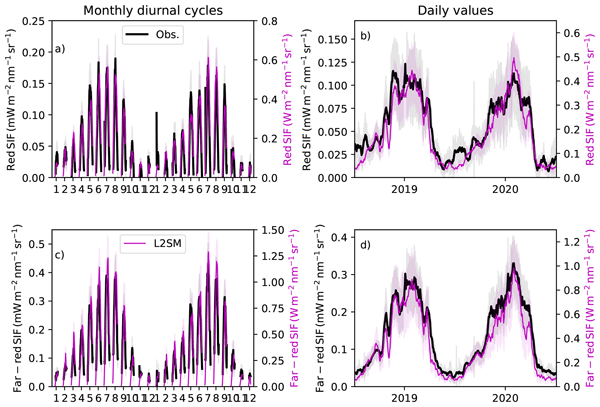
Tea Thum, Javier Pacheco-Labrador, Mika Aurela, Alan Barr, Marika Honkanen, Bruce Johnson, Hannakaisa Lindqvist, Troy Magney, Mirco Migliavacca, Zoe Amie Pierrat, Tristan Quaife, Jochen Stutz, and Sönke Zaehle
Biogeosciences, 23, 3541–3565, https://doi.org/10.5194/bg-23-3541-2026, https://doi.org/10.5194/bg-23-3541-2026, 2026
Short summary
Short summary
Solar-induced chlorophyll fluorescence (SIF) is an optical signal emitted by plants, connected to the biochemical status of the plants. Therefore it helps to unveil what happens inside plants and since it can be observed with remote sensing, it provides a global view of plant activity. We included SIF module in a terrestrial biosphere model and examined how to best describe movement of the SIF signal in the forest. Our work will help to model SIF in boreal coniferous forests.
Olivia Hau, Matthias Forkel, Wolfgang Buermann, Johanna Kranz, Mirco Migliavacca, Ulrich Weber, and Alexander Josef Winkler
EGUsphere, https://doi.org/10.5194/egusphere-2026-910, https://doi.org/10.5194/egusphere-2026-910, 2026
Short summary
Short summary
Shifts in spring and autumn growth due to climate warming change how plants reflect sunlight and release heat and moisture into the air, modulating surface warming. The strength of these effects and their regional variability remain poorly understood. Using satellite and climate data, we show that earlier spring growth increases moisture release, especially in forests, while autumn changes are smaller and less consistent. Impacts on land-atmosphere interactions vary by ecosystem and data source.
Daju Wang, Ruowen Yang, Lei Cai, Pierre Gentine, César Terrer, Shuli Niu, Mirco Migliavacca, Wenping Yuan, Ryunosuke Tateno, Junlan Xiao, Josep Peñuelas, Caixian Tang, Yongshuo H. Fu, and Weiyu Shi
EGUsphere, https://doi.org/10.5194/egusphere-2026-296, https://doi.org/10.5194/egusphere-2026-296, 2026
Short summary
Short summary
Soil respiration is a major CO2 source, yet its response to vary nitrogen addition levels remains unclear. Using global data from 226 sites, we found moderate N addition has negligible or slightly positive effects, whereas high N addition consistently suppresses total and microbial respiration. These findings were incorporated into the CLM5 model, improving predictions of soil respiration and carbon storage. Our work elucidates how N deposition alters soil carbon processes and climate feedbacks.
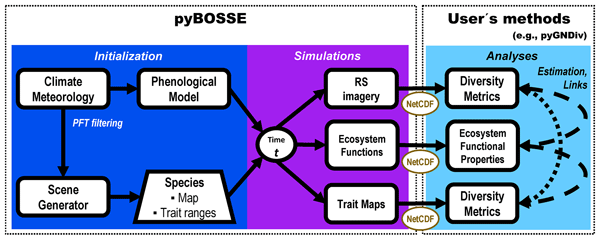
Javier Pacheco-Labrador, Ulisse Gomarasca, Daniel E. Pabon-Moreno, Wantong Li, Mirco Migliavacca, Martin Jung, and Gregory Duveiller
Geosci. Model Dev., 18, 8401–8422, https://doi.org/10.5194/gmd-18-8401-2025, https://doi.org/10.5194/gmd-18-8401-2025, 2025
Short summary
Short summary
Measuring biodiversity is necessary to assess its loss, evolution, and role in ecosystem functions. Satellites image the whole terrestrial surface and could cost-efficiently map plant diversity globally. However, developing the necessary methods lacks consistent and sufficient field measurements. Thus, we propose using a simulation tool that generates virtual ecosystems, with species properties and functions varying in response to meteorology and the respective remote sensing imagery.
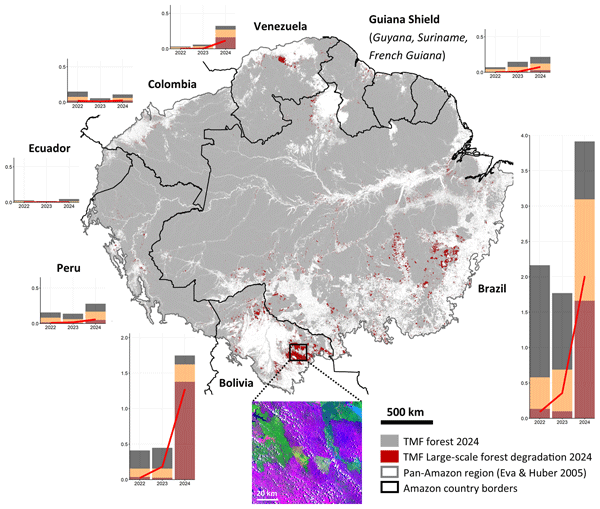
Clément Bourgoin, René Beuchle, Alfredo Branco, João Carreiras, Guido Ceccherini, Duarte Oom, Jesus San-Miguel-Ayanz, and Fernando Sedano
Biogeosciences, 22, 5247–5256, https://doi.org/10.5194/bg-22-5247-2025, https://doi.org/10.5194/bg-22-5247-2025, 2025
Short summary
Short summary
The Amazon forest faces increasing wildfires due to extreme drought and human activity. In 2024, disturbances surged by 152 %, hitting a 20-year high. Forest degradation from fires grew by over 400 %, exceeding that from deforestation. Brazil and Bolivia were hit hardest. These fires released huge amounts of CO2, 7 times more than in recent years, pushing the Amazon towards a dangerous tipping point. Urgent action is needed to prevent irreversible harm.
Friedrich J. Bohn, Ana Bastos, Romina Martin, Anja Rammig, Niak Sian Koh, Giles B. Sioen, Bram Buscher, Louise Carver, Fabrice DeClerck, Moritz Drupp, Robert Fletcher, Matthew Forrest, Alexandros Gasparatos, Alex Godoy-Faúndez, Gregor Hagedorn, Martin C. Hänsel, Jessica Hetzer, Thomas Hickler, Cornelia B. Krug, Stasja Koot, Xiuzhen Li, Amy Luers, Shelby Matevich, H. Damon Matthews, Ina C. Meier, Mirco Migliavacca, Awaz Mohamed, Sungmin O, David Obura, Ben Orlove, Rene Orth, Laura Pereira, Markus Reichstein, Lerato Thakholi, Peter H. Verburg, and Yuki Yoshida
Biogeosciences, 22, 2425–2460, https://doi.org/10.5194/bg-22-2425-2025, https://doi.org/10.5194/bg-22-2425-2025, 2025
Short summary
Short summary
An interdisciplinary collaboration of 36 international researchers from 35 institutions highlights recent findings in biosphere research. Within eight themes, they discuss issues arising from climate change and other anthropogenic stressors and highlight the co-benefits of nature-based solutions and ecosystem services. Based on an analysis of these eight topics, we have synthesized four overarching insights.
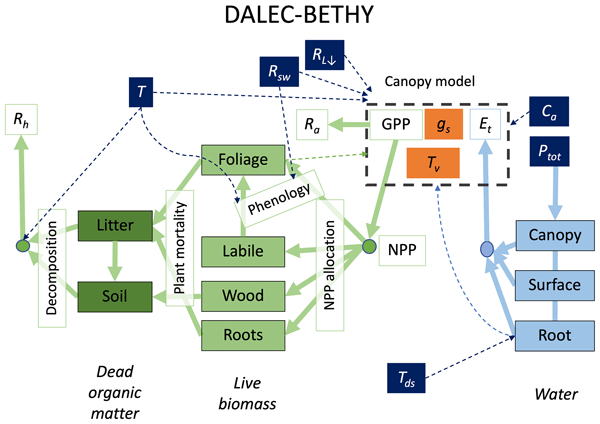
Wolfgang Knorr, Matthew Williams, Tea Thum, Thomas Kaminski, Michael Voßbeck, Marko Scholze, Tristan Quaife, T. Luke Smallman, Susan C. Steele-Dunne, Mariette Vreugdenhil, Tim Green, Sönke Zaehle, Mika Aurela, Alexandre Bouvet, Emanuel Bueechi, Wouter Dorigo, Tarek S. El-Madany, Mirco Migliavacca, Marika Honkanen, Yann H. Kerr, Anna Kontu, Juha Lemmetyinen, Hannakaisa Lindqvist, Arnaud Mialon, Tuuli Miinalainen, Gaétan Pique, Amanda Ojasalo, Shaun Quegan, Peter J. Rayner, Pablo Reyes-Muñoz, Nemesio Rodríguez-Fernández, Mike Schwank, Jochem Verrelst, Songyan Zhu, Dirk Schüttemeyer, and Matthias Drusch
Geosci. Model Dev., 18, 2137–2159, https://doi.org/10.5194/gmd-18-2137-2025, https://doi.org/10.5194/gmd-18-2137-2025, 2025
Short summary
Short summary
When it comes to climate change, the land surface is where the vast majority of impacts happen. The task of monitoring those impacts across the globe is formidable and must necessarily rely on satellites – at a significant cost: the measurements are only indirect and require comprehensive physical understanding. We have created a comprehensive modelling system that we offer to the research community to explore how satellite data can be better exploited to help us capture the changes that happen on our lands.
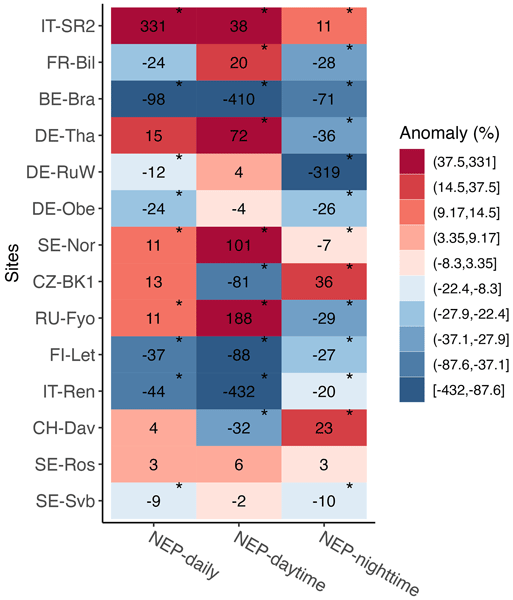
Mana Gharun, Ankit Shekhar, Lukas Hörtnagl, Luana Krebs, Nicola Arriga, Mirco Migliavacca, Marilyn Roland, Bert Gielen, Leonardo Montagnani, Enrico Tomelleri, Ladislav Šigut, Matthias Peichl, Peng Zhao, Marius Schmidt, Thomas Grünwald, Mika Korkiakoski, Annalea Lohila, and Nina Buchmann
Biogeosciences, 22, 1393–1411, https://doi.org/10.5194/bg-22-1393-2025, https://doi.org/10.5194/bg-22-1393-2025, 2025
Short summary
Short summary
The effect of winter warming on forest CO2 fluxes has rarely been investigated. We tested the effect of the warm winter of 2020 on the forest CO2 fluxes across 14 sites in Europe and found that the net ecosystem productivity (NEP) across most sites declined during the warm winter due to increased respiration fluxes.
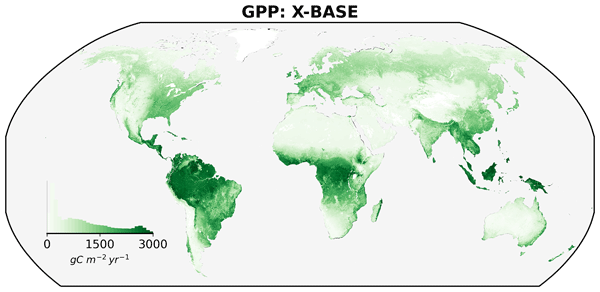
Jacob A. Nelson, Sophia Walther, Fabian Gans, Basil Kraft, Ulrich Weber, Kimberly Novick, Nina Buchmann, Mirco Migliavacca, Georg Wohlfahrt, Ladislav Šigut, Andreas Ibrom, Dario Papale, Mathias Göckede, Gregory Duveiller, Alexander Knohl, Lukas Hörtnagl, Russell L. Scott, Jiří Dušek, Weijie Zhang, Zayd Mahmoud Hamdi, Markus Reichstein, Sergio Aranda-Barranco, Jonas Ardö, Maarten Op de Beeck, Dave Billesbach, David Bowling, Rosvel Bracho, Christian Brümmer, Gustau Camps-Valls, Shiping Chen, Jamie Rose Cleverly, Ankur Desai, Gang Dong, Tarek S. El-Madany, Eugenie Susanne Euskirchen, Iris Feigenwinter, Marta Galvagno, Giacomo A. Gerosa, Bert Gielen, Ignacio Goded, Sarah Goslee, Christopher Michael Gough, Bernard Heinesch, Kazuhito Ichii, Marcin Antoni Jackowicz-Korczynski, Anne Klosterhalfen, Sara Knox, Hideki Kobayashi, Kukka-Maaria Kohonen, Mika Korkiakoski, Ivan Mammarella, Mana Gharun, Riccardo Marzuoli, Roser Matamala, Stefan Metzger, Leonardo Montagnani, Giacomo Nicolini, Thomas O'Halloran, Jean-Marc Ourcival, Matthias Peichl, Elise Pendall, Borja Ruiz Reverter, Marilyn Roland, Simone Sabbatini, Torsten Sachs, Marius Schmidt, Christopher R. Schwalm, Ankit Shekhar, Richard Silberstein, Maria Lucia Silveira, Donatella Spano, Torbern Tagesson, Gianluca Tramontana, Carlo Trotta, Fabio Turco, Timo Vesala, Caroline Vincke, Domenico Vitale, Enrique R. Vivoni, Yi Wang, William Woodgate, Enrico A. Yepez, Junhui Zhang, Donatella Zona, and Martin Jung
Biogeosciences, 21, 5079–5115, https://doi.org/10.5194/bg-21-5079-2024, https://doi.org/10.5194/bg-21-5079-2024, 2024
Short summary
Short summary
The movement of water, carbon, and energy from the Earth's surface to the atmosphere, or flux, is an important process to understand because it impacts our lives. Here, we outline a method called FLUXCOM-X to estimate global water and CO2 fluxes based on direct measurements from sites around the world. We go on to demonstrate how these new estimates of net CO2 uptake/loss, gross CO2 uptake, total water evaporation, and transpiration from plants compare to previous and independent estimates.

Guohua Liu, Mirco Migliavacca, Christian Reimers, Basil Kraft, Markus Reichstein, Andrew D. Richardson, Lisa Wingate, Nicolas Delpierre, Hui Yang, and Alexander J. Winkler
Geosci. Model Dev., 17, 6683–6701, https://doi.org/10.5194/gmd-17-6683-2024, https://doi.org/10.5194/gmd-17-6683-2024, 2024
Short summary
Short summary
Our study employs long short-term memory (LSTM) networks to model canopy greenness and phenology, integrating meteorological memory effects. The LSTM model outperforms traditional methods, enhancing accuracy in predicting greenness dynamics and phenological transitions across plant functional types. Highlighting the importance of multi-variate meteorological memory effects, our research pioneers unlock the secrets of vegetation phenology responses to climate change with deep learning techniques.
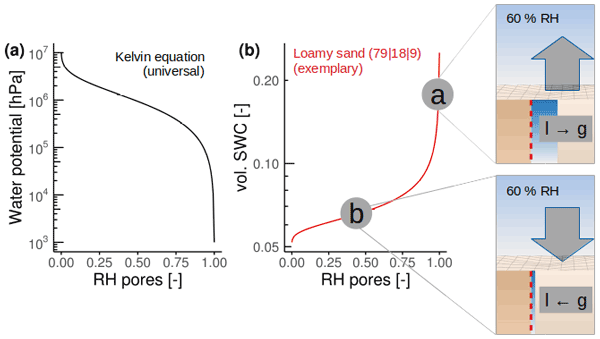
Sinikka J. Paulus, Rene Orth, Sung-Ching Lee, Anke Hildebrandt, Martin Jung, Jacob A. Nelson, Tarek Sebastian El-Madany, Arnaud Carrara, Gerardo Moreno, Matthias Mauder, Jannis Groh, Alexander Graf, Markus Reichstein, and Mirco Migliavacca
Biogeosciences, 21, 2051–2085, https://doi.org/10.5194/bg-21-2051-2024, https://doi.org/10.5194/bg-21-2051-2024, 2024
Short summary
Short summary
Porous materials are known to reversibly trap water from the air, even at low humidity. However, this behavior is poorly understood for soils. In this analysis, we test whether eddy covariance is able to measure the so-called adsorption of atmospheric water vapor by soils. We find that this flux occurs frequently during dry nights in a Mediterranean ecosystem, while EC detects downwardly directed vapor fluxes. These results can help to map moisture uptake globally.
Martin Jung, Jacob Nelson, Mirco Migliavacca, Tarek El-Madany, Dario Papale, Markus Reichstein, Sophia Walther, and Thomas Wutzler
Biogeosciences, 21, 1827–1846, https://doi.org/10.5194/bg-21-1827-2024, https://doi.org/10.5194/bg-21-1827-2024, 2024
Short summary
Short summary
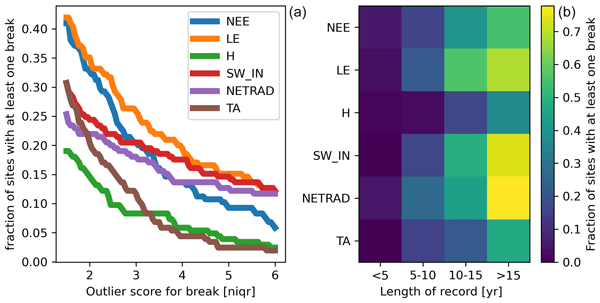
We present a methodology to detect inconsistencies in perhaps the most important data source for measurements of ecosystem–atmosphere carbon, water, and energy fluxes. We expect that the derived consistency flags will be relevant for data users and will help in improving our understanding of and our ability to model ecosystem–climate interactions.
Gregory Duveiller, Mark Pickering, Joaquin Muñoz-Sabater, Luca Caporaso, Souhail Boussetta, Gianpaolo Balsamo, and Alessandro Cescatti
Geosci. Model Dev., 16, 7357–7373, https://doi.org/10.5194/gmd-16-7357-2023, https://doi.org/10.5194/gmd-16-7357-2023, 2023
Short summary
Short summary
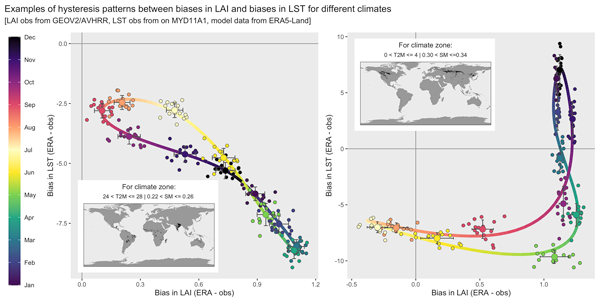
Some of our best tools to describe the state of the land system, including the intensity of heat waves, have a problem. The model currently assumes that the number of leaves in ecosystems always follows the same cycle. By using satellite observations of when leaves are present, we show that capturing the yearly changes in this cycle is important to avoid errors in estimating surface temperature. We show that this has strong implications for our capacity to describe heat waves across Europe.
Richard Nair, Yunpeng Luo, Tarek El-Madany, Victor Rolo, Javier Pacheco-Labrador, Silvia Caldararu, Kendalynn A. Morris, Marion Schrumpf, Arnaud Carrara, Gerardo Moreno, Markus Reichstein, and Mirco Migliavacca
EGUsphere, https://doi.org/10.5194/egusphere-2023-2434, https://doi.org/10.5194/egusphere-2023-2434, 2023
Preprint archived
Short summary
Short summary
We studied a Mediterranean ecosystem to understand carbon uptake efficiency and its controls. These ecosystems face potential nitrogen-phosphorus imbalances due to pollution. Analysing six years of carbon data, we assessed controls at different timeframes. This is crucial for predicting such vulnerable regions. Our findings revealed N limitation on C uptake, not N:P imbalance, and strong influence of water availability. whether drought or wetness promoted net C uptake depended on timescale.
A. Elia, M. Pickering, M. Girardello, G. Oton, G. Ceccherini, S. Capobianco, M. Piccardo, G. Forzieri, M. Migliavacca, and A. Cescatti
Int. Arch. Photogramm. Remote Sens. Spatial Inf. Sci., XLVIII-4-W7-2023, 41–46, https://doi.org/10.5194/isprs-archives-XLVIII-4-W7-2023-41-2023, https://doi.org/10.5194/isprs-archives-XLVIII-4-W7-2023-41-2023, 2023
Elena Aragoneses, Mariano García, Michele Salis, Luís M. Ribeiro, and Emilio Chuvieco
Earth Syst. Sci. Data, 15, 1287–1315, https://doi.org/10.5194/essd-15-1287-2023, https://doi.org/10.5194/essd-15-1287-2023, 2023
Short summary
Short summary
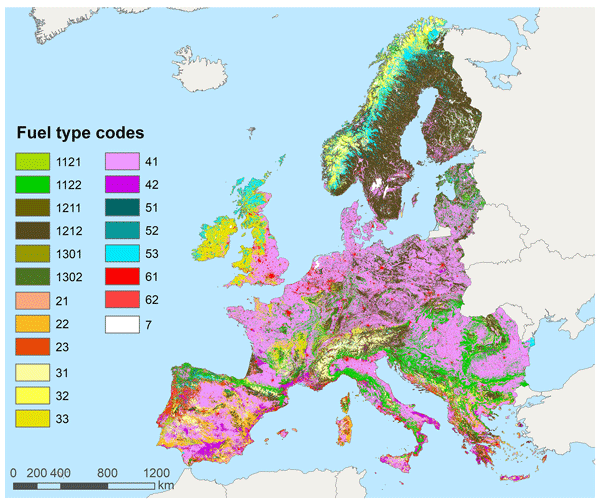
We present a new hierarchical fuel classification system with a total of 85 fuels that is useful for preventing fire risk at different spatial scales. Based on this, we developed a European fuel map (1 km resolution) using land cover datasets, biogeographic datasets, and bioclimatic modelling. We validated the map by comparing it to high-resolution data, obtaining high overall accuracy. Finally, we developed a crosswalk for standard fuel models as a first assignment of fuel parameters.
Giacomo Grassi, Clemens Schwingshackl, Thomas Gasser, Richard A. Houghton, Stephen Sitch, Josep G. Canadell, Alessandro Cescatti, Philippe Ciais, Sandro Federici, Pierre Friedlingstein, Werner A. Kurz, Maria J. Sanz Sanchez, Raúl Abad Viñas, Ramdane Alkama, Selma Bultan, Guido Ceccherini, Stefanie Falk, Etsushi Kato, Daniel Kennedy, Jürgen Knauer, Anu Korosuo, Joana Melo, Matthew J. McGrath, Julia E. M. S. Nabel, Benjamin Poulter, Anna A. Romanovskaya, Simone Rossi, Hanqin Tian, Anthony P. Walker, Wenping Yuan, Xu Yue, and Julia Pongratz
Earth Syst. Sci. Data, 15, 1093–1114, https://doi.org/10.5194/essd-15-1093-2023, https://doi.org/10.5194/essd-15-1093-2023, 2023
Short summary
Short summary
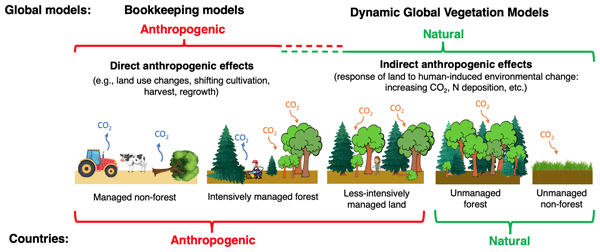
Striking differences exist in estimates of land-use CO2 fluxes between the national greenhouse gas inventories and the IPCC assessment reports. These differences hamper an accurate assessment of the collective progress under the Paris Agreement. By implementing an approach that conceptually reconciles land-use CO2 flux from national inventories and the global models used by the IPCC, our study is an important step forward for increasing confidence in land-use CO2 flux estimates.
Sinikka Jasmin Paulus, Tarek Sebastian El-Madany, René Orth, Anke Hildebrandt, Thomas Wutzler, Arnaud Carrara, Gerardo Moreno, Oscar Perez-Priego, Olaf Kolle, Markus Reichstein, and Mirco Migliavacca
Hydrol. Earth Syst. Sci., 26, 6263–6287, https://doi.org/10.5194/hess-26-6263-2022, https://doi.org/10.5194/hess-26-6263-2022, 2022
Short summary
Short summary
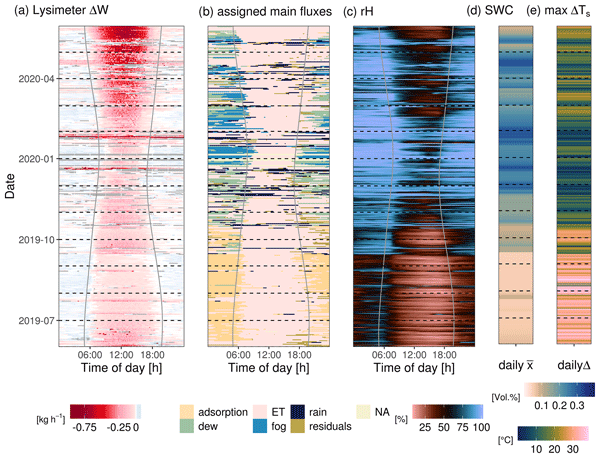
In this study, we analyze small inputs of water to ecosystems such as fog, dew, and adsorption of vapor. To measure them, we use a scaling system and later test our attribution of different water fluxes to weight changes. We found that they occur frequently during 1 year in a dry summer ecosystem. In each season, a different flux seems dominant, but they all mainly occur during the night. Therefore, they could be important for the biosphere because rain is unevenly distributed over the year.
Mark Pickering, Alessandro Cescatti, and Gregory Duveiller
Biogeosciences, 19, 4833–4864, https://doi.org/10.5194/bg-19-4833-2022, https://doi.org/10.5194/bg-19-4833-2022, 2022
Short summary
Short summary
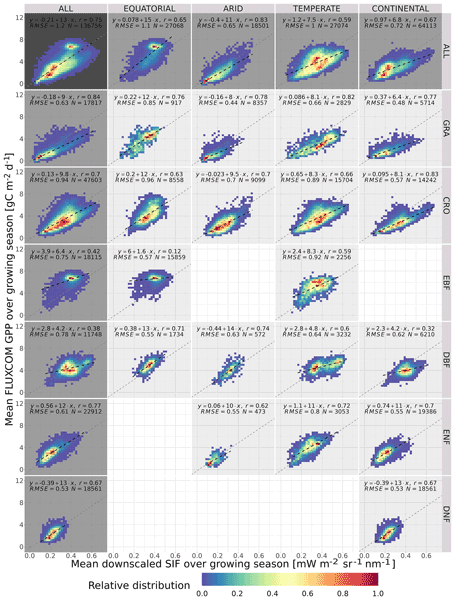
This study explores two of the most recent products in carbon productivity estimation, FLUXCOM gross primary productivity (GPP), calculated by upscaling local measurements of CO2 exchange, and remotely sensed sun-induced chlorophyll a fluorescence (SIF). High-resolution SIF data are valuable in demonstrating similarity in the SIF–GPP relationship between vegetation covers, provide an independent probe of the FLUXCOM GPP model and demonstrate the response of SIF to meteorological fluctuations.
Xin Yu, René Orth, Markus Reichstein, Michael Bahn, Anne Klosterhalfen, Alexander Knohl, Franziska Koebsch, Mirco Migliavacca, Martina Mund, Jacob A. Nelson, Benjamin D. Stocker, Sophia Walther, and Ana Bastos
Biogeosciences, 19, 4315–4329, https://doi.org/10.5194/bg-19-4315-2022, https://doi.org/10.5194/bg-19-4315-2022, 2022
Short summary
Short summary
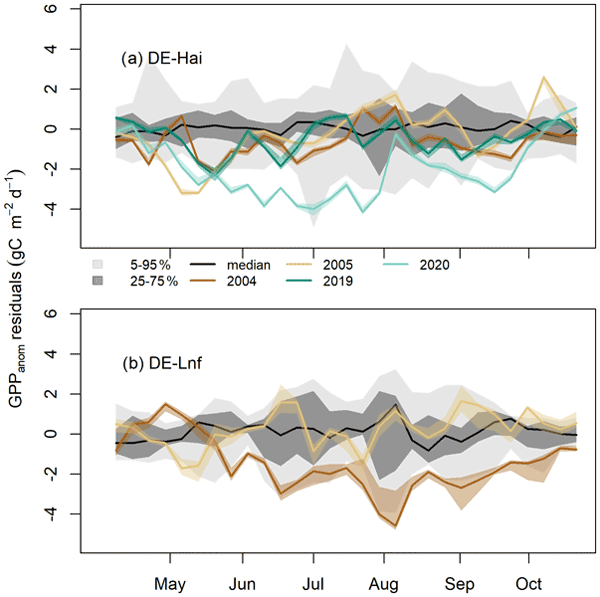
Identifying drought legacy effects is challenging because they are superimposed on variability driven by climate conditions in the recovery period. We develop a residual-based approach to quantify legacies on gross primary productivity (GPP) from eddy covariance data. The GPP reduction due to legacy effects is comparable to the concurrent effects at two sites in Germany, which reveals the importance of legacy effects. Our novel methodology can be used to quantify drought legacies elsewhere.
Roberto Pilli, Ramdane Alkama, Alessandro Cescatti, Werner A. Kurz, and Giacomo Grassi
Biogeosciences, 19, 3263–3284, https://doi.org/10.5194/bg-19-3263-2022, https://doi.org/10.5194/bg-19-3263-2022, 2022
Short summary
Short summary
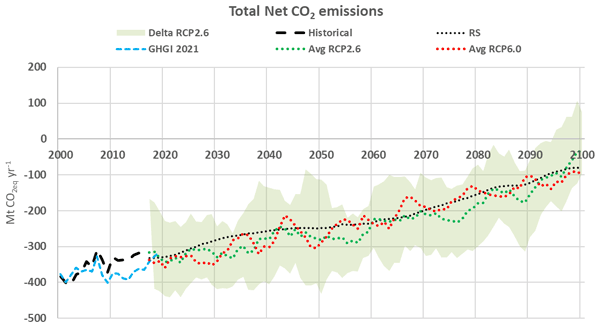
To become carbon neutral by 2050, the European Union (EU27) forest C sink should increase to −450 Mt CO2 yr-1. Our study highlights that under current management practices (i.e. excluding any policy scenario) the forest C sink of the EU27 member states and the UK may decrease to about −250 Mt CO2eq yr-1 in 2050. The expected impacts of future climate change, however, add a considerable uncertainty, potentially nearly doubling or halving the sink associated with forest management.
Sophia Walther, Simon Besnard, Jacob Allen Nelson, Tarek Sebastian El-Madany, Mirco Migliavacca, Ulrich Weber, Nuno Carvalhais, Sofia Lorena Ermida, Christian Brümmer, Frederik Schrader, Anatoly Stanislavovich Prokushkin, Alexey Vasilevich Panov, and Martin Jung
Biogeosciences, 19, 2805–2840, https://doi.org/10.5194/bg-19-2805-2022, https://doi.org/10.5194/bg-19-2805-2022, 2022
Short summary
Short summary
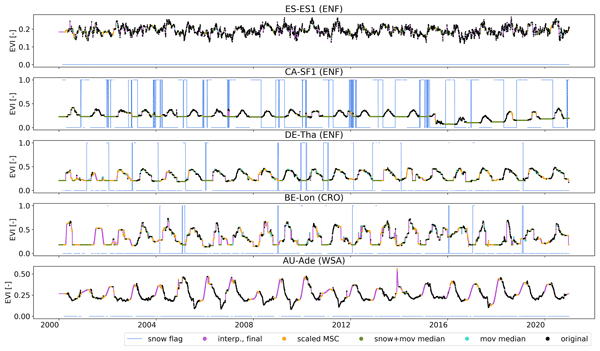
Satellite observations help interpret station measurements of local carbon, water, and energy exchange between the land surface and the atmosphere and are indispensable for simulations of the same in land surface models and their evaluation. We propose generalisable and efficient approaches to systematically ensure high quality and to estimate values in data gaps. We apply them to satellite data of surface reflectance and temperature with different resolutions at the stations.
J. Pacheco-Labrador, U. Weber, X. Ma, M. D. Mahecha, N. Carvalhais, C. Wirth, A. Huth, F. J. Bohn, G. Kraemer, U. Heiden, FunDivEUROPE members, and M. Migliavacca
Int. Arch. Photogramm. Remote Sens. Spatial Inf. Sci., XLVI-1-W1-2021, 49–55, https://doi.org/10.5194/isprs-archives-XLVI-1-W1-2021-49-2022, https://doi.org/10.5194/isprs-archives-XLVI-1-W1-2021-49-2022, 2022
Josephin Kroll, Jasper M. C. Denissen, Mirco Migliavacca, Wantong Li, Anke Hildebrandt, and Rene Orth
Biogeosciences, 19, 477–489, https://doi.org/10.5194/bg-19-477-2022, https://doi.org/10.5194/bg-19-477-2022, 2022
Short summary
Short summary
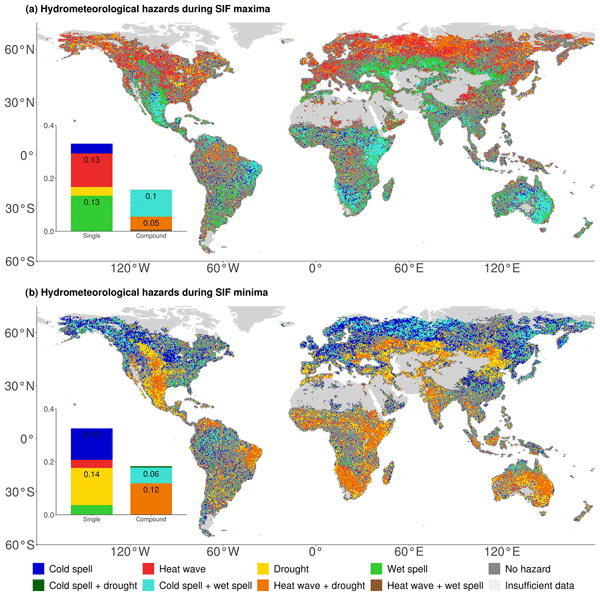
Plant growth relies on having access to energy (solar radiation) and water (soil moisture). This energy and water availability is impacted by weather extremes, like heat waves and droughts, which will occur more frequently in response to climate change. In this context, we analysed global satellite data to detect in which regions extreme plant growth is controlled by energy or water. We find that extreme plant growth is associated with temperature- or soil-moisture-related extremes.
Cited articles
Ali, A., Yan, E.-R., Chen, H. Y. H., Chang, S. X., Zhao, Y.-T., Yang, X.-D., and Xu, M.-S.: Stand structural diversity rather than species diversity enhances aboveground carbon storage in secondary subtropical forests in Eastern China, Biogeosciences, 13, 4627–4635, https://doi.org/10.5194/bg-13-4627-2016, 2016.
Altmann, A., Toloşi, L., Sander, O., and Lengauer, T.: Permutation importance: a corrected feature importance measure, Bioinformatics, 26, 1340–1347, https://doi.org/10.1093/bioinformatics/btq134, 2010.
Aponte, C., Kasel, S., Nitschke, C. R., Tanase, M. A., Vickers, H., Parker, L., Fedrigo, M., Kohout, M., Ruiz-Benito, P., Zavala, M. A., and Bennett, L. T.: Structural diversity underpins carbon storage in Australian temperate forests, Global Ecol. Biogeogr., 29, 789–802, https://doi.org/10.1111/geb.13038, 2020.
Aragoneses, E., García, M., Ruiz-Benito, P., and Chuvieco, E.: Mapping forest canopy fuel parameters at European scale using spaceborne LiDAR and satellite data, Remote Sens. Environ., 303, 114005, https://doi.org/10.1016/j.rse.2024.114005, 2024.
Atkins, J. W., Fahey, R. T., Hardiman, B. S., and Gough, C. M.: Forest Canopy Structural Complexity and Light Absorption Relationships at the Subcontinental Scale, J. Geophys. Res.-Biogeosci., 123, 1387–1405, https://doi.org/10.1002/2017JG004256, 2018.
Bae, S., Levick, S. R., Heidrich, L., Magdon, P., Leutner, B. F., Wöllauer, S., Serebryanyk, A., Nauss, T., Krzystek, P., Gossner, M. M., Schall, P., Heibl, C., Bässler, C., Doerfler, I., Schulze, E.-D., Krah, F.-S., Culmsee, H., Jung, K., Heurich, M., Fischer, M., Seibold, S., Thorn, S., Gerlach, T., Hothorn, T., Weisser, W. W., and Müller, J.: Radar vision in the mapping of forest biodiversity from space, Nat. Commun., 10, 4757, https://doi.org/10.1038/s41467-019-12737-x, 2019.
Breiman, L.: Random forests, Mach. Learn., 45, 5–32, 2001.
Bruggisser, M., Dorigo, W., Dostálová, A., Hollaus, M., Navacchi, C., Schlaffer, S., and Pfeifer, N.: Potential of Sentinel-1 C-Band Time Series to Derive Structural Parameters of Temperate Deciduous Forests, Remote Sens., 13, 798, https://doi.org/10.3390/rs13040798, 2021.
Cartus, O., Santoro, M., Wegmuller, U., Labriere, N., and Chave, J.: Sentinel-1 Coherence for Mapping Above-Ground Biomass in Semiarid Forest Areas, IEEE Geosci. Remote S., 19, 1–5, https://doi.org/10.1109/LGRS.2021.3071949, 2022.
Coops, N. C., Tompalski, P., Goodbody, T. R. H., Queinnec, M., Luther, J. E., Bolton, D. K., White, J. C., Wulder, M. A., van Lier, O. R., and Hermosilla, T.: Modelling lidar-derived estimates of forest attributes over space and time: A review of approaches and future trends, Remote Sens. Environ., 260, 112477, https://doi.org/10.1016/j.rse.2021.112477, 2021.
Coverdale, T. C. and Davies, A. B.: Unravelling the relationship between plant diversity and vegetation structural complexity: A review and theoretical framework, J. Ecol., 111, 1378–1395, https://doi.org/10.1111/1365-2745.14068, 2023.
Crockett, E. T. H., Atkins, J. W., Guo, Q., Sun, G., Potter, K. M., Ollinger, S., Silva, C. A., Tang, H., Woodall, C. W., Holgerson, J., and Xiao, J.: Structural and species diversity explain aboveground carbon storage in forests across the United States: Evidence from GEDI and forest inventory data, Remote Sens. Environ., 295, 113703, https://doi.org/10.1016/j.rse.2023.113703, 2023.
de Conto, T., Armston, J. and Dubayah, R.: Characterizing the structural complexity of the Earth's forests with spaceborne lidar, Nat. Commun., 15, 8116, https://doi.org/10.1038/s41467-024-52468-2, 2024.
Dubayah, R., Blair, J. B., Goetz, S., Fatoyinbo, L., Hansen, M., Healey, S., Hofton, M., Hurtt, G., Kellner, J., Luthcke, S., Armston, J., Tang, H., Duncanson, L., Hancock, S., Jantz, P., Marselis, S., Patterson, P. L., Qi, W., and Silva, C.: The Global Ecosystem Dynamics Investigation: High-resolution laser ranging of the Earth's forests and topography, Science of Remote Sensing, 1, 100002, https://doi.org/10.1016/j.srs.2020.100002, 2020.
Duveiller, G., Pickering, M., Muñoz-Sabater, J., Caporaso, L., Boussetta, S., Balsamo, G., and Cescatti, A.: Getting the leaves right matters for estimating temperature extremes, Geosci. Model Dev., 16, 7357–7373, https://doi.org/10.5194/gmd-16-7357-2023, 2023.
Ehbrecht, M., Seidel, D., Annighöfer, P., Kreft, H., Köhler, M., Zemp, D. C., Puettmann, K., Nilus, R., Babweteera, F., Willim, K., Stiers, M., Soto, D., Boehmer, H. J., Fisichelli, N., Burnett, M., Juday, G., Stephens, S. L., and Ammer, C.: Global patterns and climatic controls of forest structural complexity, Nat. Commun., 12, 519, https://doi.org/10.1038/s41467-020-20767-z, 2021.
FAO: On definitions of forest and forest change, https://www.fao.org/4/ad665e/ad665e00.htm (last access: 15 March 2026), 2000.
Fassnacht, F. E., Müllerová, J., Conti, L., Malavasi, M., and Schmidtlein, S.: About the link between biodiversity and spectral variation, Appl. Veg. Sci., 25, https://doi.org/10.1111/avsc.12643, 2022.
Forzieri, G., Girardello, M., Ceccherini, G., Spinoni, J., Feyen, L., Hartmann, H., Beck, P. S. A., Camps-Valls, G., Chirici, G., Mauri, A., and Cescatti, A.: Emergent vulnerability to climate-driven disturbances in European forests, Nat. Commun., 12, 1081, https://doi.org/10.1038/s41467-021-21399-7, 2021.
Gao, B.: NDWI – A normalized difference water index for remote sensing of vegetation liquid water from space, Remote Sens. Environ., 58, 257–266, https://doi.org/10.1016/S0034-4257(96)00067-3, 1996.
Girardello, M., Oton, G., Piccardo, M., and Ceccherini, G.: A dataset on the structural diversity of European forests, figshare [data set], https://doi.org/10.6084/m9.figshare.26058868.v1, 2024.
Gitelson, A. and Merzlyak, M. N.: Quantitative estimation of chlorophyll-a using reflectance spectra: Experiments with autumn chestnut and maple leaves, J. Photochem. Photobiol. B, 22, 247–252, https://doi.org/10.1016/1011-1344(93)06963-4, 1994.
Gitelson, A. A. and Merzlyak, M. N.: Remote sensing of chlorophyll concentration in higher plant leaves, Adv. Space Res., 22, 689–692, https://doi.org/10.1016/S0273-1177(97)01133-2, 1998.
Goodbody, T. R. H., Coops, N. C., Queinnec, M., White, J. C., Tompalski, P., Hudak, A. T., Auty, D., Valbuena, R., LeBoeuf, A., Sinclair, I., McCartney, G., Prieur, J.-F., and Woods, M. E.: sgsR: a structurally guided sampling toolbox for LiDAR-based forest inventories, Forestry, 96, 411–424, https://doi.org/10.1093/forestry/cpac055, 2023.
Gorelick, N., Hancher, M., Dixon, M., Ilyushchenko, S., Thau, D., and Moore, R.: Google Earth Engine: Planetary-scale geospatial analysis for everyone, Remote Sens. Environ., 202, https://doi.org/10.1016/j.rse.2017.06.031, 2017.
Gough, C. M., Atkins, J. W., Fahey, R. T., and Hardiman, B. S.: High rates of primary production in structurally complex forests, Ecology, 100, https://doi.org/10.1002/ecy.2864, 2019.
Hakkenberg, C. R. and Goetz, S. J.: Climate mediates the relationship between plant biodiversity and forest structure across the United States, Global Ecol. Biogeogr., 30, 2245–2258, https://doi.org/10.1111/geb.13380, 2021.
Hakkenberg, C. R., Atkins, J. W., Brodie, J. F., Burns, P., Cushman, S., Jantz, P., Kaszta, Z., Quinn, C. A., Rose, M. D., and Goetz, S. J.: Inferring alpha, beta, and gamma plant diversity across biomes with GEDI spaceborne lidar, Environmental Research: Ecology, 2, 035005, https://doi.org/10.1088/2752-664X/acffcd, 2023.
Hancock, S., McGrath, C., Lowe, C., Davenport, I., and Woodhouse, I.: Requirements for a global lidar system: spaceborne lidar with wall-to-wall coverage, R Soc. Open Sci., 8, https://doi.org/10.1098/rsos.211166, 2021.
Hansen, M. C., Potapov, P. V., Moore, R., Hancher, M., Turubanova, S. A., Tyukavina, A., Thau, D., Stehman, S. V., Goetz, S. J., Loveland, T. R., Kommareddy, A., Egorov, A., Chini, L., Justice, C. O., and Townshend, J. R. G.: High-Resolution Global Maps of 21st-Century Forest Cover Change, Science, 342, 850–853, https://doi.org/10.1126/science.1244693, 2013.
Holcomb, A., Burns, P., Keshav, S., and Coomes, D. A.: Repeat GEDI footprints measure the effects of tropical forest disturbances, Remote Sens. Environ., 308, 114174, https://doi.org/10.1016/j.rse.2024.114174, 2024.
Kellndorfer, J., Cartus, O., Lavalle, M., Magnard, C., Milillo, P., Oveisgharan, S., Osmanoglu, B., Rosen, P. A., and Wegmüller, U.: Global seasonal Sentinel-1 interferometric coherence and backscatter data set, Sci. Data, 9, 73, https://doi.org/10.1038/s41597-022-01189-6, 2022.
Lang, N., Jetz, W., Schindler, K., and Wegner, J. D.: A high-resolution canopy height model of the Earth, Nat. Ecol. Evol., 7, 1778–1789, https://doi.org/10.1038/s41559-023-02206-6, 2023.
LaRue, E. A., Hardiman, B. S., Elliott, J. M., and Fei, S.: Structural diversity as a predictor of ecosystem function, Environ. Res. Lett., 14, 114011, https://doi.org/10.1088/1748-9326/ab49bb, 2019.
LaRue, E. A., Knott, J. A., Domke, G. M., Chen, H. Y., Guo, Q., Hisano, M., Oswalt, C., Oswalt, S., Kong, N., Potter, K. M., and Fei, S.: Structural diversity as a reliable and novel predictor for ecosystem productivity, Front. Ecol. Environ., 21, 33–39, https://doi.org/10.1002/fee.2586, 2023.
Listopad, C. M. C. S., Masters, R. E., Drake, J., Weishampel, J., and Branquinho, C.: Structural diversity indices based on airborne LiDAR as ecological indicators for managing highly dynamic landscapes, Ecol. Indic., 57, 268–279, https://doi.org/10.1016/j.ecolind.2015.04.017, 2015.
Liu, C., Gong, W., Shi, S., Wang, T., Xu, T., Shi, Z., and Niu, J.: Deep learning-driven forest canopy height mapping in boreal regions through multi-source remote sensing fusion: Integrating Sentinel-1/2, PALSAR, and ICESat-2/LVIS data, International Journal of Applied Earth Observation and Geoinformation, 143, 104766, https://doi.org/10.1016/j.jag.2025.104766, 2025.
Ma, Q., Su, Y., Hu, T., Jiang, L., Mi, X., Lin, L., Cao, M., Wang, X., Lin, F., Wang, B., Sun, Z., Wu, J., Ma, K., and Guo, Q.: The coordinated impact of forest internal structural complexity and tree species diversity on forest productivity across forest biomes, Fundamental Research, https://doi.org/10.1016/j.fmre.2022.10.005, 2022.
Marselis, S. M., Abernethy, K., Alonso, A., Armston, J., Baker, T. R., Bastin, J., Bogaert, J., Boyd, D. S., Boeckx, P., Burslem, D. F. R. P., Chazdon, R., Clark, D. B., Coomes, D., Duncanson, L., Hancock, S., Hill, R., Hopkinson, C., Kearsley, E., Kellner, J. R., Kenfack, D., Labrière, N., Lewis, S. L., Minor, D., Memiaghe, H., Monteagudo, A., Nilus, R., O'Brien, M., Phillips, O. L., Poulsen, J., Tang, H., Verbeeck, H., and Dubayah, R.: Evaluating the potential of full-waveform lidar for mapping pan-tropical tree species richness, Global Ecol. Biogeogr., 29, 1799–1816, https://doi.org/10.1111/geb.13158, 2020.
Meyer, H. and Pebesma, E.: Predicting into unknown space? Estimating the area of applicability of spatial prediction models, Methods Ecol. Evol., 12, 1620–1633, https://doi.org/10.1111/2041-210X.13650, 2021.
Migliavacca, M., Musavi, T., Mahecha, M. D., Nelson, J. A., Knauer, J., Baldocchi, D. D., Perez-Priego, O., Christiansen, R., Peters, J., Anderson, K., Bahn, M., Black, T. A., Blanken, P. D., Bonal, D., Buchmann, N., Caldararu, S., Carrara, A., Carvalhais, N., Cescatti, A., Chen, J., Cleverly, J., Cremonese, E., Desai, A. R., El-Madany, T. S., Farella, M. M., Fernández-Martínez, M., Filippa, G., Forkel, M., Galvagno, M., Gomarasca, U., Gough, C. M., Göckede, M., Ibrom, A., Ikawa, H., Janssens, I. A., Jung, M., Kattge, J., Keenan, T. F., Knohl, A., Kobayashi, H., Kraemer, G., Law, B. E., Liddell, M. J., Ma, X., Mammarella, I., Martini, D., Macfarlane, C., Matteucci, G., Montagnani, L., Pabon-Moreno, D. E., Panigada, C., Papale, D., Pendall, E., Penuelas, J., Phillips, R. P., Reich, P. B., Rossini, M., Rotenberg, E., Scott, R. L., Stahl, C., Weber, U., Wohlfahrt, G., Wolf, S., Wright, I. J., Yakir, D., Zaehle, S., and Reichstein, M.: The three major axes of terrestrial ecosystem function, Nature, 598, 468–472, https://doi.org/10.1038/s41586-021-03939-9, 2021.
Mueller, M. M., Dubois, C., Jagdhuber, T., Hellwig, F. M., Pathe, C., Schmullius, C., and Steele-Dunne, S.: Sentinel-1 Backscatter Time Series for Characterization of Evapotranspiration Dynamics over Temperate Coniferous Forests, Remote Sens., 14, 6384, https://doi.org/10.3390/rs14246384, 2022.
Murphy, B. A., May, J. A., Butterworth, B. J., Andresen, C. G., and Desai, A. R.: Unraveling Forest Complexity: Resource Use Efficiency, Disturbance, and the Structure-Function Relationship, J. Geophys. Res.-Biogeosci., 127, https://doi.org/10.1029/2021JG006748, 2022.
Naidoo, L., Mathieu, R., Main, R., Kleynhans, W., Wessels, K., Asner, G., and Leblon, B.: Savannah woody structure modelling and mapping using multi-frequency (X-, C- and L-band) Synthetic Aperture Radar data, ISPRS J. Photogramm., 105, 234–250, https://doi.org/10.1016/j.isprsjprs.2015.04.007, 2015.
Pan, J., Zhao, R., Xu, Z., Cai, Z., and Yuan, Y.: Quantitative estimation of sentinel-1A interferometric decorrelation using vegetation index, Front. Earth Sci., 10, https://doi.org/10.3389/feart.2022.1016491, 2022.
Perrone, M., Conti, L., Galland, T., Komárek, J., Lagner, O., Torresani, M., Rossi, C., Carmona, C. P., de Bello, F., Rocchini, D., Moudrý, V., Šímová, P., Bagella, S., and Malavasi, M.: “Flower power”: How flowering affects spectral diversity metrics and their relationship with plant diversity, Ecol. Inform., 81, 102589, https://doi.org/10.1016/j.ecoinf.2024.102589, 2024.
Potapov, P., Li, X., Hernandez-Serna, A., Tyukavina, A., Hansen, M. C., Kommareddy, A., Pickens, A., Turubanova, S., Tang, H., Silva, C. E., Armston, J., Dubayah, R., Blair, J. B., and Hofton, M.: Mapping global forest canopy height through integration of GEDI and Landsat data, Remote Sens. Environ., 253, 112165, https://doi.org/10.1016/j.rse.2020.112165, 2021.
Qi, J., Chehbouni, A., Huete, A. R., Kerr, Y. H., and Sorooshian, S.: A modified soil adjusted vegetation index, Remote Sens. Environ., 48, 119–126, https://doi.org/10.1016/0034-4257(94)90134-1, 1994.
Roberts, D. R., Bahn, V., Ciuti, S., Boyce, M. S., Elith, J., Guillera-Arroita, G., Hauenstein, S., Lahoz-Monfort, J. J., Schröder, B., Thuiller, W., Warton, D. I., Wintle, B. A., Hartig, F., and Dormann, C. F.: Cross-validation strategies for data with temporal, spatial, hierarchical, or phylogenetic structure, Ecography, https://doi.org/10.1111/ecog.02881, 2016.
Rocchini, D., Thouverai, E., Marcantonio, M., Iannacito, M., Da Re, D., Torresani, M., Bacaro, G., Bazzichetto, M., Bernardi, A., Foody, G. M., Furrer, R., Kleijn, D., Larsen, S., Lenoir, J., Malavasi, M., Marchetto, E., Messori, F., Montaghi, A., Moudrý, V., Naimi, B., Ricotta, C., Rossini, M., Santi, F., Santos, M. J., Schaepman, M. E., Schneider, F. D., Schuh, L., Silvestri, S., Ŝímová, P., Skidmore, A. K., Tattoni, C., Tordoni, E., Vicario, S., Zannini, P., and Wegmann, M.: rasterdiv – An Information Theory tailored R package for measuring ecosystem heterogeneity from space: To the origin and back, Methods Ecol. Evol., 12, 1093–1102, https://doi.org/10.1111/2041-210X.13583, 2021.
Rouse, J. W., Haas, R. H., Schell, J. A., Deering, D. W., and others: Monitoring vegetation systems in the Great Plains with ERTS, NASA Spec. Publ, 351, 309, https://ntrs.nasa.gov/citations/19740022614 (last access: 15 March 2026), 1974.
Schneider, F. D., Ferraz, A., Hancock, S., Duncanson, L. I., Dubayah, R. O., Pavlick, R. P., and Schimel, D. S.: Towards mapping the diversity of canopy structure from space with GEDI, Environ. Res. Lett., 15, https://doi.org/10.1088/1748-9326/ab9e99, 2020.
Schwartz, M., Ciais, P., Ottlé, C., De Truchis, A., Vega, C., Fayad, I., Brandt, M., Fensholt, R., Baghdadi, N., Morneau, F., Morin, D., Guyon, D., Dayau, S., and Wigneron, J.-P.: High-resolution canopy height map in the Landes forest (France) based on GEDI, Sentinel-1, and Sentinel-2 data with a deep learning approach, International Journal of Applied Earth Observation and Geoinformation, 128, 103711, https://doi.org/10.1016/j.jag.2024.103711, 2024.
Shendryk, Y.: Fusing GEDI with earth observation data for large area aboveground biomass mapping, International Journal of Applied Earth Observation and Geoinformation, 115, 103108, https://doi.org/10.1016/j.jag.2022.103108, 2022.
Shimada, M., Itoh, T., Motooka, T., Watanabe, M., Shiraishi, T., Thapa, R., and Lucas, R.: New global forest/non-forest maps from ALOS PALSAR data (2007–2010), Remote Sens. Environ., 155, 13–31, https://doi.org/10.1016/j.rse.2014.04.014, 2014.
Shugart, H. H., Saatchi, S., and Hall, F. G.: Importance of structure and its measurement in quantifying function of forest ecosystems, J. Geophys. Res.-Biogeosci., 115, https://doi.org/10.1029/2009JG000993, 2010.
Sothe, C., Gonsamo, A., Lourenço, R. B., Kurz, W. A., and Snider, J.: Spatially Continuous Mapping of Forest Canopy Height in Canada by Combining GEDI and ICESat-2 with PALSAR and Sentinel, Remote Sens., 14, 5158, https://doi.org/10.3390/rs14205158, 2022.
Sun, J., Yu, X., Wang, H., Jia, G., Zhao, Y., Tu, Z., Deng, W., Jia, J., and Chen, J.: Effects of forest structure on hydrological processes in China, J. Hydrol., 561, 187–199, https://doi.org/10.1016/j.jhydrol.2018.04.003, 2018.
Taddeo, S., Dronova, I., and Harris, K.: Greenness, texture, and spatial relationships predict floristic diversity across wetlands of the conterminous United States, ISPRS J. Photogramm., 175, 236–246, https://doi.org/10.1016/j.isprsjprs.2021.03.012, 2021.
Toda, M., Knohl, A., Luyssaert, S., and Hara, T.: Simulated effects of canopy structural complexity on forest productivity, For. Ecol. Manage., 538, 120978, https://doi.org/10.1016/j.foreco.2023.120978, 2023.
Tuanmu, M. and Jetz, W.: A global, remote sensing-based characterization of terrestrial habitat heterogeneity for biodiversity and ecosystem modelling, Global Ecol. Biogeogr., 24, 1329–1339, https://doi.org/10.1111/geb.12365, 2015.
Valbuena, R., O'Connor, B., Zellweger, F., Simonson, W., Vihervaara, P., Maltamo, M., Silva, C. A., Almeida, D. R. A., Danks, F., Morsdorf, F., Chirici, G., Lucas, R., Coomes, D. A., and Coops, N. C.: Standardizing Ecosystem Morphological Traits from 3D Information Sources, Trends Ecol. Evol., 35, 656–667, https://doi.org/10.1016/j.tree.2020.03.006, 2020.
Vollrath, A., Mullissa, A., and Reiche, J.: Angular-Based Radiometric Slope Correction for Sentinel-1 on Google Earth Engine, Remote Sens., 12, 1867, https://doi.org/10.3390/rs12111867, 2020.
Wang, C., Zhang, W., Ji, Y., Marino, A., Li, C., Wang, L., Zhao, H., and Wang, M.: Estimation of Aboveground Biomass for Different Forest Types Using Data from Sentinel-1, Sentinel-2, ALOS PALSAR-2, and GEDI, Forests, 15, 215, https://doi.org/10.3390/f15010215, 2024.
Zhai, L., Will, R. E., and Zhang, B.: Structural diversity is better associated with forest productivity than species or functional diversity, Ecology, 105, https://doi.org/10.1002/ecy.4269, 2024.
Short summary
Our research addresses the challenge of assessing forest structural diversity over large spatial scales, which is essential for understanding links between canopy structure, biodiversity, and ecosystem functioning. The advent of spaceborne Light Detection and Ranging (LiDAR) sensors such as the Global Ecosystem Dynamics Investigation (GEDI) has revolutionised the ability to measure forest structure. We provide a spatially explicit dataset of eight forest structural diversity metrics.
Our research addresses the challenge of assessing forest structural diversity over large spatial...


Altmetrics
Final-revised paper
Preprint