Articles | Volume 18, issue 3
https://doi.org/10.5194/essd-18-2349-2026
© Author(s) 2026. This work is distributed under
the Creative Commons Attribution 4.0 License.
the Creative Commons Attribution 4.0 License.
https://doi.org/10.5194/essd-18-2349-2026
© Author(s) 2026. This work is distributed under
the Creative Commons Attribution 4.0 License.
the Creative Commons Attribution 4.0 License.
Data description article
| 
30 Mar 2026
Data description article |
| 30 Mar 2026
| 30 Mar 2026
A framework for gridded estimates of ammonia emissions from agriculture in South Asia
UK Centre for Ecology & Hydrology, Library Ave, Bailrigg, Lancaster, UK
Edward J. Carnell
UK Centre for Ecology & Hydrology, Bush Estate, Edinburgh Research Station, Edinburgh, UK
Clare Pearson
UK Centre for Ecology & Hydrology, Bush Estate, Edinburgh Research Station, Edinburgh, UK
Mark A. Sutton
UK Centre for Ecology & Hydrology, Bush Estate, Edinburgh Research Station, Edinburgh, UK
Niveta Jain
ICAR-Indian Agricultural Research Institute, New Delhi, India
Ulrike Dragosits
UK Centre for Ecology & Hydrology, Bush Estate, Edinburgh Research Station, Edinburgh, UK
Related authors
Samuel J. Tomlinson, Edward J. Carnell, Anthony J. Dore, and Ulrike Dragosits
Earth Syst. Sci. Data, 13, 4677–4692, https://doi.org/10.5194/essd-13-4677-2021, https://doi.org/10.5194/essd-13-4677-2021, 2021
Short summary
Short summary
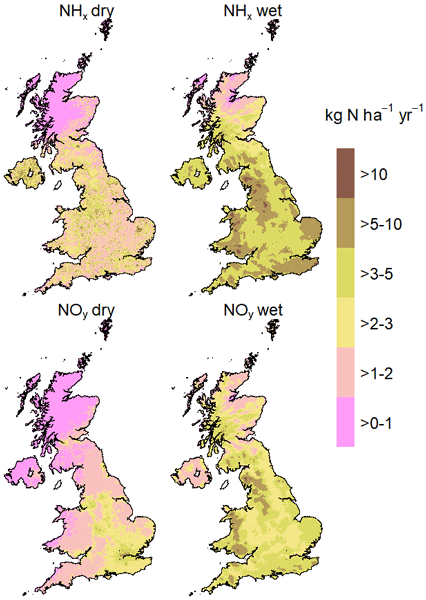
Nitrogen (N) may impact the environment in many ways, and estimation of its deposition to the terrestrial surface is of interest. N deposition data have not been generated at a high resolution (1 km × 1 km) over a long time series in the UK before now. This study concludes that N deposition has reduced by ~ 40 % from 1990. The impact of these results allows analysis of environmental impacts at a high spatial and temporal resolution, using a consistent methodology and consistent set of input data.
Jize Jiang, David S. Stevenson, Aimable Uwizeye, Giuseppe Tempio, Alessandra Falcucci, Flavia Casu, and Mark A. Sutton
Geosci. Model Dev., 18, 5051–5099, https://doi.org/10.5194/gmd-18-5051-2025, https://doi.org/10.5194/gmd-18-5051-2025, 2025
Short summary
Short summary
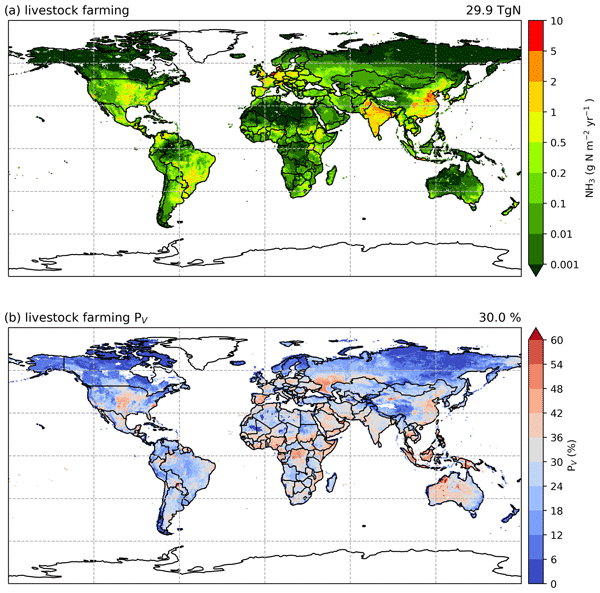
A special model called AMmonia–CLIMate (AMCLIM) has been developed to understand and calculate NH3 emissions from livestock farming. It is estimated that about 30 % of excreted N from livestock is lost due to NH3 emissions from housing, manure management and land application of manure. High NH3 volatilization often occurs in hot regions, while poor management practices also result in significant N losses through NH3 emissions.
Jize Jiang, David S. Stevenson, and Mark A. Sutton
Geosci. Model Dev., 17, 8181–8222, https://doi.org/10.5194/gmd-17-8181-2024, https://doi.org/10.5194/gmd-17-8181-2024, 2024
Short summary
Short summary
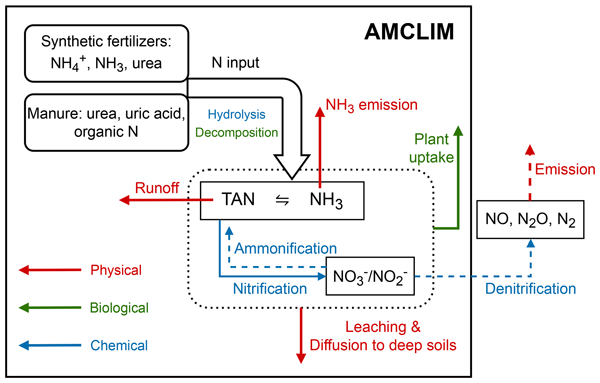
A special model called AMmonia–CLIMate (AMCLIM) has been developed to understand and calculate NH3 emissions from fertilizer use and also taking into account how the environment influences these NH3 emissions. It is estimated that about 17 % of applied N in fertilizers was lost due to NH3 emissions. Hot and dry conditions and regions with high-pH soils can expect higher NH3 emissions.
Gemma Purser, Mathew R. Heal, Edward J. Carnell, Stephen Bathgate, Julia Drewer, James I. L. Morison, and Massimo Vieno
Atmos. Chem. Phys., 23, 13713–13733, https://doi.org/10.5194/acp-23-13713-2023, https://doi.org/10.5194/acp-23-13713-2023, 2023
Short summary
Short summary
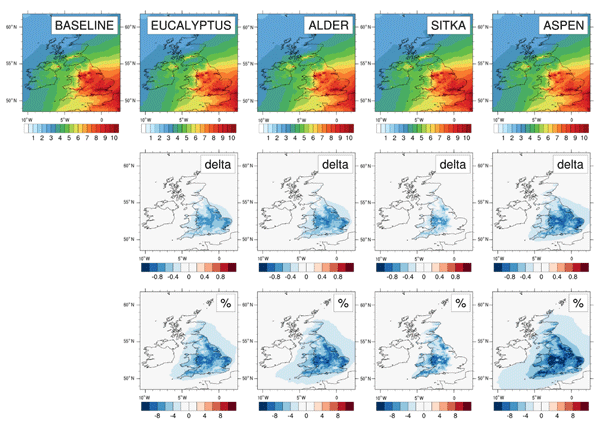
Forest expansion is a ″net-zero“ pathway, but change in land cover alters air quality in many ways. This study combines tree planting suitability data with UK measured emissions of biogenic volatile organic compounds to simulate spatial and temporal changes in atmospheric composition for planting scenarios of four species. Decreases in fine particulate matter are relatively larger than increases in ozone, which may indicate a net benefit of tree planting on human health aspects of air quality.

Pooja V. Pawar, Sachin D. Ghude, Gaurav Govardhan, Prodip Acharja, Rachana Kulkarni, Rajesh Kumar, Baerbel Sinha, Vinayak Sinha, Chinmay Jena, Preeti Gunwani, Tapan Kumar Adhya, Eiko Nemitz, and Mark A. Sutton
Atmos. Chem. Phys., 23, 41–59, https://doi.org/10.5194/acp-23-41-2023, https://doi.org/10.5194/acp-23-41-2023, 2023
Short summary
Short summary
In this study, for the first time in South Asia we compare simulated ammonia, ammonium, and total ammonia using the WRF-Chem model and MARGA measurements during winter in the Indo-Gangetic Plain region. Since observations show HCl promotes the fraction of high chlorides in Delhi, we added HCl / Cl emissions to the model. We conducted three sensitivity experiments with changes in HCl emissions, and improvements are reported in accurately simulating ammonia, ammonium, and total ammonia.
Marsailidh M. Twigg, Augustinus J. C. Berkhout, Nicholas Cowan, Sabine Crunaire, Enrico Dammers, Volker Ebert, Vincent Gaudion, Marty Haaima, Christoph Häni, Lewis John, Matthew R. Jones, Bjorn Kamps, John Kentisbeer, Thomas Kupper, Sarah R. Leeson, Daiana Leuenberger, Nils O. B. Lüttschwager, Ulla Makkonen, Nicholas A. Martin, David Missler, Duncan Mounsor, Albrecht Neftel, Chad Nelson, Eiko Nemitz, Rutger Oudwater, Celine Pascale, Jean-Eudes Petit, Andrea Pogany, Nathalie Redon, Jörg Sintermann, Amy Stephens, Mark A. Sutton, Yuk S. Tang, Rens Zijlmans, Christine F. Braban, and Bernhard Niederhauser
Atmos. Meas. Tech., 15, 6755–6787, https://doi.org/10.5194/amt-15-6755-2022, https://doi.org/10.5194/amt-15-6755-2022, 2022
Short summary
Short summary
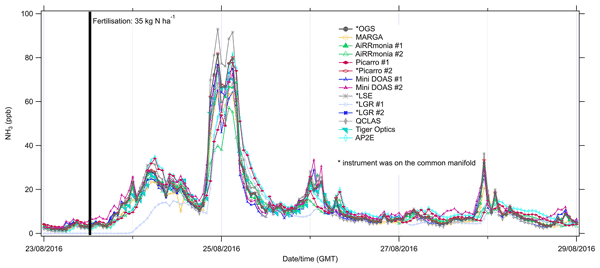
Ammonia (NH3) gas in the atmosphere impacts the environment, human health, and, indirectly, climate. Historic NH3 monitoring was labour intensive, and the instruments were complicated. Over the last decade, there has been a rapid technology development, including “plug-and-play” instruments. This study is an extensive field comparison of the currently available technologies and provides evidence that for routine monitoring, standard operating protocols are required for datasets to be comparable.
Samuel J. Tomlinson, Edward J. Carnell, Anthony J. Dore, and Ulrike Dragosits
Earth Syst. Sci. Data, 13, 4677–4692, https://doi.org/10.5194/essd-13-4677-2021, https://doi.org/10.5194/essd-13-4677-2021, 2021
Short summary
Short summary
Nitrogen (N) may impact the environment in many ways, and estimation of its deposition to the terrestrial surface is of interest. N deposition data have not been generated at a high resolution (1 km × 1 km) over a long time series in the UK before now. This study concludes that N deposition has reduced by ~ 40 % from 1990. The impact of these results allows analysis of environmental impacts at a high spatial and temporal resolution, using a consistent methodology and consistent set of input data.
Pooja V. Pawar, Sachin D. Ghude, Chinmay Jena, Andrea Móring, Mark A. Sutton, Santosh Kulkarni, Deen Mani Lal, Divya Surendran, Martin Van Damme, Lieven Clarisse, Pierre-François Coheur, Xuejun Liu, Gaurav Govardhan, Wen Xu, Jize Jiang, and Tapan Kumar Adhya
Atmos. Chem. Phys., 21, 6389–6409, https://doi.org/10.5194/acp-21-6389-2021, https://doi.org/10.5194/acp-21-6389-2021, 2021
Short summary
Short summary
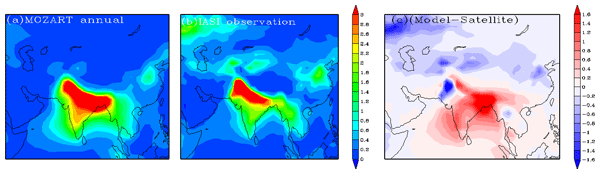
In this study, simulations of atmospheric ammonia (NH3) with MOZART-4 and HTAP-v2 are compared with satellite (IASI) and ground-based measurements to understand the spatial and temporal variability of NH3 over two emission hotspot regions of Asia, the IGP and the NCP. Our simulations indicate that the formation of ammonium aerosols is quicker over the NCP than the IGP, leading to smaller NH3 columns over the higher NH3-emitting NCP compared to the IGP region for comparable emissions.
Cited articles
Andreae, M. O. and Merlet, P.: Emission of trace gases and aerosols from biomass burning, Global Biogeochem. Cy., 15, 955–966, https://doi.org/10.1029/2000gb001382, 2001.
Aneja, V. P., Schlesinger, W. H., Erisman, J. W., Behera, S. N., Sharma, M., and Battye, W.: Reactive nitrogen emissions from crop and livestock farming in India, Atmos. Environ., 47, 92–103, https://doi.org/10.1016/j.atmosenv.2011.11.026, 2012.
Azhar, R., Zeeshan, M., and Fatima, K.: Crop residue open field burning in Pakistan; multi-year high spatial resolution emission inventory for 2000–2014, Atmos. Environ., 208, 20–33, https://doi.org/10.1016/j.atmosenv.2019.03.031, 2019.
Batjes, N. H., Calisto, L., and de Sousa, L. M.: Providing quality-assessed and standardised soil data to support global mapping and modelling (WoSIS snapshot 2023), Earth Syst. Sci. Data, 16, 4735–4765, https://doi.org/10.5194/essd-16-4735-2024, 2024.
Bhatia, A., Cowan, N. J., Drewer, J., Tomer, R., Kumar, V., Sharma, S., Paul, A., Jain, N., Kumar, S., Jha, G., and Singh, R.: The impact of different fertiliser management options and cultivars on nitrogen use efficiency and yield for rice cropping in the Indo-Gangetic Plain: Two seasons of methane, nitrous oxide and ammonia emissions, Agr. Ecosyst. Environ., 355, 108593, https://doi.org/10.1016/j.agee.2023.108593, 2023.
Bouwman, A. F., Boumans, L. J. M., and Batjes, N. H.: Estimation of global NH3 volatilization loss from synthetic fertilizers and animal manure applied to arable lands and grasslands, Global Biogeochem. Cy., 16, https://doi.org/10.1029/2000GB001389, 2002.
Christian, T. J., Kleiss, B., Yokelson, R. J., Holzinger, R., Crutzen, P. J., Hao, W. M., Sharajo, B. H., and Ward, D. E.: Comprehensive laboratory measurements of biomass-burning emissions: 1. Emissions from Indonesian, African, and other fuels, J. Geophys. Res.-Atmos., 108, https://doi.org/10.1029/2003JD003704, 2003.
CIESIN (Center for International Earth Science Information Network): Documentation for the Gridded Population of the World, Version 4 (GPWv4), Revision 11 Data Sets, Palisades NY, NASA Socioeconomic Data and Applications Center (SEDAC), Columbia University, https://doi.org/10.7927/H49C6VHW, 2018.
Crippa, M., Guizzardi, D., Muntean, M., Schaaf, E., Dentener, F., van Aardenne, J. A., Monni, S., Doering, U., Olivier, J. G. J., Pagliari, V., and Janssens-Maenhout, G.: Gridded emissions of air pollutants for the period 1970–2012 within EDGAR v4.3.2, Earth Syst. Sci. Data, 10, 1987–2013, https://doi.org/10.5194/essd-10-1987-2018, 2018.
Crippa, M., Guizzardi, D., Butler, T., Keating, T., Wu, R., Kaminski, J., Kuenen, J., Kurokawa, J., Chatani, S., Morikawa, T., Pouliot, G., Racine, J., Moran, M. D., Klimont, Z., Manseau, P. M., Mashayekhi, R., Henderson, B. H., Smith, S. J., Suchyta, H., Muntean, M., Solazzo, E., Banja, M., Schaaf, E., Pagani, F., Woo, J.-H., Kim, J., Monforti-Ferrario, F., Pisoni, E., Zhang, J., Niemi, D., Sassi, M., Ansari, T., and Foley, K.: The HTAP_v3 emission mosaic: merging regional and global monthly emissions (2000–2018) to support air quality modelling and policies, Earth Syst. Sci. Data, 15, 2667–2694, https://doi.org/10.5194/essd-15-2667-2023, 2023.
Cui, X., Zhou, F., Ciais, P., Davidson, E. A., Tubiello, F. N., Niu, X., Ju, X., Canadell, J. G., Bouwman, A. F., Jackson, R. B., Mueller, N. D., Zheng, X., Kanter, D. R., Tian, H., Adalibieke, W., Bo, Y., Wang, Q., Zhan, X., and Zhu, D.: Global mapping of crop-specific emission factors highlights hotspots of nitrous oxide mitigation, Nature Food, 2, 886–893, https://doi.org/10.1038/s43016-021-00384-9, 2021.
Das, B., Bhave, P. V., Puppala, S. P., Shakya, K., Maharjan, B., and Byanju, R. M.: A model-ready emission inventory for crop residue open burning in the context of Nepal, Environ. Pollut., 266, 115069, https://doi.org/10.1016/j.envpol.2020.115069, 2020.
Dennis, A., Fraser, M., Anderson, S., and Allen, D.: Air pollutant emissions associated with forest, grassland, and agricultural burning in Texas, Atmos. Environ., 36, 3779–3792, https://doi.org/10.1016/S1352-2310(02)00219-4, 2002.
de Ruijter, F. J. and Huijsmans, J. F. M.: A methodology for estimating the ammonia emission from crop residues at a national scale, Atmos. Environ., 2, 100028, https://doi.org/10.1016/j.aeaoa.2019.100028, 2019.
EEA (European Environment Agency): EMEP/EEA air pollutant emission inventory guidebook 2019, Luxembourg, Office for Official Publications of the European Communities, https://doi.org/10.2800/293657, 2019.
EEA (European Environment Agency): EMEP/EEA air pollutant emission inventory guidebook 2023, Luxembourg, Office for Official Publications of the European Communities, https://doi.org/10.2800/795737, 2023.
Edwards, T. M., Puglis, H. J, Kent, D. B., López Durán, J., Bradshaw, L. M., and Farag, A. M.: Ammonia and aquatic ecosystems – A review of global sources, biogeochemical cycling, and effects on fish, Sci. Total Environ., 907, 167911, https://doi.org/10.1016/j.scitotenv.2023.167911, 2024.
FAO (Food and Agriculture Organization of the United Nations): FAOSTAT Statistical Database, FAO, Rome, https://www.fao.org/faostat/en/#home (last access: 16 May 2024), 2023.
FAO (Food and Agriculture Organization of the United Nations): Livestock parameters spreadsheet, FAO, Rome, https://files-faostat.fao.org/production/EMN/Parameters_Livestock.xlsx (last access: 24 June 2024), 2024.
Gadde, B., Menke, C., and Wassmann, R.: Rice straw as a renewable energy source in India, Thailand, and the Philippines: Overall potential and limitations for energy contribution and greenhouse gas mitigation, Biomass Bioenerg., 33, 1532–1546, https://doi.org/10.1016/j.biombioe.2009.07.018, 2009.
Gilbert, M., Nicolas, G., Cinardi, G., van Boeckel, T. P., Vanwambeke, S. O., William Wint, G. R., and Robinson, T. P.: Global distribution data for cattle, buffaloes, horses, sheep, goats, pigs, chickens and ducks in 2010, Sci. Data, 5, 180227, https://doi.org/10.1038/sdata.2018.227, 2018.
Haider, M. Z.: Determinants of rice residue burning in the field, J. Environ. Manage., 128, 15–21, https://doi.org/10.1016/j.jenvman.2013.04.046, 2013.
IFA: International Fertiliser Association, IFASTAT Statistical Database, IFA, Paris, https://www.ifastat.org/fertilizer-data-query (last access: 8 August 2024), 2023.
IPCC: 2006 IPCC Guidelines for National Greenhouse Gas Inventories, edited by: Eggleston, S., Buendia, L., Miwa, K., Ngara, T., and Tanabe, K., National Greenhouse Gas Inventory Programme, Institute for Global Environmental Strategies, Hayama, Japan, IPCC-TSU NGGIP, IGES, Hayama, Japan, ISBN 4-88788-032-4, 2006a.
IPCC: 2006 Guidelines for National Greenhouse Gas Inventories: Volume 1: General Guidance and Reporting, https://www.ipcc-nggip.iges.or.jp/public/2006gl/vol1.html (last access: October 2023), 2006b.
IPCC: 2006 Guidelines for National Greenhouse Gas Inventories: Volume 4: Agriculture, Forestry and Other Land Use, Chapter 11: N2O Emissions from Managed Soils, and CO2 Emissions from Lime and Urea Application, https://www.ipcc-nggip.iges.or.jp/public/2006gl/vol4.html (last access: October 2023), 2006c.
IPCC: 2006 Guidelines for National Greenhouse Gas Inventories: Volume 4: Agriculture, Forestry and Other Land Use, Chapter 2: Generic Methodologies Applicable To Multiple Landuse Categories, https://www.ipcc-nggip.iges.or.jp/public/2006gl/vol4.html (last access: October 2023), 2006d.
IPCC: 2006 Guidelines for National Greenhouse Gas Inventories: Volume 4: Agriculture, Forestry and Other Land Use, Chapter 10: Emissions from Livestock and Manure Mangement, https://www.ipcc-nggip.iges.or.jp/public/2006gl/vol4.html (last access: October 2023), 2006e.
IPCC: 2019 Refinement to the 2006 IPCC Guidelines for National Greenhouse Gas Inventories: Volume 4: Agriculture, Forestry and Other Land Use, Chapter 11: N2O Emissions from Managed Soils, and CO2 Emissions from Lime and Urea Application, https://www.ipcc-nggip.iges.or.jp/public/2019rf/vol4.html (last access: June 2024), 2019.
Jain, N., Bhatia, A., and Pathak, H.: Emission of Air Pollutants from Crop Residue Burning in India, Aerosol Air Qual. Res., 14, 422–430, https://doi.org/10.4209/aaqr.2013.01.0031, 2014.
Janssens-Maenhout, G., Crippa, M., Guizzardi, D., Muntean, M., Schaaf, E., Dentener, F., Bergamaschi, P., Pagliari, V., Olivier, J. G. J., Peters, J. A. H. W., van Aardenne, J. A., Monni, S., Doering, U., Petrescu, A. M. R., Solazzo, E., and Oreggioni, G. D.: EDGAR v4.3.2 Global Atlas of the three major greenhouse gas emissions for the period 1970–2012, Earth Syst. Sci. Data, 11, 959–1002, https://doi.org/10.5194/essd-11-959-2019, 2019.
Jiang, J., Stevenson, D. S., Uwizeye, A., Tempio, G., and Sutton, M. A.: A climate-dependent global model of ammonia emissions from chicken farming, Biogeosciences, 18, 135–158, https://doi.org/10.5194/bg-18-135-2021, 2021.
Johansson, L., Jalkanen, J. P., and Kukkonen, J.: Global assessment of shipping emissions in 2015 on a high spatial and temporal resolution, Atmos. Environ., 167, 403–415, https://doi.org/10.1016/j.atmosenv.2017.08.042, 2017.
Kapoor, T. S., Navinya, C., Anurag, G., Lokhande, P., Rathim S., Goel, A., Sharma, R., Arya, R., Mandal, T. K., Jithin, K. P., Nagendra, S., Imran, M., Kumari, J., Muthalagu, A., Qureshi, A., Najar, T. A., Jehangir, A., Haswani, D., Raman, R. S., Rabha, S., Saikia, B., Lian, Y., Pandithurai, G., Chaudhary, P., Sinha, B., Dhandapani, A., Iqbal, J., Mukherjee, S., Chatterjee, A., Venkataraman, C., and Phuleria, H. C.: Reassessing the availability of crop residue as a bioenergy resource in India: A field-survey based study, J. Environ. Manage., 341, 118055, https://doi.org/10.1016/j.jenvman.2023.118055, 2023.
Kumar, P. and Singh, R. K.: Selection of sustainable solutions for crop residue burning: an environmental issue in northwestern states of India, Environ. Dev. Sustain., 23, 3696–3730, https://doi.org/10.1007/s10668-020-00741-x, 2021.
Kurokawa, J. and Ohara, T.: Long-term historical trends in air pollutant emissions in Asia: Regional Emission inventory in ASia (REAS) version 3, Atmos. Chem. Phys., 20, 12761–12793, https://doi.org/10.5194/acp-20-12761-2020, 2020.
Kuttippurath, J., Singh, A., Dash, S.P., Mallick, N., Clerbaux, C., Van Damme, M., Clarisse, L., Coheur, P.-F., Raj, S., Abbhishek, H., and Varikoden, H.: Record high levels of atmospheric ammonia over India: Spatial and temporal analyses, Sci. Total Environ., 740, 139986, https://doi.org/10.1016/j.scitotenv.2020.139986, 2020.
Lan, R., Eastham, S. D., Liu, T., Norford, L. K., and Barrett, S. R. H.: Air quality impacts of crop residue burning in India and mitigation alternatives, Nat. Commun., 13, 6537, https://doi.org/10.1038/s41467-022-34093-z, 2022.
Lee, D. S. and Atkins, D. H. F.: Atmospheric ammonia emission from agricultural waste combustion, Geophys. Res. Lett., 21, 281–284, 1994.
Li, M., Kurokawa, J., Zhang, Q., Woo, J.-H., Morikawa, T., Chatani, S., Lu, Z., Song, Y., Geng, G., Hu, H., Kim, J., Cooper, O. R., and McDonald, B. C.: MIXv2: a long-term mosaic emission inventory for Asia (2010–2017), Atmos. Chem. Phys., 24, 3925–3952, https://doi.org/10.5194/acp-24-3925-2024, 2024.
Li, X. G., Wang, S. X., Duan, L., Hao, J., Li, C., Chen, Y. S., and Yang, L.: Particulate and trace gas emissions from open burning of wheat straw and corn stover in China, Environ. Sci. Technol., 41, 6052–6058, https://doi.org/10.1021/es0705137, 2007.
Lin, M. and Begho, T.: Crop residue burning in South Asia: A review of the scale, effect, and solutions with a focus on reducing reactive nitrogen losses, J. Environ. Manage., 314, 115104, https://doi.org/10.1016/j.jenvman.2022.115104, 2022.
Ma, R., Zou, J., Han, Z., Yu, K., Wu, S., Li, Z., Liu, S., Niu, S., Horwath, W. R., and Zhu-Barker, X.: Global soil-derived ammonia emissions from agricultural nitrogen fertilizer application: A refinement based on regional and crop-specific emission factors, Glob. Change Biol., 27, 855–867, https://doi.org/10.1111/gcb.15437, 2020.
McDuffie, E. E., Smith, S. J., O'Rourke, P., Tibrewal, K., Venkataraman, C., Marais, E. A., Zheng, B., Crippa, M., Brauer, M., and Martin, R. V.: A global anthropogenic emission inventory of atmospheric pollutants from sector- and fuel-specific sources (1970–2017): an application of the Community Emissions Data System (CEDS), Earth Syst. Sci. Data, 12, 3413–3442, https://doi.org/10.5194/essd-12-3413-2020, 2020.
Misselbrook, T. H., Gilhespy, S. L., Cardenas, L. M., Williams, J., and Dragosits, U.: Ammonia Emissions from UK Agriculture – 2014, Inventory Submission Report November 2015, DEFRA Contract SCF0102, Department for Environment, Food & Rural Affairs, p. 38, 2015.
Monfreda, C., Ramankutty, N., and Foley, J. A.: Farming the planet: 2. Geographic distribution of crop areas, yields, physiological types, and net primary production in the year 2000, Global Biogeochem. Cy., 22, GB1022, https://doi.org/10.1029/2007GB002947, 2008.
Pawar, P. V., Ghude, S. D., Jena, C., Móring, A., Sutton, M. A., Kulkarni, S., Lal, D. M., Surendran, D., Van Damme, M., Clarisse, L., Coheur, P.-F., Liu, X., Govardhan, G., Xu, W., Jiang, J., and Adhya, T. K.: Analysis of atmospheric ammonia over South and East Asia based on the MOZART-4 model and its comparison with satellite and surface observations, Atmos. Chem. Phys., 21, 6389–6409, https://doi.org/10.5194/acp-21-6389-2021, 2021.
Ramankutty, N., Evan, A. T., Monfreda, C., and Foley, J. A.: Farming the planet: 1. Geographic distribution of global agricultural lands in the year 2000, Global Biogeochem. Cy., 22, GB1003, https://doi.org/10.1029/2007GB002952, 2008.
Sahu, S. K., Mangaraj, P., Beig, G., Tyagi, B., Tikle, S., and Vinoj, V.: Establishing a link between fine particulate matter (PM2.5) zones and COVID-19 over India based on anthropogenic emission sources and air quality data, Urban Climate, 38, 100883, https://doi.org/10.1016/j.uclim.2021.100883, 2021.
Solazzo, E., Crippa, M., Guizzardi, D., Muntean, M., Choulga, M., and Janssens-Maenhout, G.: Uncertainties in the Emissions Database for Global Atmospheric Research (EDGAR) emission inventory of greenhouse gases, Atmos. Chem. Phys., 21, 5655–5683, https://doi.org/10.5194/acp-21-5655-2021, 2021.
Somarathne, E. A. S. K. and Lokupitiya, E.: Country-specific emission information in relation to paddy residue burnt in Sri Lanka, Int. J. Environ. Sci. Te., 21, 5483–5490, https://doi.org/10.1007/s13762-023-05378-7, 2024.
Stockwell, C. E., Veres, P. R., Williams, J., and Yokelson, R. J.: Characterization of biomass burning emissions from cooking fires, peat, crop residue, and other fuels with high-resolution proton-transfer-reaction time-of-flight mass spectrometry, Atmos. Chem. Phys., 15, 845–865, https://doi.org/10.5194/acp-15-845-2015, 2015.
Stockwell, C. E., Christian, T. J., Goetz, J. D., Jayarathne, T., Bhave, P. V., Praveen, P. S., Adhikari, S., Maharjan, R., DeCarlo, P. F., Stone, E. A., Saikawa, E., Blake, D. R., Simpson, I. J., Yokelson, R. J., and Panday, A. K.: Nepal Ambient Monitoring and Source Testing Experiment (NAMaSTE): emissions of trace gases and light-absorbing carbon from wood and dung cooking fires, garbage and crop residue burning, brick kilns, and other sources, Atmos. Chem. Phys., 16, 11043–11081, https://doi.org/10.5194/acp-16-11043-2016, 2016.
Sutton, M. A., Oenema, O., Erisman, J. W., Leip, A., van Grinsven, H., and Winiwarter, W.: Too much of a good thing, Nature, 472, 159–161, https://doi.org/10.1038/472159a, 2011.
Tang, F. H. M., Nguyen, T. H., Conchedda, G., Casse, L., Tubiello, F. N., and Maggi, F.: CROPGRIDS: a global geo-referenced dataset of 173 crops, Sci, Data, 11, https://doi.org/10.1038/s41597-024-03247-7, 2024.
Tian, H., Lu, C., Ciais, P., Michalak, A. M., Canadell, J. G., Saikawa, E., Huntzinger, D. N., Gurney, K. R., Sitch, S., Zhang, B., Yang, J., Bousquet, P., Bruhwiler, L., Chen, G., Dlugokencky, E., Friedlingstein, P., Melillo, J., Pan, S., Poulter, B., Prinn, R., Saunois, M., Schwalm, C. R., and Wofsy, S. C.: The terrestrial biosphere as a net source of greenhouse gases to the atmosphere, Nature, 531, 225–228, https://doi.org/10.1038/nature16946, 2016.
Tomlinson, S. J., Carnell, E. J., Pearson, C., Sutton, M. A., Jain, N., and Dragosits, U.: Gridded emissions of ammonia (NH3) from agricultural sources in South Asia at 0.1 degrees resolution, 2015, NERC EDS Environmental Information Data Centre [data set], https://doi.org/10.5285/e0114a4f-32c2-41d9-9c2a-c46f365d4c30, 2025.
Venkataraman, C., Brauer, M., Tibrewal, K., Sadavarte, P., Ma, Q., Cohen, A., Chaliyakunnel, S., Frostad, J., Klimont, Z., Martin, R. V., Millet, D. B., Philip, S., Walker, K., and Wang, S.: Source influence on emission pathways and ambient PM2.5 pollution over India (2015–2050), Atmos. Chem. Phys., 18, 8017–8039, https://doi.org/10.5194/acp-18-8017-2018, 2018.
Warner, J. X., Wei, Z., Strow, L. L., Dickerson, R. R., and Nowak, J. B.: The global tropospheric ammonia distribution as seen in the 13-year AIRS measurement record, Atmos. Chem. Phys., 16, 5467–5479, https://doi.org/10.5194/acp-16-5467-2016, 2016.
Webb, J. and Misselbrook, T. H.: A mass-flow model of ammonia emissions from UK livestock production, Atmos. Environ., 38, 2163–2176, 2004.
Wyer, K. E., Kelleghan, D. B., Blanes-Vidal, V., Schauberger, G., and Curran, T. P.: Ammonia emissions from agriculture and their contribution to fine particulate matter: a review of implications for human health, J. Environ. Manage., 323, 116285, https://doi.org/10.1016/j.jenvman.2022.116285, 2022.
Xu, R., Pan, S., Chen, J., Chen, G., Yang, J., Dangal, S. R. S., Shepard, J. P., and Tian, H.: Half-century ammonia emissions from agricultural systems in southern Asia: Magnitude, spatiotemporal patterns, and implications for human health, GeoHealth, 2, 40–53, https://doi.org/10.1002/2017GH000098, 2018.
Yamaji, K., Ohara, T., and Akimoto, H.: Regional-specific emission inventory for NH3, N2O, and CH4 via animal farming in South, Southeast, and East Asia, Atmos. Environ., 38, 7111–7121, https://doi.org/10.1016/j.atmosenv.2004.06.045, 2004.
Yevich, R. and Logan, J.: An assessment of biofuel use and burning of agricultural waste in the developing world, Global Biogeochem. Cy., 17, 1095, https://doi.org/10.1029/2002GB001952, 2003.
Yokelson, R. J., Griffith, D. W. T., and Ward, D. E.: Open path Fourier transform infrared studies of large-scale laboratory biomass fires, J. Geophys. Res., 101, 21067–21080, https://doi.org/10.1029/96JD01800, 1996.
Yokelson, R. J., Burling, I. R., Urbanski, S. P., Atlas, E. L., Adachi, K., Buseck, P. R., Wiedinmyer, C., Akagi, S. K., Toohey, D. W., and Wold, C. E.: Trace gas and particle emissions from open biomass burning in Mexico, Atmos. Chem. Phys., 11, 6787–6808, https://doi.org/10.5194/acp-11-6787-2011, 2011.
Short summary
The release of ammonia into the air poses a serious risk to ecosystems and human health and so it is important to characterise where this polluting gas originates from. It is known that agriculture is an important source of ammonia (e.g. using fertilisers) and that South Asia is a global hotspot of this pollutant. It is, therefore, important to refine methods used to estimate how much ammonia is released in South Asia to be then used in advanced chemistry models for air quality assessments.
The release of ammonia into the air poses a serious risk to ecosystems and human health and so...


Altmetrics
Final-revised paper
Preprint