Articles | Volume 18, issue 3
https://doi.org/10.5194/essd-18-2047-2026
© Author(s) 2026. This work is distributed under
the Creative Commons Attribution 4.0 License.
the Creative Commons Attribution 4.0 License.
https://doi.org/10.5194/essd-18-2047-2026
© Author(s) 2026. This work is distributed under
the Creative Commons Attribution 4.0 License.
the Creative Commons Attribution 4.0 License.
Data description article
| 
20 Mar 2026
Data description article |
| 20 Mar 2026
| 20 Mar 2026
StageIV-IRC: a high-resolution dataset of extreme orographic Quantitative Precipitation Estimates (QPE) constrained to water budget closure for historical floods in the Appalachian Mountains
Mochi Liao
Civil and Environmental Engineering, University of Illinois Urbana-Champaign, Urbana, IL, USA
Ana P. Barros
CORRESPONDING AUTHOR

Civil and Environmental Engineering, University of Illinois Urbana-Champaign, Urbana, IL, USA
Related authors
Mochi Liao and Ana P. Barros
EGUsphere, https://doi.org/10.5194/egusphere-2026-5856, https://doi.org/10.5194/egusphere-2026-5856, 2026
This preprint is open for discussion and under review for Hydrology and Earth System Sciences (HESS).
Short summary
Short summary
We studied more than 10,000 major rainstorms in mountain regions around the world to learn whether current rainfall maps capture the heaviest events. They often do not: the maps miss large amounts of rain and smooth out local differences. By combining rainfall maps with records of river flow, we improved the estimates. Better rainfall information can strengthen flood warnings and help communities prepare for related hazards.
Mochi Liao and Ana Barros
Earth Syst. Sci. Data Discuss., https://doi.org/10.5194/essd-2024-513, https://doi.org/10.5194/essd-2024-513, 2025
Manuscript not accepted for further review
Short summary
Short summary
This StageIV-IRC is the first rainfall dataset aiming to close the water budget for flood events, consistent with fundamental physics at basin scale, and achieving superior hydrological performance at fine scale (<1hr, <1km) in headwater basins. It shows greatly-enhanced, topography-aligned rainfall spatial variability, yielding a median KGE of 0.86, with flood timing errors <1hr. This dataset can be used in operational hydrology to improve precipitation forecasts, advancing flood forecasting.
Mochi Liao and Ana P. Barros
EGUsphere, https://doi.org/10.5194/egusphere-2026-5856, https://doi.org/10.5194/egusphere-2026-5856, 2026
This preprint is open for discussion and under review for Hydrology and Earth System Sciences (HESS).
Short summary
Short summary
We studied more than 10,000 major rainstorms in mountain regions around the world to learn whether current rainfall maps capture the heaviest events. They often do not: the maps miss large amounts of rain and smooth out local differences. By combining rainfall maps with records of river flow, we improved the estimates. Better rainfall information can strengthen flood warnings and help communities prepare for related hazards.
Siddharth Singh, Carrie Vuyovich, and Ana P. Barros
EGUsphere, https://doi.org/10.5194/egusphere-2026-3588, https://doi.org/10.5194/egusphere-2026-3588, 2026
Short summary
Short summary
Forests make it difficult to measure how much water is stored in snow because trees block and scatter signals from aircraft and satellites. This study combines weather-driven snow modeling with airborne radar observations to estimate snow depth and water stored in forested snowpacks. Results compared well with field and airborne measurements, showing that this approach can improve snow monitoring in forested regions important for water supply and flood forecasting.
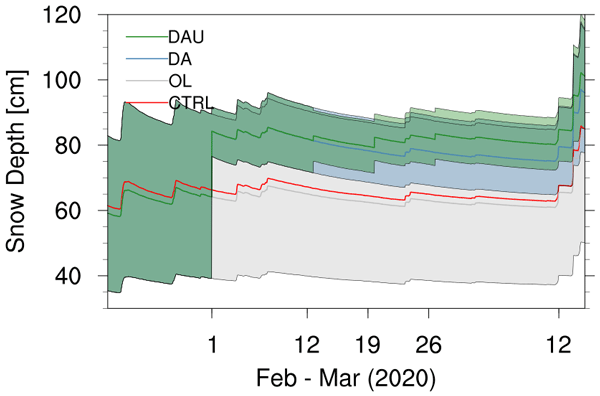
Prabhakar Shrestha and Ana P. Barros
The Cryosphere, 19, 2895–2911, https://doi.org/10.5194/tc-19-2895-2025, https://doi.org/10.5194/tc-19-2895-2025, 2025
Short summary
Short summary
The study presents the first assimilation of snow depth obtained from repeat pass airborne L-band synthetic aperture radar with a snow hydrology model. The assimilation of snow depth was found to be equivalent to the downscaling of precipitation forcing with a bias correction, which improved the snowpack simulation compared to ground-based observations.
Mochi Liao and Ana Barros
Earth Syst. Sci. Data Discuss., https://doi.org/10.5194/essd-2024-513, https://doi.org/10.5194/essd-2024-513, 2025
Manuscript not accepted for further review
Short summary
Short summary
This StageIV-IRC is the first rainfall dataset aiming to close the water budget for flood events, consistent with fundamental physics at basin scale, and achieving superior hydrological performance at fine scale (<1hr, <1km) in headwater basins. It shows greatly-enhanced, topography-aligned rainfall spatial variability, yielding a median KGE of 0.86, with flood timing errors <1hr. This dataset can be used in operational hydrology to improve precipitation forecasts, advancing flood forecasting.
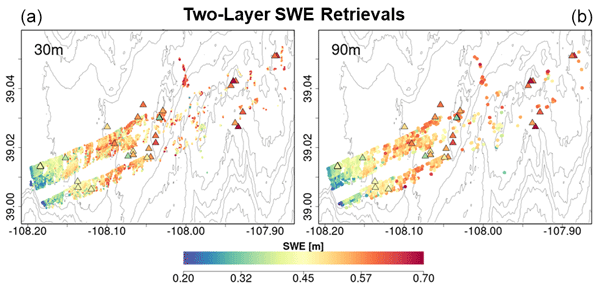
Siddharth Singh, Michael Durand, Edward Kim, and Ana P. Barros
The Cryosphere, 18, 747–773, https://doi.org/10.5194/tc-18-747-2024, https://doi.org/10.5194/tc-18-747-2024, 2024
Short summary
Short summary
Seasonal snowfall accumulation plays a critical role in climate. The water stored in it is measured by the snow water equivalent (SWE), the amount of water released after completely melting. We demonstrate a Bayesian physical–statistical framework to estimate SWE from airborne X- and Ku-band synthetic aperture radar backscatter measurements constrained by physical snow hydrology and radar models. We explored spatial resolutions and vertical structures that agree well with ground observations.
Luiz Bacelar, Arezoo ReifeeiNasab, Nathaniel Chaney, and Ana Barros
EGUsphere, https://doi.org/10.5194/egusphere-2023-2088, https://doi.org/10.5194/egusphere-2023-2088, 2023
Preprint archived
Short summary
Short summary
The study explores a computationally efficient probabilistic precipitation forecast approach to generate multiple flood scenarios. It reveals the limitations in predicting flash floods accurately and the need for advanced ensemble methodologies to combine different sources of precipitation forecasts. It highlights the scale-dependency of flood predictions at higher spatial resolutions, shedding light on the relationship between river hydraulics and flood propagation in the river network.
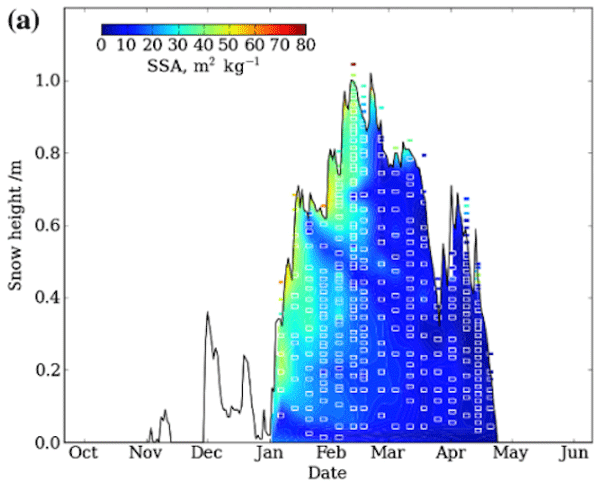
Leung Tsang, Michael Durand, Chris Derksen, Ana P. Barros, Do-Hyuk Kang, Hans Lievens, Hans-Peter Marshall, Jiyue Zhu, Joel Johnson, Joshua King, Juha Lemmetyinen, Melody Sandells, Nick Rutter, Paul Siqueira, Anne Nolin, Batu Osmanoglu, Carrie Vuyovich, Edward Kim, Drew Taylor, Ioanna Merkouriadi, Ludovic Brucker, Mahdi Navari, Marie Dumont, Richard Kelly, Rhae Sung Kim, Tien-Hao Liao, Firoz Borah, and Xiaolan Xu
The Cryosphere, 16, 3531–3573, https://doi.org/10.5194/tc-16-3531-2022, https://doi.org/10.5194/tc-16-3531-2022, 2022
Short summary
Short summary
Snow water equivalent (SWE) is of fundamental importance to water, energy, and geochemical cycles but is poorly observed globally. Synthetic aperture radar (SAR) measurements at X- and Ku-band can address this gap. This review serves to inform the broad snow research, monitoring, and application communities about the progress made in recent decades to move towards a new satellite mission capable of addressing the needs of the geoscience researchers and users.
Cited articles
Alimonti, G., Mariani, L., Prodi, F., and Ricci, R. A.: A critical assessment of extreme events trends in times of global warming, Eur. Phys. J-Plus, 137, 112, https://doi.org/10.1140/epjp/s13360-021-02243-9, 2022.
Andrieu, H., Creutin, J. D., Delrieu, G., and Faure, D.: Use of a weather radar for the hydrology of a mountainous area. Part I: Radar measurement interpretation, J. Hydrol., 193, 1–25, 1997.
Areerachakul, N., Prongnuch, S., Longsomboon, P., and Kandasamy, J.: Quantitative precipitation estimation (QPE) rainfall from meteorology radar over Chi Basin, Hydrology, 9, 178, https://doi.org/10.3390/hydrology9100178, 2022.
Arulraj, M. and Barros, A. P.: Improving quantitative precipitation estimates in mountainous regions by modelling low-level seeder-feeder interactions constrained by Global Precipitation Measurement Dual-frequency Precipitation Radar measurements, Remote Sens. Environ., 231, 111213, https://doi.org/10.1016/j.rse.2019.111213, 2019.
Arulraj, M. and Barros, A. P.: Automatic detection and classification of low-level orographic precipitation processes from space-borne radars using machine learning, Remote Sens. Environ., 257, 112355, https://doi.org/10.1016/j.rse.2021.112355, 2021.
Barros, A., Miller, D., Wilson, A., Cutrell, G., Arulraj, M., Super, P., and Petersen, W.: GPM Ground Validation Southern Appalachian Rain Gauge IPHEx, NASA Global Hydrometeorology Resource Center DAAC [data set], Huntsville, Alabama, U.S.A., https://doi.org/10.5067/GPMGV/IPHEX/GAUGES/DATA301, 2017.
Barros, A. P., Petersen, W., Schwaller, M., Cifelli, R., Mahoney, K., Peters-Liddard, C., Shepherd, M., Nesbitt, S., Wolff, D., Heymsfield, G., and Starr, D.: NASA GPM-Ground Validation: Integrated Precipitation and Hydrology Experiment 2014 Science Plan, EPL/Duke University, Durham, N.C., https://doi.org/10.7924/G8CC0XMR, 2014.
Bindlish, R. and Barros, A. P.: Aggregation of Digital Terrain Data Using a Modified Fractal Interpolation Scheme, Comput. Geosci., 22, 907–917, 1996.
Bindlish, R. and Barros, A. P.: Disaggregation of rainfall for one-way coupling of atmospheric and hydrological models in regions of complex terrain, Global Planet Change, 25, 111–132, https://doi.org/10.1016/S0921-8181(00)00024-2, 2000.
Bohling, G.: Introduction to geostatistics and variogram analysis, Kansas Geol. Surv., 1, 1–20, 2005.
Borga, M., Stoffel, M., Marchi, L., Marra, F., and Jakob, M.: Hydrogeomorphic response to extreme rainfall in headwater systems: Flash floods and debris flows, J. Hydrol., 518, 194–205, 2014.
Buytaert, W., Celleri, R., Willems, P., De Bievre, B., and Wyseure, G.: Spatial and temporal rainfall variability in mountainous areas: A case study from the south Ecuadorian Andes, J. Hydrol., 329, 413–421, https://doi.org/10.1016/j.jhydrol.2006.02.031, 2006.
Carlson, D.: Influence of lithology on vertical anisotropy of permeability at a field scale for select Louisiana geologic units, Gulf Coast Association of Geological Societies Transactions, 60, 103–118, 2010.
Cassiraga, E., Gómez-Hernández, J. J., Berenguer, M., Sempere-Torres, D., and Rodrigo-Ilarri, J.: Spatiotemporal precipitation estimation from rain gauges and meteorological radar using geostatistics, Math. Geosci., 53, 499–516, https://doi.org/10.1007/s11004-020-09882-1, 2021.
Chen, J. and Kumar, P.: Topographic influence on the seasonal and interannual variation of water and energy balance of basins in North America, J. Climate, 14, https://doi.org/10.1175/1520-0442(2001)014<1989:TIOTSA>2.0.CO;2, 2001.
Czigány, S., Pirkhoffer, E., and Geresdi, I.: Impact of extreme rainfall and soil moisture on flash flood generation, Quarterly Journal of the Hungarian Meteorological Service, 114, 79–100, 2010.
Deijns, A. A. J., Dewitte, O., Thiery, W., d'Oreye, N., Malet, J.-P., and Kervyn, F.: Timing landslide and flash flood events from SAR satellite: a regionally applicable methodology illustrated in African cloud-covered tropical environments, Nat. Hazards Earth Syst. Sci., 22, 3679–3700, https://doi.org/10.5194/nhess-22-3679-2022, 2022.
Delrieu, G., Wijbrans, A., Boudevillain, B., Faure, D., Bonnifait, L., and Kirstetter, P. E. : Geostatistical radar–rain gauge merging: A novel method for the quantification of rain estimation accuracy, Adv. Water Res., 71, 110–124, https://doi.org/10.1016/j.advwatres.2014.06.005, 2014.
Diggle, P. and Ribeiro, P. J.: Model-based geostatistics, Springer Series in Statistics, ISBN 978-1-4757-2414-1, https://doi.org/10.1007/978-1-4757-2412-7, 2007.
Dinku, T., Anagnostou, E. N., and Borga, M.: Improving radar-based estimation of rainfall over complex terrain, J. Appl. Meteorol. Clim., 41, 1163–1178, https://doi.org/10.1175/1520-0450(2002)041<1163:IRBEOR>2.0.CO;2, 2002.
Diomede, T., Davolio, S., Marsigli, C., Miglietta, M. M., Moscatello, A., Papetti, P., and Malguzzi, P.: Discharge prediction based on multi-model precipitation forecasts, Meteorol. Atmos. Phys., 101, 245–265, https://doi.org/10.1007/s00703-007-0285-0, 2008.
Dobler, C., Hagemann, S., Wilby, R. L., and Stötter, J.: Quantifying different sources of uncertainty in hydrological projections in an Alpine watershed, Hydrol. Earth Syst. Sci., 16, 4343–4360, https://doi.org/10.5194/hess-16-4343-2012, 2012.
Duan, Y., Wilson, A. M., and Barros, A. P.: Scoping a field experiment: error diagnostics of TRMM precipitation radar estimates in complex terrain as a basis for IPHEx2014, Hydrol. Earth Syst. Sci., 19, 1501–1520, https://doi.org/10.5194/hess-19-1501-2015, 2015.
Duan, Y. and Barros, A. P.: Understanding how low-level clouds and fog modify the diurnal cycle of orographic precipitation using in situ and satellite observations, Remote Sens., 9, 920, https://doi.org/10.3390/rs9090920, 2017.
Durden, S. L., Haddad, Z. S., Kitiyakara, A., and Li, F. K.: Effects of nonuniform beam filling on rainfall retrieval for the TRMM precipitation radar, J. Atmos. Ocean. Tech., 15, 635–646, https://doi.org/10.1175/1520-0426(1998)015<0635:EONBFO>2.0.CO;2, 1998.
Freeze, R. A. and Cherry, J. A.: Groundwater, Englewood Cliffs, N.J., Prentice-Hall, ISBN 978-0133653120, 1979.
Fulton, R. A., Breidenbach, J. P., Seo, D. J., Miller, D. A., and O'Bannon, T.: The WSR-88D rainfall algorithm, Weather Forecast., 13, 377–395, 1998.
Gentilucci, M., Bufalini, M., D'Aprile, F., Materazzi, M., and Pambianchi, G.: Comparison of data from rain gauges and the IMERG product to analyse precipitation in mountain areas of central Italy, ISPRS In. J. Geo-Inf., 10, 795, https://doi.org/10.3390/ijgi10120795, 2021.
Goudenhoofdt, E. and Delobbe, L.: Evaluation of radar-gauge merging methods for quantitative precipitation estimates, Hydrol. Earth Syst. Sci., 13, 195–203, https://doi.org/10.5194/hess-13-195-2009, 2009.
Grillakis, M. G., Koutroulis, A. G., Komma, J., Tsanis, I. K., Wagner, W., and Blöschl, G.: Initial soil moisture effects on flash flood generation – A comparison between basins of contrasting hydro-climatic conditions, J. Hydrol., 541, 206–217, 2016.
Gupta, H. V., Kling, H., Yilmaz, K. K., and Martinez, G. F.: Decomposition of the mean squared error and NSE performance criteria: Implications for improving hydrological modelling, J. Hydrol., 377, 80–91, https://doi.org/10.1016/j.jhydrol.2009.08.003, 2009.
Gupta, V., Nautiyal, H., Kumar, V., Jamir, I., and Tandon, R. S.: Landslide hazards around Uttarkashi township, Garhwal Himalaya, after the tragic flash flood in June 2013, Nat. Hazards, 80, 1689–1707, https://doi.org/10.1007/s11069-015-2048-4, 2016.
Harrison, D. L., Driscoll, S. J., and Kitchen, M.: Improving precipitation estimates from weather radar using quality control and correction techniques, Meteorol. Appl., 7, 135–144, https://doi.org/10.1017/S1350482700001468, 2000.
Huffman, G. J., Adler, R. F., Bolvin, D. T., Gu, G. J., Nelkin, E. J., Bowman, K. P., Hong, Y., Stocker, E. F., and Wolff, D. B.: The TRMM multisatellite precipitation analysis (TMPA): Quasi-global, multiyear, combined-sensor precipitation estimates at fine scales, J. Hydrometeorol., 8, 38–55, https://doi.org/10.1175/JHM560.1, 2007.
Iwasaki, K., Katsuyama, M., and Tani, M.: Factors affecting dominant peak-flow runoff-generation mechanisms among five neighbouring granitic headwater catchments, Hydrol. Process., 34, 1154–1166, https://doi.org/10.1002/hyp.13656, 2020.
Kobold, M. and Sušelj, K.: Precipitation forecasts and their uncertainty as input into hydrological models, Hydrol. Earth Syst. Sci., 9, 322–332, https://doi.org/10.5194/hess-9-322-2005, 2005.
Kochendorfer, J., Rasmussen, R., Wolff, M., Baker, B., Hall, M. E., Meyers, T., Landolt, S., Jachcik, A., Isaksen, K., Brækkan, R., and Leeper, R.: The quantification and correction of wind-induced precipitation measurement errors, Hydrol. Earth Syst. Sci., 21, 1973–1989, https://doi.org/10.5194/hess-21-1973-2017, 2017.
Komma, J., Reszler, C., Blöschl, G., and Haiden, T.: Ensemble prediction of floods – catchment non-linearity and forecast probabilities, Nat. Hazards Earth Syst. Sci., 7, 431–444, https://doi.org/10.5194/nhess-7-431-2007, 2007.
Konrad II, C. E.: Moisture trajectories associated with heavy rainfall in the Appalachian region of the United States, Phys. Geogr., 15, 227–248, https://doi.org/10.1080/02723646.1994.10642514, 1994.
Kreklow, J., Tetzlaff, B., Burkhard, B., and Kuhnt, G.: Radar-based precipitation climatology in Germany – developments, uncertainties and potentials, Atmosphere, 11, 217, https://doi.org/10.3390/atmos11020217, 2020.
Laiolo, P., Gabellani, S., Campo, L., Silvestro, F., Delogu, F., Rudari, R., and Puca, S.: Impact of different satellite soil moisture products on the predictions of a continuous distributed hydrological model, Int. J. Appl. Earth Obs., 48, 131–145, https://doi.org/10.1016/j.jag.2015.06.002, 2016.
Li, J. and Heap, A. D.: A review of spatial interpolation methods for environmental scientists, 11–12, 2008.
Liao, M. and Barros, A. P.: The Integrated Precipitation and Hydrology Experiment-Hydrologic Applications for the Southeast US (IPHEX-H4SE) Part IV: High-Resolution Enhanced Stage IV-Rain gauge Combined Precipitation Product, Durham, NC, Duke Digital Repository [data set], https://idn.duke.edu/ark:/87924/r4pc2zd75 (last access: 12 March 2026), 2019.
Liao, M. and Barros, A. P.: Toward optimal rainfall – Hydrologic QPE correction in headwater basins, Remote Sens. Environ., 279, 113107, https://doi.org/10.1016/j.rse.2022.113107, 2022.
Liao, M. and Barros, A. P.: Toward optimal rainfall for flood prediction in headwater basins – Orographic QPE error modeling using machine learning, Water Resour. Res., 59, e2023WR034456, https://doi.org/10.1029/2023WR034456, 2023.
Liao, M. and Barros, A. P.: Model Celerity-Discharge Behavior in Complex Terrain to Improve Orographic Quantitative Precipitation Estimation and Hydrologic Prediction in Headwater Basins, Water Resour. Res., https://doi.org/10.1029/2024WR038446, 2025a.
Liao, M. and Barros, A. P.: Toward optimal rainfall – Hydrologic QPE Correction in Headwater Basins – Closing the Water Budget within Observational Uncertainty Through Correcting Initial Soil Moisture Conditions, J. Hydrol.-Reg. Stud., https://doi.org/10.1016/j.ejrh.2025.102700, 2025b.
Liao, M. and Barros, A.: StageIV-IRC – A High-resolution Dataset of Extreme Orographic Quantitative Precipitation Estimates (QPE) Constrained to Water Budget Closure for Historical Floods in the Appalachian Mountains, Zenodo [data set], https://doi.org/10.5281/zenodo.14028866, 2025c.
Lin, Y. and Mitchell, K. E.: The NCEP stage II/IV hourly precipitation analyses: Development and applications, paper presented at 19th Conference on Hydrology, Am. Meteorol. Soc., San Diego, Calif., https://ams.confex.com/ams/pdfpapers/83847.pdf (last access: 12 March 2026), 9–13 January 2005.
Linsley, R. K., Kohler, J., Max, A., and Paulhus, J. L. H.: Hydrology for Engineers. Water Resources and Environmental Engineering. McGraw-Hill, New York, ISBN 978-0070379565, 1982.
Lowman, L. E. and Barros, A. P.: Interplay of drought and tropical cyclone activity in SE US gross primary productivity, J. Geophys. Res.-Biogeo., 121, 1540-1-567, 2016.
Lumbroso, D. and Gaume, E.: Reducing the uncertainty in indirect estimates of extreme flash flood discharges, J. Hydrol., 414, 16–30, 2012.
Maggioni, V. and Massari, C.: On the performance of satellite precipitation products in riverine flood modeling: A review, J. Hydrol., 558, 214–224, 2018.
Marchi, L., Borga, M., Preciso, E., and Gaume, E.: Characterisation of selected extreme flash floods in Europe and implications for flood risk management, J. Hydrol., 394, 118–133, 2010.
McBratney, A. B. and Webster, R.: Choosing functions for semi-variograms of soil properties and fitting them to sampling estimates, J. Soil Sci., 37, 617–639, 1986.
McBride, J. L. and Ebert, E. E.: Verification of quantitative precipitation forecasts from operational numerical weather prediction models over Australia, Weather Forecast., 15, 103–121, 2000.
McKee, J. L. and Binns, A. D.: A review of gauge–radar merging methods for quantitative precipitation estimation in hydrology, Can. Water Resour. J., 41, 186–203, https://doi.org/10.1080/07011784.2015.1064786, 2016.
Milly, P. C. D., Wetherald, R. T., Dunne, K. A., and Delworth, T. L.: Increasing risk of great floods in a changing climate, Nature, 415, 514–517, https://doi.org/10.1038/415514a, 2002.
Mockler, E. M., Chun, K. P., Sapriza-Azuri, G., Bruen, M., and Wheater, H. S.: Assessing the relative importance of parameter and forcing uncertainty and their interactions in conceptual hydrological model simulations, Adv. Water Resour., 97, 299–313, https://doi.org/10.1016/j.advwatres.2016.10.008, 2016.
Mtibaa, S. and Asano, S.: Hydrological evaluation of radar and satellite gauge-merged precipitation datasets using the SWAT model: Case of the Terauchi catchment in Japan, J. Hydrol., 42, 101134. https://doi.org/10.1016/j.ejrh.2022.101134, 2022.
Nanding, N., Rico-Ramirez, M. A., and Han, D.: Comparison of different radar-rain gauge rainfall merging techniques, J. Hydroinform., 3, 422–445, https://doi.org/10.2166/hydro.2015.001, 2015.
Nogueira, M. and Barros, A. P.: Transient Stochastic Downscaling of Quantitative Precipitation Estimates for Hydrological Applications, J. Hydrol., 529, 1407–1421, https://doi.org/10.1016/j.jhydrol.2015.08.041, 2015.
Oliver, M. A. and Webster, R.: Basic steps in geostatistics: the variogram and kriging, Springer International Publishing, Cham, Switzerland, vol. 106, ISBN 978-3319158655, 2015.
Penna, D., Tromp-van Meerveld, H. J., Gobbi, A., Borga, M., and Dalla Fontana, G.: The influence of soil moisture on threshold runoff generation processes in an alpine headwater catchment, Hydrol. Earth Syst. Sci., 15, 689–702, https://doi.org/10.5194/hess-15-689-2011, 2011.
Pielke, R. A., Downton, M. W., and Miller, J. B.: Flood damage in the United States, 1926–2000: a reanalysis of National Weather Service estimates, Boulder, CO, University Corporation for Atmospheric Research, 2002.
Prat, O. P. and Barros, A. P.: Assessing satellite-based precipitation estimates in the Southern Appalachian mountains using rain gauges and TRMM PR, Adv. Geosci., 25, 143–153, https://doi.org/10.5194/adgeo-25-143-2010, 2010a.
Prat, O. P. and Barros, A. P.: Ground observations to characterize the spatial gradients and vertical structure of orographic precipitation–Experiments in the inner region of the Great Smoky Mountains, J. Hydrol., 391, 141–156, https://doi.org/10.1016/j.jhydrol.2010.07.013, 2010b.
Rafieeinasab, A., Norouzi, A., Seo, D. J., and Nelson, B.: Improving high-resolution quantitative precipitation estimation via fusion of multiple radar-based precipitation products, J. Hydrol., 531, 320–336, https://doi.org/10.1016/j.jhydrol.2015.04.066, 2015.
Schiemann, R., Erdin, R., Willi, M., Frei, C., Berenguer, M., and Sempere-Torres, D.: Geostatistical radar-raingauge combination with nonparametric correlograms: methodological considerations and application in Switzerland, Hydrol. Earth Syst. Sci., 15, 1515–1536, https://doi.org/10.5194/hess-15-1515-2011, 2011.
Schumacher, R. S.: Heavy rainfall and flash flooding, in: Oxford research encyclopedia of natural hazard science, https://doi.org/10.1093/acrefore/9780199389407.013.132, 2017.
Shao, Y., Fu, A., Zhao, J., Xu, J., and Wu, J.: Improving quantitative precipitation estimates by radar-rain gauge merging and an integration algorithm in the Yishu River catchment, China, Theor. Appl. Climatol., 144, 611–623, https://doi.org/10.1007/s00704-021-03526-y, 2021.
Sideris, I. V., Gabella, M., Erdin, R., and Germann, U.: Real-time radar–rain-gauge merging using spatio-temporal co-kriging with external drift in the alpine terrain of Switzerland, Q. J. Roy. Meteor. Soc., 140, 1097–1111, https://doi.org/10.1002/qj.2188, 2013.
Silvestro, F., Rossi, L., Campo, L., Parodi, A., Fiori, E., Rudari, R., and Ferraris, L.: Impact-based flash-flood forecasting system: Sensitivity to high resolution numerical weather prediction systems and soil moisture, J. Hydrol., 572, 388–402, https://doi.org/10.1016/j.jhydrol.2019.02.055, 2019.
Smith, J. A., Baeck, M. L., Ntelekos, A. A., Villarini, G., and Steiner, M.: Extreme rainfall and flooding from orographic thunderstorms in the central Appalachians, Water Resour. Res., 47, https://doi.org/10.1029/2010WR010190, 2011
Špitalar, M., Gourley, J. J., Lutoff, C., Kirstetter, P. E., Brilly, M., and Carr, N.: Analysis of flash flood parameters and human impacts in the US from 2006 to 2012, J. Hydrol., 519, 863–870, 2014.
Tao, K. and Barros, A. P.: Fractal Downscaling of Satellite Precipitation Products for Hydrometeorological Applications, J. Atmos. Ocean. Tech., 27, 409–427, https://doi.org/10.1175/2009JTECHA1219.1, 2010.
Tao, J. and Barros, A. P.: Prospects for flash flood forecasting in mountainous regions – An investigation of Tropical Storm Fay in the Southern Appalachians, J. Hydrol., 506, 69–89, https://doi.org/10.1016/j.jhydrol.2013.02.052, 2013.
Tao, J. and Barros, A. P.: Multi-year atmospheric forcing datasets for hydrologic modeling in regions of complex terrain–Methodology and evaluation over the Integrated Precipitation and Hydrology Experiment 2014 domain, J. Hydrol., 567, 824–842, https://doi.org/10.1016/j.jhydrol.2016.12.058, 2018.
Tao, J. and Barros, A. P.: Coupled prediction of flood response and debris flow initiation during warm- and cold-season events in the Southern Appalachians, USA, Hydrol. Earth Syst. Sci., 18, 367–388, https://doi.org/10.5194/hess-18-367-2014, 2014.
Tao, J., Wu, D., Gourley, J., Zhang, S. Q., Crow, W., Peters-Lidard, C., and Barros, A. P.: Operational hydrological forecasting during the IPHEx-IOP campaign–Meet the challenge, J. Hydrol., 541, 434–456, https://doi.org/10.1016/j.jhydrol.2016.02.019, 2016.
Troch, P. A., Smith, J. A., Wood, E. F., and de Troch, F. P.: Hydrologic controls of large floods in a small basin: central Appalachian case study, J. Hydrol., 156, 285–309, https://doi.org/10.1016/0022-1694(94)90082-5, 1994.
Uber, M., Vandervaere, J.-P., Zin, I., Braud, I., Heistermann, M., Legoût, C., Molinié, G., and Nord, G.: How does initial soil moisture influence the hydrological response? A case study from southern France, Hydrol. Earth Syst. Sci., 22, 6127–6146, https://doi.org/10.5194/hess-22-6127-2018, 2018.
Vignal, B., Galli, G., Joss, J., and Germann, U.: Three methods to determine profiles of reflectivity from volumetric radar data to correct precipitation estimates, J. Appl. Meteorol. Clim., 39, 1715–1726, https://doi.org/10.1175/1520-0450-39.10.1715, 2000.
Villarini, G. and Krajewski, W. F.: Review of the different sources of uncertainty in single polarization radar-based estimates of rainfall, Surv. Geophys., 31, 107–129, https://doi.org/10.1007/s10712-009-9079-x, 2010.
Vivoni, E. R., Entekhabi, D., Bras, R. L., and Ivanov, V. Y.: Controls on runoff generation and scale-dependence in a distributed hydrologic model, Hydrol. Earth Syst. Sci., 11, 1683–1701, https://doi.org/10.5194/hess-11-1683-2007, 2007.
Wang, K. H., Chu, T., Yang, M. D., and Chen, M. C.: Geostatistical based models for the spatial adjustment of radar rainfall data in typhoon events at a high-elevation river watershed, Remote Sens., 12, 1427, https://doi.org/10.3390/rs12091427, 2020.
Weiland, F. C. S., Vrugt, J. A., Weerts, A. H., and Bierkens, M. F.: Significant uncertainty in global scale hydrological modeling from precipitation data errors, J. Hydrol., 529, 1095–1115, https://doi.org/10.1016/j.jhydrol.2015.08.061, 2015.
Wehbe, Y., Temimi, M., and Adler, R. F.: Enhancing precipitation estimates through the fusion of weather radar, satellite retrievals, and surface parameters, Remote Sens., 12, 1342, https://doi.org/10.3390/rs12081342, 2020.
Wernberg, T., Smale, D., Tuya, F., Thomsen, M. S., Langlois, T. J., de Bettignies, T., Bennett, S., and Rousseaux, C. S.: An extreme climatic event alters marine ecosystem structure in a global biodiversity hotspot, Nat. Clim. Change, 3, 78–82, https://doi.org/10.1038/nclimate1627, 2013.
Wilson, A. M. and Barros, A. P.: An investigation of warm rainfall microphysics in the southern Appalachians: Orographic enhancement via low-level seeder–feeder interactions, J. Atmos. Sci., 71, 1783–1805, https://doi.org/10.1175/JAS-D-13-0228.1, 2014.
Wolvin, S., Strong, C., Rupper, S., and Steenburgh, W. J.: Climatology of orographic precipitation gradients over High Mountain Asia derived from dynamical downscaling, J. Geophys. Res.-Atmos., 129, e2024JD041010, https://doi.org/10.1029/2024JD041010, 2024
Yildiz, O. and Barros, A. P.: Elucidating vegetation controls on the hydroclimatology of a mid-latitude basin, J. Hydrol., 333, 431–448, https://doi.org/10.1016/j.jhydrol.2006.09.010, 2007.
Yıldız, O. and Barros, A. P.: Evaluating spatial variability and scale effects on hydrologic processes in a midsize river basin, Sci. Res. Essays, 4, 217–225, https://doi.org/10.5897/SRE.9000465, 2009.
Zappa, M., Jaun, S., Germann, U., Walser, A., and Fundel, F.: Superposition of three sources of uncertainties in operational flood forecasting chains, Atmos. Res., 100, 246–262, https://doi.org/10.1016/j.atmosres.2010.12.005, 2011.
Zehe, E. and Blöschl, G.: Predictability of hydrologic response at the plot and catchment scales: Role of initial conditions, Water Resour. Res., 40, https://doi.org/10.1029/2003WR002869, 2004.
Zhang, J., Howard, K., Langston, C., Kaney, B., Qi, Y., Tang, L., Grams, H., Wang, Y., Cocks, S., Martinaitis, S., Arthur, A., Cooper, K., Brogden, J., and Kitzmiller, D.: Multi-radar multi-sensor (MRMS) quantitative precipitation estimation: Initial operating capabilities, B. Am. Meteorol. Soc., 97, 621–638, https://doi.org/10.1175/BAMS-D-14-00174.1, 2016.
Zhang, X. and Anagnostou, E. N.: Evaluation of numerical weather model–based satellite precipitation adjustment in tropical mountainous regions, J. Hydrometeorol., 20, 431–445, https://doi.org/10.1175/JHM-D-18-0008.1, 2019.
Zhang, Y., Schaap, M. G., and Zha, Y.: A high-resolution global map of soil hydraulic properties produced by a hierarchical parameterization of a physically based water retention model, Water Resour. Res., 54, 9774–9790, https://doi.org/10.1029/2018WR023539, 2018.
Zimmerman, D. L. and Zimmerman, M. B.: A comparison of spatial semivariogram estimators and corresponding ordinary kriging predictors, Technometrics, 33, 77–91, https://doi.org/10.1080/00401706.1991.10484771, 1991.
Short summary
The StageIV-IRC is the first precipitation dataset developed for extreme precipitation events in the mountains. This dataset strongly suggest the use of Inverse Rainfall Correction (IRC) framework to produce physically-meaningful corrections for precipitation products in the mountains, where precipitation estimation is problematic due to topography blockage. Post-IRC precipitation estimation produces improved hydrological responses, and it shows a good agreement with raingauge observations.
The StageIV-IRC is the first precipitation dataset developed for extreme precipitation events in...


Altmetrics
Final-revised paper
Preprint