the Creative Commons Attribution 4.0 License.
the Creative Commons Attribution 4.0 License.
 | 16 Feb 2026
A complete database of AMS radiocarbon estimates from Lake Baikal sediment cores with a lake-wide assessment of TOC age offsets
Samuel R. S. Newall
Anson W. Mackay
Natalia Piotrowska
Maarten Blaauw
We present a database of AMS radiocarbon dates from Lake Baikal sediment cores, encompassing 51 cores and 518 dates, providing a complete record from literature spanning 1992 to 2025 (with transcription errors corrected) and including 22 previously unpublished dates from cores CON01-603-5 and CON01-605-5. The dataset is available at https://doi.org/10.1594/PANGAEA.973799 (Newall et al., 2025). The most common material used for radiocarbon dating in our dataset is total organic carbon (TOC). Unfortunately, the interpretation of TOC ages in lake sediments is hindered by issues such as the reservoir effect, in situ contamination by old organic carbon, and/or the hardwater effect. These issues may culminate in age estimates thousands of years older than the true depositional age of that sediment, which we term the “age offset”. Linear regression of uncalibrated radiocarbon dates has previously been used to estimate the age offset in Lake Baikal, with results ranging from 0 to 1.5 14C kyr in different cores. Estimates from other methods have returned estimates of approximately 2 14C kyr. Despite this, most previous studies have not incorporated age offset uncertainty in their age depth modelling, or have included uncertainty of, at most, ±0.09 14C kyr. Furthermore, the varying age offset estimates have been interpreted by some as evidence that different regions of Lake Baikal have different age offsets, with implications as to the cause of the age offsets. We apply the linear regression age offset method to all suitable cores in our database, returning 21 estimates of age offset from throughout the lake. Our results return a lake-wide TOC radiocarbon age offset of 1.62 ± 0.76 14C kyr, suggesting previous studies in Lake Baikal have significantly underestimated the temporal uncertainty of radiocarbon ages from TOC. Furthermore, we find no statistically significant evidence for a systematic difference in age offset in different regions of Lake Baikal (specifically Academician Ridge and Buguldeika Saddle). Finally, our results are a caution that linear regression-based age offset estimates in lake sediments have a large uncertainty that might only be observable with multiple datasets.
- Article
(3522 KB) - Full-text XML
- BibTeX
- EndNote


Lake sediments are natural archives that contain information on environmental histories, spanning every continent, at timescales from the past few decades to tens of millions of years. Spatially, therefore, lakes contain palaeoenvironmental information allowing space-time reconstructions of, for example, human (Dubois et al., 2018) and climate change impacts on the environment (Fritz, 2008). Reconstructing past environments from lake sediments requires appropriate dating techniques and chronology construction. Radiocarbon dating is one of the most common dating techniques, with an ∼ 50 000-year range of applicability that includes the transition from the Last Glacial Maximum to the Holocene, one of the most studied periods of paleoclimate. The process of using radiocarbon dates includes age offset correction (if applicable), calibration, and age-depth modelling – all aspects that introduce temporal uncertainty, a significant but often ignored limitation to paleoclimate research (Snyder, 2010). Radiocarbon calibration and age-depth modelling techniques are regularly improved and updated (Reimer, 2022), facilitating better understanding of radiocarbon analyses and the opportunity to reduce temporal uncertainty. However, this can be challenging if the radiocarbon data are not easily findable or accessible. We present a database of accelerator mass spectrometry (AMS) radiocarbon dates from Lake Baikal sediment cores to promote `FAIR' principles (Wilkinson et al., 2016) and facilitate improvement of Lake Baikal paleoclimate reconstructions. Whilst a number of studies have curated regional radiocarbon datasets to facilitate better age-depth modelling (Giesecke et al., 2014; Goring et al., 2012; Wang et al., 2019; Zimmerman and Wahl, 2020) to our knowledge no systematic study has applied such an approach to a single lake before.
One challenge to reusing Lake Baikal radiocarbon dates is the presence of a significant age offset, which we define as a difference between the depositional age of a sample and the analysed age, typically making a radiocarbon date older than expected. The term “reservoir effect” has been used to describe this phenomenon (Karabanov et al., 2004) and may be more familiar to readers but we prefer not to use this term as the reservoir effect is conceptually linked to a specific process, namely the disequilibrium of radiocarbon concentrations between the atmosphere and the water in which the organic carbon is produced. In the marine setting this is typically referred to as a result of a slow rate of exchange between deep water and the atmosphere, which may also occur in lake systems: However, in lacustrine settings it is more common that this disequilibrium is due to the presence of carbonate bedrock within the watershed which supplies the water with old, radiocarbon-free dissolved inorganic carbon (DIC), known as the hardwater effect (Phillipsen, 2013). Another potential contributor to the age offset, which we consider to be different to the reservoir effect, is contamination by both young and old organic material, due to: deposition and reworking of older sediments (known as the old carbon effect); bioturbation; root penetration; and infiltration of humic acids (Björck and Wohlfarth, 2002). Contamination that occurs post-coring, such as in core storage or transport, we do not consider a contributor to age offsets. To reiterate, the difference between the depositional age and radiocarbon age of a sample (the age offset) may be the result of a number of processes, potentially including but not limited to the reservoir effect (Colman et al., 1996; Watanabe et al., 2009a). The use of these terms in the literature is, unfortunately, inconsistent.
The majority of the radiocarbon dates from Lake Baikal are of total organic carbon (TOC), also known as bulk sediment (Strunk et al., 2020). The presence of a significant age offset of TOC radiocarbon dates in Lake Baikal was highlighted by Colman et al. (1996), who wrote: “One [problem] is the mixture of carbon sources in TOC, not all of which are syndepositional in age. This problem manifests itself in apparent ages for the surface sediment that are greater than zero.” By applying a linear regression to uncalibrated radiocarbon dates they calculated age offsets of approximately 0.47 ± 0.37 14C kyr in Academician Ridge and approximately 1.22 ± 0.18 14C kyr in Buguldeika Saddle. The greater age offsets in Buguldeika Saddle were interpreted to be due to reworked sediment from the Selenga River (which outflows near the Buguldeika Saddle). Subsequent papers have used a similar linear regression method (Demske et al., 2005; Karabanov et al., 2004), or different methods such as: directly dating the surface sediment (Murakami et al., 2012); using the Younger Dryas radiocarbon plateau as a tie-point (Watanabe et al., 2009a); comparing TOC ages to pollen concentrate ages (Nara et al., 2010); using wood radiocarbon ages (Prokopenko et al., 2007); or equating it to the residence time of the lake (Nara et al., 2023). The results range from 0.38 14C kyr (Nara et al., 2023) to 2.1 ± 0.090 14C kyr (Watanabe et al., 2009a).
Despite the evident uncertainty in estimating the radiocarbon age offset of Lake Baikal, many papers do not use uncertain estimates of age offset when constructing their age models (e.g. Murakami et al., 2012; Nara et al., 2010, 2023; Prokopenko et al., 2007) and those that do have very small uncertainty ranges (e.g. ±0.09 14C kyr; Watanabe et al., 2009a). One potential reason for this in older papers is that statistical packages to incorporate such offsets were not available or were not user friendly. This is no longer the case (Sweeney et al., 2018). Bayesian age-depth modelling software are now more user-friendly and sophisticated (Blaauw and Christen, 2011; Haslett and Parnell, 2008; Bronk Ramsey, 2008) and the development of techniques to analyse the resulting temporally uncertain records has been prolific (i.e. Anchukaitis and Tierney, 2013; Franke and Donner, 2019; Hu et al., 2017; McClelland et al., 2021; McKay et al., 2021; Rehfeld and Kurths, 2014).
Whilst many papers have estimated the age offset, there remains a very poor understanding of the causes of the age offset in Lake Baikal. Despite Lake Baikal's immense volume, deep-water renewal or ventilation (the process whereby surface waters in contact with the atmosphere are exchanged with deep waters) is surprisingly rapid, ranging between 10–18 years (Hohmann et al., 1998; Weiss et al., 1991). This rapid deep-water ventilation in Lake Baikal rules out the possibility of aged water masses contributing to the lake's radiocarbon age offset (i.e. ruling out the reservoir effect). Very few carbonate rocks are present in the Baikal catchment providing no possibility of a hardwater effect (Prokopenko et al., 2007). Modern 14C concentrations of dissolved inorganic carbon (DIC) in both surface and deep waters in the lake corroborate that neither the reservoir or hardwater effect are significant in the lake (Watanabe et al., 2009a). Contamination by rootlets of subsurface sediments is not expected to be an issue at the depths from which nearly all the cores that have been dated come from. Although bioturbation does occur on the surface sediments of the lake, it has little impact on multidecadal trends (e.g. Mackay et al., 2017; Swann et al., 2020), so also cannot explain a kiloyear-order age offset. Colman et al. (1996) suggested that reworked carbon from the Selenga Delta may be responsible for the older age offsets at Buguldeika Saddle however more recent estimates of equally large age offsets at Academician Ridge (Watanabe et al., 2009a) suggest other mechanisms must also be at play. Furthermore, over 90 % of organic carbon in post-glacial Lake Baikal sediments is autochthonous (mainly from diatoms and picoplankton), and less than 10 % is allochthonous (from catchment sources – Colman et al., 1996; Nagata et al., 1994), so even infinitely old allochthonous carbon could not, solely, account for the scale of the observed age offsets (see Fig. 5 from Colman et al., 1996).
Using our database, we generate multiple estimates of the radiocarbon age offset of TOC in the lake's sediments with a linear regression method to better quantify the TOC age offset and its uncertainty in Lake Baikal. We use a linear regression age offset estimation method because it is the most commonly used in Lake Baikal (Colman et al., 1996; Demske et al., 2005; Karabanov et al., 2004) and is well-suited to our database. The method has also been used in other locations such as the Tibetan Plateau (see discussions in: Hou et al., 2012; Mischke et al., 2013). By making multiple estimates on different cores, we can deliver an estimate of age offset with a robustly calculated uncertainty and evaluate spatial variability of age offset estimates throughout the lake.
2.1 Dataset Collection
Collation of studies which have published and/or used radiocarbon dates from Lake Baikal sediments was undertaken initially using Google Scholar with search terms such as “Lake Baikal” and “radiocarbon” alongside “Palaeoclimate”, “Paleoclimate”, “Age Depth Modelling”, “Holocene”, “LGIT”. Grey literature, especially reports published pre-1995 were also consulted, including those in Russian, English and Japanese. Research leads (identified from corresponding author status in publications) were also contacted. Articles were read and their citations and references interrogated, leading to ∼ 80 relevant papers being identified. Although our approach did not set out to be a systematic review, the five basic steps required for a review were followed including (i) careful framing of the question, (ii) identification of relevant work, (iii) assessment of the quality of identified work, (iv) summarising the evidence and (v) interpretation of the findings (Khan et al., 2003).
Metadata and radiocarbon data were recorded for all cores with radiocarbon data identified from the literature. Each core was assigned to a region of the lake – as is common in Lake Baikal literature due to the lake's size. Cores reported with differing names in the literature are reported under a single name.
2.2 New Radiocarbon Dates
The dataset includes 22 previously unpublished TOC radiocarbon dates from cores CON01-603-5 and CON01-605-5. The samples were pretreated to remove any carbonates by submersion in 0.5 M hydrochloric acid at 75 °C for 1 h and then rinsed to neutral pH with demineralised water. After drying, the samples were combusted to CO2 in quartz tubes and converted to graphite for AMS radiocarbon dating following the protocol described by Piotrowska (2013). The graphite targets were analysed at Poznan Radiocarbon Laboratory (Goslar et al., 2004).
2.3 Data Organisation
All radiocarbon data are reported as conventional 14C age alongside its 1σ uncertainty (Stuiver and Polach, 1977). Following the convention suggested by Millard (2014), we also provide the laboratory codes, δ13C values, indication of how δ13C was measured, and carbon content (%), where available. AMS-derived δ13C values may have undergone fractionation during the AMS process hence may not be representative of the true sample value. We also include the section label and δ13C 1σ uncertainty where available.
We provide sample depth as a combination of the top, middle, bottom depth and thickness of the sample based on how the information was presented in the original paper or in our communication with the original author. All these depths are presented with the core top as the datum. Where cores had depth corrections for estimated loss of sediment at the top of the core (e.g. Colman et al., 1996; Morley et al., 2005) we provide a corrected middle depth for each sample. Corrected depths have the lake bottom as their datum. The method for depth correction in any core is explained in the metadata text file attached to the dataset. The original references for each date are provided. Any differences between the original data and the provided data, for example corrected typos, are explained as a comment. Any data that did not have age uncertainty values and are therefore unsuitable for re-use were not included in the dataset but are detailed in a text file for completeness.
The metadata text file attached to the dataset also provides metadata for each core, including: the core name; the general region of the core within the lake (i.e. Buguldeika Saddle or Academician Ridge); latitude and longitude in degrees; water depth of drilling site; coring method used; length of the core; references for original data; and comments describing any corrections to the data made by us or providing explanation for depth correction.
The selection of what data to provide was driven by our focus on TOC, hence we do not provide information relevant only to pollen concentrate or lipid fraction dates, such as purity as reported in Piotrowska et al. (2004). We do not perform calibration on any of the dates, so we do not provide any calibrated date ranges or calibration information. Furthermore, we do not include an indication of whether an age was rejected by previous authors or by us in our analysis as rejection can vary across publications. We highlight that all data should be carefully considered before any reuse.
2.4 Age Offset Estimation
The most common approach to estimating age offset in Lake Baikal is using linear regression. A linear regression of the mean of each (uncalibrated) radiocarbon age on sample midpoint depths for each sediment core is made, with the y-intercept value, which we term the “apparent surface age” (ASA), taken to be the age offset. This approach assumes the age offset and sedimentation rate are essentially constant over the period included in the linear regression. Studies using this technique have differed in how many ages they use in the calculation. For example, Colman et al. (1996) sometimes only used the top two dates of a core and sometimes used all dates younger than 13 14C kyr BP. Karabanov et al. (2004) and Demske et al. (2005) also apply a linear regression method to calculate age offset in their study but do not describe what subset of ages they used for each regression.
We follow Colman et al. (1996) in performing regressions using all dates younger than 13 14C kyr BP. The exclusion of ages older than 13 14C kyr BP follows from the change in sediment type at approximately this age, from organic-poor glacial sediments to organic-rich post-glacial sediments (Carter and Colman, 1994). These organic-rich sediments have carbon primarily from algae (such as diatoms and picoplankton) whereas the organic-poor glacial sediments are more heavily influenced by catchment sources of carbon (Vologina and Sturm, 2009). We also follow Colman et al. (1996) in their creation of composite cores for cores they report from the same drilling site.
For each (composite) core, we perform a simple ordinary least-squares linear regression of mean radiocarbon age on midpoint depth and use the fitted line to estimate the age at depth = 0, i.e. the ASA (Fig. 1). The radiocarbon profile of each (composite) core was examined beforehand to remove outliers and to check that the ages are generally ageing with increasing depth and are approximately linear – cores that do not follow this description are excluded from this analysis. Obvious outliers are also removed, and where the selection of outliers is not clear we evaluated multiple options and chose one. Analyses were carried out using a reproducible Jupyter Notebook workflow; the full notebook and supporting files are publicly archived on Zenodo (Newall, 2026).
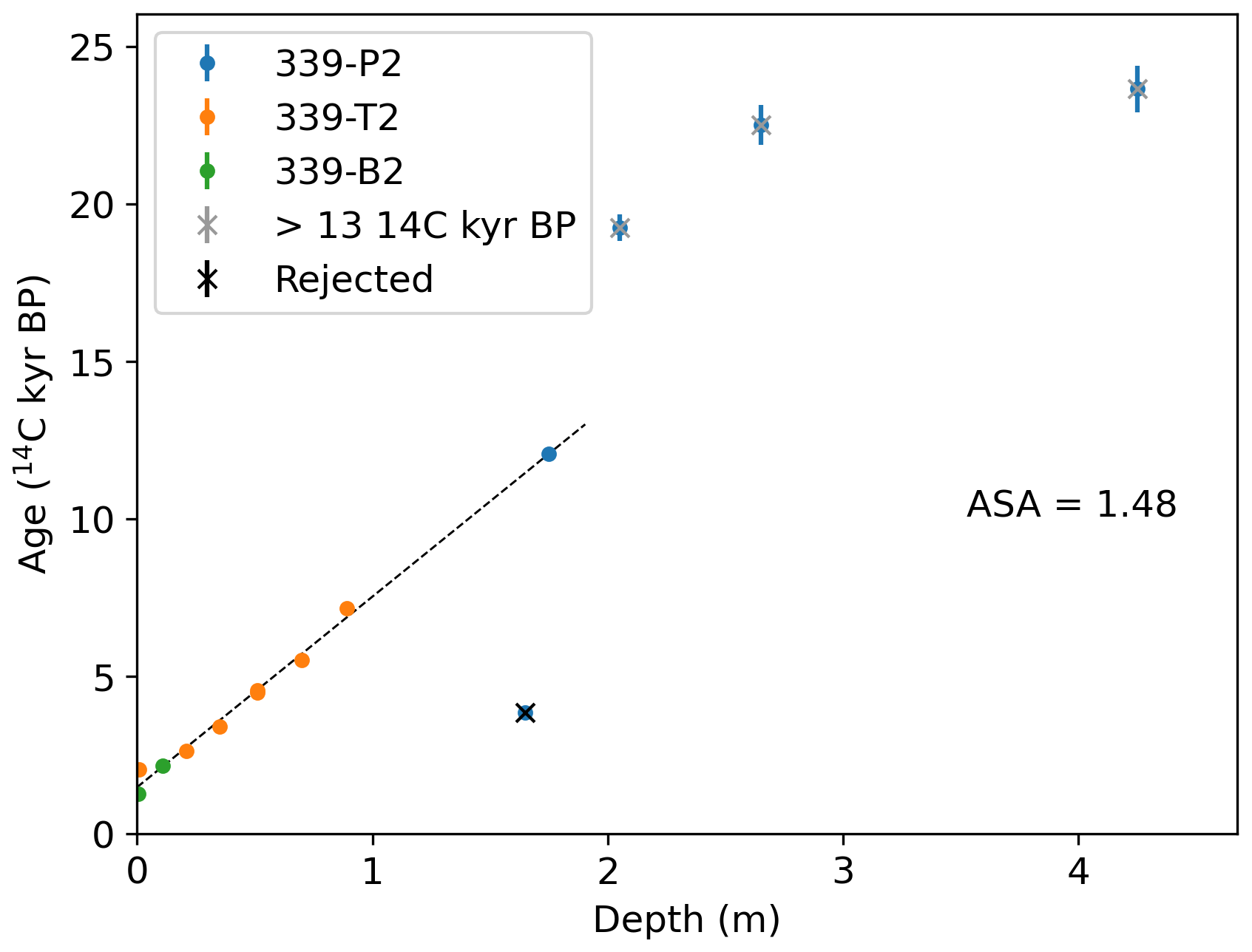
Figure 1An example of the creation of composite cores using cores from the same drilling site, following Colman et al. (1996). The radiocarbon ages (all from TOC) from cores 339-B2, 339-T2 and 339-P2 are plotted against depth forming a composite core from Site 339. Circles show the mean radiocarbon age and bars show the analytical 1σ uncertainty. Ages that are rejected or not used in the linear regression are overlain with a black or grey cross respectively. The rejected ages shown here follow the interpretation of Colman et al. (1996), and those older than 13 14C kyr BP are not used in the linear regression. The black dotted line shows the linear regression (only shown up to 13 14C kyr BP). The y-intercept, or ASA, is 1.48 14C kyr BP. In our interpretation of this core, we additionally rejected the 2nd deepest date from 339-P2 (the single blue dot in this figure), because all other ages from this core seem problematic. Both interpretations return an ASA of 1.48 14C kyr BP.
3.1 Core Data Overview
Our review identified 51 cores that contained AMS 14C dates (Table 1; Figs. 2 and 3), encompassing 518 radiocarbon datapoints (Fig. 4). The dataset is publicly available (Newall et al., 2025). The cores are mainly located on two underwater ridges: the Academician Ridge, separating the Northern Basin and Central Basin, and the Buguldeika Saddle, separating the Central Basin and the Southern Basin. Bathymetric highs such as these are often chosen as coring sites because they often provide continuous and uninterrupted sediment records free from turbidites (Vologina and Sturm, 2009), unlike slopes, deep-water basins, or delta fan sites near the mouths of large rivers (Colman et al., 2003).
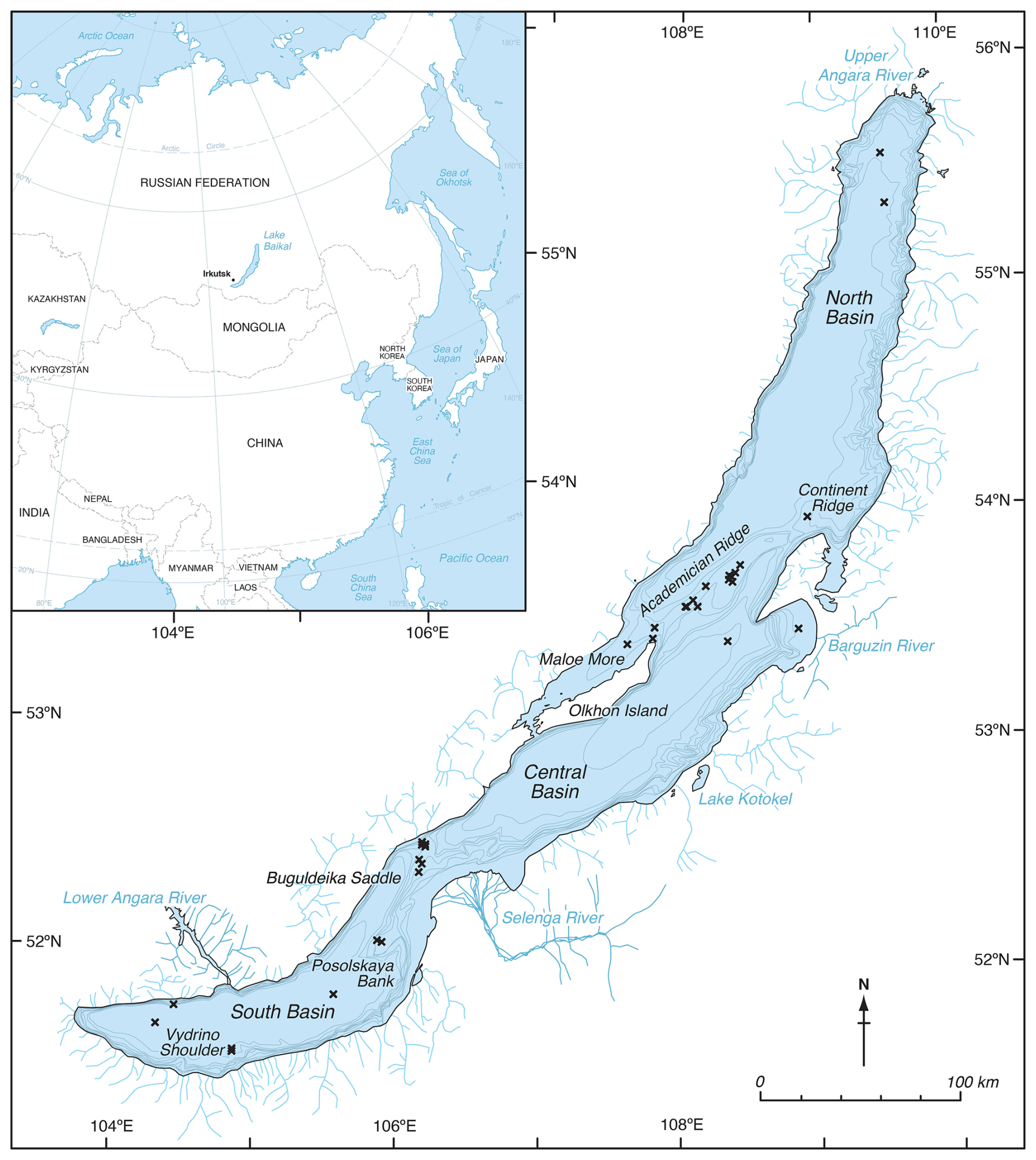
Figure 2Map of Lake Baikal showing location of all cores (black crosses). Relevant lake locations and major tributaries are labelled.
Table 1A list of all cores for which radiocarbon data were found. Each core was categorized by its general location, and the longitude, latitude and depth are provided. The references for the original radiocarbon data (or important metadata) are provided. Asterisks denote information that was not found.
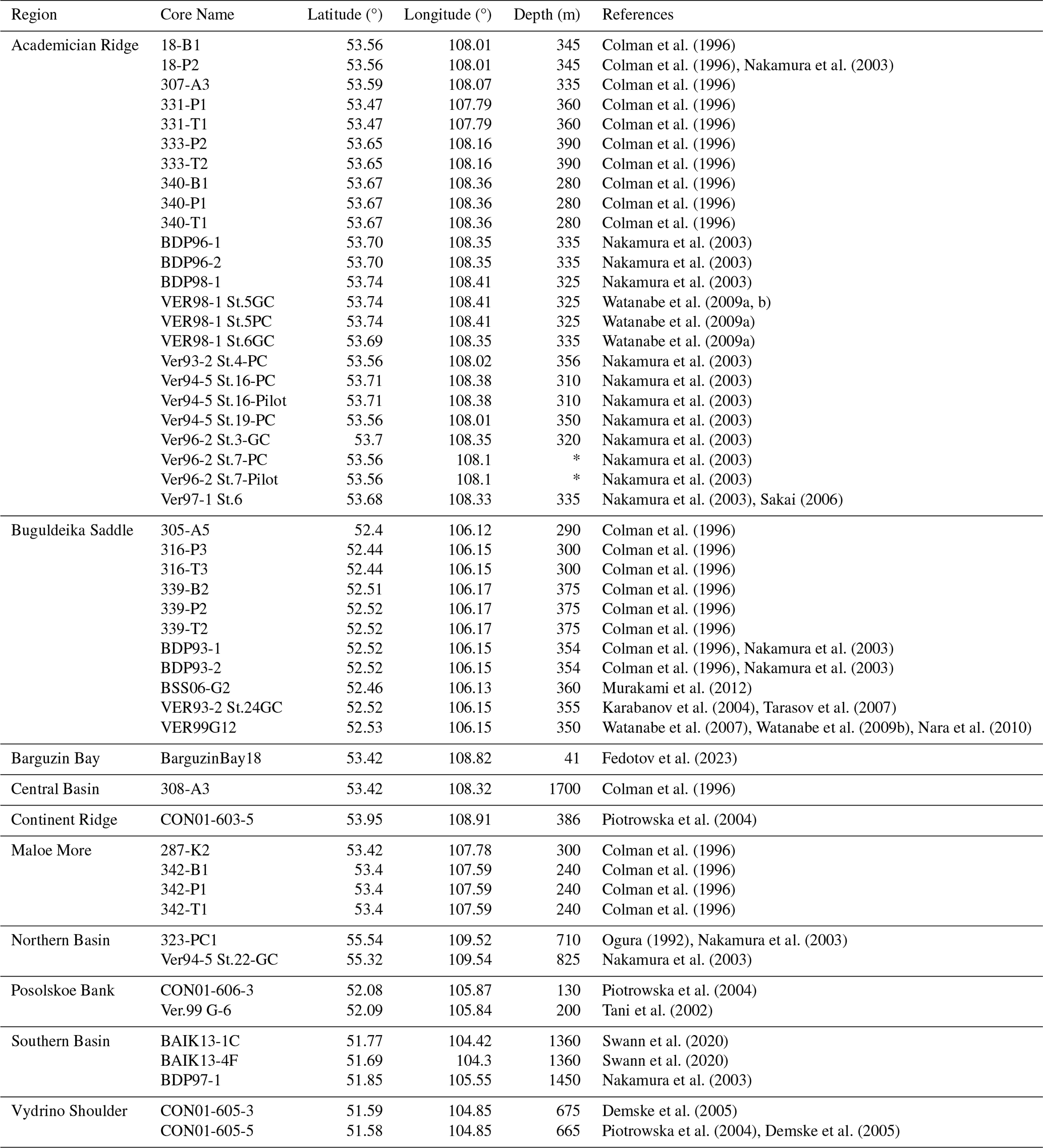
The location data provided for core CON01-603-5 by Piotrowska et al. (2004) and for core 287-K2 by Colman et al. (1996) placed the cores outside the boundaries of the lake. The location of 287-K2 was corrected by sight to match the locations provided on the map figures of Colman et al. (1996) and the location of CON01-603-5 was revised to fit that of Demske et al. (2005). Numerous slightly differing location data for BDP96-1 and BDP96-2 were found (Kashiwaya et al., 2001; Nakamura et al., 2003; Sakai et al., 2000), being 20 km apart at most. We use the value from Nakamura et al. (2003). Note, latitude/longitude data for core Ver97-1 St.6 was only found to the precision of degree minutes, not degree seconds (Sakai, 2006).
To aid the reader in finding the locations of cores in the densely cored regions, we provide higher resolution maps of Academician Ridge and Buguldeika Saddle (Fig. 3).
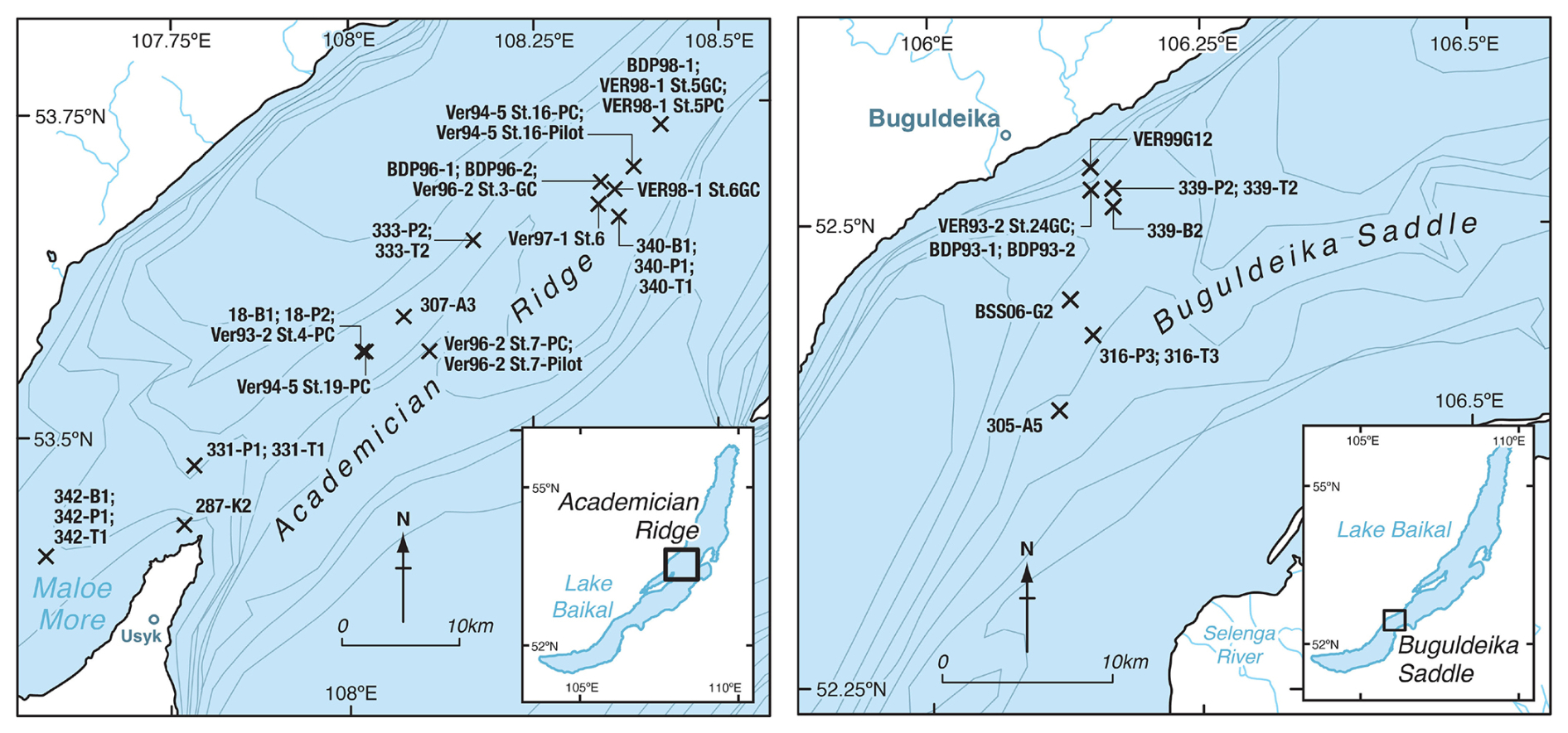
Figure 3Detailed maps of the core locations in Academician Ridge (left) and Buguldeika Saddle (right). Black crosses denote core locations; some crosses represent multiple cores.
3.2 Radiocarbon Ages Overview
The cores in the database have between 1 and 71 radiocarbon dates (Fig. 4). The vast majority of radiocarbon dates (438 dates) in the dataset are from TOC (a.k.a. decalcified bulk sediment). The dates from core BarguzinCore18 (8 dates) were described as being from “bulk silty clay” - no acidification/decalcification step is mentioned, hence we are unable to confirm that they are TOC dates (they may contain inorganic carbon). Pollen concentrates have also been dated (42 dates). However, they are not nearly as widely exploited due to their more intensive preparatory workload. It is notable that the pollen concentrate dates still seem to suffer from age offsets, as they show non-zero surface ages after regression (Demske et al., 2005). A few other materials have been dated but only in very low numbers. These include total lipids (9 dates), picked organic matter (POM; 7 dates), fine organic matter (FOM; 5 dates); lipid fraction (2 dates); and wood (2 dates). Note that POM and FOM relate to two different forms of organic matter, described by Colman et al. (1996). It was concluded that they were not statistically different to the TOC ages they reported.
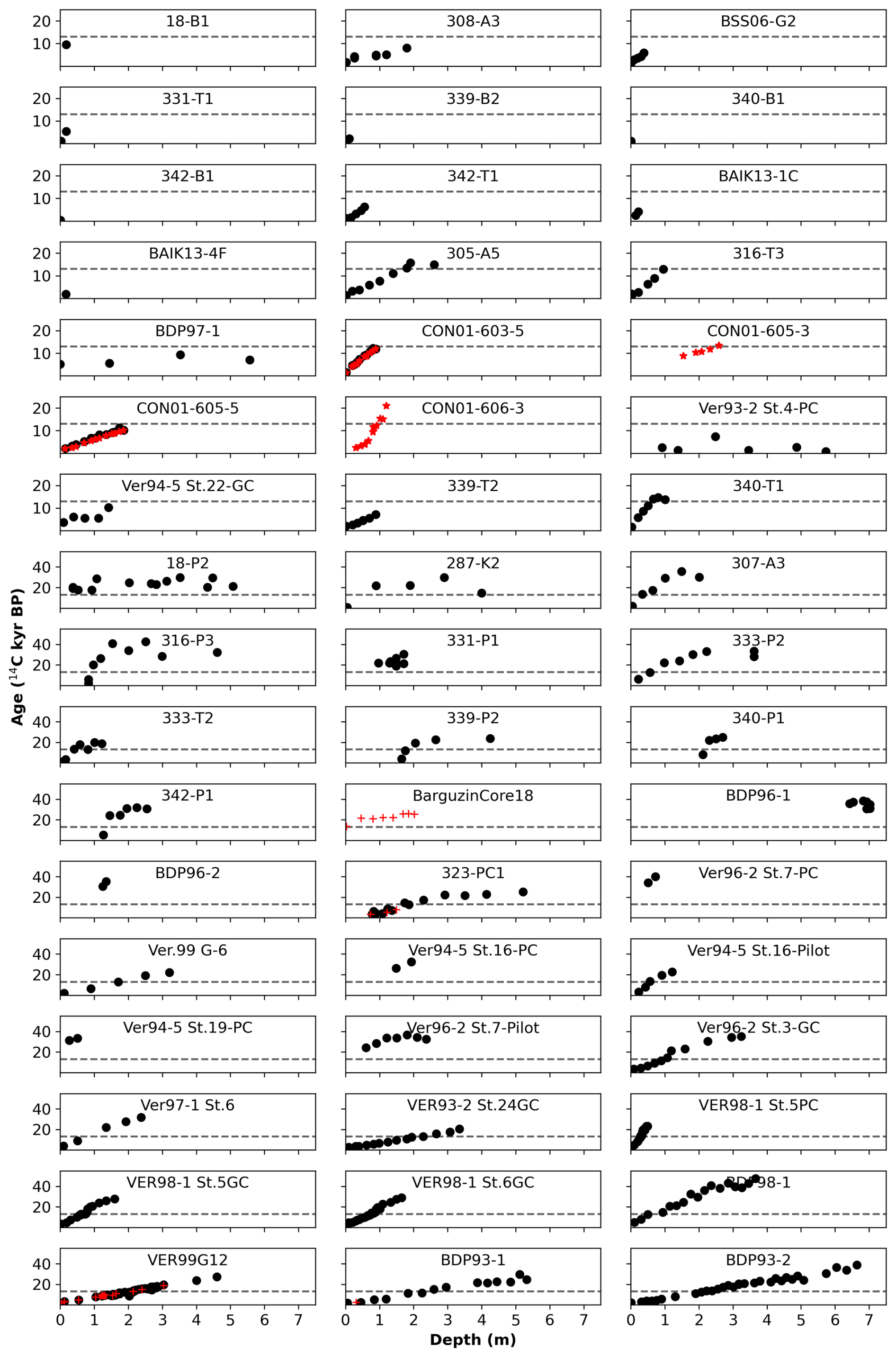
Figure 4Radiocarbon data from all 51 cores in this database, with mean uncalibrated radiocarbon age in 14C kyr BP on y axis and depth in m plotted on x axis. TOC ages are shown as black dots, pollen ages as red stars, and all other materials (lipids, diatom/pelitic silt, wood) are shown as red crosses. The top seven rows have smaller y axis limits to better show shorter cores. All x axes are the same. Horizontal dashed lines are plotted at 13 14C kyr BP to highlight the cut-off for our linear regression method.
Several errors were found in Table 2 of Colman et al. (1996) providing depth values off by a factor of 10. These were cross-checked by contacting Steven M. Colman and are reported correctly here. These errors were simply transcription errors, so no results are affected. Lab IDs and sample top/bottom depths for core BSS06 G-2 were added to this dataset by personal communication with Murakami. Finally, some lab codes that were wrongly transcribed in Nara et al. (2023) are corrected. Four dates were reported with negative radiocarbon ages, all from core Ver93-2 St.4-PC, including one with an age of −13.365 ± 80 14C kyr BP (i.e. a fraction modern value of 5.237 ± 0.049) at a core depth of 653 cm. We include them in the database for completeness. Nine dates were reported with “lower-bound” radiocarbon ages (i.e. “> 43 240”), all from cores BDP96-1 and BDP96-2: These are reported in a separate file (non_numeric_data.tab) for completeness, but we suggest not using them.
3.3 Age Offset Estimates from Linear Regression
Of the 51 cores with radiocarbon data reported in this compilation, 26 are used to calculate age offsets. In total, 21 ASA estimates are made, using 140 TOC ages. To recap, the ASA is the y-intercept of the linear regression on TOC ages younger than 13 14C kyr BP and represents an estimate of the age offset. The results for each core, grouped by their location, are provided below alongside the mean and sample standard deviation for each location.
3.3.1 Academician Ridge
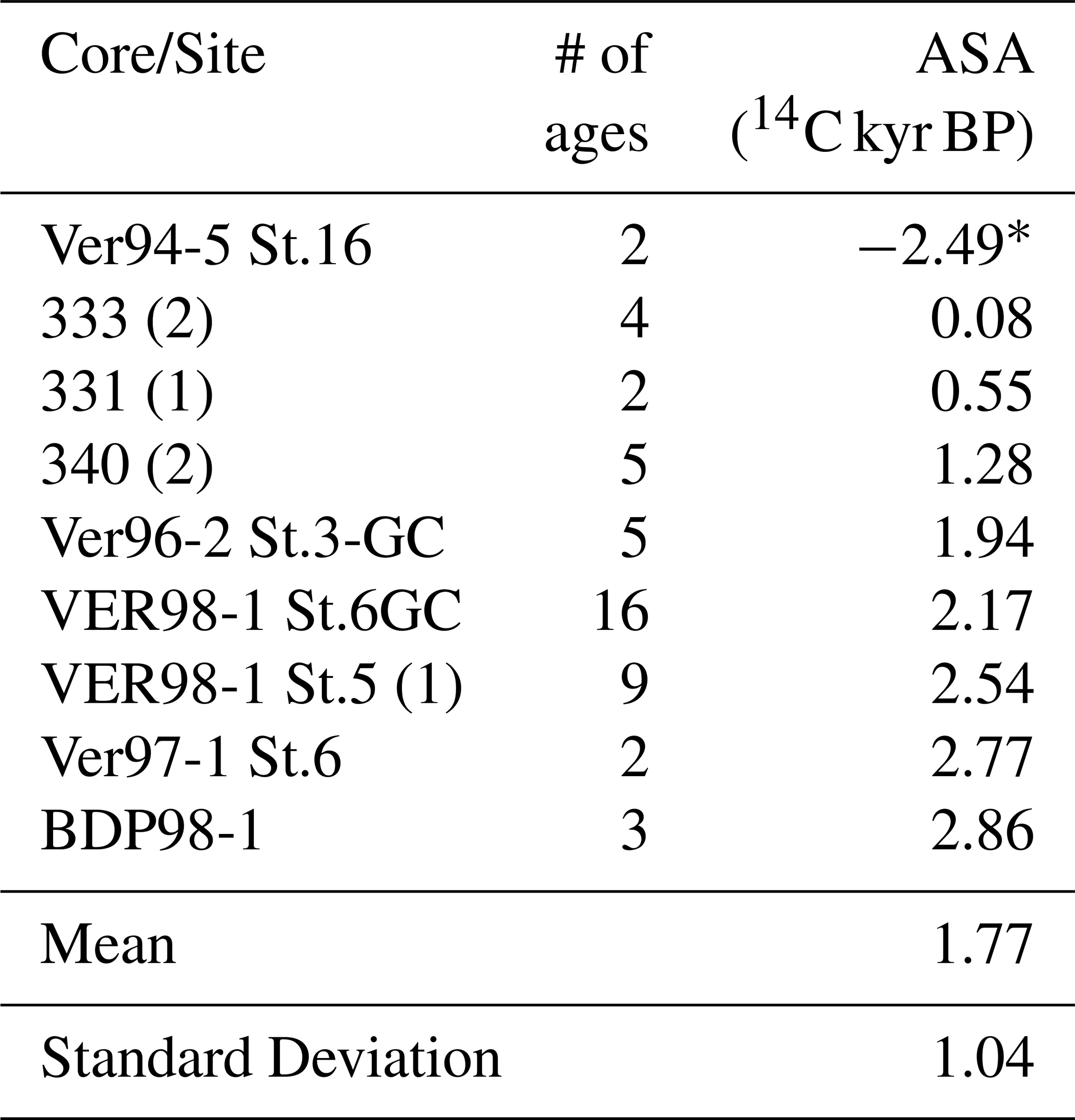
The ASA of 9 sites, using 11 cores, were returned from Academician Ridge (Table 2). Core Ver94-5 St.16 returned a negative age offset estimate and we consider it an outlier, leaving 8 accepted ASAs. Cores 18-P2 and 18-B1 were left out as the former was non-linear and the latter only had one age. Core 340-P1 was left out because its only age younger than 13 14C kyr BP was a large reversal from the older ages of 340-T1 and was clearly erroneous. Core 307-A3 was left out because it only had one age younger than 13 14C kyr BP. Cores 331-P1, Ver94-5 St.19-PC, Ver96-2 St.7-Pilot, Ver96-2 St.7PC, BDP96-1, and BDP96-2 were left out because they had no ages younger than 13 14C kyr BP. Core Ver98-1 St.5PC seems to have suffered from partial compression (clear from comparison to Ver98-1 St.5GC; Watanabe et al., 2009a) so was left out.
Table 2The ASAs (14C kyr BP) for each core/site at Academician Ridge. Where cores were analysed as a composite, the number of cores from which data was used in the linear regression is denoted in parentheses. Cores with anomalous ASAs are marked with *.
3.3.2 Buguldeika Saddle
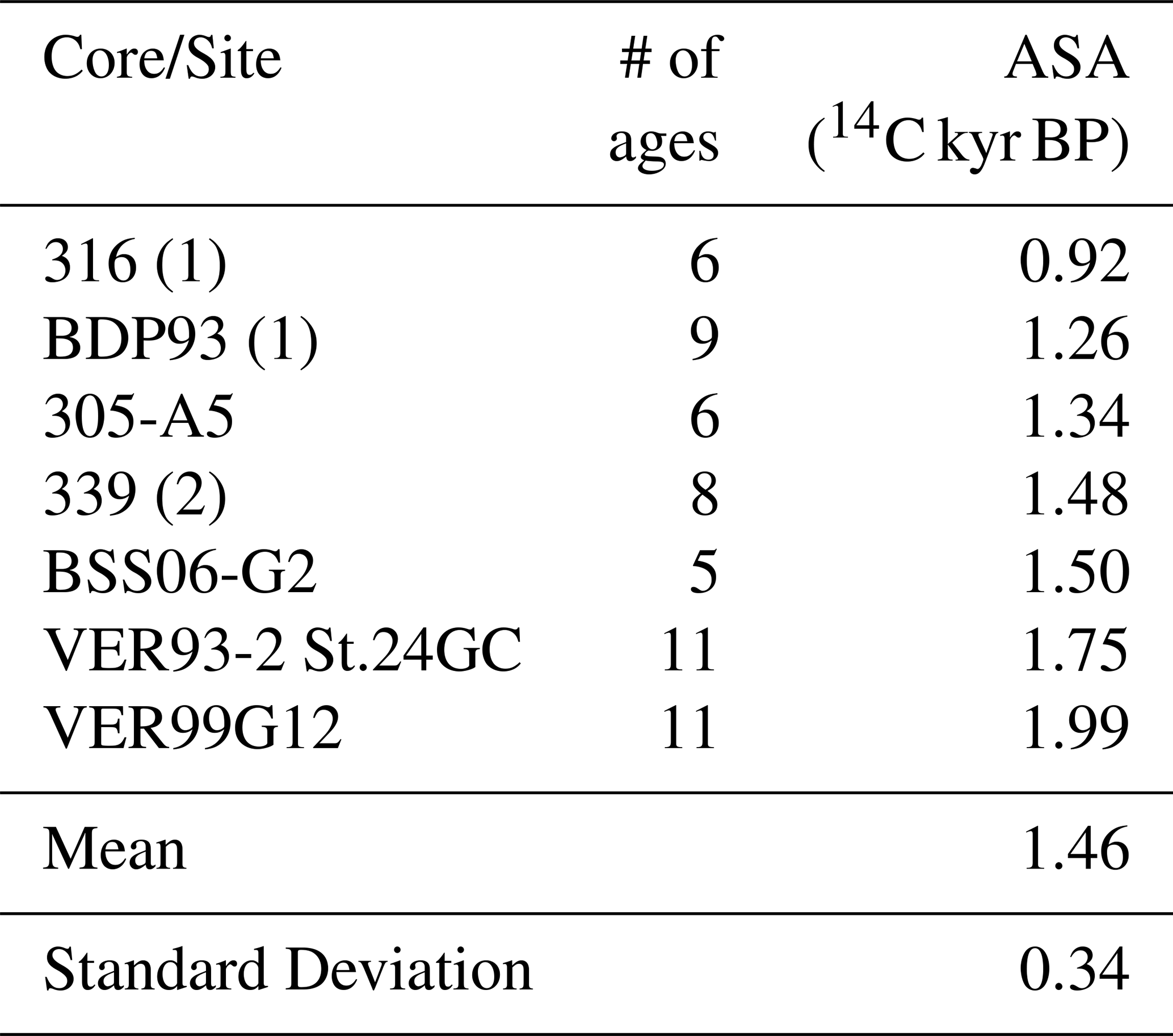
The ASA of 7 sites, using 8 cores, were returned from Buguldeika Saddle (Table 3). Core 339-P2 was left out due to its non-linearity (Fig. 1). Core 316-P3 was also left out due to its non-linearity. BDP93-1 was also left out, due to its suspected contamination by modern carbon (Colman et al., 1996). Including data from BDP93-1 would have changed the BDP93 ASA to 1.15 14C kyr BP.
Table 3The ASAs (14C kyr BP) for each core/site at Buguldeika Saddle. Where cores were analysed as a composite, the number of cores from which data was used in the linear regression is denoted in parentheses.
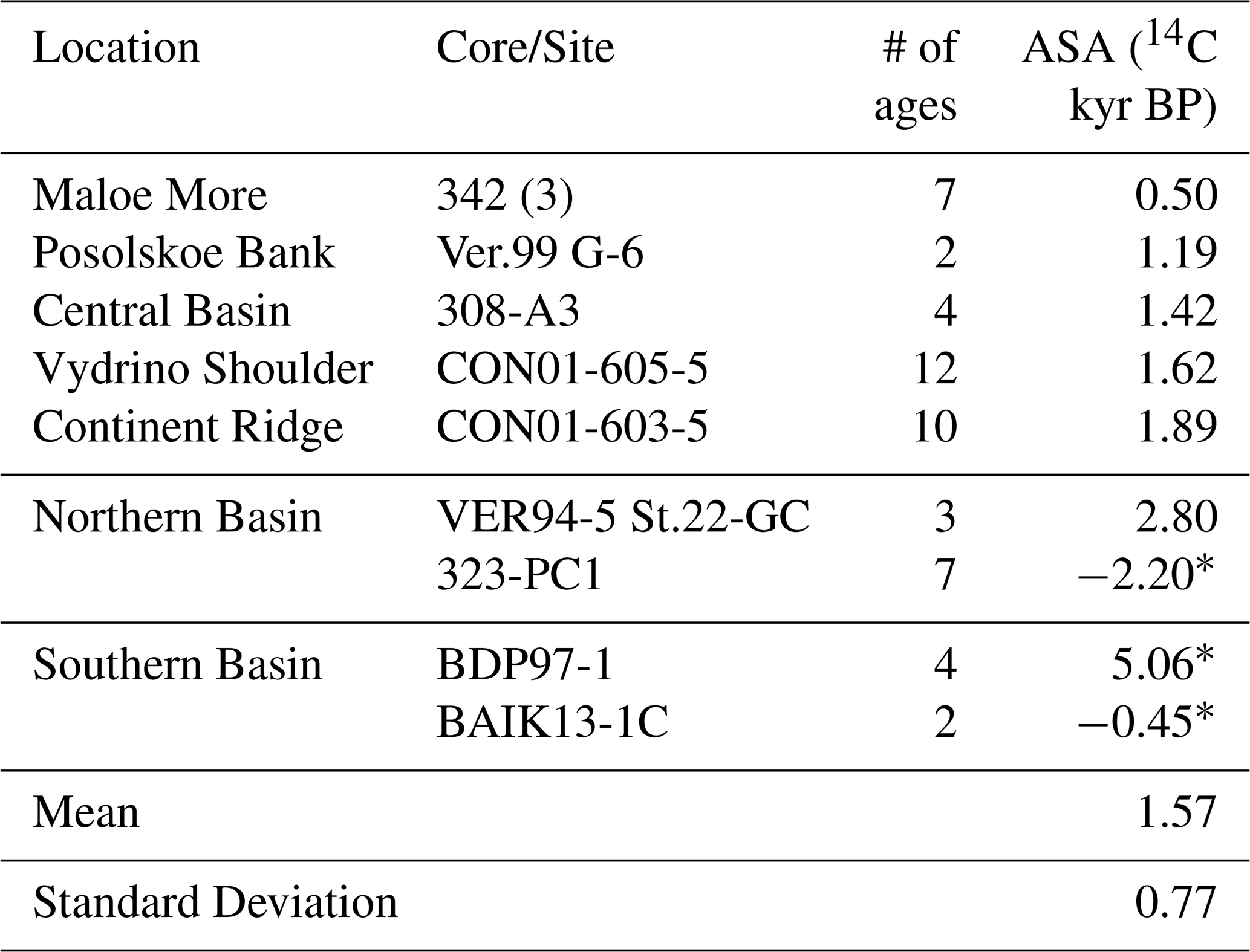
3.3.3 Other Locations
The ASA of 8 sites, using 10 cores, was returned from other locations in the lake (i.e. not Academician Ridge or Buguldeika Saddle; Table 4). The ASA of 1 site, using 3 cores, was returned from Maloe More. Core Ver.99 G-6 has a 10 cm depth correction applied (Tani et al., 2002) after comparison with a corresponding multiple core M-6. Both CON01-603-5 and CON01-605-5 were suggested by Demske et al. (2005) to have had sediment missing from the core tops. Morley et al. (2005) calculated a depth correction for CON01-605-5 of 12.5 cm based on correlation of diatom species profiles, which we apply to this data. However, no such depth correction for CON01-603-5 has been provided, so its ASA may be an overestimate. We did not calculate an ASA for core BarguzinBay18 for two reasons. First, we could not confirm that dates from core BarguzinBay18 were TOC dates, and second, it has no ages younger than 13 14C kyr BP. The top 3 cm of core sediment returned a radiocarbon age > 13 14C kyr BP, suggesting there has been erosion at this location, likely due to its shallow setting or proximity to the mouth of the Barguzin river, further rendering the core unsuitable for the linear regression method.
Table 4The ASAs (14C kyr BP) for each core/site in other regions. Where cores were analysed as a composite, the number of cores from which data was used in the linear regression is denoted in parentheses. Cores with anomalous ASAs are marked with *.
3.3.4 Synthesis
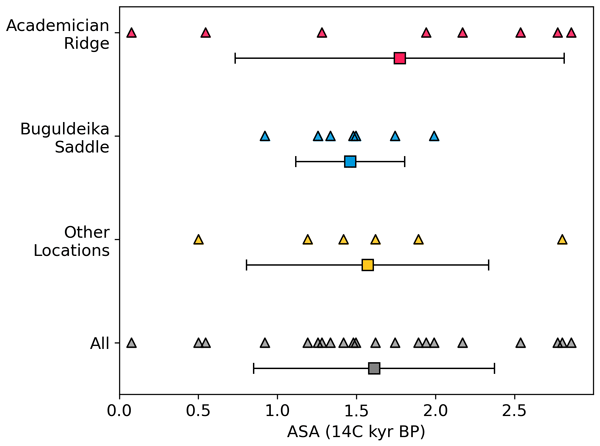
Our results have a mean and standard deviation of 1.61 ± 0.76 14C kyr BP (Table 5; Fig. 5). The median estimate is similar to the mean, at 1.50 14C kyr BP and a Shapiro-Wilk test returns a p-value of 0.69, suggesting it would be reasonable to consider the results normally distributed. The means for Buguldeika Saddle, Academician Ridge, and for all other locations are similar to the mean of the entire lake (Fig. 5). The minimum and maximum ASA estimates are 0.08 and 2.86 14C kyr BP respectively, both from Academician Ridge, providing a very large range. The Buguldeika Saddle region provides a much less variable set of ASA estimates than Academician Ridge.
Table 5Summary statistics of all ASA (14C kyr BP) estimates, when looking at different subsets, one of which being the entire lake. The standard deviation is calculated as the sample standard deviation.
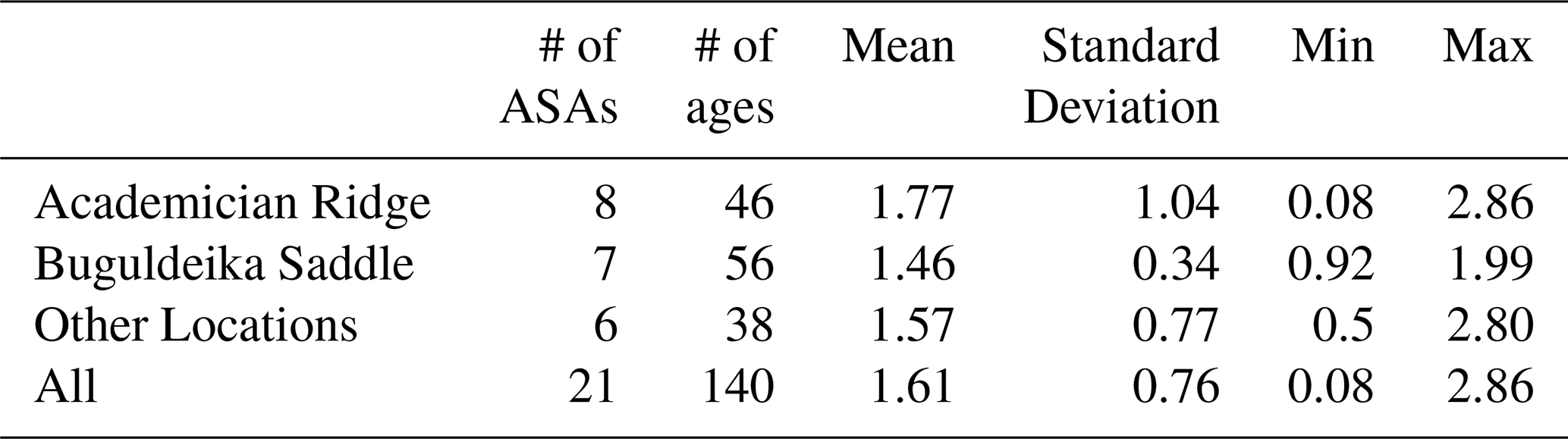
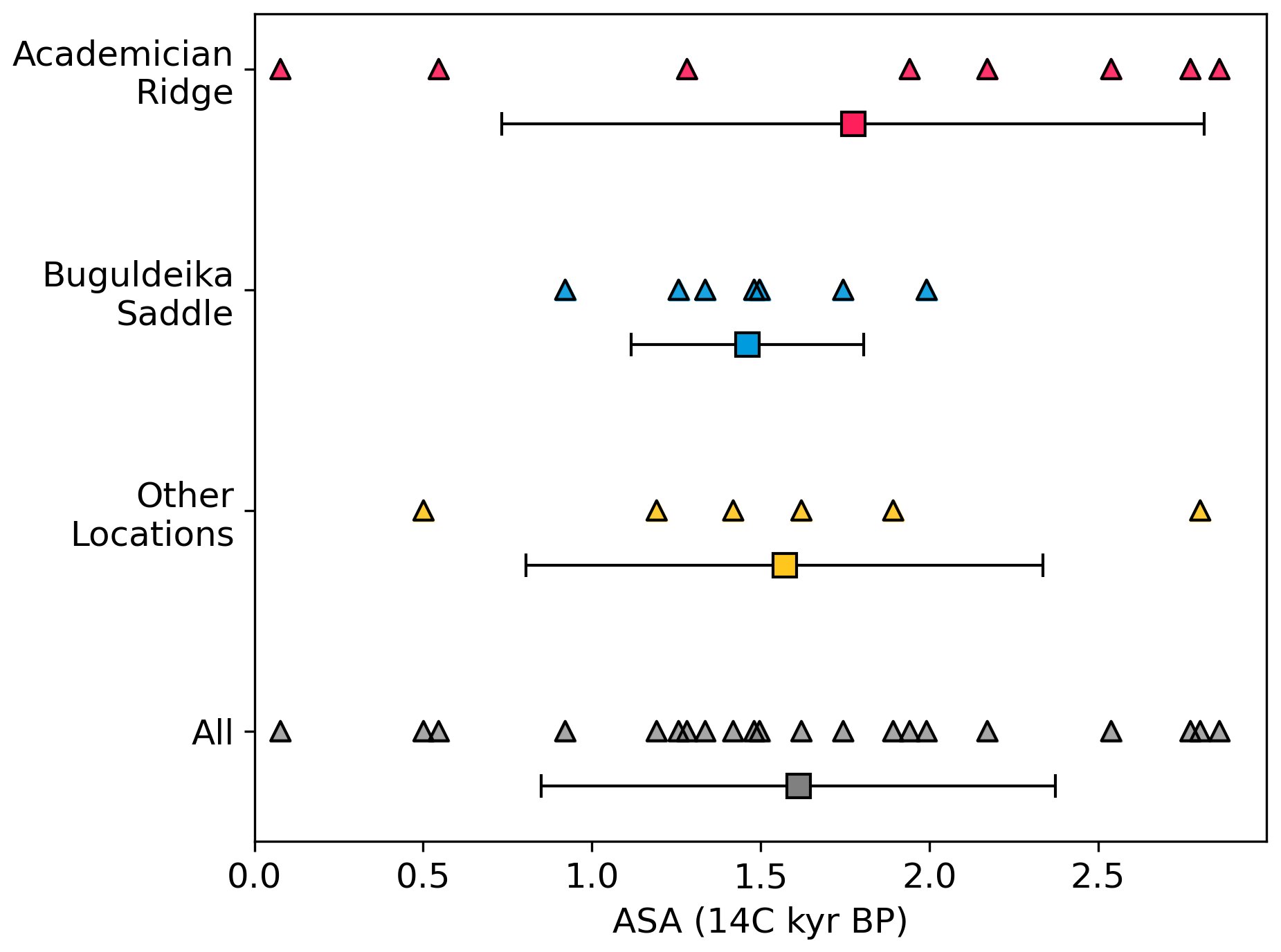
Figure 5Individual ASA estimates (triangles) grouped as being either from Academician Ridge, Buguldeika Saddle, or other locations. The mean of each location is denoted as a square and the standard deviation is illustrated with symmetrical error bars. Estimates from all locations are then considered as a single group (“All”, in grey), showing the mean and standard deviation.
4.1 Data Compilation
Whilst radiocarbon specific data compilation papers have been published for Lake Baikal before (Colman et al., 1996; Nakamura et al., 2003) this paper represents the first complete collection of all AMS radiocarbon data from sediment cores published before 2025 for Lake Baikal. Whilst most of the data we present is not of our own analysis, the paper represents a large step towards making all the data more accessible for future reuse. Having all data in one compilation, with transcription errors fixed, extra metadata, and some data made accessible for the first time will reduce the time needed to find/verify data of interest. We hope it may encourage those interested to utilise more data than they would have previously or to work on compiling databases of other proxies from the lake. Within the radiocarbon realm there is still room for growth, as radiocarbon dates from surface sediment samplers, sediment traps, suspended sediment and DIC are not included here but are present in the literature and regularly invoked when discussing the age offset (discussed in detail below; Colman et al., 1996; Prokopenko et al., 2007; Watanabe et al., 2009a). We stuck to data from sediment cores as opposed to from other sources in this paper due to the significantly better reporting of sediment core data.
4.1.1 Poor Representation in Data Repositories
Archiving of radiocarbon data (and proxy data in general) from Lake Baikal into international data repositories has been poor; compiling data using typical data repositories (Neotoma, Pangaea, NOAA) provided data from only three cores (searches done as of 1 July 2025): Neotoma contained 1 dataset for core CON01-603-5, but under a slightly different core name (CON16035); Pangaea contained datasets for CON01-603-5, CON01-605-5 and CON01-606-3, although data for core CON01-606-3 was reported twice with differing reporting standards; NOAA held no radiocarbon datasets from Lake Baikal. Furthermore, interrogating the case of CON01-605-5 from Pangaea, this dataset is actually a composite core consisting of dates taken from neighbouring cores CON01-605-5 and CON01-605-3. Whilst composite cores are certainly useful when presenting and analysing data for study, we only report datasets that are delineated by core (and we deconstruct composite cores into their original cores), as this helps highlight the origin of the data.
The lack of this representation in recognised data repositories means these data are not contributing to influential large scale data compilation or assimilation projects (Erb et al., 2022; Kaufman et al., 2020). Whilst reporting their radiocarbon data alone will not allow their inclusion in such studies, this study may act to spur proxy compilation work for Lake Baikal or the Baikal region.
4.1.2 Naming/Data Inconsistencies
Horiuchi et al. (2000) report radiocarbon data from a gravity core “VER94/st.16” which were identical to data reported by Nakamura et al. (2003) from core Ver94-5 St.16-Pilot and a sediment sampler – we report the data under Ver94-5 St.16-Pilot and do not report the date from the sediment sampler (which has laboratory code NUTA-4152). This inconsistency in core naming, and the reporting of a date from a sediment sampler as if it was from a core, makes proper reuse of data more difficult. Inconsistency in the spellings of different locations within the lake, such as five different spellings for Posolskoe Bank, may also make searching for relevant literature difficult. However, different spellings are to be expected across such a broad range of research, perhaps for cultural or linguistic reasons. We chose the more common spellings in the radiocarbon literature (such as “Northern Basin” instead of “North Basin” and “Posolskoe Bank” instead of “Posolsky Bank”). There were also inconsistencies in the data reported for a single core between different papers: For example, subsequent papers describing radiocarbon data for cores Ver93-2 St.24GC and VER99G12 sometimes left out some radiocarbon dates from previous papers without explanation. Lastly, there were some radiocarbon data with identical laboratory codes (which are supposed to be unique) but different data.
4.1.3 Data Reporting Conventions
Despite longstanding published conventions for reporting radiocarbon ages (Stuiver and Polach, 1977) and recent calls for better adherence to these conventions (Millard, 2014) many of the papers that have reported radiocarbon in Lake Baikal do not follow the conventions. All followed the most important convention of reporting conventional radiocarbon ages. However, two papers did not provide the laboratory codes (Murakami et al., 2012; Swann et al., 2020) and 7 papers did not provide any quality control measurements such as δ13C in their radiocarbon data tables (Fedotov et al., 2023; Murakami et al., 2012; Nara et al., 2023; Swann et al., 2020; Watanabe et al., 2007, 2009a, b). We were able to gather much missing information by contacting the authors, but not all authors were within contact. We reaffirm the need for better adherence to radiocarbon age reporting conventions.
Another proposal by Millard (2014) is that the pretreatment method should be described or referenced. Description regarding preparation of samples for dating TOC was generally very concise. All papers, with the exception of Fedotov et al. (2023), describe an acidification step similar to the steps we describe in Sect. 2.2. Only Colman et al. (1996) describes any sieving procedure, but this is likely because they analysed samples of both picked organic matter (POM) and fine organic matter (FOM) to evaluate whether these fractions of organic matter may have provided better results than TOC. They found no consistent relationship between the POM, FOM, and TOC ages, which may be why future studies did not mention (and therefore, we assume, did not perform) any sieving or filtering. No papers reported any treatment with alkaline solution to remove base-soluble organic carbon (humic acids).
No convention has been agreed upon regarding how to report sample depth information from sediment cores. In the papers reporting radiocarbon data in Lake Baikal, sample depth information was reported in the following three ways: (1) reporting the top and bottom depth of the core sample; (2) reporting the middle depth and thickness of the core sample; (3) reporting just the middle depth of the sample. Khider et al. (2019) record a community belief that sample thickness should be an essential property to report and note a community preference for top and bottom depth to be reported. Lacourse and Gajewski (2020) stress the importance of this metric after analysing a set of publications from 2018 and 2019 in Quaternary Research and Journal of Quaternary Science, finding that 75 % of 34 papers they analysed failed to report sample thickness. Only 56 % of radiocarbon dates in this compilation contain thickness data. We reaffirm the need for better reporting of sample thickness, either by reporting top and bottom depth of the core sample or reporting the middle depth and thickness.
4.2 Age Offset Estimates
The application of a single age offset estimation method to a number of cores within a single lake, or a single region of a lake has been done before by Colman et al. (1996; n= 10 age offset estimates) and Watanabe et al. (2009a; n= 3 age offset estimates) however this study represents the largest number of cores analysed with the same method (n= 21 age offset estimates). The method used in this paper is similar to that of Colman et al. (1996). The method of Watanabe et al. (2009a), by contrast, aligns positive anomalies in linear sedimentation rate to the radiocarbon plateau of the Younger Dryas. We first discuss other results on the age offset for Lake Baikal, then compare them to our own. The papers discussed below are not an exhaustive list of papers that utilise an age offset estimate but focus on those that make some justification for their choice.
4.2.1 Previous Age Offset Estimates
Colman et al. (1996) use linear regression methods to estimate the age offset for cores in Lake Baikal, using either the topmost two ages in a core or all ages younger than 13 14C kyr BP. The cores they analyse come from either the Academician Ridge or Buguldeika Saddle regions. They report that the age offsets from these two regions are distinct from each other (0.47 ± 0.37 14C kyr BP at Academician Ridge and 1.22 ± 0.18 14C kyr BP at Buguldeika Saddle). They hypothesise that the older age offset in Buguldeika Saddle may be due to an influx of older terrigenous sediment from the Selenga River, with its outflow very near the Buguldeika Saddle, supported by a radiocarbon age of 2.68 ± 0.03 14C kyr BP from suspended sediment of the Selenga River. However, they recognise that where allochthonous carbon is ∼ 10 %, as in Academician Ridge, even infinitely old terrigenous sediment could not cause some of the age offsets they observe.
Karabanov et al. (2004), use a regression methodology to estimate an age offset of 1588 years from core VER93-2 st.24GC in the Buguldeika Saddle, however, they do not describe whether all their dates are used for regression. This result was not reproducible by us using any subset of their ages. Tarasov et al. (2007), examining the same core, chose instead to use an age offset estimate from Colman et al. (1996). However, instead of using the average Buguldeika Saddle estimate of 1.22 ± 0.18 14C kyr, they use 1.16 14C kyr based on the linear regression of the BDP93 cores' radiocarbon data.
Demske et al. (2005) estimate the age offset of pollen concentrate ages (not the TOC age offset) by performing linear regressions on three cores, however the number of ages used for each regression is not described. For core CON01-603-5 (Continent Ridge) they use a value of 0.930 14C kyr, which we could reproduce using the shallowest three ages in the core. For core CON01-606-3 (Posolskoe Bank) they report a value of 0.675 14C kyr and for the composite core consisting of cores CON01-605-3 and CON01-605-5 (Vydrino Shoulder) they report a value of 0.96 14C kyr. We could not reproduce either of those values using any combination of their data with a simple ordinary least squares linear regression. Note these results are from pollen concentrates, which likely have a different age offset to TOC. The non-zero nature of these offsets however highlights that pollen concentrate ages in Lake Baikal still suffer from an age offset, similar to what has been determined by other studies (Kilian et al., 2002; Neulieb et al., 2013; Schiller et al., 2021), possibly through contamination or redeposition.
Prokopenko et al. (2007) argue that a “true reservoir effect for a lake cannot be core- or site-specific” and reject age offset estimates determined from linear regression-based approaches due to their resulting in “core-specific reservoir corrections… from the same site”. However, the different estimates from nearby cores can be simply reconciled by recognising that the estimation method used has uncertainty, like all estimation methods. Further, they propose that Lake Baikal TOC age corrections “should not exceed 500 years”. However, this proposal is based on 3 ages from surface sediments or modern sediment traps, which may underestimate the age estimates due to bomb carbon (Colman et al., 1996) and their justifications show misunderstandings that both wood samples and pollen concentrates are free themselves from age offsets (which they are not). For example, Prokopenko et al. (2007) suggest a “critical cross-check” for the TOC age offset is available in the radiocarbon ages of the twin BDP-93 cores, referencing a wood and a TOC age that are from similar depths in different cores. The wood age is approximately 500 years younger than the slightly deeper TOC age, so imposing an offset of over 500 years on the TOC age creates a stratigraphic reversal, the deeper age now being younger. This supposed contradiction, however, doesn't account for the fact that wood ages are also known to have age offsets (Hatté and Jull, 2013). For example, Oswald et al. (2005) compare the ages of different macrofossil types in Arctic lakes and find that “wood and charcoal are generally older than other macrofossils of the same sample depth with age differences ranging from tens to thousands of years”, which they attribute to the decay-resistance and/or the in-built age of woody macrofossils. Similarly, Prokopenko et al. (2007) discuss a lamina enriched in the diatom Synedra acus and compare the age of this lamina in CON01-603-5, interpolated from pollen concentrate ages, to the TOC ages of similar lamina in three other cores. They suggest the difference in radiocarbon age of only ∼ 0.3 14C kyr is consistent with a 500-year adjustment to bulk TOC ages. Again, this doesn't account for the fact that pollen concentrate ages can exhibit age offsets (Kilian et al., 2002; Neulieb et al., 2013; Schiller et al., 2021). These two instances of mistaking dates of terrestrial material as being free of age offsets highlight here the utility in using the term age offset, instead of reservoir age: The fact that terrestrial material is free of a reservoir age does not mean it is free of an age offset.
Watanabe et al. (2009a) present radiocarbon dates from three cores in Academician Ridge each showing a region of paired positive and negative linear sedimentation rate (LSR) anomalies. These events all show anomalously low apparent sedimentation rate and then anomalously high apparent sedimentation rate before returning to `normal' sedimentation rates at 12.1 14C kyr BP or 12.2 kyr BP. Several explanations for these LSR anomalies are ruled out before settling on the possibility that they represent the radiocarbon plateau of the Younger Dryas (YD). Using a calendar age of 11.6 cal kyr BP for the end of the YD, they de-calibrate this to 10.1 14C ka BP and calculate a 2.1 ± 0.09 14C kyr correction to match their LSR anomaly dates to the end of the YD. The uncertainty of their estimate does not include the uncertainty of the de-calibration, however.
Nara et al. (2010) apply an age offset of 0.5 14C kyr to both TOC dates and pollen concentrate dates from core VER99G12. They mention the modern sediment trap radiocarbon age of 0.61 ± 0.04 reported by Colman et al. (1996) and that Boës et al. (2005) found a lag of ∼ 500 years between the GISP2 δ18O and a record of grayscale fluctuation from core CON01-603-5 attached to a pollen concentrate radiocarbon chronology (no age offset correction is mentioned for the pollen concentrate radiocarbon chronology). Recognising the offset predicted by Watanabe et al. (2009a) of 2.1 ± 0.09 14C yr at Academician Ridge, they suggest that this lower offset at Buguldeika Saddle may be due to a large input of modern organic material from the Selenga River. Coincidentally, this is the mirror image of the reasoning Colman et al. (1996) who suggested the Selenga may have provided older carbon material.
Murakami et al. (2012) use an age offset value of 1.418 14C kyr. This is inferred from a radiocarbon date from depth 0–1 cm in their core BSS06-G2, reported with an age 1.418 ± 0.036 14C yr BP, assuming that this sediment should be approximately modern.
Nara et al. (2023) correct for a reservoir effect of 0.38 14C kyr in core VER99G12, due to the 380 year water residence time of the lake measured by Shimaraev et al. (1993). There is no reason the residence time of water should impact the reservoir age, however, especially given the lake's rapid ventilation rates (Weiss et al., 1991).
4.2.2 Our Age Offset Results
We return 21 age offset estimates from cores across the whole lake (Fig. 5; Table 5). The range of accepted estimates (0.08–2.86) is greater than the range of estimates in the previous literature. The range and standard deviation of estimates from Buguldeika Saddle (n= 7), are much lower than the Academician Ridge (n= 8). The lower spread of estimates in Buguldeika Saddle is likely related to higher sedimentation rates, approximately 5 times that of the Academician Ridge (Colman et al., 2003), for two reasons: Regarding the estimation method, the y-intercept of a linear regression is more susceptible to error in the y-direction when the slope is lower; Regarding sediment processes, in slower accumulating sediments dates may be affected by post-depositional processes, such as bioturbation of the surface sediments, for longer.
The mean and standard deviation of the estimates from each site are 1.77 ± 1.04 14C kyr for Academician Ridge and 1.46 ± 0.34 14C kyr for Buguldeika Saddle. To test whether we can argue the Academician Ridge or Buguldeika Saddle have different age offsets we use a Welch's t-Test. This returns a p-value of 0.44, so we cannot reject the null-hypothesis that these regions have statistically indistinguishable age offsets. Estimates from other regions of the lake are all within the range of estimates from Academician Ridge providing no clear evidence that the age offset of the lake differs between different regions of the lake.
However, the absence of statistically significant spatial variation in age offset does not imply that spatial variability does not exist. This may contribute to the spread in ASA estimates, alongside other sources of variability such as: temporal variability of sedimentation rate; temporal variability of age offset; and variable loss of top sediment during coring. Temporal variability of sedimentation rate or age offset will increase scatter in the results but are not expected to introduce a systematic bias. In contrast, variable loss of top sediment during coring would introduce scatter and impart a bias towards older ASAs. This bias would be greater where sedimentation rates are lower, which may partially explain why the Academician Ridge ASAs have a greater mean than the Buguldeika Saddle estimates. Additionally, while all samples in our analysis appear to have undergone broadly comparable pretreatment (i.e., an acidification/decalcification step applied to bulk sediment), we cannot rule out the possibility that differences in laboratory pretreatment protocols contributed to some of the observed variability in age offset estimates.
Grouping the cores by location helps control for spatial variability in age offset, however even within our regional groupings the Academician Ridge cores are spread over ∼ 35 km and the Buguldeika Saddle cores over ∼ 15 km (Fig. 3). We highlight a cluster of cores/sites within the Buguldeika Saddle area (BDP93, 339, VER93-2 St.24GC, and VER99G12) that are within 2 km of each other (Fig. 3) and can, with high confidence, be expected to have experienced the same sediment input. These returned ASA estimates of 1.26, 1.48, 1.75 and 1.99 14C kyr BP respectively, with a mean and standard deviation of 1.62 ± 0.32 14C kyr BP. This demonstrates that factors other than spatial variability account for a standard deviation of at least 0.32 14C kyr in Buguldeika Saddle.
Other methods of estimating age offset, such as taking a surface sample or comparing to some perceived known date (i.e. Watanabe et al., 2009a), may seem to have lower uncertainty, however this uncertainty is likely less well constrained and may be just as large. We argue, therefore, that any estimate of age offset should, for Lake Baikal, incorporate a 1σ uncertainty of at least 0.32 14C kyr – a more conservative approach would be to use the standard deviation of all estimates in the lake, leading to a 1σ uncertainty of 0.76 14C kyr. Considering that most previous studies incorporated no uncertainty in their age offset estimates, or at the most an uncertainty of 0.09 14C kyr, it is clear that previous work using radiocarbon will have significantly underestimated their temporal uncertainty. Temporal changes in carbon dynamics may lead to temporal changes in the age offset. For example, given the change in carbon content in Lake Baikal sediments at 13 14C kyr BP, it is reasonable that the age offset of TOC may be significantly different when comparing post-glacial and glacial sediments, imparting further uncertainty on the age offset for older ages.
The indistinguishable mean age offsets at Academician Ridge and Buguldeika Saddle have interesting implications regarding the sources of the age offsets. A region-specific age offset may be explained by some source of older terrestrial carbon entering the system and having a local effect, for example through the Selenga River as was proposed by Colman et al. (1996). However, it is not obvious that this mechanism could explain the lake-wide age offsets that our results suggest.
More generally, our results highlight that the method of using a linear regression to estimate the age offset can have uncertainties of multiple hundreds of years. Linear regression is likely to provide a more accurate answer where sedimentation rates are high, but it should not be used where turbidites or variable sedimentation break the assumption of constant sedimentation that is required for the technique. Ideally, when used in previously unstudied lake systems, multiple cores should be taken/used to evaluate the uncertainty in the estimate. A further implication of our result is that many previous studies are likely to have significantly underestimated the uncertainty in their estimates of age offset.
4.3 Future Directions
Future work to improve the linear regression method would be welcome. For example, we followed Colman et al. (1996) in using simple ordinary least squares linear regression, however given the provided uncertainties in radiocarbon ages, a weighted least squares linear regression technique may be more appropriate. Furthermore, when multiple subsets of ages could be used in the regression for each core, we made a subjective choice regarding which subset to use (see choices for site 339, site BDP93, core VER99G12, core CON01-603-5, core CON01-605-5, core VER94-5 St.22-GC in the interactive computing environment) – protocol as to how to propagate the uncertainty related to making those subjective choices would be valuable. Most significantly, however, would be an update to incorporate calibration of the radiocarbon ages into the linear regression method. Without calibration the uncertainty of the ages is understated, and the assumption of constant sedimentation rates is not truly held, because the calibration curve is not quite straight. One difficulty would be that calibrated ages are often bimodal, non-parametric, and cannot be well-represented by a single point estimate (Michczyński, 2007) but a Monte-Carlo approach could solve this.
The linear regression method, regardless of any aforementioned improvements, assumes the age offset over the period of the regression is constant, so cannot resolve changes in the age offset. Understanding temporal changes in TOC age offset would not only improve geochronological pursuits but could be used to evaluate carbon cycle dynamics (e.g. Gaglioti et al., 2014; Lindberg et al., 2025) and would help uncover the cause of the TOC age offsets. Such studies typically use pairs of TOC and plant macrofossil radiocarbon dates, but plant macrofossils are not sufficiently found in Lake Baikal sediments to do this. However the promise of reliable radiocarbon dating free of age offsets through a new technique preparing pollen concentrates by Omori et al. (2023) may now make this possible.
The data can be accessed at https://doi.org/10.1594/PANGAEA.973799 (Newall et al., 2025).
In this study, we have (i) created a complete database of all AMS radiocarbon dates from Lake Baikal sediment cores published up to 2025, standardising the reporting, updating missing or incorrect metadata, and adding some previously unpublished dates, (ii) produced a new estimate of age offset for TOC in Lake Baikal sediments of 1.61 ± 0.76 14C kyr BP, and (iii) did not find evidence to suggest that different regions of Lake Baikal have a statistically different age offset, as previous studies have suggested. The primary implication of our results is that previous Lake Baikal studies have significantly underestimated the temporal uncertainty from radiocarbon results. More generally, our study has shown that a linear regression method for estimating age offsets has a large inherent uncertainty that has likely been underestimated when used in other lakes/previous studies. Other techniques for estimating age offset should be examined in a similar manner to evaluate their uncertainties. We hope that this study facilitates further research in Lake Baikal by improving access to, and understanding of, previous radiocarbon work that has taken place, and spurs on further work to understand the uncertainties in estimating radiocarbon age offsets.
A fully interactive computing environment (ICE) accompanying this study is archived in Zenodo and can be accessed at https://doi.org/10.5281/zenodo.18344188 (Newall, 2026). The ICE provides a Jupyter Notebook (notebooks/ASAanalysis.ipynb) containing age offset analyses and creation on non-map figures used in this paper. This allows readers to reproduce all scientific results presented here and to interact directly with figures, plots, and analytical steps. The ICE is containerized using Binder web services, enabling the notebook to be executed online in a browser without local installation. The environment can be accessed via its DOI on Zenodo, and executed through the Binder launch link provided in both the Zenodo record and the associated GitHub repository (https://github.com/samrsnewall/baikal_essd_ice, last access: 19 January 2026). To access the analyses within the ICE, navigate to notebooks/ASAanalysis.ipynb.
Conceptualisation: SN and AM, Data Curation: SN, Formal Analysis: SN, Investigation: SN and NP, Methodology: SN, Project Administration: SN and AM, Software: SN, Supervision: AM, Visualisation: SN, Writing: original draft preparation: SN and AM, Writing: Review and Editing: SN, AM, NP, and MB.
The contact author has declared that none of the authors has any competing interests.
Publisher's note: Copernicus Publications remains neutral with regard to jurisdictional claims made in the text, published maps, institutional affiliations, or any other geographical representation in this paper. The authors bear the ultimate responsibility for providing appropriate place names. Views expressed in the text are those of the authors and do not necessarily reflect the views of the publisher.
Many thanks to Miles Irving for creating the map figures. We are very grateful for feedback from Darrell Kaufman and one anonymous reviewer that made the manuscript much tighter and more thorough. We would also like to acknowledge the great help we received from Daniela Ransby and the PANGAEA team.
This paper was edited by Alessio Rovere and reviewed by Darrell Kaufman and one anonymous referee.
Anchukaitis, K. J. and Tierney, J. E.: Identifying coherent spatiotemporal modes in time-uncertain proxy paleoclimate records, Clim. Dynam., 41, 1291–1306, https://doi.org/10.1007/s00382-012-1483-0, 2013.
Björck, S. and Wohlfarth, B.: 14C Chronostratigraphic Techniques in Paleolimnology, in: Tracking Environmental Change Using Lake Sediments, vol. 1, edited by: Last, W. M. and Smol, J. P., Kluwer Academic Publishers, Dordrecht, 205–245, https://doi.org/10.1007/0-306-47669-X_10, 2002.
Blaauw, M. and Christen, J. A.: Flexible paleoclimate age-depth models using an autoregressive gamma process, Bayesian Anal., 6, 457–474, https://doi.org/10.1214/11-BA618, 2011.
Boës, X., Piotrowska, N., and Fagel, N.: High-resolution diatom/clay record in Lake Baikal from grey scale, and magnetic susceptibility over Holocene and Termination I, Global and Planetary Change, 46, 299–313, https://doi.org/10.1016/j.gloplacha.2004.09.025, 2005.
Bronk Ramsey, C.: Deposition models for chronological records, Quaternary Science Reviews, 27, 42–60, https://doi.org/10.1016/j.quascirev.2007.01.019, 2008.
Carter, S. J. and Colman, S. M.: Biogenic Silica in Lake Baikal Sediments: Results From 1990–1992 American Cores, Journal of Great Lakes Research, 20, 751–760, https://doi.org/10.1016/S0380-1330(94)71192-8, 1994.
Colman, S. M., Jones, G. A., Rubin, M., King, J. W., Peck, J. A., and Orem, W. H.: AMS radiocarbon analyses from Lake Baikal, Siberia: Challanges of dating sediments from a large, oligotrophic lake, Quaternary Science Reviews, 15, 669–684, https://doi.org/10.1016/0277-3791(96)00027-3, 1996.
Colman, S. M., Karabanov, E. B., and Nelson, C. H.: Quaternary Sedimentation and Subsidence History of Lake Baikal, Siberia, Based on Seismic Stratigraphy and Coring, Journal of Sedimentary Research, 73, 941–956, https://doi.org/10.1306/041703730941, 2003.
Demske, D., Heumann, G., Granoszewski, W., Nita, M., Mamakowa, K., Tarasov, P. E., and Oberhänsli, H.: Late glacial and Holocene vegetation and regional climate variability evidenced in high-resolution pollen records from Lake Baikal, Global and Planetary Change, 46, 255–279, https://doi.org/10.1016/j.gloplacha.2004.09.020, 2005.
Dubois, N., Saulnier-Talbot, É., Mills, K., Gell, P., Battarbee, R., Bennion, H., Chawchai, S., Dong, X., Francus, P., Flower, R., Gomes, D. F., Gregory-Eaves, I., Humane, S., Kattel, G., Jenny, J., Langdon, P., Massaferro, J., McGowan, S., Mikomägi, A., Ngoc, N. T. M., Ratnayake, A. S., Reid, M., Rose, N., Saros, J., Schillereff, D., Tolotti, M., and Valero-Garcés, B.: First human impacts and responses of aquatic systems: A review of palaeolimnological records from around the world, The Anthropocene Review, 5, 28–68, https://doi.org/10.1177/2053019617740365, 2018.
Erb, M. P., McKay, N. P., Steiger, N., Dee, S., Hancock, C., Ivanovic, R. F., Gregoire, L. J., and Valdes, P.: Reconstructing Holocene temperatures in time and space using paleoclimate data assimilation, Clim. Past, 18, 2599–2629, https://doi.org/10.5194/cp-18-2599-2022, 2022.
Fedotov, A. P., Trunova, V. A., Stepanova, O. G., Vorobyeva, S. S., Parkhomchuk, E. V., Krapivina, S. M., Zheleznyakova, T. O., and Legkodymov, A. A.: Changes in patterns of mineral and chemical elements in bottom sediments of Lake Baikal (Russia) as high-resolution records of moisture for the past 31–16 ka BP, Quaternary International, 644–645, 51–60, https://doi.org/10.1016/j.quaint.2021.05.026, 2023.
Franke, J. G. and Donner, R. V.: Correlating paleoclimate time series: Sources of uncertainty and potential pitfalls, Quaternary Science Reviews, 212, 69–79, https://doi.org/10.1016/j.quascirev.2019.03.017, 2019.
Fritz, S. C.: Deciphering climatic history from lake sediments, J. Paleolimnol., 39, 5–16, https://doi.org/10.1007/s10933-007-9134-x, 2008.
Gaglioti, B. V., Mann, D. H., Jones, B. M., Pohlman, J. W., Kunz, M. L., and Wooller, M. J.: Radiocarbon age-offsets in an arctic lake reveal the long-term response of permafrost carbon to climate change: Radiocarbon age-offsets, J. Geophys. Res. Biogeosci., 119, 1630–1651, https://doi.org/10.1002/2014JG002688, 2014.
Giesecke, T., Davis, B., Brewer, S., Finsinger, W., Wolters, S., Blaauw, M., De Beaulieu, J.-L., Binney, H., Fyfe, R. M., Gaillard, M.-J., Gil-Romera, G., Van Der Knaap, W. O., Kuneš, P., Kühl, N., Van Leeuwen, J. F. N., Leydet, M., Lotter, A. F., Ortu, E., Semmler, M., and Bradshaw, R. H. W.: Towards mapping the late Quaternary vegetation change of Europe, Veget. Hist. Archaeobot., 23, 75–86, https://doi.org/10.1007/s00334-012-0390-y, 2014.
Goring, S., Williams, J. W., Blois, J. L., Jackson, S. T., Paciorek, C. J., Booth, R. K., Marlon, J. R., Blaauw, M., and Christen, J. A.: Deposition times in the northeastern United States during the Holocene: establishing valid priors for Bayesian age models, Quaternary Science Reviews, 48, 54–60, https://doi.org/10.1016/j.quascirev.2012.05.019, 2012.
Goslar, T., Czernik, J., and Goslar, E.: Low-energy 14C AMS in Poznań Radiocarbon Laboratory, Poland, Nuclear Instruments and Methods in Physics Research Section B: Beam Interactions with Materials and Atoms, 223–224, 5–11, https://doi.org/10.1016/j.nimb.2004.04.005, 2004.
Haslett, J. and Parnell, A.: A Simple Monotone Process with Application to Radiocarbon-Dated Depth Chronologies, Journal of the Royal Statistical Society Series C: Applied Statistics, 57, 399–418, https://doi.org/10.1111/j.1467-9876.2008.00623.x, 2008.
Hatté, C. and Jull, A. J. T.: Radiocarbon dating | 14C of Plant Macrofossils, in: Encyclopedia of Quaternary Science, Elsevier, 361–367, https://doi.org/10.1016/B978-0-444-53643-3.00049-2, 2013.
Hohmann, R., Hofer, M., Kipfer, R., Peeters, F., Imboden, D. M., Baur, H., and Shimaraev, M. N.: Distribution of helium and tritium in Lake Baikal, J. Geophys. Res., 103, 12823–12838, https://doi.org/10.1029/97JC02218, 1998.
Horiuchi, K., Minoura, K., Hoshino, K., Oda, T., Nakamura, T., and Kawai, T.: Palaeoenvironmental history of Lake Baikal during the last 23000 years, Palaeogeography, Palaeoclimatology, Palaeoecology, 157, 95–108, https://doi.org/10.1016/S0031-0182(99)00156-X, 2000.
Hou, J., D'Andrea, W. J., and Liu, Z.: The influence of 14C reservoir age on interpretation of paleolimnological records from the Tibetan Plateau, Quaternary Science Reviews, 48, 67–79, https://doi.org/10.1016/j.quascirev.2012.06.008, 2012.
Hu, J., Emile-Geay, J., and Partin, J.: Correlation-based interpretations of paleoclimate data – where statistics meet past climates, Earth and Planetary Science Letters, 459, 362–371, https://doi.org/10.1016/j.epsl.2016.11.048, 2017.
Karabanov, E., Williams, D., Kuzmin, M., Sideleva, V., Khursevich, G., Prokopenko, A., Solotchina, E., Tkachenko, L., Fedenya, S., Kerber, E., Gvozdkov, A., Khlustov, O., Bezrukova, E., Letunova, P., and Krapivina, S.: Ecological collapse of Lake Baikal and Lake Hovsgol ecosystems during the Last Glacial and consequences for aquatic species diversity, Palaeogeography, Palaeoclimatology, Palaeoecology, 209, 227–243, https://doi.org/10.1016/j.palaeo.2004.02.017, 2004.
Kashiwaya, K., Sakai, H., Ryugo, M., Horii, M., and Kawai, T.: Long-term climato-limnological cycles found in a 3.5-million-year continental record, Journal of Paleolimnology, 25, 271–278, 2001.
Kaufman, D., McKay, N., Routson, C., Erb, M., Dätwyler, C., Sommer, P. S., Heiri, O., and Davis, B.: Holocene global mean surface temperature, a multi-method reconstruction approach, Sci. Data, 7, 201, https://doi.org/10.1038/s41597-020-0530-7, 2020.
Khan, K. S., Kunz, R., Kleijnen, J., and Antes, G.: Five Steps to Conducting a Systematic Review, J. R. Soc. Med., 96, 118–121, https://doi.org/10.1177/014107680309600304, 2003.
Khider, D., Emile‐Geay, J., McKay, N. P., Gil, Y., Garijo, D., Ratnakar, V., Alonso‐Garcia, M., Bertrand, S., Bothe, O., Brewer, P., Bunn, A., Chevalier, M., Comas‐Bru, L., Csank, A., Dassié, E., DeLong, K., Felis, T., Francus, P., Frappier, A., Gray, W., Goring, S., Jonkers, L., Kahle, M., Kaufman, D., Kehrwald, N. M., Martrat, B., McGregor, H., Richey, J., Schmittner, A., Scroxton, N., Sutherland, E., Thirumalai, K., Allen, K., Arnaud, F., Axford, Y., Barrows, T., Bazin, L., Pilaar Birch, S. E., Bradley, E., Bregy, J., Capron, E., Cartapanis, O., Chiang, H. ‐, Cobb, K. M., Debret, M., Dommain, R., Du, J., Dyez, K., Emerick, S., Erb, M. P., Falster, G., Finsinger, W., Fortier, D., Gauthier, N., George, S., Grimm, E., Hertzberg, J., Hibbert, F., Hillman, A., Hobbs, W., Huber, M., Hughes, A. L. C., Jaccard, S., Ruan, J., Kienast, M., Konecky, B., Le Roux, G., Lyubchich, V., Novello, V. F., Olaka, L., Partin, J. W., Pearce, C., Phipps, S. J., Pignol, C., Piotrowska, N., Poli, M. ‐S., Prokopenko, A., Schwanck, F., Stepanek, C., Swann, G. E. A., Telford, R., Thomas, E., Thomas, Z., Truebe, S., Von Gunten, L., Waite, A., Weitzel, N., Wilhelm, B., Williams, J., Williams, J. J., Winstrup, M., Zhao, N., and Zhou, Y.: PaCTS 1.0: A Crowdsourced Reporting Standard for Paleoclimate Data, Paleoceanog. Paleoclimatol., 34, 1570–1596, https://doi.org/10.1029/2019PA003632, 2019.
Kilian, M. R., Van Der Plicht, J., Van Geel, B., and Goslar, T.: Problematic 14C-AMS dates of pollen concentrates from Lake Gosciaz (Poland), Quaternary International, 88, 21–26, https://doi.org/10.1016/S1040-6182(01)00070-2, 2002.
Lacourse, T. and Gajewski, K.: Current practices in building and reporting age-depth models, Quat. Res., 96, 28–38, https://doi.org/10.1017/qua.2020.47, 2020.
Lindberg, K. R., Thomas, E. K., Rosenheim, B. E., Miller, G. H., Sepúlveda, J., Firesinger, D. R., De Wet, G. A., and Gaglioti, B. V.: Postglacial Carbon Cycling History of a Northeastern Baffin Island Lake Catchment Inferred From Ramped Pyrolysis Oxidation and Radiocarbon Dating, J. Geophys. Res.-Biogeo., 130, e2024JG008515, https://doi.org/10.1029/2024JG008515, 2025.
Mackay, A. W., Seddon, A. W. R., Leng, M. J., Heumann, G., Morley, D. W., Piotrowska, N., Rioual, P., Roberts, S., and Swann, G. E. A.: Holocene carbon dynamics at the forest–steppe ecotone of southern Siberia, Global Change Biology, 23, 1942–1960, https://doi.org/10.1111/gcb.13583, 2017.
McClelland, H. L. O., Halevy, I., Wolf-Gladrow, D. A., Evans, D., and Bradley, A. S.: Statistical Uncertainty in Paleoclimate Proxy Reconstructions, Geophysical Research Letters, 48, e2021GL092773, https://doi.org/10.1029/2021GL092773, 2021.
McKay, N. P., Emile-Geay, J., and Khider, D.: geoChronR – an R package to model, analyze, and visualize age-uncertain data, Geochronology, 3, 149–169, https://doi.org/10.5194/gchron-3-149-2021, 2021.
Michczyński, A.: Is it Possible to Find a Good Point Estimate of a Calibrated Radiocarbon Date?, Radiocarbon, 49, 393–401, https://doi.org/10.1017/S0033822200042326, 2007.
Millard, A. R.: Conventions for reporting radiocarbon determinations, Radiocarbon, 56, 555–559, https://doi.org/10.2458/56.17455, 2014.
Mischke, S., Weynell, M., Zhang, C., and Wiechert, U.: Spatial variability of 14C reservoir effects in Tibetan Plateau lakes, Quaternary International, 313–314, 147–155, https://doi.org/10.1016/j.quaint.2013.01.030, 2013.
Morley, D. W., Leng, M. J., Mackay, A. W., and Sloane, H. J.: Late glacial and Holocene environmental change in the Lake Baikal region documented by oxygen isotopes from diatom silica, Global and Planetary Change, 46, 221–233, https://doi.org/10.1016/j.gloplacha.2004.09.018, 2005.
Murakami, T., Takamatsu, T., Katsuta, N., Takano, M., Yamamoto, K., Takahashi, Y., Nakamura, T., and Kawai, T.: Centennial- to millennial-scale climate shifts in continental interior Asia repeated between warm–dry and cool–wet conditions during the last three interglacial states: evidence from uranium and biogenic silica in the sediment of Lake Baikal, southeast Siberia, Quaternary Science Reviews, 52, 49–59, https://doi.org/10.1016/j.quascirev.2012.08.001, 2012.
Nagata, T., Takai, K., Kawanobe, K., Kim, D.-S., Nakazato, R., Guselnikova, N., Bondarenko, N., Mologawaya, O., Kostrnova, T., Drucker, V., Satoh, Y., and Watanabe, Y.: Autotrophic picoplankton in southern Lake Baikal: abundance, growth and grazing mortality during summer, J. Plankton Res., 16, 945–959, https://doi.org/10.1093/plankt/16.8.945, 1994.
Nakamura, T., Oda, T., Tanaka, A., and Horiuchi, K.: High precision 14C age estimation of bottom sediments of Lake Baikal and Lake Hovsgol by AMS, Gekkan Chikyu, Special No. 42, Kaiyoshuppasha, Tokyo, 20–31, 2003.
Nara, F. W., Watanabe, T., Nakamura, T., Kakegawa, T., Katamura, F., Shichi, K., Takahara, H., Imai, A., and Kawai, T.: Radiocarbon and Stable Carbon Isotope Ratio Data from a 4.7-Mlong Sediment Core of Lake Baikal (Southern Siberia, Russia), Radiocarbon, 52, 1449–1457, https://doi.org/10.1017/S0033822200046531, 2010.
Nara, F. W., Watanabe, T., Lougheed, B. C., and Obrochta, S.: Alternative radiocarbon age-depth model from Lake Baikal sediment: implication for past hydrological changes for last glacial to the Holocene, Radiocarbon, 1–18, https://doi.org/10.1017/RDC.2023.63, 2023.
Neulieb, T., Levac, E., Southon, J., Lewis, M., Pendea, I. F., and Chmura, G. L.: Potential Pitfalls of Pollen Dating, Radiocarbon, 55, 1142–1155, https://doi.org/10.1017/S0033822200048050, 2013.
Newall, S. R.: samrsnewall/baikal_essd_ice: Baikal14C_ESSD, Zenodo [code], https://doi.org/10.5281/ZENODO.18344188, 2026.
Newall, S. R. S., Mackay, A. W., Blaauw, M., and Piotrowska, N.: Lake Baikal sediment core AMS radiocarbon data, PANGAEA [data set], https://doi.org/10.1594/PANGAEA.973799, 2025.
Ogura, K.: A preliminary report on 14C ages of a 4.6 m long core sample of Lake Baikal, International Project on Paleolimnology and Late Cenozoic Climate, 6, 123–124, 1992.
Omori, T., Yamada, K., Kitaba, I., Hori, T., and Nakagawa, T.: Reliable radiocarbon dating of fossil pollen grains: It is truly possible, Quaternary Geochronology, 77, 101456, https://doi.org/10.1016/j.quageo.2023.101456, 2023.
Oswald, W. W., Anderson, P. M., Brown, T. A., Brubaker, L. B., Hu, F. S., Lozhkin, A. V., Tinner, W., and Kaltenrieder, P.: Effects of sample mass and macrofossil type on radiocarbon dating of arctic and boreal lake sediments, The Holocene, 15, 758–767, https://doi.org/10.1191/0959683605hl849rr, 2005.
Philippsen, B.: The freshwater reservoir effect in radiocarbon dating, Herit. Sci., 1, 24, https://doi.org/10.1186/2050-7445-1-24, 2013.
Piotrowska, N.: Status report of AMS sample preparation laboratory at GADAM Centre, Gliwice, Poland, Nuclear Instruments and Methods in Physics Research Section B: Beam Interactions with Materials and Atoms, 294, 176–181, https://doi.org/10.1016/j.nimb.2012.05.017, 2013.
Piotrowska, N., Bluszcz, A., Demske, D., Granoszewski, W., and Heumann, G.: Extraction and AMS Radiocarbon Dating of Pollen from Lake Baikal Sediments, Radiocarbon, 46, 181–187, https://doi.org/10.1017/S0033822200039503, 2004.
Prokopenko, A. A., Khursevich, G. K., Bezrukova, E. V., Kuzmin, M. I., Boes, X., Williams, D. F., Fedenya, S. A., Kulagina, N. V., Letunova, P. P., and Abzaeva, A. A.: Paleoenvironmental proxy records from Lake Hovsgol, Mongolia, and a synthesis of Holocene climate change in the Lake Baikal watershed, Quat. Res., 68, 2–17, https://doi.org/10.1016/j.yqres.2007.03.008, 2007.
Reimer, P. J.: Evolution of radiocarbon calibration, Radiocarbon, 64, 523–539, https://doi.org/10.1017/RDC.2021.62, 2022.
Rehfeld, K. and Kurths, J.: Similarity estimators for irregular and age-uncertain time series, Clim. Past, 10, 107–122, https://doi.org/10.5194/cp-10-107-2014, 2014.
Sakai, H.: Paleoenvironment deduced from magnetic susceptibility studies on surface sediments of Lake Baikal and Lake Biwa, Kanazawa University 21st Century COE Program: Environmental monitoring of the Circum-Japan Sea region and prediction of long- and short-term variability, 78–82, https://kanazawa-u.repo.nii.ac.jp/records/35021 (last access: 3 February 2026), 2006.
Sakai, H., Nomura, S., Horii, M., Kashiwaya, K., Tanaka, A., Kawai, T., Kravchinsky, V., and Peck, J.: Paleomagnetic and rock-magnetic studies on lake baikal sediments – BDP96 borehole at academician ridge, in: Lake Baikal, Elsevier, 35–52, https://doi.org/10.1016/B978-044450434-0/50004-4, 2000.
Schiller, C. M., Whitlock, C., Elder, K. L., Iverson, N. A., and Abbott, M. B.: Erroneously old Radiocarbon Ages from terrestrial pollen concentrates in Yellowstone Lake, Wyoming, Usa, Radiocarbon, 63, 321–342, https://doi.org/10.1017/RDC.2020.118, 2021.
Shimaraev, M. N., Granin, N. G., and Zhdanov, A. A.: Deep ventilation of Lake Baikal waters due to spring thermal bars, Limnology & Oceanography, 38, 1068–1072, https://doi.org/10.4319/lo.1993.38.5.1068, 1993.
Snyder, C. W.: The value of paleoclimate research in our changing climate: An editorial comment, Climatic Change, 100, 407–418, https://doi.org/10.1007/s10584-010-9842-5, 2010.
Strunk, A., Olsen, J., Sanei, H., Rudra, A., and Larsen, N. K.: Improving the reliability of bulk sediment radiocarbon dating, Quaternary Science Reviews, 242, 106442, https://doi.org/10.1016/j.quascirev.2020.106442, 2020.
Stuiver, M. and Polach, H. A.: Discussion Reporting of 14C Data, Radiocarbon, 19, 355–363, https://doi.org/10.1017/S0033822200003672, 1977.
Swann, G. E. A., Panizzo, V. N., Piccolroaz, S., Pashley, V., Horstwood, M. S. A., Roberts, S., Vologina, E., Piotrowska, N., Sturm, M., Zhdanov, A., Granin, N., Norman, C., McGowan, S., and Mackay, A. W.: Changing nutrient cycling in Lake Baikal, the world's oldest lake, P. Natl. Acad. Sci. USA, 117, 27211–27217, https://doi.org/10.1073/pnas.2013181117, 2020.
Sweeney, J., Salter-Townshend, M., Edwards, T., Buck, C. E., and Parnell, A. C.: Statistical challenges in estimating past climate changes, WIREs Computational Stats, 10, e1437, https://doi.org/10.1002/wics.1437, 2018.
Tani, Y., Kurihara, K., Nara, F., Itoh, N., Soma, M., Soma, Y., Tanaka, A., Yoneda, M., Hirota, M., and Shibata, Y.: Temporal changes in the phytoplankton community of the southern basin of Lake Baikal over the last 24,000 years recorded by photosynthetic pigments in a sediment core, Organic Geochemistry, 33, 1621–1634, https://doi.org/10.1016/S0146-6380(02)00107-9, 2002.
Tarasov, P., Bezrukova, E., Karabanov, E., Nakagawa, T., Wagner, M., Kulagina, N., Letunova, P., Abzaeva, A., Granoszewski, W., and Riedel, F.: Vegetation and climate dynamics during the Holocene and Eemian interglacials derived from Lake Baikal pollen records, Palaeogeography, Palaeoclimatology, Palaeoecology, 252, 440–457, https://doi.org/10.1016/j.palaeo.2007.05.002, 2007.
Vologina, E. G. and Sturm, M.: Types of Holocene deposits and regional pattern of sedimentation in Lake Baikal, Russian Geology and Geophysics, 50, 722–727, https://doi.org/10.1016/j.rgg.2008.12.012, 2009.
Wang, Y., Goring, S. J., and McGuire, J. L.: Bayesian ages for pollen records since the last glaciation in North America, Sci. Data, 6, 176, https://doi.org/10.1038/s41597-019-0182-7, 2019.
Watanabe, T., Nakamura, T., and Kawai, T.: Radiocarbon dating of sediments from large continental lakes (Lakes Baikal, Hovsgol and Erhel), Nuclear Instruments and Methods in Physics Research Section B: Beam Interactions with Materials and Atoms, 259, 565–570, https://doi.org/10.1016/j.nimb.2007.01.200, 2007.
Watanabe, T., Nakamura, T., Nara, F. W., Kakegawa, T., Nishimura, M., Shimokawara, M., Matsunaka, T., Senda, R., and Kawai, T.: A new age model for the sediment cores from Academician ridge (Lake Baikal) based on high-time-resolution AMS 14C data sets over the last 30 kyr: Paleoclimatic and environmental implications, Earth and Planetary Science Letters, 286, 347–354, https://doi.org/10.1016/j.epsl.2009.06.046, 2009a.
Watanabe, T., Nakamura, T., Nara, F. W., Kakegawa, T., Horiuchi, K., Senda, R., Oda, T., Nishimura, M., Matsumoto, G. I., and Kawai, T.: High-time resolution AMS 14C data sets for Lake Baikal and Lake Hovsgol sediment cores: Changes in radiocarbon age and sedimentation rates during the transition from the last glacial to the Holocene, Quaternary International, 205, 12–20, https://doi.org/10.1016/j.quaint.2009.02.002, 2009b.
Weiss, R. F., Carmack, E. C., and Koropalov, V. M.: Deep-water renewal and biological production in Lake Baikal, Nature, 349, 665–669, https://doi.org/10.1038/349665a0, 1991.
Wilkinson, M. D., Dumontier, M., Aalbersberg, Ij. J., Appleton, G., Axton, M., Baak, A., Blomberg, N., Boiten, J.-W., Da Silva Santos, L. B., Bourne, P. E., Bouwman, J., Brookes, A. J., Clark, T., Crosas, M., Dillo, I., Dumon, O., Edmunds, S., Evelo, C. T., Finkers, R., Gonzalez-Beltran, A., Gray, A. J. G., Groth, P., Goble, C., Grethe, J. S., Heringa, J., 'T Hoen, P. A. C., Hooft, R., Kuhn, T., Kok, R., Kok, J., Lusher, S. J., Martone, M. E., Mons, A., Packer, A. L., Persson, B., Rocca-Serra, P., Roos, M., Van Schaik, R., Sansone, S.-A., Schultes, E., Sengstag, T., Slater, T., Strawn, G., Swertz, M. A., Thompson, M., Van Der Lei, J., Van Mulligen, E., Velterop, J., Waagmeester, A., Wittenburg, P., Wolstencroft, K., Zhao, J., and Mons, B.: The FAIR Guiding Principles for scientific data management and stewardship, Sci. Data, 3, 160018, https://doi.org/10.1038/sdata.2016.18, 2016.
Zimmerman, S. R. H. and Wahl, D. B.: Holocene paleoclimate change in the western US: The importance of chronology in discerning patterns and drivers, Quaternary Science Reviews, 246, 106487, https://doi.org/10.1016/j.quascirev.2020.106487, 2020.