Editor(s): Chaim Garfinkel (Hebrew University of Jerusalem, Israel), Stephanie Fiedler (Heidelberg University, Germany), and Graciela Raga (Universidad Nacional Autónoma de México, Mexico)
Special issue jointly organized between Weather and Climate Dynamics, Earth System Dynamics, Earth System Science Data, and Geoscientific Model Development
13 Oct 2026
Attributing observed and projected precipitation changes in Cape Town to atmospheric circulation
EGUsphere, 2026
Preprint under review for WCD (discussion: open, 0 comments)
07 Oct 2026
Dynamical adjustment and observational constraints to estimate recent forced European warming
EGUsphere, 2026
Preprint under review for WCD (discussion: open, 0 comments)
01 Oct 2026
Explaining the Modulation of Forced Precipitation Changes with Internal Variability Storylines: The case of decadal Sahel Precipitation Changes
EGUsphere, 2026
Preprint under review for WCD (discussion: open, 0 comments)
15 Sep 2026
ThawCoupler-1D (v1.0): A physically-based one-dimensional coupled thermo-mechanical model for simulating thaw subsidence in heterogeneous permafrost
EGUsphere, 2026
Preprint under review for GMD (discussion: open, 5 comments)
31 Aug 2026
Emergence of a non-linear global surface air temperature response to rapidly increasing effective radiative forcing
EGUsphere, 2026
Preprint under review for ESD (discussion: open, 2 comments)
31 Jul 2026
Boreal autumn to winter North Atlantic atmosphere-ocean coupling in large ensemble climate simulations
EGUsphere, 2026
Revised manuscript under review for WCD (discussion: final response, 4 comments)
28 Jul 2026
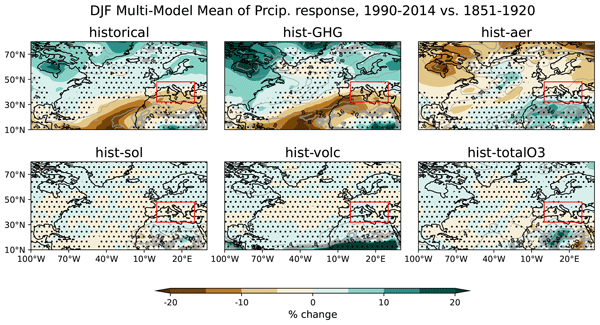
Revisiting the historical wintertime drying of the Mediterranean in the LESFMIP simulations
Weather Clim. Dynam., 7, 1331–1348, 2026
24 Jul 2026
Isolating the boreal winter response to the Pinatubo and Krakatoa eruptions using large-ensemble single-forcing simulations
EGUsphere, 2026
Preprint under review for WCD (discussion: final response, 2 comments)
22 Jul 2026
Reconstruction and Multiyear Prediction of Global Air-sea CO2 Flux using NOAA GFDL’s SPEAR Ensemble
EGUsphere, 2026
Preprint under review for ESD (discussion: final response, 2 comments)
21 Jul 2026
Sensitivity of ECMWF’s seasonal forecast model CY49R2-NEMO4-SI3 to CO2 and anthropogenic aerosol forcings: Experimental design and impact on climate trends
EGUsphere, 2026
Preprint archived (discussion: closed, 2 comments)
16 Jul 2026
Low-Frequency Stratospheric Variability and its Link to Surface Climate: Insights from Reanalysis and Multi-Century Coupled Climate Model Simulations
EGUsphere, 2026
Preprint under review for WCD (discussion: final response, 2 comments)
06 Jul 2026
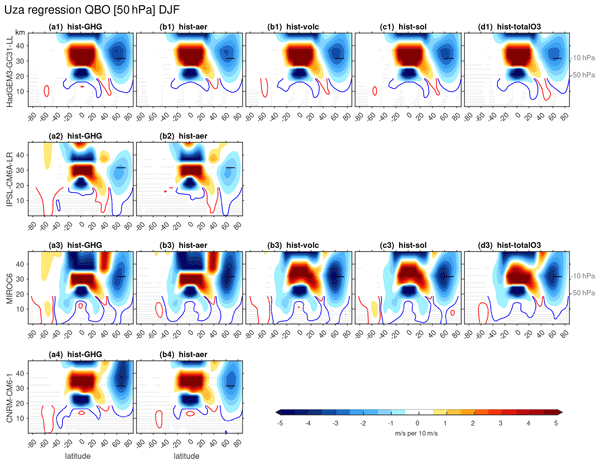
Revisiting the surface impacts of the QBO in the Large Ensemble Single Forcing MIP simulations: are teleconnections still too weak?
Weather Clim. Dynam., 7, 1133–1152, 2026